Showing posts with label animal cruelty. Show all posts

Wednesday, May 31, 2017

2620. Blood Center to Pay Towards Care for Chimpanzees It Used For Hepatitis B Research

By James Gorman, The New York Times, May 30, 2017
Chimpanzees once used in blood center research is a sanctuary in Liberia. Photo: Zoom Dosso/Agence France-Presse--Getty Images
Two years after the New York Blood Center set off a storm of protest from animal welfare advocates by withdrawing support for a colony of chimpanzees used for biomedical research, the organization has joined with the Humane Society of the United States to guarantee their future care, pledging $6 million.

In a joint announcement on Tuesday, the two groups said the blood center would donate the money to the Humane Society, which will assume responsibility for the lifetime care of the chimps. In captivity, chimps can live 50 to 60 years.

In the statement, Dr. Christopher D. Hillyer, head of the blood center, said he was “pleased that we have found a capable organization to take care of the chimpanzees for their lifetime.” He said the agreement would allow the blood center to concentrate on ensuring the blood supply.

The donation amounts to roughly half the estimated cost of caring for the animals on their island sanctuary in Liberia, said Wayne Pacelle, the head of the Humane Society of the United States. Mr. Pacelle said he was delighted that the two groups had “found a path forward.”

Until now, that path had been hard to find.

Beginning in the 1970s, the blood center used the chimps for research on a hepatitis B vaccine, which ended in 2006. The animals were owned by the government of Liberia.

The center supported the chimps until the spring of 2015, when it cut off funds. Officials said negotiations with the Liberian government had not been productive.

At the time, Victoria O’Neill, a spokeswoman for the blood center, said that the organization “never had any obligation for care for the chimps, contractual or otherwise.”

Primatologists and animal welfare advocates reacted with outrage.

“I have studied great apes for 20 years in all contexts across the globe — labs, zoos, sanctuaries, the wild,” Brian Hare, an anthropologist and primatologist at Duke University, wrote in an email at the time. “Never, ever have I seen anything even remotely as disgusting as this.”

Protests were held at the blood center’s headquarters in New York. The Humane Society began supporting the chimps and pressuring the blood center to take on some of the financial burden.

The Humane Society and the blood center have been negotiating off and on for the last few years. The Humane Society gained the help of Bill Richardson, a former governor of New Mexico, and other prominent people in talking to the blood center, which Mr. Pacelle said had been “incredibly resistant.”

He described the agreement as “a real turnaround for the blood center” and said “the sensible voices within their organization prevailed.”

“We’re very pleased,” Mr. Pacelle added.

Robert Purvis, a spokesman for the blood center, said reaching an agreement was a complicated process. “The blood center has been looking for an organization to take on the care of the chimpanzees for the last 10 years,” he said.

Fortunately, he said, “Nobody gave up.”

Sunday, May 22, 2016

2329. Killing of Bulls Is Banned at Toro de la Vega Festival in Spain

By Rapahel Minder, The New York Times, May 19, 2016

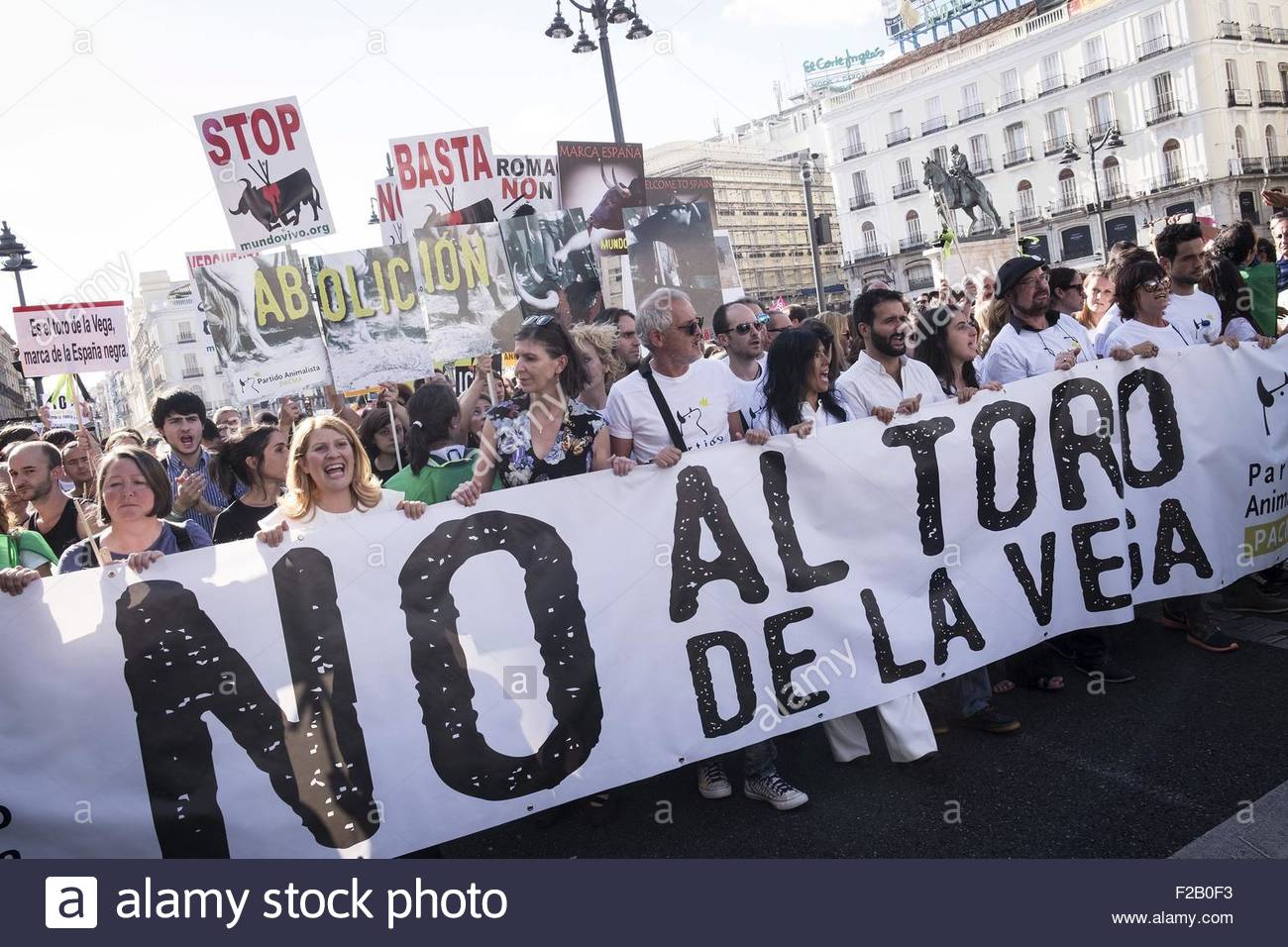
Protesters at bull-killing Toro de la Vega festival in 2015
MADRID — The killing of bulls at an annual town festival in Spain was outlawed on Thursday, in what animal rights activists hailed as a major victory in their campaign to banish traditional events that involve what they consider cruelty.

The decision by the regional government of Castile and León to ban killings at the annual Toro de la Vega festival in the town of Tordesillas, and other similar events, comes amid mounting tensions in Spain over festivities in which bulls take center stage, including bullfighting.

An overhaul in Spanish politics is also influencing the debate as the country prepares for a rerun of national elections next month. A new generation of far-left politicians is leading the call to end public financing of festivals involving bulls, which have been fiercely defended by the conservative establishment and the Popular Party of Mariano Rajoy, Spain’s caretaker prime minister.

The Toro de la Vega festival, held in September, has in recent years become an epicenter of protests by animal rights activists who consider it a particularly gruesome public event. Bulls are killed with spears after being pursued on foot and horseback.

Pacma, a political party that defends the rights of animals, said in a statement Thursday that the ban was “a historic step” toward eliminating all celebrations involving violence toward animals. The regional government’s decree, however, must still be approved by the regional Parliament. The mayor of Tordesillas told reporters on Thursday that his administration would appeal the ban in court.

The regional decree says that the ban is a response to the rising number of protests against animal violence. While it notes that the festivals are part of the country’s cultural heritage, modern lawmakers must recognize that times and the sensitivities and ethics of Spaniards have changed.

While the ban did not address bullfighting, that industry has languished in recent years as revenues and government subsidies have declined. Animal rights activists hope that more regions will follow the lead of Catalonia, which held its final corrida in 2011, after a ban on bullfighting was enacted.

Sunday, August 31, 2014

1529. Book Review: Ecological Hoofprint: The Global Burden of Industrial Livestock

By Gabriel Levy, People and Nature, August 31, 2014

The rapid expansion of world meat consumption is (1) an indication that more people are getting better fed, right?
This “nutritional transition” is (2) great news for human health, right?
And (3), notwithstanding issues of excessive cruelty to animals, industrial meat production is just a high-tech version of what humans have been doing since they started hunting, right?
Wrong, wrong, wrong, Tony Weis argues.
Weis demolishes justifications for the global process he calls “meatification” with a rigorous analysis of how it exacerbates inequality, and widens the rift between capitalist economies and the natural environment. It’s damaging and unsustainable.
At a time when academics are forced to focus more and more narrowly, he looks at the big picture.
On question (1) – who benefits from growing meat consumption – Weis unpacks the extent of inequalities: people in rich countries consume more than three times as much meat, and more than four times as much dairy, as people in developing countries (see table).
At one extreme is the USA (121 kg of meat per person per year), Australia (113 kg), Argentina (104 kg), Canada (99 kg) and western Europe (86 kg). In 2010 these countries, with 12% of the world’s population, consumed nearly one third of meat – despite the way that per capita consumption, and therefore the proportion of all meat consumed, has rocketed in both China and Brazil over the last forty years. At the other extreme, southeast Asia (23nkg per person per year), South Asia (18 kg) and Africa (7 kg), which together account for a little under half the world population, consumed 16% of the meat (p. 84).
UNEQUAL CONSUMPTION: Meat consumption (kg/person/year), 1961-2010, 
in selected countries. From The Ecological Hoofprint, p. 83.
Those numbers (see “Unequal consumption” figure) are only part of the picture: there are vast differences in consumption levels within each country.
But this is not just about consumption statistics. The historical development of the “industrial grain-oilseed-livestock complex”, as Weis calls it, has turned over vast resources to producing meat for the rich, at the expense of producing food for the poor.
He tells the history of livestock production, arguing that the key driver in the twentieth century was chronic grain surpluses produced by US farmers. These were cycled through “fast-rising populations of concentrated livestock” (p. 73). “Roughly two-thirds of the incredible boom in grain production […] in the USA and Europe between 1950 and 1985 went into animal feed.” Next came the “explosive” growth of industrial oilseed production.
The international food system that developed around these imperatives also produced rising flows of cheap grain imports for poor countries. This helped to sustain rapid population growth – but simultaneously ruined their farmers and wrecked food self-sufficiency. In the 1980s and 1990s the World Bank’s structural adjustment programmes exacerbated poor countries’ dependence on these global markets. (And today, the clashes continue: the World Trade Organisation talks on trade rules were teetering on the brink this summer because India was insisting that food subsidies and stockpiles be exempted.)
The use of about one third of the world’s crop land to grow maize, soybeans and other animal feedstuffs is integral to this unequal food system, Weis argues, picking up a theme highlighted by Frances Moore Lappé in Diet for a Small Planet.
Despite efforts to reduce wastage, this amounts to a “reverse protein factory” – that is, “cycling humanly edible grains and oilseeds through animals to produce flesh, eggs and milk destroys much more protein and other usable plant nutrition than it contributes to human societies” (p. 111).

Protein in meat and dairy products also has vastly greater costs than in plant-based foods in terms of water and energy (see “Eating Oil” figure).
One way of maximising nutritional output per land area, Weis argues, would be to stop funnelling resources down this “net nutritional drain” (p. 148).
This waste “can not be trumped by the nutritional ‘mythology’ of animal protein”, Weis argues with respect to question (2), about the much-vaunted triumphs of the “nutritional transition” (p. 75). He questions these, citing, on one hand, the growing body of opinion among nutritionists about the importance of plant-based foods for balanced diets, and, on the other, the epidemic of “diseases of affluence” such as obesity caused partly by excessive consumption of meat and meat products in rich countries.
Weis is at his most trenchant on question (3), about whether the industrial food system is a logical continuation of previous relations between people and nature. He argues against “the pretence that industrial livestock production is anything like a mere technological amplification of age-old interrelations” between humans, animals and the natural environment (p. 131).
Industrial livestock overburdens land: a given amount of usable nutrition can “always be obtained from much less cultivated land” if crops are directly consumed, instead of being cycled through livestock to produce meat. And the more land used for grain and oilseed monocultures – much of which goes to feed livestock, not humans directly – the greater the ecological burden of industrial fertilisers, pesticides and other persisted toxins.
Industrial livestock is a disproportionate burden on water on freshwater resources, and accounts for almost one fifth of all anthropogenic greenhouse gas emissions.
That’s not all. Weis describes the vicious circle into which industrial agriculture has entered by repeatedly applying external inputs – fertilisers, pesticides, technological fixes to hike crop yields – in a vain attempt to escape its problems. These “biophysical overrides”, he argues (p. 104), “not only fail to resolve the basic contradictions necessitating their use, which makes them like a treadmill, but over time can serve to make problems much worse”. The treadmill speeds up.
Science and technology can not resolve the biophysical contradictions of a system where “incessant growth and accumulation” are the motive force (p. 146). Humanity needs to break from this “pathological economic logic”, Weis argues; then, “productivity would be delinked from resource-intensive machinery and overrides”.
Effective farming would halt the “major vector of inequality, degradation and violence” that industrial livestock production has become. It would be “much more labour- and knowledge-intensive”: it would use fewer external inputs, be more biologically diverse, cultivate multiple crops, manage natural controls on pests and strive to enhance soil biota.
“An ecologically rational conception of efficiency thus turns a basic tenet of modernisation on its head: rather than technology displacing labour in large monocultures, there is a need for labour and knowledge to displace mechanisation.”
Weis favours a reduction in meat consumption as a social and ecological imperative, not a moral one.
“Should people in rich countries aim to reduce their per capita annual consumption of meat (~80-120 kg) to the world average (~42 kg in 2010)? Is the current average across most of the global south (well under 30 kg) a better, and fairer, target?”
He refrains from answering this question, arguing that his analysis of industrial farming “can’t settle intense debates about whether people should eat some but less meat, none, or no animal products at all” (p. 153).
What the analysis does show, he concludes, is that “the ethical dilemmas and responsibilities bound up in millennia of co-evolution [with other species] are being obliterated by the imperatives of industrial capitalism and the violence of commodification”.
For those seeking a socialist view of industrial agriculture – as opposed to Malthusian ones – this short, readable and thoroughly researched book is a great place to start.

Thursday, March 13, 2014

1351. Industrial Farming and Your Diet

By Nicholas Kristof, The New York Times, March 12, 2014

Where does our food come from? Often the answer is Tyson Foods, America’s meat factory.
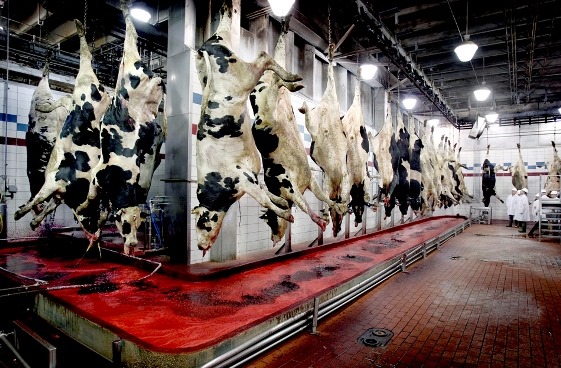
Tyson, one of the nation’s 100 biggest companies, slaughters 135,000 head of cattle a week, along with 391,000 hogs and an astonishing 41 million chickens. Nearly all Americans regularly eat Tyson meat — at home, at McDonalds, at a cafeteria, at a nursing home.
“Even if Tyson did not produce a given piece of meat, the consumer is really only picking between different versions of the same commoditized beef, chicken, and pork that is produced through a system Tyson pioneered,” says Christopher Leonard, a longtime agribusiness journalist, in his new book about Tyson called “The Meat Racket.”
Leonard’s book argues that a handful of companies, led by Tyson, control our meat industry in ways that raise concerns about the impact on animals and humans alike, while tearing at the fabric of rural America. Many chicken farmers don’t even own the chickens they raise or know what’s in the feed. They just raise the poultry on contract for Tyson, and many struggle to make a living.
Concerned by the meat oligopoly’s dominance of rural America, President Obama undertook a push beginning in 2010 to strengthen antitrust oversight of the meat industry and make it easier for farmers to sue meatpackers. The aim was grand: to create a “new rural economy” to empower individual farmers.
Big Meat’s lobbyists used its friends in Congress to crush the Obama administration’s regulatory effort, which collapsed in “spectacular failure,” Leonard writes.
Factory farming has plenty of devastating consequences, but it’s only fair to acknowledge that it has benefited our pocketbooks. When President Herbert Hoover dreamed of putting “a chicken in every pot,” chicken was a luxury dish more expensive than beef. In 1930, whole dressed chicken retailed for $6.48 a pound in today’s currency, according to the National Chicken Council. By last year, partly because of Tyson, chicken retailed for an average price of $1.57 per pound — much less than beef.
Costs came down partly because scientific breeding reduced the length of time needed to raise a chicken to slaughter by more than half since 1925, even as a chicken’s weight doubled. The amount of feed required to produce a pound of chicken has also dropped sharply.
And yet.
This industrial agriculture system also has imposed enormous costs of three kinds.
First, it has been a catastrophe for animals. Chickens are bred to grow huge breasts so that as adults they topple forward and can barely breathe or stand.
“These birds are essentially bred to suffer,” says Laurie Beacham of the American Society for the Prevention of Cruelty to Animals, which argues that there’s an inherent cruelty in raising these “exploding chickens.”
Poultry Science journal has calculated that if humans grew at the same rate as modern chickens, a human by the age of two months would weigh 660 pounds.
Second, factory farming endangers our health. Robert Martin of the Johns Hopkins Bloomberg School of Public Health notes that a farm with 10,000 hogs produces as much fecal waste as a small city with 40,000 people, but the hog operation won’t have a waste treatment plant. Indeed, the hogs in a single county in North Carolina produce half as much waste as all the people in New York City, Martin says.
Leonard writes in his book that in 68 percent of the counties where Tyson operates, per capita income has grown more slowly over the last four decades than the average in that state. We may think of rural America as a halcyon pastoral of red barns and the Waltons, but today it’s also a land of unemployment, poverty, despair and methamphetamines.
It’s easy to criticize the current model of industrial agriculture, far harder to outline a viable alternative. Going back to the rural structure represented by the inefficient family farm on which I grew up in Oregon isn’t a solution; then we’d be back to $6.48-a-pound chicken.

But a starting point is to recognize bluntly that our industrial food system is unhealthy. It privatizes gains but socializes the health and environmental costs. It rewards shareholders — Tyson’s stock price has quadrupled since early 2009 — but can be ghastly for the animals and humans it touches. Industrial meat has an acrid aftertaste.