Showing posts with label The Great Acceleration. Show all posts

Monday, February 19, 2018

2833. 'Loneliest Tree' Records the Onset of the Anthropocene

By Jonathan Amos, BBC, February 19, 2018
BBC
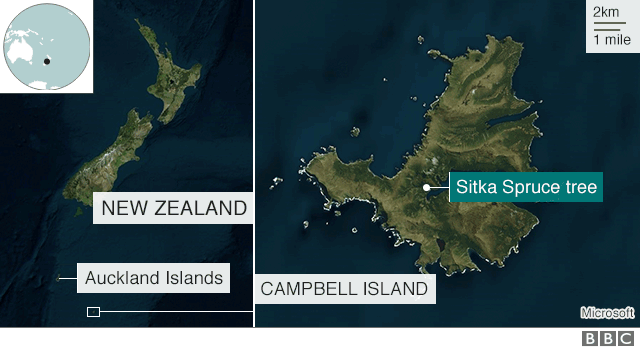
It’s been dubbed "the loneliest tree on the planet" because of its remote location, but the Sitka spruce might represent something quite profound about the age in which we live.
The tree, sited on Campbell Island in the Southern Ocean, records in its wood a clear radioactive trace from the A-bomb tests of the 1950s and 60s.
As such, it could be the "golden spike" scientists are seeking to define the start of the Anthropocene Epoch - a new time segment in our geological history of Earth.
The suggestion is that whatever is taken as the golden spike, it should reflect the so-called "Great Acceleration" when human impacts on the planet suddenly intensified and became global in extent.
This occurs after WWII and is seen for example in the explosion in plastics production.
Chris Turney, from the University of New South Wales, Australia, and colleagues, say the Sitka spruce captures this change exquisitely in the chemistry of its growth rings.
"We're putting this forward as a serious contender to mark the start of the Anthropocene. It's got to be something that reflects a global signal," Prof Turney told BBC News.
"The problem with any Northern Hemisphere records is that they largely reflect where most major human activity has happened. But this Christmas tree records the far-reaching nature of that activity and we can't think of anywhere more remote than the Southern Ocean."
The spruce shouldn't really be on Campbell Island, which is some 600km from the southern tip of New Zealand. Its natural habitat is found at northern Pacific latitudes, but a single tree was placed on the subantarctic island around 1905, possibly as the start of an intended plantation.
The next nearest tree is on the Auckland Islands about 200km to the northwest.
Prof Turney and colleagues drilled a fine core into the spruce, which has wide, sharply delineated growth rings, and examined the wood's chemistry.
They found a big leap in the amount of carbon-14 in a part of a ring representing the latter half of 1965.
This peak in the radioactive form of the element is an unambiguous signature of the atmospheric nuclear tests that occurred post-war.
The radioisotope would have been incorporated into the tree as carbon dioxide through photosynthesis.
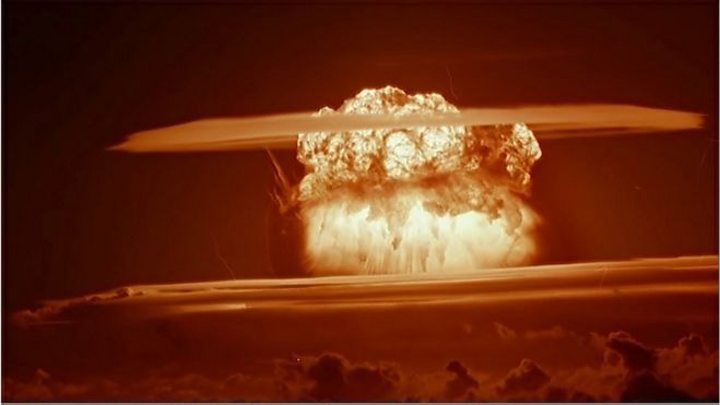


Media captionProf Chris Turney: "The nuclear tests doubled the amount of radiocarbon in the atmosphere"

Co-author Mark Maslin, from University College London, UK, says the date comes just after the ban on atmospheric nuclear testing (1963), but describes that moment when the fallout from previous detonations had truly gone worldwide and even inveigled itself into the biosphere of the planet.
"If you want to represent the Anthropocene with the start of The Great Acceleration then this is the perfect record to define it. And what's really nice is that we planted a tree where it shouldn't be which has then given us this beautiful record of what we've done to the planet."
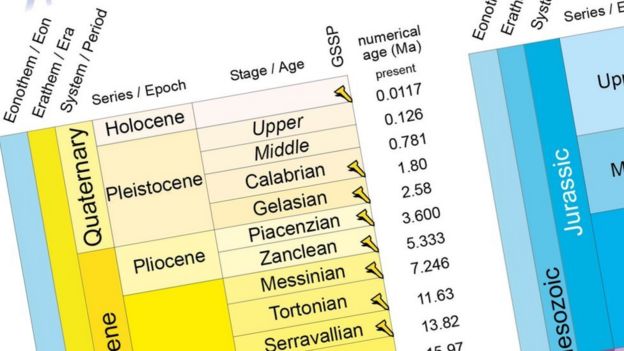


ChartImage copyrightIUGS
Image captionThe Anthropocene would be added to the chart, above the Holocene

The international geological community is currently assessing how to update the "official" timeline of Earth history - the famous Chronostratigraphic Chart featured in all science textbooks.
The working group charged with leading the discussion recently concluded that the current epoch - the so-called Holocene, which has pertained for the last 11,700 years - could no longer constrain the immense changes taking place on Earth as a result of human activity.
The panel said the search should now be stepped up to find a suitable marker to define the onset of the proposed Anthropocene Epoch. Technically referred to as a Global Boundary Stratotype Section and Point (GSSP), the marker is more commonly called a golden spike.
For the start of the Holocene, the GSSP is a section ice drilled from the Greenland Ice Sheet. Its hydrogen chemistry records an uptick in warming as we emerged from the last ice age.
For the famous Cretaceous–Palaeogene (K–Pg) boundary 66 million years when the asteroid struck, wiping out the dinosaurs - the spike is an outcrop of rock in Tunisia that contains a strong trace of the element iridium that was delivered by the impacting space object.
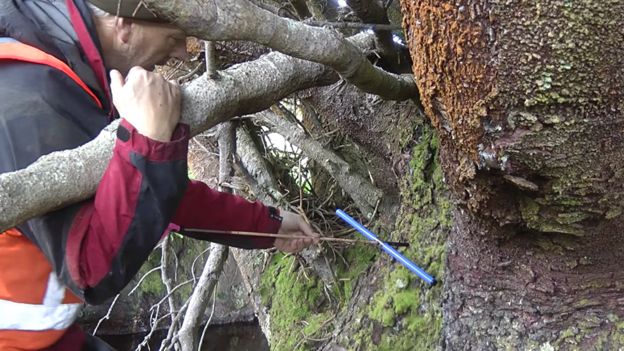


CoreImage copyrightINTREPID SCIENCE
Image captionTaking a wooden core sample does not harm the tree

What will be key for any golden spike chosen to represent the Holocene-Anthropocene boundary is that it is long-lasting; that geologists a million years from now will be able to point at something and say, "There! That's the start of the Anthropocene Epoch."
"Radiocarbon persists in measurable amounts on the order of 50,000 to 60,000 years. After that, other radioisotopes associated with the bomb tests such as plutonium would still be there in the natural environment, preserving the signal," explained Prof Turney.
"We have archives of the spruce wood collected at the University of New South Wales in Sydney and at Invercargill in New Zealand at the museum and art gallery, so people can go and visit and put their finger on the actual moment we're suggesting the Anthropocene began."
Prof Turney and colleagues have published their study of the Sitka spruce (Picea sitchensis) in the journal Scientific Reports.


Tuesday, April 18, 2017

2605. The Great Acceleration

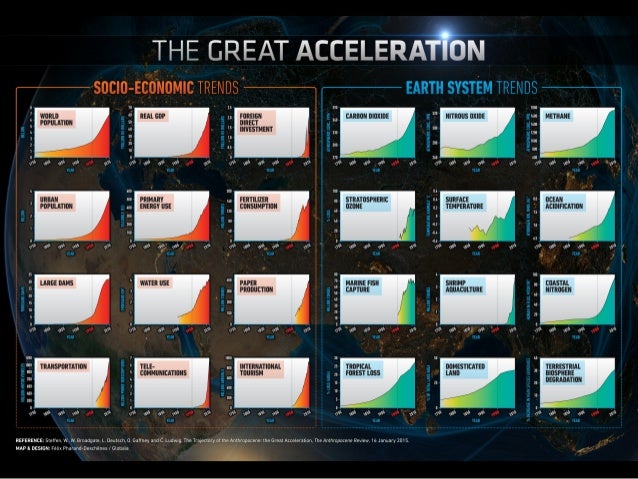
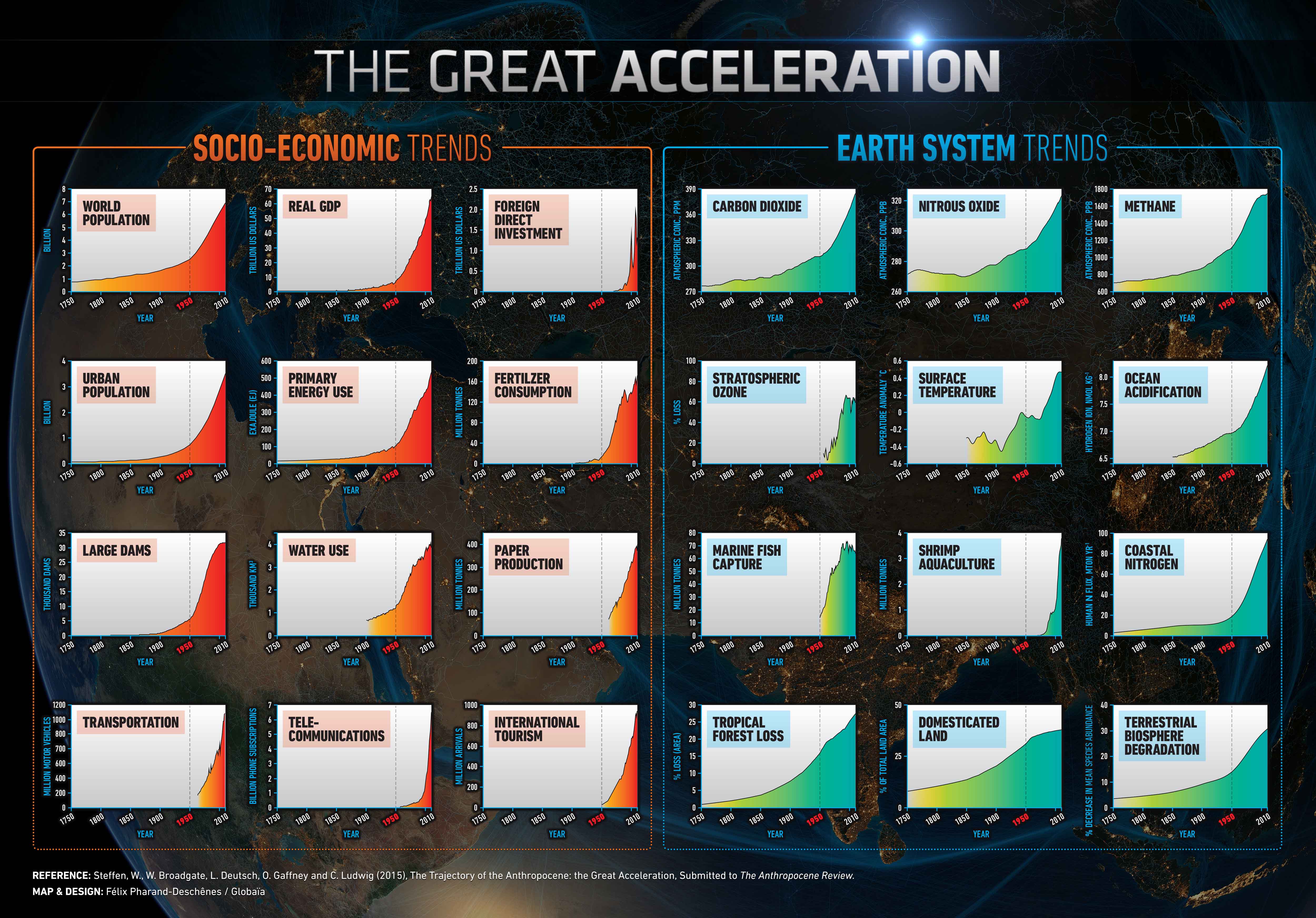
Great Acceleration 2015 from International Geosphere-Biosphere Programme


The second half of the 20th Century is unique in the history of human existence. Many human activites reached take-off points sometime in the 20th Century and sharply accelerated towards the end of the century. 


The last 60 years have without doubt seen the most profound transformation of the human relationship with the natural world in the history of humankind. 

The effects of the accelerating human changes are now clearly discernible at the Earth system level. Many key indicators of the functioning of the Earth system are now showing responses that are, at least in part, driven by the changing human imprint on the planet. The human imprint influences all components of the global environment--oceans, coastal zone, atmosphere, and land. 

Dramatic though these human-driven impacts appear to be, their rates and magnitudes must be compared to the natural patterns of variability in the Earth system to begin to understand their significance.


The increase in atmospheric carbon dioxide concentration provides a useful measure with which to evaluate the rate and magnitude of human-driven change compared to natural variability. The human imprint on carbon dioxide is unmistakable. In December 2014, atmospheric carbon dioxide concentration stood at 399 parts per million by volume (ppmV), over 100 ppmV above the previous maximum level of around 280 ppmV recorded in the Vostok ice core.


Within the current limits of resolution of the ice-core records, the present concentration has been reached at a rate at least 10 and possibly 100 times faster than carbon dioxide increases at any other time during the previous 420 000 years. Thus, in this case human-driven changes are well outside the range of natural variability exhibited by the Earth system for the last half-million years at least.

Over just the past few hundred years, human activities have clearly evolved from insignificance in terms of Earth system functioning to the creation of global-scale impacts that:


• are approaching or exceeding in magnitude some of the great forces of nature
• operate on much faster time scales than rates of natural variability, often by an order of magnitude or more
• taken together in terms of extent, magnitude, rate and simultaneity, have produced a no-analogue state in the dynamics and functioning of the Earth system.


Download images
Download data  (excel 2007, 364.7 kB)
Download powerpoint  (powerpoint, 21.1 MB)

The domino effect
Human impacts on the Earth system do not operate in separate, simple cause-effect responses. A single type of human-driven change triggers a large number of responses in the Earth system, which themselves cascade through the system, often merging with patterns of natural variability.

The responses seldom follow linear chains, but more often interact with each other, sometimes damping the effects of the original human forcing and at other times amplifying them. Responses become feedbacks, which in turn can lead to further forcings that can alter the functioning of the Earth system.

The nature of the Earth system’s responses to the increasing anthropogenic forcing is more complex than simple cause-effect relationships, such as greenhouse gas emissions causing global warming. 

Fossil-fuel combustion produces a range of gases that have a large number of cascading effects. For example, carbon dioxide not only affects climate but directly affects how vegetation grows. It changes the carbonate chemistry in the ocean – the oceans are becoming more acidic, which in turn affects marine organisms. Changing carbonate chemistry is a factor in the widespread decline of coral reefs around the world
Fossil-fuel combustion also produces oxidising gases such as nitric oxide and sulphur dioxide that have well-known effects such as acidification and eutrophication of ecosystems. 

However, these gases can eventually contribute to changes in fundamental Earth system functioning because of their indirect effects on the radiative properties of the atmosphere, and hence climate. The mechanisms are through reactions with other gases plus their impacts on the ability of the atmosphere to cleanse itself through oxidation and other processes.

Aerosols produced by fossil-fuel combustion can fertilise or reduce plant growth, depending on the circumstances, and directly affect human health. They also lead to large-scale direct or indirect modifications of climate.

We can trace even more subtle effects back to fossil-fuel combustion. Increasing carbon dioxide levels affect the stomatal opening of terrestrial vegetation, reducing water vapour loss through the stomates. This results in higher water-use efficiency. This effect is especially pronounced in semi-arid vegetation, and can lead to increased productivity through enhanced soil moisture.


More generally, no two species react in an identical way to elevated atmospheric carbon dioxide concentration. This leads to changes in the competitive abilities of plants and hence to changes in species abundances and community composition. Fossil-fuel combustion cascades through the Earth system to become even a biodiversity issue.


Like fossil-fuel combustion, land-cover and land-use change also trigger widespread cascading effects at local, regional and global scales. We can show a few ways local effects of land-use change cascade through regional to global scales.


Multiple, interacting stresses
Global change does not operate in isolation but rather interacts with an almost bewildering array of natural variability modes and also with other human-driven effects at many scales. Especially important are those cases where interacting stresses cause a threshold to be crossed and a rapid change in state or functioning to occur.

Adapted from Steffen et al, Global Change and the Earth System, 2004  (pdf, 4.2 MB)


Great Acceleration 2015 - Press release 15 January 2015

Great Acceleration 2015 - Data  (excel 2007, 364.7 kB)