By Tathi Bhattachaya, Verso, February 15, 2018
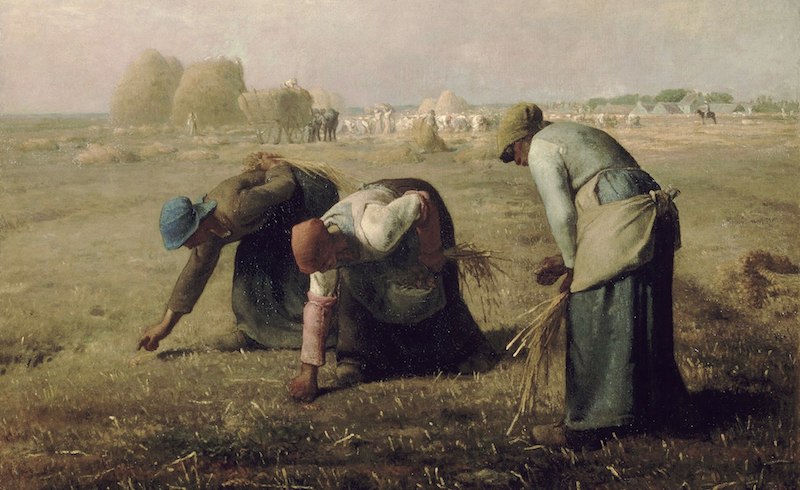 |
| Detail from Jean-François Millet, Des glaneuses, 1857. via Wikimedia Commons. |
Life itself appears only as a means to life.
—Karl Marx, Economic and Philosophical Manuscripts of 1844
A working woman comes home from work after an eight hour day, eats dinner in 8 to 10 minutes, and once again faces a load of physical work: washing linens, cleaning up, etc. There are no limits to housework . . . [a woman is] charwoman, cook, dressmaker, launderer, nurse, caring mother, and attentive wife. And how much time it takes to go to the store and drag home dinner!
—testimonies of factory women in Moscow, 1926
This [unpaid care work] is the type of work where we do not earn money but do not have free time either. Our work is not seen but we are not free as well.
—woman in Patharkot, Nepal, 2013
If our kitchens are outside of capital, our struggle to destroy them will never succeed in causing capital to fall.
—Silvia Federici, Revolution at Point Zero: Housework, Reproduction and Feminist Struggle
Let us slightly modify the question “who teaches the teacher?” and ask this of Marxism: If workers’ labor produces all the wealth in society, who then produces the worker? Put another way: What kinds of processes enable the worker to arrive at the doors of her place of work every day so that she can produce the wealth of society? What role did breakfast play in her work-readiness? What about a good night’s sleep? We get into even murkier waters if we extend the questions to include processes lying outside this worker’s household. Does the education she received at school also not “produce” her, in that it makes her employable? What about the public transportation system that helped bring her to work, or the public parks and libraries that provide recreation so that she can be regenerated, again, to be able to come to work?
The goal of social reproduction theory (SRT) is to explore and provide answers to questions such as these. In doing so, SRT displays an analytical irreverence to “visible facts” and privileges “process” instead. It is an approach that is not content to accept what seems like a visible, finished entity — in this case, our worker at the gates of her workplace — but interrogates the complex network of social processes and human relations that produces the conditions of existence for that entity. As in much of critical theory, here too we “build from Marx,” for both this approach and the critical interrogation mirror the method by which Marx studies the commodity.
The fundamental insight of SRT is, simply put, that human labor is at the heart of creating or reproducing society as a whole. The notion of labor is conceived here in the original sense in which Karl Marx meant it, as “the first premise of all human history” — one that, ironically, he himself failed to develop fully. Capitalism, however, acknowledges productive labor for the market as the sole form of legitimate “work,” while the tremendous amount of familial as well as communitarian work that goes on to sustain and reproduce the worker, or more specifically her labor power, is naturalized into nonexistence. Against this, social reproduction theorists perceive the relation between labor dispensed to produce commodities and labor dispensed to produce people as part of the systemic totality of capitalism. The framework thus seeks to make visible labor and work that are analytically hidden by classical economists and politically denied by policy makers.
SRT develops upon the traditional understanding of both Marxism and capitalism in two transformative ways.
First, it proposes a commodious but more specific reading of the “economy.” SRT, as Susan Ferguson has recently pointed out,
insists that our understanding of capitalism is incomplete if we treat it as simply an economic system involving workers and owners, and fail to examine the ways in which wider social reproduction of the system—that is the daily and generational reproductive labor that occurs in households, schools, hospitals, prisons, and so on—sustains the drive for accumulation.1
Marx clearly marks for us the pivotal role played by labor power, for it is that which in effect sets the capitalist production process in motion. He also indicates how, unlike all other commodities under capitalism, the “unique” commodity labor power is singular in the sense that it is not produced capitalistically. The implications of this insight are, however, underdeveloped in Marx. Social reproduction theorists begin with these silences in Marxism and show how the “production of goods and services and the production of life are part of one integrated process,” as Meg Luxton has put it. 2 If the formal economy is the production site for goods and services, the people who produce such things are themselves produced outside the ambit of the formal economy, in a “kin-based” site called the family.
Second, and following from above, SRT treats questions of oppression (gender, race, sexuality) in distinctly nonfunctionalist ways precisely because oppression is theorized as structurally relational to, and hence shaped by, capitalist production rather than on the margins of analysis or as add-ons to a deeper and more vital economic process.
The essays in this volume thus explore questions of who constitutes the global working class today in all its chaotic, multiethnic, multigendered, differently abled subjectivity: what it means to bind class struggle theoretically to the point of production alone, without considering the myriad social relations extending between workplaces, homes, schools, hospitals — a wider social whole, sustained and coproduced by human labor in contradictory yet constitutive ways. Most importantly, they address the relationship between exploitation(normally tethered to class) and oppression (normally understood through gender, race, etc.) and reflect on whether this division adequately expresses the complications of an abstract level of analysis where we forge our conceptual equipment, and a concrete level of analysis, i.e., the historical reality where we apply those tools.
Renewing Social Reproduction Theory in the Shadow of Neoliberalism
Since the financial crisis of 2008 and 2009 and exacerbated by the government bailouts of those who perpetrated the crisis, there has emerged a renewed interest in Marx and Marxism. Major news sources of the Global North, from the New York Times to the Guardian and even to the conservative Foreign Policy have declared that Marx, without a doubt, “is back.” 3
Within this generalized interest, there has been a revival of more specific attention to Marx’s Capital. Even aside from Thomas Piketty’s 700-page Capital in the Twenty-First Centurybecoming a runaway bestseller, the period following 2008 has seen an unprecedented rise in scholarly publications on Marx’s seminal text. 4
While this is an unqualifiedly welcome development, there remains room — indeed, an urgency — to redraw the contours of some of these conversations about Capital in particular and its object of study, capitalism, in general. This book is an attempt to begin that process by highlighting the critical contribution of SRT to an understanding of capitalist social relations.
There is a limited but rich literature by Marxists and feminists across disciplinary boundaries which has, since the 1980s, developed the insights of the social reproduction framework in very productive directions. 5 The republication in 2014 of Lise Vogel’s classic work Marxism and the Oppression of Women: Toward a Unitary Theory has given a new lease of life to this growing body of scholarship. While this literature embodies instantiations of SRT in a range of critical areas, there remains a need for a text that can act as a map and guide to this vivid and resonant body of work. Indeed, it is precisely because social reproduction scholars have so effectively applied and extended its theoretical insights to a diverse set of concerns in such creative ways that it is useful to compile and outline its key theoretical components along with its most significant historical applications.
That said, this volume stands in a very specific relationship to the recent literature on oppression. We see our work as furthering the theoretical conversation with this existing body of scholarship in two kinds of ways: (a) as a conversation between Marxism and the study of specific oppressions such as gender and race, and (b) as developing a richer way of understanding how Marxism, as a body of thought, can address the relationship between theory and empirical studies of oppression.
Let me elaborate. We make two central proposals in this volume about SRT: first, that it is a methodology to explore labor and labor power under capitalism and is best suited to offer a rich and variegated map of capital as a social relation; further, that this is a methodology that privileges process, or, to use Lukács’s words, we believe that the “developing tendencies of history constitute a higher reality than the empirical ‘facts.’” 6
Many recent studies similarly grapple with elaborating on these. Cinzia Arruzza, in her book Dangerous Liaisons (2013), offers a summary of the historic relationship between Marxism and feminism and tries to plot precisely where the tributaries of analysis about the system as a whole (capitalism) meet or diverge from analyses of categories produced by the system (gender and/or race). Arruzza’s work refuses the reduction of this complex dynamic to a simple question of “whether class comes before gender or gender before class,” but points the way toward thinking about how “gender and class intertwine in capitalist production.” 7
Similarly, Shahrzad Mojab, in her recently edited volume Marxism and Feminism (2015), alerts us to the actual dangers of theoretically severing the integrated relationship between class and gender. Contributors to Mojab’s volume show how decoupling feminism from capitalism carries the twin perils of emptying out the revolutionary content of feminism which “reduces gender to questions of culture” and of “reduc[ing] gender to class relations.” 8
A slightly older edited volume by Nancy Holmstrom (2002) likewise takes a integrative approach to the relationship between the oppression and the source of oppressions: capitalism. Holmstrom clarifies that although Marxism’s “basic theory” does not require “significant revision,” it does need to be “supplemented.” The volume thus seeks to champion a specific deployment of historical materialism that “gives a fuller picture of production and reproduction than Marx’s political economic theory does, that extends questions of democracy not only to the economy but to personal relations.” 9
Kate Benzanson and Meg Luxton’s edited collection Social Reproduction (2006) is perhaps the closest theoretical kin to our project. This is not solely because Benzanson and Luxton deal explicitly with SRT, but because they restore to it a “thick” description of the “economy” and “political process.” The volume is premised upon the understanding that “in capitalist societies the majority of people subsist by combining paid employment and unpaid domestic labor to maintain themselves . . . [hence] this version of social reproduction analyzes the ways in which both labors are part of the same socio-economic process.” 10
While Benzanson and Luxton problematize the concept of labor and the role it plays in the constitution and disruption of capitalism, Kathi Weeks (2011) has usefully drawn our attention to the most common articulation of labor under capitalism, namely, work. Weeks’s approach coincides with our own in that it is dissatisfied with efforts to align “work” with “a more equitable distribution of its rewards” — in other words, to think about how our working lives might be improved. Instead, Weeks points to the fundamental incommensurability of capitalism with any productive or creative sense of work. Hence her volume urges us to think about how the right to work and the right of refusal to work can be reimagined under the sign of an anticapitalist political theory.
This brings us to how this volume, while in conversation with the above scholarship, is nonetheless about developing a set of theoretical concerns that are related but different. The contributing essays of the volume can be said, broadly, to do three kinds of work: determining the definitional contours of SRT, using SRT to develop and deepen Marxist theory, and exploring the strategic implications of applying SRT to our current conjuncture. It is to an elaboration of those themes that we now turn.
Mapping Social Reproduction Theory: The Work of Definitions
All the essays in this volume are in some way engaged in the task of sketching out the contours of what exactly social reproduction theory is and what kinds of questions it seeks to answer.
In Marx’s own writing, the term social reproduction is most often deployed to refer to the reproduction of the capitalist system as a whole. Johanna Brenner and Barbara Laslett therefore suggest a useful distinction between societal and social reproduction, with the former retaining the original meaning as Marx has used it, and the latter referring to
the activities and attitudes, behaviors and emotions, and responsibilities and relationships directly involved in maintaining life, on a daily basis and intergenerationally. It involves various kinds of socially necessary work—mental, physical, and emotional—aimed at providing the historically and socially, as well as biologically, defined means for maintaining and reproducing population. Among other things, social reproduction includes how food, clothing, and shelter are made available for immediate consumption, how the maintenance and socialization of children is accomplished, how care of the elderly and infirm is provided, and how sexuality is socially constructed. 11
The primary problematic of what is meant by the social reproduction of labor power is, however, only a preliminary start to this definitional project. Simply put, while labor puts the system of capitalist production in motion, SRT points out that labor power itself is the sole commodity — the “unique commodity,” as Marx calls it — that is produced outside of the circuit of commodity production. But this status of labor power as a commodity that is simultaneously produced outside the “normal” productive cycle of other commodities raises more questions than it answers. For instance, Marx is very clear that every commodity under capitalism has two manifestations: one as use value, the other as exchange value. Indeed, when the commodity appears in its social form we only encounter it in its second manifestation because the capitalist circulation process, through an act of “necromancy,” turns use value into its direct opposite. But labor power becomes a “commodity” (that is, it becomes something that is not simply endowed with use value) without going through the same process of “necromancy” as other commodities, which raises a question about the very ontology of labor power beyond the simple questions of its “production” and “reproduction.” If the totality of the capitalist system is shot through with this “commodity” that is not produced in the manner of other commodities, what then are the points of determination and/or contradictions that must necessarily be constitutive of the system, yet must be overcome within it?
One way of resolving this problem is through a spatial understanding: that there are two separate but conjoined spaces — spaces of production of value (points of production) and spaces for reproduction of labor power. But then, as we gestured above, labor power is not simply replenished at home, nor is it always reproduced generationally. The family may form the site of individual renewal of labor power, but that alone does not explain “the conditions under which, and . . . the habits and degree of comfort in which” the working class of any particular society has been produced. 12 Public education and health care systems, leisure facilities in the community, and pensions and benefits for the elderly all compose together those historically determined “habits.” Similarly, generational replacement through childbirth in the kin-based family unit, although predominant, is not the only way a labor force may be replaced. Slavery and immigration are two of the most common ways capital has replaced labor in a bounded society.
The complex concatenation of social relations making up the reproduction of labor power has led some theorists to define social reproduction to include “the processes necessary for the reproduction of the workforce, both biologically and as compliant wage workers.” 13
How can labor be made “compliant”? Relatedly, if labor power is a “unique” commodity in the sense of being produced noncapitalistically, then does that countervailing fact work against the manufacture of compliance? Susan Ferguson’s essay in this volume seeks to explore the dynamic, often contested relationship between capital and childhood. Ferguson takes us beyond the trope of consumerism under which capitalist childhoods are most often studied. Instead, she asks a more difficult question: “What exactly are capitalist productive relations? And how are children implicated in them?” (Emphasis mine.) While she argues that “capitalist productive relations determine the terrain upon which children and childhoods are produced and reproduced,” Ferguson avoids any functionalist correlation between capital’s vision of/need for children as pre-workers and the actual historical delineation of childhood. Instead, the essay illuminates the “deeply contradictory relationship between the social reproduction of children and childhoods, on the one hand, and the continued thriving and expansion of capital, on the other.” Like Walter Benjamin in his Berlin Childhood, Ferguson urges us to reconsider the child as a liminal, ambiguous figure, one capable of both compliance with capital and collusion with chthonic revolutionary energies.
If under capitalism the child will always be a figuration of what could be, then the retired worker is perhaps, in capitalist terms, the termination of all possibilities. But a social reproduction framework that extends analysis beyond both wage labor and spaces of production suggests a more robust understanding of human labor. Serap Saritas Oran’s essay in this volume hence theorizes pensions as “not simply deferred wages or individual savings” but “from a political economy perspective.” Oran’s essay reframes the question of what constitutes labor power: is it composed of a set of use values represented by the labor time necessary for its production, or can we determine its value through its exchange value, or wage? She locates a lacuna in both approaches, for they fail to adequately theorize those goods and services that have “use value but not exchange value, such as reproductive household activities or state services” such as pensions. Since pensions are not necessarily commodities, nor do they correspond neatly with labor time; they cannot be considered the direct equivalent of an individual worker’s labor power during the worker’s work life. Oran thus urges us to look at pensions as “a component of the broader understanding of the value of labor power as a standard of living for the working class that consists of the payments and benefits necessary for generational social reproduction.”
Theorizing pensions is one way to reveal the superficial nature of the neat spatial divisions between production (public) and reproduction (private), for the two separate spaces — spaces of production of value (point of production) and spaces for reproduction of labor power — while they may be separate in a strictly spatial sense are actually united in both the theoretical and operational senses. They are particular historical forms of appearance in which capitalism as a process posits itself.
The question of separate spheres and why they are historical forms of appearance is an important one, and we will reflect upon it at length in this volume. One understanding of social reproduction is that it is about two separate spaces and two separate processes of production: the economic and the social — often understood as the workplace and home. In this understanding, the worker produces surplus value at work and hence is part of the production of the total wealth of society. At the end of the workday, because the worker is “free” under capitalism, capital must relinquish control over the process of regeneration of the worker and hence the reproduction of the workforce. The corpus of social relations involving regeneration — birth, death, social communication, and so on — is most commonly referred to in scholarly as well as policy literature as care or social care.
If, as we propose, the spatial separation between production (public) and reproduction (private) is a historical form of appearance, then the labor that is dispensed in both spheres must also be theorized integratively.
The classical Marxist example that outlines the relationship between the two forms of labor is Marx’s discussion of the working day. The reduction of the working day (time of production), for Marx, is the first step toward humanity developing any rudimentary notion of freedom or its own human potential. In the third volume of Capital he argues that “the realm of freedom really begins only where labor determined by necessity and external expediency ends... . . . the reduction of the working day is the basic prerequisite.” 14 Thus Marx famously describes the effects of alienation in the productive sphere, as “the worker . . . only feels himself outside his work, and in his work feels outside himself. He is at home when he is not working, and when he is working he is not at home.”
Some scholars have gone as far as to claim that concrete labor, as opposed to abstract labor, is nonalienated labor, as it is not producing for profit or exchange. 15 This sort of interpretation conflates the relationship between “work” and “leisure” in commonsensical terms with abstract and concrete labor in Marxist terms. For example, I may garden in my own yard during the weekend (concrete labor) and work at Starbucks during the week (abstract labor). Is this gardening then nonalienated? A strong reading of Marx may suggest otherwise.
In my reading, along with the useful distinction between concrete and abstract labor, Marx is also proposing that our performance of concrete labor, too, is saturated/overdetermined by alienated social relations within whose overall matrix such labor must exist. Hence even my concrete labor (gardening) is not performed during and for a time of my own choosing or in forms that I can determine, but has to “fit in” with the temporal and objective necessities of other social relations. Indeed, if we go back to the epigraphs with which this essay begins, then it seems that the time after work (time of reproduction) is equally tedious. Lenin, usually not one to mince words, refers to the woman worker as a “domestic slave” precisely because “petty housework crushes, strangles, stultifies, and degrades her, chains her to the kitchen and the nursery, and she wastes her labor on barbarously unproductive, petty, nerve-wracking, stultifying and crushing drudgery.” 16 Was Marx then wrong, or simply sexist, to indicate this sphere as a point of departure for freedom?
It is certainly true that Marx reserves both his developed theorization and his rage against the form that labor assumes in the sphere of production. 17 But since under capitalism the wage-labor relation “suffuses the spaces of nonwaged everyday life,” the time of reproduction must necessarily respond to the structuring impulses of the time of production. Structuring impulse, however, is not simple correspondence, and it is important to highlight this point — for, while capitalism limits our horizon of possibilities in both spheres, it simultaneously does have to relinquish absolute control over the time of reproduction.
Marx recognizes this weak link of capitalism but, like many analytical categories of social reproduction, leaves it undertheorized. Consider his oft quoted statement about the bestiality of capitalist social relations. The worker, says Marx,
no longer feels himself to be freely active in any but his animal functions—eating, drinking, procreating, or at most in his dwelling and in dressing-up, etc.; and in his human functions he no longer feels himself to be anything but an animal. 18
Certainly, Marx recognizes that “eating, drinking, procreating, etc., are also genuine human functions.” But “in the abstraction which separates them from the sphere of all other human activity” these activities are turned into their “sole and ultimate ends”: that is, they come to seem purely biological and, in that, they can be likened to animal functions. That abstraction is the conditioning impulse of wage labor. But there is more to this passage, for note how Marx states that the worker does feel “freely active” in her time away from production. From this Bertell Ollman correctly summarizes:
Eating, drinking and procreating are occasions when all man’s powers may be fulfilled together; yet, in capitalism, they only serve their direct and most obvious functions as do their equivalents in the animal kingdom. Despite their depraved state, however, the individual exercises more choice in these activities than he does in those others, work in particular, which distinguish him as a human being. As unsatisfactory as eating and drinking are from a human point of view, the worker feels at least he is doing something he wants to do. The same cannot be said of his productive activity. 19
Capitalism, then, generates a set of two distinct relations that are nevertheless unified: the particular relations that adhere to production and to reproduction. Ollman’s description of Marx’s method is of use to us in addressing this contradictory unity. Marx’s practice, says Ollman, “of seeing the whole in the part links all particular relations together as aspects in the full unfolding of any one of them.” 20
Much more theoretical attention needs to be paid to the relationship between the physical body in all its acts (such as “eating, drinking and procreating”) and the social relationships of capital that such a body finds itself in. Insights from queer theory are useful in this regard to draw out how far the social implicates the physical and vice versa. Alan Sears’s essay in this volume grapples with a particular aspect of the physical-social question. Sears perceptively imbricates the horizons of sexual freedom with freedom from capitalism, thus making one the condition of possibility for the other. The essay shows why sexuality under capitalism is always-already organized as a “paradoxical double freedom, in which control over one’s own body is always combined with forms of compulsion.” Contradictory impulses of the capital-labor relation shape and mirror body-consciousness expressions, such as sexuality. Sears roots the paradoxes of capitalist sexuality, the constant shadow dance between freedom and repression in a systemic contradiction:
Members of the working class are free in that they own their own bodies, yet are subjected to systemic compulsion because they must sell their capacity to work in order to gain access to the basic requirement for subsistence. The combination of consent and compulsion that underlies basic labor relations under capitalism also shapes the realities of sexual freedom within the bounds of that system.
Nancy Fraser’s essay similarly theorizes this constitutive and contradictory impulse that is indicative of capitalism as a system. While the neoliberal moment is marked by a crisis of social provisioning, Fraser challenges the notion that this is simply a “crisis of care” or a crisis of “the capacities available for birthing and raising children, caring for friends and family members, maintaining households and broader communities, and sustaining connections more generally.” Instead Fraser offers a much darker thesis that this is a generalized crisis of the system’s ability to reproduce itself, brought on by the depletion and decimation of social reproductive functions. The crises evidenced in care work, then, is “not accidental but have deep systemic roots in the structure of our social order.” They have been generated and accelerated by “unlimited accumulation” that “tends to destabilize the very processes of social reproduction on which it relies.” Fraser, like many other contributors to the volume, offers us a deeply gendered vision of capital, one in which the resolution to the crisis of care can only proceed by way of a resolution of the inherent injustice of the system as a whole and “requires reinventing the production/reproduction distinction and reimagining the gender order.”
This line of theorization about the nature of waged and unwaged labor also touches upon critical branches of feminist thought and activism, the most prominent of course being the wages-for-housework movement. Carmen Teeple Hopkins’s essay discusses the important contributions of scholar-activists such as Mariarosa Dalla Costa, Selma James, and Silvia Federici and addresses the theoretical challenge that autonomist feminists posed to the Marxist schema of social reproduction. 21
Teeple Hopkins’s study of immigrant domestic workers in Montreal adds another layer of theoretical questions to the complex issue of domestic labor. She argues that while we owe the autonomist feminists “a debt of gratitude” for their serious consideration of housework, we need to have a renewed conversation about the very category of “care” in an age where care is increasingly becoming commodified and sold on the market for a price. Here, Teeple Hopkins denaturalizes paid care work in two important ways. The first is by reminding us that such work takes very specific forms under the current conjuncture, in that it is mostly performed by “working-class women of color and migrant workers,” a fact that rightly locates “race and citizenship status” as central determinants of both societal and social reproduction. Second, her essay places the racialization process in its historical context of “unpaid labor of enslaved African American women during US slavery” and the “ paid domestic labor that many African American women performed in the post-slavery period,” thereby putting the “recognized social reproduction canon” in a productive dialogue with Black feminist writing.
One challenge to defining SRT is a more literal one. The content of this volume deals with issues (such as domestic labor and the informal economy) that have been addressed under theoretical rubrics other than social reproduction, such as anthropology, labor studies, and certain his- toriographic traditions, such as subaltern history. Should we continue to think of this tradition specifically as a social reproduction framework or should we think more broadly? This raises an important question that goes to the heart of what this theoretical tradition stands for as well as its scope.
Social reproduction theorists, who by no means represent a unified political or theoretical tradition, are generally concerned with one particular aspect of the reproduction of the capitalist production cycle as a whole. Marx famously concentrates on the cycle of production of commodities to show how surplus value is produced through this process of or production undertheorized (M – the C (Mp,Lp) – P – C' – M'). 22 He leaves undeveloped or undertheorized the production and reproduction of labor power. It is this part of the total reproduction of the system that is of concern to social reproduction theorists. In this sense, it is perhaps more accurate to think of this theoretical tradition as a series of reflections on the political economy of labor power, a recasting of the labor theory of value from the point of view of wage labor (as opposed to from the side of capital).
Nevertheless, I believe, social reproduction theory, as a term, still carries an important analytical charge to which we should be attentive. First, it is not simply an attempt to explore the relationship between social relations established through the market and extramarket social relations. It represents an effort to develop Marx’s labor theory of value in a specific direction. SRT is primarily concerned with understanding how categories of oppression (such as gender, race, and ableism) are coproduced in simultaneity with the production of surplus value. In this aspect, it seeks to overcome reductionist or deterministic representations of Marxism while at the same time creatively exposing the organic totality of capitalism as a system. It is important thus to retain the term social reproduction theory, as it declares its heritage to be within the Marxist tradition. Second, several new terms have been in circulation among social theorists to describe the sphere of extramarket relations. Moral economy, shadow economy, the social factory, and the unwaged work sector are among some of the terms employed. 23 SRT is unique in the sense that it theorizes the relationship between the market and extramarket relations rather than simply gesturing toward their distinction.
Mapping Social Reproduction Theory: Defending a Theory of Totality
Following from above, a basic element that troubles the relationship between market and nonmarket categories is surely the thorny problem of reality itself. For instance, the reality I can see tells me that the worker and her boss are fundamentally and juridically equal, and the difference in their wages or life situations are the consequence of personal choices. Similarly, a slightly darker version of the same reality tells me that, because white workers in the Global North typically earn more than workers of color, there can never be common grounds of struggle uniting them, as the very real, material, empirically documented difference between them will always fuel white racism. The same can be said about the real material differences between men and women. What is interesting about these very real situations is that to try to challenge them within the context set by capitalism — or capitalist reality — would have two consequences: either failure (for example, as in the numerous historical instances where sexism and/or racism overwhelm or choke the workers’ movement) or a political strategy that seeks to overcome such differences of race/gender between workers by moral appeals, asking people to “do the right thing” even if it is not in their immediate interest to do so: Even though the male worker earns more than his female counterpart, he ought to join in a struggle on her behalf because it is the right thing to do, even if it does not further his own interests.
In contrast to this vision of the world and politics, Marx argues that to try to act upon our world on the basis of an empirical or factual knowledge of reality, as it is perceived, involves a category mistake. Instead, he presents us with a more disconcerting idea: that the reality we perceive is only the partial truth, and that it appears to us in a particular, historically specific form. Capital concerns itself with demonstrating this “difference between everyday experience of the surface phenomena determined by the prevailing mode of production and a scientific analysis of which goes beneath this surface to grasp an essence.” 24 We thus need “science” to fully grasp the phenomena that remain hidden behind this appearance of the real. But as Ben Fine and Laurence Harris have reminded us, the hidden phenomena are not “simply there waiting to be found.” Indeed, it is the task of science to forge tools so as to produce “concepts appropriate to these hidden phenomena” and knowledge that explains how such phenomena give rise to and determine the specific appearance of reality. 25 To develop this further: What is the logic of the relationship between us (subjects) and empirically apprehended facts (objects)?
Empirical appearances, then, do not simply shroud some unspoiled “truth” or essence. There is, rather, a relationship between hidden phenomena and empirical appearance. “The question then becomes,” as Lukács puts it,
are the empirical facts — (it is immaterial whether they are purely “sensuous” or whether their sensuousness is only the ultimate material substratum of their “factual” essence) — to be taken as “given” or can this “givenness” be dissolved further into rational forms, i.e. can it be conceived as the product of “our” reason?
As far as SRT is concerned, we can draw two important conclusions from this discussion: first, that the way reality appears in all its racialized and gendered form is neither accidental nor complete; and second, that our tools to understand that reality can neither consist of a rejection of said empirical facts nor a simple aggregation of them. Instead, following Marx, we ought to think of reality or the “concrete” as “concrete because it is the concentration of many determinations, hence unity of the diverse.” David McNally’s essay approaches intersectionality theory from this understanding of a concrete totality to explore whether intersectionality is an adequate tool, or the science we need, to expose the hidden phenomena that shape our apprehension of reality and whether such a theory can explain the relationship between the diverse “real” elements that form a unified “concentration of many determinations.” While McNally acknowledges at the outset the “deep theoretical flaws” of intersectionality theory, his essay is particularly notable for its rejection of dualist (often pugilist) approaches to the problem. While many recent debates around the efficacy of intersectionality as a theoretical tool pit it against Marxism or SRT, this essay situates it analytically as a body of critical thought. For instance, to take just one example out of many, a left that ignores Patricia Hill Collins’s detailed study of postwar racism in the United States does so at the risk of its own impoverishment; Hill Collins draws a masterful picture of “globalization, transnationalism, and the growth of hegemonic ideologies within mass media [that] provide the context for a new racism that has catalyzed changes within African, Black American, and African-Diasporic societies.” 26 McNally thus begins by acknowledging the rich empirical work done by scholars of intersectionality that arose in response to inadequate scholarly attention to race as a central dynamic of capitalism.
But how should we situate these empirical data in our understanding of reality?
Martha Gimenez points out that Marx, in one of his rare methodological propositions, argues that if we started our investigations from aspects of social reality that seem to us the most concrete and real, like say, the family, then we would in fact be beginning with “a very vague notion of a complex whole.” Instead, Marx suggests that we produce knowledge about reality when we advance from such “imaginary concrete concepts” (the family, childcare, etc.) to “increasingly simple concepts” or abstractions (such as, for example, domestic labor). Such abstractions then have to be investigated at an empirical level, keeping in mind their historic conditions of production and thereby their limits. But then a reverse theoretical movement must take place. We must return to the phenomena we started out with, but now they can be understood as “a totality comprising many determinations and relations.” The concept is now a “real concrete” because it is “a synthesis of many definitions, thus representing the unity of diverse aspects.” 27
Intersectionality theory, however, shows us a world where race, gender, and other oppressions “intersect,” thereby producing a reality that is latticed — a sum total of different parts. At first glance this “whole,” as an aggregate of different parts, may appear to be the same as the Hegelian-Marxist concept of totality. An elementary question about the nature of intersections, however, reveals the distinction between the two concepts. If, as intersectionality theory tells us, race and gender intersect like two streets, then surely they are two separate streets, each with its own specificities? What, then, is the logic of their intersection?
I suggest that the insights or conclusions of intersectional theorists actually contradict their methodology. Instead of race and gender being separate systems of oppression or even separate oppressions with only externally related trajectories, the findings of Black feminist scholars show how race and gender are actually co-constitutive. Intersectionality theory’s methodology belies its own findings, for its theoretical model, as McNally shows, is a social Newtonian one — of discrete parts colliding, intersecting, or interlocking to produce a combined, an externally related whole. In contrast, McNally’s essay is a powerful discussion of how SRT offers us a way to “retain and reposition” the insights of intersectionality, yet reject its theoretical premise of an aggregative reality.
The understanding of totality as an organic whole rather than an aggregate of parts is important precisely because it has real material implications for how we must choose to act upon that world. Are struggles against racism and sexism internally or externally related? Does the white worker have a material, not moral, interest in challenging racism? The next section is about how and why, in a praxis-predicated philosophy such as Marxism, what we theoretically determine has strategic import in the lived experience of our world.
Mapping Social Reproduction Theory: Strategy as a Heuristic Principle
How can our theoretical understanding about whether production and reproduction belong to separate processes impinge upon our ways of grasping the nature of labor as well as its organizational impulses?
The materials necessary to produce the worker in the image of her own needs and goals — be they food, housing, “time for education, for intellectual development” or the “free play of his [or her] own physical and mental powers” — cannot be realized within the capitalist production process, for the process as a whole exists for the valorization of capital and not the social development of labor. 28 Thus the worker, due to the very nature of the process, is always-already reproduced as lacking in what she needs. Hence the struggle for higher wages (or, to call it by its more agentive name, class struggle) is built into the fabric of wage labor as a form.
Here we arrive at the strategic implications of SRT, or how an integrative sense of capitalism is central to our actual battles against capital. In this volume we approach the question of class struggle from this standpoint in order to address the conceptual and strategic totality of workplace struggle, along with struggle that erupts away from the point of production. My own essay theoretically explores the analytical category and historical processes of “class formation.” While it is easy to state that workers have an existence outside of the circuit of commodity production or point of production, the challenge the essay takes up is to clarify “the relationship between this existence and that of their productive lives under the direct domination” of capital, for that relation between spheres has the potential to chart the path of class struggle.
Similarly, Salar Mohandesi and Emma Teitelman’s essay is based on a longue durée approach to class struggle upon what they call the “terrain of social reproduction” in the United States. Tracing a counterintuitive history of labor struggles in the early twentieth century, Mohandesi and Teitelman show how the work of life-production — “household budgeting, food shopping, managing household needs” — acquired a new political charge in this period in response to earnings from wage labor emerging as the dominant component of total household income. Whereas, in previous decades, keeping animals in the backyard or growing vegetables in family plots had always supplemented wage earnings for families, the expansion and consolidation of the social relations of capital undermined or even outlawed such practices, eventually forcing households to become primarily dependent on wage labor. As the activities to reproduce life (unwaged) and the activities to produce commodities (waged) grew to be strictly separated and the latter began to determine the former, “rent, food, and cost of living” developed as “key points of contestation that inspired a variety of actions, such as boycotts, rent strikes, and the organization of cooperatives.” Mohandesi and Teitelman’s rich account of the past allows us to review our current political conjuncture through the framework of SRT, for the present moment is a map of political protest that is united in its extreme unevenness, where militant workplace strikes (China and India) are combined with political struggles against various forms of dispossession (water rights in Ireland, land rights in Latin America) and forms of oppression (the Black Lives Matter movement in the United States).
Cinzia Arruzza’s contribution to the volume is a vibrant instantiation of SRT in practice. As one of the national organizers of International Women’s Strike on March 8, 2017, Arruzza brings to the volume a productive urgency. Her essay, on the one hand, outlines the theoretical framework that informed the national mobilization for the strike; on the other, it boldly rejects what Engels once called “specific tactics of hushing up the class struggle.” Indeed, the political methods of the Women’s Strike, Arruzza shows, could be one of our lineaments of hope. SRT, then, offers us an opportunity to reflect upon the manifold ways that the neoliberal moment has forced us to reassess the potency and efficacy of certain previously uncontested terms in the Marxist tradition. Conceptual categories such as “class,” the “economy,” or even the “working class” can no longer be filled with the historical data of the nineteenth century that were available to Marx. This does not invalidate them as categories. Instead, our own historical moment demands that we engage rigorously with these categories and make them represent our own politico-historic totality.
SRT is especially useful in this regard because it reveals the essence-category of capitalism, its animating force, to be human labor and not commodities. In doing so, it exposes to critical scrutiny the superficiality of what we commonly understand to be “economic” processes and restores to the economic process its messy, sensuous, gendered, raced, and unruly component: living human beings, capable of following orders as well as of flouting them.
Like all worthwhile Marxist projects, it is important to state that this project to develop SRT is both ongoing and collective. It is ongoing in the sense that our understanding of Marxism ought to be paradigmatic rather than prescriptive, where we see Marxism as a framework or tool to understand social relations and thereby change them. This means, necessarily, that such a tool will sometimes need to be sharpened and honed to fit new, emerging social realities. The revolutionary Marxist tradition has always used Marxism in this manner, which has allowed it to rejuvenate and add to itself in new moments of crises. Lenin’s theory of imperialism, Luxemburg’s understanding of the mass strike, and Trotsky’s thesis on the permanent revolution are all examples of this constant revivification of Marxism in different epochs because these thinkers employed the Marxist method to understand the social reality of their own time.
The present volume is similarly animated by this sense of the historical materialist approach as, essentially, a method of analysis that applies itself to concrete historical situations. As the global neoliberal economy continues to foreclose real living alternatives for the vast majority and centers of resistance start developing from within its matrix, we hope SRT will continue to develop Marxism as a real tool for understanding our world in order to change it.
Such a project must also, of necessity, be collaborative. So we see this as the start of a conversation about SRT, one that will contribute to and continue that tradition of practicing critical thinking in open and exploratory ways to combat the challenges of our sly and dangerous times.
While this book is very much about excavating and recuperating the revolutionary Marxist tradition from the past, like Ernst Bloch, we reserve our greatest excitement for the “not yet.”
Notes
1. Susan Ferguson, “Capitalist Childhood, Anti-Capitalist Children: The Social Reproduction of Childhood,” unpublished paper, 2015.
2. Meg Luxton, “Feminist Political Economy in Canada and the Politics of Social Reproduction,” in Social Reproduction: Feminist Political Economy Challenges Neoliberalism, edited by Kate Bezanson and Meg Luxton (Montréal: McGill-Queen’s University Press, 2006), 36.
3. “Marx Is Back” was the headline for Foreign Policy (January 21, 2014), while the Guardianled with “Why Marxism Is on the Rise Again” (July 4, 2012), the New York Times with “Marx Rises Again” (April 19, 2014), and Salon.com “Believe It or Not: Karl Marx Is Making a Comeback” (June 22, 2014).
4. These include, among others: Elmar Altvater, Marx neu entdecken (Rediscovering Marx) (Hamburg: VSA Verlag, 2012); David Harvey’s A Companion to Marx’s Capital (New York: Verso, 2010) and A Companion to Marx’s Capital Volume 2 (New York: Verso, 2013), Wolfgang Fritz Haug, Das Kapital lesen—aber Wie? Materialien (Reading Capital—But How? Materials) (Hamburg: Argument-Verlag/Ariadne, 2013), the English translation of Michael Heinrich’s introductory book to Capital: An Introduction to the Three Volumes of Marx’s Capital (New York: Monthly Review Press, 2012), originally published in German in 2004; Fredric Jameson, Representing Capital: A Reading of Volume One (New York: Verso, 2011); Alex Callinicos, Deciphering Capital (London: Bookmarks, 2014).
5. This literature is too vast to be reported in its entirety here, but some key representational texts are: Veronica Beechey, Unequal Work (New York: Verso, 1987); Dorothy Smith, “Feminist Reflections on Political Economy,” Studies in Political Economy 30 (1987); Johanna Brenner, Women and the Politics of Class (New York: Monthly Review Press, 2000); Antonella Picchio, Social Reproduction: The Political Economy of the Labor Market (Cambridge: Cambridge University Press, 1992); and work by Canadian Marxists such as Heather Jon Maroney, Bonnie Fox, Kate Bezanson, and Isabella Bakker.
6. György Lukács, History and Class Consciousness: Studies in Marxist Dialectics (Cambridge, MA: MIT Press, 1971), 181.
7. Cinzia Arruza, Dangerous Liaisons (London: Merlin, 2013), 128.
8. Shahrzad Mojab, ed., Marxism and Feminism (London: Zed Books, 2015).
9. Nancy Holmstrom, ed., The Socialist Feminist Project: A Contemporary Reader in Theory and Politics (New York: Monthly Review Press, 2002), 7.
10. Kate Benzanson and Meg Luxton, eds., Social Reproduction (Montreal: McGill-Queen’s University Press, 2006), 37, emphasis mine.
11. Johanna Brenner and Barbara Laslett, “Gender, Social Reproduction, and Women’s Self-Organization: Considering the US Welfare State.” Gender & Society 5, no. 3 (1991): 314.
12. Karl Marx, Capital, Vol. 1 (Washington, DC: Gateway Editions, 1996),139.
13. Ben Fine and Alfredo Saad-Filho, Marx’s ‘Capital,’ 6th ed. (London: Pluto,2017), 60.
14. Karl Marx, Capital, Vol. 3 (London: Penguin, 1981), 959.
15. John Holloway, Crack Capitalism (London: Pluto Press, 2010).
16. V.I. Lenin, “A Great Beginning,” Collected Works, Vol. XXIX (London: Lawrence & Wishart, 1965 [March–August 1919]), 429.
17. As Ollman points out, given that Marx variously described capitalist labor “as ‘torment,’ a ‘sacrifice of life’ and ‘activity as suffering,’ it is not to be wondered at that no one in capitalism works unless he is forced.” Bertell Ollman, Alienation (Cambridge: Cambridge University Press, 1977), 141.
18. Karl Marx, Economic and Philosophic Manuscripts of 1844 (Moscow: Progress Publishers, 1959), 69.
19. Bertell Ollman, Alienation: Marx’s Conception of Man in Capitalist Society (Cambridge: Cambridge University Press, 1971), 141.
20. Ibid.
21. For more details, see Bonnie Fox, ed., Hidden in the Household: Women’s Domestic Labor Under Capitalism (New York: Women’s Press, 1980); Maxine Molyneux, “Beyond the Domestic Labor Debate,” New Left Review 116 (1979).
22. In which money (M) is exchanged for commodities (C), that is, a combination of means of production (Mp) and labor power (Lp). The two elements combine through capitalist production (P) to produce new commodities and surplus value (C') to be then exchanged for a greater amount of money (M').
23. For details, see George Caffentzis, “On the Notion of a Crisis of Social Reproduction,” in Letters of Blood and Fire: Work, Machines and the Crisis of Capitalism (Oakland, CA: PM Press, 2013).
24. Philip J. Kain, Marx and Ethics (Oxford: Oxford University Press, 1988), 160.
25. Ben Fine and Laurence Harris, Rereading Capital (London and Basingstoke: McMillan Press, 1983), 6.
26. Patricia Hill Collins, Black Sexual Politics: African Americans, Gender and the New Racism(New York: Routledge, 2004), 65.
27. Quoted in M. Dobb, “Introduction,” in Karl Marx, Appendix to A Contribution to the Critique of Political Economy (Moscow: Progress Publishers, 1970 [1857]), 206.
28. Marx, Capital, Vol. 1, 284.


