By Ted Trainer, Resilience, May 7, 2018
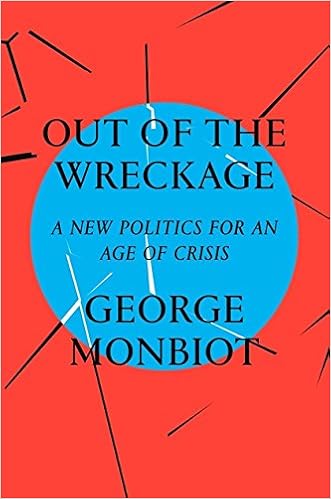
Few have made a more commendable contribution to saving the planet than George Monbiot. His recent book, Out of the Wreckage, continues the effort and puts forward many important ideas…but I believe there are problems with his diagnosis and his remedy.
The book is an excellent short, clear account of several of the core faults in consumer-capitalist society, and the alternatives advocated are admirable. Monbiot’s focal concern is the loss of community, and the cause is, as we know, neo-liberalism. He puts this in terms of the “story” that dominates thinking. Today the taken for granted background story about society is that it is made of competitive, self-interest-maximizing individuals, and therefore our basic institutions and processes are geared to a struggle to accumulate private wealth, rather than to encouraging concern for each other and improving the welfare of all. Thatcher went further, instructing us that there is not even any such thing as society, only individuals. Monbiot begins by rightly contradicting such vicious nonsense, pointing out that humans are fundamentally nice, altruistic, caring and cooperative, but we have allowed these dispositions to be overridden primarily by an economic system that obliges us to behave differently.
He gives heavy and convincing documentation of- this theme. Chapters 1 and 2 deal with several indicators of the sad state of affairs. “ … this age of atomization breeds anxiety, discontent and unhappiness.” (p. 18.) “An epidemic of loneliness is sweeping the world.” (p. 16.) Chapter 3 deals with the way neoliberalism has caused the social damage that has accumulated over the last forty years.
But my first concern with the book is that disastrous as it is, neo-liberalism isn’t the main problem confronting us and likely to destroy us. The main problem is sustainability. Monbiot does refer to this briefly and rather incidentally (e.g., p. 117) and again it seems to me that what he says is correct… it’s just that he doesn’t deal adequately with the magnitude or centrality of the problem or it’s extremely radical implications.
I need to elaborate here. Few seem to grasp that the “living standards” enjoyed in rich countries involve per capita use rates for resources and environmental impact are around ten times those that all people expected to be living on earth by 2050 could have. For fifty years now a massive “limits to growth” literature has been accumulating. For instance the Australian per capita use of productive land is 6 – 8 ha, so if the almost 10 billion people expected to be living on the planet by 2050 were to live as we do now, up to 80 billion ha would be needed. But there are only about 8 billion ha of productive land available on the planet and at present loss rates more than half will be gone by 2050. Many other areas, such as per capita minerals use, also reveal the largely unrecognized magnitude of the overshoot.(For a summary of the situation see TSW: The Limits to Growth.)
The inescapable implication is that we in rich countries should accept the need to shift to lifestyles and systems which involve enormous reductions in resource use and ecological impact. A De-growth movement recognizing this has now emerged. Yet the supreme goal in this society remains economic growth, i.e., increasing production, consumption, sales, and GDP without limit. To refuse to face up to the absurdity of this, which is what almost everyone does, is to guarantee the onset of catastrophic global breakdown within decades.
Thus the sustainability problem cannot be solved unless we abandon affluence and growth (…the title of my 1985 book.) Just getting rid of neo-liberal doctrine and exploitation is far from sufficient. Even a perfect socialism ensuring equity for all would bring on just about the same range of global problems as that we face now if the goal was affluence for all.
When all this is understood it is clear that the solution has to be transition to some kind of “Simpler Way”. That is, there can be no defensible option but to shift to lifestyles and systems that involve extremely low per capita throughput. This cannot be done unless there is also historically unprecedented transition to new economic, political and value systems. Many green people fail to grasp the magnitude of the change required; reforming a system that remains driven by market forces, or growth or the desire for wealth cannot do it. Just getting rid of capitalism will not be enough; the change in values is more important and difficult than that. Yet we advocates of simplicity have no doubt that our vision could be achieved while providing a very high quality of life to everyone. (For a detailed account of how thing might be organised see TSW: The Alternative.)
Monbiot doesn’t seem to grasp the significance of the limits, the magnitude of the overshoot, or therefore the essential nature of the sustainability problem and its extremely radical implications. Above all he does not stress the need to happily embrace extremely frugal “lifestyles”. Sustainability cannot be achieved unless the pursuit of affluence, as well as the dominance of neo-liberalism, ceases, and he, therefore, does not deal with what is in fact the main task for those wishing to save the planet; i.e., increasing general awareness that a Simpler Way of some kind must be taken. Monbiot does not discuss the simplicity theme.
This has been a criticism in terms of goals. I think the book also has a problem regarding means. The book is primarily about politics. It is a sound critique of the way the present decision-making system works for the rich and of the need for us to take control of it into our hands via localism. But Monbiot is saying in effect, ”Let’s get out there and build community and take control and then we can fix things.” Unfortunately, I think that advice is based on a questionable analysis of the situation and of how to fix it.
My case requires some discussion of what I see as perhaps the book’s major problem, which is to do with the nature of community, more accurately with the conditions required for it to exist or come into existence. Again Monbiot’s documentation of the sorry state of community today is to be applauded. But I think his strategic recommendations mostly involve little more than a plea for us to just come together and commune, as if we have made the mistake of forgetting the importance of community and all would be well if we just woke up and knocked on our neighbour’s door.
Firstly Monbiot’s early pages give us powerful reasons to believe that such “voluntaristic” steps are not going to prevail against the massive and intensifying forces at work driving out community. Economic reality gives most people no choice but to function as isolated, struggling, stressed, time-poor, insecure individuals competing against all others to get by, having to worry about unemployment, the mortgage and now the robots. Mobility obliges the individual to move through several careers in a lifetime, “development” eliminates stable neighbourhoods and rips up established support networks. Developers and councils prosper most when high rise units are thrown up everywhere, and the resulting land prices weigh against allocating space to a diverse landscape of mini-farms and firms and community gardens and leisure facilities likely to increase human interaction. Smart phones preoccupy with trivia and weaken parental control. Commerce and councils takes over functions families and neighbourhoods once performed for themselves, making us into privatized customers with fewer social responsibilities. People understandably retreat to TV and IT screens for trivial distraction, and to drugs and alcohol. No surprise that the most common illnesses now are reported to be depression and loneliness.
Just ask yourself what proportion of national productive capacity and investment is explicitly targeted to building cohesive and mutually supportive communities … try finding that line item in the Budget Papers. Now how much goes into trying to increase business turnover and consumption. I rest my case. Monbiot is more aware of all this than most of us but he falls far short of explaining how it can be overcome … or that it can be overcome. In my firm view it cannot be overcome until the capitalist system and several other unacceptable things have been scrapped, and that will take more than knocking on your neighbour’s door.
More important than recognizing the opposing forces, Monbiot’s recommendations for action seem to me to be based on a questionable understanding of community, leading to mistaken ideas about how to create it. As I see it community is most important for a high quality of life, but it is strange, very complicated, and little understood. It involves many intangible things including familiarity, a history of interactions, close personal relations, habits and customs, a sense of common interests and values, helping and being helped, giving and receiving, sharing, lending, debt, gratitude, reciprocity, trust, reliability, shared tasks, resilience, concern for the community and readiness to act collectively to achieve common goals. It is analogous to an ecosystem, a network of established dynamic interrelationships in which a myriad of components meshing spontaneously contribute to the “health” of the whole … without which the components couldn’t do their thing. But the community ecosystem also involves consciousness, of others and of the whole, and it involves attitudes and bonds built by a history of interactions. This history has established the values and dispositions that determine the communal behavior of individuals and groups. Community is a “property” that emerges from all this.
Community is therefore not a “thing” that can be set up artificially at a point in time, nor is it a property or ingredient that can be added like curry powder or a coat of paint. It cannot be brought in or installed by well-intentioned social workers, council officers or government agencies. It is about deep-seated ideas, memories, feelings, habits and social bonds. It therefore has almost nothing to do with money and economists can tell us almost nothing about it. You could instantly and artificially raise the “living standards” of a locality just by adding dollars, but you can’t just add social bonds. They can only grow over time, and under the right conditions. Monbiot explains clearly why neo-liberalism eliminates those conditions – my problem is that he doesn’t explain how to get them back and he proceeds as if it is simply a matter of individual will or choice, of volunteering to go out and connect. As I see it we won’t get far until social conditions make us connect. Monbiot ’s urging will prompt some few to make the effort, and he refers to many admirable initiatives underway including community gardens, local currencies and cooperatives. I see these “Transition Towns” ventures as extremely important and Monbiot is right to encourage people to get involved in them. They are the beach-heads, establishing the example local institutions that must eventually become the norm and that people will be able turn to when the crunch comes, but I do not think they will grow beyond the point where a relatively few find them attractive … until macro conditions change dramatically.
Here is a brief indication of how Simpler Way transition theory sees it.
There is now no possibility of heading off an extremely serious multifactorial global breakdown. For instance greenhouse gas emissions would have to be reduced at maybe 8% p.a., and yet they are rising. Renewable energy would have to replace fossil fuels in a few decades … but presently it contributes only 1.5% of world energy use. There are strong reasons to think that oil will become very scarce within ten years. (See Ahmed, 2017.) Global debt levels are so high now and rising so fast that the coming CFC 2.0 will dwarf the previous GFC1. Did you know that global insect populations have suddenly begun to plunge? Forget about your white rhino, it’s the little fellows at the base of food chains that really matter. Need I go on.
There are many other accelerating problems feeding into what Mason (2003) described as the coming 2030 spike. What we have to pray for is a slow-onset terminal depression, not a sudden one, giving people time to wake up and realize that we must move to The Simpler Way. The Transition Towns movement is the beginning of this but I do not think it will really take off until the supermarket shelves thin out. Then people will be forced to come together in their suburbs and towns to work out how they can build cooperative local self-sufficiency. They will realize this must be done collectively, that the market must be prevented from determining what happens, and above all that the competitive quest for wealth is suicidal and that frugal “lifestyles” must be embraced. In other words, if we are lucky and the breakdown in global systems is not too rapid, the coming conditions of intense scarcity will force us to create local economies, committees, cooperatives, working bees, commons etc. … and these conditions will produce community … out of the wreckage.
But community is not the crucial goal. What matters most at this early stage of this revolution is people coming together to take collective control of their town, that is, to go beyond setting up a local swap shop here, a community orchard there a cooperative bakery somewhere else, and to start asking questions like, “What are our most urgent needs in this town … bored teenagers, homeless people, lonely older people, too few leisure activities…well let’s get together to start fixing the problems.” Essential to The Simpler Way vision is citizens in direct participatory control of their own situation, i.e., the classic Anarchist form of government. The big global problems cannot be solved any other way because only settlements of this kind can get the resource and ecological impacts right down while providing well for all. For thousands of years people have taken for granted being governed. That is not just political immaturity, it is not viable now. Distant, central agencies like the state cannot run the kinds of settlements that will enable per capita resource rates to be decimated. These can only be run by conscientious, cooperative citizens aware of their local needs and keen to work together to build and maintain their own local water, energy, agricultural, social etc. systems. (There will still be a remnant role for central agencies.)
In TSW: The Transition it is argued that this taking of control at the town level must be seen as the beginning of a process that in time could lead to revolutionary change at the level of the national and international economies, and of the state itself. As townspeople realize they must prevent the global economy from determining their fate and as they find they must build their power to take control of their own situation they will increasingly pressure state policies to be geared primarily to facilitating local economic development…and in time they will replace state power by citizen assemblies.
The activities and projects Monbiot advocates could be most important contributors to this process, but I don’t think they will add up to the required revolution unless they are informed by a basically Anarchist vision whereby people come to understand that the main goal is not a town containing nice things like community orchards, nor indeed one with robust community, but a town we run on principles of frugal, cooperative, needs-focused, local self-sufficiency.
Ahmed, N. M., (2017), Failing States, Collapsing Systems, Dordrecht, Springer.
Mason, C., (2003), The 2030 Spike, Earthscan Publications.
Monbiot, G., (2018), Out of the Wreckage: A New Politics for an Age of Crisis, London, Verso.
TSW: The Limits to Growth, thesimplerway.info/LIMITS.htm
TSW: The Alternative, thesimplerway.info/THEALTSOCLong.htm
TSW: The Transition. thesimplerway.info/TRANSITION.htm
TSW: The Transition. thesimplerway.info/TRANSITION.htm


