Showing posts with label book review. Show all posts

Wednesday, April 22, 2026

3682. Book Review: Michael Roberts on Three Books about Capitalist History and Transformation, Controlling or Replacing Capitalism

By Michael Roberts, Michael Roberts Blog, April 22, 2026


This post reviews some recent economics books published by various authors, both Marxist and non-Marxist.

Let me start with a magnum opus, Capitalism – a global history, by Sven Beckert. Beckert is the Laird Bell Professor of History at Harvard University, where he teaches the history of the United States in the 19th century and global history.  His ‘Capitalism’ is called a ‘monumental book’ by global inequality expert, Thomas Piketty, himself an author of an eariler gargantuan publication back in 2014 called Capital in the 21st century (Piketty’s suggestion then was that he was ‘updating’ Marx’s Capital from the 19th century). 

Beckert in contrast is not trying to update or critique Marx’s Capital.  Instead, as an economic historian, he aims to paint a broad canvas of the rise of capitalism from its early embryonic origins, that he takes back to 1000 years ago. He does not provide a theoretical analysis of capitalism as Piketty tries in his book.  This book is very much more descriptive than analytical.  He delivers a global view of capitalism , not confined what he calls the ‘eurocentric’ approach of others. That is the book’s merit, full of anecdotes and examples of capitalists at work worldwide.  But the book’s de-merit is its lack of any systematic understanding of capitalism.  Indeed, it is like the work of Adam Tooze – namely, it is ‘more the how, than the why’.

As the blurb says for the book, “Sven Beckert, author of the Bancroft Prize–winning Empire of Cotton , places the story of capitalism within the largest conceivable geographical and historical framework, tracing its history during the past millennium and across the world. An epic achievement, his book takes us into merchant businesses in Aden and car factories in Turin, onto the terrifyingly violent sugar plantations in Barbados, and within the world of women workers in textile factories in today’s Cambodia”.

Capitalism, argues Beckert, was born global. Emerging from trading communities across Asia, Africa, and Europe.  And capitalism can only be described as a global phenomenon. “This book understands capitalism as, above all, a global development whose local articulations can only be understood globally. The economic dynamics of a given place are inescapably shaped by its connections to the outside world. There is no “French capitalism” or “American capitalism”; rather, there is capitalism in France and America, which have contested and complicated relationships with capitalism elsewhere, indeed everywhere “

Beckert makes big claims for the revolutionary nature of capitalism. “It was a fundamental break in human history not just because it revolutionized economic affairs but because it turned human relations upside down; infiltrated our politics, societies, and cultures; altered the natural environment we inhabit; and made revolution a permanent feature of economic life. The capitalist revolution is the only revolution whose fundamental core is that it is ongoing, that it qualifies as a state of permanent revolution.” 

But of course, he recognises that capitalism has its faults. “Capitalism is also distinctive for the particular kinds of social inequalities and global hierarchies it creates.”  But Beckert does not want to take sides between those authors supporting and those critiquing capitalism. “On one side, Marx’s writings became sacred texts through which to filter the politics du jour; on the other side, scholars read capitalism’s history through the equally sacralizing lens of Adam Smith’s writings. This book strives to avoid either idolatrous extreme.” 

Actually, it is not true that Marx did not recognise the great changes that capitalism made to human progress; or that Adam Smith saw no faultlines in market economies. But Beckert resorts to descriptive history rather than economic insight. As Beckert puts it: “this work is an effort to reclaim capitalism as a territory for historical investigation. This history will show that capitalism is neither a state of nature nor a process whose internal logic determines its eventual outcome in more than the most general way.”  So the Marxist materialist conception of history and Marx’s explanation of the internal contradictions in capitalism are to be put aside; as are the views of mainstream neoclassical economists that markets and profit making are an eternal and beneficial feature of human social organisation. Instead, capitalism is a contingent history.

Beckert does not hide the brutal nature of the emergence of capitalism globally. “Although capitalism’s history is often told as a story of contracts, private property, and wage labor—that is, stylized as a history of the realization of human freedom—there is another story, equally important, about vast expropriations, huge mobilizations of coerced labor, brutality in factories and on plantations, fierce destructions of noncapitalist economies, and massive extractions of resources for private gain. Capitalism rested, as we will see in the chapters that follow, not just on productivity gains but on enormous appropriations”.

Many of the early sections of the book give the reader a panoramic view of the capitalist process at work across the world, even when other social formations like, slavery, feudalism and Asian despotism were dominant. Unfortunately, when Beckert gets into 20th century, the period when capitalism became fully dominant globally as the mode of production and social formation, Beckert’s analysis becomes weaker. He notes the post-1970s crisis of reconstructed capitalism, ie the neoliberal period, but it seems he remains confident that capitalism is here to stay despite the accumulating economic, environmental and geopolitical crises that we see accelerating in the 21st century. ”We can anticipate that capitalism will remain a global totality, even if the nature of that totality continues to change, perhaps in radical and surprising ways. We can expect capitalism’s enormous creativity to persist, along with its amazing adaptability.” 

Or does he? “Eventually, however, there will be a moment when capitalism ends. Regardless of whether we fear or hope for that end, capitalism, like everything in human history, is finite, even if it is impossible to say when or how it will end or what will replace it.”  But even if capitalism is to give way to a new stage of human social organisation, it will take a very long time and “be interwoven within capitalism itself, just as capitalism was itself embedded in noncapitalist societies for centuries.”  Or maybe not – if the “ecological and social crises unfolding right now and right here become unbearable”.   All these maybes are a product of his descriptive approach to the history of capitalism.

Another opus magnum is the latest book by former World Bank lead economist and global inequality expert, Branco Milanovic.  I have posted several times on Milanovic’s indepth studies of global inequality, but this new book is not so much about inequality but more about what he considers is the great transformation in the world economy that is taking place –namely the movement of economic power from North America and Europe to Asia. “The first defining change is the much greater importance of, and the movement of economic activity towards, Asia and the Pacific.”

The second big change is the result of that shift. As China became richer, the Chinese people also became richer. That meant that people who were in the lower-middle class in the US, Germany, or Italy, for the first time in the last 200 years, fell behind substantial numbers of people from Asia. At the level of the nation-state, we have had a movement towards much greater importance of Asia in economics and politics. At the level of personal incomes, we see the decline of the Western middle class.”

Milanovic argues that the Industrial Revolution transformed the countries that were leading the industrialization—the UK, France, Northern Europe, then the United States, and finally Japan—and made their people much richer than people elsewhere. But In the last 40 years, we have had, for the first time, a serious challenge to that. Countries in Asia are now not only catching up but, in some cases, even overtaking Western countries technologically.

This has led to a new cold war not now based on ideology (capitalism v communism, as with the US and the Soviet Union), but now economically between the US and China. If China continues with real GDP growth rates 2-3% points higher than the US rate, within one generation, and a maximum of two generations, you will have the same number of people in China who are above the US median income as Americans. “If one thinks that the real sign of catching up is when China becomes equally rich on a per capita basis as the United States, it will take a long time. But before that happens, China as a nation would be much more powerful than the United States simply because it is so much bigger.”  But see my forthcoming paper on Catching up , to be published by the World Association of Political Economy.

Milanovic says there are three views on the benefits or otherwise of the globalisation of trade and finance in the last 40 years. The mainstream one is that trade among nations benefits all countries and so leads to peace. Adam Smith is more nuanced and argued that only ‘balanced trade’ would maintain peace. But there is the Hobson-Luxemburg-Lenin theory, which holds that the big powers would fight for control of the resources and assets of the rest of the world and that would eventually lead them to war ie imperialism.  Milanovic tends to a mix of the last two views.  The end of globalisation and free trade has led to a loss of living standards for many in the West and thus “a huge dissonance between different parts of the Western population.”  I would add that globalisation led to a massive transfer of value and resources from the Global South to the Global North, hitting living standards not just in the Global North but also for the vast majority in the Global South..

According to Milanovic, neoliberal globalism has now been replaced by ‘national market liberalism.’  Tariffs are being imposed and immigration controls are increasing.  The world has moved from option two to option three. ”We still have neoliberalism, but only at the national level. We end up with a version of neoliberalism stripped of its international component.” Milanovic concludes that “we clearly have a global disorder.” But he lays his hope on the world moving towards a multipolar system. Eventually, “we can build a more equitable international system where major powers have a greater stake than they do now.”  So a new balance of trade and finance and economic power can emerge. Option three becomes option two again, hmm.

Mariana Mazzucato is another rock star economist of the ‘left’, once called the world’s scariest economist.  I have reviewed many of her previous books (search my blog). But it seems she does not really scare the international powers that be.  She is regularly invited to speak around the world at various mainstream economic gatherings and as an adviser to governments.  Her latest book is called The Common Good Economy.  This follows on from a previous book, the Mission economy. – each time a new attractive title suggesting economic innovation and insight.

Mazzucato tells us that “Our economic system is broken. The climate crisis is accelerating. Inequality is deepening. Public trust is crumbling. Wealth concentrates in fewer hands while governments scramble to fix what markets can’t do, rather than to shape them from the outset.”  So what should well-meaning governments do? Instead of trying to correct these ‘market failures’ and trying to patch up problems, governments need “to proactively build the economy we need”.  She offers a ‘new theory of the common good, one which allows governments and businesses to develop purposeful economic relationships, creating value and building spaces where human flourishing can happen.”

As in previous books, she starts from the premiss that what is needed is ‘partnership’ between an ‘activist’ state and capitalist businesses – ‘participation and reciprocity’.  You see “capitalism and workers’ rights are not in tension — they are co-dependent. Industrial policy that includes workers in design and delivery produces better outcomes for all.”   So the answer is not to replace capitalism, but to strengthen worker representation in decision-making bodies, including corporate boards.  Governments must encourage capitalist companies to invest but under what she calls “green and social conditionalities across all sectors” so “ensuring we socialize both risks and rewards through smart (??) public financing.”   What is needed is not socialism, but with “strong social contracts into our industrial policies now, we can ensure this historic wave of green investment builds an economy that works for both people and planet.”  We need “mission-oriented industrial policy that treats workers as co-creators of value — with conditionalities that share the rewards.” Mazzucato sort of admits that such a social contract with conditionalities placed on the big multinationals, the fossil fuel giants and the financial sector would be “a delicate task, as too much micromanaging with a shopping list of conditions can, of course, stifle innovation.” On the other hand, “close relationships with private firms could make governments prone to capture.”  Indeed!

Mazzucato continues her merry way across the globe at conferences, government meetings etc to advocate ‘mission projects’; conditionalities on big business and a social contract between workers and bosses – all for the ‘common good’ economy.  Dare I say it, but clever jargon and trendy titles do not make for radical change.

Ann Pettifor in her new book, Global Casino, does not even look for radical change.  You see, unregulated global finance is causing the crises we see in the world economy.  The global market in money – housed in the offshore ‘shadow’ banking system – holds $217 trillion in financial assets and operates beyond the reach of any nation’s taxman. Asset managers, private equity firms, and pension and sovereign wealth funds scoop up the world’s savings for investment and manage them as they choose, unaccountable to politicians or the citizens who elect them.

But it does not require socialist or very radical measures to sort this out.  Pettifor: “societies and gov­ernments can take back control of the global financial system. We have done it before and can do it again. Indeed, it is imperative that we do so, if we are to manage the twin threats of climate breakdown and biosphere collapse.”  Pettifor reckons that in those halcyon days after the second world war, a global financial order was established with the Bretton Woods agreement to manage ‘global imbalances’ and currency and trade flows as well as regulation of financial excesses and recklessness.  But President Nixon blew all this up internationally when he took the dollar off the gold standard in the early 1970s and later government leaders deregulated the financial sector, turning the world economy into a giant casino.  This was the reason for the global financial crash in 2008-9 –  it has nothing to do with falling profitability of capital or any other rigid Marxist explanation.  The answer now is to return to the post-war period of managed trade and financial regulation – simples.  But I think not.

What is stopping a return to global regulation being implemented is the current ideology. Pettifor, in an interview on her book: “If you read the Financial Times, people who talk about managing trade are treated as mad Trotskyists. I dare not say it because I don’t want to be branded as a mad Trotskyist, I’m just a very moderate Keynesian, for God’s sake. But even my moderate views are considered extreme in the world of free markets. And how we overcome that ideology is the issue that we face.”

You see Pettifor knows what she is talking about – unlike the rest of us on the left. “What always strikes me about the great financial crisis of 2007–9 was that the Left didn’t know it was coming. I am very proud of having written The Coming First World Debt Crisis (2006), but the rest of the Left didn’t see it coming. People talked about globalization as if it was a given. And then when it blew up, there was no plan B. We didn’t even know it could happen. We were as stupid as the chair of the Federal Reserve, Alan Greenspan. The Left was as stupid as Greenspan, who said he didn’t believe it could happen.” Actually many on the left (at least the Marxist left) did see the financial crash coming (see my paper here). And what is this plan B to replace globalisation and unregulated speculative finance?  According to Pettifor, it is restoring proper regulation.  But regulation always fails. Indeed, since the Great Recession, there have been several banking crises, despite increased regulation. 

Moreover, if the cause of all our woes globally is an uncontrolled financial sector, why does Pettifor not call for the public ownership of the banking system in the major economies and the closure of hedge funds and other speculative forms of finance capital? Instead, Pettifor offers a tax on speculative financial transactions and capital controls on footloose capital flows – and which governments are going to introduce these?  This is like putting a bandage on a gaping wound with blood flowing from a pierced artery.

Mazzucato offers us capitalism with ‘conditionalities’ for the common good and Pettifor offers us capitalism ‘regulated and managed’. Only one book proposes ending the capitalist mode of production and it is not by a feted academic, but by an Irish Marxist activist. James O-Toole’s Economics for the Exploited is written from a working class point of view.  He explains clearly and simply how capitalism works and why it cannot deliver the needs of humanity any more.

O’Toole covers Marx’s law of value and answers its critics clearly (he explains Marx’s law of profitability and even deals with the so-called ‘transformation problem’).  He explains the cause of economic crises, inflation and the rise of imperialism. And he outlines the case for a planned economy under common ownership and democratic control as the way forward for humanity and the planet.

“Modern humans have been on Earth for around 300,000 years. Class society is a few thousands years old and capitalism only a few hundred. There’s nothing “natural” about this system. In those few hundred years capitalism has brought us to the point where corporate greed could actually destroy the natural underpinnings of any advanced social order. The clock is ticking. This system isn’t natural. We can live in other ways. We workers produce this system. It’s in our hands. Workers have to take control.”

Sunday, January 31, 2021

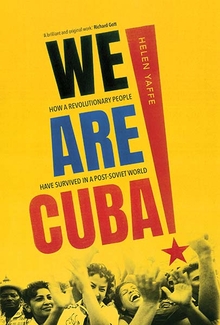
3472. Book Review: We Are Cuba! How a Revolutionary People Have Survived in a Post-Soviet World

By Sara Kozameh, Jacobin, January 30, 2021


The fall of the Soviet Union in 1991 and the consequent demise of its multilateral economic assistance programs shook what had been the socialist world. By the time the USSR voted to formally dissolve, the Council for Mutual Economic Assistance (COMECON) — the economic trading bloc that provided crucial economic assistance and preferential trade agreements to smaller Communist states — had already been dismantled.

This threw Cuba, COMECON’s only member in the Western hemisphere, into economic turmoil. Nearly overnight, the island nation found itself cut off from its primary trading partner. It lost more than four-fifths of both its import and export markets, which had supplied it with energy, food, and machinery, helping sustain the Cuban economy for over three decades, ever since the start of the US embargo in 1961.

GDP plunged by 35 percent over the space of three years. Cuban agricultural output fell by 47 percent, construction by 74 percent, and manufacturing capacity by a staggering 90 percent. The lack of fuel imports from abroad paralyzed Cuba’s industries. Lengthy blackouts and food queues became a feature of daily life.

With no gasoline to power their cars or buses, Cubans had to walk or cycle to their destinations. Lack of electricity meant there were no fans to stave off the sweltering tropical heat — and no way to power refrigerators, either. People’s intake of calories fell by about one-third, as hunger and malnutrition rose to levels not seen since before the 1959 Revolution.

After the Fall

Few in the Western world expected Cuba’s political and economic system to survive. History, we were told, had ended; capitalism reigned, while the socialist world was crumbling. It was only a matter of time before the Cuban exception ceased to be exceptional. Yet in Cuba, “history” has continued to plod on.

Thirty years after the fall of the USSR, the government that emerged from the Cuban Revolution still holds power. It has now existed in the post-Soviet world for longer than it spent under the wing of the Soviets. The distinctive Cuban model has endured, and its leaders still seek to balance the pressures of functioning amidst an overwhelmingly capitalist global system with the objective of advancing a non-capitalist economy that doesn’t follow the same logic.

In her book We Are Cuba: How A Revolutionary People Have Survived in a Post-Soviet World, Helen Yaffe sets out to explain how Cuba’s model of socialism has held out against such odds. The answer, Yaffe argues, can only be found by taking the Cuban Revolution on its own terms, instead of allowing the residual insularity of US Cold War battles to condition the debate.

Those who perceive the Cuban system exclusively as a repressive dictatorship are unable to come to terms with the real society that exists — and by some measures, even thrives — beneath the obfuscating layers of political rhetoric. Yaffe aims to provide an economic and policy-based analysis of Cuba’s last thirty years, evaluating the island’s progress and setbacks on the basis of its own objectives.

The Special Period

Yaffe’s book identifies several reasons for the persistence of the Cuban model. A willingness to adjust the parameters of centralized government control is one of them. Cubans remember the 1980s as a time of relative abundance and stability. Soviet goods filled store shelves, and workers who met or exceeded production quotas frequently received beach vacations — even international travel.

From 1981 to 1984, Cuba’s annual average growth was 7.3 percent — starkly at odds with the downwards trajectory in the rest of Latin America. The region as a whole experienced a 10 percent drop in GDP during those years. However, there were a number of challenges associated with managing economic productivity — the growth of excessive bureaucracy, and a focus on providing material incentives for workers that bloated the budget — which eventually led to stagnation.

In 1986, Fidel Castro opted not to follow in the liberalizing strides of Mikhail Gorbachev’s perestroika and glasnost program in the USSR. Instead, he sought to reform Cuba’s central planning system by recentralizing control over the economy. His government also launched several new platforms for citizen participation and opened the island up to tourism.

Yaffe argues that this renewed emphasis on state intervention against what the government saw as the inadequacies of the market put Cuba in a better position to withstand the Soviet collapse a few years later. Since the state had recentralized agricultural production, for example, it was able to get food to those who needed it most during the worst years of the crisis — roughly 1991 to 1995 — which became known as the “Special Period” (shorthand for what Castro called the “Special Period in Time of Peace”).

In explaining how Cuba made it through this crisis, Yaffe also stresses the importance of a “humanistic austerity” as the state’s budget dried up in the early 1990s. Cuban leaders made drastic cuts: state spending on defense, for example, fell by 86 percent, and the government eliminated fifteen ministries altogether. However, it maintained and even increased expenditure on health, welfare, and social services. Subsidies helped ensure that basic goods reached people and protected jobs.

Broken infrastructure or equipment might have gone unrepaired, but every school and hospital stayed open. The share of GDP accounted for by spending on welfare and health rose by 29 percent and 13 percent, respectively, from 1990 to 1994. The mid-1990s saw the graduation of 15,000 new medical professionals, bringing the doctor-to-patient ratio to one doctor for every 202 inhabitants.Despite the economic collapse, Cuba’s child mortality rates actually dropped, and life expectancy inched up from 75 years in 1990 to 75.6 in 1999. Although an increase of six months may appear trivial, it would have been reasonable to expect a drop under the circumstances — something that did occur in ex-Communist European states like Russia, where life expectancy fell by 6 years between 1991 and 1994.

Cuba’s fiscal deficit soared as a result of this approach, but it averted the threat of famine. To make up for the lack of imports, Yaffe reports, local food production expanded, ushering in the organic urban farming systems for which Cuba is now widely known. After eight years of state control over agriculture — an attempt to curb price gouging in food supplies — the state allowed private farmers’ markets to reopen.

By choosing fiscal stimulus over austerity, Cuban economists helped shield the population from some of the most devastating effects of economic collapse. In 1995, economic growth resumed. Although it took ten years to get GDP back to pre-crisis levels, incremental improvements made it easier for people get by. By comparison, recovery from the 2008–9 crash in the US also took nearly a decade, while the recovery period for most ex-Soviet countries was even longer — about fifteen years.

Innovations

After making it out of this trough, the Cuban government launched a number of initiatives that were meant to stabilize the economy. The island’s lack of access to fossil-fuel energy had proved catastrophic in the 1990s; in the 2000s, it still experienced constant blackouts. In 2006, the government began pursuing alternative development strategies and making large-scale investments in renewable energy.

In a series of chapters, Yaffe describes the development of job training programs that turned unemployed young Cubans into social workers, an “Energy Revolution” that reduced wasteful practices and expanded the use of renewables, and ensured the country’s successful entrance into the biotechnology industry. Yaffe argues that such programs allowed Cuba to get back onto a path of economic growth, which in turn enabled it to improve the standard of living.

Cuba’s commitment to international solidarity has also paid off. Cuban medical internationalism is now the island’s principal export, bringing in $6.4 billion in 2018. This practice goes back a long way, well before it was a source of national income. In 1960, Cuba dispatched a disaster response brigade to Chile following a devastating earthquake. It then sent doctors to Algeria during that country’s independence struggle, and later to North Vietnam and central Africa. By the end of the 1960s, Cuban medics were working in twelve different countries.

Over the decades that followed, Cuba expanded its programs for overseas medical assistance, training tens of thousands of foreign students to become doctors at no charge. In many countries, Cuban doctors helped eliminate diseases like polio, malaria, and dengue, saving thousands of lives.

This has become a key plank of Cuban foreign policy, directly challenging established notions of the medical profession and the function of development aid in the leading capitalist states. While Cuba does now receive payment for its medical assistance, its commitment to providing free healthcare abroad still endures: nearly half of the sixty-two countries that housed Cuban medical brigades in 2017 paid nothing for their services.

Many Cubans remember the early 1990s not only as a time of long queues and unfilled stomachs, but also as one that produced new ideas and activities. As the old saying goes, necessity is the mother of invention. But Yaffe argues that a commitment to socialist principles has also fostered such innovation, favoring models for sustainable development that prioritize human wellbeing.

Cuba’s state-led, centrally planned approach to medicine, for example, contrasts with the growth of profit-making healthcare services in the wealthiest capitalist countries — even those that had previously established public systems of provision. The small island’s current efforts to develop and complete clinical trials for a COVID-19 vaccine rival those of its vast northern neighbor.

Politics in Cuba

The portrait of Cuban society presented in We Are Cuba will be unfamiliar to readers who rely on the mainstream press in the US. Yaffe believes that Cuba’s variety of socialism has survived in part because the island has a dynamic citizenry, many of whom are committed to socialist ideals and willing to participate in efforts to advance them.

There is, of course, a long-running and bitter debate about the nature of Cuba’s one-party state, and whether its existence means that the Cuban people have no say over their own lives. The author challenges those who consider the Cuban political system to be a priori illegitimate and undemocratic, insisting that its electoral process is in fact characterized by “grassroots representation and participation in decision-making.” According to Yaffe, public engagement in local administration through a number of state-led organizations strengthened bonds among Cuba’s citizens and renewed a sense of community that was critical to its post-Soviet survival.

After Fidel Castro stepped down in 2006, his brother Raúl took over as head of government and introduced structural reforms that were designed to address problems like dependence on food imports, low wages, and poor productivity. Instead of pushing through these measures in a unilateral manner, Yaffe argues, the government launched a series of forums and debates that sought to engage all sections of Cuban society, aiming to get a sense of what reforms were considered necessary or desirable, and what kind of changes would be broadly acceptable.

Yaffe describes a similar process that took place in 2011 when the Cuban Communist Party held its Sixth Congress. Several million Cubans took part in consultations that drew up a set of guidelines for updating the national economy, considering proposals to eliminate the ration book, reform pricing, and improve the quality of services like health, education, and transport.

The lengthy process of consultation and debate included 163,000 meetings held locally by residential, political, and workplace groups. It registered over three million opinions and organized them into 780,000 distinct recommendations. Before the Congress took place, 68 percent of the guidelines had been revised, while 45 proposals were rejected.

A national debate to write a new constitution began in 2013. Proposals for the constitution included reforms in the areas of private business and property ownership, age limits and term limits for government positions, and decentralization of administrative and political structures. In July 2018, the National Assembly of People’s Power released a draft of the constitution for two months of debate.

Yaffe describes Cuban citizens attending assemblies with annotated copies of the draft, demonstrating their level of engagement. A month in, three print editions had been sold out, with requests for additional copies arriving from the most remote mountainous regions. Social media became a space for critical views; some of the strongest criticism came from evangelical groups that opposed recognition of same-sex marriage.

In 2019, after substantial revisions to the draft, 87 percent of voters — 6.8 million people — voted to ratify the new constitution. While the final draft retained Cuba’s commitment against capitalism and the one-party state, it introduced reforms to the way it functions, such as presidential term limits and the right to legal representation upon arrest.

Meanwhile, the lack of independent trade unions and constraints on civil liberties are at least two areas of democratic deficiency identified by Cuba’s critics. The yardstick that Yaffe uses purposely leaves those types of critiques out of her assessment. And to be fair, there are many other elements of capitalist democracy that Cuba doesn’t have: hedge funds, corporate control over the economy, and endemic homelessness, for example.

If the Cuban system has endured, Yaffe shows, it is because enough people on the island have continued to engage and identify with it. And whether or not people agree with Yaffe’s largely positive evaluation of that system, it’s vital to acknowledge the context that has shaped it.

Since 1959, there have been credible threats of invasion from the US at several points, along with other forms of violence orchestrated by Washington and a debilitating economic blockade that has been in place for more than half a century. During the same time period, left-wing governments elsewhere in Latin America have repeatedly been ousted by force, from Chile in 1973 to Bolivia in 2019. If the US ceased to apply such overweening pressure and recognized the right of a vastly weaker nation to follow its own course, it would change the political calculus in Cuba.

A State-Centered View

While Yaffe’s book seeks to correct some important misconceptions about Cuba, it also raises a series of questions. How, for example, can we explain the large numbers of young Cubans who want to emigrate? It’s true that the US economic blockade is a major cause of Cuba’s deprivations (and as Yaffe points out, rates of defection among Cubans who work and travel abroad — doctors and sports players, for example — are actually quite low).

Yet if Cuban socialism has survived by combining innovative policies with popular participation and support, as the author suggests, then what accounts for the seeming abandonment of the revolutionary project by many young people — the very people who came of age during the period upon which the book focuses?

We Are Cuba tackles a wide range of subjects, but in many ways, it is a portrait of post-Soviet Cuba as seen from the vantage point of the Cuban state. Many of the sources and voices cited by Yaffe are Cuban diplomats, professionals, and government officials. The book offers less insight into how Cubans have experienced the last three decades of crisis, recovery, and reform on an everyday basis, or into the question of whether and to what extent their relations with the state have become more strained. It does, however, contain some important perspectives on Cuba’s trajectory from those who support the system.

Yaffe could have strengthened the message of her book by interrogating some of the categories it deploys. There are multiple references in the text to a rather amorphous group called “the revolutionary people of Cuba,” a label that comes across as passive and formulaic when the author clearly does not mean it to be either. Cuban society is not static or unchanging; like that of any other country, it is dynamic and complex. Its government has critics and supporters alike, and not all Cubans are “revolutionary.”

Treating everyone on the island as if they belonged to a single revolutionary monolith flattens out the real stories of hardship and endurance over the past thirty years. The Cuban government is now trying to figure out how to respond to the new demands of a vibrant civil society, whose members are not necessarily less committed or less socialist in their outlook.

Towards the end of 2020, for example, there were protests against the detention of the rapper Denis Solís by several hundred artists and intellectuals: some oppose the Cuban system outright, while others want that system to be reformed, retaining a commitment to socialism while ending what they view as arbitrary detention and censorship.

The Road Ahead

We Are Cuba fills an important gap for readers outside the country who mostly lack basic information about how its leaders have navigated a unique set of challenges since 1991, showing how government policies have developed over time in impressive detail. Yet many more challenges lay ahead.

The reinsertion of Cuba’s economy into the global capitalist market and subsequent liberalizing reforms have led to the return of the US dollar and with it, growing inequality. Yaffe describes the Cuban government as being concerned to balance a commitment to equity and social justice with the introduction of new market mechanisms, while not succumbing to capitalism altogether — no easy task when US sanctions, embargoes and political threats still keep the island very much under siege.

Cuba also has to deal with the COVID-19 crisis, the tightening in recent years of US sanctions that were already harsh, and the potential economic fallout from plans to unify the double currency, which may result in devaluation of the peso. Its government also plans to finally eliminate the ration book, which has guaranteed basic food supplies to all Cubans, regardless of income, since 1963.

Despite the limitations that have been imposed upon it from abroad, Cuba has still managed to forge its own path in a post-Soviet world to a greater extent than most people would have thought possible in the early 1990s. Yaffe’s book should prompt readers to wonder what it might achieve without the burden of US intransigence — if the island finally had the opportunity to prosper rather than simply survive.

Tuesday, December 1, 2020

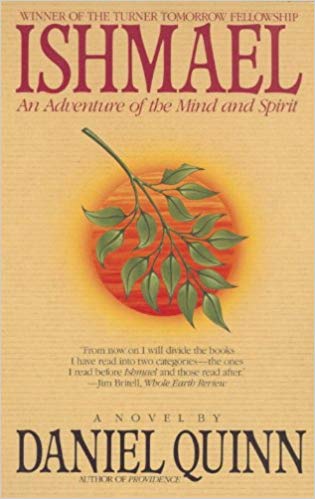
3456. Book Review: Ishmael: An Adventure of the Mind and Spirit

By CliffNotes, no date


Daniel Quinn's philosophical novel Ishmael: An Adventure of the Mind and Spirit opens with the narrator reading the newspaper and finding himself both disgruntled and intrigued by a personal advertisement. The ad indicates that a teacher is looking for a student interested in saving the world. For most of the narrator's early life, he had searched for such a teacher, and he's angry that only now is one looking for him. He's sure the ad is a hoax, but he goes to the indicated address, only to find an empty office space with a gorilla in one of the rooms, looking at him through a glass pane. The gorilla is able to speak with the narrator telepathically, and the narrator quickly realizes that this is the teacher he's been searching for.

The gorilla's name is Ishmael. He was caught in the jungles of Africa at a young age and has lived his life in captivity ever since. He started out in a zoo, then ended up in a traveling carnival, and finally was purchased by Walter Sokolow, with whom he learned to communicate telepathically. Through his telepathic connection, Ishmael was able to have Mr. Sokolow get him books and help him educate himself. Ishmael's primary investigation began with the issue of captivity but grew into a more comprehensive exploration of humanity and the shape of the world. Ishmael, having been apportioned part of Sokolow's estate after Walter's death, is mostly independent and lives his life in the city, trying to find students to help spread his teachings.

Ishmael and the narrator begin a series of meetings wherein Ishmael helps the narrator understand his cultural history. Ishmael divides humans into two groups: Leavers and Takers. Takers are members of the dominant culture, which sees humans as rulers of the world, whose destiny is to grow without check and dominate first the planet, then the universe, through technological innovations. Leavers are members of tribal cultures that live more simply, following the same basic rules that govern other populations on Earth. Ishmael helps the narrator see that while it may seem that Taker culture has outwitted the ecological rules that govern other life-forms, in many ways Taker culture is in freefall, doomed to crash once it has depleted the planet of its biological and environmental resources.

In addition to helping the narrator see the traits of Taker and Leaver cultures, Ishmael shows the narrator how various cultural myths have helped shape both cultures. One of the main myths he discusses is the story of Adam and Eve. Ishmael helps the narrator see that while Taker culture, through the dominance of Christianity, sees this myth as explaining its own creation, historically this myth was used by Leaver cultures to explain the expansion of Taker cultures. Leavers were trying to understand why Takers had turned to agriculture and were trying to force their way of life on the Leavers. Leavers used the myth to explain that it was because Takers had eaten of the Tree of the Knowledge of Good and Evil — the tree the gods must eat from in order to know who should live and die. Thus, the Takers were acting like the gods because they believed they'd gained the gods' knowledge, when in reality, such knowledge does not belong to any life-form on Earth.

Toward the end of their discussions, the narrator gets caught up with personal matters, forcing him to miss several days of meetings with Ishmael. When he finally returns to Ishmael's office, Ishmael is nowhere to be found. He tracks Ishmael down to a traveling carnival and visits him at night, so they can finish their lessons. The narrator comes up with a plan to rescue Ishmael from the circus by buying him from the circus's owner. By the time he gets the cash together, however, Ishmael has died from pneumonia. The narrator gathers up a few of Ishmael's remaining belongings and starts contemplating how he'll fulfill Ishmael's command to become a teacher himself and help other people see the problems with Taker culture and find a new way to live in balance with other life on the planet.

Ishmael is a gorilla who was captured in the wild as a youth and has spent his adult life in various forms of captivity. During captivity, he grows more and more self-aware and eventually comes under the care of Walter Sokolow, who encourages his intellectual growth through their telepathic communication. Ishmael becomes a teacher whose focus is on how to save the world and challenges his students with his intellect, obstinacy, and pride, and his hope for the human race, despite the challenges facing it.

Throughout the novel, Ishmael is used as a distancing mechanism by the author; Quinn puts his own philosophical theories in the mouth of a gorilla to upset readers' expectations about and biases against other life-forms and their intelligence. Ishmael, having spent his life in captivity, has learned to question captivity; thus, he tries to teach his captors (humans) what he's learned about them through his studies. Through his research on human history, he's come to see that they, too, are captive to a destructive way of life in their pursuit of domination over the rest of the world.

Through his studies, Ishmael tries to understand why humans feel called to dominate the world, and he teaches the explanation he's come up with to his student (the narrator). Ishmael speaks as a symbol of the sentience and intelligence of the rest of the world's life-forms that humans (at least humans in the "Taker" cultures — that is, basically everyone except for tribal cultures) have dismissed, because they see themselves as superior and removed from the rules that structure the evolution and survival of other life-forms on the planet.

The nameless narrator is Ishmael's fifth student and the only one who isn't completely defeated at the end of his instruction. The narrator was an idealistic youth who's grown into a somewhat jaded yet hopeful adult. He's open-minded and maintains his desire to save the world, though he often finds it difficult to maintain a sense of hope. The narrator can be self-centered but strives to see Ishmael as not only a teacher but a friend. He's unsure of his ability to be a teacher after Ishmael's death.

Thursday, August 27, 2020

3417. Book Review: The Death of Nature: Women, Ecology, and the Scientific Revolution

By Anthony Chaney, Society for U.S. Intellectual History (USIH), March 27, 2016 
 
Earlier this year, the state of Texas passed a bill banning municipalities from limiting the practice of hydraulic fracturing (fracking) locally. In 2014, the city of Denton voted to prohibit fracking within its borders, and this new bill was the response of state legislators. One oil industry representative explained his support for the bill by saying that some people just wanted to stop drilling for oil and gas altogether. “To these folks I say, ‘Ride your horse to work every day’,” he added.
One might go on for a long time unpacking the remark. I heard it in connection to my re-reading of The Death of Nature, Carolyn Merchant’s 1980 classic of social-environmental-intellectual history.
Along with other early classics by David Worster and William Cronin, Merchant’s book represented a decade of historical scholarship following the widespread emergence of modern environmentalism during the last few years of the 1960s. The work done by these historians added complexity and sophistication to initial conversations on the topic, such as Lynn White, Jr.’s seminal essay, “The Historical Roots of our Environmental Crisis,” published in Science in 1967. To identify the root of the problem, White initially seized on the Scientific Revolution, the “marriage between science and technology” that marked the shift from the medieval to the modern. But he quickly leapt back another half a millennium, to Christianity’s snuffing out of the old pagan animism. By pinning the blame on the Judeo-Christian element in the Western mind, White could then identify a solution to present troubles in the equivalent of “a new religion.” Merchant, in contrast, burrowed into the sixteenth and seventeenth centuries and put hundreds of pages of scholarly flesh on the bones that White had skimmed over.
Her work culminates, just past the halfway point, in five industrial-strength paragraphs. To remedy the anxious breakdown of all the old hierarchical and geocentric orders, new forms of order and power were provided, she explains. The new order was based on a “determined system” of natural laws. Power was redefined as
active and immediate intervention in a secularized world. Order and power together constituted control. Rational control over nature, society, and the self was achieved by redefining reality itself through the new machine metaphor.
By depicting nature as “a system of dead, inert particles,” the machine metaphor permitted a new kind of leveraging of the natural world: large-scale, profit-driven, and based on values all “fully compatible with the directions taken by commercial capitalism” (193).
This is where I thought of the remarks of the Texas senator. It may be that the oil and gas industry and their representatives grasp the environmentalist critique more clearly than do many mainstream sympathizers.
Here and elsewhere, Merchant’s analysis lays the loss of the moral constraints that once protected nature at the doorstep of “the emerging market economy.” Capitalism and the “mechanistic utopia” underwrote new forms of hierarchy that “tended to widen the gap between upper and lower social classes” (80, 185). What was needed wasn’t necessarily a new religion, but a new economic system to combat the present crisis, or so implied The Death of Nature in the year Ronald Reagan was elected president.
The Death of Nature is also significant for the case it made for an environmental history. Too heavy a reliance on economic or political modes of historical explanation was “inadequate,” Merchant argued. She offered instead an “ecosystem model,” a history “from the ground up” (42). This explains the “ecology” in her subtitle, and it partially explains the “women” in the subtitle, too. Before the triumph of mechanism, an association between nature and women had included both positive and negative components. For the triumph to occur, the positives had to be eliminated. The negatives were then constituted as persons and targeted. Eliminating the perception of a living, nurturing earth meant eliminating those women who were perceived to have access to earth’s reproductive bounty. Midwives and other practitioners of folk medicine were identified as witches and burned.
Merchant’s inclusion of this rich, gender-related material was informed by a decade of identity politics, the rise of a bolder and more separatist feminism, and the disciplinary standing of social history after the crises of the Sixties and Seventies. When Merchant spoke of “history from the ground up,” she was of course alluding to the “bottom up” perspective of social history, which then held the moral high ground within the field.
What may not have been as clear at the time of publication was how The Death of Nature was one of several variations on a broader post-Sixties theme. It was a theme in which communal-Gaia-woman was set off against rational-Promethean-man, within a consciousness of environmental deterioration. Richard Tarnas’s survey, The Passion of the Western Mind (1991), ends on something of that note. Beginning in the late 1980s, SUNY Press devoted a whole series to Constructive Modern Thought, under the editorship of David Ray Griffin, and many of the writers in that series play a similar tune. Looking back, it appears that The Death of Nature was one of the works that initiated a period when eco-feminist theory offered the best hope for a humane and fruitful postmodernism.
That hope has not completely evaporated. Who can argue that the earth’s atmosphere would not now be so pumped full of carbon particles had the earth continued to be honored as a living Mother, rather than being penetrated and probed? The extractive industries and their financiers have been the big winners of modernization, the biggest shapers of the way we now live. To see the world as alive again would likely mean also to re-gender it, to restore its “female soul.” Calling for this sort of restoration, however, would be to traffic in a feminine essentialism which Merchant soundly rejects. “I am not asking about unchanging essences,” she assures in her 1990 preface. Her concern is with “social change” and “changing constructions of nature” (xvi). The point is under-argued, but her insistence remains with the premise that the human perception of reality is a construct, socio-economically situated. That stance must dismiss any creeping essentialism.
Now I come to matters in The Death of Nature that remain most live to me.  Reality is a human construct, and as such, it can be re-constructed. That’s the basic premise, is it not? If accepted, it can undermine prevailing constructions, ones that make the natural world, women, people of color, and the poor objects of exploitation. If accepted, it can make way for new constructions that support the sustainability and egalitarianism that we prize. We can stop employing the machine metaphor and construct a new one. We have that in our power. This way of thinking challenges the mechanistic philosophy’s new form of order, as Merchant explained it. It does not challenge, however, the mechanistic philosophy’s new form of power. The idea that power is “derived from active and immediate intervention in a secularized world” is not undermined, but rather, reinforced.
If this seems like a dead-end path of inquiry, that’s because any other conception of human power is unimaginable. “As the unifying model for science and society,” Merchant writes, “the machine has permeated and reconstituted human consciousness so totally that today we scarcely question its validity.” It is “our everyday, common sense reality” (193). That was thirty-five years ago. Since then, the amount of heat-trapping carbon in the atmosphere has doubled.
This makes me wonder whether Merchant’s socially-sensitive mode of historical analysis was radical enough. Can we really look at history with from an “earth’s eye view” (42), in the same way we can look from the perspective of women, laboring people, and people of color? Can we grant nature “rights,” in the same way we grant rights to other human beings? Nature may not be an “it,” but it isn’t quite a “thou,” either. To think that way is intuitive, and it speaks clearly to our desire for alternative forms of order. To alternative forms of power it speaks less clearly. The emphasis remains on differentiation, on bodies of interest in “masculine” competition, rather than on undifferentiated (allegedly) feminine unity. For the contemporary mind, the modern creed of human power remains the “active and immediate intervention in a secularized world.” Might such power be surrendered? The notion is barely tolerable. The human “fix,” technological or otherwise, is still the final bulwark against giving up in despair and doing nothing.