By Grant A. Mincy, Truthout, January 2, 2015
The Sixth Mass Extinction
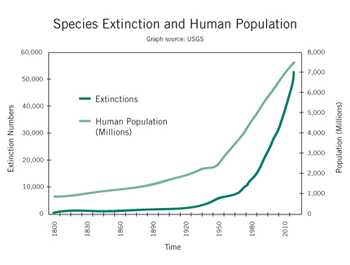
Of all the complex, wicked problems addressed by the current environmental movement, perhaps the most urgent is the rarely discussed mass extinction. We are currently experiencing Earth's sixth great mass extinction crisis — on par with the rate that ended the reign of the dinosaurs, thus terminating the Mesozoic. Stuart Pimm of Duke University, a recognized expert in the field of conservation biology, has published a landmark study in the peer-reviewed journal Science pertaining specifically to the causes of species decline. The number one culprit, by far, is habitat destruction.
This is rather dangerous in regards to our surrounding ecology. Pimm's publication describes the current plight of flora and fauna around the planet. Pimm notes that species are disappearing at least 1,000 times faster than the natural background rate — ten times faster than ecologists previously believed. "We are on the verge of the sixth extinction," Pimm said in a statement about his research. "Whether we avoid it or not will depend on our actions." As land is the ultimate commodity in today's global market, we are sure to see more habitat destroyed and an increasing number of entire species lost.
As flora and fauna continue their precipitous decline, geologists and ecologists are again looking at the geologic timescale — a system of chronological measurements that relate rock strata with time. The timescale is divided by major moments in Earth's history — the most common divisions are in recognition of mass extinctions and subsequent radiations of life. As we experience this modern biodiversity crisis a new epoch is being contemplated, and it is already (unofficially) in wide use: Welcome to the Anthropocene.
The Eocene
Our pale blue dot has an incredible evolutionary story. For much of the 4.5 billion year history of the Earth, this third rock from the sun would seem like an alien world to us all. Landscapes would appear strange. Historically, continents were located in different positions, perhaps even completely united. Much of the color we perceive and enjoy today would be absent, as flowering plants are relatively young regarding the eons in which we measure geologic time. For all the subdivisions of Earth's humble history, however, I am partial to our place in time: The Cenozoic.
The age of the mammals began with a bang some 65 million years ago with the bolide impact that finished the reign of non-avian dinosaurs. This extraterrestrial impact loaded the skies with a thick dust, temperatures in the deep-sea and across a rifting Pangaea rose as greenhouse gases accumulated in the atmosphere. But, with the giant predators gone, mammals explored the world. Our ancestors left their safe havens in the limbs of trees, as others left burrowed ground, and experienced a grand radiation. The human place in history was soon to come.
Climate change is the norm of our era, punctuated by regressive and transgressive seas. The Cenozoic is perhaps most famous for the ice ages and periglacial intermissions. Each progression and recession of glaciers molded the landscapes we experience today. Furthermore, it can be argued, these geologic processes allowed for our chance existence, crafting the conditions necessary for human civilization.
56 million years ago the Eocene Epoch began. Plate tectonic movements isolated Antarctica over the south pole and continued the rift of the once majestic Pangea as continents continued their migration toward the geography of today. With Antarctica fixed at the pole a long cooling trend advanced. The conditions were ripe for animal life to continue a rather unique radiation. Cloven-hooved herbivores, for example, the early ancestors of our agricultural species of today, adapted to the new landscapes.
A common principle in ecology is that diversity breeds more diversity. This grand radiation of fauna is preceded by an even greater ecological shift in flora. Plants boomed.
Angiosperms, the flowering plants, came to dominate the global system. Color erupted across the cool Earth. Radiant yellows, reds, purples, greens, and so much more, appealed to animal species. Nectar filled the air. I am envious of our mammal ancestors witnessing for the first time in our planet's history a true explosion of color. How wonderful it must have been to breathe deep of the sweet, lucid air.
The evolutionary trend toward mutualism advanced. Symbiotic relationships between flora and fauna developed, advancing the speciation of fungus, plants and animals. The modern Earth was under construction. This construction is punctuated by two very important terrestrial ecosystems: The modern tropical and temperate rainforests.
Along the equator, South America witnessed the development of a rich landscape. The Eocene gave rise to the great Amazon rainforest. Along the equator, the sun's rays bathed plants in the energy needed for glucose production. As the angiosperms radiated, the sheer amount of energy in this region allowed for a great development of new flora. The broad-leafed tropics were born, and along with the tremendous radiation of plants, so too came the animals.
Sitting in temperate North America, the steep slopes of the valley and ridge system, typical to the Appalachians, protected the valleys, mesic cove forests and meadows of the now humbled terrain from advancing ice sheets. With an array of micro-climates, habitats and niche space, the old growth forest, thick with deciduous trees, rich nutrient cycling and a moist understory produced the "Great Cradle of Biodiversity" for the North American continent — the very birth place of flowering plants.
Together, these majestic forests are today the two greatest hotspots of biodiversity on the terrestrial planet. The great Amazon is so important to the global ecological system that it is deemed the lungs of the Earth — sequestering carbon and producing much of the very oxygen we breath. The lush Appalachians, in the splendor of Autumn's hue, decorate the landscape in a mosaic of detritus, creating a nutrient dense topsoil that offers invaluable services to all of its inhabitants, aquatic and terrestrial alike. An array of organisms adapted, as beauty ever exploded.
The Eocene would eventually come to a close, of course. What followed was even more biological diversification. The human story begins some 1.8 million years ago as our ancestors left the safety of the trees, stood upright and walked across the savannah. For the first time, a species looked to the sky with wonder. Thus began the grand human experiment, an experiment defined by cooperation, competition and the challenging mechanisms of civilization.
The Biotic Pump
The broad-leafed, tropical rainforest of the mighty Amazon is a biodiversity hot spot. No other landscape on Earth is home to so much wildlife. Home to all the great kingdoms, the forest pumps out a large amount of terrestrial oxygen. Despite the grand importance of the forest, it is disappearing at an astonishing rate. In the modern era of resource exploitation, approximately 20% of the forest has disappeared and even more is threatened as 20,000 square miles of the Amazon is lost each year. The forest loss occurs because of a host of factors — slash and burn agriculture, industrial agriculture and extensive deforestation for timber among the top perpetrators.
Interestingly enough, programs designed to mitigate forest loss in many cases exacerbate the problem. Take the United Nations program Reducing Emissions from Deforestation and Forest Degradation (REDD) as an example. REDD is designed as a big picture fix to deforestation. Using the "hot spot" conservation approach, the program identifies areas of forest that have a particularly large number of at-risk or threatened species. Under the program, these areas are off-limits to exploitation. One challenge, of many, with this conservation strategy, however, is that often this encourages extreme extraction in areas that are not hot-spots. Furthermore, this is not a holistic view of ecology. Ecosystems are healthiest when connected, diverse and intact. Though hot-spots protect charismatic species, ecosystem health is still degraded overall — biodiversity loss, even in protected areas, still occurs.
More perplexing is how forest degradation impacts overall forest mechanics. The rich forest of the Amazon, converting sunlight to glucose to form the lungs of the world, also regulates how matter and energy flow through its unique system. The Amazon is also a beating heart.
Antonio Nobre is a respected Earth scientist from São Paulo, Brazil. He is also a senior researcher at the National Institute of Space Research and the National Institute of Amazonian Research who has studied the Amazon for three decades. He describes the Amazon as a biotic pump, largely due to his research regarding deforestation and its effect on the rainforest and climate. What Nobre ultimately describes is the principle of transpiration.
Trees absorb water from soil into their root system via the process of osmosis. Osmosis describes the phenomena of how water moves into the plant. Root systems are rich in glucose and salts — at a much higher concentration than their surrounding environment. Because of this, the chemistry of water is naturally attracted to root systems. The moisture gravitates towards the roots where it is absorbed into the tissue of the plant. Once inside, water travels through this tissue towards the leaves as the plant breathes.
During photosynthesis, all plants inhale carbon dioxide from the atmosphere. This gas then combines with water traveling through the plant to form the rich sugar glucose. The glucose is stored for the plant, but water vapor and oxygen gas are waste products of this reaction and are thus released into the atmosphere. This release of water vapor is transpiration. You can think of it like evaporation, but it is water that has moved through the plant — it's plant sweat.
This process has operated undisturbed in the Amazon for 50 million years. The release of all this water vapor is why the tropics are a lush rainforest. The plants regulate their own climate. As the water collects in the atmosphere, it continually soaks the forest as the cycle repeats. The forest creates its own precipitation as it manipulates the pressure of its atmosphere. Nobre tells us, in an interview on public radio, that 20 billion tons of water transpires everyday in the Amazon basin — more water than the mighty Amazon river delivers to the Atlantic ocean in the same period.
This is a grand ecological process. Sadly, deforestation, the leading cause of habitat loss in the forest, is destabilizing this mechanism. The Amazon climate is completely regulated by this process; all the trees work as a single unit to move moisture through the air. When this mechanism is disturbed, then, there are large implications for the entire ecosystem. The Amazon region is currently in the midst of a large drought. This drought is causing the forest to transpire even more. Nobre explains in an interview for NPR:
You know, it's like love. Love is the only quantity that increases the more you give. And so the trees do this, lower the pressure during a drought, pull the moisture from the oceans and counter the droughts… When you come with the chainsaw and the bulldozer and fire, then forest doesn't know how to handle this. That's what I call the Achilles' heel of the rain forest… I've been witness of the most serious episode of destruction in one go, you know? In Brazil alone — and Brazil has only 65 percent of the Amazon — we have destroyed more than 40 billion trees — billion — six trees per human being on the face of the earth.
Even in a year that was very wet, still she saw incredible number of fires breaking into the rain forest. This is a very, very alarming sign that the system is failing — failing. It means multiple organ failure, like in an intensive care unit.
The health of the forest, and the livelihood of folks who call the region home, is dependent upon the rich biodiversity unique to the tropics. Habitat loss throughout the region needs to stop, or the underlying ecological mechanism that has allowed the forest to blossom into such grandeur will ultimately shut down. But, the forest has an incredible capacity to heal. The Amazon is the product of deep time. With grand preservationists initiatives and the restoration of disturbed systems, it is possible to assist these complicated forest mechanics. The forest can restore the splendor of its creation.
A Humbled Terrain
I am lucky to call the Southern Appalachians home. The once majestic peaks of the mountains are now humbled by over 300 million years of natural process. With such depths of time, an incredible array of biodiversity has adapted to the temperate hardwood forest. Steep slopes and deep valleys are continuously carved by water. The forest's canopy is the true peak of succession, with underlying shrubs, mosses, fungus and rich soils that assist the flow of matter and energy throughout the system. Clouds hug these smoky mountains in ways only to be described as breathtaking. The forest is a deep green in the summer, a colorful mosaic in Autumn's hue, deeply mysterious in the depth of winter and colorfully vibrant with bursting wildflowers in the spring. I love to breathe deep of the fresh, lucid mountain air. I love to feel the cold of mountain waters. The blue ridge with purple horizons, deep vibrant forests and soaked, fog laden valleys: Home!
Though breathtaking, the region is subject to much trespass.
In the Spring of 2010 my wife (then girlfriend) invited me to accompany herself and four fellow sociology graduate students from the University of Tennessee, Knoxville on a three-day trip to Boone County, West Virginia. I eagerly accepted the invitation. A good portion of my childhood was spent in the hills of Wheeling, West Virginia along the banks of the Ohio River. My mom is a Wheeling native and I hold fond memories of visiting my great-grandmother as a child in the rusting industrial town. I was excited to once again visit the Mountaineer State.
At the time of the trip I was an incoming graduate student at the University, enrolled in the Earth and Planetary Sciences program. The purpose of the trip was to visit a coal mining town in the Central Appalachians. We earned this opportunity by the sociology department to gain insight to the environmental and socio-economic impact of resource extraction in the area from a local resident.
On the trip, we were particularly concerned with trying to understand the effects of strip mining throughout the region. Coal mining has a long history in Appalachia as it is deeply rooted in mountain culture. Coal will no doubt remain an important part of the Appalachian economy for some time. Early mining in the region primarily used methods of underground resource extraction. Miners often used picks and shovels on exposed coal seems.
The old images of miners deep in the Earth gathering coal in pit mines, the nostalgic "canary in the coal mine" days, are reminiscent of a mining method whose time has, for the most part, passed. The "new school" method of coal extraction is coal surface (strip) mining. Through much of Appalachia, the preferred surface mining method is mountaintop removal/valley fill — a process that literally blasts away the tops of mountains and pushes the leftover material, deemed overburden, into the valleys and streams below. Since the 1970's, over 520 mountains have been leveled by the mining technique (an area three times the size of the Great Smoky Mountains National Park) and waste from this process has added toxic pollutants to over 2000 miles worth of Appalachian waters. This is extensive habitat loss.
We met our host, West Virginia native Maria Gunnoe, on an early May afternoon — Maria is one of the most influential people I have ever met. She holds rank among the most outspoken environmental activists of our time. She is a community organizer and a board member for the non-profit group South Wings (who, to this date, are solely responsible for aerial views of mountaintop removal sites). She advocates ending the practice of mountaintop mining and transitioning Appalachia beyond coal. Her activism is not always popular in the depths of coal country, however. Her life has been threatened numerous times over the years, but she refuses to silence her message. In 2009 Maria earned the Goldman Prize, known as the "Green Nobel," for her work in environmental justice and Appalachian transition.
Maria's family settled in Boone County generations before coal extraction reached the area. She lives in a holler, surrounded by lush Appalachian forest. Above her family heritage today, however, lies a massive mountaintop removal site that looms over the valley. Maria and her family continue to survive the boom and bust markets that accompany the coal industry, the human caused disasters, increased mortality and sickness experienced by so many in the Appalachian region. She takes pride in the resilience of her family and close friends, the surrounding ecology and their sustainable use of forest resources and mountain streams. She is fighting the good fight, hardened by resource extraction that robs Mountaineers the ability to practice their unique culture of survival. In a 2014 interview with Earth Justice, Gunnoe describes her experience in Boone County:
Frasure Creek Mining Company, which is owned by a foreign corporation, is blowing up my homeland. One day in 2007, a blast that I watched them prepare for five days went off close to my home. And of all this dust of course ended up right on top of my home. I'm not the only one. People across Appalachia are forced to deal with these conditions all day every day. Their water is poisoned, they're covered up with dust, and no one is listening to what they're saying.
The Clean Water Act was supposed to protect us. In my lifetime I do not know of this law ever being fully enforced. But over recent years, crooked politics and coal money influence have completely gutted the intent of this law in Appalachia.
Our communities are becoming ghost towns, so that coal mining companies can expand their surface mining and fill the valleys and streams with their mining waste. The people around here have either been run out by blasting dust, water pollution and health and safety concerns, or they were bought out, signing contracts intended to take away their rights to contact state or federal regulatory agencies about these problems. Even our historic cemeteries are left inaccessible to the public; we must go through the coal company and its guards to visit our deceased loved ones in these now-active destruction sites…
The coal industry and its friends in Congress claim stopping mountaintop removal mining would end jobs. The people in West Virginia definitely need jobs. But the people who think that their jobs are more important than our water haven't had to live without water. You think it's hard to live without a paycheck? Try living with jars over your water faucets. Try living with nothing to give your children to drink. We shouldn't be made to choose between a temporary paycheck and clean water for our children.
This is absolutely against everything that America stands for. And I know that we have better options than this. We do not have to blow up our mountains and poison our water to create energy. I will be here to fight for our rights. My family is here, we've been here for the past 10 generations, and we're not leaving. We will continue to demand better for our children's future in all that we do.
Mountaintop removal mining is going to be ended. We will not back down on this.
For a brief few days Maria invited us into her life. We traveled around Boone County and she showed us large strip mines and informed us of the degrading water quality in the region. She told us how she and her family must keep their eyes closed when they bathe because the well water burns. She told us that her groundwater is so corrosive that the plumbing has to be redone in her house every few years. She showed us the bottled water her family must use because the tap water is unsafe. Adding insult to injury, she pointed out the "Friends of Coal" sticker on the bottles. She told us of family cemeteries in the area and how they are blasted away for resource extraction. She gave us insight to families that have to be accompanied by industry personnel to visit the buried because the grave is near company property.
One afternoon we traveled with her to Lindytown, West Virginia. Once a small mountain community, the area is now abandoned. A large surface mine, owned and operated by Alpha Natural Resources, pushed residents out of their homes. As we walked around the town, the soot and ash from mining operations in the area was thick black on the exterior walls of homes and the community church. Many houses were bulldozed, with others marked for destruction. We explored the abandoned church. Inside, spray painted behind the pulpit, read the ominous message: "MTR did this.”
Later that day we helped Maria maintain a family cemetery. Some of the small burial plots in rural West Virginia are undocumented. A portion of her work as a community organizer is registering these old cemeteries. This is an important charge as it prevents coal companies from blasting them apart for the underlying resource. On this particular site, as we took a break, an explosion rocked across an adjacent ridge and thick dust swelled into the air. Disturbed by the lack of warning before the blast I looked to Maria to ask a question about safety protocol and efforts to alert locals blasting is about to commence, but I stopped. Maria was weeping.
There currently exists a very real human tragedy in the Appalachian region. Rural communities are subject to the resource demands of high population centers in urban areas. Furthermore, locals are fighting an uphill battle against capital and state power, entrenched economic interests and a stigma that mountain "hillbillies" are backwards and do not know what is best for them. There exists tension among families, armed by those who long for transition and others who are dependent on industry to put food on the table. The Appalachian story is one of resource extraction and domination from powerful institutions. In spite of this, women like Maria Gunnoe remind us that the Appalachian story is also one of resistance, class struggle and an innate resiliency that can only be imagined by an ancient, beautiful and infinitely complex terrain and people.
The Grouse
I traveled through Pinedale, Wyoming in the summer of 2007. I will never forget the trip, it was my first experience in the great, wide-open North American west. I was traveling with a group of geologists and environmental scientists for a capstone experience to end my undergraduate studies. I was huddled in with the geology crew, as we mapped some amazing landscapes.
Pinedale was not our first stop, but it was our first location in the high desert. We had a caravan of about nine vehicles, ours (affectionately named "The Feldscar" as a geology pun) brought up the rear. I was buried in a book (The Dharma Bums) as we moved across the landscape, and did not study my surroundings until we stopped for gas on a beautifully isolated road. I fell in love with the desert the first time I saw her. When I crawled out of the van, I was stunned. A storm was gathering over the horizon, miles away from us. The dark clouds flashed periodically, and in the distance you could make out rain as it pelted the Earth. The contrast between storm clouds against the typically blue sky of the desert was amazing. The wind whipped around us, the smell of sage was thick in the air, as was the gasoline for our caravan that was soon back on the road.
That evening we set up camp in the pine along Fremont Lake. I tied sage brush to the top of my tent, rolled out my sleeping bag, tucked Kerouac's book away and made my way to the community bonfire. We were still breaking the ice (cracking beers) and getting to know one another, still in the beginning of our 30 day wilderness experience. Pinedale was our first long base camp, it was here that we became a tight-knit group. The landscape demanded it.
Carved thousands of years ago by heavy glacial activity, the landscape is built of molded valleys and moraines. Home to an array of pines, sage, juniper and herbaceous cover, the high desert is a naturalist's dream. It is also home to a number of wild animal species. One such species is in the news as of late: The Sage Grouse.
This grouse is as odd as a chicken, but distinctly Western. The bird has made its home in the relics of this glacial landscape. The sage brush and rolling desert hills are perfect habitat for the bird. It is this landscape that caught my attention, and this habitat that has allowed the grouse to thrive.
Thrive until recently, that is. While in Pinedale, we geologists also paid a visit to the Pinedale anticline. Anticlines are a distinct geological feature. Shaped like a rounded "A," they award the perfect environment for the entrapment of hydrocarbons. And there is carbon to burn all across Pinedale's most profitable rock formation. As we mapped the anticline, we also toured a number of the oil rigs and surveyed a number of gas pads. It was a rather fun day, out in the sun with the workers — we even got free camouflage hats that said "Pinedale Anticline" on them (along with a number of corporate insignia's, of course). I didn't realize it then, but these structures paint a broader story of a much changing American West. Wide open spaces are continually entrenched upon as oil, gas and coal exploration, coupled with industrial agriculture, cut into the ancient landscape.
As the natural landscape is lost, the grouse is finding it increasingly difficult to nest, breed and rear young. There are around 400,000 greater grouse left across the Western states. This may sound like a large number, but it pales in comparison to their population numbers just a century ago when the west was still wild. Their flocks used to black out the skies! Population crash is a particularly acute problem, eyed closely by the ecological sciences. Fast population crashes risk a genetic bottle neck, where the number of traits in a population can be drastically reduced, impacting the over all selective genetic diversity of a population and ushering the group into extinction. So, the population decline over a century is startling enough, but a recent study by Pew Charitable Trusts found that greater sage grouse numbers decreased by 56% from 2007 to 2013. For ecologists, this is alarming.
There are a number of natural causes for the population decline, such as wildfires and predation, but the number one cause of the grouse decline (and all species decline for that matter) is habitat loss stemming from human development. As ecologists and conservation biologists have raised concern over the birds population numbers, the U.S. Fish and Wildlife Service was tasked with a report to determine if the grouse was to receive protections under the Endangered Species Act (ESA).
The Western States exploded.
Industry is booming, but federal regulations under the ESA would drastically reduce their output. Furthermore, other property owners saw only new burdens placed on land use. The grouse, however, battles extinction.
Extinction is caused by change in a species' environment, such as habitat destruction, fragmentation or invasive species. To preserve biodiversity, numerous tactics have been deployed over the years, such as enaction of the ESA, but market approaches have arguably had the most success. Conservationists have found that the cheapest and most efficient way to save any species is to preserve its natural environment. This is accomplished with the ecosystem service approach to habitat conservation — an economic incentive. This may sound undesirable, especially to my fellow preservationists, but in today's system it is by far the most important and effective approach to conservation. "Nature for Nature's Sake" is a beautiful ethic, and it is one I hold, but ecosystem services and market dynamics offer a method of conservation that is attractive to power systems.
Of course, particular problems do arise. Preserving the natural environment in the current capital apparatus means strong trade offs need to occur. Establishing protected areas such as wilderness preserves is great; however, protected areas are relatively small in size and number, are usually not connected, and many threatened or at risk species do not live within their boundaries. It follows then, that conservation methods also require approaches that protect species in areas utilized by humans. This becomes a question of governance — what legal, economic and social structures exist that are just and hold the potential to reduce the human impact on threatened species?
In 1973, in dawn of a renewed global environmental movement, the United States populace turned to the federal government for the answer. In this year, numerous environmental laws were passed nationally and internationally. One such law was signed into existence by United States President Richard Nixon: The Endangered Species Act (ESA). The ESA is a commonly invoked statute charged with the protection of species. The act directs state agencies, such as the U.S. Fish and Wildlife Service, to maintain a list of species and populations (subspecies, varieties, or distinctive populations) that are endangered or threatened. If a species or population is defined as endangered, then they are in immediate danger of extinction. Threatened species or populations are on the verge of endangerment. Furthermore, the ESA directs state agencies to develop a recovery plan for every listed species in the United States and to protect the "critical habitat" it needs for survival.
The ESA is incredibly controversial, congressional chambers are often full of chatter about the bills reauthorization, or if it should happen at all. As always within the halls of power, some want to weaken or eliminate the act, while others want to strengthen it. In the meantime, biodiversity still plummets. As the ESA is commonly invoked, landowners, extractive industries and other organizations often hire legal teams to punch holes through the language of the act. An occurring theme in their protest is that the ESA violates their right to own private property. With each lawsuit the act is weakened.
From a conservationist perspective it is important to point out the law is rather ineffective. Though charismatic species fair well under the act, the number of listed species has well outpaced delisted species (plus, some species are delisted as they go extinct, noting failure as opposed to success). Furthermore, this list of species and populations focuses on the political boundaries of the United States, which is a sharply small sample of global at risk diversity. In addition, thousands of candidates for the list await their protection, but with inadequate funding to pay for litigation their time is running out. This is not high praise of the nation's "most powerful environmental law.”
And, such is the fate of the grouse. After heated debate and litigation, in the early autumn of 2015, the bird failed to reach protective status. In twisted logic, the Department of Interior touted the failed listing as success. Secretary Jewell noted the conservation strategies of states is holding population decline in check, therefore, the act is not needed. Ecologists would disagree that the population is stable, but the decision shines light on the fact that legislative decree cannot be trusted to preserve the wild.
So what are we to do? A potential solution that is rising in popularity among conservationist circles is to protect entire ecosystems as opposed to critical species. Habitat conservation plans, operating under the rules of adaptive commons governance, experience a great deal success in this area.
As It Could Be
Famed Evolutionary Biologist E.O. Wilson kicked off a long conversation among natural and social science circles with the announcement of a big idea. His anticipated book, Half Earth: Our Planet's Fight for Life, builds the case for an incredible preservationist strategy. Wilson argues it critical that human civilization set aside half of the Earth for the preservation of biodiversity. This method of preservation would be achieved by the establishment of biodiversity parks. These parks would serve as safe havens for species, places of restoration and a means of connection between wild lands. This vision transcends political boundaries and instead envisions natural systems — bio-regions would mark boundaries. The principle is continental in scale, as opposed to governmental.
This rewilding, no doubt, holds large implications for modern human civilization. The idea implicitly dissolves the idea of national borders and requires the rise of new environmental markets. Commons governance regimes would need to develop, argues Wilson, so local communities could labor in the sciences, environmental education, as natural resource managers or even park rangers. There is evidence that such a shift is possible, most notably perhaps is the Area de Conservacion Guanacaste (ACG) in the savannah and cloud forests of Costa Rica. This initiative successfully protects 147,000 hectares of terrestrial and aquatic habitats along with the flora and fauna that calls the region home.
Big ideas are important, especially with the rates of biodiversity loss experienced today. The Half Earth Solution is bold, but in radicalism we find our best way forward.
The half Earth is an idea worth thinking about. In this age of the Anthropocene, the United Nations and other powerful institutions are searching for ways to combat climate change, depreciating ecosystem services and the aforementioned biodiversity loss. The half Earth idea is not ridiculous, it is rather feasible. More importantly, it empowers local institutions as commons regimes, as opposed to systems of power and organized domination. So how would people live together with this rewilding, how would governance have to adapt? The natural world would soon be a large part of our lives. Instead of encroaching on wilderness, the hinterlands would not only be preserved, but they would grow.
It is important to note, that this is not exactly Wilson's idea. The deep ecology movement, with names like Gary Snyder and his agrarian friend Wendell Berry, started the development of this idea in the early 1990s. Various civic sector institutions, such as the Wildalands Network, Rewilding Institute, Wild Foundation and in a small part the Nature Conservancy all adhere to the preservationist value. Civic sector environmental groups deploy conservation biology, natural resource management, environmental education and public policy outreach to preserve wild lands. The idea behind these institutions is to make safe havens for native, endemic species by preserving as much natural landscape possible. A notable example is the effort to connect Yellowstone National Park and Wilderness Area to the Yukon wilderness in the Rocky Mountains.
So, just how feasible is this proposal? Developing such a preservationists strategy will surely call into question governance of land and resources as we know it. Habitat conservation plans would certainly play a role in such preservation. New England is already developing wildlife corridors, and there is abundant private capital lying around looking to build legacy parks. Restoration ecology is also taking off. Restoration is an emerging field in the ecological sciences, developed in the 1980s. Today it is a leading employer for the sciences. Existing national parks, wilderness preserves and restored landscapes could be linked together to save species diversity. An enormous project, for just one example, is the Western Wildway vision, that is looking to unite lands along the entirety of the Rockies, from Mexico to Alaska. This project in gaining traction, sponsored by the Wildlands Network of Seattle, funding keeps pouring in for the project.
It is of course still to early to tell if there is real traction for half the Earth, but Wilson and his ilk are looking to accomplish this feat by 2050.
Urban Wildness
How would preserving half the Earth change our cities? The field of urban ecology might provide some clues. When most folks think of ecosystems they probably envision natural wilderness landscapes. This need not always be the case, however, as urban landscapes are in and of themselves ecosystems. Urban landscapes may even be home to large forest tracts and aquatic systems that provide habitat for many different species. Urban ecology is a biological science in its own right as it not only deals with human beings living in neighborhoods, towns and cities (coupled with the environmental problems of such living standards such as air, water and soil pollution, the extraction of potable water, etc) but also with other organisms, how they relate to the urban landscape and what habitats are available to them. Urban ecologists are concerned with the distribution and species richness of plants and animals in cities and even seek to organize urban systems based on the individual organisms, populations and communities present.
Ecosystems are evolving landscapes that direct the development of species. With this in mind, any system or landscape can be examined at the compositional level of the populations that form them — this includes species richness, diversity, productivity, stability, resilience, and energetics. The ecology of an urban area is just as complex as a natural area, complete with various communities composed of different individual organisms that interact with one another. Even a single city park can be divided into various different types of communities such as lawns, meadows, woodlands, and aquatic habitats that all interact with one another.
Urban ecosystems are of course rather different from natural areas, however, and offer their own acute problems to biodiversity. Urban landscapes, as a product of human activity, greatly impact the migration, dispersal and extinction of species. Urban systems eliminate natural bio-geographical barriers so it is very common to find species co-existing together that have no common evolutionary history. This has allowed for incredible competition among species, both native and those introduced by humans. Many exotics are able to disperse through urban areas and establish themselves, sometimes to the detriment of native populations. Environmental changes in urban spaces are rather dramatic which makes it hard for natives to survive. Exotics, however, have no natural predators and are able to establish themselves and fill the niche left behind by natives. For this reason it is important to encourage landscapes suitable for natives.
There are of course other activities in urban landscapes that impact biodiversity. Construction and urban development destroys habitat and can eliminate local populations. Use of groundwater, eutrophication from nutrient loading of local aquatic systems, waste dispersal and a host of other activities normal to cities can also have negative impacts on local biota.
Particularly interesting about urban ecosystems are changes in species composition over time. Succession is fairly well understood in natural systems but it becomes rather complicated in the city. This is because the urban experience alters the biological interactions among species. Biological norms such as competition, predation, mutualism (symbiosis) and how these interactions react to one another are all altered by urban systems and increased human influence. Anthropogenic activity can exacerbate challenges facing species richness and diversity, ecosystem complexity, stability and equilibrium. Depending on the challenges facing a biological community, even the productivity of urban ecosystems can vary from low to incredibly high depending on environmental parameters. Urban ecosystems are very complex!
Over 50% of the human population now lives in cities and as populations expand so too does urbanization. By the end of this century, it is projected that 90% of humanity will live in a metropolitan area. This creates an incredible challenge to species conservation as the total size of urban spaces in the United States now exceeds the total size of areas protected for conservation (another up-hill battle of the half Earth proposal). It is important then for markets to develop that encourage biodiversity conservation. The best way to do this, according to most urban ecologists and foresters, is through the "greening" of communities — people naturally like green spaces.
Urban landscapes are very large and thus are very important for local, regional and even global biodiversity. To protect species richness many urban planners are looking to establish large blocks of protected habitats coupled with ecologically responsible development in surrounding areas. The idea of establishing large blocks of protected habitat is emerging in urban environments today, largely in the form of greenways and natural parks. Some cities are taking this idea a step further and developing urban wilderness (my favorite example is my scruffy little city of Knoxville, Tennessee). This is no easy feat as most often cities do not have large enough habitat blocks to sustain natural populations of plants and animals.
So what exactly would an ecological city look like? The sustainable city is far beyond the ill ideas of primitivism as it holds to three central paradigms of ecology: Preservation, restoration and reconciliation. The number one cause of habitat loss initiated by urban systems is sprawl. Cities expand unsustainably. By adhering to the conservation paradigm this would stop. Conservation notes that is a place is not disturbed it should remain that way. Cities would develop their center and no longer stretch into the hinterlands.
Restoration would then look at habitats disturbed by the human dominated system. Restoration looks at areas that are disturbed and works to rebuild the natural system. If streams are channelized, for instance, restoring the original meander, planting natives and regulating water quality to bring the ecosystem back would be common practice. Reclaiming old mine sites by planting grasses, shrubs and trees, even installing wetlands for water quality regulation, all fall under the guise of restoration. Finally, the third paradigm, reconciliation takes over. How do we re-imagine our cities, and reconnect with the wild from inside our human boundaries?
The new urbania would be a landscape that participates in evolution. Instead of holding to old technologies, like centralized grids, and powerful industries, like coal, oil or natural gas (to name a few), the eco-city would be a democratic city. In this landscape energy would be democratic — available resources would be used to fuel society at the micro scale, while the macro scale would allow for trade and sharing of resources in an open market. The new city would mimic how matter and energy flow through natural ecosystems.
One way to accomplish this would be to soften "hard-scapes." Greening the city, by adding grass, cultivating community gardens, planting trees, adding rain gardens, cultivating wetlands, encouraging recreation, and so forth would create a more comfortable atmosphere in cities. Another way to re-imagine development would be by practicing brownfield and compact development. This would help limit encroachment to the hinterlands. Brownfield development means developing areas that have been abandoned, such as an old parking lot or and abandoned building. While compact development requires build up, as opposed to sprawling across the landscape. Doing so leaves more room for plants and reduces the need for road construction. Fewer roads means fewer cars. The livable city is a walkable city. Less sprawl coupled with development of the urban center requires less transportation. Cars would no longer be a necessity — now that's freedom!
As a species, we evolved in mature forests, savannahs and wild landscapes. Our current landscapes, urban spaces, can invite the hinterlands back into their boundaries by establishing forest tracts, wetlands and greenways. When accomplished, we can anchor our identity in ourselves — what we have crafted together. Place is an integrating concept, as such, landscapes are a part of life. We should plan, manage and celebrate our own neighborhoods. In this way, we can craft a society worthy of wilderness.
A Wild Liberty
Unbound freedom, natural liberty, is possible only in the wild. There await frightening, joyful, sorrowful, eerie, exciting, reflective, hopeful, lovely experiences in the great out there. The human animal, in all its wildness, is naked and exposed in nature. Whether it is moments of silent, still reflection, physical exhaustion across deep terrain, the excitement of the loud roar of a river, the sting of pelted rain, or deep rest, bone weary, under the chill of a night sky, love natural spaces. Love this wildness for it provides us with a liberty that cannot be experienced anywhere else. The untouched landscapes, the uninterrupted wild, is liberty in the basic sense of the word.
We cannot truly know freedom, nor understand absolute liberty, without wilderness. We cannot understand humanity without biodiversity. We cannot know our precious space in time without preserving the products of deep times creation.
We have only a brief moment on this Earth, the blink of an eye regarding the eons in which we measure geology, to understand boundless freedom. In the wilderness there exist only the fixed laws of nature. There are no economic systems, no political powers, no established authority, but rather an anarchic freedom we are blessed to experience. In open spaces we are free to live, even if just briefly, absent of control or administration from the Leviathans of civilization.
Imagine the forest. Suddenly, with a crack of lightning and thunderous boom, from dark, weeping clouds, falls a torrent of water. Plummeting from the vivid horizon towards the lush, ominous hue of green Earth, the cascade crashes into a mixed canopy of poplar, oak, hemlock and spruce.
A rich, harmonious chorus fills the brilliant forest. A howling melody of pattered rain pails the rhododendron, splats the trillium, showers the fern, soaks the detritus and beads the moss before saturating the damp, woodland floor. Beneath the soil, among mycorrhizae, annelids and abundant microbes there is a pull downslope, a burst from a spring and the rush of a high country stream. Along twists and turns, crags and ridge, falls and flow there is a longing for, and final jubilation with, the communion of rivers roar. Among carved rock and knotted limb, the journey across the watershed begins long toward the basin. What a great, dangerous adventure!
Nothing but a dizzying wonder awaits beyond every fall, rapid and maelstrom eddy. As clouds recede the Earth breaths a mountain mist, illuminated by the sun, that instills natures heart breaking splendor. Oh, be free young, wild torrent! In wildness may you travel deeper still! Rush along your crooked channel walls, carve the valley, shape the open plain, welcome the delta, bask in the sea, rise to the heavens and fall once more!
Imagine yourself in this forest. A human animal. An individual. Sitting, legs crossed on a log. The water showers your spirit. You stare into the canopy. There's an unbreakable smile on your face. You laugh, roar and howl!