Showing posts with label Price on Carbon. Show all posts

Tuesday, January 19, 2016

2161. Proof That a Price on Carbon Works

By The Editorial Board, The New York Times, Janauary 19, 2016
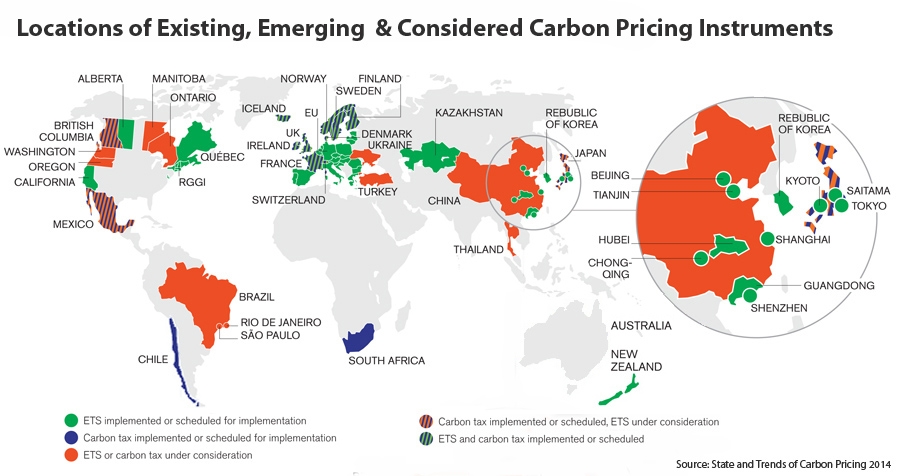

Lawmakers who oppose taking action to lower greenhouse gas emissions by putting a price on carbon often argue that doing so would hurt businesses and consumers. But the energy policies adopted by some American states and Canadian provinces demonstrate that those arguments are simply unfounded.

Around the world, nearly 40 nations, including the 28-member European Union, and many smaller jurisdictions are engaged in some form of carbon pricing. In this hemisphere, British Columbia, Quebec, California and nine Northeastern states have raised the cost of burning fossil fuels without damaging the economy. Alberta, Canada’s biggest oil and gas producer, and Ontario have said they will adopt similar policies.

Carbon pricing comes in two forms: a direct tax on emissions or a cap on emissions. British Columbia, for instance, has levied a tax on emissions from fuels like gasoline, natural gas and heating oil. California and Quebec, which are working together, place a ceiling on overall emissions and allow utilities, manufacturing plants, fuel distributors and others to buy and sell permits that entitle them to emit greenhouse gases. Like the cap itself, the number of permits decline over time, becoming more expensive.

Many economists regard carbon taxes as the simpler and more elegant solution, and cap-and-trade systems like the one that failed in the United States Congress as complex and hard to explain. But both systems effectively raise the price of using fossil fuels, which encourages utilities and other producers to generate more energy from low-carbon sources like solar, wind and nuclear power.

British Columbia, which is home to 4.7 million people, has placed the highest price on emissions in North America, taxing a ton of carbon emitted at 30 Canadian dollars, or about $21. By comparison, emission permits in California and Quebec are trading at about $13 a ton. And permits sold for $7.50 a ton in a December auction in the Northeastern trading system known as the Regional Greenhouse Gas Initiative. That system covers emissions from power plants in nine states that include Connecticut, New York and Massachusetts.

British Columbia started taxing emissions in 2008. One big appeal of its system is that it is essentially revenue-neutral. People pay more for energy (the price of gasoline is up by about 17 cents a gallon) but pay less in personal income and corporate taxes. And low-income and rural residents get special tax credits. The tax has raised about $4.3 billion while other taxes have been cut by about $5 billion. Researchers have found that the tax helped cut emissions but has had no negative impact on the province’s growth rate, which has been about the same or slightly faster than the country as a whole in recent years.

Meanwhile, jurisdictions using the cap-and-trade approach like California, the nine Northeastern states and Quebec are investing the revenue generated by auctioning emission permits in mass transit, energy efficiency, renewable energy and other strategies to reduce carbon emissions. Some of the revenue is also dedicated to helping low-income families cope with higher energy costs.

In recent months, the leaders of Ontario and Manitoba said they would join the California-Quebec cap-and-trade system. In October, Gov. Andrew Cuomo of New York said he was interested in linking the Northeastern system to the California-Quebec trading platform.

In Alberta, a new government announced in November that it would impose a tax of 30 Canadian dollars on most greenhouse gas emissions by the start of 2018. The province’s leaders also said they would phase out the use of coal power plants and impose caps on carbon and methane emissions from Alberta’s oil and gas industry.

These actions deserve applause. But their real value may lie in providing a template for the rest of the world. Broad participation is essential to keeping warming below a point of no return; as a practical matter, it is also essential to keep companies from moving their operations to nations that do not impose a cost on carbon emissions.

In that context, China’s announcement last year that it would set up a national cap-and-trade system was hugely encouraging — the world’s largest emitter agreeing to tax itself to help solve a problem that, only a few years ago, it barely acknowledged. Yet Congress has refused to act even as it becomes clear that putting a price on greenhouse gas emissions is the most direct and cost-effective way to address climate change.

Wednesday, December 16, 2015

2121. Thomas L. Friedman: To Fight Climate Catastrophe Put a Price on Carbon

By Thomas L. Friedman, The New York Times, December 15, 2015


PARIS — I had low expectations for the U.N. climate meeting here and it met all of them — beautifully. I say that without cynicism.

Any global conference that includes so many countries can’t be expected to agree on much more than the lowest common denominator. But the fact that the lowest common denominator is now so high — a willingness by 188 countries to offer plans to steadily and verifiably reduce their carbon emissions — means we still have a chance to meet what scientists say is our key challenge: to avoid the worst impacts of global warming that we cannot possibly manage and to manage those impacts that we can no longer avoid. That is a big, big deal.

Many leaders had a hand in it, but it would not have happened without the diplomacy of President Obama and John Kerry.

Hat’s off, because this keeps alive the hope of capping the earth’s warming to 2 degrees Celsius, or 3.6 Fahrenheit, above the level that existed at the dawn of the Industrial Revolution — the rough redline scientists have drawn beyond which “global weirding” will set in and the weather will most likely get really weird and unstable. We’re already almost halfway to passing that redline.

The only important holdout in the world to this deal is the U.S. Republican Party. I wouldn’t care about such cave men — as one sign borne by a Paris demonstrator said, “Dinosaurs didn’t believe in climate change either,” and it didn’t end well for them — except that one of these knuckleheads could be our next president and mess this up.

The G.O.P. should take the wise counsel of Andy Karsner, who was George W. Bush’s assistant energy secretary and one of his climate negotiators, and use the Paris deal to build a bridge back to constructive engagement on the subject. The G.O.P. can plausibly argue, said Karsner, that it was Bush who, in 2007, created the “major economies” strategy to address climate change through precisely the kind of market-enabled, voluntary national targets adopted in Paris.

“The price of getting this issue behind us may never again be this cheap,” Karsner said of the G.O.P. “Congressional leaders need to evaluate the opportunity they have to reconnect with mainstream voters, scientific, civic and business leaders, geopolitical strategists and most anyone under 35 years old who’s completed eighth-grade science.”

With the earth on pace to add two billion more people by 2050, who will all want cars and homes, and with scientists saying the only way to stay below the 2 degrees C redline is to phase out all fossil fuels by roughly the same date, there is only one force big enough to do that — to take on Mother Nature at scale — and that’s Father Greed, a.k.a., the market.

What will make this deal epochal is if the U.S. and China now lead the world in imposing a price on carbon, because only that will take to scale the already significant technology breakthroughs that have happened with wind, solar, batteries, energy efficiency and nuclear power.
Some in the November 21 climate rally and march in Oakland. California, called for putting a price on carbon.

“In the last six years,” said Hal Harvey, C.E.O. of Energy Innovation, a policy research group, “solar prices have dropped by more than 80 percent, and now cost less than a new coal plant. Wind is down 60 percent, and LED lights more than 90 percent.” With other new technologies near at hand “it becomes clear that a clean future costs no more than a dirty one,” he said. “Texas now has the most wind installed of any U.S. state. Texas!”

Harvey’s team has built a computer model to see which policies can decarbonize the economy at the lowest price. It lets a user test varying policy options on climate, pollution and the economy. If you pick the right blend, the results will have you grinning. Go online, at www.energypolicy.solutions, and try it for yourself.

The point, said Harvey, is that today’s chief executive doesn’t “have to be a hero anymore” to invest in clean power.

Indeed, José Manuel Entrecanales, chairman of Acciona, the giant Spanish renewables company, told me that he used to be sprinting alone in the race to install renewables “with the wind in my face.” But now he finds the wind is at his back, and some of the biggest oil companies are trying to muscle into the race. That is not an accident, he said, considering that recent deals from Morocco to South Africa to Chile were struck for around 2.8 cents a kilowatt-hour of wind and 4.2 cents a kW-h for solar, making them highly competitive with fossil fuel.

“In Chile,” said Entrecanales, “there was [just] an auction which was technology agnostic, so the government was offering big bunches of energy to be supplied over the next 10 years, 20 years, and all the energy awarded was renewable. Not one single megawatt hour of conventional energy was supplied.”

But, he stressed, leveraging the Paris consensus to get a price on carbon in the big emitting countries is the “Holy Grail,” the thing that tips everything. Because while renewables can win against new fossil fuel plants, old fossil fuel plants built without any pollution control, and with all their capital expense amortized and still enjoying subsidies, can still run very cheaply — if you don’t count their massive carbon impacts.

A price on carbon, said Entrecanales, “would drive technology, it would drive R&D, it would drive investment, it would drive consumer habits.” So Paris was necessary. A price on carbon will make it sufficient.