Showing posts with label Cap-and-trade. Show all posts

Thursday, September 15, 2016

2443. Americans Appear Willing to Pay for a Carbon Tax Policy

By Michael Greenstone, The New York Times, September 15, 2016
Climate march in Sydney, Australia
The stumbling block in Congress for confronting climate change has perpetually been the economic challenge. There has been little support for paying to reduce greenhouse gas emissions.

But now, there is some evidence of a quiet undercurrent of support for a carbon policy, whether it be a tax, cap-and-trade or regulations.

The Energy Policy Institute at the University of Chicago (EPIC) — which, in full disclosure, I direct — and The Associated Press-NORC Center for Public Affairs Research released a poll Wednesday on how Americans feel about various issues related to climate and energy.

One of the questions looked at willingness to pay for a carbon policy. The results, on the surface, are not very encouraging to any of its advocates: 43 percent of Americans aren’t willing to pay anything to fund such a policy.

Most people would infer from this that putting a price on carbon is challenging. And, politically, it is. But buried in the polling data is a striking revelation: Many people are willing to pay real money for a carbon policy. In fact, on average, Americans appear willing to pay more than a robust climate policy is projected to cost.

Let’s take a look at the results of the poll. Respondents were asked if they would support a fee on their monthly electricity bill to combat climate change, and they were offered fees at various levels: $1, $10, $20, $30, $40 and $50. (Each household was asked about only one of these levels.) The responses were that 57 percent would pay at least $1; 39 percent would pay at least $10; 29 percent would pay $20; 24 percent would pay $30; 17 percent would pay $40; and 20 percent would pay $50.

Yes, 43 percent of the people surveyed said they were unwilling to pay even $1 per month, and that tells us something about the political challenges facing adoption of a climate policy. But the intensity of preferences of the other 57 percent also tells us something important.

Specifically, these responses can be used to infer how much people value addressing climate change. To give you a flavor of the approach, take the 39 percent of households that are in favor of at least a $10 fee and the 29 percent that are in favor of at least a $20 fee. Doing some back-of-the-envelope calculations, I find that 10 percent (39 percent minus 29 percent) of households would favor a fee between $10 and $20. I then assign the midpoint — $15 — to this 10 percent of the population. I carry this approach through for the rest of the responses.

The net result is that, on average, American households are willing to pay $15 to $20 per month more on their electricity bill. The $15 is a lower bound because it assumes that the entire 20 percent of respondents who accept at least $50 are willing to pay $50, while the $20 figure assumes that this group is willing to pay $75 on average.

The resulting average willingness to pay is higher than what the Congressional Budget Office estimated the Waxman-Markey cap-and-trade bill for greenhouse gas emissions would have cost households (economywide, not just for electricity) had it passed the Senate back in 2009.

There are some limitations to this exercise that are worth noting. It’s a hypothetical question, so people might like to think they might pay more than they really would. Even if this poll has accurately caught a measure of societal willingness to pay, it is not the same thing as how people or their elected representatives will vote.

What this finding does mean is that the possibility of a robust climate policy may not be as remote as the conventional wisdom suggests. The foundation for paying for such a climate policy appears quite strong — much stronger than I thought when we designed the survey.

The question that remains unanswered: If the economics are not as big a problem as we thought, then will the politics follow?

Tuesday, January 19, 2016

2161. Proof That a Price on Carbon Works

By The Editorial Board, The New York Times, Janauary 19, 2016


Lawmakers who oppose taking action to lower greenhouse gas emissions by putting a price on carbon often argue that doing so would hurt businesses and consumers. But the energy policies adopted by some American states and Canadian provinces demonstrate that those arguments are simply unfounded.

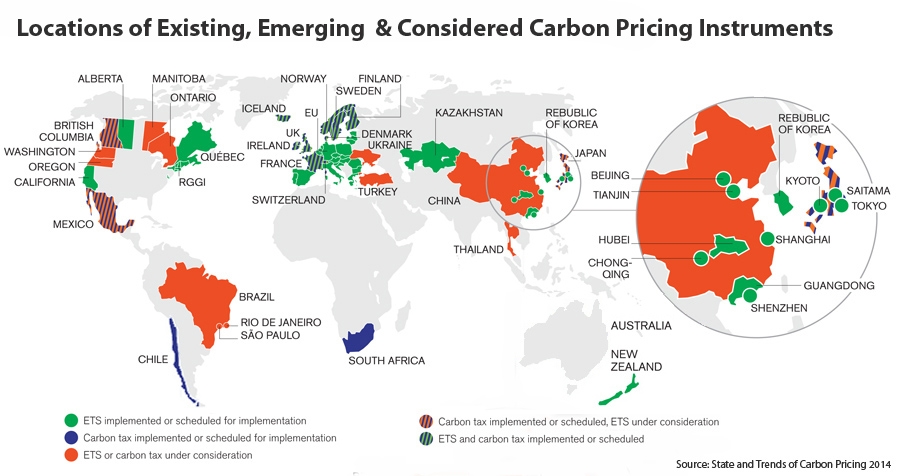
Around the world, nearly 40 nations, including the 28-member European Union, and many smaller jurisdictions are engaged in some form of carbon pricing. In this hemisphere, British Columbia, Quebec, California and nine Northeastern states have raised the cost of burning fossil fuels without damaging the economy. Alberta, Canada’s biggest oil and gas producer, and Ontario have said they will adopt similar policies.

Carbon pricing comes in two forms: a direct tax on emissions or a cap on emissions. British Columbia, for instance, has levied a tax on emissions from fuels like gasoline, natural gas and heating oil. California and Quebec, which are working together, place a ceiling on overall emissions and allow utilities, manufacturing plants, fuel distributors and others to buy and sell permits that entitle them to emit greenhouse gases. Like the cap itself, the number of permits decline over time, becoming more expensive.

Many economists regard carbon taxes as the simpler and more elegant solution, and cap-and-trade systems like the one that failed in the United States Congress as complex and hard to explain. But both systems effectively raise the price of using fossil fuels, which encourages utilities and other producers to generate more energy from low-carbon sources like solar, wind and nuclear power.

British Columbia, which is home to 4.7 million people, has placed the highest price on emissions in North America, taxing a ton of carbon emitted at 30 Canadian dollars, or about $21. By comparison, emission permits in California and Quebec are trading at about $13 a ton. And permits sold for $7.50 a ton in a December auction in the Northeastern trading system known as the Regional Greenhouse Gas Initiative. That system covers emissions from power plants in nine states that include Connecticut, New York and Massachusetts.

British Columbia started taxing emissions in 2008. One big appeal of its system is that it is essentially revenue-neutral. People pay more for energy (the price of gasoline is up by about 17 cents a gallon) but pay less in personal income and corporate taxes. And low-income and rural residents get special tax credits. The tax has raised about $4.3 billion while other taxes have been cut by about $5 billion. Researchers have found that the tax helped cut emissions but has had no negative impact on the province’s growth rate, which has been about the same or slightly faster than the country as a whole in recent years.

Meanwhile, jurisdictions using the cap-and-trade approach like California, the nine Northeastern states and Quebec are investing the revenue generated by auctioning emission permits in mass transit, energy efficiency, renewable energy and other strategies to reduce carbon emissions. Some of the revenue is also dedicated to helping low-income families cope with higher energy costs.

In recent months, the leaders of Ontario and Manitoba said they would join the California-Quebec cap-and-trade system. In October, Gov. Andrew Cuomo of New York said he was interested in linking the Northeastern system to the California-Quebec trading platform.

In Alberta, a new government announced in November that it would impose a tax of 30 Canadian dollars on most greenhouse gas emissions by the start of 2018. The province’s leaders also said they would phase out the use of coal power plants and impose caps on carbon and methane emissions from Alberta’s oil and gas industry.

These actions deserve applause. But their real value may lie in providing a template for the rest of the world. Broad participation is essential to keeping warming below a point of no return; as a practical matter, it is also essential to keep companies from moving their operations to nations that do not impose a cost on carbon emissions.

In that context, China’s announcement last year that it would set up a national cap-and-trade system was hugely encouraging — the world’s largest emitter agreeing to tax itself to help solve a problem that, only a few years ago, it barely acknowledged. Yet Congress has refused to act even as it becomes clear that putting a price on greenhouse gas emissions is the most direct and cost-effective way to address climate change.