Showing posts with label History. Show all posts

Sunday, November 28, 2021

3555. On David Graeber and David Wengrow's New History of Humanity


By Justin E. H. Smith,
Justin E, H. Smith Hinternet, November 14, 2021

1.

I have seen many things (corpses, the Northern Lights, a beached whale), but a few sights have left a particularly vivid impression. One is of a boy I spotted in Istanbul eighteen years ago. He was fifteen or so, with a pathetic whispy moustache, wearing a suit for what appeared to be the first time. We were in the textile district of Zeytinburnu, and it seemed to me he was likely beginning a new life in his father’s small business, though I could be wrong. Whatever the occasion, the boy had deemed fitting to commission the labor of an even smaller boy, nine years old or so, to shine his shoes. The shoeshine kid was kneeling on the ground, scrubbing away with rags and polish from his portable kit, a borderline-homeless street gamin for whom all of our rhetoric about the sacred innocence of childhood means nothing at all. The fifteen-year-old stared down haughtily, like a small sovereign, and the nine-year-old, knowing his place, did not dare even to look up.

Such is the way of the world, our collective, complacency-inducing clichés invite us to think on such occasions. Curiously, such a thought comes to us most naturally when we are observing an instance of domination as it were from above. The haughty kid dared to look down on the lowly kid, and yet if he had noticed he was being observed his haughtiness could quickly have curdled into shame. The further haughtiness of the ultimate obsever, in turn —in the event, me (as far as I know I was not being observed myself)— seems to arise from the passive and prejudicial presumption that the world of Turkish textile merchants and their sons is somehow a more accurate approximation of the mythical state of nature than what we are used to seeing in, say, a fast-food drive-through or a CostCo self-checkout.

But this is of course an illusion. The fifteen-year-old was channeling particular historical forces that pressed down upon him unawares, and that are far less distinct from anything I do at a Starbucks, with all the historical forces that press down upon me, than they are from the actions of a Paleolithic mammoth hunter or a New Guinean hunter of heads. The boy had perhaps seen his father humiliated by creditors; his father had perhaps humiliated him in a similar way; and now the boy was just passing the humiliation downward along the great chain of social being. This chain however is one that is ultimately formed by capital, by debt, by sedentism, by the state tyranny of which domestic tyranny is to some extent only a microcosm, and by a number of other factors that place even the most brazenly lupine behavior of man towards man in quite a different context than the state of nature. No, that’s entirely the wrong frame of reference.

2.

What people then may we more veridically hold up as living in such a state? The Sakha people of the Lena river basin in northeastern Siberia, whom I’ve come to know rather well, both through books and through people, over the past years, appear to be a splinter group that settled in this extreme climate region in the middle ages in order to evade the tyranny of the rising Mongol Empire. Mongol tax collectors couldn’t be bothered to enter the coldest inhabited region on earth, and so the newly formed Sakha ethnie in turn adapted to the new exigencies of life and lived in relative freedom from outside domination, though with a complex hierarchy from within. They had advanced metallurgy, a revered warrior class with armor and swords, and four to five months of seasonable temperatures each year that enabled them to build their economy around livestock. Those who went even further north however, perhaps to escape not just Mongol domination but domination from within by their fellow Sakha, largely adopted the geographically determined lifeways of the Indigenous Tungusic (e.g., Evens and Evenks) and Paleo-Siberian (e.g., Yukaghir) peoples: reindeer husbandry, in particular, but also seal-hunting and other circumpolar forms of subsistence common also to Greenland and Canada. At the same time as some Sakha were arriving from the south and taking on Arctic habits, socially marginal ethnic Russians were arriving from the west and doing the same, leading to a convergence in forms of life across people with different phenotypes and different historical trajectories that brought them into the same region and into the same destiny.

Who among these groups is “Indigenous”? We might in this case feel this is the wrong question to ask, but this feeling may in turn help to prime us for the further realization that the encounter zone of the Slavic, Turkic, Tungusic, and Paleo-Siberian peoples is in fact fairly representative of every corner of the inhabited globe, even those we take to be the most hermetic and (therefore?) the most pristinely representative of humanity in its original state. In their half-posthumous new book, the anthropologist David Graeber (1961-2020) and the archeologist David Wengrow (1972-) suggest that “even” the pre-contact Amazonian groups we generally take to conform most closely to the definition of “tribe” or “band” were likely aware of the Andean empires to their west, and may also have had, at an earlier time, relatively complex state structures that they consciously abandoned because they were lucid enough to come to see these as inimical to human thriving. The groups Europeans first encountered in the rainforest, in other words, may also have been splinters that broke away from tyrannies, just like the Sakha fleeing the Mongols, and to some extent also like the Mountain Time Zone libertarians grumbling about the tax agents from the mythical city of Washington.

It may be that more or less all societies that appear to us as “pre-state” would be more accurately described as “post-state” — even if the people who constitute them are not in fact fleeing from the center to the margins of a real tyranny, they are nonetheless living out their statelessness as a conscious implementation of an ideal of the human good. Even if they have not observed Inca ceremonies through the forest thicket from across a mountain ravine, they already know enough about tyranny simply from the expression of innate personality tendencies of individual members of their group —boastfulness, bullying, pride—, and have developed rational mechanisms to ensure that these traits are countered by ridicule, dismissiveness, and other mechanisms that keep any would-be tyrant in his place.

This is the sense of Pierre Clastres’s “society against the state”: societies that lack state structures are not in the “pre-” stage of anything, but are in fact actively working to keep such structures from rising up and taking permanent hold. They do this to differing degrees, with many societies around the world exhibiting a sort of seasonal duality in which they are subject to tyranny during the months of the buffalo hunt or the rainy season or the period of potlatch or inter-clan commerce, and then the hierarchy dismantles itself again and they all become as it were “anarchists in the off season”. As Graeber and Wengrow write of the Kwakiutl of the Pacific Northwest:

[I]t was winter —not summer— that was the time when society crystallized into its most hierarchical forms, and spectacularly so. Plank-built palaces sprang to life along the coastline of British Columbia, with hereditary nobles holding court over compatriots classified as commoners and slaves, and hosting the great banquets known as potlatch. Yet these aristocratic courts broke apart for the summer work of the fishing season, resorting to smaller clan formations — still ranked, but with entirely different and much less formal structures. In this case, people actually adopted different names in summer and winter — literally becoming someone else, depending on the time of year.

3.

On the authors’ telling, it is really only in the 1950s and ‘60s, with the quantitatively precise work on daily calorie intake and other such measurables spearheaded by such anthropologists as V. Gordon Childe (1892-1957), that the idea of “man the hunter” took hold, and the default setting of the species was taken to be a seasonally invariant, efficiency-maximizing, and culturally lifeless prehistory. When “man” in “his” “natural” condition is determined to be doing but one thing, a basic flexibility between forms of life, adaptability to both expected seasonal variation and to longer-term unforeseen changes, become correspondingly less salient for research. And when these are screened out, the narrative of monolithic unidirectional progress from bands to states becomes vastly easier to maintain.

In their opposition to this narrative, Graeber and Wengrow are building most immediately on the crucial work of James C. Scott, who has shown that repeatedly and in several different places in human “pre-history”, societies reverted from agriculture back to hunting and foraging, that they did so by choice, and that for several millennia farming existed alongside other viable forms of subsistence in the absence of any well-defined state structure with all its usual indices of inequality. This adaptability should not be at all surprising, given that there are many societies still in existence that alternate seasonally between sedentism and nomadism, as they move their grazing animals up and down in elevation in harmony with changing patterns of vegetation. But the prevailing view is that there can be no states without sedentism, and that states succeed bands as a “higher” stage of development, and that therefore transhumance must be some sort of “transitional” stage on the way to finally “settling down”. The part of the year that is spent wandering complicates the narrative of sedentization that is presupposed by the narrative of progress from bands to states.

And in fact we don’t even need to look as far as semi-nomadic pastoralists; until very recently it was common in Western Europe to “flip” the social order every now and then, in a way that was also determined ultimately by the cycles of the agrarian calendar. When things went à rebours for a limited time, nobodies got to act like kings, and sometimes kings had to submit to humiliation by nobodies, even allowing psychopaths and criminals to sit in the throne and to act the part for a time (or more specifically, people socially recognized as psycopaths and criminals, as the real king may in fact be both of these things himself, even if this fact is ordinarily only acknowledged sotto voce). We know the last dregs of such reversals from festivals such as Carnival or Halloween, which have something to do with popular religion, but are also periodically supressed in the name of that same religion when the lines of its authority have become blurred with those of the state.

In other words, even absolute monarchies with fully sedentary subjects have been known to practice anarchy “for a limited time only”: controlled anarchy that is both in the service of the state but also a full-fledged parallel reality, like dreams or story-telling, anarchy that continues to exist alongside or in alternation with the state. It is only in the most recent era of totalization of civic life —where some of us now have eyeball-tracking software that follows our faces eight-to-ten hours a day as we work from “home” in order to ensure that we aren’t doing anything anarchic on company time— that this parallel reality has been monitored and administered out of existence, or at least reduced to the hours of sleep, in which we just can’t do otherwise than hallucinate a topsy-turvy world, and the state so far has not been able to come up with a way to stop us.

4.

When the “quants” such as Childe took over a certain portion of the discipline, they left the interpretation of culture to those anthropologists who welcomed a corresponding retreat from any claim to scientificity. An earlier generation of work in cultural anthropology, notably the rich legacies of Marcel Mauss (1872-1950) and Franz Boas (1858-1942), helped to solidify the long-dominant narrative according to which the history of humanity is a progression from pre-state to state-based societies, and that where there are states there is also inequality, but this equality is compensated by a leisure of the mind that is more conducive to creativity and to the efflorescence of material and symbolic culture. Meanwhile hermeneuticists like Clifford Geertz (1926-2006), having retreated from any claim to the sort of authority that can tell you “how things really were”, to invoke the positivist definition of historical research offered by Leopold von Ranke, were in no position to dispute the claims of the quants.

While Mauss and Boas had been sensitive to the ultimate arbitrariness of cultural expressions —in the end, people do stuff because they want to, not because it maximizes calorie efficiency or body-surface heat-dispersal or some such thing—, late-twentieth-century scholars such as Childe came to treat human “prehistory” as if it were a branch of engineering. This is very much in line with the reigning behaviorism of the era (to which Chomsky dealt a fatal blow as early as 1959, though the methods and biases remained broadly entrenched across all the disciplines with an interest in what it is to be a human), and ironically it ended up eliminating from view among human societies the very sort of diversity and creativity (add scare-quotes according to taste) that evolutionary theorists continued to recognize among biological species: we kept right on observing island dwarfism right alongside island gigantism, for example, or bright patterns on one species’ skin offering a “dishonest signal” of toxicity, inhabiting the same ecosystem as another related species that instead uses camouflage to avoid getting eaten.

There is no single efficiency-maximizing formula at work in such cases. Sometimes, when isolated on an island, a population of animals will get really big; sometimes it will get really small. Both directions can do a fairly good job of helping it survive. Similarly, one group of Inuit may exhibit “reverse seasonality” in relation to its neighbors, crystallizing into an elaborate hierarchy in winter, and dispersing into “anarchism” in the summer, while the others do the opposite. Some hierarchical societies measure a person’s place in the chain of social being by how much wealth that person has permanently hoarded; others require anyone who seeks a high rank to hoard only temporarily, and soon to give it all away, potlatch-style, in a ritual of ceremonial magnanimity. Such a person is not “generous” — he’s just doing what he has to do to stay on top, according to the specific rules of the game that have taken hold in his cultural context and that cannot possibly be rationalized from the outside in terms of energy efficiency or any model of rational agency familiar to economists.

 5.

Our inability to conceive of pre-modern peoples as existing all along in complex networks of long-distance exchange, as defining themselves against one another through what Gregory Bateson (1904-1980) called “schismogenesis”, as knowing what states are even when they construct and maintain their societies “against the state”, has as its corollary an equally handicapping inability to exercise the historical imagination in a way that fully appreciates the individual humanity of those who inhabit the deep past.

We know that anatomically modern humans have been around for 100,000 to 200,000 years, while we find little evidence of symbolic thought until roughly 40,000 to 50,000 years ago. This could be a mere result of not looking in the right places, or of the eventual return to nature of all artificial constructions. But still most still agree that something changed in the Paleolithic and that human beings began to externalize their inner lives in new ways. Yet we also know that any anatomically modern person has by definition the same brain we do, and while some theorists have speculated on late-stage “mutations”, some as recently as 3,000 years ago, that brought about a sudden propulsion forward in our capacity for abstract thought and our “transcendental” apprehension of our own selfhood, a generous interpretation has to suppose that any AMH’s life mattered as much to that AMH as your own life matters to you, even if she was not manifesting this mattering through woven fabrics, a sharp sense of fashion, or a proliferation of selfies. Same brains, same subjectivities — even through wildly different cultural expressions.

Perhaps Graeber and Wengrow’s most affecting accomplishment lies not so much in their new “theory” of the human past, which in any case is only a synthesis of already existing research, as rather in their sympathetic plaidoyer for the singular reality of lives lived in the past, their commitment to the idea that these were real people, as weird and idiosyncratic and unfathomable by quantitative methods as you and I. The alternative view is Hobbesian by default, and it is overwhelmingly more popular in our culture. I go to the Whole Foods with my elderly mother, and she looks at the produce section: “Aren’t we lucky to live in this era,” she says, “when there is such a variety and abundance of foods. It really enables us to enjoy it all, rather than just to survive.” This is a sort of entailment from the hypothesis that life before the state was “nasty, poor, brutish, and short”, an existential condition in which, we ordinarily presume, no one had the “luxury” of preferring one food over another, of ever getting their “favorite” for supper.

Yet we know of no human culture that does not have strict rules about what may be eaten, no culture that outside of periods of famine does not have a long list of perfectly edible species of animal that they nonetheless categorically refuse to eat, no culture that fails to organize itself around preferences enshrined into a scheme of values. “Aren’t we lucky to be here at this festin à tout manger,” every Cree who ever got to participate in an “eat-all feast” is likely to have thought or muttered aloud, each perhaps content with the piece of beaver meat doled out to him in accordance with his social rank, or perhaps aspiring to eat the brains out of the skull some day like the chiefs do, but either way experiencing a condition of abundance and leisure at least as intense as that known by any Whole Foods shopper.

Leisure, like calorie consumption, is something that can be measured from the outside, and the anti-Hobbesian descendants of Jean-Jacques Rousseau, for whom man was born free but is everywhere in chains, have long attempted, as in Marshall Sahlins’s magnificent Stone Age Economics of 1972, to show that through our successive revolutions in agriculture and industry leisure has progressively given way to labor as constituting the principal part of human life. It may be true that hunter-gatherers (as they used to be called) engaged in no more than four hours of “work” per day and dedicated the rest of their time to leisure activities, as Sahlins contends. But this neo-Rousseauian estimation is generally proferred in the same spirit in which we talk about the daily cycles of the lives of lions or koalas — to mention just two other species that spend most of their time sitting around. What is lost is the “why” of the leisure, the fact that all those people were sitting around not just because it is their species-specific condition to do so (though perhaps that too), but because they like to do so, because it is “fun”.

6.

It’s a weird thing to have to insist on: that there is something that it was like to be a member of the prehistoric leisure class, which is to say to have been a prehistoric human being. Graeber and Wengrow’s reanimation effort for past humans echoes the former author’s earlier plaidoyer for currently living poor humans, notably in his magnum opus Debt: The First 5,000 Years (2011). In order to have a big wedding blowout, poor people might have to take out loans against which any rational financial advisor would sternly counsel them. Yet they just keep doing it, going into debt, wearing ruffled blue tuxedoes, and loving one another as much as any human being has ever loved another. That’s culture against credit, so to speak. In the course of a mortal life, a good wedding matters more than good credit; poor people have generally been able to keep this in mind whereas upstanding accountants have forgotten it.

A wedding is a ritual enactment of mythical, world-structuring motifs, and to this extent it is a form of heaven on earth, along with all the other high-ceremonial occasions for music, dance, and heightened speech. This is the stuff people live for. We know from the discovery of windholes drilled into an avian femur that even before the arrival of AMH’s in Europe, Neanderthals were performing music, and thus also, presumably, engaging in forms of ceremonial ecstasy during which the imaginations of all participants must have been fully activated and alive. Such ecstatic joy as a basic mode of existence is of course hardly compatible with the “nasty, poor, brutish, and short” scenario. It is also, curiously, an experience that typically is not acknowledged when affluent “thought leaders” and policy makers turn to consider the lives of the living poor.

In this case as in the case of our prehistoric conspecifics, what we are witnessing is dehumanization. The two make a natural pair, as both are symptoms of the general ideological delusion that bourgeois modernity is the only way to go, and anyone who fails to do bourgeois modernity right must be to some degree “poor-in-world”, as Heidegger said of animals, must really not have that much “going on in there”. Graeber spent his life combatting this conceit on all fronts, and was lucid enough to understand that it is a unified project. Many who defend the poor against the predations of the rich might imagine it’s not exactly a pressing matter to reconstruct what the lives of Paleolithic peoples were really like. But Graeber and Wengrow’s accomplishment in this book is to show how, in prejudice too, ontogeny recapitulates phylogeny, or, rather, the way in which the social reproduction of inequality with each new generation has something to do with our presumption of progress, which is to say our presumption of the inequality, the not-quite-humanness, of our ancestors in relation to us. The past is not so much a foreign country, as it is an Indian reservation, where, if it looks from the outside like the inhabitants are not thriving, one has the convenience of imagining that this is because they don’t know what thriving is.

7.

But if prehistoric people were like us, as Graeber and Wengrow insist they were, it also follows that they were not like each other, since we are ourselves, among the living, not like one another. The authors are particularly sensitive to the past existence of “anomalous” individuals, both those who have some special social distinction in view of physical abnormalities such as albinism or blindness, and those who are simply characterologically quirky in a way that marks them out for a special social role as a shaman, a prophet, a seer — as someone who is permanently in touch with a parallel reality that the average run of people is able to access only through ritual, if at all.

Contrary to the common idea that such people were typically eliminated through euthanasia or otherwise neglected until they perished, the archeological record clearly shows that they were often accorded special treatment. Many of the earliest evidence we have of ritual burial yields up skeletons of people who had evident deformities. This is likely not because skeletal deformities were common, and postmortem taphonomic deformation can also be ruled out. The simplest explanation is that these people were buried because they were revered, an explanation that at the same time does away with the idea that the earliest burials are at once evidence of the earliest emergence of social inequality. While the skeletons are often found adorned with riches and what might be interpreted as “royal” accoutrements such as antler crowns or sceptres carved from mammoth ivory, we know plainly that the deformities of those who have been buried are not hereditary, and thus that their special status in society could not have been traduced down to them across the generations through noble lineage.

What would it have been like to have been anomalous in prehistory? You would probably still enjoy stories and music (though there were also no doubt some reserved and awkward people who shied away from communal activities), but you would be exempted from typical adult responsibilities, and expected mostly just to “do your thing”. Graeber and Wengrow vividly imagine a prehistoric epileptic who passes his days “hanging upside down while arranging and rearranging snail shells”, the patterns of whose arrangements are attended to by his loved ones and neighbors, who keep him well fed and shower him with affection. They might have thought the snail-shell patterns literally held cryptic messages passed down through the epileptic man from another plane of reality; they might just have thought that the man is better off when he’s left to do what makes him comfortable, and if we are sensitive to his comfort, to what he’s muttering, under what circumstances, we might be better able to take the measure of our own well-being. The truth is probably somewhere in between, just as it always is when we are trying to determine whether some unfamiliar conduct is an instance of practical rationality or rather of natural magic.

8.

Graeber and Wengrow’s return to grand anthropological theory in the vein of Boas and Mauss parallels a similar return in the work of Philippe Descola. Like the French proponent of the “ontological turn”, they are notably at ease with the methodology of recovering Indigenous voices from European sources. One must of course read historical sources, written by Europeans implicated in their individual ways in the centuries-long process of conquest and domination, with considerable caution. But to suppose that these sources trap the reader as well in the same colonial “gaze” as the author, is to give up too easily and retreat into skepticism. Descola is prepared to say that travel reports from early modern Brazil, even the ones that portray sheer cannibalistic brutality as in the famous engravings of Hans Staden, tell us at least something about the form of life prevailing in that place in the early contact period. When reports consistently echo similar themes across several different European languages and multiple generations of trans-Atlantic encounter, it is reasonable to presume the Europeans were identifying something real, even where that real thing is filtered through ungrounded contempt.

Graeber and Wengrow are prepared to go much further than Descola, and to see real elements of American social reality filtering into European texts from the sixteenth to the eighteenth centuries, even where no direct encounter is being related, and even sometimes where the author himself recognizes the work as a pure product of his own imagination. This is most of all the case in the European “discovery of freedom” via the Americans. According to Graeber and Wengrow, while by the time of Rousseau the people living in a purported “state of nature” are mostly of interest in view of what they can tell us about the origins of inequality, for roughly the first two hundred years of encounter what was of primary interest was not the apparent equality of les naturels, as Americans were often called by the French, but rather their freedom, their ability to live according to their individual desire without fear of repression.

In his remarkable book Native Pragmatism: Rethinking the Roots of American Philosophy (2002), Scott L. Pratt makes a convincing case that early American philosophy was forged through significant cultural exchange between colonists, missionaries, and Native Americans, with those on the European side often compelled to learn Native languages and to restructure their conceptual schemes in accordance with what is sayable in, say, Iroquois or Naragansett. Graeber and Wengrow revisit this argument, and add also that it was not just in the acquisition of languages, but most importantly in adopting the free deliberative and discursive practices that constituted the social “glue” and obviated any need for explicit systems of punitive justice in many Native American societies. This sort of deliberation would filter into such familiar colonial American settings as the Quaker meeting hall, and more generally would come to force freedom into European consciousness as an ideal.
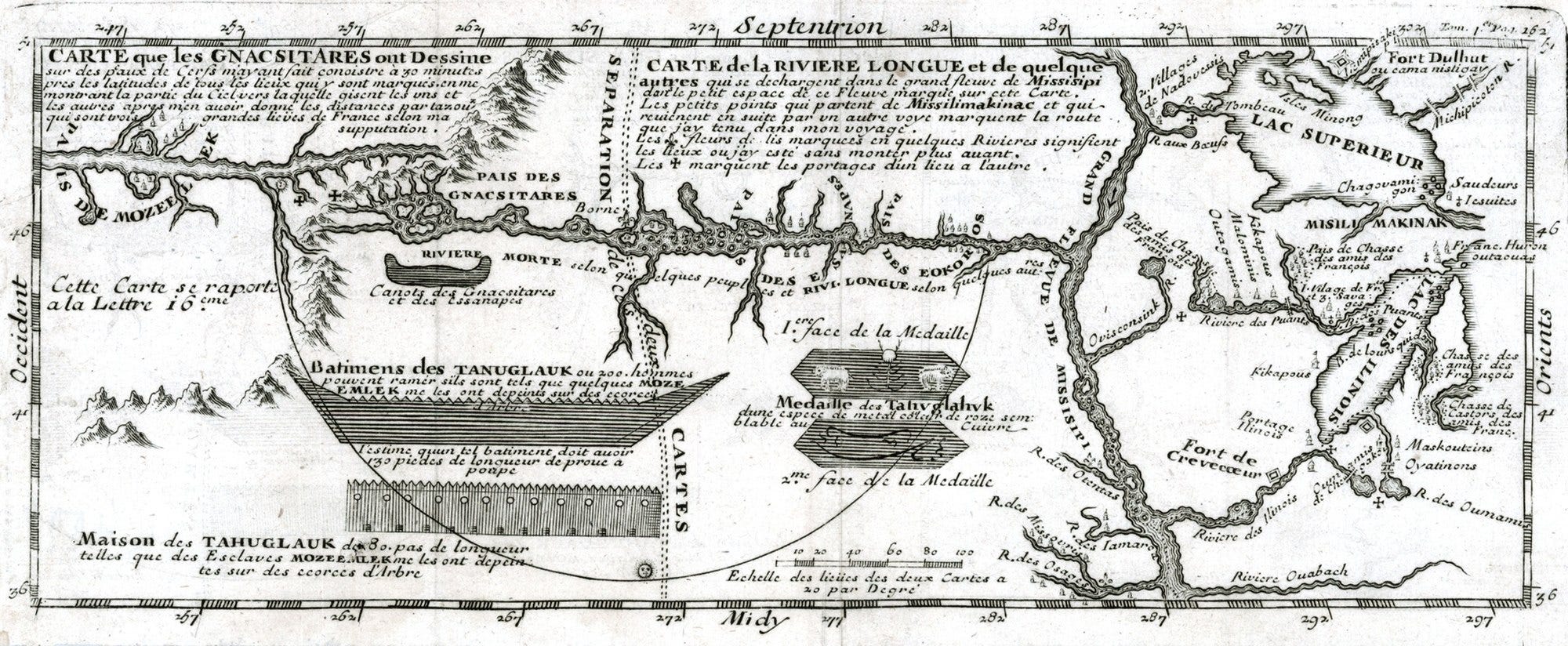
The authors draw our attention in particular to a certain Kondarionk (c. 1649-1701), a Huron elder who may have engaged in lengthy dialogical exchange with the French traveler Louis-Armand de Lom d’Arce de Lahontan (1666-1716), who wrote in his later life in Amsterdam the Dialogues avec le sauvage Adario (aka Kondarionk) describing the views of the Native chief he had known at Michilimackinac, a region of what is today called Michigan. It is certain that there is a real Kondarionk, but how faithful Lahontan’s representation of his views is remains a matter of pure speculation.

One common view, which we see in the work of Jean-Pierre Vernant, is that in the early modern period Europeans, and particularly French authors such as Pierre-François-Xavier de Charlevoix (1682-1761), began to cast the Indigenous people of eastern North America in the role of political philosophers, in view of a perceived analogy between their “primitive” condition and the “pristine” or elemental structures of Old World society that had arisen in antiquity but had long since slipped away: thus, America as a window onto Europe’s past. Graeber and Wengrow however, like Descola, reasonably suppose that there was not only this sort of projection, but also a considerable amount of bidirectional flow of cultural practices, norms, and ideals. This “flow” may be more evident in French colonial history than in the English case. It sounds untimely to put it this way, but it is clear to anyone who reads the primary sources that the French sank more deeply into the American continent, in a transformation comparable in its thoroughness to that of the Yakutized Russians of the Taimyr Peninsula, than those who would eventualy usurp them in all but a single Canadian province. Until recently there was a lingering French dialect community in Michigan that spoke what was known as “Muskrat French”; “Kondarionk” in turn is a Huron word for “muskrat”, and the Huron chief was sometimes known in French simply as Le Rat. The French language would “rebrand” as one of supremely urban-centered universalism by the late eighteenth century, but when Lahontan and Kondarionk discoursed, it seemed natural to do so in French, in the wetlands, in the company, and perhaps in the imagined likeness, of the rat musqué.

The verisimilitude of Lahontan’s depiction may seem threatened by the fact that his Kondarionk speaks mostly in clichés, familiar already in Michel de Montaigne’s essay “On Cannibals”, and still a common rhetorical trope on the social-media-based lazy wing of the left, which loves nothing more than to play on the topsy-turvy trope of calling the United States a “failed state” that urgently needs election monitors sent from South Sudan, etc. Throughout these disparate expressions, the rhetorical aim is to show that “the real savages are us”, that, seen from an external point of view, European ideas about “justice”, and European tolerance of gross inequality, are more barbarian than anything encountered in the parts of the world to which the Europeans pretend to bring civilization. But this trope only makes sense if we are already familiar with, and inhabiting, the presumed default view according to which Europe represents civilization, and Americans (for example) represent savagery. If you aren’t already presuming the accepted view, suggesting that South Sudan send election monitors to the US doesn’t sound like a powerful rhetorical inversion; it just sounds like a bad idea.

The tropes that Kondarionk channels are in turn put in the mouths of countless other species of foreigner over the course of the eighteenth century, notably in Montesquieu’s Persian Letters, where the outsiders, far from being American savages, are simply the proximate neighbors of Europe from the Muslim world, which is fully acknowledged to be a center of great civilizations and to share the same points de repère of Europe and of Christendom in, for example, Greek philosophy and in the revealed scriptures of the Abrahamic faiths. In light of this fashion for inversion in European Enlightenment texts, conjuring up exotic franc-tireurs not only from the pre-state Americas but also from the “Oriental despotries”, it seems even more of a stretch to suppose that Lahontan’s effort to “look in from without” may be traced back to the real views of a particular Native American political philosopher named Kondarionk. The half-Inca half-Spanish author Garcilaso de la Vega (1539-1616), writing in sixteenth-century Spain, whom Graeber and Wengrow do not mention, likely gives us something closer to a “political philosophy from the Americas”. But significantly the political system he happens to know best is not at all one of the “societies against the state” among which we might perhaps, with qualifications, include the Hurons; it is rather the Inca Empire, and the world that de la Vega depicts is sooner ripe for comparison with Plato’s vision of an ideal totalitarian regime than with any idea of a return to Edenic freedom.

Still, we are surely better off looking to Lahontan’s fictional Kondarionk, along with any other sources we can get our hands on, in order to come to as full a picture as possible of the “Columbian exchange of light”, of the full cultural impact in Europe of the encounter with Americans over the first 250 years or so, than we are simply dismissing a work such as this out of hands on the grounds that it is nothing more than an ideological construct and a sheer fantasy. We still need to know why and by what influences authors such as Lahontan came to have the fantasies they did, and it seems certain that Kondarionk, or someone like him, played a role in this history. Graeber and Wengrow are to be credited for helping to relegitimize this necessary component of historical anthropology, which for better or worse is born out of the history of the missions and of early modern global commerce.

9.

Curiously enough in our aggressively presentist era, “big histories” of the world seem to be reliably popular. Yet until Graeber and Wengrow’s intervention, most of the people who tried their hands at this genre —which has its “scientific” origins in the cosmographical works of early modern authors such as Sebastian Münster (1488-1552), and which has always been, as Graeber and Wengrow acknowledge, its own sort of mythmaking about origins— have a scholarly formation that prepares them poorly for the undertaking. Steven Pinker is a psychologist, a field that hardly has any special grasp of how culture works, and that is no better equipped to understand methodological and epistemological challenges in reconstructing the distant past than is, say, structural linguistics. Jared Diamond is principally an ornithologist, and in his leap from the birds of New Guinea to the peoples of the earth, he makes considerable speculative errors. Yuval Noah Harari is some kind of “big historian” and a disciple of Diamond. What has been missing is the kind of expertise that comes from anthropology, which at its best straddles the boundary between hermeneutical art in its application to culture on the one hand, and on the other exact science, while sometimes slipping onto the one side of this divide and self-destructively disowning the other.

What anthropology is particularly well-suited to discern is the way in which culture works “against the state” (though of course not all anthropologists do so, and some even work directly for the state themselves, spinning out ethnographic narratives on Indigenous peoples that validate state encroachment on their lands and life-ways). This is because anthropology focuses on human beings, who, even when they live within state structures, continue to have carnivals, fail to pay their taxes, hide out in the borderlands, waste their money on weddings and go into debt. When the state attempts to incorporate new territories, sometimes it finds the inhabitants there totally indifferent to its efforts to get them to recognize it, as in Debt Graeber vividly showed with his example from French colonial Madagascar, where the French kept trying to give the Malgaches money, and the Malgaches kept burning it in lively ceremonies that only made sense from the inside: it’s not that they did not value money, it’s just that they valued burning it.

In this respect, anthropology is fundamentally an anarchist project, as it zeroes in on levels of social reality where the state, even when it exists, is not the most salient factor in accounting for why human beings do what they do. When this anarchist spirit is embraced, significant new conceptual insights may be had about the place of the state in human history. We have long attempted to bracket all “pre-state” societies into a chronological period known as “prehistory”, so that it comes out as trivially true that for as long as there has been history, there has been the state. But Graeber and Wengrow have made the most significant case yet that there is no good reason to do this. In fact the state is itself as adaptable as its supposed subjects; it can wax and wane with the seasons; it is not nearly as monolithic and necessary as we typically take it to be, and as all the other recent “big histories” of humanity have supposed it is.

The Dawn of Everything is clearly packaged and published as a conscious intervention in a discussion that has been dominated over recent years by Pinker, Diamond, and Harari. Sometimes it is annoying in the same way their works are, for reasons that, one suspects, were imposed in the editorial process and that have nothing to do with the authors’ natural styles. It is a welcome intervention, and a strong reason for hope that anarchist anthropology may have its place, alongside —what shall we call it?— plutocratic psychology and related endeavors, in helping us to understand what humanity is and how we got to be this way.

Tuesday, August 18, 2020

3409. Book Review: Seeing Like a State

By Fred Murphy, N. B. Review, Summer 1998


"To be ruled is to be kept an eye on," said the French anarchist Pierre-Joseph Proudhon—"inspected, spied on, regulated, indoctrinated, sermonized, listed and checked off, estimated, appraised, censured, ordered about...To be ruled is at every operation, transaction, movement, to be noted, registered, counted, priced, admonished, prevented, reformed, corrected." In Seeing Like a State, the Yale anthropologist and historian of peasant movements James Scott provides an extensive gloss on Proudhon's aphorism and considers the tragic consequences that have ensued time and again in the 20th century when rulers with the capacity to monitor human populations in such ways have embarked on grandiose projects to reshape social and economic arrangements. 
Scott's initial chapters sketch the rise of the modern state and the development of its capacity and inclination to measure, standardize, and make "legible" its subjects and their activities. He discusses and links convincingly to this state project such disparate phenomena as "the creation of permanent last names, the standardization of weights and measures, the establishments of cadastral surveys and population registers, the invention of freehold tenure, the standardization of language and legal discourse, the design of cities and the organization of transportation." In order to maximize the extraction of material and human resources through taxation and military conscription, rulers not only compile information but actively reshape their population in ways that render them more transparent and manageable. "Thus categories that may have begun as the artificial invention of cadastral surveyors, census takers, judges, or police officers can end by becoming categories that organize people's daily experience precisely because they are embedded in the state-created institutions that structure that experience." The more powerful the authoritarian state, the greater its ability and determination to make "fictitious facts-on-paper" such as ethnic classification or land ownership prevail on the ground: "it is on behalf of such pieces of paper that police and army are deployed.”

In all this Scott is mainly elaborating and synthesizing concepts developed by state theorists and historians such as Charles Tilly or Allan Pred. The central contribution of this book, however, is Scott's identification of the conditions and state practices common to such 20th-century catastrophes as Stalinist collectivization, the US devastation of the Vietnamese countryside, or the Ethiopian famine of the 1970s. In each of these episodes, the state's ongoing effort to impose administrative order on nature and society reflected what Scott calls a "high modernist" ideology among state officials. They believed in the scientific superiority of their own plans and denigrated the practical knowledge possessed by their subjects. Such faith in the "use of state power to bring about huge, utopian changes in people's work habits, living patterns, moral conduct and worldview" sprang initially from the feats of national mobilization in World War I (especially in Germany under Walter Rathenau) and became especially prevalent among planners, engineers, architects, scientists, and technicians.

To bring such high modernist aims to fruition, though, it is also necessary to have established a dominating state that is willing and able to use its coercive power. Emergency conditions such as war, revolution, economic depression, or the struggle for national liberation foster the seizure of such emergency powers while furthering the prostration of civil society. A population weakened through warfare or economic collapse is both less able to collectively resist state imposition and more willing to accept radical attempts to redress its situation

But why, finally, do high modernist projects so often fail or lead to disaster? At bottom, Scott asserts, because their practitioners fail utterly to take into account "the indispensable role of practical knowledge, informal processes and improvisation in the face of unpredictability." Such knowledge, Scott calls metis, a classical Greek term usually translated inadequately as "cunning." Metis "represents a wide array of practical skills and acquired intelligence in responding to a constantly changing natural and human environment"; such skills are largely implicit and are "exceptionally difficult to teach, apart from engaging in the activity itself." And they have historically been inaccessible to, and subject to the scorn of, university trained planners and technocrats who formulate and implement high modernist agendas. Thus where grandiose state schemes have gone awry their proponents have typically "regarded themselves as far smarter and farseeing than they really are and, at the same time, regarded their subjects as far more stupid and incompetent than they really were." 

Scott's conclusion is not that all large-scale efforts at societal progress are illusory and doomed to fail. He acknowledges the durable benefits of many state projects, such as public-health efforts to curb epidemics and eliminate deadly disease. Nor is he an advocate of the unfettered capitalist market, faith in which has become as fetishistic and pernicious as earlier high modernist statism. Rather, Scott wants to make a case for "metis-friendly institutions" and for greater humility on the part of social reformers and planners. Advocates of planned or legislated social change need constantly to test a project by asking,"To what degree does it promise to enhance the skill, knowledge and responsibility of those who are a part of it?”

In Seeing Like a State James Scott has given us powerful new paradigms of state action and popular resistance. His work is sure to inspire new thinking and research in history and the social sciences. 

Friday, February 8, 2019

3179. After the Storm: Progress and the Demented Quest for Historical Purity

By Ben Ehrenreich, The Baffler, February 2019
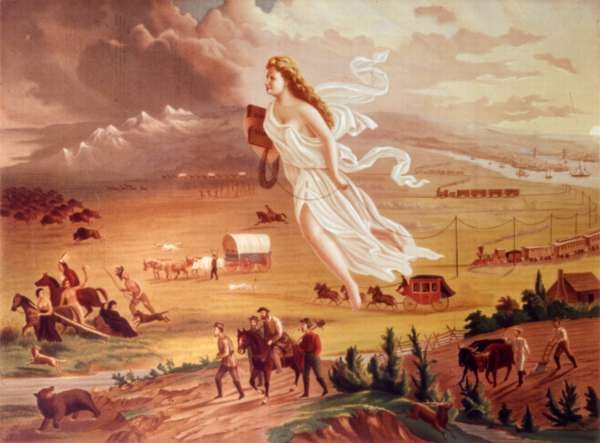
American Progress by John Gast, 1872, Library of Congress. It depicts Manifest Destiny. 
Late in November 1939, Walter Benjamin an unemployed Jewish writer who had been residing in Paris, was released from a makeshift prison camp for German nationals housed in a disused chateau near the city of Nevers, in central France. He had been confined there for nearly three months since Hitler had invaded Poland, leading France to declare war on Germany. Influential friends were able to secure Benjamin’s release. He returned to his one-room, seventh-story flat in Paris and, as Europe tumbled into war, began writing what would become his final work, the twenty paragraph-length fragments that together form the “Theses on the Philosophy of History.”


The “Theses” is an essay of lasting strangeness, dense and elliptical, intended, per Benjamin’s biographer, Bernd Witte, “as a fundamental consideration of the essence of historical time.” Yet for all its abstraction, much of it feels depressingly topical. In one fragment, Benjamin expresses scorn for the “current amazement that the things we are experiencing are ‘still’ possible in the twentieth century.” As if to prove his point, well into the twenty-first, with fascism on the creep from Washington and Brasilia through the capitals of Europe, we find ourselves astonished once again: How can this still be happening? 

Then as now, Benjamin would argue, the problem—one of them anyway—was and is an unexamined faith in a highly irrational notion, one that blinds us to facts and conditions that would otherwise be obvious—and that, against all evidence opposing it, continues to inform the shape of our thoughts and the contours of our political discourse. In short, we are in thrall to the fetish of progress: the belief that history has a direction and a purpose, the faith that humankind is ascending a steady if circuitous route to greater and greater perfection.
Against this creed, Benjamin posed a curious interpretation of a then-obscure drawing by Paul Klee, one he had splurged to buy in 1922 and had hung like an amulet on the wall of every apartment in which he lived. It depicted an angel. Its wings were spread, its head spun all the way around so that it stared backward at the viewer. Thus, Benjamin wrote, was the “angel of history” propelled into the future while facing the past: “Where we perceive a chain of events, he sees one single catastrophe which keeps piling wreckage and hurls it in front of his feet.” The angel is pushed onward, he went on, by a terrible storm. “This storm is what we call progress.”
By 1940, when Benjamin was forced to flee his last apartment in Paris, the notion of progress had for more than a century provided the dominant narrative that allowed Europeans to understand themselves. The always imperiled edifice of Western civilization—the far-right’s fears today are not so different from the far-right’s fears 80 or 160 years ago—is unimaginable without it. Progress described for Europeans their past, their position on the path that carried them into the future, and their relation to everyone else on the planet. It created an easy hierarchy into which every time, every place, and every people could be slotted. By the mid-nineteenth century, faith in progress was already so ubiquitous as to be largely invisible to its adherents, whether they counted themselves revolutionaries or traditionalists and whether they lived in Europe itself, in the rapidly expanding settlements in the Americas and Australia, or in colonial outposts in Africa and Asia. To question it with any seriousness was to marginalize yourself as a crank, a heretic, or a fool. In the European imagination—which increasingly operated in racial terms, understanding itself as white—progress defined the world.
The Flouring of Humanity
Despite its pretensions to cosmic immutability, the idea of progress in the West has a legible history—one bound from the outset to conquest, and to fantasies of racial dominance. Its first explicit articulation is generally agreed to have appeared in a speech delivered in 1750 by the brilliant political economist Anne Robert Jacques Turgot, then just twenty-three. It is surely no coincidence that an early evangelist of economic liberty—“All branches of commerce ought to be free, equally free, and entirely free,” he wrote in 1773—would also be the first to lay out the ideology that would everywhere accompany the spread of capitalism.
Turgot would have ample opportunity to test his economic theories, if not his conviction that mankind was destined to shed its every flaw. In 1774, serving as the controller-general of finances under Louis XVI, he issued an edict abolishing all restrictions regulating the trade of grain in France. That year’s harvest was poor. Merchants, freed from laws that had outlawed stockpiling, hoarded wheat to drive up prices. Famine ensued. Riots broke out. In an uprising that later historians would view as a prelude to the French Revolution, crowds, many of them led by women, forced landowners and merchants to sell their grain at prices they deemed reasonable. The Flour War, as it would be known, ended with a fierce repression. The government called in twenty-five thousand troops. By 1776, court intrigues would lead to Turgot’s dismissal, and his reforms were soon reversed. Perhaps he was lucky. Turgot died a private man, of gout, twelve years before the monarch met the guillotine.
His quiet demise, at any rate, makes for a dramatic contrast with his quasi- millennial visions of the prospects for human improvement—so long as the humanity in question was white and European. At the very beginning of the lecture in question, “A Philosophical Review of the Successive Advances of the Human Mind,” Turgot made a surprising move. Once he’d laid out the key difference between the sort of time that governs humankind and that which governs nature—unending fealty to the cyclical rule of death and regeneration in the latter case, while human events succeed one another in a linear and “ever-changing spectacle” as the species lurches from “infancy” to “greater perfection”—he evoked the specter of “the Americans.” They put in their appearance on the second page. He was not thinking of the well-armed citizens of the current American polity, but of the original inhabitants of the hemisphere, whose presence posed something of a problem. If history was to be narrated as the story of the growing perfection of mankind, how to explain all those who seemed to lag behind, the tribes of so-called primitives scattered across the jungles, plains, and desert wastes?
We might think that progress is a way of thinking about history, and hence about time, but very nearly the first thing Turgot did was transpose time onto space by summoning the Americas as the place of the past. He explained the apparently uneven development of humankind and the anachronistic existence of the people he regarded as savages as a result of naturally occurring inequalities: “Nature, distributing her gifts unequally, has given to certain minds an abundance of talent which she has refused to others.” Differing environmental circumstances allowed those original talents to develop at different rates, “and it is from the infinite variety of circumstances that there springs the inequality in the progress of nations.”
We the Supreme
Before it was anything else, progress was a doctrine of supremacy—a fresh new faith for a rising era of unchallenged European dominance, a way of celebrating European hegemony by anchoring it in time, and rendering Europe, and specifically Bourbon France, the very apotheosis of human achievement. In a parallel move three quarters of a century later, Hegel would claim that same honor for the Prussian monarchy. “World history travels from east to west,” he declared, “for Europe is the absolute end of history, just as Asia is the beginning.” One-and-a-half centuries after that, thinkers like Francis Fukuyama would advance much the same claim for an empire still further to the west—American liberal democracy in its most aggressively capitalist guise in the immediate aftermath of the Cold War. As an ideology of over-confident elites, progress would prove itself remarkably resilient.
It’s worth recalling, though, that even in their earliest, most self-regarding rhapsodies, the initial prophets of progress had to ignore an enormous share of countervailing evidence. The first Europeans to lay eyes on the great cities of the Americas, for example, did not see them as Turgot did. Francisco Pizarro, the conqueror of Peru, wrote to King Charles V that the Inca capital of Cuzco, which Pizarro plundered and largely destroyed, “is so beautiful and has such fine buildings that it would be remarkable even in Spain.” Cortés apologized to the same monarch that he did not have the literary skills to adequately describe the marvels of Tenochtitlán, built across Lake Texcoco, its temples and wide causeways rising from the water, with fragrant gardens and great public squares and markets filled with endless riches. Cortés’s soldiers, his lieutenant Bernal Díaz del Castillo wrote, “had been in many parts of the world, in Constantinople, and all over Italy, and in Rome,” but they had never seen anything so wondrous as the Aztec city. “I stood looking at it, and thought that no land like it would ever be discovered in the whole world,” Díaz wrote. “But today all that I then saw is overthrown and destroyed; nothing is left standing.”
Issue Forth, Europe!
Just this past March, a team of British and Brazilian archaeologists published a paper about their discoveries of the remains of villages, roads, and fortified settlements long concealed by foliage in the Amazon, traces left by as many as a million people who nearly all disappeared at the same time—roughly when Europeans arrived on the continent. “Diseases traveled much faster than people,” the lead archaeologist told the Guardian. The Amazon’s population may have been largely wiped out before the Portuguese ever reached the area. Genocide helped too. The indigenous population of the Americas likely would fall by some 90 percent in the first 150 years after the conquest.
It’s a good trick, really, so seamlessly clever that Turgot and many millions since didn’t see it as a trick at all: allow biological agents to help you conquer half the world, slaughter and enslave whoever the microbes let live. You can then declare the hobbled remnants of the civilizations you have destroyed primitive and savage and interpret the degraded manner in which many of your victims survive as evidence of your inherent superiority, your right to rule over them and to continue to exploit them under cover of civilizing motives. As an ideology that put European culture at the pinnacle of human history and consigned everyone else to time’s lowland wastes, progress would function at once as an explanation of European dominance and a rationale for the slaughter and pillage on which it depended, and continues to depend. 
Turgot went on to sketch out a narrative that, with some modifications, would soon become widespread: the mantle of civilization passed from the once-great civilizations of Egypt, India, and China, all strangled by their own despotism, and onward, via the Phoenicians—in themselves mere “agents of exchanges between peoples”—to Greece and then Rome. This latter empire, a victim of its own descent into tyranny, “at last suddenly collapses” under the attacks of opportunistic hordes. The rise of Islam merited brief condemnation, almost parenthetically, as “a raging torrent which ravages the whole territory from the Indian frontiers to the Atlantic Ocean and the Pyrenees.” The glories of Baghdad and al-Andalus were passed over without comment, though Turgot acknowledged that Islamic scholars did perform the service of transmitting Europe’s past to its future by disseminating “the feeble sparks” of Greek wisdom that they had managed to preserve. That was all it took. “The treasures of antiquity, rescued from the dust . . . summon[ed] genius from the depths of its retreats. The time has come,” Turgot enthused. “Issue forth, Europe, from the darkness which covered thee!”
His discourse concluded with a paean to the king—not the one Turgot would later serve and who would still later lose his head in the Place de la Concorde, but his predecessor, also named Louis, who died in his bed in the palace at Versailles, of smallpox. “O Louis, what majesty surrounds thee!” Turgot crooned. “Century of Louis the Great, may your light beautify the precious reign of his successor! May it last for ever, may it extend over the world!”
God’s Perfect Children
It is now such a reflex to consider past civilizations stupid and superstitious—or stupider at least than we are—that it’s hard to imagine the relief that thinkers of Turgot’s era must have felt on unburdening themselves of the past, launching themselves into a limitless future. Previous generations of human beings on nearly every patch of the planet had regarded their ancestors with veneration—and what a drag it must have been to have to lug those old farts and all their dumb ideas everywhere, and always with a smile. Turgot’s jubilation broke through in his punctuation, and in the impatience of his syntax: “What ridiculous opinions marked our first steps! How absurd were the causes which our fathers thought up to make sense of what they saw! What sad monuments they are to the weakness of the human mind!”
The first thing he hastened to toss over was the notion that all things are alive and infused with divinity. This idea—then still pervasive in the animistic beliefs of conquered and not-yet-conquered peoples across the globe, in the folk beliefs of Europe and in the more pantheistic strands of its esoteric theologies—was, by Turgot’s reckoning, one of “those delusive analogies to which the first men in their immaturity abandoned themselves with so little thought.” Like children, Turgot explained, they imagined that all the things they perceived that “were independent of their own actions were produced by beings similar to them, but invisible and more powerful.” Thus, they supposed, superstitiously, “All objects of nature had their gods.” Against this, he allied himself, if only half-heartedly, to a sterile monotheism, nodding to the Christian deity later in the lecture, but only in passing, and without a shred of the enthusiasm that he brought to subjects such as Reason, Europe, and France. But the task of denuding the natural world of agency and divinity was apparently an important one, and could not be neglected. For the grand procession of progress to march, the stage had to first be cleared of rivals. All the world must be dead, and man alone alive, rushing to the glory of his fate.
This odd notion would show up again, and with even greater force, in the work of Turgot’s friend and biographer, Marie Jean Antoine Nicolas Caritat, better known as the Marquis de Condorcet. An ardent republican, Condorcet served during the early years of the Revolution as secretary of the Legislative Assembly until that body was dissolved, and the king dethroned, in 1792. In those days, surely, the world must have felt like it was ending, or beginning again. Condorcet welcomed its rebirth. He was at odds, though, with the Revolution’s most radical factions, and was sharply critical of the constitution drafted in June of 1793 by Robespierre and Saint-Just. In July, a warrant was issued for his arrest.
Condorcet would spend the next nine months in hiding, cooped up in a house on a small Parisian street just north of the Luxembourg Gardens. Three months into his confinement, he would be condemned to death in absentia. The Terror had begun. Despite these pressures, Condorcet continued to work on the text for which he would be best known, a book-length treatise of astonishing optimism entitled Outlines of an Historical View of the Progress of the Human Mind. “The perfectibility of man is absolutely indefinite,” he wrote in the introduction, and “the progress of this perfectibility . . . has no other limit than the duration of the globe upon which nature has placed us.”
He would not live to see the work published. Early in April of 1794, informed that his capture was imminent, Condorcet fled Paris. Two days later, bleeding from a wound on his leg, dirty and bedraggled from sleeping in the open, he walked into an inn in a village just outside the city. He ordered an omelet. When the proprietor asked how many eggs he wanted, Condorcet, who had presumably not eaten for days, aroused the suspicion of his host by answering, “a dozen”: only an aristocrat would presume to order an omelet of a dozen eggs. He was dragged to the prison in the commune of Bourg-la-Reine, which at the time was known as Bourg-l’Égalité, or, roughly, Equality-ville. Accounts vary, but either the following morning or the one after that, the Marquis de Condorcet was found dead on the floor of his cell.
While still in hiding in Paris, at work on the Outlines, confined to the rooms of the small house on Rue Servandoni, his country at war against most of Europe, hearing frequent news of the beheadings of friends and colleagues, Condorcet surely must have suspected that his own death, and not a pleasant one, was likely near. He nonetheless remained convinced, with a fervor that can only be described as ecstatic, that there was no other path for humankind than that of ever-increasing perfection. The final chapter of the text was devoted to forecasting the outlines of that bright future. Everyone on the planet, he predicted, would “one day arrive at the state of civilization attained by those people who are most enlightened, most free . . . as the French, for instance, and the Anglo-Americans.” This would mean an end to “the slavery of countries subjected to kings, the barbarity of African tribes, and the ignorance of savages.”
Condorcet was serenely confident that Europe held exclusive title to reason, peace, and justice despite the conflicts that had wracked the continent over the previous century—a seven- year war that had killed nearly a million just three decades earlier, the wars over the Austrian and Spanish successions that between them killed another million and a half—and despite the conflict into which it had recently been thrown. Europe had lit the way for humanity thus far, and so the continent was likewise destined to cut through all remaining darkness, leading the scattered people of the earth to a future without war or oppression or discrimination based on sex or tribal prejudice. Sanitation would improve, and nutrition, and medicine. Human lifespans would grow longer. One universal language would spread across the earth “and render error almost impossible.” Except for the language bit—English functions well enough—this is still the faith that fuels contemporary neoliberalism and the logic of “development”: the global extension of European ways, meaning open markets and liberal institutions, will spur technological improvements and improve the lot of all, indefinitely. One day the natives will thank us. It’s a powerful and alluring vision—at least for those who’ve appointed themselves as its lead administrators. Little wonder that Condorcet clung to it even as the world he knew was being washed away with blood.


The Biography of Races

Of course, there are blood sacrifices along every stage of the progress myth—though some stand out in especially high relief. In volume three of his monumental Black Athena, Martin Bernal wrote of the surprising discovery, in 1978, at Knossos, of ceramic pots, likely more than 3,600 years old, containing the dismembered remains of children. Their bones were scarred with knife marks. They had been butchered and, apparently, cooked. Nearby, archaeologists found pottery and amphorae decorated with shields and the head of a Gorgon, images associated with Athena. Others would be more cautious, but for Bernal the find confirmed that Athena, goddess of wisdom and war, “was associated with human, and especially child, sacrifice.”
In that volume, which is largely concerned with presenting linguistic evidence for the African and Asian heritage of ancient Greece—Classical Greek, by Bernal’s estimate, owes as much as 40 percent of its vocabulary to the Ancient Egyptian and West Semitic languages—Bernal also argued that Athena was a descendant of the Egyptian goddess Nēit and a near cousin to the Canaanite deity ’Anat. All three were powerful figures—bloodthirsty warriors “of renewable virginity,” as Bernal put it. All three were associated with weaving and birds of prey: Nēit with vultures, ’Anat with eagles, Athena with the owl. Plato and Herodotus both attested to Athena’s identity with Nēit. Inscriptions in Cyprus, where Athena and ’Anat shared a temple, equated the two deities.
“There are no simple origins,” Bernal cautioned. It is never a question of a direct and singular genetic inheritance, of roots leading up a trunk and bifurcating into branches. Human history, he suggested, is more like a river, splitting off into tributaries, merging and diverging again and again. Or perhaps like a crowd, joining arms and letting go, splitting into smaller groups that at times reach out to clasp hands with one another. The worship of Nēit would be largely subsumed by a cult to Isis, the veneration of whom would in turn be transferred to the Virgin Mary. ’Anat, whose worship may have involved the sacrifice of virgins, was in northwest Syria regarded as the sister and sometimes the consort of Ba’al, one of the primary gods in the Canaanite pantheon, who was alternately adored and rejected by the ancient Israelites. Archaeological evidence uncovered on the Nile island of Elephantine, in the contemporary Egyptian city of Aswan, suggests that an isolated community of Jewish mercenaries living there in the fifth and sixth centuries B.C. worshiped ’Anat as the “Queen of Heaven” and the consort of Yahweh, who was regarded by other contemporary Jews as the one and only god. Behind and beside any One there is always an other, and behind each of those wait many more.
Bernal’s larger argument was not about ’Anat or Athena or even language, but about the making of history itself. (Black Athena, it should be said, sparked a furious controversy. Many of Bernal’s etymological claims have been discredited, but his broader historiographical argument has held up quite well and, in some cases has been confirmed by the outsized fury of his conservative critics.) Until the early nineteenth century, he proposed, there was little controversy about the debts Greek culture owed to Africa and to points farther east. During the Renaissance revival of Greek thought, “no one questioned the fact that the Greeks had been the pupils of the Egyptians.” Throughout the Enlightenment, too, European intellectuals were openly fascinated by Egypt.
In the second half of the eighteenth century, though, a new paradigm took hold of Europe. It arose, not coincidentally, as European economies reconfigured themselves around the by-then steady flow of wealth from the Americas, most of it procured through the labor of African and indigenous slaves. This wealth, and the quick pace of technological change that followed in its wake, only served to validate the ever-deeper conviction in the superiority of European civilization. All that exploitation had to be justified somehow; or if not justified, disguised. History was reconceived, in Bernal’s words as “the biography of races,” a narrative subject to the laws of something called progress.
If Europe represented the mature stage of human development, it would need a lineage. Since the genealogically obsessed tend to favor purity, it would help if its ancestry suffered as little admixture as possible. Greece—whose natives were unquestionably European, famously clever, and passably fair-skinned—would be elevated. The Greeks would be reinvented to match the most flattering self-image that Europeans could muster: a people supremely rational and wise, with the stubborn independence of a noble race, uniquely capable of self-governance, and mercilessly strong when justice and necessity demanded it.
That this image would not have been recognized by either the Greeks’ contemporaries or by the inhabitants of the continents being mowed under by “Western civilization” was irrelevant to the larger project of historical reclamation. Plato and Aeschylus became the heritage of the English, the Germans, and far-flung white Americans. Greek joined Latin as an indispensable part of the education of the European elite. Classics emerged as a discipline. By the early nineteenth century, wrote Bernal, it had become “increasingly intolerable that Greece—which was seen by the Romantics not merely as the epitome of Europe but also as its pure childhood—could be the result of the mixture of native Europeans and colonizing Africans and Semites.”
Egypt, until recently the object of admiration and awe, would now be “flung into prehistory to serve as a solid and inert basis for the dynamic development of the superior races, the Aryans and the Semites.” As the nineteenth century gave way to the twentieth, the Semites, too, would be tossed out in a hurry. All Phoenician and Canaanite influence on Greece, and any evidence of substantive cultural exchange with the cultures of Mesopotamia and the Levant, which had until recently been considered uncontroversially obvious, would become suspect. Except to the undeniable degree to which Christianity was inconceivable without them, the Jews would also be largely crowded out. Thus was established what the Israeli historian Shlomo Sand calls “the mythology of white continuity.”
One more thing about Athena. Homer customarily followed her name with the adjective glaukopis, which is usually translated as either “bright-eyed” or “grey-eyed” and holds a range of meanings from bright and flashing to blue, light grey, or even green. The point would likely have been lost on most early twentieth-century lovers of the classics, for whom fair eyes were an indicator of racial superiority. But for the Greeks, Bernal wrote, blue eyes were associated with ferocity, and with misfortune. “The paleness of Athena’s eyes,” he concluded, would have “added to the terror she inspired.”
The Hermetic Vanishing Trick
There is another way to think about the origins of progress. In the mid-1960s, the British historian Frances Yates began to document the influence of the Hermetic tradition on Renaissance thought: Hermetic as in Hermes Trismegistus—the mythic figure associated with the Greek god Hermes and the Egyptian god Thoth—to whom the varied writings grouped together as the Corpus Hermeticum were for centuries attributed. The god Hermes, whom the Greeks considered identical to Thoth, was a mediator between gods and mortals, a guide to the paths that stretch between us and the heavens. Hermes/Thoth was the messenger, the patron of travelers, thieves, and seekers. In his more ancient form, as Thoth, he was the scribe of the gods—at times depicted with the head of an ibis or the head of a baboon, or with the face of a dog on a baboon’s body. It was Thoth who brought hieroglyphs to humanity, and with them astronomy, medicine, botany, mathematics, gifts of all the many forms of knowledge of the cosmos.
His supposed heir, Hermes Trismegistus, or “Thrice Great Hermes,” was likewise a sort of gateway between divine wisdom and human ignorance, passing on wisdom that had been lost for generations, and illuminating the secret pathways that access the divine. In The City of God, Augustine wrote that Hermes Trismegistus lived “long before the sages and philosophers of Greece,” and was a grandson of the god Hermes and hence a distant cousin of Prometheus, who stole fire from Zeus and presented it as a gift to mankind, just as Thoth had given us writing. The actual Hermetic texts are a diverse bunch, and not nearly as old as Augustine supposed, though Cosimo de’ Medici did not know that when, in about 1460, he had them brought to Florence from the monastery in Macedonia where his agents had discovered them. Cosimo ordered Marsilio Ficino to translate them as quickly as possible into Latin. He already had Ficino working on a translation of the complete works of Plato. Put that aside, he told him, and do this one first. Cosimo was old, and wanted to read the fabled Hermes Trismegistus before he died; Plato mattered less.
The texts themselves were likely composed by several different authors from the middle of the first to the end of the third century A.D. They were written in Greek but were likely composed in Egypt. In them theology, cosmology, magic, and the seeds of what we would now call science—astronomy, medicine, botany, mathematics—are inseparably linked. Together, Yates argued over the course of her career, they form a hidden and much-repressed current that in various ways informed many of the great minds of the European Renaissance and the Enlightenment: from Bruno, Ficino, and Pico della Mirandola to Bacon, Leibniz, and Newton. In other words, the proudest treasure of what we persist in calling Western Civilization, its tradition of empirical and critical reason, was until the eighteenth century in fruitful and more or less constant conversation with esoteric works of Egyptian, gnostic mysticism attributed to the grandson of a trickster god.
In the years that followed, this lineage would be meticulously erased. The strands of thought and belief with which it had fruitfully intersected—Jewish and Christian mystical traditions, Paracelsian alchemy, Neoplatonist philosophy—would be marginalized and mocked. Just over a decade after Newton’s death, the German historian Johann Jakob Brucker published a monumental and influential history of philosophy, the first of its kind, in which he characterized the Hermetic texts—as well as Kabbalah and Neoplatonism—as Philosophia Barbarica. They were, to Brucker, corrupt, pagan superstitions that stood opposed to the eminently rational history of Christian, European truth-seeking. Many of the entries in Diderot’s Encyclopedia would be cribbed straight from Brucker, whose ideas were smuggled hence into the heart of the French Enlightenment.
This was the same historical moment when the grand narrative of progress, that glorious arc of Reason that had traveled to Paris and London from Athens and Rome, was beginning to take shape—as well as the critical interval at which, as Bernal documented, the Greeks were being elevated and all traces of Africa erased. Brucker’s work had been published in Latin by 1744, the Encylopedia beginning in 1751, Turgot’s “A Philosophical Review of the Successive Advances of the Human Mind” in 1750. For most of the next two centuries, the texts of the Hermetic corpus would be consigned to the forbidden and derided margins. To take them seriously got you labeled an occultist, a swindler, or a quack. Like a forgotten continent, the Hermetic corpus would not be rediscovered until the middle of the twentieth century, when Italian historians, and later Yates, began to rescue it from the disrepute into which it had been banished for so long.
But perhaps old thrice-great Hermes never really went away. Was not the very idea of progress also dependent on the conviction, shouted throughout the Hermetic corpus, that heaven is here for the taking and that humans, despite our mortal bodies, are in essence godly, capable of understanding all that exists, and even of sharing in the creative powers of the divine? “Unless you make yourself equal to God, you cannot understand God,” the Hermetic texts advised, and then explained just how to do it: “Make yourself grow to a greatness beyond measure, by a bound free yourself from the body; raise yourself above all time, become Eternity; then you will understand God.” If that wasn’t easy enough, the text went on: “Believe that nothing is impossible for you, think yourself immortal and capable of understanding all, all arts, all sciences, the nature of every living being.”
This, even long after Hermes was banished, would remain the very creed underlying modern scientific endeavor: that all things could be known and all of nature mastered, that mankind, or at least some civilized subset thereof, was marching on a path toward perfection. He—and until very recently, it was always only he—could understand the behavior of the farthest stars, the nuclei of cells and the viscera of atoms, the nature of tortoises and finches, and also of the unfortunate savages who could not walk this path unaided. He could construct a society in which justice reigned and human beings lived, like gods, as equals. This vision, or what little spark of it remained, would not only be a cudgel for empire. How can we imagine any revolutionary faith without it—and not just faith but practice?
Redemption Song
For Walter Benjamin at least, refusing to be blinded by the false promises of progress did not mean that hope was lost. It meant that one could begin to see. Even at the very end, Benjamin believed that the past contains within it an orientation toward its own redemption. This is perhaps less mystical than it sounds. He understood the present—what he called the “time of the now”—to be pregnant with all that has come before, each moment containing within it, “in an enormous abridgment,” the entirety of the past. The past is not inert. It calls out, clamoring for redress. It exists in the present as demand. The “time of the now,” he wrote, is “shot through with chips of Messianic time.” If eternity, all the past and every future, flits through every moment, then we can grab it there. In other words, right here.
For Benjamin this could only be a political act. It meant overturning any structures that relied on the exploitation of labor—which is to say not only our sweat and our skills but our time, being in all its divinity as it pulses through our veins—or on the “mastery of nature,” which was, he suggested, of a piece with any other form of exploitation. And it meant rejecting the slumbrous fantasy that history will carry us to some better land. It would not. Time had to be “blasted out” and history blasted open. Only then could it be redeemed, and with it, us.
This was not, for Benjamin, a choice. It wasn’t that redemption lay behind some distant gate at the end of a path that we could choose not to walk, or that there were other, smoother and easier roads that we might take with less effort, on which we might nonetheless survive. Then, as now, the only other way led to extinction.
In June of 1940, shortly after Benjamin completed the “Theses on the Philosophy of History,” German troops entered Paris. Benjamin fled to Lourdes and then Marseilles. He left a copy of the “Theses” with his friend Hannah Arendt, another German Jewish philosopher who was, like him, hoping to escape to the United States by way of Portugal. That September, Benjamin made it as far as the sleepy town of Port Bou, on the Spanish side of the border with France. He was welcomed with neither hospitality nor mercy. Local police informed him that he would be escorted back to the border the following morning and delivered to the French authorities—and thence, almost certainly, to the Gestapo. Benjamin, ill and exhausted, despaired. Alone in his hotel room, he swallowed an overdose of morphine tablets. His body remains in Port Bou, in a cemetery carved high into a bluff overlooking the Mediterranean Sea.
Hannah Arendt made it out. She and her husband were allowed to leave France and to pass through Spain into Portugal, where they spent three months stranded in Lisbon. They passed the hours reading Benjamin’s words aloud to one another, and to the small group of refugees who had gathered there, waiting to sail to safety, on the edge of a crumbling world.