Showing posts with label The idea of progress. Show all posts

Friday, February 8, 2019

3179. After the Storm: Progress and the Demented Quest for Historical Purity

By Ben Ehrenreich, The Baffler, February 2019
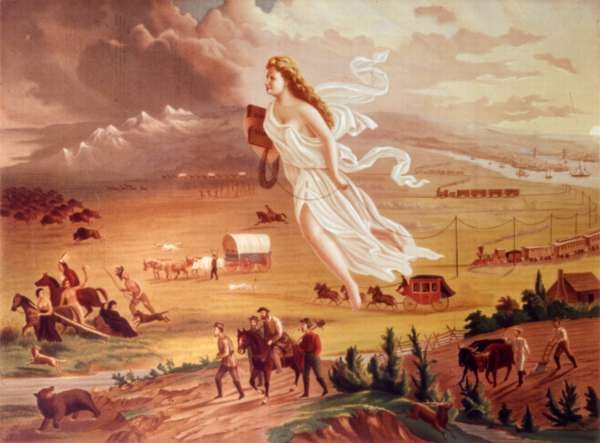
American Progress by John Gast, 1872, Library of Congress. It depicts Manifest Destiny. 
Late in November 1939, Walter Benjamin an unemployed Jewish writer who had been residing in Paris, was released from a makeshift prison camp for German nationals housed in a disused chateau near the city of Nevers, in central France. He had been confined there for nearly three months since Hitler had invaded Poland, leading France to declare war on Germany. Influential friends were able to secure Benjamin’s release. He returned to his one-room, seventh-story flat in Paris and, as Europe tumbled into war, began writing what would become his final work, the twenty paragraph-length fragments that together form the “Theses on the Philosophy of History.”


The “Theses” is an essay of lasting strangeness, dense and elliptical, intended, per Benjamin’s biographer, Bernd Witte, “as a fundamental consideration of the essence of historical time.” Yet for all its abstraction, much of it feels depressingly topical. In one fragment, Benjamin expresses scorn for the “current amazement that the things we are experiencing are ‘still’ possible in the twentieth century.” As if to prove his point, well into the twenty-first, with fascism on the creep from Washington and Brasilia through the capitals of Europe, we find ourselves astonished once again: How can this still be happening? 

Then as now, Benjamin would argue, the problem—one of them anyway—was and is an unexamined faith in a highly irrational notion, one that blinds us to facts and conditions that would otherwise be obvious—and that, against all evidence opposing it, continues to inform the shape of our thoughts and the contours of our political discourse. In short, we are in thrall to the fetish of progress: the belief that history has a direction and a purpose, the faith that humankind is ascending a steady if circuitous route to greater and greater perfection.
Against this creed, Benjamin posed a curious interpretation of a then-obscure drawing by Paul Klee, one he had splurged to buy in 1922 and had hung like an amulet on the wall of every apartment in which he lived. It depicted an angel. Its wings were spread, its head spun all the way around so that it stared backward at the viewer. Thus, Benjamin wrote, was the “angel of history” propelled into the future while facing the past: “Where we perceive a chain of events, he sees one single catastrophe which keeps piling wreckage and hurls it in front of his feet.” The angel is pushed onward, he went on, by a terrible storm. “This storm is what we call progress.”
By 1940, when Benjamin was forced to flee his last apartment in Paris, the notion of progress had for more than a century provided the dominant narrative that allowed Europeans to understand themselves. The always imperiled edifice of Western civilization—the far-right’s fears today are not so different from the far-right’s fears 80 or 160 years ago—is unimaginable without it. Progress described for Europeans their past, their position on the path that carried them into the future, and their relation to everyone else on the planet. It created an easy hierarchy into which every time, every place, and every people could be slotted. By the mid-nineteenth century, faith in progress was already so ubiquitous as to be largely invisible to its adherents, whether they counted themselves revolutionaries or traditionalists and whether they lived in Europe itself, in the rapidly expanding settlements in the Americas and Australia, or in colonial outposts in Africa and Asia. To question it with any seriousness was to marginalize yourself as a crank, a heretic, or a fool. In the European imagination—which increasingly operated in racial terms, understanding itself as white—progress defined the world.
The Flouring of Humanity
Despite its pretensions to cosmic immutability, the idea of progress in the West has a legible history—one bound from the outset to conquest, and to fantasies of racial dominance. Its first explicit articulation is generally agreed to have appeared in a speech delivered in 1750 by the brilliant political economist Anne Robert Jacques Turgot, then just twenty-three. It is surely no coincidence that an early evangelist of economic liberty—“All branches of commerce ought to be free, equally free, and entirely free,” he wrote in 1773—would also be the first to lay out the ideology that would everywhere accompany the spread of capitalism.
Turgot would have ample opportunity to test his economic theories, if not his conviction that mankind was destined to shed its every flaw. In 1774, serving as the controller-general of finances under Louis XVI, he issued an edict abolishing all restrictions regulating the trade of grain in France. That year’s harvest was poor. Merchants, freed from laws that had outlawed stockpiling, hoarded wheat to drive up prices. Famine ensued. Riots broke out. In an uprising that later historians would view as a prelude to the French Revolution, crowds, many of them led by women, forced landowners and merchants to sell their grain at prices they deemed reasonable. The Flour War, as it would be known, ended with a fierce repression. The government called in twenty-five thousand troops. By 1776, court intrigues would lead to Turgot’s dismissal, and his reforms were soon reversed. Perhaps he was lucky. Turgot died a private man, of gout, twelve years before the monarch met the guillotine.
His quiet demise, at any rate, makes for a dramatic contrast with his quasi- millennial visions of the prospects for human improvement—so long as the humanity in question was white and European. At the very beginning of the lecture in question, “A Philosophical Review of the Successive Advances of the Human Mind,” Turgot made a surprising move. Once he’d laid out the key difference between the sort of time that governs humankind and that which governs nature—unending fealty to the cyclical rule of death and regeneration in the latter case, while human events succeed one another in a linear and “ever-changing spectacle” as the species lurches from “infancy” to “greater perfection”—he evoked the specter of “the Americans.” They put in their appearance on the second page. He was not thinking of the well-armed citizens of the current American polity, but of the original inhabitants of the hemisphere, whose presence posed something of a problem. If history was to be narrated as the story of the growing perfection of mankind, how to explain all those who seemed to lag behind, the tribes of so-called primitives scattered across the jungles, plains, and desert wastes?
We might think that progress is a way of thinking about history, and hence about time, but very nearly the first thing Turgot did was transpose time onto space by summoning the Americas as the place of the past. He explained the apparently uneven development of humankind and the anachronistic existence of the people he regarded as savages as a result of naturally occurring inequalities: “Nature, distributing her gifts unequally, has given to certain minds an abundance of talent which she has refused to others.” Differing environmental circumstances allowed those original talents to develop at different rates, “and it is from the infinite variety of circumstances that there springs the inequality in the progress of nations.”
We the Supreme
Before it was anything else, progress was a doctrine of supremacy—a fresh new faith for a rising era of unchallenged European dominance, a way of celebrating European hegemony by anchoring it in time, and rendering Europe, and specifically Bourbon France, the very apotheosis of human achievement. In a parallel move three quarters of a century later, Hegel would claim that same honor for the Prussian monarchy. “World history travels from east to west,” he declared, “for Europe is the absolute end of history, just as Asia is the beginning.” One-and-a-half centuries after that, thinkers like Francis Fukuyama would advance much the same claim for an empire still further to the west—American liberal democracy in its most aggressively capitalist guise in the immediate aftermath of the Cold War. As an ideology of over-confident elites, progress would prove itself remarkably resilient.
It’s worth recalling, though, that even in their earliest, most self-regarding rhapsodies, the initial prophets of progress had to ignore an enormous share of countervailing evidence. The first Europeans to lay eyes on the great cities of the Americas, for example, did not see them as Turgot did. Francisco Pizarro, the conqueror of Peru, wrote to King Charles V that the Inca capital of Cuzco, which Pizarro plundered and largely destroyed, “is so beautiful and has such fine buildings that it would be remarkable even in Spain.” Cortés apologized to the same monarch that he did not have the literary skills to adequately describe the marvels of Tenochtitlán, built across Lake Texcoco, its temples and wide causeways rising from the water, with fragrant gardens and great public squares and markets filled with endless riches. Cortés’s soldiers, his lieutenant Bernal Díaz del Castillo wrote, “had been in many parts of the world, in Constantinople, and all over Italy, and in Rome,” but they had never seen anything so wondrous as the Aztec city. “I stood looking at it, and thought that no land like it would ever be discovered in the whole world,” Díaz wrote. “But today all that I then saw is overthrown and destroyed; nothing is left standing.”
Issue Forth, Europe!
Just this past March, a team of British and Brazilian archaeologists published a paper about their discoveries of the remains of villages, roads, and fortified settlements long concealed by foliage in the Amazon, traces left by as many as a million people who nearly all disappeared at the same time—roughly when Europeans arrived on the continent. “Diseases traveled much faster than people,” the lead archaeologist told the Guardian. The Amazon’s population may have been largely wiped out before the Portuguese ever reached the area. Genocide helped too. The indigenous population of the Americas likely would fall by some 90 percent in the first 150 years after the conquest.
It’s a good trick, really, so seamlessly clever that Turgot and many millions since didn’t see it as a trick at all: allow biological agents to help you conquer half the world, slaughter and enslave whoever the microbes let live. You can then declare the hobbled remnants of the civilizations you have destroyed primitive and savage and interpret the degraded manner in which many of your victims survive as evidence of your inherent superiority, your right to rule over them and to continue to exploit them under cover of civilizing motives. As an ideology that put European culture at the pinnacle of human history and consigned everyone else to time’s lowland wastes, progress would function at once as an explanation of European dominance and a rationale for the slaughter and pillage on which it depended, and continues to depend. 
Turgot went on to sketch out a narrative that, with some modifications, would soon become widespread: the mantle of civilization passed from the once-great civilizations of Egypt, India, and China, all strangled by their own despotism, and onward, via the Phoenicians—in themselves mere “agents of exchanges between peoples”—to Greece and then Rome. This latter empire, a victim of its own descent into tyranny, “at last suddenly collapses” under the attacks of opportunistic hordes. The rise of Islam merited brief condemnation, almost parenthetically, as “a raging torrent which ravages the whole territory from the Indian frontiers to the Atlantic Ocean and the Pyrenees.” The glories of Baghdad and al-Andalus were passed over without comment, though Turgot acknowledged that Islamic scholars did perform the service of transmitting Europe’s past to its future by disseminating “the feeble sparks” of Greek wisdom that they had managed to preserve. That was all it took. “The treasures of antiquity, rescued from the dust . . . summon[ed] genius from the depths of its retreats. The time has come,” Turgot enthused. “Issue forth, Europe, from the darkness which covered thee!”
His discourse concluded with a paean to the king—not the one Turgot would later serve and who would still later lose his head in the Place de la Concorde, but his predecessor, also named Louis, who died in his bed in the palace at Versailles, of smallpox. “O Louis, what majesty surrounds thee!” Turgot crooned. “Century of Louis the Great, may your light beautify the precious reign of his successor! May it last for ever, may it extend over the world!”
God’s Perfect Children
It is now such a reflex to consider past civilizations stupid and superstitious—or stupider at least than we are—that it’s hard to imagine the relief that thinkers of Turgot’s era must have felt on unburdening themselves of the past, launching themselves into a limitless future. Previous generations of human beings on nearly every patch of the planet had regarded their ancestors with veneration—and what a drag it must have been to have to lug those old farts and all their dumb ideas everywhere, and always with a smile. Turgot’s jubilation broke through in his punctuation, and in the impatience of his syntax: “What ridiculous opinions marked our first steps! How absurd were the causes which our fathers thought up to make sense of what they saw! What sad monuments they are to the weakness of the human mind!”
The first thing he hastened to toss over was the notion that all things are alive and infused with divinity. This idea—then still pervasive in the animistic beliefs of conquered and not-yet-conquered peoples across the globe, in the folk beliefs of Europe and in the more pantheistic strands of its esoteric theologies—was, by Turgot’s reckoning, one of “those delusive analogies to which the first men in their immaturity abandoned themselves with so little thought.” Like children, Turgot explained, they imagined that all the things they perceived that “were independent of their own actions were produced by beings similar to them, but invisible and more powerful.” Thus, they supposed, superstitiously, “All objects of nature had their gods.” Against this, he allied himself, if only half-heartedly, to a sterile monotheism, nodding to the Christian deity later in the lecture, but only in passing, and without a shred of the enthusiasm that he brought to subjects such as Reason, Europe, and France. But the task of denuding the natural world of agency and divinity was apparently an important one, and could not be neglected. For the grand procession of progress to march, the stage had to first be cleared of rivals. All the world must be dead, and man alone alive, rushing to the glory of his fate.
This odd notion would show up again, and with even greater force, in the work of Turgot’s friend and biographer, Marie Jean Antoine Nicolas Caritat, better known as the Marquis de Condorcet. An ardent republican, Condorcet served during the early years of the Revolution as secretary of the Legislative Assembly until that body was dissolved, and the king dethroned, in 1792. In those days, surely, the world must have felt like it was ending, or beginning again. Condorcet welcomed its rebirth. He was at odds, though, with the Revolution’s most radical factions, and was sharply critical of the constitution drafted in June of 1793 by Robespierre and Saint-Just. In July, a warrant was issued for his arrest.
Condorcet would spend the next nine months in hiding, cooped up in a house on a small Parisian street just north of the Luxembourg Gardens. Three months into his confinement, he would be condemned to death in absentia. The Terror had begun. Despite these pressures, Condorcet continued to work on the text for which he would be best known, a book-length treatise of astonishing optimism entitled Outlines of an Historical View of the Progress of the Human Mind. “The perfectibility of man is absolutely indefinite,” he wrote in the introduction, and “the progress of this perfectibility . . . has no other limit than the duration of the globe upon which nature has placed us.”
He would not live to see the work published. Early in April of 1794, informed that his capture was imminent, Condorcet fled Paris. Two days later, bleeding from a wound on his leg, dirty and bedraggled from sleeping in the open, he walked into an inn in a village just outside the city. He ordered an omelet. When the proprietor asked how many eggs he wanted, Condorcet, who had presumably not eaten for days, aroused the suspicion of his host by answering, “a dozen”: only an aristocrat would presume to order an omelet of a dozen eggs. He was dragged to the prison in the commune of Bourg-la-Reine, which at the time was known as Bourg-l’Égalité, or, roughly, Equality-ville. Accounts vary, but either the following morning or the one after that, the Marquis de Condorcet was found dead on the floor of his cell.
While still in hiding in Paris, at work on the Outlines, confined to the rooms of the small house on Rue Servandoni, his country at war against most of Europe, hearing frequent news of the beheadings of friends and colleagues, Condorcet surely must have suspected that his own death, and not a pleasant one, was likely near. He nonetheless remained convinced, with a fervor that can only be described as ecstatic, that there was no other path for humankind than that of ever-increasing perfection. The final chapter of the text was devoted to forecasting the outlines of that bright future. Everyone on the planet, he predicted, would “one day arrive at the state of civilization attained by those people who are most enlightened, most free . . . as the French, for instance, and the Anglo-Americans.” This would mean an end to “the slavery of countries subjected to kings, the barbarity of African tribes, and the ignorance of savages.”
Condorcet was serenely confident that Europe held exclusive title to reason, peace, and justice despite the conflicts that had wracked the continent over the previous century—a seven- year war that had killed nearly a million just three decades earlier, the wars over the Austrian and Spanish successions that between them killed another million and a half—and despite the conflict into which it had recently been thrown. Europe had lit the way for humanity thus far, and so the continent was likewise destined to cut through all remaining darkness, leading the scattered people of the earth to a future without war or oppression or discrimination based on sex or tribal prejudice. Sanitation would improve, and nutrition, and medicine. Human lifespans would grow longer. One universal language would spread across the earth “and render error almost impossible.” Except for the language bit—English functions well enough—this is still the faith that fuels contemporary neoliberalism and the logic of “development”: the global extension of European ways, meaning open markets and liberal institutions, will spur technological improvements and improve the lot of all, indefinitely. One day the natives will thank us. It’s a powerful and alluring vision—at least for those who’ve appointed themselves as its lead administrators. Little wonder that Condorcet clung to it even as the world he knew was being washed away with blood.


The Biography of Races

Of course, there are blood sacrifices along every stage of the progress myth—though some stand out in especially high relief. In volume three of his monumental Black Athena, Martin Bernal wrote of the surprising discovery, in 1978, at Knossos, of ceramic pots, likely more than 3,600 years old, containing the dismembered remains of children. Their bones were scarred with knife marks. They had been butchered and, apparently, cooked. Nearby, archaeologists found pottery and amphorae decorated with shields and the head of a Gorgon, images associated with Athena. Others would be more cautious, but for Bernal the find confirmed that Athena, goddess of wisdom and war, “was associated with human, and especially child, sacrifice.”
In that volume, which is largely concerned with presenting linguistic evidence for the African and Asian heritage of ancient Greece—Classical Greek, by Bernal’s estimate, owes as much as 40 percent of its vocabulary to the Ancient Egyptian and West Semitic languages—Bernal also argued that Athena was a descendant of the Egyptian goddess Nēit and a near cousin to the Canaanite deity ’Anat. All three were powerful figures—bloodthirsty warriors “of renewable virginity,” as Bernal put it. All three were associated with weaving and birds of prey: Nēit with vultures, ’Anat with eagles, Athena with the owl. Plato and Herodotus both attested to Athena’s identity with Nēit. Inscriptions in Cyprus, where Athena and ’Anat shared a temple, equated the two deities.
“There are no simple origins,” Bernal cautioned. It is never a question of a direct and singular genetic inheritance, of roots leading up a trunk and bifurcating into branches. Human history, he suggested, is more like a river, splitting off into tributaries, merging and diverging again and again. Or perhaps like a crowd, joining arms and letting go, splitting into smaller groups that at times reach out to clasp hands with one another. The worship of Nēit would be largely subsumed by a cult to Isis, the veneration of whom would in turn be transferred to the Virgin Mary. ’Anat, whose worship may have involved the sacrifice of virgins, was in northwest Syria regarded as the sister and sometimes the consort of Ba’al, one of the primary gods in the Canaanite pantheon, who was alternately adored and rejected by the ancient Israelites. Archaeological evidence uncovered on the Nile island of Elephantine, in the contemporary Egyptian city of Aswan, suggests that an isolated community of Jewish mercenaries living there in the fifth and sixth centuries B.C. worshiped ’Anat as the “Queen of Heaven” and the consort of Yahweh, who was regarded by other contemporary Jews as the one and only god. Behind and beside any One there is always an other, and behind each of those wait many more.
Bernal’s larger argument was not about ’Anat or Athena or even language, but about the making of history itself. (Black Athena, it should be said, sparked a furious controversy. Many of Bernal’s etymological claims have been discredited, but his broader historiographical argument has held up quite well and, in some cases has been confirmed by the outsized fury of his conservative critics.) Until the early nineteenth century, he proposed, there was little controversy about the debts Greek culture owed to Africa and to points farther east. During the Renaissance revival of Greek thought, “no one questioned the fact that the Greeks had been the pupils of the Egyptians.” Throughout the Enlightenment, too, European intellectuals were openly fascinated by Egypt.
In the second half of the eighteenth century, though, a new paradigm took hold of Europe. It arose, not coincidentally, as European economies reconfigured themselves around the by-then steady flow of wealth from the Americas, most of it procured through the labor of African and indigenous slaves. This wealth, and the quick pace of technological change that followed in its wake, only served to validate the ever-deeper conviction in the superiority of European civilization. All that exploitation had to be justified somehow; or if not justified, disguised. History was reconceived, in Bernal’s words as “the biography of races,” a narrative subject to the laws of something called progress.
If Europe represented the mature stage of human development, it would need a lineage. Since the genealogically obsessed tend to favor purity, it would help if its ancestry suffered as little admixture as possible. Greece—whose natives were unquestionably European, famously clever, and passably fair-skinned—would be elevated. The Greeks would be reinvented to match the most flattering self-image that Europeans could muster: a people supremely rational and wise, with the stubborn independence of a noble race, uniquely capable of self-governance, and mercilessly strong when justice and necessity demanded it.
That this image would not have been recognized by either the Greeks’ contemporaries or by the inhabitants of the continents being mowed under by “Western civilization” was irrelevant to the larger project of historical reclamation. Plato and Aeschylus became the heritage of the English, the Germans, and far-flung white Americans. Greek joined Latin as an indispensable part of the education of the European elite. Classics emerged as a discipline. By the early nineteenth century, wrote Bernal, it had become “increasingly intolerable that Greece—which was seen by the Romantics not merely as the epitome of Europe but also as its pure childhood—could be the result of the mixture of native Europeans and colonizing Africans and Semites.”
Egypt, until recently the object of admiration and awe, would now be “flung into prehistory to serve as a solid and inert basis for the dynamic development of the superior races, the Aryans and the Semites.” As the nineteenth century gave way to the twentieth, the Semites, too, would be tossed out in a hurry. All Phoenician and Canaanite influence on Greece, and any evidence of substantive cultural exchange with the cultures of Mesopotamia and the Levant, which had until recently been considered uncontroversially obvious, would become suspect. Except to the undeniable degree to which Christianity was inconceivable without them, the Jews would also be largely crowded out. Thus was established what the Israeli historian Shlomo Sand calls “the mythology of white continuity.”
One more thing about Athena. Homer customarily followed her name with the adjective glaukopis, which is usually translated as either “bright-eyed” or “grey-eyed” and holds a range of meanings from bright and flashing to blue, light grey, or even green. The point would likely have been lost on most early twentieth-century lovers of the classics, for whom fair eyes were an indicator of racial superiority. But for the Greeks, Bernal wrote, blue eyes were associated with ferocity, and with misfortune. “The paleness of Athena’s eyes,” he concluded, would have “added to the terror she inspired.”
The Hermetic Vanishing Trick
There is another way to think about the origins of progress. In the mid-1960s, the British historian Frances Yates began to document the influence of the Hermetic tradition on Renaissance thought: Hermetic as in Hermes Trismegistus—the mythic figure associated with the Greek god Hermes and the Egyptian god Thoth—to whom the varied writings grouped together as the Corpus Hermeticum were for centuries attributed. The god Hermes, whom the Greeks considered identical to Thoth, was a mediator between gods and mortals, a guide to the paths that stretch between us and the heavens. Hermes/Thoth was the messenger, the patron of travelers, thieves, and seekers. In his more ancient form, as Thoth, he was the scribe of the gods—at times depicted with the head of an ibis or the head of a baboon, or with the face of a dog on a baboon’s body. It was Thoth who brought hieroglyphs to humanity, and with them astronomy, medicine, botany, mathematics, gifts of all the many forms of knowledge of the cosmos.
His supposed heir, Hermes Trismegistus, or “Thrice Great Hermes,” was likewise a sort of gateway between divine wisdom and human ignorance, passing on wisdom that had been lost for generations, and illuminating the secret pathways that access the divine. In The City of God, Augustine wrote that Hermes Trismegistus lived “long before the sages and philosophers of Greece,” and was a grandson of the god Hermes and hence a distant cousin of Prometheus, who stole fire from Zeus and presented it as a gift to mankind, just as Thoth had given us writing. The actual Hermetic texts are a diverse bunch, and not nearly as old as Augustine supposed, though Cosimo de’ Medici did not know that when, in about 1460, he had them brought to Florence from the monastery in Macedonia where his agents had discovered them. Cosimo ordered Marsilio Ficino to translate them as quickly as possible into Latin. He already had Ficino working on a translation of the complete works of Plato. Put that aside, he told him, and do this one first. Cosimo was old, and wanted to read the fabled Hermes Trismegistus before he died; Plato mattered less.
The texts themselves were likely composed by several different authors from the middle of the first to the end of the third century A.D. They were written in Greek but were likely composed in Egypt. In them theology, cosmology, magic, and the seeds of what we would now call science—astronomy, medicine, botany, mathematics—are inseparably linked. Together, Yates argued over the course of her career, they form a hidden and much-repressed current that in various ways informed many of the great minds of the European Renaissance and the Enlightenment: from Bruno, Ficino, and Pico della Mirandola to Bacon, Leibniz, and Newton. In other words, the proudest treasure of what we persist in calling Western Civilization, its tradition of empirical and critical reason, was until the eighteenth century in fruitful and more or less constant conversation with esoteric works of Egyptian, gnostic mysticism attributed to the grandson of a trickster god.
In the years that followed, this lineage would be meticulously erased. The strands of thought and belief with which it had fruitfully intersected—Jewish and Christian mystical traditions, Paracelsian alchemy, Neoplatonist philosophy—would be marginalized and mocked. Just over a decade after Newton’s death, the German historian Johann Jakob Brucker published a monumental and influential history of philosophy, the first of its kind, in which he characterized the Hermetic texts—as well as Kabbalah and Neoplatonism—as Philosophia Barbarica. They were, to Brucker, corrupt, pagan superstitions that stood opposed to the eminently rational history of Christian, European truth-seeking. Many of the entries in Diderot’s Encyclopedia would be cribbed straight from Brucker, whose ideas were smuggled hence into the heart of the French Enlightenment.
This was the same historical moment when the grand narrative of progress, that glorious arc of Reason that had traveled to Paris and London from Athens and Rome, was beginning to take shape—as well as the critical interval at which, as Bernal documented, the Greeks were being elevated and all traces of Africa erased. Brucker’s work had been published in Latin by 1744, the Encylopedia beginning in 1751, Turgot’s “A Philosophical Review of the Successive Advances of the Human Mind” in 1750. For most of the next two centuries, the texts of the Hermetic corpus would be consigned to the forbidden and derided margins. To take them seriously got you labeled an occultist, a swindler, or a quack. Like a forgotten continent, the Hermetic corpus would not be rediscovered until the middle of the twentieth century, when Italian historians, and later Yates, began to rescue it from the disrepute into which it had been banished for so long.
But perhaps old thrice-great Hermes never really went away. Was not the very idea of progress also dependent on the conviction, shouted throughout the Hermetic corpus, that heaven is here for the taking and that humans, despite our mortal bodies, are in essence godly, capable of understanding all that exists, and even of sharing in the creative powers of the divine? “Unless you make yourself equal to God, you cannot understand God,” the Hermetic texts advised, and then explained just how to do it: “Make yourself grow to a greatness beyond measure, by a bound free yourself from the body; raise yourself above all time, become Eternity; then you will understand God.” If that wasn’t easy enough, the text went on: “Believe that nothing is impossible for you, think yourself immortal and capable of understanding all, all arts, all sciences, the nature of every living being.”
This, even long after Hermes was banished, would remain the very creed underlying modern scientific endeavor: that all things could be known and all of nature mastered, that mankind, or at least some civilized subset thereof, was marching on a path toward perfection. He—and until very recently, it was always only he—could understand the behavior of the farthest stars, the nuclei of cells and the viscera of atoms, the nature of tortoises and finches, and also of the unfortunate savages who could not walk this path unaided. He could construct a society in which justice reigned and human beings lived, like gods, as equals. This vision, or what little spark of it remained, would not only be a cudgel for empire. How can we imagine any revolutionary faith without it—and not just faith but practice?
Redemption Song
For Walter Benjamin at least, refusing to be blinded by the false promises of progress did not mean that hope was lost. It meant that one could begin to see. Even at the very end, Benjamin believed that the past contains within it an orientation toward its own redemption. This is perhaps less mystical than it sounds. He understood the present—what he called the “time of the now”—to be pregnant with all that has come before, each moment containing within it, “in an enormous abridgment,” the entirety of the past. The past is not inert. It calls out, clamoring for redress. It exists in the present as demand. The “time of the now,” he wrote, is “shot through with chips of Messianic time.” If eternity, all the past and every future, flits through every moment, then we can grab it there. In other words, right here.
For Benjamin this could only be a political act. It meant overturning any structures that relied on the exploitation of labor—which is to say not only our sweat and our skills but our time, being in all its divinity as it pulses through our veins—or on the “mastery of nature,” which was, he suggested, of a piece with any other form of exploitation. And it meant rejecting the slumbrous fantasy that history will carry us to some better land. It would not. Time had to be “blasted out” and history blasted open. Only then could it be redeemed, and with it, us.
This was not, for Benjamin, a choice. It wasn’t that redemption lay behind some distant gate at the end of a path that we could choose not to walk, or that there were other, smoother and easier roads that we might take with less effort, on which we might nonetheless survive. Then, as now, the only other way led to extinction.
In June of 1940, shortly after Benjamin completed the “Theses on the Philosophy of History,” German troops entered Paris. Benjamin fled to Lourdes and then Marseilles. He left a copy of the “Theses” with his friend Hannah Arendt, another German Jewish philosopher who was, like him, hoping to escape to the United States by way of Portugal. That September, Benjamin made it as far as the sleepy town of Port Bou, on the Spanish side of the border with France. He was welcomed with neither hospitality nor mercy. Local police informed him that he would be escorted back to the border the following morning and delivered to the French authorities—and thence, almost certainly, to the Gestapo. Benjamin, ill and exhausted, despaired. Alone in his hotel room, he swallowed an overdose of morphine tablets. His body remains in Port Bou, in a cemetery carved high into a bluff overlooking the Mediterranean Sea.
Hannah Arendt made it out. She and her husband were allowed to leave France and to pass through Spain into Portugal, where they spent three months stranded in Lisbon. They passed the hours reading Benjamin’s words aloud to one another, and to the small group of refugees who had gathered there, waiting to sail to safety, on the edge of a crumbling world.

Thursday, February 8, 2018

2824. Marx and the Progress

By Paresh Chattopadhyay, Marxism.org, September 2000
Paresh Chattopadhyay

Introduction

The basic theme of the paper is the passage from the “pre-history of human society” to humanity’s history through revolutionary transformation of the old society. This passage is considered as humanity’s progress in the sense of contradictory movement, as a manifestation of the dialectic of negativity. First, the paper restates and discusses Marx’s central proposition that capital through its inherent contradictions creates the conditions of its own demise as well as the elements for building a union of free individuals. Then, in the light of Marx’s correspondence with the Russians in his later years, the paper goes into the question, if the capitalist mode of production (CMP) is the necessary precondition for building the new society, or the old society in the absence of the CMP could, on its own, generate the necessary conditions for passage to the new society. Finally, the whole question of the revolutionary transformation of society is discussed within the broad Marxian purview of human progress where it is argued that Marx is a great ‘rethinker’ of progress, that his perspective has nothing in common with any unilateral view (positive or negative) of human advancement (or regression) and that progress in this view is an aspect of the dialectic of negativity pervading the critique of political economy.


Socialism, the Offspring of Capital

The whole of Marx’s ‘Critique of Political Economy’ (‘Critique’ for short) is informed, one could say, by what he wrote in two texts referring, respectively, to two great philosophers: Spinoza and Hegel. In his Parisian manuscripts (1844), referring to Hegel’s Phenomenology, Marx underlined that its “greatness” lay in the “dialectic of negativity as the moving and creating principle” (1966a: 67). Many years later, in the first manuscript of Capital, vol. 2, Marx completed Spinoza’s well-known phrase thus: “all determination is negation and all negation is determination” (1988: 316. This manuscript is not included in Engels’s edition of Capital, vol. 2). Marx shows how capital creates the subjective and objective conditions of its own negation and, simultaneously, the elements of the new society destined to supersede it – socialism. In the ‘Critique’ socialism (equivalently communism) signifies a “society of free and associated producers” based on the “associated mode of production (AMP).” This “union of free individuals,” the crowning point of the producers’ act of self-emancipation where individuals are subject neither to personal dependence – as in pre-capitalism – nor to material dependence – as in commodity (capitalist) society – excludes, by definition, private property in the means of production, commodity form of the product of labor, wage labor and state. Here the freely associated “social individuals” are the masters of their own social movement, subjecting their social relations to their own control (Marx 1987: 110; 1965: 614).


The individual’s freedom from material dependence, necessarily associated with the collective (social) domination of the conditions of production by the “union of free individuals,” depends first of all on the existence of an abundance of material wealth based on a high degree of development of the productive forces at the universal level including the quantitative and qualitative development of the “greatest productive force,” the proletariat – the revolutionary class – in its “world-historical existence” (Marx 1965: 135; in Marx and Engels 1973: 34). First, the development of productive forces, which is basically the “development of the wealth of human nature as an end in itself,” is an absolutely necessary “practical (pre)condition of human emancipation because without it only the penury and the necessity will be generalized and, with the need, shall also start the struggle for necessity” (1973: 34-35; Marx 1959: 107). Not only this. With the growth in the productive powers of labor, also increases the disposable time beyond the necessary labor time – that is, the increase in society’s free time as the basis of all creative activities of the individuals. On the other hand, “only with this universal development of the productive powers can universal intercourse (Verkehr) of human beings be posited” (in Marx and Engels 1973: 33). 


Society’s (collective) domination over the conditions of production in its turn implies the mastery of the social individuals of their own social relations. However, the existence of universally developed individuals subordinating their social relations to their own control is not something naturally given, it is a “product of history” presupposing a whole series of material conditions, themselves the product of a “long and painful history of development” (1953: 77; 1987: 110). And if the material conditions of production and the corresponding relations of circulation for a classless society do not exist in a latent form in the society as it is, (then) “all attempts at exploding the society would be Don Quixotism” (1953: 77). Precisely it is capital which creates the requisite material conditions of the proletarian (and thereby human) emancipation.


First, the contradictory character of the necessary labor – surplus labor relation, true for all class societies, takes on a special meaning with labor’s subsumption under capital. In the pre-capitalist modes of production where use values and not exchange values dominate, surplus labor is circumscribed by a definite circle of needs. In the earlier class societies labor time is extended to produce, beyond the subsistence of the immediate producers, a certain amount of use values for the masters. The importance of surplus labor beyond the labor necessary for the natural needs of subsistence assumes a far greater importance when exchange value becomes the determining element of production. Under capital, which is basically generalized commodity production, the constraint on labor to extend labor time beyond necessary labor time is maximum (1976: 174). Compared with earlier class societies based on the extraction of surplus labor from the immediate producers, capital extracts surplus labor in a way and in the conditions which are more advantageous for the development of productive forces and of social relations as well as for the creation of the elements of “a new and higher type of society” – which constitutes “one of the civilising sides of capital” (1992: 837; 1964: 827). “Production for production’s sake as an end in itself (als Selbstzweck),” writes Marx, “already appears with the formal subsumption of labor under capital as soon as the immediate goal of production becomes the production of as big a surplus value as possible (and) exchange value of products becomes the decisive aim ... This is a production which is not bound either by limited needs nor by needs which limit it. This is one side, positive side if you like, as distinguished from the earlier modes of production” (1988: 107; the expression “if you like” appears in English in the text). Along with the ceaseless striving to drive society’s majority to labor beyond what is required to satisfy the immediate needs, capital pushes labor to a greater diversity of production toward an enlargement of the circle of needs and the means to satisfy them and thereby the exercise of the human faculties in all directions. To the extent that it is capital’s coercion which compels society’s masses to labor beyond their immediate needs, “capital creates culture, it performs a historical-social function” (1976: 173, 175). Thus the degree and the universality of the development of the faculties (Vermögen) necessary to create “universally developed individuals” precisely (pre)suppose production based on exchange values which contradictorily creates, for the first time, along with the general alienation of the individual in relation to oneself and to others, the universality and totality of the individual’s relations and faculties (1953: 79-80). This is the “historical justification” of labor’s separation from property.


Wealth in its autonomous being exists only for either directly forced labor – slavery – or indirectly forced labor – wage labour. The directly forced labour does not confront wealth as capital, but only as a relation of (personal) domination. Therefore on the basis of directly forced labor there will only be the reproduction of the relation of (personal) domination for which wealth itself has value only as enjoyment, not as wealth as such, “a relation, therefore, which can never create universal industry” (1953:232). “The original unity between the laborer and the conditions of production,” writes Marx, “has two main forms (leaving aside slavery where the laborer himself is a part of the objective conditions of production): the Asiatic community (natural communism) and the small family agriculture (bound with household industry) in one or the other forms. Both are infantile forms and equally little suited to develop labor as social labor and productive power of social labor, whence the necessity of separation, of rupture, of the opposition between labor and ownership (in the conditions of production). The extreme form of this rupture within which at the same time the productive forces of social labour are most powerfully developed is the form of capital. On the material basis which it creates and by the means of the revolutions which the working class and the whole society undergoes in the process of creating it can the original unity be restored” (1962: 419; emphasis in the text. The expressions “the productive forces ... developed,” and “the whole society undergoes “are in English in the text).


Needless to add, production for production’s sake takes place under capitalism “at the cost of the human individual” along with the general alienation of the individual in relation to oneself and to others, as mentioned earlier. The economy of the social means of production, the economy of cost becomes, in the hands of capital, simultaneously “a system of robbery, during work, of the conditions of life of the worker, of space, air, light and the personal conditions of safety against the dangers and the unhealthy environment of the productive process,” merciless dissipation of labor power, and the most “shameless robbery” of the normal conditions of labor’s functioning (1987: 413, 443; 1965: 959-60, 983; 1988: 107). “The capitalist production is most economical of realized labor, labor realized in commodities. It is a greater spendthrift than any other mode of production of man, of living labor, spendthrift not only of flesh and blood and muscles, but also of brains and nerves” (1976: 324. Both the sentences are in English in the text). While the capitalist mode of production (CMP) never considers and never holds – contrary to the earlier modes of production – the existing form of a productive process as definitive, rendering its technical basis revolutionary, it, at the same time, generates the monstrosity of the reserve army of labor, creates “incessant hecatombs (Opferfest) of the laboring class, reckless dilapidation of powers of labor, and gives full vent to the ravages of social anarchy,” making “each economic progress a public calamity” (1987: 466; 1965: 991). Thus under capital the “productive forces know only a unilateral development and becomes the destructive forces for the majority” (in Marx and Engels 1973: 60).


Now, the development of antagonisms of a social form of production is the “only historical (real) way toward its dissolution and metamorphosis” (1987: 467; 1965: 993). It is capital itself which creates the conditions of its own negation. In an early text, addressed to the workers, Marx clearly underlines what he calls the “positive side of capital,” that is, without the big industry, free competition, the world market and the corresponding means of production there would be no material resources for the emancipation of the proletariat and the creation of the new society. He adds that without these conditions the proletariat would not have taken the road of union nor known the development which makes it capable of revolutionizing the old society as well as itself” (1973: 555). At the same time capital transforms the dispersed, isolated, small-scale labor into large scale socially organized combined labor under its direct domination and thereby also generalizes workers’ direct struggle against this domination. With the material conditions and social combinations of production” capital develops, simultaneously, the contradictions and antagonisms, “the forces of destruction of the old society and the elements of formation of a new society.” Along with the increasing misery oppression, slavery, degradation, exploitation, there also grows the “resistance of the working class more and more disciplined, united and organized by the mechanism of the capitalist production itself” (1987: 475, 682; 1965: 995-96, 1239). While the capitalist mode of production, in contrast with the earlier modes of production, generates immense progress as regards the development of the productive powers of social labor, “it also includes within its antagonistic form, ... the necessity of its downfall” (1962: 426).


On the other hand, capital itself comes to constitute a material barrier to the capitalist production. The limits within which alone can the conservation and valorization of capital values move enter continually into contradiction with the methods of production which capital must employ toward its aim and which drive it toward unlimited increase in production, production as an end in itself, unconditional development of social productive powers of labor. The means – the unconditional development of the social productive powers – runs into continual conflict with the limited end - the valorization of existing capital. “If, therefore, the capitalist mode of production is a historical means to develop the material productive power and to create world market corresponding to it, it is at the same time a perpetual contradiction between this historical task and the corresponding social relations of production” (1964: 260; 1992: 324). Thus it is clear that “the material and intellectual (geistigen) conditions of the negation of wage labor and capital, which themselves are the negation of the earlier forms of unfree social production, are themselves the results of its (capital’s) process of production.” The increasing inadequacy of the productive development of society in relation to its hitherto existing production relations is expressed in sharp contradictions, crises, convulsions. “The violent destruction of capital, not through the relations external to it, but as the condition of its self preservation (is) the most striking form in which advice is given to it to be gone and to give room to a higher state of social production” (1953: 635-16; the word “advice” and the whole expression starting with “to be gone” is in English in the text). In this profound sense the capitalist mode of production constitutes the transition to the socialist or the “associated mode of production” (1962: 426; 1992: 504, 662; 1964: 456, 621). In the well-known words of the Gothakritik, the socialist (communist) society “comes out of the womb” of the capitalist society (Marx 1966b: 178).


The ‘Late Marx’ and the Road to Socialism

It has been widely held that Marx in his last years particularly and notably in his writings on Russia – did fundamentally change, if not contradict, his earlier central position that the elements of the new society are generated within capital through a process of creating the conditions of its own negation. This was specially emphasized not so long ago by Teodor Shanin and Haruki Wada in a book which has exercised a certain influence on scholars – Marxist or otherwise (Shanin 1983). Later a Latin American Marx scholar basically held, with some qualifications, the same idea (Dussel 1990). Let us examine this argument.


Now, in these writings, Marx was reacting to a question posed to him by his Russian correspondents: could the already existing Russian rural communes be the basis for building socialism (communism) in Russia without going through the capitalist mode of production, or must Russia pass through a capitalist stage in order to arrive at the new society?


In his reply Marx first observed that in Capital he had underlined that his analysis of CMP – its genesis and development generating, in the process, the elements of its own negation – was confined strictly to “Western Europe,” He derisively rejected any claim to possess a “master key of a general historical-philosophical theory fatally imposable” on all peoples irrespective of the specific historical circumstances in which they found themselves (to Mikhailovsky 1968: 1555). Thus the analysis in Capital could not offer either a positive or a negative answer to the question posed by the Russian correspondents. But, added Marx, from his independent studies on Russia he had concluded that the Russian rural commune could serve as the point of departure of “social regeneration” in Russia. However, this transition will not be automatic. The communal ownership in land, the point of departure of this “regeneration,” has already been affected by adverse forces – working inside and outside the commune – tending to undermine the system. On the one hand, parcellary cultivation of land and private appropriation of its fruits by its members, and, on the other hand, States’ fiscal exactions, fraudulent exploitation by usury and merchant capital happening since 1861 when the Tsarist State adopted measures for the “so-called emancipation of the peasants.” Hence, “social regeneration” is possible provided the negative factors are eliminated, most importantly by a “Russian Revolution” by the peasant masses. In the process the commune could benefit from the scientific and technological acquisitions of the existing capitalism of the west.


According to Shanin, Marx’s new familiarity with the Russian situation would as if make Marx uphold the position that a peasant revolution in Russia towards its immediate socialist transformation would serve as the prototype of revolution towards immediate transition to socialism from the peasant societies in the backward countries like the way England served as the prototype for the capitalist world (1983: 18). Following Shanin, the Russian case added a fourth dimension to “Marx’s analytical thought” where to the “triple origin suggested by Engels – German philosophy, French socialism and English political economy” should be added “a fourth one, that of Russian revolutionary populism” (1983: 20). If this is the reading of Marx’s correspondence (on Russia) by a non-Marxist, a Marx scholar from Mexico asserted that Marx, confronted with the Russian communes, underwent a “change of direction” (viraje). Though it does not mean a “fundamental change in Marx’s theoretical position,” it signifies the “opening up of a broad road for the development of Marx’s discourse on the different ways” (to socialism) – one for the central, more developed capitalism, the other for the less developed countries of the periphery (Dussel 1990: 260-261). An eminent Marxist, in her turn, read this correspondence as if it signified that the Russian case lent itself to a “concept of revolution which changed everything, including economic laws” as if it was on a par with the Western European case, “choosing a different path” (Dunayevskaya 2002: 259. Emphasis in text).


Let us now put Marx’s discussion on Russia in the proper perspective to see on the basis of his relevant texts, what exactly Marx was saying in 1877 and 1881. At the outset it is necessary to refer to the emphasis Marx put on what he called the “uniqueness” of the Russian case, which of course automatically excludes its generalization into some kind of a ‘law’ applicable to the backward peasant societies, as, for example, the “law of motion of capital” would apply to the capitalist societies in general. To Marx the Russian “agricultural communes” offered a “unique situation, without any precedent in history” (Marx 1968: 1566, our emphasis). First, contrary to India, the victim of a foreign conqueror who had violently destroyed its rural communes with “common land ownership,” Russia had no foreign conqueror, and it was the “only European country” where “till today” its communes “have maintained themselves on a national scale.” Secondly, along with communal property of the soil, its historical environment, the contemporaneity of the capitalist production in Western Europe offer it “ready made the material conditions of cooperative labour on a vast scale” which allows it to incorporate all the “positive acquisitions of the capitalist system,” the “fruits with which capitalist production has enriched humanity” avoiding it to go through the capitalist regime” (Marx 1968: 1561, 1565, 1566).


However, while considering the positive side, Marx emphasizes, one has to reckon with the negative side contained in the “dualism inherent in the Russian communal constitution” namely, along with the communal ownership of land there is also “parcellary labour, the source of private appropriation,” enabling the communes’ members to “accumulate moveable property, money and sometimes even slaves and serfs, uncontrolled by the commune” – which constituted the “dissolvent of the original social and economic equality” (1564). Thus the “dualism” of the communes offers an alternative: “either its (private) ownership element will prevail (l’emportera) over its collective element or its collective element will prevail over the (private) ownership element” (1565). One should not forget that the “agricultural commune” constituting the “last phase of the primitive formation of society” is “at the same time the phase of transition to the society based on private property including the series of societies founded on slavery and serfdom” (1564-1565). “Theoretically speaking,” the Russian commune could conserve its soil by developing its base, the communal ownership of the land, and by eliminating the “principle of private ownership which it also implies,” and thereby “become a direct point of departure of the economic system to which the modern society tends” (1565). However, “coming down from the theory to reality,” nobody can hide the fact that the “Russian commune today is facing a conspiracy of powerful forces and interests.” Besides exercising “incessant exploitation on the peasants, the State has facilitated the domination (within the commune) of a certain part of the capitalist system, stock market, bank, railway, commerce.” Similarly, the commune is “exploited fraudulously by the intruding capitalists, merchants, landed ‘proprietors’ as well as undermined by usury.” These different factors have “unleashed inside the commune itself the conflict of interest already present and rapidly developed its germs of decomposition.” This “concourse of destructive influences, unless smashed by a powerful reaction will naturally end in the death of the rural commune” (1570, 1571, 1572). Hence Marx’s emphasis on the need of a “Russian Revolution” (1573). However, even if this “Revolution” is victorious and defeats the commune’s transformation into capitalism, the building of communism in the peasant (and technologically backward) Russia would absolutely require the help of the advanced productive forces, the “positive acquisition elaborated by the capitalist system” (1566). This material aid Russia could obtain almost certainly not from the capitalist regimes but only from the victorious proletariat in Western Europe which naturally would also serve as a bulwark against any attempted capitalist armed intervention in Russia from outside. This seems to be the clear message that we get from the ‘Preface’ to the Russian edition of the Manifesto, the last to appear under the joint signatures of its authors. There, observing that though the Russian commune had already been “seriously undermined” (stark untergrebene), it could still directly go over to the “communist form of collective ownership” provided that there is a “revolution” in Russia which gives signal to a “proletarian revolution” in the West and that the one complements the other (Marx, Engels 1972b: 576).


Shanin imputes uniquely to Engels the position that the Russian revolution needed a proletarian revolution as a complement and asserts that “Marx was moving away from such views” (22). Wada, in his turn, in an otherwise well researched paper, adds that the ‘Preface’ of 1882 “expresses the opinion of Engels, more directly that of Marx.” Marx being “in low spirits (due to his wife’s death) asked Engels to make the draft and simply put his signature to it” (Wada in Shanin 1983: 70). As if Marx resigned himself to putting his name to whatever Engels wanted to draft. Unbelievable! Dussel, in his turn, though not going to Wada’s extreme extent, wrote: “(the 1882 Preface) is a text of compromise between Marx and Engels on the question of the Russian commune (that is, writing Marx’s Russian Revolution’ and Engels’s proletarian revolution’) and the ‘compromise’ contained a contradiction indicative of the future” (Dussel 1990: 262). Let us be more serious. True, in his different drafts and the final version of his letter to Zassulitch as well as in his letter to Mikhailovsky, Marx does not explicitly refer to ‘proletarian revolution’ (by name) in the West as a complement to the Russian (peasant) revolution, so that ‘proletarian revolution’ in the 1882 ‘Preface’ seems to come uniquely from Engels who had, in a polemic in 1875 “at Marx’s demand and developing their common point of view” (Rubel in Marx 1968: 1552) – had explicitly spoken of the necessity of this complement for successfully transforming the existing commune system into a higher form. However, a careful reading of Marx’s drafts shows that the question of a ‘proletarian revolution’ in the West as an aid to the peasant revolution in Russia is very much present there, though the specific term is not there. In the very first draft (Engels was not aware of these drafts, later discovered by Riazanov) Marx considers as a “very favourable circumstance” for the agricultural commune to go over to a higher form of society without passing through capitalism the fact that, after having survived a period when the capitalist system still appeared intact, bearing its technological fruits, the commune is now witness to this (capitalist) system “struggling, on the one hand with its labouring masses and, on the other, with science and the productive forces which it has itself engendered, in a word, in a fatal crisis which will end in the system’s elimination by a return of the present society to a higher form of the most ‘archaïque’ type of collective ownership and production” (1568, 1570; our emphasis). What else is he saying here but indicating – as if paraphrasing his famous, much misunderstood, ‘Preface’ of 1859 – a situation of acute contradiction between the relations of production and the material forces of production within western capitalism ending in a “fatal crisis” of the whole system and leading to its elimination and its substitution by a society of a higher type – obviously only possible through a revolution by its “labouring masses,” that is, the proletariat. If our textual reading of Marx is correct, Marx’s position here is basically the same as that of the ‘Preface’ (1882) - only expressed in a different way – and certainly not very different from Engels’s which is easily verified when one reads Engels’s two texts closely, those of 1875 and of 1894, the first published at Marx’s demand and with his full accord (Rubel asserts this and even Wada concedes this [in Shanin 1983:53-54]) and the second without its author being aware of Marx’s drafts (Engels in Marx and Engels 1964 and 1972).


A couple of points should be stressed here concerning Marx’s depicting the future society (after capital) as a return, in a higher form, of the most ‘archaïque’ type. This is in fact a paraphrase of a sentence from Morgan – whom Marx mentions as an “American author” - where this author speaks of a ‘new system’ as ‘a revival in a superior form of an archaïque type’ towards which the modern society tends. Now, Shanin cites Marx’s expression (1983:17) and argues (without mentioning Marx’s source) that this represents a kind of (new) enlightenment for Marx confronted with the Russian commune. We would, however, submit that the idea underlying Marx’s expression here does not really represent a new position for Marx. Rather he found in Morgan’s statement a re-affirmation of his and Engels’s (Yes, Engels’s pace Shanin, Wada e tutti quanti) earlier position, held, it is true, in a more condensed theoretical manner without much of an empirical reference. Thus in his 1865 lectures to the workers Marx speaks of three “historical processes” of the relation between what he calls the “Man of Labour and the Means of Labour” – first, their “Original Union,” then their “Separation” through the “Decomposition of the Original Union,” third, the “restoration of the original union in a new historical form” through a “fundamental revolution in the mode of production” (1988: 412; emphasis in original). Earlier we referred to a passage from Marx’s 1861-63 manuscript where Marx in the same way, speaks of the “Original unity between the labourer and the conditions of production,” as in family agriculture and ‘natural communism,’ separation between them under capital and the “restoration of the original unity by means of a working class revolution” (along with the rest of society). Engels in his turn, in his preparatory notes towards Anti-Dühring, writes: “All Indo-Germanic peoples started with common ownership. In course of social development, in almost all of these, this common ownership was eliminated, negated, thrust aside by these forms ... It is the task of the social revolution to negate this negation and to restore (wieder herzustellen) the common ownership to a higher stage of development” (Marx, Engels 1962: 583).


Another point in the draft has to be noted in this connection. In the draft we find an interesting representation of the most archaïque type of community. This representation in a ‘right form’ broadly corresponds to Marx’s configuration of the society envisaged as succeeding capitalism long before Marx had read Kovalevsky and Morgan. We mean the portrait of communism drawn in a few bold strokes particularly in Capital (1867) and later in somewhat greater detail in the Gotha-Critique (1875). Here is the laconic sentence in the draft characterizing the most archaïque type (as opposed to its derivative, the ‘agricultural commune’): “in the more primitive communities (besides the common ownership of land) labour is done in common and the product, which is also common, is distributed (to the members) according to the needs of consumption after having put aside the part reserved for reproduction” (1563). Now, with this text in front of us when we read in Capital (volume 1) about the “union of free individuals” labouring with the common means of production where the product of labour is a “social product” of which one part is reserved in order to serve again as means of production while the rest is distributed among the members for consumption (1987: 109) – when we read this, does not this look like the primitive archaïque society appearing at a higher level in a new form which Marx reaffirms in his 1881 draft citing Morgan?


Now the crucial question: does Marx’s position on the Russian commune constitute a fundamental departure as regards his basic point of view on the question of the transition to a society of free and associated labour? We have already referred to the singularity and “uniqueness” of the Russian case (underlined by Marx more than once) sufficient to exclude any generalization of this case (as a prototype) to the pre-capitalist peasant society anywhere else in the world. In this sense this unique example naturally does not affect Marx’s general position. It is quite clear from Marx’s correspondence that in its effort to go over to a higher type of society, assuming a successful “Russian Revolution,” the commune cannot, after all, avoid capitalism, developed elsewhere, which, through the proletarian revolution produced by capitalism itself by its own contradictions, and the advanced forces of production which it had created and which would be made available precisely by the victorious proletariat in the West, would be indispensable for the commune’s survival as well as its extended reproduction. Thus the commune’s transformation into a higher type of society would be impossible in the absence of capitalism elsewhere. All this of course assumes a successful “Russian Revolution.” However, even before arriving at this point the Russian commune already faces a sombre future which Marx discerns in his dissection of the elements of its decomposition, contained integrally in its “dualism,” on the basis of the “Russian reality,” as we saw earlier. Even before he had composed his drafts of letter to Zassulitch, Marx’s letter to Mikhailovsky (1877) already indicates the possibility of decomposition of the commune and clearly emphasized that the path of 1861 which the commune was already traversing, if continued, would exactly fall within the general case of Capital, which in fact turned out to be the case.


The Russian case also, far from invalidating, rather confirms Marx’s 1860s assertion – referred to above – that the two basic pre-conditions of building the new, “free association” namely, the development of labour as social labour and a high development of the productive powers of labour, could not be generated by the “original unity” between the labour and the conditions of production as manifested in the different forms of natural “communism” (and small family mode of production).


In Russia not only the productive powers of labor were very backward but also the rural commune was “struck by a weakness, hostile in every sense” – besides the paracellary mode of labour - namely, its existence as a “localised microcosm,” the isolation and the “lack of contact of its life with the life of the other communes” (far from developing labor as social labor) (1968: 1567).


Now this “weakness” of the commune system – even with common ownership of land – constituting an obstacle to its transformation into a society of a new type Marx had earlier put theoretically in the first edition of Capital (1867) (reiterating his 1860s position) that is, before his exposure to Chernishevsky in 1870 which, according to Wada, was a “turning point for Marx (in Shanin 1983: 45). Very interestingly, in the second edition of Capital (1872) as well as in its French version (1875) Marx retained the same passage word for word. Here is the passage: “The ancient social organisms, of production (in the “modes of production of ancient Asia, of antiquity” etc.) are extraordinarily much simpler and more transparent than the bourgeois (mode). But they are based either on the immaturity of the individual human who has not yet severed his umbilical chord connecting him with others in a natural community (of a primitive tribe), or the direct relations of lordship and bondage. They are conditioned by a low level of development of the productive powers of labour and correspondingly the narrowness of the relations of human beings as between themselves and with nature in the process of production of material life” (1983: 48; 1987: 109-110; 1965: 614). As we see much of this central idea about the old communal system is carried over and gets confirmed in the concrete case of Russia, as seen in Marx’s 1881 correspondence (after he has read Kovalevaky and Morgan).


It would of course be wrong to affirm that there was nothing new in Marx’s thought in his reflections on the Russian communes. Marx and Engels were undoubtedly impressed by the vitality of these communes still having about half the land under communal ownership which existed nowhere else at that period. This is seen in their continued interest in the question for at least two decades beginning with the early 1870s. Common ownership of the means of production by the producers themselves, being the very basis of the new society, its existence in the Russian communal system – absent elsewhere - would indeed be, so thought Marx (and Engels), a very favourable factor enabling, to that extent, the Russian peasant to skip the stage of capitalist private ownership and start right away with this great asset, provided of course they eliminate beforehand the Tsarist régime, the system’s principal enemy, and are helped by capitalism’s positive achievements, necessarily mediated by the victorious proletariat in the West. However, the reason why we hold that this does not change fundamentally, Marx’s thought in general, is simply because it does not affect Marx’s general position on the transition to a “reunion of free individuals” at a higher level whose indispensable (pre) conditions are first, the existence of social labour (with socialization of production) not at a local level but at the level of the whole society and, secondly, a high level of the productive powers of social labour contributing not only to an abundance of material wealth in order to free the “social individuals” from the struggle for necessity, as mentioned earlier, but also contributing to the increasing availability of “free time” beyond labour time, thus enabling the individuals to enjoy the wealth produced, as well as showing them time for “free activity” undetermined by the “compulsion of an external necessity” (Marx 1962: 255. The expressions “free time,” “free activity” are in English in the text in the original MS). Ideally, capitalism need not be the system where these conditions are created, and it would certainly be better if it were not. Historically, however, as Marx never tires of repeating, it is only capital which, through its contradictions, generates these conditions. The Russian communal system – abstracting from its factors of decomposition already operating – even as an exceptional case due solely to its communal land ownership, had to depend on capitalism’s positive achievements, particularly the “ready made material conditions of cooperative labour” (Marx 1968: 1566), that is, the conditions of socialising labour and production at the level of society. Finally, it is only the western proletariat, itself a product of capital, which could, through its own revolution, stand as a bulwark against all intervention from outside in order to ensure, a successful Russian Revolution against the Tsarist regime, the traditional reserve and “head of European reaction,” as the 1882 ‘Preface’ observes (Marx, Engels 1972: 576). In short, what was new in Marx’s thinking, confronted with the Russian commune, was his theoretical non-exclusion of the possibility for a society to go over directly to socialism without passing through capitalism, though not without the help of capitalism prevailing elsewhere which would both generate a proletarian revolution and make available to the society in question, precisely mediated by the victorious proletariat, the fruits of its advanced technology. At the same time Marx severely qualified this idea by emphasizing the uniqueness of the Russian case and underlining the negative factors inherent in the communal’s “dualism” working steadily towards its decomposition with the possibility of transforming the situation into the general case as depicted in Capital. In the event history, the ‘greatest of all Marxists,’ as Hilferding used to say, vindicated Marx’s dire prognostic.


At this point let us dispose of a serious confusion resulting from an ideological reading of Marx’s writings on Russia in 1881-1882. A number of distinguished people have read Marx’s idea of a “Russian Revolution” in his correspondence and in the ‘Preface’ (1882) to the Manifesto as the prefiguration of the twentieth century revolutions, particularly those led by the Marxists, beginning with the Bolshevik seizure of power. Thus, according to Shanin, Marx’s new position was vindicated by “victorious revolution led by the Marxists “in the backward countries, some of which starting with Russia and led by “Lenin, Mao and Ho, proved socialist in leadership and results, whereas “no socialist revolution came in the West” (1983: 25, 254). Similarly Dussel has written: “Russia has certainly followed the road foreseen by Marx (siguio el camino previsto por Marx). Without passing through capitalism it has realized its revolution allowing the rural Russian commune to pass, in great measure, directly from the communal ownership to the social ownership ... since the revolution of 1917” (1990: 261; emphasis in text). Michael Löwy, in his turn, writes: it is often forgotten that, in their preface to the Russian translation of the Manifesto, Marx and Engels envisaged a hypothetical situation in which socialist revolution could begin in Russia and then spread to western Europe” (Löwy, 1998: 18-19). Similarly Raya Dunayevskaya interpreted the 1882 ‘Preface’ as “projecting the idea that Russia could be the first to have a proletarian revolution ahead of the West” (Dunayevskaya 1991: 187)


Now, if one reads Marx’s writings under consideration non-ideologically it is easy to see that the mentioned texts contain no reference to a ‘proletarian’ or ‘socialist’ revolution in Russia. In the relevant texts it is always a question of “Russian Revolution” tout court. It is a question of a revolution by Russian communal peasants against the principal enemy of the communal system – the Tsarist régime. Naturally, in the thinking of Marx (and Engels), following the materialist conception of history, there could be no question of a proletarian revolution in the quasi absence of a proletariat (unless Marx’s Russian experience had made him abandon his materialism for which there is no textual evidence). The idea of the possibility of a proletarian revolution occurring in a technologically backward society where the proletariat constitutes at most a very small part of society gained its droit de cité through a theory propagated around the time of the first world war advancing the specious idea of the possibility of a proletarian revolution breaking out in the ‘weakest link’ in the world capitalist chain, supposed to be not foreseen by Marx and Engels, according to the principal proponent of this theory.


Apart from the absence of any idea of such a revolution existing in Marx’s texts, there is a more important point that should be stressed in this connection. There is in fact an unbridgeable gulf between the Marx envisaged socialist revolution led by the producers themselves towards a society of free and associated labour as what Marx calls producers’ “self activity” (Selbstbetätigung) and the revolutions in the twentieth century taking place under the leadership, not of the producers themselves, but of a small compact group in their name beginning with the Bolshevik seizure of power which from the start excluded the immediate producers from all real powers excepting in name. Even taking Marx’s correspondence in question one is struck by the emphasis Marx puts in the text on the creative power of the immediate producers in the transformation of their society. Absolutely nowhere Marx mentions the need of a special apparatus to substitute for the spontaneous self activity of the masses toward their own emancipation. Thus Marx stresses the need of “substituting the governmental institution volost' by an assembly of peasants elected by the communes themselves and serving as the economic and administrative organ of their interests” (1968: 1567). This is clearly in stark contrast with the systematic elimination of the producers’ organs of self rule almost from the start of the Bolshevik régime and culminating in the bloody liquidation of Kronstadt’s soviet democracy, “bustling, self-governing, egalitarian and highly politicized, the like of which had not been seen in Europe since the Paris commune (of 1871),” in the words of perhaps the most authoritative academic historian of the question (Getzler, 1983: 246). What would, a contrario, have broadly corresponded to Marx’s idea of a “Russian Revolution” was Russia’s popular uprising of February, 1917, initiated by the producers themselves without any party guidance, as an immense revolutionary mass movement in an open-ended, plural revolutionary process. The Bolshevik seizure of power, putting a brake on the process, destroyed this revolutionary democracy (see in particular, on the whole question, Anweiler 1958, Daniels 1967, Ferro 1967, 1980).


Marx, ‘Rethinker’ of Progress


Marx, it is well known, places the “bourgeois mode of production” – that is, CMP – as the last of the “progressive epochs of the economic-social formation” before its replacement by the AMP. In which sense does Marx view (human) ‘progress’? More precisely put, could Marx be placed among the partisans of the idea of ‘progress,’ conceived basically as a cumulative and continuing improvement in the situation of the human beings thanks notably to the continuing advances in science and technology – a conception associated with Bacon, Descartes, Pascal, the Encyclopedists and the positivists of the nineteenth century – the very idea that is coming under increasing scrutiny today?

Far from answering this question in the positive we submit that Marx, on the contrary, ‘rethought’ progress more profoundly than almost any of those who reflected on progress. Marx firmly placed (human) progress in its historical context, never as an absolute, abstract category, never unilaterally. He warns against taking the “concept of progress in the commonplace (customary) abstract” sense (1953: 29). Progress was always considered by him as a contradictory movement, simultaneously positive and negative. Indeed, most of the criticisms of progress made today could be shown to apply to the pre-Marxian unilateral idea of progress. As a matter of fact, the all-round misdeeds of the capitalist progress were already emphasized by Marx, and in a more penetrating way compared to most of the modern critics of progress. But unlike these critics whose ideas on progress are also equally unilateral as the ideas of their opponents, Marx clearly saw the profoundly contradictory character of progress under capital.


Given the extraction of unpaid surplus labor as the common basis of all hitherto existing social formations (at least beginning with a certain period), Marx considers the capitalist social formation superior to the earlier social formations precisely because with its specific mode of extracting surplus labor from the immediate producers, capital – unlike any earlier mode of production - contributes to the universal development of the productive powers of labor, a basic condition for building the new society. This is achieved of course at a tremendous cost to society undergoing “a long and painful history of development” (1987: 110). This tendency of capital toward universal development of the productive powers of labor, unconstrained by any particular limit, Marx calls the “positive side” of capital only in comparison with the pre-capitalist modes of production or as opposed to the earlier modes of production the “human development in which had only a limited and local character” (1953: 313; 1988: 107). However, Marx underlines, more than any other critic of capital, the antagonistic character of this “positive side” of the capitalist progress.


Marx’s position on progress follows from his rejection of the “dogmatic distinction between the good and the bad” in favor of the “dialectical movement” which consists of the necessary “coexistence of two contradictory sides and their fusion into a new category”(1965: 81). We mentioned already in the opening section of this paper how Marx highlights the devastating misdeeds of capital necessarily co-existing with its “positive side” (as compared with the pre-capitalist modes of production). Thus, approvingly citing a passage from Richard Jones where the latter, speaking precisely of “progress” under modern society as certainly “not the most desirable state of things” (as regards the relation between the laborers and the “accumulated stock”) but which nevertheless has to be viewed as “constituting a stage in the march of industry which has hitherto marked the progress of advancing nations,” Marx interprets Jones as asserting, on the one hand, that CMP constitutes an “immense progress as opposed to all the earlier forms when one considers the productive powers of social labor,” while underlining, on the other hand, the “antagonistic form” of this progress which contains also the “necessity of its downfall” (1962: 425).


The very principle of production for production’s sake, the recognition of wealth for its own sake as supreme virtue, leading to the universal development of the productive powers of social labor which marks the “positive side” of the “modern world,” also shows, at the same time, the other side of progress, its backward and inferior character in the “modern world” as compared with the “ancient world,” whatever the different types of narrowness which otherwise mark the latter. Thus the idea of the ancients that the human being is the aim of production, not production the aim of the human being appears “very lofty against the modern world.” Compared with the form of “complete emptiness” which the “full elaboration of the human essence (des menschlichen Innern)” assumes in the modern world (the “bourgeois economy”), the “childlike ancient world appears superior” (1953: 387). In his comments on Morgan, referring to the early period of human evolution, Marx contrasts the absence of passion for possession in the early humans with possession being “such a commanding force in the human mind now” (in Krader 1974: 128; emphasis in the text. This expression appears in English.) Again, in the first draft of his letter to Zassulitch Marx asserts that “one should not be afraid of the word ‘archaic’,” that the “vitality of the primitive communities was incomparably greater” not only compared to the Semitic, Greek, Roman, but “even more so compared to the modern capitalist societies,” and adds that some bourgeois writers “infatuated (épris) with the capitalist system and aiming to praise this system and show its superiority are incapable of understanding (this)” (Marx 1968: 1568).


Years earlier Marx had written sarcastically the following: “Antipatros, a Greek poet of Cicero’s time, greeted the discovery of the watermill as the liberator (Befreierin) of the female slaves and the builder of the golden age. Oh those pagans! They, as the learned Bastiat and, before him, still more gifted MacCulloch have discovered, understood nothing of political economy and Christianity. Among other, things. they did not grasp that the machine is the most tested means for prolonging the working day. These pagans excused the slavery of one as the means towards the full human development of another. But they lacked the specific Christian charity of preaching the slavery of the masses for turning the crude or half educated upstarts into ‘eminent spinners,’ ‘extensive sausage makers’ and ‘influential shoe black dealers’” (1987: 396-97; words under single quotation marks appear in English in the text).


Marx’s view of progress under capital as eminently contradictory (antagonistic) also clearly comes out in his observations on the two great classical economists – Ricardo and Sismondi – regarding their respective point of view on the development of productive powers of labor under the CMP. Ricardo, who considered the capitalist production as the absolute form of production and who insisted on the creation of wealth for the sake of wealth, production for the sake of production which has no barriers and which encounters no contradiction, showed a “profound understanding of the positive nature of capital.” Sismondi, in his turn, “profoundly grasped” capital’s “limitedness” (Borniertheit), its “negative unilaterality” with his “profound sentiment that capitalist production is contradictory” and that the contradictions grow with the growth of the productive powers of labor. Ricardo understood more the universal tendency of capital, Sismondi more its limitedness. Whereas Ricardo’s viewpoint was “revolutionary” in relation to the old society, Sismondi’s was “reactionary” in relation to the capitalist society (1953: 314; 1962: 48, 50; emphasis ours).


It would be completely wrong to depict Marx – as some ecologists often do – as a productionist par excellence, a high priest of production for production’s sake. Everybody knows theCommunist Manifesto’s ‘compliments’ to the bourgeoisie for their material achievements, the immense development of the productive powers of labor. We also earlier referred to the great importance Marx attaches to the growth of these powers as a condition of human emancipation. Indeed, Marx considers Ricardo’s insistence on the need for unlimited production without any regard for individuals as “just” and considers Ricardo’s critics in this regard as “reactionaries.” However, we should be careful to note that when, in this connection, Marx refers to Ricardo’s position of “equating the proletariat with machines or beasts of burden or a commodity,” and goes so far as to say that this point of view is “not mean of Ricardo” and that this is “stoic, scientific, objective,” Marx is doing this, as he makes clear, because “from his (Ricardo’s) point of view ‘production’ is enhanced this way,” because the proletarians are “merely machines or beasts of burden or they are really simple commodities in bourgeois production.” In other words, “Ricardo’s ruthlessness (Rücksichtslosigkeit) was not only scientifically honest, but also scientifically necessary for his point of view,” inasmuch as Ricardo, “rightly for his time,” considering the “capitalist production as the most advantageous for creating wealth” gave a scientifically honest representation of the bourgeois reality (1959: 106, 107, 108; emphasis in Marx’s statement is ours). Of course this praise for Ricardo goes hand in hand with Marx’s severe critique of Ricardo for the latter’s “unilaterality,” his denial of the contradictory character of the CMP, taken by him as the “absolute form of production.”


Thus, far from advancing the productionist principle as his own, Marx is highlighting the principle as reflecting the reality of capital’s ceaseless striving for producing and appropriating riches, mediated by the unlimited development of the productive powers of labor. Of course, Marx emphasizes that the development of the productive powers of labor ultimately signifies the “development of wealth of human nature as an end in itself” (1959:107; emphasis in the text). CMP shows its “civilising side” only to the extent that, compared with the preceding modes of production it is this mode which contributes most to this process. At the same time, as Marx never fails to emphasize this process, following from the very nature of capital, cannot but be inherently antagonistic, cannot but have profoundly destructive dimensions. For Marx, the “negative or the contradictory character of capitalist production (is that) this production is indifferent and in opposition to the producers. The producer (is) a simple means of production, the material wealth is the end in itself. Therefore the development of this material wealth (is) in opposition to and at the cost of the human individual” (1988: 107; emphasis ours). However, as long as capital continues, we cannot have one without the other. In general, given a society divided in classes, “if there is no antagonism, there is no progress.” This is the “law that civilisation has followed till our times. Till now the productive forces have developed thanks to the antagonistic regime of classes” (Marx 1965: 35-36; our emphasis).


While Marx praises Sismondi for his profound analysis of capital’s contradiction (which Ricardo could not understand), Marx also reproaches Sismondi for trying to eliminate these contradictions by setting “moral and legal limits” to capital “from outside,” which, as “external and artificial barriers” capital necessarily throws overboard (1953: 314) (How astonishingly modern this sounds!). Indeed, the critics of capital’s tendency toward unlimited development of the human productive powers fail to realise that though this development is effected “at first at the cost of the majority of human individuals and even of the entire classes,” it “ends up by breaking through this antagonism and coincides with the development of the singular individuals,” that the “higher development of the individuality is brought only through a historical process in which the individuals are sacrificed” (1959: 107: emphasis ours). This catastrophic situation – the destruction of the majority as a cost of ‘progress’ – Marx certainly does not posit as a universal law valid for all times. This is valid only during what Marx famously calls the “pre-history of human society.” Marx puts this very clearly in almost identical terms in two texts: “It is in fact only at the greatest waste of individual development that the development of general men is secured in the epochs of history which preludes to a socialist constitution of mankind” (1976: 327; 1992: 124-25; the whole sentence appears in English almost identically in the two manuscripts; emphasis ours).


Conclusion

Let us conclude. It is the old society itself which contradictorily creates the conditions of its own negation together with the conditions of building a society of free and associated producers. Two basic material conditions in this regard are an immense development of productive powers of labor and the development of labor as social labor. The CMP alone, among all the hitherto existing modes of production, creates these conditions. Even though socialism could arise in an essentially non-capitalist society, given some form of communal ownership in the means of production not already undermined from within, the process would prove unviable unless helped by the material acquisitions of the CMP from outside. Such help is difficult to conceive in the absence of a victorious proletarian revolution in capitalist countries.

However, the creation of the material conditions in question – commonly called material progress – under capital is necessarily bought at a tremendous cost to human beings including their surroundings, given the specific nature of capital. Capital cannot create the conditions of its own negation and those for building the new society except by devouring, à la Timur, myriads of human souls. Many have stressed unilaterally the regressive or negative progress under capital just as many have stressed equally unilaterally its positive side. Marx ‘rethought’ progress more profoundly and more clearly than perhaps anyone else by underlining the non-separability of these contradictory aspects belonging to the same process of capitalist development. You cannot simply have only the ‘good’ side and not the ‘bad’ side of progress under this tremendously antagonistic social formation. In fact the negative side itself proves to be positive by generating as necessarily as it generates the bad side – massive resistance and struggle by capital’s victims to uproot the basic cause itself. As Marx emphasizes in the French version of Capital, “in history, as in nature, putrefaction is the laboratory of life” (1965: 995; not reproduced in the German version).


References

Anweiler, Oskar. Die Rätebewegung in Russland 1905-1921 Leiden: E.J. Brill. 1958.
Benton, T. “Marxism and Natural Limits” in New Left Review (NLR) (November-December, 1989).
Benton, T. “The Ecological Challenge to Marxism” in NLR (May-June, 1991).
Burkett, P. Marx and Nature: A Red and Green Perspective. New York: St. Martin’s Press 1999.
Daniels, Robert V. The Red October. New York: Charles Scribner. 1967
Dunayevskaya, R. Rosa Luxemburg, Women’s Liberation and Marx’s Philosophy of Revolution. Chicago, University of Illinois Press, 1991.
Dunayevskaya, R. Selected Writings on the Dialectic in Hegel and Marx, edited by P. Hudis and K. Anderson. New York: Lexington Books, 2002.
Dussel, Enrique. El ultimo Marx (1863-1882). Mexico: siglo veintiuno editores. 1990.
Engels, Friedrich. “Soziales aus Russland” (1875) in Karl Marx, Friedrich Engels Ausgewählte Schriften, vol. 2. Berlin: Dietz. 1964.
Engels, Friedrich. (1894) [zu “Soziales aus Russland”] in MEW 22. Berlin: Dietz. 1972.
Engels, Friedrich. Aus Engels’ Vorarbeiten zum anti Duhring. MEW 20. Berlin: Dietz 1962.
Ferro, Marc. La Révolution de 1917, vol. 1. Paris: Aubier Montaigne. 1967.
Engels, Friedrich. Des Soviets au communisme bureaucratique. Paris Gallimard. 1980.
Getzler, Israel. Kronstadt (1917-1927): The Fate of a Soviet Democracy. Cambridge: Cambridge University Press 1983.
Kovel, J. “Ecological Marxism and Dialectic” in Capitalism, Nature, Socialism, (December, 1995).
Krader, Lawrence. The Ethnological Notebooks of Karl Marx, Assen. Van Gorcum & Comp. 1974.
Krader, Lawrence. The Asiatic Mode of Production, Assen: Van Gorcum 1975.
Löwy, M. “Globalization and Internationalism” in Monthly Review, (November, 1998).
Luxemburg, Rosa Einführung in die National ökonomie. Hamburg: Rowohlt, 1972.
Marx, K. Grundrisse der Kritik der politischen Ökonomie. (1857-58) Berlin: Dietz Verlag, 1953.
Marx, K. Theorien über den Mehrwert Vol II (1861-63), Berlin: Dietz, 1959.
Marx, K. Theorien über den Mehrwert Vol III (1861-63), Berlin: Dietz, 1962.
Marx, K. Das Kapital Vol III (1863-1865). Berlin: Dietz, 1964.
Marx, K. Misère de la philosophie (1847); Le Capital I (1875); “Considérants du programme du parti ouvrier français” (1880) in Oeuvres: Economie I. Paris: Gallimard, 1965.
Marx, K. Ökonomisch-philosophische Manuskripte (1844) in Marx-Engels, Studienausgabe (MESAI). Frankfurt: Fischer, 1966a.
Marx, K. “Randglossen Zum Programm der deutschen Arbeiterpartei” in MESA II 1966b.
Marx, K. Sur “la commune rurale et les perspectives révolutionnaires en Russie;” in Oeuvres: Economie II. Paris: Gallimard, 1968.
Marx, K. “Arbeitslohn” (1847). In MEW vol. VI. Berlin: Dietz 1973.
Marx, K. “Zur Kritik der politischen Ökonomie, Manuskript (1861-63)” in Marx, Engels. Gesamtsausgabe. (MEGA) 2.3.1. Berlin: Dietz, 1976.
Marx, K. Ökonomische Manuskripte und Schriften 1858-1861 in MEGA. 2.2 Berlin: Dietz 1980.
Marx, K. “Zur Kritik der politischen Ökonomie, Manuskript (1861-63)” in MEGA, 2. 3.6. Berlin: Dietz, 1982.
Marx, K. Das Kapital Vol. 1 (1867), in (MEGA) 2.5. Berlin: Dietz, 1983.
Marx, K. Das Kapital Vol I (1872), in Marx-Engels.Gesamtausgabe (MEGA) 2.6. Berlin: Dietz, 1987.
Marx, K. “Das Kapital,” Buch II (Manuscript I) (1863-1865) and “Value, Price and Profit” (1865) in Ökonomische Manuskripte (1863-1867) in MEGA. 2.4.1 Berlin: Dietz 1988.
Marx, K. Ökonomische Manuskripte (1863-67) in MEGA. 2.4.2. Berlin: Dietz, 1992.
Marx, K. (and Engels, F.). Die heilige Familie. (1844-1845) in MEW 2. Berlin: Dietz. 1972a.
Marx, K. Preface to the Russian edition of the Communist Manifesto (1882). In Marx, Engels Werke (hereafter MEW) vol. IV. Berlin: Dietz 1972b.
Karl Marx, Friedrich Engels. Briefe über “Das Kapital”. Erlangen: Politladen 1972c.
Karl Marx. (and Engels, F.) Die Deutsche Ideologie (1845-46). in MEW vol. III. Berlin: Dietz 1973.
Rubel, Maximilien. Karl Marx: Essai de biographie intellectuelle. Paris: Marcel Rivière. 1979.
Shanin, T. (ed.) Late Marx and the Russian Road. New York, Monthly Review Press, 1983.
Sikorski, Modernity and Technology. Tuscalossa: University of Alabama Press, 1993.