Showing posts with label Greenhouse gas emissions. Show all posts

Saturday, November 24, 2018

3095. Worsening Effects of Climate Change in the US

By Oliver Milman, The Guardian, November 23, 2018

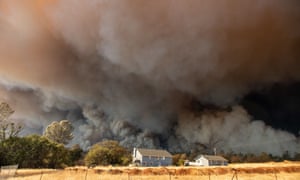
Ahome is overshadowed by towering smoke plumes in Paradise, California . Climate change-related risks will continue to grow without additional action̢۪, the report is set to warn.
A home is overshadowed by towering smoke plumes in Paradise, California . Climate change-related risks will continue to grow without additional action’, the report is set to warn. Photograph: Josh Edelson/AFP/Getty Image

Climate change is already harming Americans’ lives with “substantial damages” set to occur as global temperatures threaten to surge beyond internationally agreed limits, a major US government report has warned.

The influence of climate change is being felt across the US with increases in disastrous wildfires in the west, flooding on the east coast, soil loss in the midwest and coastal erosion in Alaska, according to the US National Climate Assessment. The Guardian saw a draft of the report before publication on Friday.

The draft outlined that “impacts of climate change are intensifying across the country, and that climate-related threats to Americans’ physical, social, and economic wellbeing are rising”. Climate change-related risks “will continue to grow without additional action”, it added.
The quadrennial report, the combined work of 13 federal agencies, was released by the Trump administration on the day after Thanksgiving. Scientists who worked on the report said their research was not watered down but claimed the release was timed to bury the findings during the holiday season.
Global temperatures could be limited to 2C above pre-industrial era if greenhouse gas emissions are slashed but “without significant reductions, annual average global temperatures could increase by 9F (5C) or more by the end of this century”, a previously released chapter states.
Even 2C warming is likely to have major ramifications for societies, as the recent Intergovernmental Panel on Climate Change (IPCC) report spelled out. Heating the planet well beyond this would create a “totally different world”, said Michael Oppenheimer, a climate scientist at Princeton University.
“It would be indescribable, it would turn the world upside down in terms of its climate. There would be nothing like it in the history of civilization.”
Oppenheimer, with many other scientists, has said warming of around 3C is more likely given the advance of renewable energy and expected emissions reductions in the future.
“That is more of an economic, political and technology question,” a report author who wished to remain unnamed told the Guardian. “It’s hard to say what we are on track for right now.”
The draft report warned that the current response was insufficient to stave off the worst impacts, stating that “neither global efforts to mitigate the causes of climate change nor regional efforts to adapt to the impacts currently approach the scales needed to avoid substantial damages to the US economy, environment, and human health and well-being over the coming decades”.
Another report author said: “Climate change is loading the dice against us, it’s going to affect our water, food and ecosystems. This report is important because it shows it’s already happening where we live, not on far off islands or at the poles.”
Included in the dozens of draft report chapters:
  • The summary states the “earth’s climate is now changing faster than at any point in the history of modern civilization, primarily as a result of human activities. The impacts of global climate change are already being felt in the United States and are projected to intensify in the future.”
  • Average sea levels along the US coast have increased by around 9in since the early 20th century as the oceans have warmed and land ice has melted. If emissions are not constrained, “many coastal communities will be transformed by the latter part of this century”.
  • Fisheries, tourism, human health and public safety are being “transformed, degraded or lost due in part to climate change impacts, particularly sea level rise and higher numbers of extreme weather events”.
  • Wildfires have burned at least 3.7m acres in the US in all but three years from 2000 to 2016. “More frequent and larger wildfires, combined with increasing development at the wildland-urban interface portend increasing risks to property and human life,” the report states.
  • More than 100m people in the US live in places with poor air quality and climate change will “worsen existing air pollution levels”. Increased wildfire smoke risks heightening respiratory and cardiovascular problems, while the prevalence of asthma and hay fever is also likely to rise.
  • Major groundwater supplies have declined over the last century, with this decrease accelerating since 2001. “Significant changes in water quantity and quality are evident across the country,” the report finds.
  • Climate change will “disrupt many areas of life” by hurting the US economy, affecting trade and exacerbating overseas conflicts. Low-income and marginalized communities will be worst hit.
The national climate assessment is mandated by Congress to compile the latest research on climate change. The last report came out in 2014. Donald Trump has since announced the US will withdraw from the Paris climate deal, with his administration working to dismantle every major policy designed at lowering emissions.

The release of the report comes as California is racked by its most deadly wildfire on record, the so-called Camp fire, which razed the town of Paradise. At least 84 people have died and tens of thousands of people have had to flee the fire, which has occurred at the same time as a smaller blaze further south, near Los Angeles.
Trump has downplayed assertions by scientists and firefighters that climate change is making California more wildfire-prone, instead pointing to “gross mismanagement” of forest areas. Ryan Zinke, the interior secretary, has said conservationist lawsuits by “radical environmental groups” were to blame.
While visiting devastated parts of California last weekend Trump was asked if what he had seen and heard had changed his mind about climate change, which he has previously called a “hoax”. Trump responded to the question with a firm: “No.”
“When there are daily images of California burning up it’s hard for the administration to argue climate change isn’t happening,” said Oppenheimer. “The strategy seems to be let sleeping dogs lie and hope the public doesn’t pay much attention to it.”

Thursday, November 15, 2018

3078. Increased CO2 Emissions Due to Intensified Wildfires

By Navin Singh Khadka, BBC News, November 15, 2018

Wildfire
Getty Images

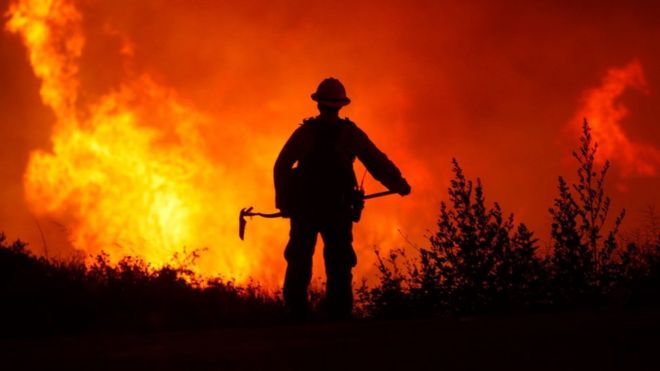
Rising numbers of extreme wildfires could result in a significant increase in CO₂ emissions, scientists warn.
That could mean attaining the Paris climate agreement's goal of keeping global temperature rise well below 2C could become harder, they say.
Present emission-cut pledges by countries are projected to increase the average global temperature rise by more than 3C by the end of the century.
That would lead to dangerous climate change impacts, experts say.
These include sea level rise, drought, wildfires, among other extreme events.
"We can't neglect the emissions from wildfires," says Ramon Vallejo, a scientist specialising on fire ecology with the University of Barcelona.
"Particularly now that we are seeing intense wildfires all around the world."

Estimates and uncertainties

Although estimates vary and still carry uncertainties, some experts say wildfires account for up to 20% of total global greenhouse gas emissions.
They are estimated to increase by a few percent to roughly 30% by the end of this century depending on how the climate changes.
"It is a double whammy," said William Lau, atmospheric scientist with Nasa's Goddard Space Flight Center in Maryland.
"Big forest fires first lead to significant reduction of forests that suck in CO₂ from the atmosphere and the second loss is they cause significant amount of greenhouse gas emissions."
A study earlier this year, however, had found that the annual amount of CO₂ emitted as a result of wildfires having fallen over the past 80 years.
It said the main reason was that large areas of forest and savannah had been converted to land for crops over the past few decades and therefore wildfires had decreased.
The research, however, found that the drop was not huge though.

Intense wildfires

The reason behind that, experts say, is the significantly increased intensity and size of wildfires.
That is why, they add, there are now concerns over possible notable rise of CO₂ emissions.
The total global CO₂ emissions reached 32.5 billion tons last year, according to the International Energy Agency (IEA).
There has, however, not been an exact quantification of emissions from recent wildfires and the one in California now.
Some estimates suggest that the wildfire in northern California last year emitted as much CO₂ in a week as what all of the cars and trucks in the state do in a year.
That is why some fire experts in that US state fear that its level of CO₂ emissions could endanger its progress toward meeting its greenhouse gas reduction targets.

Other hotspots

While California and Australia are most of the time in news for their wildfires these days, other regions have also seen intensified wildfires recently.
Earlier this year, Greece saw its most deadly wildfire season in Europe since 1900 as it claimed 91 lives.
Last year, in Portugal and Spain nearly 70 people were killed by the extreme event.
Wildfires in Sweden this year were another extreme case.
According to the World Meteorological Organization, the fires burned 30,000 hectares of Swedish forest and triggered EU emergency response mechanisms.
In Indonesia, wildfires in September and October of 2015 released about 11.3 teragrams of CO₂ per day, the UN's weather agency said.
"For comparison, the daily release of CO₂ from fossil fuel burning in the European Union is 8.9 teragrams."
A recent study found that the Earth's boreal forests are now burning at a rate unseen in at least 10,000 years.

'100% rise in wildfires'

Another study published in Nature Communications has concluded that if global temperatures rose by three degrees, Mediterranean Europe could see a 100% rise in wildfires.
It added that a 1.5C rise could lead to a 40% increase in wildfires.
"We cannot extrapolate our findings to other forested regions of the world," said Dr Marco Turco, lead author of the report.
"But the projection is that most places across the globe will see similar intensified wildfires in a warming climate."
Scientists say warming causes more fires which, in turn, cause more warming.

Fossil fuel emissions

Some experts, however, say greenhouse emissions from wildfires are still tiny compared to emissions from other human activities.
"The California wildfires are enormous," said Pieter Tans, from the US National Oceanic and Atmospheric Administration (Noaa).
"But I expect that the amount of CO₂ emitted is at most a few percent of what the US burns annually in making electricity, heating and cooling of buildings, traffic, etc."
Thomas Smith, assistant professor in environmental geography at the London School of Economics (LSE) has a similar view.
"These (California) fires are likely fairly insignificant in terms of their global contribution to greenhouse gases," he said.
"At any one time, there are many fires of a similar size burning across the planet; it's just that this one has been close to populated places."

Peatland perils

Some scientists say the really worry is burning of peatlands.
Many of them believe the largest ever wildfire emissions in modern times was the Indonesian peat fire in 1997-98.
Estimates vary, but the largest emission figure for it is 3.7 billion metric ton CO₂.
"The real wildcard is permafrost thaw due to climate change that can make a large amount of northern peat susceptible to fire, which was previously unavailable for burning," says Bill Degroot, a research scientist with the Canadian Forest Service.
"Peatlands are a very large terrestrial [carbon] pool."
Scientists also say the issue of wildfires is even more challenging compared to cutting down carbon emissions from burning of fossil fuels.
"If you want to, you can indeed cut down carbon emissions from fossil fuel burning activities - that is something under your control," says Professor Vallejo.
"But wildfires are not something controllable like that. They will happen and will intensify in a warming world."

Wednesday, June 24, 2015

1902. Environmental Protection Agency's Plans for Greenhouse Emission Reductions Are Contested by Environmental Groups and Scientists

By Eduardo Porter, The New York TimesJune 23, 2015


Is the American approach to combating climate change going off the rails?
Last year, President Obama set a goal of reducing carbon emissions by as much as 28 percent from 2005 levels by 2025, only 10 years from now.

Now, environmental experts are suggesting that some parts of the strategy are, at best, a waste of money and time. At worst, they are setting the United States in the wrong direction entirely.

That is the view of some of the world’s top environmental organizations, including Greenpeace, Friends of the Earth and the Sierra Club. On Tuesday, they argued in a letter to the White House that allowing the burning of biomass to help reduce consumption of fossil fuels in the nation’s power plants, as proposed by the Environmental Protection Agency, would violate the Clean Air Act.

It’s also the view of economists from the University of Chicago and the University of California, Berkeley, who on Tuesday released the disappointing results of a field test of the federal Weatherization Assistance Program, the government’s largest effort to improve residential energy efficiency.

It turns out that burning biomass — wood, mainly — for power produces 50 percent more CO2 than burning coal. And even if new forest growth were to eventually suck all of it out of the atmosphere, it would take decades — perhaps more than a century — to make up the difference and break even with coal.

One study commissioned by the state of Massachusetts concluded that the climate impacts of burning wood were worse than those for coal for 45 years, and worse than for natural gas for about 90 years. Humans do not have that kind of time.

The energy efficiency push has a different problem: It is much too expensive. The weatherization improvements cost more than twice as much as households’ energy savings. Even after including the broad social benefits from less pollution, it was still a bad deal. Indeed, the program spent $329 per ton of CO2 it kept out of the air, some eight times as much as the administration’s estimate of the social cost of damages caused by carbon.

These are not small setbacks. Most of the scenarios that keep the rise in global temperatures under a 2 degree Celsius ceiling, the point at which scientists fear the risk of climate upheaval rises significantly, rely heavily on bioenergy, including biomass for power generation and other biofuels, which face similar problems . Coupled with carbon capture and storage systems, they are wishfully expected to deliver “negative emissions” in the second half of this century.

Efficiency gains are also critical. The Obama administration’s plan for the electricity generating industry has not been completed yet. But the E.P.A.’s original proposal estimated that energy efficiency would account for almost one-fifth of reductions in greenhouse gas emissions from the power sector.

There is plenty of opportunity on the efficiency front, according to Amory B. Lovins of the Rocky Mountain Institute, one of the nation’s most prominent energy experts. He says improvements in energy efficiency have the capacity to take the United States economy almost two-thirds of the way toward phasing out oil, coal and nuclear power by 2050.

The International Energy Agency also relies on energy efficiency gains to deliver almost half of the reduction in greenhouse gas emissions in 2020 in its projected policy scenarios.

Mr. Lovins, a longtime advocate of investment in energy efficiency, argues that such targets are easily achievable. “There is a lot of cheap efficiency to be bought out there,” he told me.

But forecasts like his must contend with the fact that worldwide improvements in energy efficiency are slowing. While there may be great investment opportunities, residential retrofits do not seem to fit the bill.

What this evidence suggests is that climate change strategies too often lack strong analytical foundations, and are driven more by hope than science. Policy makers would be making a mistake to proceed as if their favored methods are working, when the data shows they aren’t.

The task of replacing the world’s entire energy system within the next few decades requires experimenting intensely along many technological avenues, learning quickly from failures and moving on. Yet too often the goal of bringing the world’s carbon emissions under control is put at the service of other agendas, ideological or economic, limiting the world’s options.

Driven by the imperative to find ways to decarbonize the human footprint — yet unwilling to consider potentially fruitful strategies, such as nuclear energy or genetically modified agriculture — many policy makers and environmental advocates have hung their hopes on implausible forecasts for their favored tools, like energy efficiency, or implicitly assumed that much of the world will get by without energy.

This was eloquently illustrated in Pope Francis’s environmental encyclical “Laudato Si’” released last week, in which he made a forceful call to combat climate change and at the same time condemned technology and market mechanisms like carbon trading.
The pope sees in climate change an opportunity to reform humanity’s ways. So he called on the world to address the challenge by tempering overconsumption. In so doing, however, his encyclical deprived people of the tools humanity will need to prevent climatic upheaval.

“We need to look at it as a program of carbon management, not of reforming society,” said Armond Cohen, executive director of the Clean Air Task Force, a nonprofit research and advocacy group.

Michael Greenstone, who runs the Energy Policy Institute at the University of Chicago and was one of the authors of the energy efficiency study, puts that in practical terms. “There is a limited appetite to devote resources to mitigating carbon emissions, so we should aim to pursue the least expensive ones,” he said. “There is a risk that we do a bunch of policies that make us feel better about ourselves but do not hit the climate target directly.”

We are losing time in many ways. Investment in carbon capture and storage technologies is virtually nonexistent. Nuclear energy, the only proven technology to have produced zero-carbon energy at a large scale, has been pushed off the menu in many countries.

“People are taking things off the table that historically have worked, and only putting things on the table that are untried,” Mr. Cohen said.

He welcomes investment in newfangled renewable energy, but argues for much more experimentation with nuclear power, too. Powering an entire grid with the wind and sun, he notes, requires building generation capacity to satisfy peak demand many times over, to keep the lights on when the wind doesn’t blow and the sun is down. Or it requires a fossil-fuel-based backup grid with the capacity to satisfy 100 percent of peak demand.

The biomass industry, meanwhile, is in full throttle. Angus King, the independent senator from biomass-rich Maine, has even proposed a bill in Congress that would direct the E.P.A. to assume that forest biomass emissions do not increase CO2 accumulation as long as forest stocks are not decreasing. The same concept has showed up in a rider to the Interior, Environment and Related Agencies appropriations bill moving through the House and Senate.

Mary Booth, an expert on bioenergy who heads the Partnership for Policy Integrity, said that was like legislating that the sea level cannot rise more than eight inches.

The King Canute strategy cannot protect us and our children from climate change. We need experimentation that will deliver genuine breakthroughs. And that requires putting wishful thinking and phobias aside and letting science guide the way.