Showing posts with label Paris UN Climate Summit. Show all posts

Saturday, November 24, 2018

3095. Worsening Effects of Climate Change in the US

By Oliver Milman, The Guardian, November 23, 2018

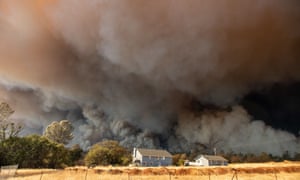
Ahome is overshadowed by towering smoke plumes in Paradise, California . Climate change-related risks will continue to grow without additional action̢۪, the report is set to warn.
A home is overshadowed by towering smoke plumes in Paradise, California . Climate change-related risks will continue to grow without additional action’, the report is set to warn. Photograph: Josh Edelson/AFP/Getty Image

Climate change is already harming Americans’ lives with “substantial damages” set to occur as global temperatures threaten to surge beyond internationally agreed limits, a major US government report has warned.

The influence of climate change is being felt across the US with increases in disastrous wildfires in the west, flooding on the east coast, soil loss in the midwest and coastal erosion in Alaska, according to the US National Climate Assessment. The Guardian saw a draft of the report before publication on Friday.

The draft outlined that “impacts of climate change are intensifying across the country, and that climate-related threats to Americans’ physical, social, and economic wellbeing are rising”. Climate change-related risks “will continue to grow without additional action”, it added.
The quadrennial report, the combined work of 13 federal agencies, was released by the Trump administration on the day after Thanksgiving. Scientists who worked on the report said their research was not watered down but claimed the release was timed to bury the findings during the holiday season.
Global temperatures could be limited to 2C above pre-industrial era if greenhouse gas emissions are slashed but “without significant reductions, annual average global temperatures could increase by 9F (5C) or more by the end of this century”, a previously released chapter states.
Even 2C warming is likely to have major ramifications for societies, as the recent Intergovernmental Panel on Climate Change (IPCC) report spelled out. Heating the planet well beyond this would create a “totally different world”, said Michael Oppenheimer, a climate scientist at Princeton University.
“It would be indescribable, it would turn the world upside down in terms of its climate. There would be nothing like it in the history of civilization.”
Oppenheimer, with many other scientists, has said warming of around 3C is more likely given the advance of renewable energy and expected emissions reductions in the future.
“That is more of an economic, political and technology question,” a report author who wished to remain unnamed told the Guardian. “It’s hard to say what we are on track for right now.”
The draft report warned that the current response was insufficient to stave off the worst impacts, stating that “neither global efforts to mitigate the causes of climate change nor regional efforts to adapt to the impacts currently approach the scales needed to avoid substantial damages to the US economy, environment, and human health and well-being over the coming decades”.
Another report author said: “Climate change is loading the dice against us, it’s going to affect our water, food and ecosystems. This report is important because it shows it’s already happening where we live, not on far off islands or at the poles.”
Included in the dozens of draft report chapters:
  • The summary states the “earth’s climate is now changing faster than at any point in the history of modern civilization, primarily as a result of human activities. The impacts of global climate change are already being felt in the United States and are projected to intensify in the future.”
  • Average sea levels along the US coast have increased by around 9in since the early 20th century as the oceans have warmed and land ice has melted. If emissions are not constrained, “many coastal communities will be transformed by the latter part of this century”.
  • Fisheries, tourism, human health and public safety are being “transformed, degraded or lost due in part to climate change impacts, particularly sea level rise and higher numbers of extreme weather events”.
  • Wildfires have burned at least 3.7m acres in the US in all but three years from 2000 to 2016. “More frequent and larger wildfires, combined with increasing development at the wildland-urban interface portend increasing risks to property and human life,” the report states.
  • More than 100m people in the US live in places with poor air quality and climate change will “worsen existing air pollution levels”. Increased wildfire smoke risks heightening respiratory and cardiovascular problems, while the prevalence of asthma and hay fever is also likely to rise.
  • Major groundwater supplies have declined over the last century, with this decrease accelerating since 2001. “Significant changes in water quantity and quality are evident across the country,” the report finds.
  • Climate change will “disrupt many areas of life” by hurting the US economy, affecting trade and exacerbating overseas conflicts. Low-income and marginalized communities will be worst hit.
The national climate assessment is mandated by Congress to compile the latest research on climate change. The last report came out in 2014. Donald Trump has since announced the US will withdraw from the Paris climate deal, with his administration working to dismantle every major policy designed at lowering emissions.

The release of the report comes as California is racked by its most deadly wildfire on record, the so-called Camp fire, which razed the town of Paradise. At least 84 people have died and tens of thousands of people have had to flee the fire, which has occurred at the same time as a smaller blaze further south, near Los Angeles.
Trump has downplayed assertions by scientists and firefighters that climate change is making California more wildfire-prone, instead pointing to “gross mismanagement” of forest areas. Ryan Zinke, the interior secretary, has said conservationist lawsuits by “radical environmental groups” were to blame.
While visiting devastated parts of California last weekend Trump was asked if what he had seen and heard had changed his mind about climate change, which he has previously called a “hoax”. Trump responded to the question with a firm: “No.”
“When there are daily images of California burning up it’s hard for the administration to argue climate change isn’t happening,” said Oppenheimer. “The strategy seems to be let sleeping dogs lie and hope the public doesn’t pay much attention to it.”

Saturday, November 28, 2015

2101. COP21: Why Science Make a Difference

By Eric Rehm, Yes Magazine, November 21, 2015

I’m a climate scientist headed to Paris next week for the 21st round of U.N. Conference of Parties climate talks because I believe this time will be different. Why? Science.

In less than one week, COP21 will establish an international agreement on the reduction of carbon dioxide, methane, and other greenhouse gas emissions required to keep global warming below 2 degrees Celsius. But individually and collectively the commitments countries have made in advance of COP21, even if carried out to the letter, have failed to meet this target, allowing warming to 2.7–3 degrees. I’m making the trip to observe the talks and join in with organizations demanding better commitments than that.

Let’s examine the evidence: Has science sufficiently warned the planet so that we can take action? Has the scientific community provoked policy change? Has science inspired and supported movements for climate and social change?

Yes, yes, and yes.

Scientists have been publishing the dire consequences of global warming since the 1970s, when Yale professor William Nordhaus predicted that sea level rise and “hardship in low-lying areas” would accompany 1 C of global temperature warming, a level we recently achieved, according to the UK Met Office.

And what about me, just one scientist? I study the effects of the changing climate on Arctic marine ecosystems. I see that ice is melting sooner, forming later. Spring algae blooms in the Arctic are occurring earlier, lasting longer. I spend weeks on the ice doing field work near indigenous communities that are among the first to suffer from climate-based changes to their food sources, directly aggravating their struggle with poverty and food security. I write papers, create posters, and speak in classrooms about what I do and what I have learned. I am aware that all of my colleagues are also spending each day like this, confronting Earth’s changes every hour of their working lives. I think we are learning to do a better job telling the story of what has happened and will happen to the planet, and why.

But that’s not enough.

From science to radical change
As fascinating as it is to study, I don’t want to see climate change. The change I do want to see is nations responding to the widespread calls for limiting carbon emissions from fossil fuels. We can make better choices about agriculture and forest land use, and governments need to assure safe and healthy lives for their citizens. Personal and social transformation go hand-in-hand. One person alone changes very little, but unjust authority can be overturned when many people work together with passion and discipline. I’m driven to discover the path from science to policy to radical change. How does this happen?

One of the most influential papers in the history of climate science was published six years ago, and it was only six pages long. “Greenhouse-Gas Emission Targets for Limiting Global Warming to 2 °C” changed the way scientists and activists alike advocated for climate change policy by shifting the conversation from concentration to accumulation. Malte Meinshausen and colleagues created a carbon budget, showing that we can emit only 565 more gigatonnes of carbon into the atmosphere before 2050 if we want to reliably limit warming to 2 degrees. Further, they found that at current rates of carbon emission, we will blow this 565 gigatonnes budget by 2024. This immediately transformed the science and policy questions to how much coal, oil, and natural gas is unburnable and how can we quickly slow down our burn rate?

By 2012, Bill McKibben and 350.org had seized on this idea of the carbon budget with their brilliant “Do the Math” tour and movie, identifying three simple numbers that activists could use:

1. We need to keep global warming below 2 C.
2. To do that we can only emit roughly 565 more gigatonnes of carbon into the atmosphere.
3. The scariest of all, the amount of fossil fuel recoverable under current economic conditions is five times that, or 2,795 gigatonnes.

The result? The climate movement is successfully promoting a “leave it in the ground” fossil fuel strategy, divestment in the financially risky fossil fuel sector—whose net worth may plummet by 80 percent because of those “stranded assets”—and instigating calls for the U.S. Department of Justice to investigate ExxonMobil and other fossil fuel companies for organizing a sustained deception campaign disputing climate science and failing to disclose truthful information to investors and the public.

These campaigns have led hundreds of thousands of people into the streets to demand specific limits on carbon emissions and helped to topple the Keystone XL pipeline. After the People's Climate March in New York City, in September 2014, President Obama remarked, “Our citizens keep marching. We cannot pretend we do not hear them. We have to answer the call.”

For the climate movement, science provided the numbers, and the numbers added up.

Scientists as activists
Using this carbon budget, science has identified the radical changes needed in how we produce and distribute electricity, in the forms and modes of transportation we use, in the use and care of agricultural and forest land, and in how much energy we must conserve in our homes, buildings, and industries. Unlike at previous climate talks, countries are coming to the table with science-backed contributions that challenge the business-as-usual approach.

Yes, some rich countries will try to buy their way out. Switzerland, for example, proposes to buy 40 percent of its carbon emission reductions on the carbon market rather than making actual reductions itself. Yes, the U.S. moved the goal post by basing their 35 percent reduction on 2005 levels. U.S. carbon emission commitments to 2030 actually represent a 15 percent increase from the internationally recognized benchmark date of 1990.

Yes, some of the reductions we are sold are a lie. For example, greenhouse gas emissions due to movement from coal to fracked natural gas fuels appear lower until you factor in methane leakage from gas drilling sites, pipelines, and flaring. Until such “fugitive emissions” are resolved, the greenhouse gas footprint of fracked gas is larger than coal, and gas plays no transitional role toward real reductions in climate warming.

But science is getting in the way of business-as-usual. COP21 representatives will return home to popular movements increasingly demanding radical change. Outside the formal COP21 talks, popular movements will take advantage of this unique moment in history to engage in important and vigorous debate about how the climate movement and other social movements can unite around common goals. When we consider, for example, the inattention to the physical, environmental, and cultural destruction of the Arctic communities shared by polar bears, whales, walruses, and Inuit alike, the questions and urgency for action are very similar to those raised by Black Lives Matter and Idle No More when discussing human rights.

Popular movements need to take note that science has demonstrated the links between climate change, mass migration, and war in Syria. Similarly, we must link climate, refugee support, and antiwar movements. Green and anti-austerity parties are proposing climate stabilization strategies focused on clean renewable and efficiency investments, demanding large-scale public investment. We, the people, will also win by proposing specific carbon budget objectives.

Scientists have and will continue to get uncomfortably in the way of things, creating a new narrative for change.

For example, climatologist Michael E. Mann, whose 1999 “hockey stick graph” of the mean temperature record of the past 100 years demonstrates the uncharacteristic and rapid nature of current warming, helped establish RealClimate.org, where claims of climate deniers are soundly and scientifically debunked.

Intergovernmental Panel on Climate Change lead author Petra Tschakert has called to task U.N. Framework Convention on Climate Change executives on their apparent acceptance of carbon emission targets that lead to a 2 C warmer world, calling the resulting “danger, risk and harm … utterly unacceptable.” Her passionate argument is not just about a specific temperature target. Rather she sees at stake “a commitment to protect the most vulnerable and at-risk populations and ecosystems.” Agreeing, former NASA climatologist James Hansen has called the 2 C target “highly dangerous,” backing it up with science currently under peer review.

Scientists are “people like you, with hopes and dreams and loved ones,” stories from MoreThanScientists.org remind us. “We are mothers, fathers, farmers, fishermen, hikers, hunters … and we’re concerned.”

The world depends on continued conversation with scientists. So I'm headed to Paris in a few days to raise my voice.