By Gale Sinatra and Barbara K. Hofer, The Conversation, January 5, 2022
Every disaster movie seems to open with a scientist being ignored.“Don’t Look Up”is no exception – in fact, people ignoring or flat out denying scientific evidence is the point.
Leonardo DiCaprio and Jennifer Lawrence play astronomers who make a literally Earth-shattering discovery and then try to persuade the president to take action to save humanity. It’s a satire that explores how individuals, scientists, the media and politicians respond when faced with scientific facts that are uncomfortable, threatening and inconvenient.
The movie is an allegory for climate change, showing how those with the power to do something about global warming willfully avoid taking action and how those with vested interests can mislead the public. But it also reflects science denial more broadly, including what the world has been seeing with COVID-19.
The most important difference between the film’s premise and humanity’s actual looming crisis is that while individuals may be powerless against a comet, everyone can act decisively to stop fueling climate change.
Knowing the myths that feed science denial can help.
Myth #1: We can’t act unless the science is 100% certain
The first question President Orlean (Meryl Streep) asks the scientists after they explain that a comet is on a collision course with Earth is, “So how certain is this?” Learning that the certitude is 99.78%, the president’s chief of staff (Jonah Hill) responds with relief: “Oh great, so it’s not 100%!” Government scientist Teddy Oglethorpe (Rob Morgan) replies, “Scientists never like to say 100%.”
This reluctance to claim 100% certainty is a strength of science. Even when the evidence points clearly in one direction, scientists keep exploring to learn more. At the same time, they recognize overwhelming evidence and act on it. The evidence is overwhelming that Earth’s climate is changing in dangerous ways because of human activities, particularly the burning of fossil fuels, and it has been overwhelming for many years.
When politicians take a “let’s wait and see” attitude toward climate change (or “sit tight and assess,” as the movie puts it), suggesting they need more evidence before taking any action, it’s often a form of science denial.
Myth #2: Disturbing realities as described by scientists are too difficult for the public to accept
The title phrase, “Don’t Look Up,” portrays this psychological assumption and how some politicians conveniently use it as an excuse for inaction while promoting their own interests.
A 2021 international study found that 80% of individuals are indeed willing to make changes in how they live and work to help reduce the effects of climate change.
Myth #3: Technology will save us, so we don’t have to act
Often, individuals want to believe in an outcome they prefer, rather than confront reality known to be true, a response that psychologists call motivated reasoning.
For example, belief that a single technological solution, such as carbon capture, will fix the climate crisis without the need for change in policies, lifestyles and practices may be more grounded in hope than reality. Technology can help reduce our impact on the climate; however, research suggests advances are unlikely to come quickly enough.
Hoping for such solutions diverts attention from significant changes needed in the way we work, live and play, and is a form of science denial.
Myth #4: The economy is more important than anything, including impending crises predicted by science
Taking action to slow climate change will be expensive, but not acting has extraordinary costs – in lives lost as well as property.
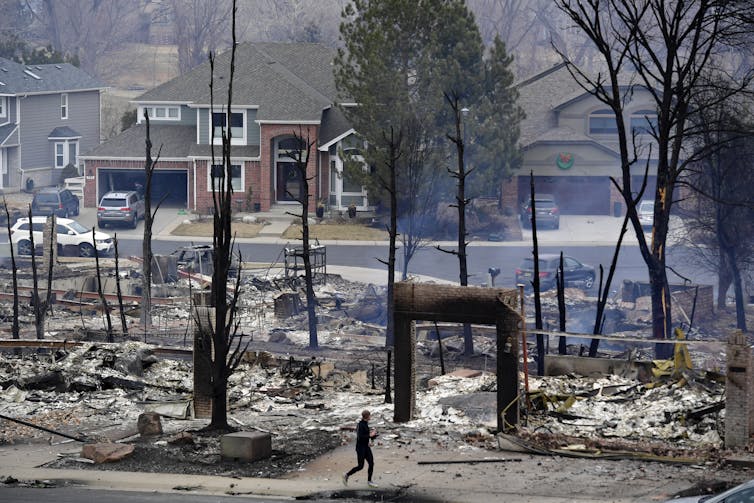
Consider the costs of recent Western wildfires. Boulder County, Colorado, lost nearly 1,000 homes to a fire on Dec. 30, 2021, after a hot, dry summer and fall and little recent rain or snow. A study of California’s fires in 2018 – another hot, dry year – when the town of Paradise burned, estimated the damage, including health costs and economic disruption, at about $148.5 billion.
Myth #5: Our actions should always align with our social identity group
In a politically polarized society, individuals may feel pressured to make decisions based on what their social group believes. In the case of beliefs about science, this can have dire consequences – as the world has seen with the COVID-19 pandemic. In the U.S. alone, more than 825,000 people with COVID-19 have died while powerful identity groups actively discourage people from getting vaccines or taking other precautions that could protect them.
Viruses are oblivious to political affiliation, and so is the changing climate. Rising global temperatures, worsening storms and sea level rise will affect everyone in harm’s way, regardless of the person’s social group.
How ideology drives responses to climate change
The Pew Research Center asked people worldwide: "How much, if anything, would you be willing to change about how you live and work to help reduce the effects of global climate change?" The difference between those identifying on the ideological left vs. right is stark in the U.S., but less so in other countries. The chart shows percentages willing to make "a lot" or "some" changes.
The difference between those identifying as on the ideological left vs. right is stark in the U.S., but less so in other countries.
When people say we can’t take action because action is expensive, they are in denial of the cost of inaction.
Myth #5: Our actions should always align with our social identity group
In a politically polarized society, individuals may feel pressured to make decisions based on what their social group believes. In the case of beliefs about science, this can have dire consequences – as the world has seen with the COVID-19 pandemic. In the U.S. alone, more than 825,000 people with COVID-19 have died while powerful identity groups actively discourage people from getting vaccines or taking other precautions that could protect them.
Viruses are oblivious to political affiliation, and so is the changing climate. Rising global temperatures, worsening storms and sea level rise will affect everyone in harm’s way, regardless of the person’s social group.
How to combat science denial – and climate change
A comet headed for Earth might leave little for individuals to do, but this is not the case with climate change. People can change their own practices to reduce carbon emissions and, importantly, pressure leaders in government, business and industry to take actions, such as reducing fossil fuel use, converting to cleaner energy and changing agricultural practices to reduce emissions.
In ourbook, we discuss steps that individuals, educators, science communicators and policymakers can take to confront the science denial that prevents moving forward on this looming issue. For example:
Individuals can check their own motivations and beliefs about climate change and remain open minded to scientific evidence.
Educators can teach students how to source scientific information and evaluate it.
Science communicators can explain not just what scientists know but how they know it.
Policymakers can make decisions based on scientific evidence.
As scholars who work to help people make sound decisions about complex problems, we encourage people to consume news and science information from sources outside their own identity group. Break out of your social bubble and listen to and talk with others. Look up.
Carbon pricing and carbon taxes are now proposed by international institutions and mainstream economics as the main solutions to ending global warming and destructive climate change. For some time, the IMF has been pushing for carbon pricing as ‘a necessary if not sufficient’ part of a climate policy package that also includes investment in ‘green technology’ and redistribution of income to help the worst-off cope with the financial burden. The IMF is now proposing a global minimum carbon price — along the lines of the global minimum floor on corporate taxes which has recently secured agreement.
At the recent meeting of the G20 finance ministers, carbon pricing was endorsed as one of “a wide set of tools” to tackle climate change. Speaking at the Venice International Conference on Climate, Christine Lagarde, president of the European Central Bank, also underscored the need for carbon pricing, emphasising the importance of an “effective carbon price that reflects the true cost of carbon”. An agreed carbon price would then be a precursor to the establishment of a carbon border tax, which would serve as a tariff on imports from countries without carbon pricing. This would be an incentive for others to join the ‘coalition of the willing’.
The EU Commission announced what it calls ‘Fit for 55’ plan to achieve a carbon-neutral EU by 2050 and reduce carbon emissions by 55% below 1990s levels before the decade is out. Again, it looks to carbon pricing to achieve this, as well as carbon import taxes. The EU commission proposes gradually increasing minimum taxes on the most polluting fuels such as petrol, diesel and kerosene used as jet-fuel over a period of ten years. Zero-emissions fuels, green hydrogen and sustainable aviation fuels will face no levies for a decade under the proposed system. Paolo Gentiloni, Brussels economics commissioner, has called the reform a “now or never moment”.
It was no accident that the EU and G20 have turned to William Nordhaus, an American economist and Nobel laureate for economics advice on climate change. Nordhaus gave the keynote address at the Venice conference. He said that “It is a painful, painful realisation, but I think we need to face it: Our international climate policy, the approach we are taking, is at a dead end.” But what was Nordhaus’ answer to this dismal conclusion? He called for a “climate club” of countries willing to commit to a carbon price. “A key ingredient in reducing emissions is high carbon prices,” he said, adding that a “climate club” would have to impose a penalty tariff on countries that did not have carbon pricing in place. Nordhaus said such an approach would help solve the problem of ‘free riding’, which has plagued existing global climate agreements, all of which are voluntary.
Nordhaus has been a major advocate of a ‘market solution’ to climate change. Nordhaus has constructed so-called integrated assessment models (IAMs) to estimate the social cost of carbon (SCC) and evaluate alternative abatement policies. Nordhaus’ IAMs assume that the world economy will have a much larger GDP in 50 years so that even if carbon emissions rise as predicted, governments can defer the cost of mitigation to the future. In contrast, if you apply stringent carbon abatement measures eg ending all coal production, you might lower growth rates and incomes and so make it more difficult to mitigate in the future. Instead, according to Nordhaus, with carbon pricing and taxes we can control and reduce emissions without reducing fossil fuel production and consumption at source.
It is the tobacco/cigarette pricing and taxing solution. The higher the tax or price, the lower the consumption, without touching the tobacco industry. Leaving aside the question of whether smoking has really been eradicated globally by pricing adjustments, can global warming really be solved by market pricing? Market solutions to climate change are based on trying to correct “market failure” by incorporating the nefarious effects of carbon emissions via a tax or quota system. The argument goes that, as mainstream economic theory does not incorporate the social costs of carbon into prices, the price mechanism must be “corrected” through a tax or a new market. But asa recent essay pointed out, the problem is that climate change is not one market failure (like tobacco) but several: in capitalist transport, energy, technology, finance and employment.
Economists who have attempted to calculate what the ‘social price’ of carbon should be have found that there are so many factors involved and the pricing must be projected over a such a long time horizon that it is really impossible to place a monetary value on the ‘social damage’– estimates for the carbon price range from $14 per ton of CO2 to $386! “It is impossible to approximate the uncertainties in low-probability but high-damage, catastrophic or irreversible outcomes.” Indeed, where carbon pricing has been applied, it has been a miserable failure in reducing emissions, or in the case of Australia, dropped by the government under the pressure of energy and mining companies.
And while there is much talk about raising carbon emission prices, little or nothing is said about the huge subsidies that governments continue to make to fossil fuel industries. EU Commissioner Gentiloni admitted as such: “Paradoxically, [the current energy taxation directive] is incentivising fossil fuels and not environmentally friendly fuels. We have to change this.”
The G20 countries have provided more than $3.3tn (£2.4tn) in subsidies for fossil fuels since theParis climate agreement was sealed in 2015, a report shows, despite many committing to tackle the crisis. The report says all 19 G20 member states continue to provide substantial financial support for fossil-fuel production and consumption – the EU bloc is the 20th member. Overall, subsidies fell by 2% a year from 2015 to reach $636bn in 2019, the latest data available.
But Australia increased its fossil fuel subsidies by 48% over the period, Canada’s support rose by 40% and that from the US by 37%. The UK’s subsidies fell by 18% over that time but still stood at $17bn in 2019, according to the report. The biggest subsidies came from China, Saudi Arabia, Russia and India, which together accounted for about half of all the subsidies.
The report found that 60% of the fossil fuel subsidies went to the companies producing fossil fuels and 40% to cutting prices for energy consumers. A recent report by the International Institute for Sustainable Development concluded that reforming fossil fuel subsidies aimed at consumers in 32 countries could reduce CO2 emissions by 5.5bn tonnes by 2030, equivalent to the annual emissions of about 1,000 coal-fired power plants. It said these changes would also save governments nearly $3tn by 2030. The International Energy Agency’s road map for net-zero emissions by 2050 calls for a 6 per cent decline in coal-fired generation annually. Yet coal will grow by almost 5 per cent this year, and another 3 per cent in 2022, hitting a new peak.
Nordhaus is right. Current climate change policies are at a dead end and the impact of climate change and environmental destruction is getting worse by the day. Earthquakes, storms, floods and droughts — the number of recorded loss events resulting from natural disasters – has been increasing for some years now.
The report also examined how G20 countries were putting a price on carbon pollution. It found that more than 80% of emissions were covered by such prices in France, Germany and South Africa. In the UK, 31% of emissions are covered but the UK has one of highest carbon prices at $58 per tonne of CO2. Just 8% of US emissions are covered and at the low price of $6 per tonne. Russia, Brazil, and India do not have any carbon prices. In his address to the G20, Nordhaus showed that the current average global carbon price is under $2 and 80% of global emissions have no carbon emissions pricing market at all!
So the carbon pricing and taxation solution, even if it worked to lower emissions, is a pipedream as it can never be implemented globally before global warming reaches dangerous ‘tipping points’. All the latest climate science suggests that the tipping points are approaching fast and allowing fossil fuel production to continue while trying to reduce its use by ‘market’ solutions’ like carbon pricing and taxes will not be enough. Even the IMF has admitted that market solutions have not worked.
Market solutions are not working because for capitalist companies it is just not profitable to invest in climate change mitigation: “Private investment in productive capital and infrastructure faces high upfront costs and significant uncertainties that cannot always be priced. Investments for the transition to a low-carbon economy are additionally exposed to important political risks, illiquidity and uncertain returns, depending on policy approaches to mitigation as well as unpredictable technological advances.” (IMF)
Indeed: “The large gap between the private and social returns on low-carbon investments is likely to persist into the future, as future paths for carbon taxation and carbon pricing are highly uncertain, not least for political economy reasons. This means that there is not only a missing market for current climate mitigation as carbon emissions are currently not priced, but also missing markets for future mitigation, which is relevant for the returns to private investment in future climate mitigation technology, infrastructure and capital.” In other words, it ain’t profitable to do anything significant.
What is the alternative? Mark Carney, former Bank of England governor and climate change envoy for the UN and many multi-nationals, reckons it is ‘regulation’. “We need clear, credible and predictable regulation from government,” he said. “Air quality rules, building codes, that type of strong regulation is needed. You can have strong regulation for the future, then the financial market will start investing today, for that future. Because that’s what markets do, they always look forward.”
Carney’s answer is really an excuse for continuing to expand fossil fuel production. Although the IEA recently said that the world was to stay within 1.5C Paris target increase in global heating, there could be no more exploration or development of fossil fuel resources, Carney argues that countries and companies could still carry on exploiting fossil fuels, if they use technology such as carbon capture and storage, or other ways of reducing emissions. “With the right regulation, with a rising carbon price, with a financial sector that is oriented this way, with public accountability of government, of financial institutions, of companies, yes, then we can, we certainly have the conditions in which to achieve [holding global heating to 1.5C“.
This is disingenous nonsense. Carbon pricing schemes just hide the reality that, as long as the fossil fuel industry and the other big multinational emitters of greenhouse gases are untouched and not brought into a plan for phasing them out, the tipping point for irreversible global warming will be passed. Instead of waiting for the market to speak, and for ‘regulation’, we need a global plan where fossil fuel industries, financial institutions and major emitting sectors are brought under public ownership and control.
Who are the biggest emitters or consumers of carbon apart from the fossil fuel industry? It is the richest wealth and income earners in the Global North who have excessive consumption and fly everywhere. It is the military (the biggest sector of carbon consumption). The waste of capitalist production and consumption in autos, aircraft and airlines, shipping, chemicals, bottled water, processed foods, unnecessary pharmaceuticals and so on is directly linked to carbon emissions. Harmful industrial processes like industrial agriculture, industrial fishing, logging, mining and so on are also major global heaters, while the banking industry operates to underwrite and promote all this carbon emission.
A global plan could steer investments into things society does need, like renewable energy, organic farming, public transportation, public water systems, ecological remediation, public health, quality schools and other currently unmet needs. And it could equalize development the world over by shifting resources out of useless and harmful production in the North and into developing the South, building basic infrastructure, sanitation systems, public schools, health care. At the same a global plan could aim to provide equivalent jobs for workers displaced by the retrenchment or closure of unnecessary or harmful industries. Planning not pricing.
By James Dyke, Robert Watson, and Wolfgang Knorr, The Conversation, April 22, 2021
Sometimes realisation comes in a blinding flash. Blurred outlines snap into shape and suddenly it all makes sense. Underneath such revelations is typically a much slower-dawning process. Doubts at the back of the mind grow. The sense of confusion that things cannot be made to fit together increases until something clicks. Or perhaps snaps.
Collectively we three authors of this article must have spent more than 80 years thinking about climate change. Why has it taken us so long to speak out about the obvious dangers of the concept of net zero? In our defence, the premise of net zero is deceptively simple – and we admit that it deceived us.
The threats of climate change are the direct result of there being too much carbon dioxide in the atmosphere. So it follows that we must stop emitting more and even remove some of it. This idea is central to the world’s current plan to avoid catastrophe. In fact, there are many suggestions as to how to actually do this, from mass tree planting, to high tech direct air capture devices that suck out carbon dioxide from the air.
The current consensus is that if we deploy these and other so-called “carbon dioxide removal” techniques at the same time as reducing our burning of fossil fuels, we can more rapidly halt global warming. Hopefully around the middle of this century we will achieve “net zero”. This is the point at which any residual emissions of greenhouse gases are balanced by technologies removing them from the atmosphere.
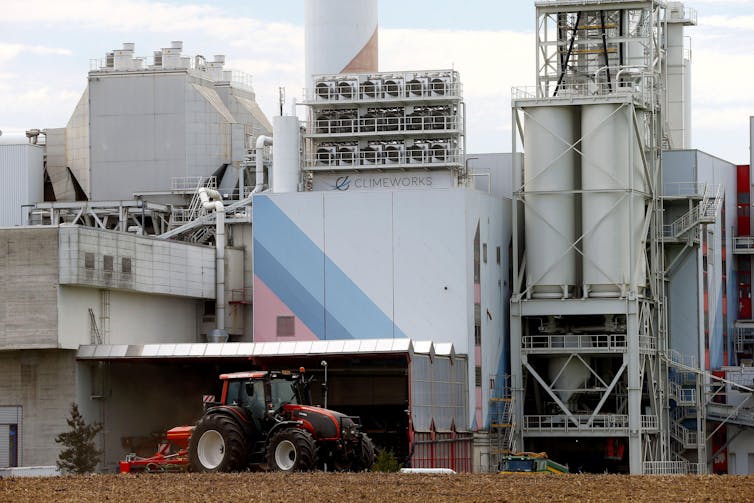
A facility for capturing carbon dioxide from air on the roof of a waste incinerating plant in Hinwil, Switzerland July 18, 2017. This is one of the handful of demonstrator projects currently in operation.REUTERS/Arnd Wiegmann
This is a great idea, in principle. Unfortunately, in practice it helps perpetuate a belief in technological salvation and diminishes the sense of urgency surrounding the need to curb emissions now.
We have arrived at the painful realisation that the idea of net zero has licensed a recklessly cavalier “burn now, pay later” approach which has seen carbon emissions continue to soar. It has also hastened the destruction of the natural world by increasing deforestation today, and greatly increases the risk of further devastation in the future.
To understand how this has happened, how humanity has gambled its civilisation on no more than promises of future solutions, we must return to the late 1980s, when climate change broke out onto the international stage.
Steps towards net zero
On June 22 1988, James Hansen was the administrator of Nasa’s Goddard Institute for Space Studies, a prestigious appointment but someone largely unknown outside of academia.
By the afternoon of the 23rd he was well on the way to becoming the world’s most famous climate scientist. This was as a direct result of his testimony to the US congress, when he forensically presented the evidence that the Earth’s climate was warming and that humans were the primary cause: “The greenhouse effect has been detected, and it is changing our climate now.”
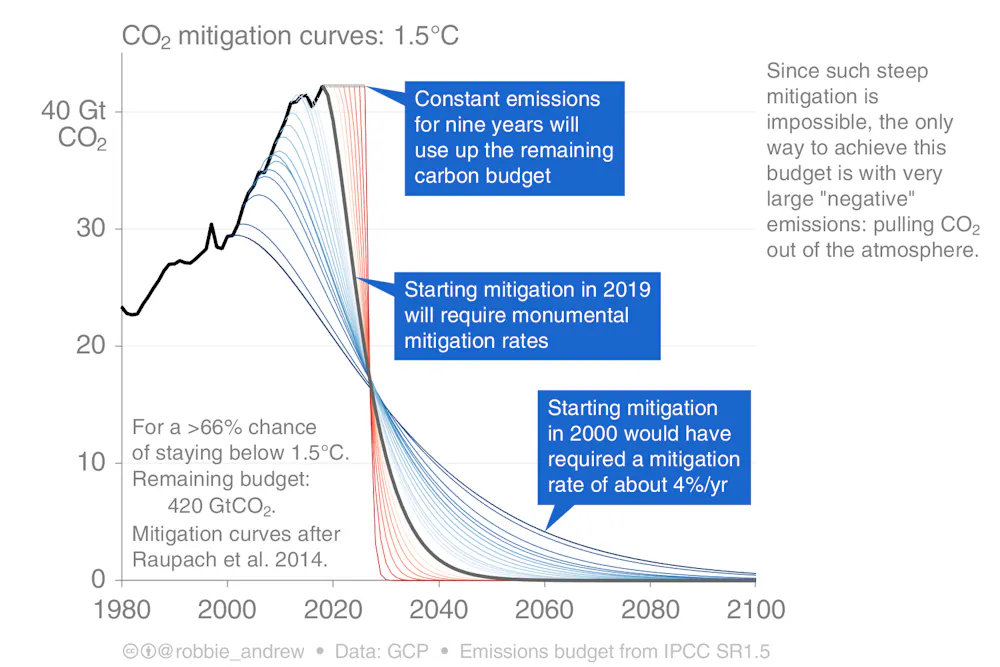
If we had acted on Hansen’s testimony at the time, we would have been able to decarbonise our societies at a rate of around 2% a year in order to give us about a two-in-three chance of limiting warming to no more than 1.5°C. It would have been a huge challenge, but the main task at that time would have been to simply stop the accelerating use of fossil fuels while fairly sharing out future emissions.
Four years later, there were glimmers of hope that this would be possible. During the 1992 Earth Summit in Rio, all nations agreed to stabilise concentrations of greenhouse gases to ensure that they did not produce dangerous interference with the climate. The 1997 Kyoto Summit attempted to start to put that goal into practice. But as the years passed, the initial task of keeping us safe became increasingly harder given the continual increase in fossil fuel use.
It was around that time that the first computer models linking greenhouse gas emissions to impacts on different sectors of the economy were developed. These hybrid climate-economic models are known as Integrated Assessment Models. They allowed modellers to link economic activity to the climate by, for example, exploring how changes in investments and technology could lead to changes in greenhouse gas emissions.
They seemed like a miracle: you could try out policies on a computer screen before implementing them, saving humanity costly experimentation. They rapidly emerged to become key guidance for climate policy. A primacy they maintain to this day.
Unfortunately, they also removed the need for deep critical thinking. Such models represent society as a web of idealised, emotionless buyers and sellers and thus ignore complex social and political realities, or even the impacts of climate change itself. Their implicit promise is that market-based approaches will always work. This meant that discussions about policies were limited to those most convenient to politicians: incremental changes to legislation and taxes.
Around the time they were first developed, efforts were being made to secure US action on the climate by allowing it to count carbon sinks of the country’s forests. The US argued that if it managed its forests well, it would be able to store a large amount of carbon in trees and soil which should be subtracted from its obligations to limit the burning of coal, oil and gas. In the end, the US largely got its way. Ironically, the concessions were all in vain, since the US senate never ratified the agreement.
Forests such as this one in Maine, US, were suddenly counted in the carbon budget as an incentive for the US to join the Kyoto Agreement.Inbound Horizons/Shutterstock
Postulating a future with more trees could in effect offset the burning of coal, oil and gas now. As models could easily churn out numbers that saw atmospheric carbon dioxide go as low as one wanted, ever more sophisticated scenarios could be explored which reduced the perceived urgency to reduce fossil fuel use. By including carbon sinks in climate-economic models, a Pandora’s box had been opened.
It’s here we find the genesis of today’s net zero policies.
That said, most attention in the mid-1990s was focused on increasing energy efficiency and energy switching (such as the UK’s move from coal to gas) and the potential of nuclear energy to deliver large amounts of carbon-free electricity. The hope was that such innovations would quickly reverse increases in fossil fuel emissions.
But by around the turn of the new millennium it was clear that such hopes were unfounded. Given their core assumption of incremental change, it was becoming more and more difficult for economic-climate models to find viable pathways to avoid dangerous climate change. In response, the models began to include more and more examples of carbon capture and storage, a technology that could remove the carbon dioxide from coal-fired power stations and then store the captured carbon deep underground indefinitely.
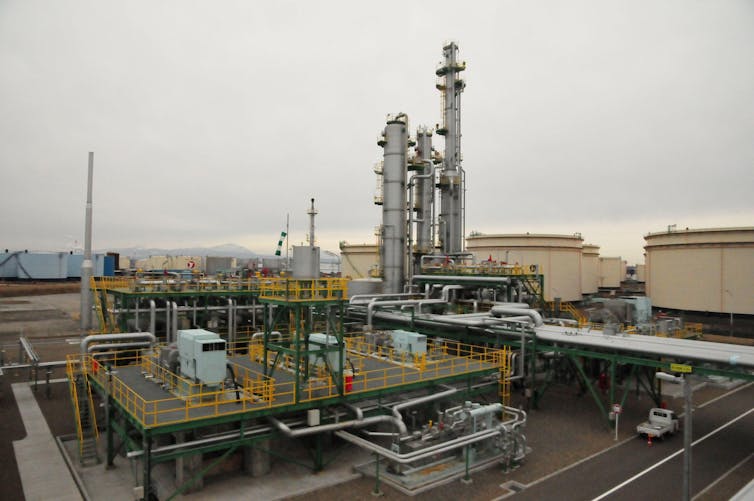
The Tomakomai carbon, capture and storage test site, Hokkaido, Japan, March 2018. Over its three-year lifetime, it’s hoped that this demonstrator project will capture an amount of carbon approximately 1/100,000 of current global annual emissions. The captured carbon will be piped into geological deposits deep under the sea bed where it will need to remain for centuries.REUTERS/Aaron Sheldrick
This had been shown to be possible in principle: compressed carbon dioxide had been separated from fossil gas and then injected underground in a number of projects since the 1970s. These Enhanced Oil Recovery schemeswere designed to force gases into oil wells in order to push oil towards drilling rigs and so allow more to be recovered – oil that would later be burnt, releasing even more carbon dioxide into the atmosphere.
Carbon capture and storage offered the twist that instead of using the carbon dioxide to extract more oil, the gas would instead be left underground and removed from the atmosphere. This promised breakthrough technology would allow climate friendly coaland so the continued use of this fossil fuel. But long before the world would witness any such schemes, the hypothetical process had been included in climate-economic models. In the end, the mere prospect of carbon capture and storage gave policy makers a way out of making the much needed cuts to greenhouse gas emissions.
The rise of net zero
When the international climate change community convened in Copenhagen in 2009 it was clear that carbon capture and storage was not going to be sufficient for two reasons.
First, it still did not exist. There were no carbon capture and storage facilitiesin operation on any coal fired power station and no prospect the technology was going to have any impact on rising emissions from increased coal use in the foreseeable future.
The biggest barrier to implementation was essentially cost. The motivation to burn vast amounts of coal is to generate relatively cheap electricity. Retrofitting carbon scrubbers on existing power stations, building the infrastructure to pipe captured carbon, and developing suitable geological storage sites required huge sums of money. Consequently the only application of carbon capture in actual operation then – and now – is to use the trapped gas in enhanced oil recovery schemes. Beyond a single demonstrator, there has never been any capture of carbon dioxide from a coal fired power station chimney with that captured carbon then being stored underground.
Just as important, by 2009 it was becoming increasingly clear that it would not be possible to make even the gradual reductions that policy makers demanded. That was the case even if carbon capture and storage was up and running. The amount of carbon dioxide that was being pumped into the air each year meant humanity was rapidly running out of time.
With hopes for a solution to the climate crisis fading again, another magic bullet was required. A technology was needed not only to slow down the increasing concentrations of carbon dioxide in the atmosphere, but actually reverse it. In response, the climate-economic modelling community – already able to include plant-based carbon sinks and geological carbon storage in their models – increasingly adopted the “solution” of combining the two.
So it was that Bioenergy Carbon Capture and Storage, or BECCS, rapidly emerged as the new saviour technology. By burning “replaceable” biomass such as wood, crops, and agricultural waste instead of coal in power stations, and then capturing the carbon dioxide from the power station chimney and storing it underground, BECCS could produce electricity at the same time as removing carbon dioxide from the atmosphere. That’s because as biomass such as trees grow, they suck in carbon dioxide from the atmosphere. By planting trees and other bioenergy crops and storing carbon dioxide released when they are burnt, more carbon could be removed from the atmosphere.
With this new solution in hand the international community regrouped from repeated failures to mount another attempt at reining in our dangerous interference with the climate. The scene was set for the crucial 2015 climate conference in Paris.
A Parisian false dawn
As its general secretary brought the 21st United Nations conference on climate change to an end, a great roar issued from the crowd. People leaped to their feet, strangers embraced, tears welled up in eyes bloodshot from lack of sleep.
The emotions on display on December 13, 2015 were not just for the cameras. After weeks of gruelling high-level negotiations in Paris a breakthrough had finally been achieved. Against all expectations, after decades of false starts and failures, the international community had finally agreed to do what it took to limit global warming to well below 2°C, preferably to 1.5°C, compared to pre-industrial levels.
The Paris Agreement was a stunning victory for those most at risk from climate change. Rich industrialised nations will be increasingly impacted as global temperatures rise. But it’s the low lying island states such as the Maldives and the Marshall Islands that are at imminent existential risk. As a later UN special report made clear, if the Paris Agreement was unable to limit global warming to 1.5°C, the number of lives lost to more intense storms, fires, heatwaves, famines and floods would significantly increase.
But dig a little deeper and you could find another emotion lurking within delegates on December 13. Doubt. We struggle to name any climate scientist who at that time thought the Paris Agreement was feasible. We have since been told by some scientists that the Paris Agreement was “of course important for climate justice but unworkable” and “a complete shock, no one thought limiting to 1.5°C was possible”. Rather than being able to limit warming to 1.5°C, a senior academic involved in the IPCC concluded we were heading beyond 3°C by the end of this century.
Instead of confront our doubts, we scientists decided to construct ever more elaborate fantasy worlds in which we would be safe. The price to pay for our cowardice: having to keep our mouths shut about the ever growing absurdity of the required planetary-scale carbon dioxide removal.
Taking centre stage was BECCS because at the time this was the only way climate-economic models could find scenarios that would be consistent with the Paris Agreement. Rather than stabilise, global emissions of carbon dioxide had increased some 60% since 1992.
Alas, BECCS, just like all the previous solutions, was too good to be true.
Across the scenarios produced by the Intergovernmental Panel on Climate Change (IPCC) with a 66% or better chance of limiting temperature increase to 1.5°C, BECCS would need to remove 12 billion tonnes of carbon dioxide each year. BECCS at this scale would require massive planting schemes for trees and bioenergy crops.
The Earth certainly needs more trees. Humanity has cut down some three trillion since we first started farming some 13,000 years ago. But rather than allow ecosystems to recover from human impacts and forests to regrow, BECCS generally refers to dedicated industrial-scale plantations regularly harvested for bioenergy rather than carbon stored away in forest trunks, roots and soils.
Currently, the two most efficient biofuels are sugarcane for bioethanol and palm oil for biodiesel – both grown in the tropics. Endless rows of such fast growing monoculture trees or other bioenergy crops harvested at frequent intervals devastate biodiversity.
It has been estimated that BECCS would demand between 0.4 and 1.2 billion hectares of land. That’s 25% to 80% of all the land currently under cultivation. How will that be achieved at the same time as feeding 8-10 billion people around the middle of the century or without destroying native vegetation and biodiversity?
Growing billions of trees would consume vast amounts of water – in some places where people are already thirsty. Increasing forest cover in higher latitudes can have an overall warming effect because replacing grassland or fields with forests means the land surface becomes darker. This darker land absorbs more energy from the Sun and so temperatures rise. Focusing on developing vast plantations in poorer tropical nations comes with real risks of people being driven off their lands.
And it is often forgotten that trees and the land in general already soak up and store away vast amounts of carbon through what is called the natural terrestrial carbon sink. Interfering with it could both disrupt the sink and lead to double accounting.
As these impacts are becoming better understood, the sense of optimism around BECCS has diminished.
Pipe dreams
Given the dawning realisation of how difficult Paris would be in the light of ever rising emissions and limited potential of BECCS, a new buzzword emerged in policy circles: the “overshoot scenario”. Temperatures would be allowed to go beyond 1.5°C in the near term, but then be brought down with a range of carbon dioxide removal by the end of the century. This means that net zero actually means carbon negative. Within a few decades, we will need to transform our civilisation from one that currently pumps out 40 billion tons of carbon dioxide into the atmosphere each year, to one that produces a net removal of tens of billions.
Mass tree planting, for bioenergy or as an attempt at offsetting, had been the latest attempt to stall cuts in fossil fuel use. But the ever-increasing need for carbon removal was calling for more. This is why the idea of direct air capture, now beingtouted by some as the most promising technology out there, has taken hold. It is generally more benign to ecosystems because it requires significantly less land to operate than BECCS, including the land needed to power them using wind or solar panels.
Unfortunately, it is widely believed that direct air capture, because of its exorbitant costs and energy demand, if it ever becomes feasible to be deployed at scale, will not be able to compete with BECCS with its voracious appetite for prime agricultural land.
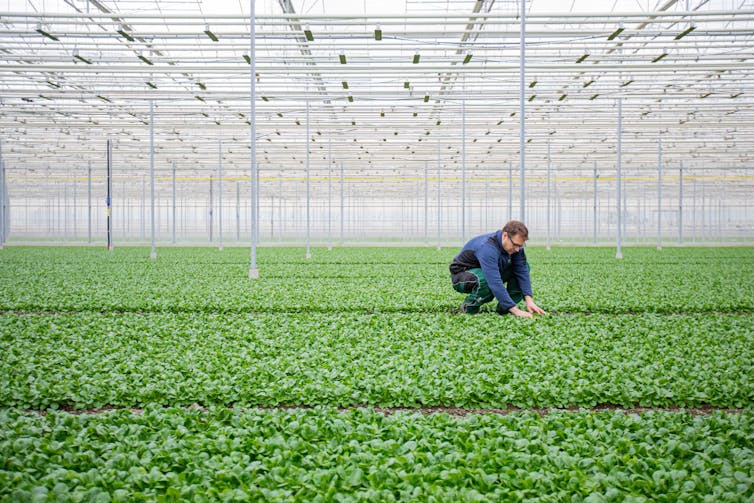
The Climeworks Gebr. Meier Greenhouse in Hinwil, Zurich. CO2 increases crop yield from direct air capture. Such projects demonstrate exciting possible applications for captured carbon, but there is no prospect they will have any measurable impact on reducing global warming.Orjan Ellingvag/Alamy
It should now be getting clear where the journey is heading. As the mirage of each magical technical solution disappears, another equally unworkable alternative pops up to take its place. The next is already on the horizon – and it’s even more ghastly. Once we realise net zero will not happen in time or even at all, geoengineering – the deliberate and large scale intervention in the Earth’s climate system – will probably be invoked as the solution to limit temperature increases.
One of the most researched geoengineering ideas is solar radiation management – the injection of millions of tons of sulphuric acid into the stratosphere that will reflect some of the Sun’s energy away from the Earth. It is a wild idea, but some academics and politicians are deadly serious, despite significant risks. The US National Academies of Sciences, for example, has recommended allocating up to US$200 million over the next five years to explore how geoengineering could be deployed and regulated. Funding and research in this area is sure to significantly increase.
Difficult truths
In principle there is nothing wrong or dangerous about carbon dioxide removal proposals. In fact developing ways of reducing concentrations of carbon dioxide can feel tremendously exciting. You are using science and engineering to save humanity from disaster. What you are doing is important. There is also the realisation that carbon removal will be needed to mop up some of the emissions from sectors such as aviation and cement production. So there will be some small role for a number of different carbon dioxide removal approaches.
The problems come when it is assumed that these can be deployed at vast scale. This effectively serves as a blank cheque for the continued burning of fossil fuels and the acceleration of habitat destruction.
Carbon reduction technologies and geoengineering should be seen as a sort of ejector seat that could propel humanity away from rapid and catastrophic environmental change. Just like an ejector seat in a jet aircraft, it should only be used as the very last resort. However, policymakers and businesses appear to be entirely serious about deploying highly speculative technologies as a way to land our civilisation at a sustainable destination. In fact, these are no more than fairy tales.
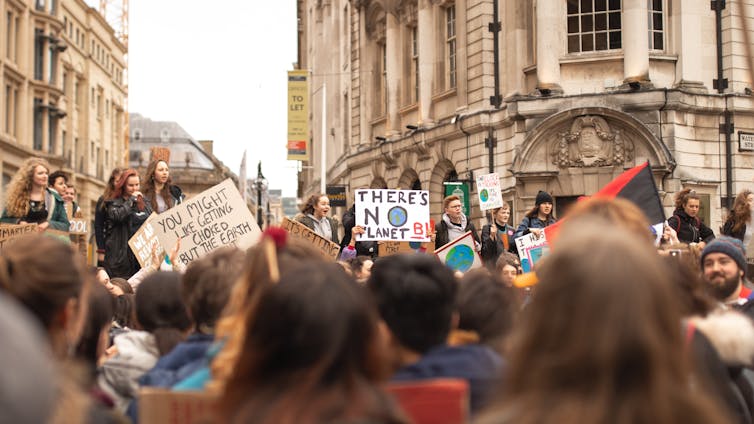
‘There is no Planet B’: children in Birmingham, UK, protest against the climate crisis.Callum Shaw/Unsplash, FAL
The only way to keep humanity safe is the immediate and sustained radical cuts to greenhouse gas emissions in a socially just way.
Academics typically see themselves as servants to society. Indeed, many are employed as civil servants. Those working at the climate science and policy interface desperately wrestle with an increasingly difficult problem. Similarly, those that champion net zero as a way of breaking through barriers holding back effective action on the climate also work with the very best of intentions.
The tragedy is that their collective efforts were never able to mount an effective challenge to a climate policy process that would only allow a narrow range of scenarios to be explored.
Most academics feel distinctly uncomfortable stepping over the invisible line that separates their day job from wider social and political concerns. There are genuine fears that being seen as advocates for or against particular issues could threaten their perceived independence. Scientists are one of the most trusted professions. Trust is very hard to build and easy to destroy.
But there is another invisible line, the one that separates maintaining academic integrity and self-censorship. As scientists, we are taught to be sceptical, to subject hypotheses to rigorous tests and interrogation. But when it comes to perhaps the greatest challenge humanity faces, we often show a dangerous lack of critical analysis.
In private, scientists express significant scepticism about the Paris Agreement, BECCS, offsetting, geoengineering and net zero. Apart from some notable exceptions, in public we quietly go about our work, apply for funding, publish papers and teach. The path to disastrous climate change is paved with feasibility studies and impact assessments.
Rather than acknowledge the seriousness of our situation, we instead continue to participate in the fantasy of net zero. What will we do when reality bites? What will we say to our friends and loved ones about our failure to speak out now?
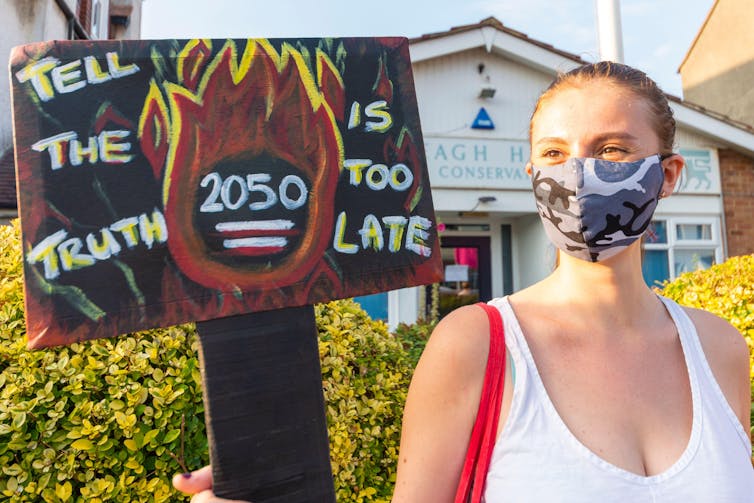
A young woman protests the UK’s target of reaching net zero emissions by 2050, which many believe is too late. Essex, UK, August 10 2020.Avpics/Alamy
The time has come to voice our fears and be honest with wider society. Current net zero policies will not keep warming to within 1.5°C because they were never intended to. They were and still are driven by a need to protect business as usual, not the climate. If we want to keep people safe then large and sustained cuts to carbon emissions need to happen now. That is the very simple acid test that must be applied to all climate policies. The time for wishful thinking is over.