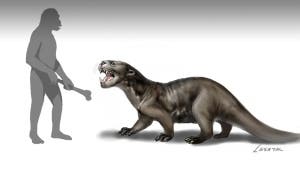
The 200-kilogram ‘bear otter’ is one of several large carnivores that became extinct around 2 million years ago. illustration: Victor Leshyk
New research disputes a long-held view that our earliest tool-bearing ancestors contributed to the demise of large mammals in Africa over the last several million years. Instead, the researchers argue that long-term environmental change drove the extinctions, mainly in the form of grassland expansion likely caused by falling atmospheric carbon dioxide (CO2) levels.
Tyler Faith, curator of archaeology at the Natural History Museum of Utah and assistant professor in the Department of Anthropology at the University of Utah, led the study. The research team also includes John Rowan from the University of Massachusetts Amherst, Andrew Du from the University of Chicago, and Paul Koch from the University of California, Santa Cruz.
The study is published today in the journal Science.
"Despite decades of literature asserting that early hominins impacted ancient African faunas, there have been few attempts to actually test this scenario or to explore alternatives," Faith says. "We think our study is a major step towards understanding the depth of anthropogenic impacts on large mammal communities, and provides a convincing counter-argument to these long-held views about our early ancestors."
To test for ancient hominin impacts, the researchers compiled a seven-million-year record of herbivore extinctions in eastern Africa, focusing on the very largest species, the so-called 'megaherbivores' (species over 2,000 lbs.) Though only five megaherbivores exist in Africa today, there was a much greater diversity in the past. For example, three-million-year-old 'Lucy' (Australopithecus afarensis) shared her woodland landscape with three giraffes, two rhinos, a hippo, and four elephant-like species at Hadar, Ethiopia.
When and why these species disappeared has long been a mystery for archaeologists and paleontologists, despite the evolution of tool-using and meat-eating hominins getting most of the blame.
"Our analyses show that there is a steady, long-term decline of megaherbivore diversity beginning around 4.6 million years ago. This extinction process kicks in over a million years before the very earliest evidence for human ancestors making tools or butchering animal carcasses and well before the appearance of any hominin species realistically capable of hunting them, like Homo erectus," says Faith.
The team analyzed more than 100 sites in East Africa with rich fossil records to track the longterm decline of megaherbivore diversity. Credit: J. Tyler Faith
Taking a Closer Look
Faith and his team quantified long-term changes in eastern African megaherbivores using a dataset of more than 100 fossil assemblages spanning the last seven million years. The team also examined independent records of climatic and environmental trends and their effects, specifically global atmospheric CO2, stable carbon isotope records of vegetation structure, and stable carbon isotopes of eastern African fossil herbivore teeth, among others.
Their analysis reveals that over the last seven million years substantial megaherbivore extinctions occurred: 28 lineages became extinct, leading to the present-day communities lacking in large animals. These results highlight the great diversity of ancient megaherbivore communities, with many having far more megaherbivore species than exist today across Africa as a whole.
A fossil tooth of a hippo (Hippopotamus amphibius) (left) and a fossil tooth of a white rhinoceros (Ceratotherium simum) (right) , two of the few surviving megaherbivores, from the Late Pleistocene of western Kenya (left). Credit: J. Tyler Faith
Further analysis showed that the onset of the megaherbivore decline began roughly 4.6 million years ago, and that the rate of diversity decline did not change following the appearance of Homo erectus, a human ancestor often blamed for the extinctions. Rather, Faith's team argues that climate is more likely culprit.
"The key factor in the Plio-Pleistocene megaherbivore decline seems to be the expansion of grasslands, which is likely related to a global drop in atmospheric CO2 over the last five million years," says John Rowan, a postdoctoral scientist from University of Massachusetts Amherst. "Low CO2 levels favor tropical grasses over trees, and as a consequence savannas became less woody and more open through time. We know that many of the extinct megaherbivores fed on woody vegetation, so they seem to disappear alongside their food source."
The loss of massive herbivores may also account for other extinctions that have also been attributed to ancient hominins. Some scientist suggest that competition with increasingly carnivorous species of Homo led to the demise of numerous carnivores over the last few million years. Faith and his team suggest an alternative.
The decline of African megaherbivore diversity (gray curve) over the last seven million years was driven by falling atmospheric carbon dioxide and the expansion of grasslands, not ancient hominin impacts. The onset of the megaherbivore …more
"We know there are also major extinctions among African carnivores at this time and that some of them, like saber-tooth cats, may have specialized on very large prey, perhaps juvenile elephants," says Paul Koch. "It could be that some of these carnivores disappeared with their megaherbivore prey."
"Looking at all of the potential drivers of the megaherbivore decline, our analyses suggest that changing climate and environment played the key role in Africa's past extinctions," said Faith. "It follows that in the search for ancient hominin impacts on ancient African ecosystems, we must focus our attention on the one species known to be capable of causing them—us, Homo sapiens, over the last 300,000 years."
Painting of dodo: Frederick William Frohawk (1905)
In “Catcher in the Rye”, one sign of Holden Caulfield’s looming nervous breakdown is his worries over the ducks in Central Park:
The funny thing is, though, I was sort of thinking of something else while I shot the bull. I live in New York, and I was thinking about the lagoon in Central Park, down near Central Park South. I was wondering if it would be frozen over when I got home, and if it was, where did the ducks go. I was wondering where the ducks went when the lagoon got all icy and frozen over. I wondered if some guy came in a truck and took them away to a zoo or something. Or if they just flew away.
The title of the novel stems from Holden’s misreading of Robert Burns’s “Comin’ Through the Rye”. He sees himself as protector of children playing in a huge rye field near a cliff. If he can’t catch children as they come to the edge, they will die. In my mind, his worries over the ducks and the children amount to the same thing.
Those who don’t care about the ducks and the children are “phonies” in Holden’s world, including a girl named Sally who is much more comfortable with 50s values than him. When she goes out on a date with Holden, he asks her to blow off the city and come live in a cabin with him, like Henry David Thoreau. He said that would be a lot better than becoming typical New Yorkers who “are working in some office, making a lot of dough, and riding to work in cabs and Madison Avenue buses, and reading newspapers…”
For people my age, the novel connected deeply in the same way that “On the Road” did. Holden Caulfield, Jack Kerouac and even James Dean in “Rebel without a Cause” rejected the “straight” world. Holden even dreams about moving to someplace in the Southwest and getting a job as a gas station attendant. Getting back to nature in the 1950s was equivalent to being connected to the ducks that Holden worried about. Leave everything behind and move to Vermont where such birds can be found, as well as the bees and the bats.
65 years later, Holden might have found out that there was no place to go to since Mother Nature was in danger of being destroyed just like those kids in the rye field. They are being destroyed by the “phonies”, especially those whose class interests the White House defends.
Starting with the seabirds, there are signs that they are headed toward extinction because of overfishing and climate change as the Guardian reported on December 12, 2017. The numbers of kittiwakes have fallen by up to 90 percent because overfishing and changes in the Pacific and north Atlantic caused by climate change have affected the availability of sand eels which black-legged kittiwakes feed on during the breeding season.
The black-legged kittiwake.
If it isn’t climate change and overfishing, seabirds have to contend with plastic that kills millions of marine bird species each year. The albatross is particularly vulnerable since they use their beak to skim the surface, picking plastic up along the way. Up to 98 percent of the albatross that have been studied have plastic debris in their gut. Once ingested, it can obstruct the digestive tract and can puncture internal organs.
Dead albatross with plastic in its gut
If civilization needs plastic, it also needs electric lights that are used in urban centers at night to show off skyscrapers to the public. The allure of beams and bulbs can be a death sentence for migratory birds when they reach metropolises like New York. Drawn by the light, they collide into buildings at an alarming rate. Between 100 million and 1 billion birds crash into buildings across North America every year with some deaths caused by reflective windows during the day and others by bright lights at night.
Finally, there is industrial farming that is based on commodity production. In both Europe and the USA, monoculture cash crops such as soybeans, corn and wheat require extensive use of pesticides kill the insects that birds feed on. In 2013, the Guardian reported on the drastic decline of birds in England, the country where industrial farming was born. “Numbers of the farmland-dwelling grey partridge have halved since 1995, while the turtle dove has declined by 95%. The yellow wagtail, which inhabits farm and wetland, has declined by 45% over the same period.” The deaths are not only a result of insects being reduced but also by birds feeding on crops that have been sprayed by a type of chemical known as neonicotinoids.
Neonicotinoids are also responsible for bees dying off. Derived from nicotine (what else would you expect), they have a tendency to show up in pollen besides the cash crops they are used to protect. You can find the residue in clover and wildflowers nearby the cash crop fields, especially corn.
I suppose people like Donald Trump and Scott Pruitt could give less of a shit whether an albatross lives or dies but the extinction of honey bees is a direct threat to our ability to reproduce as a species. More than two-thirds of key crops require naturally occurring pollinators such as the honeybee. This includes coffee, cacao, and many fruits and vegetables. It will also have an impact on drinking water since a disappearance of trees will not be able to retain water. Some scientists worry that homo sapiens can become extinct within a few hundred years if honeybees go extinct.
Why should I worry about extinction? At my age, I am facing my personal extinction before very long. I guess it is some kind of neurotic obsession thinking about how we are going to last another three hundred years let alone the billion years an expanding sun will evaporate all the water on earth and kill everything on it. That doesn’t take into account an asteroid hitting earth long before that and doing a number on us like it did to the dinosaurs about 65 million years from now.
Like Holden Caulfield, I fret over the kids near the cliff and the ducks. If we could at least manage our resources intelligently, we’d have an outside chance of surviving. But with people like Donald Trump and Vladimir Putin in charge of an irrational system, rationality does not go very far.
The majestic giraffe, the world’s tallest land mammal and a prime attraction at zoos worldwide, is threatened with extinction because of illegal hunting and a loss of its habitat, according to a report published on Thursday by an international monitoring group.
The giraffe population has declined by 40 percent over the past three decades and now stands at about 97,600, according to the findings by the International Union for the Conservation of Nature, which designates endangered species.
While the largest giraffe populations reside in national parks and reserves, those protected areas have proved to be inadequate, one of several alarming conclusions about the animals’ future in the group’s latest Red List of Threatened Species report.
“While global attention has been on threats to elephantsand rhinos, giraffes have been off the radar, and we’ve been losing them in significant numbers,” said Liz Bennett, the vice president for species conservation for the Wildlife Conservation Society, which was not involved in the report. “People and governments need to start acting to save giraffes, fast.”
With their soaring heights of up to 20 feet and their stunning necks, which are typically about six feet long, giraffes have long been the stuff of dreams — for children who love to draw them and for adults who retain an awe for the otherworldly creatures. Their tongues can extend a foot or more, making feeding times an especially popular sight at zoos and on safari.
Yet the animals’ rare size and regal visage have made them a prime target of poachers in Africa, who drop steel-wire snares from tree canopies or stalk and shoot giraffes with rifles, wildlife experts say.
The threat to giraffes is so great that the Red List upgraded the species from the “least concern” category to “vulnerable,” skipping over the intermediary “near-threatened” designation. Graver categories include “critically endangered,” “extinct in the wild” and, ultimately, “extinct.”
The animals are divided into nine subspecies; according to the Red List report, five have decreasing populations, three are on the increase, and one is stable.
One bright spot: The numbers of West African giraffes are on the rise, numbering about 400 now, up from 50 in the 1990s. This remains the smallest of the subspecies.
Asked if it was possible for giraffes to become extinct in the wild in the next 20 years if nothing is done, Derek Lee, an ecologist who contributed to the Red List report, paused for several moments during a phone interview on Thursday from Tanzania. He then said, “I think we’d see drastic declines at the very least.”
Giraffes are found mostly in southern and eastern Africa, with smaller populations in West and Central Africa. Some of those populations are particularly vulnerable because of war and other civil unrest in countries on the Continent, like Sudan.
Poaching and the loss of habitat are “equally dangerous threats that vary in degree from place to place,” said Dr. Lee, who is a founder of the Wild Nature Institute. While governments and organizations could take stronger actions against poaching by enforcing laws and animal protection rules, habitat loss can be harder to stop because it involves curbing economic activity, such as land development, mining and scavenging.
“These are problems everywhere for giraffes,” Dr. Lee said. “You need to stop both threats.”
The threat to giraffes is not expected to affect their numbers at zoos in New York and other cities around the world, wildlife specialists said, because zookeepers have a good record helping the animals with reproduction.
Still, zoo leaders are likely to consider changing signs at their exhibits to stress the animals’ vulnerability to extinction as a way to raise public awareness.
“That would be the best way to get the word out to people that we need to do more to protect these animals,” said Dr. Bennett, of the conservation society, which runs the Bronx Zoo, the New York Aquarium and other zoos in the city.
The dodo was a medium-large sized flightless bird that was discovered on the Island of Mauritius in the 1590s and was declared extinct less than a century later, in 1681.
New research suggests that the dodo, an extinct bird whose name has entered popular culture as a symbol of stupidity, was actually fairly smart. The work, published today in the Zoological Journal of the Linnean Society, finds that the overall size of the dodo's brain in relation to its body size was on par with its closest living relatives: pigeons--birds whose ability to be trained implies a moderate level of intelligence. The researchers also discovered that the dodo had an enlarged olfactory bulb -- the part of the brain responsible for smelling -- an uncharacteristic trait for birds, which usually concentrate their brainpower into eyesight.
The dodo (Raphus cucullatus) was a large, flightless bird that lived on the island of Mauritius in the Indian Ocean. They were last seen in 1662.
"When the island was discovered in the late 1500s, the dodos living there had no fear of humans and they were herded onto boats and used as fresh meat for sailors," said Eugenia Gold, the lead author of the paper, a research associate and recent graduate of the American Museum of Natural History's Richard Gilder Graduate School, and an instructor in the Department of Anatomical Sciences at Stony Brook University.
"Because of that behavior and invasive species that were introduced to the island, they disappeared in less than 100 years after humans arrived. Today, they are almost exclusively known for becoming extinct, and I think that's why we've given them this reputation of being dumb.”
Even though the birds have become an example of oddity, obsolescence, stupidity, and extinction, and have been featured in popular stories ranging from Alice in Wonderland to Ice Age, most aspects of the dodo's biology are still unknown. This is partly because dodo specimens are extremely rare, having disappeared during the nascent stage of natural history collections.
To examine the brain of the dodo, Gold tracked down a well-preserved skull from the collections of the Natural History Museum, London, and imaged it there with high-resolution computed tomography (CT) scanning. In the American Museum of Natural History's Microscopy and Imaging Facility, she also CT-scanned the skulls of seven species of pigeons -- ranging from the common pigeon found on city streets, Columba livia, to more exotic varieties. Out of these scans, Gold built virtual brain endocasts to determine the overall brain size as well as the size of various structures. Gold's colleagues at the Natural History Museum of Denmark and National Museum of Scotland sent her the endocast for the dodo's closest relative, the extinct island-dwelling bird Rodrigues solitaire (Pezophaps solitaria).
When comparing the size of the birds' brains to their body sizes, Gold and collaborators found that the dodo was "right on the line.”
"It's not impressively large or impressively small -- it's exactly the size you would predict it to be for its body size," Gold said. "So if you take brain size as a proxy for intelligence, dodos probably had a similar intelligence level to pigeons. Of course, there's more to intelligence than just overall brain size, but this gives us a basic measure.”
The study also revealed that both the dodo and the Rodrigues solitaire, which recently was driven to extinction by human activity, had large and differentiated olfactory bulbs. In general, birds depend much more on sight rather than smell to navigate through their world, and as a result, they tend to have larger optic lobes than olfactory bulbs. The authors suggest that, because dodos and solitaires were ground-dwellers, they relied on smell to find food, which might have included fruit, small land vertebrates, and marine animals like shellfish.
"It is really amazing what new technologies can bring to old museum specimens," said co-author Mark Norell, Macaulay Curator of Paleontology and Chair of the Division of Paleontology at the American Museum of Natural History. "This really underscores the need for the maintenance and growth of natural history collections, because who knows what's next.”
The researchers also discovered an unusual curvature of the dodo's semicircular canal -- the balance organs located in the ear. But as of yet, there's not a good hypothesis for this atypical feature.
Journal Reference:
1Maria Eugenia, Leone Gold, Estelle Bourdon Andmark A. Norell. The first endocast of the extinct dodo (Raphus cucullatus) and an anatomical comparison amongst close relatives (Aves, Columbiformes). Zoological Journal of the Linnean, 2016 DOI: 10.1111/zoj.12388
HELENA, Mont. — FROM an evolutionary perspective, the pallid sturgeon is a thing of beauty.
Its eyes are a bit beady, it’s true, but good vision is not a prerequisite for living on the bottom of the Missouri River. And its toothless mouth, with its protruding, whiskerlike barbels, is creepy. But these barbels are perfect for sensing food, which it sucks in like a vacuum cleaner.
No, these fish are not sleek and beautiful like trout. But this species of sturgeon, which can grow to a length of six feet and weigh as much as 80 pounds, has managed to survive since the time of the dinosaurs, with fossils dating back some 70 million years.
For all of the adaptations that have enabled this fish to have such a long run, however, the pallid sturgeon is in serious trouble. Twenty-five years ago, the federal government concluded the fish was in imminent danger of extinction and placed it on the endangered species list, where it remains today.
Despite government efforts to expand the population, only perhaps 200 or fewer wild-born pallid sturgeons are thought to inhabit one of its last strongholds — the Montana stretches of the Missouri and Yellowstone Rivers.
And now, paradoxically, a federal agency, the Army Corps of Engineers, is pursuing a project that threatens this population, perhaps the most genetically robust of the groups still surviving in the Missouri and Mississippi Rivers. These fish in the upper Missouri River basin can live upward of 50 years, but they are old and their chances of reproducing are diminishing.
Dams along the Missouri River have contributed to the sturgeon’s undoing, blocking spawning runs and altering hundreds of miles of river habitat in ways that have been harmful not only to the pallid sturgeon but also to other species, like the least tern and piping plover. Fifty-one of the river’s 67 native fish species are now rare, uncommon or decreasing, according to the government.
The mostly free-flowing Yellowstone River, which converges with the Missouri River near the border of Montana and North Dakota, offers the most cost-effective chance in the region for pallid sturgeon recovery. But the Intake Dam, an irrigation diversion impoundment on the Yellowstone, is a major obstacle for fish attempting to swim upstream to spawn.
The dam, in operation since the early 1900s, is a collection of boulders that straddle the river and cause it to rise so water can flow into an irrigation ditch that sustains tens of thousands of acres of sugar beets and other crops. On occasion, when the water is high enough, sturgeon have been able to make it around the dam by swimming up a naturally occurring side channel to reach the spawning habitat on the lower Yellowstone and tributaries like the Powder River. Last year, only five pallid sturgeon were known to have made it up the natural bypass. One of them, a tagged female, was later recaptured and it was determined that she had spawned.
Now the corps wants to spend some $60 million to build a concrete dam to upgrade the existing rock weir. The dam will block the river entirely, as well as the natural channel sturgeon have used in the past. In its place, the corps proposes to build a canal around the concrete dam as a bypass for the fish. Many biologists who have studied the pallid sturgeon believe these fish are unlikely to use this bypass. But the dam will, according to the corps, continue to provide water for irrigation.
The corps is seeking to move forward with construction. Two environmental groups, Defenders of Wildlife and the Natural Resources Defense Council, have asked a federal judge for an injunction blocking construction of this new dam.
The corps should return to the drawing board. Otherwise, this remnant wild population, whose ancestors were around when dinosaurs walked the landscape, is doomed.
Chris Hunter is the former chief of fisheries for the Montana Department of Fish, Wildlife and Parks.