Showing posts with label European conquest of the Americas. Show all posts

Saturday, October 28, 2017

2735. Race, Land, and an Urgent Journey

By Steven Johnson, Ecological Commonwealth, December 9, 2016
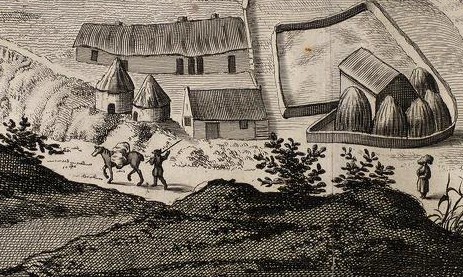
A Scottish Lowland farm from John Slezer'Prospect of Dunfermline, published in the Theatrum Scotiae, 1693
I learned fairly recently, from reading Roxanne Dunbar-Ortiz, that my own ancestors, the Scots-Irish, were Scottish peasants who, after being violently uprooted from their own lands and land-based communal ways, became rootless “foot soldiers of empire,” helping to conquer others’ lands, in Ireland and North America.
And I wondered, why didn’t we ever hear about the earliest part of this story growing up? Why were all the stories about Columbus, the Pilgrims, George Washington, Daniel Boone, Davy Crockett…? Why did “history” – not the academic subject, but the story we were taught to live in and celebrate – focus entirely on settler-colonizers, and not on peoples who were uprooted from their own lands, including my own ancestors, who have been kept nameless to me, abiding in a fog of historical oblivion?
Two things dawned on me. First, to advance the aims of the empire and its ruling elites, the heroes in the story that people are induced to tell must be those who furthered conquest and exploitation, in order to justify continued conquest and exploitation. The conquered, on the other hand, must be denied historical personality. Their story must be effectively erased from social memory, because, otherwise, it would expose the illegitimacy of the social order that keeps the elites in their privileged position. We might then rediscover the possibility of truly INHABITING places – tenderly caring for and regenerating the bioregion that sustains us, and living in balance. Such a discovery would deeply threaten the global capitalist empire, because it directly contradicts that world order’s rootless exploit-and-move-on approach to land and resources that concentrates “wealth” (but not true well-being) in elites at the top.
Second, the dispossession of peasants in Europe, centuries ago, is a gaping, untreated wound that continues to affect my kin and me, and “white people” in general, in all sorts of ways of which we are not aware. The pathologies have been, and continue to be, transmitted from generation to generation. And the erasure of this primordial cataclysm, from the origins story we were raised to consider our own, only gives it more power over us. We walk, we act, we destroy, influenced by the pain of wounds that we do not recognize as such, that have no name, that come from nobody knows where. We have no true home, but fail to recognize or name that problem, because we’ve long forgotten what it even means to live at home – that is to say, to live in mutually beneficial relationships with our human and nonhuman neighbors in the web of life, on a land base.
Since the dispossession of our ancestors, over our centuries-long career as rootless conquerors, my fellow “white people” and I have accumulated wealth derived from the robbery of lands and the labor-power of slaves. This wealth has gone disproportionately to just a few of us – capitalists at the top. The rest of us, over most of this time, lived in conditions that, notwithstanding our relative privilege, still qualified, objectively, as misery. But, through systemic racism, we were bribed with just enough social and economic privilege, relative to and over others, to keep us from uniting with the more severely oppressed classes and peoples to overthrow the unjust system, and redistribute land and other productive resources equitably to all.
More recently, since the dawn of the age of cheap fossil fuels, and especially since the post-World War II economic boom, our racially privileged access to education, and managerial and professional careers, combined with the U.S.’s post-war position as the principal power towards which global imperialist wealth transfers flow, have greatly increased whites’ advantage over others, and given us unprecedented material affluence. This has made us walk with our chests out, as Malcolm X observed. We feel like we are gods walking the earth. And we insist that we are entitled to this, greatly underestimating the role that robbery and exploitation have played, and greatly exaggerating the role of our own ingenuity and effort, in building our wealth.
As humans are generally prone to do, we assume that how things have been since our own childhood to the present day is how things will, or should, always be, not realizing how ephemeral and fragile the conditions of this brief historical moment really are. We have partaken of forbidden fruit. In our folly, we took a devil’s promise at his word that we would be as gods. But our fall is near, because our imbalanced, exploitative, and unjust ways – the true nature of which is obscured by the false stories we tell ourselves about “progress” – are destroying the very fabric of life without which human communities cannot be sustained. Conditions we imagined would be eternal are really a bubble, and it has popped. We have dropped out of that bubble into a free fall, without even knowing it, while dragging the whole world with us. And the cushion of privilege that we hold beneath us will not be remotely enough to soften the crash.
My fellow white settlers and I must reach into the fog, bring into conscious awareness the lost history that set us on destructive paths, and treat the wound that was inflicted on us. And we must recognize the mistakes that our ancestors and we have made since then, make reparations for the wounds that were thereby inflicted on others, work together with others to establish equitable access to land and other productive resources for all, and decisively break the pattern of robbery and exploitation that is destroying ecosystems and keeping people in misery. We won’t likely accomplish any of these goals unless we pursue them all. They are the essential, intertwined tasks that are upon us.
As the fabric of life is daily torn to shreds, at ever-accelerating rates, we haven’t a moment to lose.

Tuesday, October 14, 2014

1590. The Real Christopher Columbus

By Howard Zinn, Jacobin, October 13, 2014

Artist's imagination of Indian chief informing his tribe of the arrival of strangers on ships - Credit: United States Library of Congress


Arawak men and women, naked, tawny, and full of wonder, emerged from their villages onto the island’s beaches and swam out to get a closer look at the strange big boat. When Columbus and his sailors came ashore, carrying swords, the Arawaks ran to greet them, brought them food, water, gifts. He later wrote of this in his log:
They brought us parrots and balls of cotton and spears and many other things, which they exchanged for the glass beads and hawks’ bells. They willingly traded everything they owned…They do not bear arms, and do not know them, for I showed them a sword, they took it by the edge and cut themselves out of ignorance. They would make fine servants … with fifty men we could subjugate them all and make them do whatever we want.
These Arawaks of the Bahama Islands were much like Indians on the mainland, who were remarkable (European observers were to say again and again) for their hospitality, their belief in sharing. These traits did not stand out in the Europe of the Renaissance, dominated as it was by the religion of popes, the government of kings, the frenzy for money that marked Western civilization and its first messenger to the Americas, Christopher Columbus.
The information that Columbus wanted most was: Where is the gold? He had persuaded the king and queen of Spain to finance an expedition to the lands, the wealth, he expected would be on the other side of the Atlantic—the Indies and Asia, gold and spices. For, like other informed people of his time, he knew the world was round and he could sail west in order to get to the Far East.
Spain was recently unified, one of the new modern nation-states, like France, England, and Portugal. Its population, mostly poor peasants, worked for the nobility, who were 2 percent of the population and owned 95 percent of the land. Like other states of the modern world, Spain sought gold, which was becoming the new mark of wealth, more useful than land because it could buy anything.
There was gold in Asia, it was thought, and certainly silks and spices, for Marco Polo and others had brought back marvelous things from their overland expeditions centuries before. Now that the Turks had conquered Constantinople and the eastern Mediterranean, and controlled the land routes to Asia, a sea route was needed. Portuguese sailors were working their way around the southern tip of Africa. Spain decided to gamble on a long sail across an unknown ocean.
In return for bringing back gold and spices, they promised Columbus 10 percent of the profits, governorship over newfound lands, and the fame that would go with a new title: Admiral of the Ocean Sea. He was a merchant’s clerk from the Italian city of Genoa, part-time weaver (the son of a skilled weaver), and expert sailor. He set out with three sailing ships, the largest of which was the Santa Maria, perhaps 100 feet long, and thirty-nine crew members.
Columbus would never have made it to Asia, which was thousands of miles farther away than he had calculated, imagining a smaller world. He would have been doomed by that great expanse of sea. But he was lucky. One-fourth of the way there he came upon an unknown, uncharted land that lay between Europe and Asia—the Americas. It was early October 1492, and thirty-three days since he and his crew had left the Canary Islands, off the Atlantic coast of Africa. Now they saw branches and sticks floating in the water. They saw flocks of birds.
These were signs of land. Then, on October 12, a sailor called Rodrigo saw the early morning moon shining on white sands, and cried out. It was an island in the Bahamas, the Caribbean Sea. The first man to sight land was supposed to get a yearly pension of 10,000 maravedis for life, but Rodrigo never got it. Columbus claimed he had seen a light the evening before. He got the reward.
So, approaching land, they were met by the Arawak Indians, who swam out to greet them. The Arawaks lived in village communes, had a developed agriculture of corn, yams, cassava. They could spin and weave, but they had no horses or work animals. They had no iron, but they wore tiny gold ornaments in their ears.
This was to have enormous consequences: it led Columbus to take some of them aboard ship as prisoners because he insisted that they guide him to the source of the gold. He then sailed to what is now Cuba, then to Hispaniola (the island which today consists of Haiti and the Dominican Republic). There, bits of visible gold in the rivers, and a gold mask presented to Columbus by a local Indian chief, led to wild visions of gold fields.
Columbus’s report to the Court in Madrid was extravagant. He insisted he had reached Asia (it was Cuba) and an island off the coast of China (Hispaniola). His descriptions were part fact, part fiction:
Hispaniola is a miracle. Mountains and hills, plains and pastures, are both fertile and beautiful … There are many spices, and great mines of gold and other metals …
The Indians, Columbus reported, “are so naive and so free with their possessions that no one who has not witnessed them would believe it. When you ask for something they have, they never say no. To the contrary, they offer to share with anyone…” He concluded his report by asking for a little help from their Majesties, and in return he would bring them from his next voyage “as much gold as they need … and as many slaves as they ask.”
Because of Columbus’s exaggerated report and promises, his second expedition was given seventeen ships and more than twelve hundred men. The aim was clear: slaves and gold. From his base on Haiti, Columbus sent expedition after expedition into the interior. They found no gold fields, but had to fill up the ships returning to Spain with some kind of dividend.
In the year 1495, they went on a great slave raid, rounded up 1,500 Arawak men, women, and children, put them in pens guarded by Spaniards and dogs, then picked the 500 best specimens to load onto ships. Of those 500, 200 died en route.
Too many of the slaves died in captivity. And so Columbus, desperate to pay back dividends to those who had invested, had to make good his promise to fill the ships with gold. In the province of Cicao on Haiti, where he and his men imagined huge gold fields to exist, they ordered all persons fourteen years or older to collect a certain quantity of gold every three months. When they brought it, they were given copper tokens to hang around their necks. Indians found without a copper token had their hands cut off and bled to death.
The Indians had been given an impossible task. The only gold around was bits of dust garnered from the streams. So they fled, were hunted down with dogs, and were killed. When it became clear that there was no gold left, the Indians were taken as slave labor on huge estates, known later as encomiendas. They were worked at a ferocious pace, and died by the thousands. By the year 1515, there were perhaps 50,000 Indians left. By 1550, there were 500. A report of the year 1650 shows none of the original Arawaks or their descendants left on the island.
The chief source — and, on many matters the only source — of information about what happened on the islands after Columbus came is Bartolome de las Casas, who, as a young priest, participated in the conquest of Cuba. For a time he owned a plantation on which Indian slaves worked, but he gave that up and became a vehement critic of Spanish cruelty. Las Casas transcribed Columbus’s journal and, in his fifties, began a multi-volume History of the Indies.
In book two of his History of the Indies, Las Casas (who at first urged replacing Indians by black slaves, thinking they were stronger and would survive, but later relented when he saw the effects on blacks) tells about the treatment of the Indians by the Spaniards. After a while, Spaniards refused to walk any distance. They “rode the backs of Indians if they were in a hurry” or were carried on hammocks by Indians running in relays. “In this case they also had Indians carry large leaves to shade them from the sun and others to fan them with goose wings.”
Total control led to total cruelty. The Spaniards “thought nothing of knifing Indians by tens and twenties and of cutting slices off them to test the sharpness of their blades.” The Indians’ attempts to defend themselves failed. So, Las Casas reports, “they suffered and died in the mines and other labors in desperate silence, knowing not a soul in the world to whom they could turn for help.” He describes their work in the mines:
… mountains are stripped from top to bottom and bottom to top a thousand times; they dig, split rocks, move stones, and carry dirt on their backs to wash it in the rivers, while those who wash gold stay in the water all the time with their backs bent so constantly it breaks them.
After each six or eight months’ work in the mines, which was the time required of each crew to dig enough gold for melting, up to a third of the men died. While the men were sent many miles away to the mines, the wives remained to work the soil, forced into the excruciating job of digging and making thousands of hills for cassava plants.
Thus husbands and wives were together only once every eight or ten months and when they met they were so exhausted and depressed on both sides … they ceased to procreate. As for the newly born, they died early because their mothers, overworked and famished, had no milk to nurse them … Some mothers even drowned their babies from sheer desperation….in this way, husbands died in the mines, wives died at work, and children died from lack of milk.,.and in a short time this land which was so great, so powerful and fertile … was depopulated,
When he arrived on Hispaniola in 1508, Las Casas says, “there were 60,000 people living on this island, including the Indians; so that from 1494 to 1508, over three million people had perished from war, slavery, and the mines. Who in future generations will believe this? I myself writing it as a knowledgeable eyewitness can hardly believe it…”
What Columbus did to the Arawaks of the Bahamas, Cortes did to the Aztecs of Mexico, Pizarro to the Incas of Peru, and the English settlers of Virginia and Massachusetts to the Powhatans and the Pequots. They used the same tactics, and for the same reasons — the frenzy in the early capitalist states of Europe for gold, for slaves, for products of the soil, to pay the bondholders and stockholders of the expeditions, to finance the monarchical bureaucracies rising in Western Europe, to spur the growth of the new money economy rising out of feudalism, to participate in what Karl Marx would later call “the primitive accumulation of capital.” These were the violent beginnings of an intricate system of technology, business, politics, and culture that would dominate the world for the next five centuries.
How certain are we that what was destroyed was inferior? Who were these people who came out on the beach and swam to bring presents to Columbus and his crew, who watched Cortes and Pizarro ride through their countryside? What did people in Spain get out of all that death and brutality visited on the Indians of the Americas? As Hans Koning sums it up in his book Columbus: His Enterprise:
For all the gold and silver stolen and shipped to Spain did not make the Spanish people richer. It gave their kings an edge in the balance of power for a time, a chance to hire more mercenary soldiers for their wars. They ended up losing those wars anyway, and all that was left was a deadly inflation, a starving population, the rich richer, the poor poorer, and a ruined peasant class.

Thus began the history of the European invasion of the Indian settlements in the Americas. That beginning is conquest, slavery, death. When we read the history books given to children in the United States, it all starts with heroic adventure — there is no bloodshed — and Columbus Day is a celebration.