By Stockholm Resilience Centre, April 28, 2015
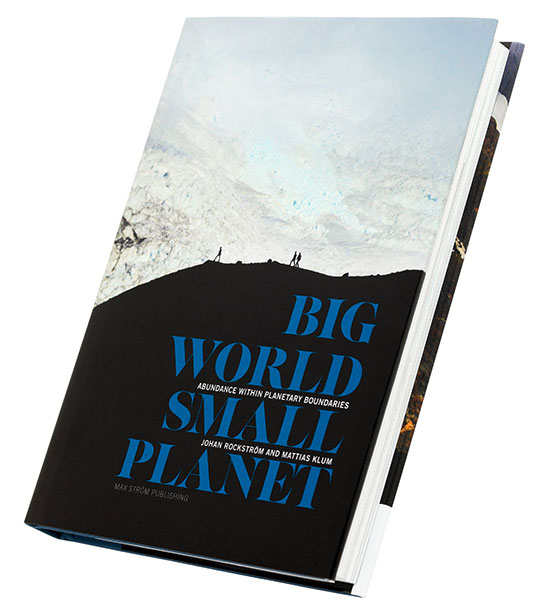
As a sequel to their 2012 book, "The Human Quest: Prospering Within Planetary Boundaries", Centre Director Johan Rockström and National Geographic fotographer and senior fellow Mattias Klum have launched "Big World Small Planet: Abundance within Planetary Boundaries".
The book, which was launched at the Swedish embassy in London in April 2015, describes a world full of possibilities even though "humanity has in just two generations overwhelmed Earth’s capacity to continue supporting our world in a stable way".
"We have gone from being a small world on a big planet to a big world on a small planet. Now Earth is responding with environmental shocks to the global economy. This is a great turning point. Our home is changing, and our future depends on what we do next," they write.
A new positive narrative
Talking about what to do next, the book argues that the world needs a new narrative about the links between human development and the environment. This is a story of new opportunities for humanity to thrive on the planet by using ingenuity, core values, and humanism to become wise stewards of nature and the entire planet.
"The dominant narrative until now has been about infinite material growth on a finite planet, assuming that Earth and nature have an endless capacity to take abuse without punching back. That narrative held up as long as we inhabited a relatively small world on a relatively big planet. But that is no longer the case," write Rockström and Klum.
Predicament, prosperity and possibilities
The book is divided into three parts. The first summarizes the urgent predicament of massive human impacts on the planet whereas the second part makes the case for a new way of thinking about prosperity, justice and happiness on a sustainable planet.
The book is divided into three parts. The first summarizes the urgent predicament of massive human impacts on the planet whereas the second part makes the case for a new way of thinking about prosperity, justice and happiness on a sustainable planet.
In the third part Rockström and Klum go into practical solutions to the biggest challenges facing humanity, such as feeding nine billion people and powering tomorrow’s economies in sustainable ways.
Combining stunning photography and recent insights from sustainability science they argue that the tools to do what’s required already exist. Using humanity’s intelligence, creativity, and technological know-how can reverse the negative trends.
It is possible to feed nine billion people without destroying our forests and deliver power to our economies without burning fossil fuels, they conclude.
The book’s positive tone is based on a firm belief that humanity has an incredible ability to overcome even the most daunting of challenges.
Once people understand the risks of continuing along the current path, they will search for creative and profitable alternatives, write Rockström and Klum.
"That is how innovation works. The planetary boundaries will help. By defining thresholds and a maximum allowable use of resources, ecosystems, and the climate, we can trigger a new wave of sustainable technological inventions thanks to an abundance of ideas and solutions for human prosperity and planetary stability."
Brain and heart
Recognizing that human actions are now threatening to trigger tipping points that could knock the planet out of its stable state, Rockström and Klum urge for bold political action during 2015. This is the most important year in decades for crucial environmental decisions, they write. The UN will adopt new Sustainable Development Goals and world leaders will meet in Paris later in the year to hopefully forge a new globally binding climate deal.
Recognizing that human actions are now threatening to trigger tipping points that could knock the planet out of its stable state, Rockström and Klum urge for bold political action during 2015. This is the most important year in decades for crucial environmental decisions, they write. The UN will adopt new Sustainable Development Goals and world leaders will meet in Paris later in the year to hopefully forge a new globally binding climate deal.
The authors suggest a new development paradigm: "Abundance within planetary boundaries".
It is not about growth without limits. Not limits to growth, but development within limits. This, however, requires a deep mind-shift and new ways to communicate scientific insights. Such a mind-shift for genuine change cannot, however, be reached through numbers alone, they argue. It has to come from both the heart and the brain.
"As a photographer and a scientist, respectively, Mattias and I travelled in different worlds. I always thought it was a scientist’s job to appeal to the rationality of others. But it was becoming painfully clear to me how naive it was to assume that, just because the facts were on the table, people would not make the right decisions," says Johan Rockström.


