Showing posts with label Climate movement policies. Show all posts

Tuesday, February 26, 2019

3201. Extinction Rebellion

By Chris Hedges, Truthdig, February 24, 2019
Extinction Rebellion protest in London
There is one desperate chance left to thwart the impending ecocide and extinction of the human species. We must, in wave after wave, carry out nonviolent acts of civil disobedience to shut down the capitals of the major industrial countries, crippling commerce and transportation, until the ruling elites are forced to publicly state the truth about climate catastrophe, implement radical measures to halt carbon emissions by 2025 and empower an independent citizens committee to oversee the termination of our 150-year binge on fossil fuels. If we do not do this, we will face mass death.
The British-based group Extinction Rebellion has called for nonviolent acts of civil disobedience on April 15 in capitals around the world to reverse our “one-way track to extinction.” I do not know if this effort will succeed. But I do know it is the only mechanism left to force action by the ruling elites, who, although global warming has been well documented for at least three decades, have refused to carry out the measures needed to protect the planet and the human race. These elites, for this reason alone, are illegitimate. They must be replaced.
“It is our sacred duty to rebel in order to protect our homes, our future, and the future of all life on Earth,” Extinction Rebellion writes. This is not hyperbolic. We have, as every major climate report states, very little time left. Indeed, it may already be too late.
In Britain, Extinction Rebellion has already demonstrated its clout, blocking roads, occupying government departments and amassing 6,000 people to shut down five of London’s bridges last Nov. 17. Scores of arrests were made. But it was just the warm-up act. In April, the group hopes, the final assault will begin.
If we do not shake off our lethargy, our anomie, and resist, our misery, despondency and feelings of helplessness will mount. We will become paralyzed. Resistance, especially given the bleakness before us, is about more than winning. It is about a life of meaning. It is about empowerment. It is a public declaration that we will no longer live according to the dominant lie. It is a message to the elites: YOU DO NOT OWN US. It is about defending our dignity, agency and self-respect. The more we free ourselves from the bondage of fear to throw up barriers along the forced march toward ecocide the more we will be enveloped by a strange kind of euphoria, one I often felt as a war correspondent documenting horrific suffering and atrocities to shame the killers. We obliterate despair in our acts of defiance, even if our victories are Pyrrhic. We reach out to those around us. Courage is contagious. It is the spark that ignites mass revolt. And we should, even if we fail, at least choose how we will die. Resistance is the only action left that will allow us to remain psychologically whole. And it is the only action left that has any hope of halting the wholesale extinction of the human race, not to mention most other species.
“The times are inexpressibly evil,” Daniel Berrigan wrote. “And yet—and yet … the times are inexhaustibly good. In this time of death, some men and women, the resisters, work hardily for social change. We think of such people in the world and the stone in our breast is dissolved.”
“People have to go to the capital city,” said Roger Hallam, the co-founder of Rebellion Extinction and a researcher at King’s College London, who spoke to me from London. “That’s where the elite is, the business class. That’s where the pillars of the state exist. That’s the first element. Then you have to have a lot of people involved. They have to break the law. There’s no point in just doing a march. They have to literally close down the streets. They have to remain nonviolent. That’s absolutely crucial. Once you get violent, police and the state have an excuse to remove you. It’s got to be cultural. You make it into a sort of Woodstock affair. Then thousands more people come onto the streets.”
“There’s a fundamental difference between breaking the law and not breaking the law,” he went on. “It’s a binary difference. When you break the law, then you’re massively more effective in terms of material and psychological influence as well as media interest. The more dramatic the civil disobedience, the better. It’s a numbers game. You want people blocking the streets, but you need ten, twenty, thirty thousand. You don’t need 3 million. You need enough for the state to have to decide whether to use repression on a mass scale or invite you into the room. The gambit, of course, particularly in the U.K., is that the state is weak. It’s been hollowed out by neoliberalism. They’re going to find themselves overwhelmed. We will get in the room.”
“We’re going to start on that Monday [April 15],” he said. “We’re going to block several major roundabouts in central London. We’re going to spread across the city—swarming. When the riot police or the police come, we’re going get up and go somewhere else. This is a tactic we innovated in November. We’ll give the authorities a fundamental dilemma: ‘Do we allow these people to continue blocking the center of a global city, or do we arrest thousands of people?’ If they opt for arresting thousands of people, lots of things are going to happen. They will be overwhelmed. The police force in the U.K. is underfunded, like most of the public sector. There’s massive disaffection amongst the police. I won’t be surprised if they form a union and say, ‘We’re not doing this anymore.’ I’ve been arrested 10, 12 times in the last two years. Every time, police come up to me going, ‘Keep it up, mate. What you’re doing is great.’ We’re disciplined, nonviolent people. They’re not going to get pissed off at us. They also know it’s over. They spend their days scraping mentally ill people off the streets. There’s no glamour in being a police officer in a global city. The security forces are something you want to subvert, not denigrate.”
The group has stressed what it calls a “pre-social-media age” strategy for organizing. It has created structures to make decisions and issue demands. It sends out teams to give talks in communities. It insists that people who participate in the actions of Rebellion Extinction undergo “nonviolent direct-action” training so they will not be provoked by the police or opposition groups.
“Most of recent mass mobilizations have been social-media-fueled,” Hallam said. “Consequently, they have been chaotic. They are extremely fast mobilizations. Social media’s a bit like heroin. It’s a high, but then it collapses, like we’ve seen in France. It becomes chaotic or violent. A lot of modern social movements put stuff on social media. It gets clogged up with trolls. There’s lots of radical-left organizations arguing about different privileges. We’ve circumvented that and gone straight to the ‘common people,’ as you might say. We’ve held meetings in village town halls and city halls. We go around the country in a 19th-century sort of way, saying, ‘Hey guys. We’re all fucked. People are going to die if this isn’t sorted out.’ The second half of the talk is: There’s a way of dealing with this called mass civil disobedience.”
“Nonviolent discipline, as the research shows, is the No. 1 criterion for maximizing the potential for success,” he said. “This is not a moral observation. Violence destroys movements. The Global South has been at it for a few decades. Violence just ends up with people getting shot. It doesn’t lead anywhere. You might as well take your chances and maintain nonviolent discipline. There’s a big debate within the radical left over the attitude towards the police. This debate is a proxy for the justification of violence. As soon as you don’t talk to police, you’re more likely to provoke police violence. We try to charm the police so they’ll arrest people in a civilized way. The metropolitan police [in London] are probably one of the most civilized police forces in the world. They have a professional team of guys who go to social protests. We’ve been in regular communication with them. We say to the police, ‘Look, we’re going to be blocking the streets. We’re not going to not do that because you ask us not to.’ That’s the first thing to make clear. This is not an item for discussion. They know it’s serious. They don’t try to dissuade us. That would be silly. What they are concerned about is violence and public disorder. It’s in our interest as civil-disobedience designers not to have public disorder, because it becomes chaotic.”
“You’re basically holding the economy of a city to ransom,” he said of the shutdowns. “It’s the same dynamic as a labor strike. You want to get into the room and have a negotiation. Extinction Rebellion hasn’t quite decided what that negotiation is going to be. We’ve got three demands—the government tells the truth, the carbon emissions go to zero by 2025, which is a proxy for transformation of the economy and the society, and we have a national assembly which will sort out what the British people want to do about it. The third demand [calling for a national assembly] is a proxy for transforming the political structure of the economy. It proposes a different, concrete form of democratic governance, based around sortition rather than representation. This has had a big influence in Ireland and Iceland. The optimal transition is going to be from the corrupted ‘representational’ model to a sortition model in the same way aristocratic law shifted to representational law at the end of the 17th and beginning of the 19th century.”
“The intelligent people on the political left have woken up to the fact that we’ve got an existential emergency that could destroy human society in the next 10 years,” he said. “It’s in the cards. A lot of us have already gone through the grief process. But these [newly awakened] people just had that enlightenment. They’re in shock. They’re maintaining a veneer of ‘It’s sort of OK.’ This is what the Green Deal [a United Kingdom government policy initiative] is about. It is an attempt to pretend that industrialization can stay the same. We can all still be wealthy. We can all still have great jobs. It is like Roosevelt’s New Deal. But the New Deal was based on the idea that we can carry on plundering nature and nothing’s going to happen. Maybe that was right in the 1930s. But it’s not right anymore. It’s a matter of physics and biology. We simply cannot maintain these levels of consumption. They haven’t reckoned with that. One of the main reasons the climate debate has not gotten into a serious mode over the last 30 years is because people who are in charge of informing the public are terrified of telling the public that they can’t have the high consumer lifestyle anymore. It’s a taboo. But like any addiction, there comes a moment of truth. We’re there now.”
“For 30 years we’ve had one political metaphysic, reform,” he said. “You either reform or you are irrelevant. But now, we have two massive, exponentially increasing structural faults—the inequality problem and the climate problem. A lot of people—because of path dependency dynamics—have worked for 30 years in this lost-cause sort of space. They’re desperate for change. For 30 years they’ve been putting their money on reform. The tragedy—and you can see this in the history of political struggle going back hundreds of years—is there’s a flip where the reformists lose control. They’re still living in the past world. The revolutionaries, who everyone thinks are ridiculously naive, suddenly come to the fore. It’s usually a quake. It’s not a gradualist thing. It’s a double tragedy because it’s a quake and the revolutionaries usually aren’t organized. I think that’s what’s happening now. It has very big implications for [resistance against] fascism. Unless you have a clearheaded mass mobilization on the left which is connected with the working class you’re not going to be able to stop the fascism.”
The mass actions on April 15 might fizzle out. The crowds might not gather. The public might be apathetic. But if only a handful of us attempt to block a bridge or a road, even if we are swiftly swept away by the police, so swiftly there is not enough disruption to notice, it will be worth it. I am a father. I love my children. It is not about me. It is about them. This is what parents do.

Sunday, February 17, 2019

3196. Kali Akuno: “It’s Eco-Socialism or Death”

By the Editors, Jacobin, February 15, 2019


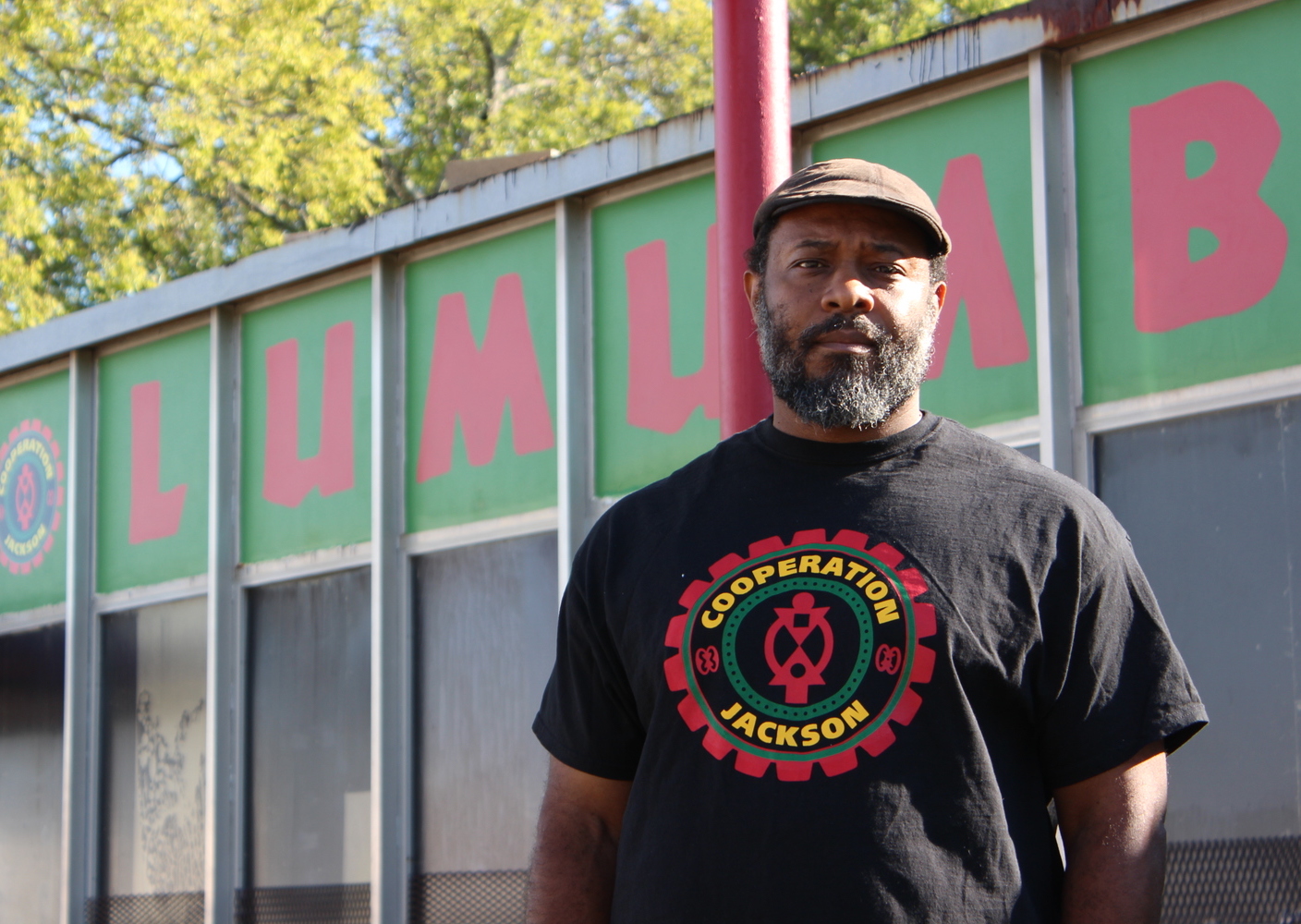
Kali Akuno
The Green New Deal (GND) is now part of the national conversation. But for decades, social movements have been doing the on-the-ground work to resist fossil capitalism and envision a different future. Such grassroots social mobilization — but at a massive scale — is vital to ensuring the GND catalyzes transformative social change.
Cooperation Jackson is at the forefront of eco-socialist organizing to create a new society and economy from the bottom up. Cooperation Jackson encompasses a network of worker cooperatives and supporting institutions fighting to build a solidarity economy in Mississippi and beyond. Jacobin’s Green New Deal editorial team spoke with Kali Akunothe co-founder and executive director of Cooperation Jackson, and co-editor of Jackson Rising: The Struggle for Economic Democracy and Black Self-Determination in Jackson, MS.
In this wide-ranging interview, we discussed the links between local eco-socialist action, national movement-building, and an internationalist orientation; tactics and strategies for interacting with electoral politics to radicalize the GND — and much more. Throughout, Akuno draws on a long history of environmental justice activism in the United States and around the world, providing key lessons about how to move forward — and quickly — to generate a militant, mass movement for a just planet. 

We’re in an interesting political moment where there’s a lot of excitement around a GNDcoming from insurgent left-wing Democrats, but also a lot of pushback from centrists in the party who have a lot of power, as we saw in Nancy Pelosi’s move to weaken the Select Committee on a GND. How can we be strategic about interacting with different representatives and power players? Looking forward to 2020, how can we orient ourselves towards the most radical GND possible?

KA: Organizing is the answer. We have to organize a strong independent base to advance the transition program we need, be it the Green New Deal or anything similar. Without that this epic issue will be held hostage to forces seeking to maintain the capitalist system as is, whether it be the Democratic or Republican variety of this worldview and its articulated interests. And we have to build this base to advance two strategies at once.
One, we have to organize a mass base within the working class, particularly around the job-focused side of the just transition framework. We have to articulate a program that concretely addresses the class’s immediate and medium-term need for jobs and stable income around the expansion of existing “green” industries and the development of new ones, like digital fabrication or what we call community production, that will enable a comprehensive energy and consumption transition. This will have to be a social movement first and foremost, which understands electoral politics as a tactic and not an end unto itself.
For our part, one of the critical initiatives that we as Cooperation Jackson are arguing for is the development of a broad “union-co-op” alliance that would seek to unite the three forms of the organized working-class movement in this country — i.e. the trade unions, workers’ centers, and worker cooperatives — around what we call a “build and fight” program. It would seek to construct new worker-owned and self-managed enterprises rooted in sustainable methods of production on the build side and to enact various means of appropriation of the existing enterprises by their workers on the fight side, which would transition these industries into sustainable practices (or in some cases phase them out entirely). We think this is a means towards building the independence that is required to dictate the terms of the political struggle in the electoral arena.
The second strategy calls for mass civil disobedience, as we witnessed at Standing Rock. We have to recognize that the neoliberal and reactionary forces at the heart of the Democratic Party are only part of the problem. The main enemy is and will be the petrochemical transnationals. We have to weaken their ability to extract, and this entails stopping new exploration and production initiatives. This is critical because it will weaken their power, particularly their financial power, which is at the heart of their lobbying power. If we can break that, we won’t have to worry about the centrists, as you put it. 

Cooperation Jackson is a local project, and a lot of the most exciting left projects now are local or municipal. The Green New Deal is likely to involve a lot of money that will ultimately be spent by local bodies. Yet the history of the US, including the New Deal, includes a lot of examples of local institutions actually defending inequalities and privileges from federal intervention, whereas something like what W. E. B. Dubois called “abolition democracy” required federal back-up. How do you think about the role of decentralization and the federal government in terms of a Green New Deal, especially in the early years?


KA: Cooperation Jackson is a locally situated project, as you noted, but we see ourselves as part of an international, or more appropriately, several international movements. I say this because we don’t think the answers to the questions posed are local or national; they are of necessity global. We have to build an international movement to stop runaway climate change and the sixth great extinction event that we are living through right now. There is no way around that.
One of the reasons why we have to build a powerful international movement is to fortify our national, regional, and local movements against the reactionary threats and counter-movements that exist throughout the US, but that are extremely concentrated in places like Mississippi. For instance, on a practical level, being connected to an array of international forces helps give cover to our work in Jackson. We can bring various types of pressure to bear on local reactionary forces whose constant threats against us can be mitigated (to varying degrees) by acts of economic and political reprisal by our international (and national) allies.
To the extent that the Green New Deal becomes policy, and is rooted in a radical just transition framework, it will make a significant contribution toward addressing the climate crisis as it transforms energy and consumption practices in the US, particularly those of the government, which is one of the leading carbon emitters on the planet. However, in order for the Green New Deal to be effective in its implementation, it is going to have to be extremely nuanced to address the situated racial and class inequalities that are at the heart of your question.
So for instance, barring a major radical transformation of the Mississippi government (and society), we in Jackson would need a direct relationship with the federal government to ensure access to the federal resources provided by the Green New Deal. Under present conditions, if those resources were allocated to the state government alone, you best believe that Jackson would only receive a fraction of those resources — if that. The primary reason being the ongoing structural intersections between settler colonialism, capitalism, and white supremacy that continue to define the US as a project.

Therefore, in order to be effective, the Green New Deal must not be one-dimensional in its orientation — i.e., only concern itself with reducing carbon emissions, without taking into account how to address and overcome the racial, class, gender, and regional-based inequities in this society.

Cooperation Jackson has been working on cooperative agricultural models. What role should food sovereignty movements play in the GND, in terms of agricultural production methods?
KA: A significant part of the sixth extinction event is the rapid loss of habitat and corresponding ecological destruction that countless species have suffered the past two hundred years. We have to, and I stress have to, figure out a way to severely restrict our habitat (i.e. land) use and engage in some major ecological restoration.
The challenge is how to produce more food, on smaller plots of land, without resorting to genetic modification. We haven’t figured this out, to my mind. Not even close. I think permaculture points us in the right direction, as does some degree of small-scale agriculture to at least break the stranglehold the monopolies currently have. I also think we will need to maximize urban density, fairly significantly, to enable more habitats to be recuperated for other species and to restore ecological balance and the replenishment of the soil, which are major carbon sinks. In doing this we will have to turn our urban spaces into “living farms” to address many of our caloric needs.

The Green New Deal is going to have to address this challenge head on and leave ample room for experimentation, but an experimentation that intentionally breaks the power of the monopolies and creates new incentives for production that are not profit-driven or bound.

You’ve been very lucid on the problem of productivism that’s implicit in a lot of Green New Deal proposals. One way some of us have tried to address this issue is by emphasizing other kinds of work, like care work. Another idea out there is to transition huge amounts of the workforce toward part-time work — that is, to distribute existing work more evenly. What are some of the ways you think we should finesse a jobs guarantee to avoid reproducing capitalist and/or socialist productivist politics?

KA: The Left has to start positioning itself around improving the overall quality of life of the working class, the oppressed, and humanity as a whole. A broader distribution of work is a necessary step in this direction without question, and it’s not only the right direction, but the imperative one. However, this has to be combined with forms of solidarity exchange to improve the quality of life of the majority of humanity. This is where things like time-banking on a mass scale can and should come in. As well as the overall expansion of the commons.


To my mind, this will also entail transitional measures, such as a universal basic income (UBI). I say transitional because instituting a UBI without socializing the means of production would only serve to reproduce the capitalist logic of accumulation and the unequal relationships that are necessary for its reproduction.
Ultimately, I think we are going to have to develop a comprehensive and democratic planning system that equitably distributes the essential goods and services we all need to survive and thrive. And to be clear, I’m not arguing for a return to the centralized state-capitalist economies of the twentieth century, but the democratic socialization of the emergent information-based exchange economies, and that would utilize technological innovations to create a regenerative economy.

This would entail, at least in its early stages, various rules and limits, to make sure that exchanges stay within scientific and social limits related to resource extraction and energy utilization, until they become normative — which would take a few generations to undo the century of conspicuous consumption that has been advanced and promoted by late capitalism.
You’ve pointed to indigenous leadership in stopping pipelines at places like Standing Rock and argued we need to “scale up our campaigns against the oil companies,” including through direct action. Others have called for nationalizing and shutting down oil and gas companies. What does scaling up the fight against fossil-fuel companies look like? What’s the political path to taking down these incredibly rich and powerful companies?
KA: As I noted, the type of direct action that we witnessed at Standing Rock is where we are going to have to go. The march of death that the petrochemical companies are leading us on leaves us with no other choice.
There are some critical steps that must be taken before we get to that level of mass direct action on an ongoing basis. We have to do a much more thorough job of getting the masses of people to understand the severity of the crisis and our collective ability to do something about it. We have some hearts and minds to win; and we have to defeat the notion that capitalism can’t be defeated. It’s going to be hard, but it’s not an immutable system.
The forces of reaction are doing everything within their power to make the direct action we’ve seen over the last decade explicitly illegal. They are going to escalate their brutality. Standing Rock should have taught us that. Indeed, many land, water, and sky protectors are already getting killed throughout the Global South.
We are going to have to get people to understand that preserving life on this planet is well worth the sacrifices that thousands if not millions of us are going to have to consciously make, by throwing our bodies directly on the line against the system. We are at the midnight hour, and it’s eco-socialism or death. We have to be clear about what it will entail to eliminate the current system.
This type of consciousness-raising has to precede options such as nationalization as a means of liquidating fossil capital. This doesn’t mean that we shouldn’t introduce the idea and use it as a motivating factor, but we have to be real that it is going to take millions of people acting in accord with one another to make this option a concrete reality.
You’ve been active in the environmental justice movement for a long time. What lessons do you draw from that work? What kinds of strategies and coalitions have been most effective? What can we learn from the people who have been fighting on this for a long time about how to take on powerful industries?
KA: To be honest, the answer to this question would take a book. Let me redirect the question a bit. It is time that we seriously appreciate the insights of groups like Earth First!. In terms of social movement development, they were ahead of their time. Our challenge now is figuring out how to scale them up significantly and in a very short period of time — within five years, because we only have a decade at best to get this right.
We need to reevaluate the differences in outcomes between the ecologically oriented movements of the 1960s and 1970s from those of the 1990s to the present. It is no accident that the most significant environmental legislation yet passed in the US, like the Endangered Species Act, the construction of the Environmental Protection Agency, the Clean Air Act, were passed in the late 1960s and early 1970s — and by Richard Nixon no less. These acts were passed on the basis of the strength and militancy of the social movements of the era, which posed a direct threat to the system.
The ecological movements of the 1990s to the present have not benefited from coexisting with strong, militant movements amongst broad layers of the oppressed and the working class. In the absence of these latter movements, the struggles against environmental racism and for climate justice have had to rely on lobbying to address their demands. This has in turn forced these movements to rely on “good politicians,” rather than creating conditions that the system had to respond to — or else. We have to build movements that have the size, clarity, strength, and determination to pose clear “or else” threats.
Internationalism is one of the principles of Cooperation Jackson, and you’ve emphasized the importance of internationalism on climate in particular. What would it look like to build internationalist policies into a GND? And what examples of political projects in the Global South — of eco-socialism, just transitions, sustainable agriculture, cooperatives, energy democracy, etc. — do you find inspiring or exciting? How can leftists in the US connect to, support, and learn from those projects?
KA: Another excellent question. I will mention four critical policies:


  1. Policies that create international mechanisms and institutions that work directly with indigenous peoples and communities in the rainforest regions of Africa, Asia, the Caribbean, Latin America, and Oceania to stop the operations of multinational mining, petrochemical, agricultural, fishing, and medical corporations. These policies would need to explicitly counter the United Nations Reducing Emissions through Deforestation and Forest Degradation in Developing Countries (UN REDD) program — not because we are haters of the United Nations, but because this program is rooted in neoliberal logic and is a reintroduction of colonial practices that threaten to displace millions of indigenous peoples from their lands.
  2. Policies that promote the development of open source technologies to directly transfer technology and information to peoples throughout the world. This will enable communities to produce the new carbon-reducing or carbon-neutral technologies that are innovated locally, thus eliminating the need for long-distance trade that would fuel more carbon emissions.
  3. Policies that will end the international operations of the US-based petrochemical, mining, agricultural, fishing, and medical transnational monopolies. This will enable local production of essential goods and services when and where needed and put a halt to the extraction and accumulation regimes that currently dominate our planet.
  4. Policies that eliminate the impositions of the World Trade Organization (WTO) that negate national and local sovereignty, which has been detrimental to the introduction of major climate mitigation initiatives in the US and Canada. 
There are no shortage of political projects occurring in the Global South addressing the climate crisis and the broad range of topics that you mention. I have been deeply inspired by movements in Micronesia and the Maldives to force the world to deal with the fact that their island homelands are disappearing as we speak. Their direct-action engagements at various UN and international functions have been heart-wrenching and eye-opening. There are a few explicitly eco-socialist movements in the Global South that I am aware of. The most developed in my view are in South Africa, Venezuela, and Bolivia. The critical thing about the movements in these countries is that they have put the question of climate change and the regeneration of the ecology on their national agendas.
And finally, it is imperative for our movements here in the Global North to be intentional about connecting with the movements in the Global South. In many respects, the movements in the Global South are far more advanced than those in the Global North, especially in terms of their political consciousness, organizational development, membership, and social bases. However, what many of the movements in the Global South don’t possess are the resources we have at our disposal in the Global North — and I don’t just mean financial resources, but varying degrees of infrastructure, like widespread access to electricity and telecommunications services.
In thinking about how to build a new international, we have to think strategically about how best to utilize our respective strengths to overcome our respective weaknesses. We need to draw on the political and organizing strengths of our comrades in the Global South, understanding that we will have to adapt them to our respective context and all the social struggle that will entail, while also figuring out how to transfer our own strengths, if only by providing them with greater resource and media access to speak and act on their own behalf to the wider world.

Friday, June 26, 2015

1904. The Climate Movement Should Demand: "Tax Greenhouse Gases Emissions With Subsidies for Low-Income People"

By Kamran Nayeri, June 26, 2015
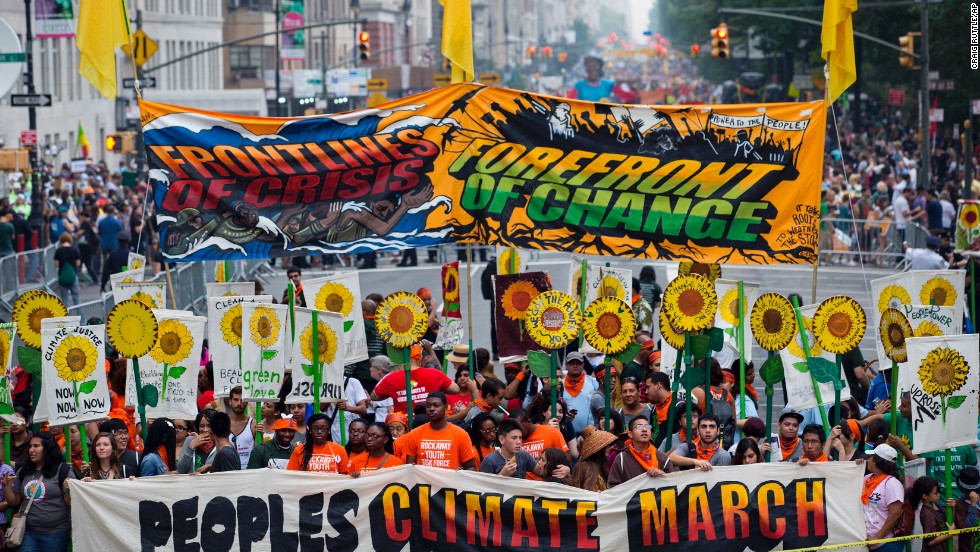
Climate March in New York City, Septermber 2014


The climate movement must take the initiative
The world governments, in particular, the American government, have failed miserably to adopt and implement effective policies to mitigate global warming and catastrophic climate change despite scientific knowledge that it threatens the very existence of human species and much besides. 

While the grassroots movement demanding action to mitigate catastrophic climate change has been gaining momentum its focus so far has been on registering opposition to government inaction.  It is high time that the climate movement raise specific policy demands because government devised policies  have failed to work so far.  This is because governments place corporate and economic interests above protecting the climate. Precious time is wasted as the world edges closer to the tipping point when it will become impossible to stop the coming catastrophe due to feedback effects. 

For an emissions tax with subsidies to low-income people
The movement needs to adopt as its central demand a carbon/emissions tax with subsidies for low-income people.  This is easy to explain and to understand. Economic activities producing greenhouse gases (GHGs) do not factor in the cost of pollution.  Economists call this “externalities.” Since the Industrial Revolution, this has served as a generous subsidy to industries that cause emissions.  It is high time to add in this environmental cost through an emission tax.  However, the low-income people should be cushioned against such a tax eroding their already low purchasing power.  A subsidy is necessary which can be funded from the emission tax itself.  Emission taxes can also be used for subsidies to speed up transition to clean renewal energy (those that have minimal adverse effect on the environment—solar, wind and geothermal but not natural gas and nuclear).

The climate movement can enhance its effectiveness by focusing its campaigns on nine countries and European Union that are responsible for more than 70% of greenhouse gases. Ranked by their “absolute emissions,” they are China, U.S., E.U., India, Russian Federation, Indonesia, Brazil, Japan, Canada, and Mexico. 

Seven of these countries and E.U. have higher per capita emissions than the world average: Canada, U.S., Russian Federation, Japan, E.U., Indonesia, China and Brazil.  In eight countries and E.U.,  the transition to clean renewables energy will be largely accomplished by phasing out fossil fuels through a carbon tax (a form of emissions tax).  In Indonesia where key sources of GHGs are deforestation and land use an emission tax is required.

Climate Club
Early industrializers of the West and Japan as well as China should take the lead because of the historic responsibility of the former and the fact that China’s pollution is largely driven by industrial production for the West that makes China the leading emitter today. The E.U., in particular some of its member states like Germany, have taken notable steps to cut emissions already.  Last year, United States and China announced intention to reduce emissions in the coming years. And on Germany’s urging the recent G-7 meeting announced its intention to work for a world free of fossil fuels by the end of the century; a largely symbolic gesture. But all these have been rather timid action boxed in by each country's corporate and economic interests.  The climate movement should demand that they honor and exceed these intentions by creating a Climate Club through adopting meaningful emissions (or when appropriate carbon) taxes with subsidies to low-income people.  

Emissions tariff and Climate Change Assistance Fund
Key to the international success of emissions taxes is that Climate Club countries impose import tariffs on leading emitters who are not yet in compliance. The combination of emissions tax and import tariffs will benefit any country that joins the Climate Club and make it unfeasible economically not to join it.  All such tariff should go to a Climate Change Assistance Fund that gives assistance to the countries most affected by climate change and least able to face it alone and to help them transition to a post-carbon economy.  

How to proceed
In sum, I believe it is high time for each organization in the climate movement to discuss this and other policy proposals in their general meetings. What to do about climate change is too important to leave to politicians, bureaucrats, technocrats and business interests who routinely place corporate and economic interests before the health of the planet and all who live on it. 

Whenever we plan for protest actions various participating groups propose demands or slogans close to their own vision. There is usually harmony with the directions and goals of the climate movement.  However, it is time to strive for greater unity by adopting clear and concise policy of our own on how to combat climate change.  

The policy proposals here will run into opposition by many politicians, bureaucrats, and corporate leaders. However, climate movement is a political movement precisely because we must overcome such oppositions by our ever-more powerful mobilizations and unity in action.  Who else will design and implement solutions to climate crisis if not the climate movement?  At the same time, there may be criticism by some of us who have proclaimed “System Change, Not Climate Change.”  Of course, there is truth in the notion that the capitalist system is responsible for global warming and the planetary crisis. However, most people who raise this slogan do not subscribe to the idea that effective policy to combat climate change has to wait for the downfall of capitalism. In fact, it is the reverse.  Only through building a mass climate movement that can forge and force an effective climate policy on the existing capitalist world order that we can take genuine steps to overcome it.  

We can win the fight to reverse 250 years of greenhouse gas emissions if enough social forces are organized and mobilized in key countries and across the world.  It requires a clear understanding of policies, strategies and tactics that can achieve our goal.  Of course, we will continue with campaigns to end fracking, tar sands oil, explorations in particularly dangerous locations, coal trains and bomb trains.  But emission taxes with subsidies to low-income people and formation of a Climate Club that impose import tariff on major emitting countries and provide assistance to the countries of Global South to cope with climate change and transition to a post-carbon economy will be a powerful complement that will unify the movement across the world and point the way forward. 

Technical Appendix
It is well known among economists that in the global capitalist economy individual countries have no incentive to limit emissions that bring them economic benefits as long as they do not have to share its costs.  It is a typical free rider problem.  Given this, in a recent article in the American Economic Review, Yale climate economist William Nordhaus has argued for the formation of a Climate Club to combat climate change.  The two basic conditions for membership are: (1) to impose a meaningful carbon tax; and, (2) to impose import tariffs on countries not in the Club.  Professor Nordhaus discusses estimates for Social Cost of Carbon (environmental costs) to estimate proper tax rates as well as proper import tariff rates. Professor Nordhaus does not consider subsidies for low-income people nor a Climate Change Assistance Fund for countries of the Global South.  However, his work shows that relying on “peer pressure” and a “cap and trade” system will not work.  His policy proposal is also simple to understand and easy to implement if accepted.  Even in the environmentalist movement proposed policies to confront climate change is often a laundry list of options that work if they are undertaken at the same time and by a range of economic and social actors.  Taxing GHGs emissions and cutting off subsidies given to the fossil fuel industry historically are easy to understand and explain and effective. 


Notes
 1. They failed to arrive at any common policy for 21 years of Conference of the Parties (COP) and 11 years of Meetings of the Parties (MOP). Meanwhile CO2 concentration in atmosphere has continued to rise rapidly reaching 403 ppm in May 2015. 
 2. See, Kamran Nayeri, “People’s Climate March Was a Huge Success; What to Do Next?,” October 1, 2014
 3. See, for example, June 23, 2015 Letter to the White House by thirteen environmentalist organizations protesting EPA’s intended policy to substitute biomass for coal instead of transition to clean energy. 
 4.Mengpin Ge, “6 Graphs Explain the World’s Top 10 Emitters,” World  Resources Institute, November 25, 2014. 

Related posts:

1913. Discussion: Emissions Tax, The Climate Movement, and Radical Social Change