Showing posts with label Climate change denial. Show all posts

Thursday, December 6, 2018

3115. US Government Suppressing Critical Scientific Findings

By Joel Clement, Scientific American, December 4, 2018
Monumental Disaster at the Department of the Interior
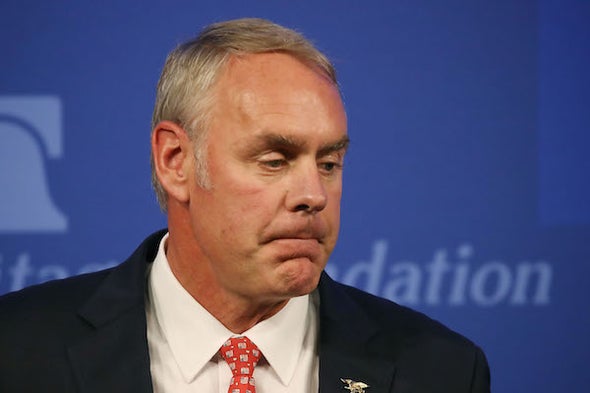
Interior Secretary Ryan Zinke. Credit: Mark Wilson Getty Images


This is a tough time to be a federal scientist—or any civil servant in the federal government. The Trump administration is clamping down on science, denying dangerous climate change and hollowing out the workforces of the agencies charged with protecting American health, safety and natural resources.
At the Department of the Interior (DOI), with its mission to conserve and manage America’s natural and cultural resources, the Trump administration’s political appointees are stumbling over one another to earn accolades for disabling agency operations. I should know; I was one of dozens of senior executives targeted by Interior Secretary Ryan Zinke for reassignment in a staff purge just six months into the new administration.
From that day onward, Zinke and his political staff have consistently sidelined scientists and experts while handing the agency’s keys over to oil, gas and mining interests. The only saving grace is that Zinke and his colleagues are not very good at it, and in many cases the courts are stopping them in their tracks. The effects on science, scientists and the federal workforce, however, will be long-lasting.

A DAMNING REPORT
In a new report, Science Under Siege at the Department of the Interior, the Union of Concerned Scientists (UCS) has documented some of the most egregious and anti-science policies and practices at the DOI under Secretary Zinke. The report describes suppression of science, denial of climate change, the silencing and intimidation of agency staff, and attacks on science-based laws that help protect our nation’s world-class wildlife and habitats.
 It is a damning report and required reading for anyone who values public lands, wildlife, cultural heritage, and health and safety.
 It would be impossible to cover everything this clumsy political wrecking crew is up to, but the report provides details on the most prominent actions that deserve greater scrutiny, such as: the largest reduction in public lands protection in our nation’s history; a systematic failure to acknowledge or act on climate change; unprecedented constraints on the funding and communication of science; and a blatant disregard for public health and safety.
Why is this administration so scared of science? Why cancel a study into the health effects of mountaintop removal coal mining so soon after lifting a moratorium on coal leasing on public lands? Why keep scientists from speaking with the press? Because, while science provides the best evidence we have for making policy decisions that serve the broader public, Ryan Zinke has been very clear that he is in office to serve the oil, gas and mining industries, not the general public.

THE ATTACKS ON SCIENCE NEVER STOP
It is challenging to keep up with the relentless attacks on science coming from Secretary Zinke and his team of political appointees. Since the finalization of UCS’s report, we have seen Secretary Zinke blame “radical environmental groups” as the cause of wildfires, with no mention of climate change, which scientists know is creating the conditions for bigger, hotter, more ferocious fires. Like President Trump, he continues to suggest that poor forest management is the real reason for the deadly fires, regardless of whether they occur in suburbs or shrublands, far from federally managed forests. His ignorance of science is perhaps only surpassed by that of his boss.
It has also recently come to light that DOI has taken steps to roll back protections for individuals impacted the most by the agency’s anti-science actions. In November, it was reported that DOI rescinded two environmental justice policy memos that were put in place over 20 years ago to reverse decades of environmental racism and the marginalization of low-income communities. This is an affront to Native American communities suffering from the ongoing impacts of fossil fuel development.
Zinke’s disdain for science was on display again the day after Thanksgiving, when the Trump administration quietly released two groundbreaking climate reports that featured the work of DOI scientists: the 2018 National Climate Assessment (NCA) and a report on the greenhouse-gas emissions produced from fossil fuel development on federal lands. The NCA describes a stark future for the United States if climate change is left unchecked: destructive sea-level rise, long-lasting droughts, infectious disease outbreaks and crippling economic costs. The federal lands emissions report pointed out that carbon dioxide emissions from fossil fuels produced on federal lands represent nearly 24% of all U.S. greenhouse gas emissions. These are vitally important reports sounding a clarion call that climate action on federal lands is essential to the safety and well-being of the American public.
How did Zinke respond? With the standard anti-science lies being trotted out by Trump and others in the administration. Like his colleagues, Zinke claimed that the NCA was based only on extreme scenarios, when in fact it considered a broad range of emissions scenarios; he also claimed that the U.S. Geological Survey (USGS) at DOI had “concerns” with the NCA when in fact dozens of USGS staff, as well as scientists from other DOI bureaus, were co-authors and contributors to the report. Apparently he didn’t have time to get to the other administration talking point about how climate scientists are just trying to get rich off of their work—a laughable assertion for anyone familiar with the compensation afforded to scientists who volunteer to contribute to such reports. He had nothing at all to say about the federal lands emissions report that was produced entirely within DOI.

A DESECRATION OF PUBLIC SERVICE
It is a desecration of the concept of public service for Zinke to ignore science aimed to protect the public’s best interest, and an insult to the taxpayers who pay his salary and those of his political colleagues. Zinke won’t be around forever, but he has filled the ranks of political appointees at DOI with like-minded industry lobbyists and climate deniers, so things are not likely to change at Interior anytime soon unless Congress, with a vocal public behind it, insists on transparency, scientific integrity and immediate climate action.
America’s public lands, and the natural and cultural resources they contain, belong to all of us. It is astounding that a small group of ideologues thinks they can hand these resources, and the agencies that manage them, over to industries eager to carve them up for private profit. To do so with blithe disregard for the impact upon our planet’s operating system is careless and dangerous, and we must demand better.
In addition to the comprehensive new report, UCS is providing resources and support for Americans eager to fight for science in our democracy while supporting federal scientists under siege. A new Congress will soon be asking harder questions and holding DOI leadership accountable for its actions. We can make it much harder for Zinke and his colleagues to run roughshod over the agency at the expense of our health, our safety, our heritage and our shared public lands.

Sunday, November 18, 2018

3085. Brazil's Top Diplomat Calls Climate Change a Marxist Plot

by Jonathan Watts, The Guardian, November 15, 2018

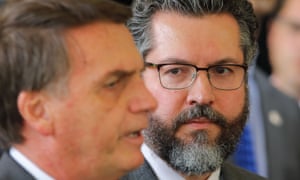
Ernesto Araujo, right, has been nominated by President-elect Jair Bolsonaro, left, to be Brazil’s top diplomat. His appointment could undermine Brazil’s leading global role on climate change.
Ernesto Araujo, right, has been nominated by President-elect Jair Bolsonaro, left, to be Brazil’s top diplomat. His appointment could undermine Brazil’s leading role in climate change. Photograph: Sergio Lima/AFP/Getty Images


Brazil’s president-elect Jair Bolsonaro has chosen a new foreign minister who believes climate change is part of a plot by “cultural Marxists” to stifle western economies and promote the growth of China.

Ernesto Araújo – until recently a mid-ranking official who blogs about the “criminalisation” of red meat, oil, and heterosexual sex – will become the top diplomat of South America’s biggest nation, representing 200 million people and the greatest and most biodiverse forest on Earth, the Amazon.
His appointment, confirmed by Bolsonaro on Wednesday, is likely to send a chill through the global climate movement.
Brazil was where the international community first came together in 1992 to discuss reductions in greenhouse gas emissions. Its diplomats have played a crucial role in bridging the gap between rich and poor nations, particularly during the forging of the Paris agreement in 2015]

But when the new government takes power in January, the foreign ministry that leads that work will be headed by a man who claims climate science is mere “dogma”.
In his blog, Araújo states his goal is to “help Brazil and the world liberate themselves from globalist ideology”, which he sees as anti-Christian.
The 51-year-old diplomat – who has never served as an overseas ambassador – claims unnamed leftist politicians have hijacked environmentalism to serve as a tool for global domination.
“This dogma has been used to justify increasing the regulatory power of states over the economy and the power of international institutions on the nation states and their populations, as well as to stifle economic growth in democratic capitalist countries and to promote the growth of China,” he wrote in a post last month.
In another, he claimed the centre-left Workers party in Brazil was “criminalising sex and reproduction, saying that all heterosexual intercourse is rape and every baby is a risk to the planet as it will increase carbon emissions”. He then went on to accuse the party of criminalising red meat, oil, air conditioners and Disney movies.
The incendiary rhetoric echoes that of Bolsonaro, who won last month’s presidential election with about 57.7m votes. The former army captain has since moved to put in place one of the world’s most far-right administrations and promised to align Brazil more closely to Trump and the US.
Climate negotiation experts said the appointment was sad for Brazil and the world – though they held out hope that the new foreign minister will be more pragmatic when he comes to represent his country.
“Brazil has played a very significant role for the Paris agreement. It would be really bad for the country’s image if he brings with him his ideology,” said Carlos Rittl, the executive secretary of the Brazilian Climate Observatory.
He said climate was the one area where Brazil could proudly boast to be a global leader, and urged the new foreign minister and president not to isolate the country in this field.
“Bolsonaro is not Trump. Brazil is not the United States. We don’t have the same cards,” he said. “If Brazil becomes a pariah on the global climate agenda, it would be extremely bad for our business, especially agribusiness. When they go to Europe to negotiate a deal, climate safeguards will be on the table. ”
The risk of losing soya and beef sales in Europe is thought to be why Bolsonaro has backtracked on threats to quit the Paris agreement and merge the agriculture and environment ministries.
But he remains intent on opening up the Amazon to the farmers, miners and construction companies that supported his campaign.
His pick as agriculture minister is the head of the farming lobby, Tereza Cristina Dias, who conservationists have nicknamed the “Muse of Poison” due to her enthusiastic support for relaxing controls on agro-toxins.
She and her colleagues are said to be gutting the responsibilities of the environment ministry before its new head is appointed. The environment institution is likely to be so subservient that insiders joke there will soon be two agriculture ministries in Brazil.
The slim hope now for climate advocates is that the powerful agribusiness lobby will come to realise that the rain for their crops depends on a healthy Amazon and stable global environment. More than 80% of Brazil’s municipalities have experienced drought in the past five years, which scientists have linked to deforestation.
But loggers are not waiting. The latest deforestation figures showed a sharp rise in deforestation during the election campaign, suggesting protections for nature and indigenous land are already weakening.

Thursday, November 13, 2014

1636. NASA Scientist Takes on the Republican Congressman Denial of Climate Change

By Piers J. Sellers, The New York Times, November 11, 2014


GREENBELT, Md. — I’M a climate scientist and a former astronaut. Not surprisingly, I have a deep respect for well-tested theories and facts. In the climate debate, these things have a way of getting blurred in political discussions.

In September, John P. Holdren, the head of the White House Office of Science and Technology Policy, was testifying to a Congressional committee about climate change. Representative Steve Stockman, a Republican from Texas, recounted a visit he had made to NASA, where he asked what had ended the ice age:

“And the lead scientist at NASA said this — he said that what ended the ice age was global wobbling. That’s what I was told. This is a lead scientist down in Maryland; you’re welcome to go down there and ask him the same thing.

“So, and my second question, which I thought it was an intuitive question that should be followed up — is the wobbling of the earth included in any of your modelings? And the answer was no...
“How can you take an element which you give the credit for the collapse of global freezing and into global warming but leave it out of your models?”

That “lead scientist at NASA” was me. In July, Mr. Stockman spent a couple of hours at NASA’s Goddard Space Flight Center listening to presentations about earth science and climate change. The subject of ice ages came up. Mr. Stockman asked, “How can your models predict the climate when no one can tell me what causes the ice ages?”

I responded that, actually, the science community understood very well what takes the earth into and out of ice ages. A Serbian mathematician, Milutin Milankovitch, worked out the theory during the early years of the 20th century. He calculated by hand that variations in the earth’s tilt and the shape of its orbit around the sun start and end ice ages. I said that you could think of ice ages as resulting from wobbles in the earth’s tilt and orbit.

The time scales involved are on the order of tens of thousands to hundreds of thousands of years. I explained that this science has been well tested against the fossil record and is broadly accepted. I added that we don’t normally include these factors in 100-year climate projections because the effects are too tiny to be important on such a short time-scale.

And that, I thought, was that.

So I was bit surprised to read the exchange between Dr. Holdren and Representative Stockman, which suggested that at best we couldn’t explain the science and at worst we scientists are clueless about ice ages.

We aren’t. Nor are we clueless about what is happening to the climate, thanks in part to a small fleet of satellites that fly above our heads, measuring the pulse of the earth. Without them we would have no useful weather forecasts beyond a couple of days.

These satellite data are fed into computer models that use the laws of motion — Sir Isaac Newton’s theories — to figure out where the world’s air currents will flow, where clouds will form and rain will fall. And — voilà — you can plan your weekend, an airline can plan a flight and a city can prepare for a hurricane.

Satellites also keep track of other important variables: polar ice, sea level rise, changes in vegetation, ocean currents, sea surface temperature and ocean salinity (that’s right — you can accurately measure salinity from space), cloudiness and so on.

These data are crucial for assessing and understanding changes in the earth system and determining whether they are natural or connected to human activities. They are also used to challenge and correct climate models, which are mostly based on the same theories used in weather forecast models.

This whole system of observation, theory and prediction is tested daily in forecast models and almost continuously in climate models. So, if you have no faith in the predictive capability of climate models, you should also discard your faith in weather forecasts and any other predictions based on Newtonian mechanics.

The earth has warmed nearly 0.8 degrees Celsius over the last century and we are confident that the biggest factor in this increase is the release of carbon dioxide from fossil fuel burning. It is almost certain that we will see a rise of two degrees Celsius (3.6 degrees Fahrenheit) before 2100, and a three-degree rise (5.4 degrees Fahrenheit) or higher is a possibility. The impacts over such a short period would be huge. The longer we put off corrective action, the more disruptive the outcome is likely to be.

It is my pleasure and duty as a scientist and civil servant to discuss the challenge of climate change with elected officials. My colleagues and I do our best to transmit what we know and what we think is likely to happen.

The facts and accepted theories are fundamental to understanding climate change, and they are too important to get wrong or trivialize. Some difficult decisions lie ahead for us humans. We should debate our options armed with the best information and ideas that science can provide.

Piers J. Sellers is the acting director of earth science at NASA’s Goddard Space Flight Center.

Tuesday, May 6, 2014

1408. Climate Change Study Finds U.S. Already Widely Affected

By Justin Gillis, The New York Times, May 6, 2014

The effects of human-induced climate change are being felt in every corner of the United States, scientists reported Tuesday, with water growing scarcer in dry regions, torrential rains increasing in wet regions, heat waves becoming more common and more severe, wildfires growing worse, and forests dying under assault from heat-loving insects.
Such sweeping changes have been caused by an average warming of less than 2 degrees Fahrenheit over most land areas of the country in the past century, the scientists found. If greenhouse gases like carbon dioxide and methane continue to escalate at a rapid pace, they said, the warming could conceivably exceed 10 degrees by the end of this century.
“Climate change, once considered an issue for a distant future, has moved firmly into the present,” the scientists declared in a major new report assessing the situation in the United States.
“Summers are longer and hotter, and extended periods of unusual heat last longer than any living American has ever experienced,” the report continued. “Winters are generally shorter and warmer. Rain comes in heavier downpours. People are seeing changes in the length and severity of seasonal allergies, the plant varieties that thrive in their gardens, and the kinds of birds they see in any particular month in their neighborhoods.”
The report, the National Climate Assessment, was prepared by a large scientific panel overseen by the government, and received final approval at a meeting Tuesday morning in Washington. The report was unveiled at the White House, and President Obama planned to spend part of the day highlighting the findings in interviews with television weather forecasters around the country.
The administration hopes to use the report to shore up public support for the president’s climate policies as he attempts to put new regulations in place to limit emissions. A major political battle over the rules is expected this summer, with Republicans already accusing Mr. Obama of plotting a “war on coal.”
Some Republican members of Congress have contended that the science of global warming is a hoax perpetrated by a global conspiracy of climate scientists, a point of view Mr. Obama has mocked as comparable to belief in a flat earth. Other Republicans concede that climate change caused by human activity is real, but nonetheless fear — as do some Democrats — that the president’s policies will destroy jobs for miners and hurt the broader economy.
The report found some benefits from climate change in the short run, such as a longer growing season for crops and a longer shipping season on the Great Lakes. But it warned that these were likely to be countered by escalating damages. Food production may be hit hard by rising heat and water stress in coming decades, the report found.
“Yes, climate change is already here,” said Richard B. Alley, a climate scientist at Pennsylvania State University who was not involved in writing the report but reviewed a late draft. “But the costs so far are still on the low side compared to what will be coming under business as usual by late in this century.”
The ominous findings of the report are likely to give Mr. Obama fresh ammunition as he seeks to tackle the problem in a significant way. However, scientists involved in the report said there had been no political interference in their work. In fact, they went beyond any language the president has used as they cataloged risks.
“Climate change presents a major challenge for society,” the report warned. “There is mounting evidence that harm to the nation will increase substantially in the future unless global emissions of heat-trapping gases are greatly reduced.”
The report was supervised and approved by a large committee representing a cross section of American society, including representatives of two oil companies. Congress ordered in 1990 that a major scientific assessment of climate change be compiled every four years, though the administrations of Presidents Bill Clinton and George W. Bush were slow to comply with the law, and this is only the third report to have been produced.
One of the report’s most dramatic findings concerned the rising frequency of torrential rains. Scientists have expected this effect for decades because more water is evaporating from a warming ocean surface, and the warmer atmosphere can hold the excess vapor, which then falls as rain or snow. But even the leading experts have been surprised by the magnitude of the effect.
The report found that the eastern half of the country is receiving more precipitation in general. And over the past half-century, the proportion of precipitation that is falling in very heavy rain events has jumped by 71 percent in the Northeast, by 37 percent in the Midwest and by 27 percent in the South, the report found.
“It’s a big change,” said Radley M. Horton, a climate scientist at Columbia University in New York who helped write the report. He added that scientists do not fully understand the regional variations.
In recent years, sudden, intense rains have caused extensive damage.
For instance, large parts of Nashville were devastated by floods in 2010 after nearly 20 inches of rain fell in two days. Last year, parts of Colorado flooded after getting as much rain in a week as normally falls in a year. This March, a landslide killed dozens after heavy rains in Washington State. Just last week, widespread devastation occurred in the Florida Panhandle from rains that may have exceeded two feet in 24 hours; the exact total is unclear because the official rain gauge at Pensacola was knocked out by the storm.
Scientists are reluctant to attribute any of these specific events to human-caused climate change, but they say that such heavy rains are consistent with what they expect in a warming climate.
The new report emphasized, however, that people should not expect global warming to happen at a steady pace, or at the same rate throughout the country. Bitterly cold winters will continue to occur, the report said, even as they become somewhat less likely.
And the regional pattern varies for many effects beyond precipitation: for instance, while most of the country has warmed sharply over the past century, the Deep South has barely warmed at all, and a section of southern Alabama has even cooled slightly. In general, colder, more northerly regions are warming faster.
The report cited the likely role of climate change in causing an outbreak of mountain pine beetles that has devastated millions of acres of pine forest across the American West and the Canadian province of British Columbia; warmer winters and longer summers have let more of the beetles survive and reproduce at an exponential rate. It is now possible to drive for hours in some states and see mostly gray, dead trees across mountainsides.
And the report said that severe, long-lasting heat waves were likely to become much more common. For instance, it cited research saying the type of record-breaking heat wave that baked Texas in 2011 had become substantially more likely because of the human release of greenhouse gases.
On rising sea levels, the new report went beyond warnings issued recently by the United Nations. That body’s Intergovernmental Panel on Climate Change warned in September that by the end of the century, sea levels could rise by as much as three feet globally if emissions continue at a rapid pace. The American scientists said the rise could be anywhere from one to four feet, and added that six feet could not be entirely ruled out. Along much of the East Coast, the situation will be worse than the global average because the land there is sinking, the scientists said.
Historically, the United States — with its large cars, large houses and high per capita consumption of energy — was responsible for more emissions than any other country. Lately, China has become the largest emitter over all, though its emissions per person are still far below those of the United States.

The report pointed out that while the country as a whole still has no comprehensive climate legislation, many states and cities have begun to take steps to limit emissions and to adapt to climatic changes that can no longer be avoided. But the report found that these efforts are inadequate compared with the magnitude of the problems that are coming.