Showing posts with label Art. Show all posts

Saturday, May 19, 2018

2923. Edward Burtynsky: The Photographer of the Anthropocene

By Nick Glass, CNN, May 18, 2018
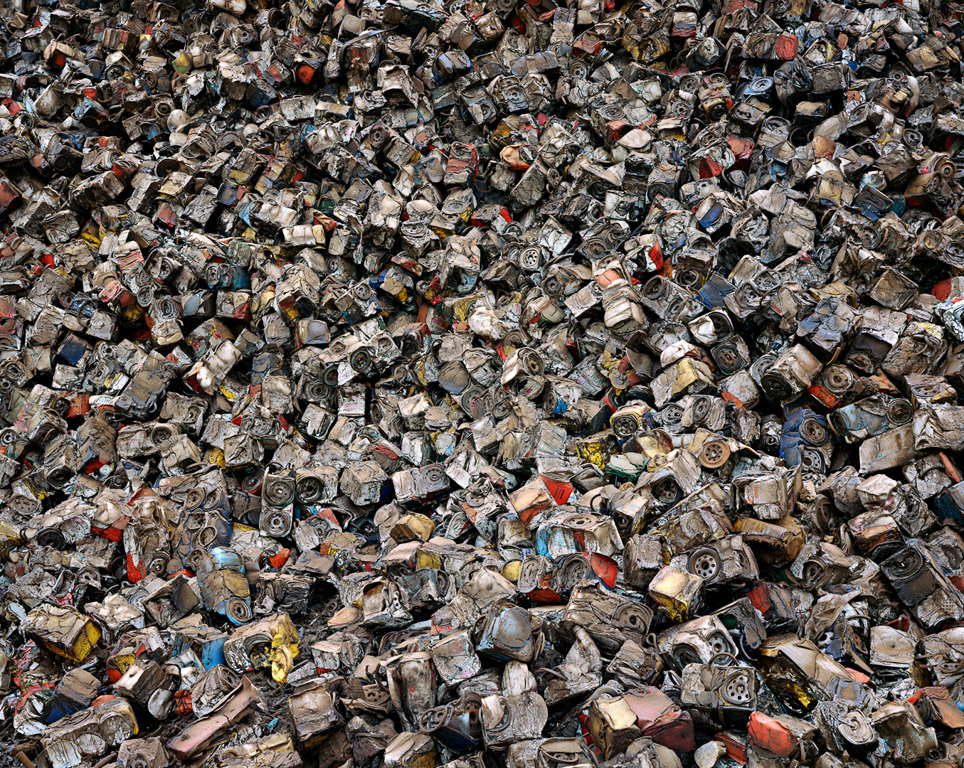
Densified oil filters, Hamilton, Ontario, 1997. Photo: Edward Burtynsky. 


Edward Burtynsky likes to think big. It's always been his natural inclination. Every time the Canadian photographer frames an image, he imagines it big. The bigger the print the better -- anything up to 9 feet by 18 feet -- which makes complete sense, given the size of his subject matter.

For some 35 years, Burtynsky has been photographing humankind's industrial intervention in natural landscapes. His panoramas have expanded with technology. Since 2003, he has used helicopters and, since 2012, a bespoke drone. His images help us look down on our planet in a new and detailed way

We all know that humans are scarring the landscape. But Burtynsky provides the visual evidence on a breathtaking scale: great wounds slashed into the earth -- from coal and copper mines, oil refineries, salt pans -- and all the wasteland, spills and debris that result from them.

As with NASA's photographs from space, there is an unquestionable beauty to Burtynsky images. He brings a painterly eye to the landscape -- and that's the paradox. "The technical revolution has turned us into a virus consuming all living organisms, diminishing biodiversity," he says.
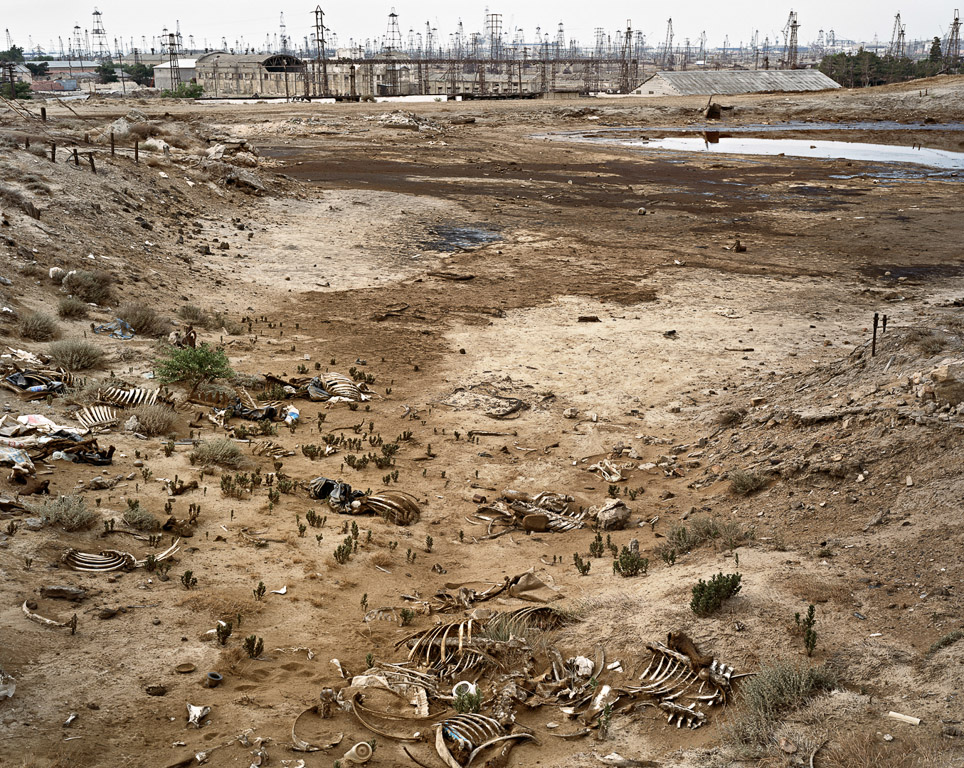
SOCAR oil field, Baku, Azerbaijan. Photo: Edward Burtynsky

But as Burtynsky is well aware, he is recording it beautifully, making it as "visually compelling and as transcendent" as he can. "It's an immersive thing" for the viewer. In Burtynsky's vision, the apocalypse has its sublime moments.

I meet up with Burtynsky during a fleeting visit to London. (He has been named "Master of Photography" for this week's Photo London fair, where he's showing work and has given a talk.) He's evidently a busy man, and his lifestyle more than a little nomadic. He has just opened an exhibition of his work outside Frankfurt, and, before that, was on an underwater shoot in Indonesia.

Burtynsky's prints are large, usually 60 inches by 80 inches. You often need to read the labels to know precisely what you are looking at. The photographs on show in London range from copper mining in British Columbia (the viewer peers down into a great pit beside a sinuous road of loaded trucks climbing and descending) to oil pirating in the Niger Delta (a scorched earth of oil slicks, languid muddy waters and sparse vegetation) and a gleaming Italian marble quarry (an astonishing vertical wall of Carrara marble, marked out in great blocks and ready for extraction).
Los Angels, U.S. 2003. Photo: Edward Burtynsky.

Throughout our interview, Burtynsky refers to himself as "an artist." His work, he tells me, has been influenced by the Abstract Expressionists. In previous interviews, he's made reference to Jackson Pollock and Paul Klee, and you can see this in the shapes and subdued earthy palettes of his photographs. "I am thinking of Pollock in the intensity and vibrancy of the surface," he explains.
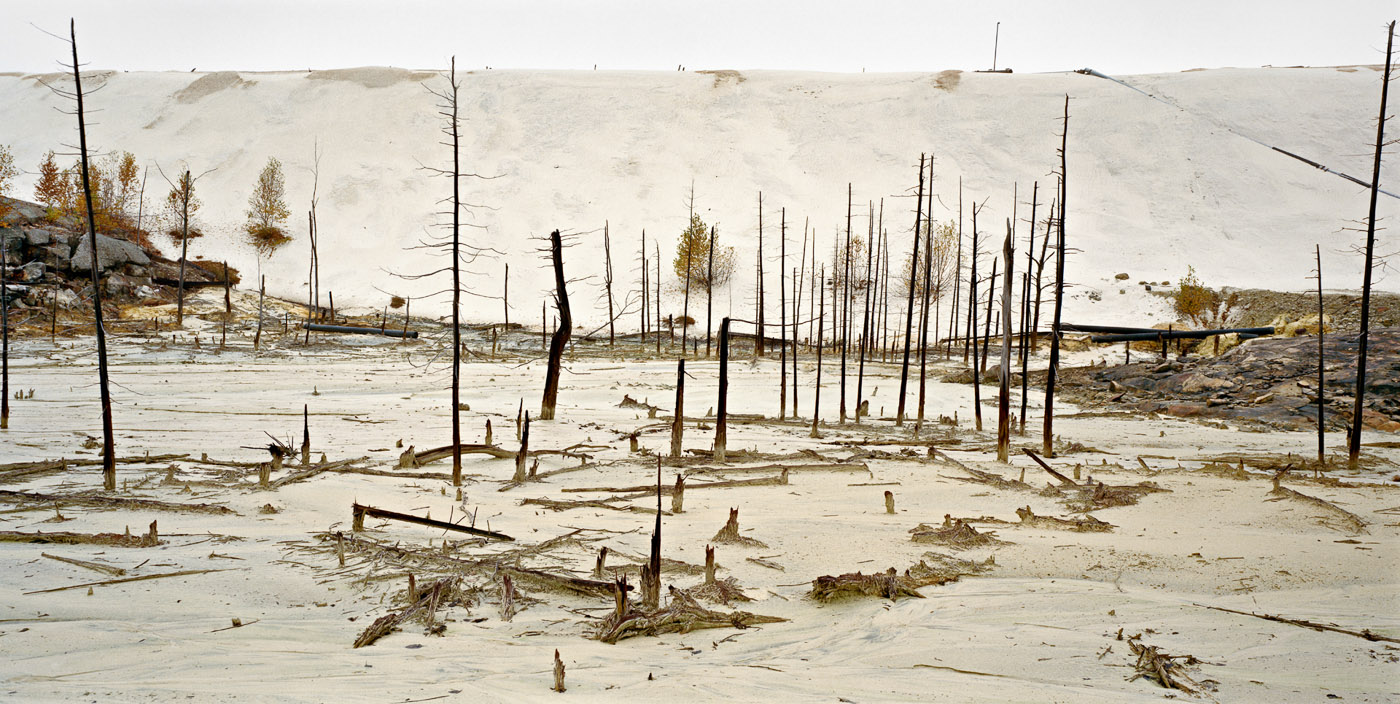
Uranium trailing. Elliot Lake, Ontario, 1995. Photo: Edward Burtynsky.

In Burtynsky's photographs, we look down on swirls, spirals and loops. The landscapes sometimes look quilted, man-made rectangles of muddied color and watery rainbow oil slicks. In depleting our natural resources, we humans can't help ourselves. We must make marks and patterns. Looking at them, I find myself longing for signs of life, and in a few photos you can just make out the occasional human being -- tiny figures in hard hats among sawmills, or villagers paddling boats in the oil swamp of the Niger Delta.

Burtynsky has entitled his latest body of work "Anthropocene," the term some scientists use to define our current age, as humanity has become the dominant influence on the planet's climate and environment. He believes this era began in the 19th century with the widespread use of the internal combustion engine. Others think it began later, after 1945 and nuclear testing.

Regardless, Burtynsky claims to be non-judgmental, saying that his work is "revelatory, not accusatory." The landscape is simply "the consequence of what we are." He likes to hope that his images -- his "compendium of that rash spread across the planet," as he puts it -- has had some impact, not least on the next generation who are "less engaged in materiality."

This leads us to the bluntest of questions: What's the future of our planet?

"I like to remain optimistic that technology will save the day," Burtynsky replies, though his tone suggests otherwise. He expresses surprise at "how slow we are to react, and how impossible it seems to tackle the problem on the scale it needs to be tackled." And when Donald Trump was elected Burtynsky didn't sleep for a week. "After 35 years looking at the wastelands of our cities, of our lives, we're running out of time," he says.

Yet Burtynsky doesn't speak in an impassioned or alarmist way. Easygoing by nature, he's said it all before and will do so again. It's simply what he's observed -- and it makes him anxious.
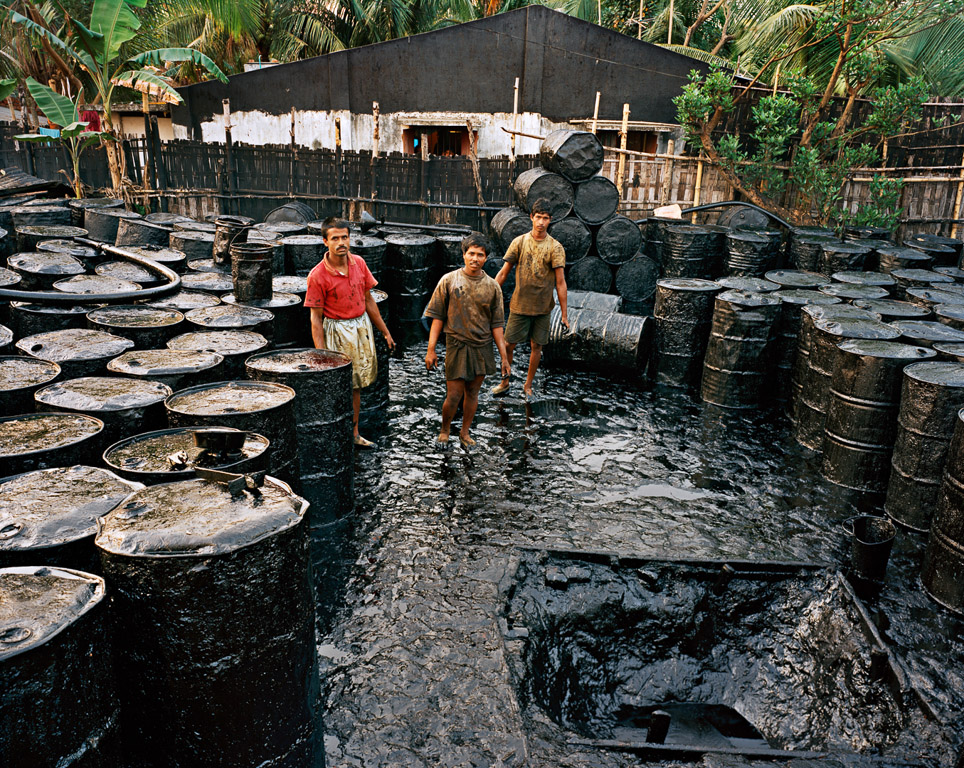
Shipbreaking, Chittagong, Bangladesh, 2001.  Photo: Edward Burtynsky.

A return to nature
As a young photographer, Burtynsky was first interested in "pristine landscapes" and his own yearning for the past. He cites two great 20th-century American photographers as early influences: Ansel Adams, with his majestic images of the American West, and Eliot Porter, for his intimate portraits of nature. But Burtynsky quickly realized that "the altered landscape was truer to my time as an artist."
Spain, 2010. Photo: Edward Burtynsky. 

It all began close to home in 1983, just "me and my car and my camera," photographing railway lines cutting through the Rocky Mountains, and the coalmines of Western Canada. Then he went a little further afield to an open-pit copper mine near Salt Lake City. Burtynsky sold his first series of landscape photos to a museum for $200 soon afterward.

He admits that he never expected to make a living doing this type of photography, and, at the beginning, he subsidized his work by setting up a commercial photo lab in Toronto. Now he sells his large-format photographs, in editions of three, at $100,000 each. He also plans elaborate photographic shoots that can cost him just as much.
Kennecott copper mine, Bingham Valley, Utah, 1983. Photo: Edward Burtynsky.
Burtynsky acknowledges that he isn't alone in his niche, though his approach is perhaps the most global. Other North American photographers have absorbed themselves in the Earth's scarred landscape, and he names three in particular: Emmet Gowin, David Maisel, and Richard Misrach. But their work is focused on America's landscape. Burtynsky, meanwhile, continues to travel widely with "that very useful tool, Google Earth" and a team comprised of -- among others -- a producer, a documentary filmmaker, and a drone operator.

Access is often the biggest challenge. "They don't want you there!" I interject, and he agrees. Nine months ago, he was in the northernmost city in the world, Norilsk in northern Russia, where there are huge open mines for nickel, copper, and palladium. "That was tough," says Burtynsky, who obtained a Russian visa for cultural activities. (Had he tried to enter as a journalist, it is unlikely that he would have been allowed in.)

In 2005, Burtynsky published a book about China called "China" ("I'm not very poetic in my titles," he admits cheerfully). Now, for his next book, he's switched his attention to Africa. At 63, he's quietly ticking off the countries he's photographed, which now includes Nigeria (whose capital, Lagos, he refers to as "the hyper-crucible of globalism"), Kenya (where he captured a huge pyre of burning elephant ivory) and Ghana (where he photographed an engine recycling plant from above).
Plastic toy parts. Guiyu Guangdong province, China, 2004.  Photo: Edward Burtynsky.

Since then, the photographer has allowed himself some brief respite. He's recently returned to "the pristine" by photographing ancient forests in Vancouver and coral reef in Indonesia's Komodo National Park in Indonesia, where he recently took a team of ten divers. The result -- yet to be published -- will be a 200-square-footprint showing a wall of coral precisely the same size. The chosen image is a composite of 160 high-resolution shots stitched together digitally. "Amazing colors," reflects Burtynsky, "reds, oranges, purples."

Burtynsky has often made reference to Henri Cartier-Bresson's famous remark about "the decisive moment" of taking a great photo. Yet he reminds me that his own approach is rather different -- "contemplative and methodic." Burtynsky likes to take his time and wait for the right light, which he says is overcast but bright). Then, of course, he likes to make the final image as big as he can.
Railcuts. C. N. Track, Skihist Provisional Park, British Columbia, 1995.


Wednesday, January 4, 2017

2529. John Berger's Theory of Art

By Robert Minto, Los Angeles Review of Books, January 2, 2017

EARLY IN HIS CAREER, John Berger’s weekly art criticism for the New Statesman provoked outraged letters and public condemnation. Once, the British Council issued a formal apology to Henry Moore because Berger had suggested his latest work showed a decline. Nor was the hostility limited to such comic passive-aggression. Berger’s politics were deemed so objectionable that his publisher was compelled to withdraw his first novel, A Painter of Our Time (1958), from circulation.
At 90, Berger is harvesting a sudden flowering of praise. It is well deserved. For more than half a century, he has been our greatest art critic — as well as a superior novelist, a poet, and the star and screenwriter of one of the best art documentaries ever made, Ways of Seeing. Most of the writers currently rushing to canonize him, however, avoid dwelling on the heart of Berger’s point of view — his Marxism. No doubt avoiding this disfavored topic makes eulogy easier, but it reminds me of something Berger wrote about Frederick Antal: “the importance of his Marxism tends to be underestimated. In a curious way this is probably done out of respect for him: as though to say ‘He was brilliant despite that — so let’s charitably forget it.’ Yet, in fact, to do this is to deny all that Antal was.” To make such a denial about Berger should no longer be possible after the publication of Landscapes: John Berger on Art.
Landscapes and its companion volume, Portraits: John Berger on Artists (Verso, 2015), are the best summation to date of Berger’s career as a critic. Both volumes were edited by Tom Overton. In Portraits, Overton made selections from decades of essays on the whole historical gamut of art, from the prehistoric cave paintings of Lascaux to the work of 33-year-old Randa Mdah, and organized them chronologically into a history and appraisal of the art of painting. To read it was to be reminded of Berger’s unique virtues: the clarity of his writing, the historical and technical erudition of his insight, and above all his unique focus on each artist’s way of looking. What Landscapes in turn makes clear, through its assemblage of more programmatic pieces — book reviews, manifestos, autobiography — is that Berger is a rigorous thinker with a theory of art. That theory evolved considerably between the 1950s and the 2010s. Yet two threads hold it together with the tenacity of spider silk: a critique of the political economy of art and a sophisticated account of its human value, each rooted in a committed but elastic Marxism.
A Marxist art criticism of any real subtlety has to be elastic, because it must deal with a problem Marx himself diagnosed but failed to solve. Berger puts it like this:
A question which Marx posed but could not answer: If art in the last analysis is a superstructure of an economic base, why does its power to move us endure long after the base has been transformed? Why, asked Marx, do we still look towards Greek art as an ideal? He began to answer the question […] and then broke off the manuscript and was far too occupied ever to return to the question.
Berger takes up the thread where Marx broke off. He is not, of course, the first Marxist to address the question of art, and he is familiar with most of those who tried before him, sorting through and furthering their legacy.
The most famous of Berger’s influences, Walter Benjamin, wrote the essay “Art in the Age of Mechanical Reproduction,” from which came most of the ideas in Berger’s documentary, Ways of Seeing. But Landscapes reveals that his most important influence as a practicing art critic was Max Raphael.
Raphael, an undeservedly obscure theorist, located the value of art in the activity of the artist. According to him, an artist performs two operations. On the one hand, the artist turns raw material into artistic material by shaping it to represent an idea or an object; this is true both of Michelangelo shaping a block of marble into David and of Jackson Pollock embodying the rhythms of jazz in drip paintings. On the other, the artist turns his perception into something external and objective, a representation. The work of art is the result of these two transformations, of raw stuff and of subjective perception into an art object. For Raphael, the point of art is these two transformations: they are the artist’s way of “undoing the world of things” and constructing “the world of values.”
So Raphael’s answer to Marx’s problem — why is art enduringly moving even though it merely reflects its social context? — is to say that art doesn’t merely reflect its social context. It does reflect it, because the artist’s material, style, the things they want to represent, even the way they see, are historically conditioned; but it doesn’t merely reflect it, because the transformed material speaks of something deeper and more voluntary. It speaks of humanity’s ability to make its own world, to become the subject and not merely the victim of history. “The function of the work of art,” Berger sums up Raphael, “is to lead us from the work to the process of creation which it contains.”
Anyone familiar with Berger’s own writing will sit up with a shock of recognition. Here is a theory of art directly correlated to his practice of criticism. Berger takes art out of the sanitizing temples where we store it and drops it firmly back onto the easel, in a messy studio, where a sweaty artist bites her lip and stores her way of looking in an object. Over and over again, he asks us to imagine the artist at work. Many have attributed this to his own training as a painter, which might have inspired his fascination with technique, as I, an amateur pianist, am fascinated by the technique of my favorite recording artists. But I think his admiring discussion of Raphael suggests a much deeper reason. If Berger believes that the most important meaning of art is what it shows us of our ability to create the world we want, it turns out that his criticism is connected to his Marxism much more fundamentally than through the borrowing of a few insights from Walter Benjamin.
For Berger, art criticism is a revolutionary practice. It prepares the ground for a new society. In Landscapes, Overton includes a translation by Berger and Anya Rostock of a poem by Bertolt Brecht. It includes this passage:
Yet how to begin? How to show
The living together of men
That it may be understood
And become a world that can be mastered?
How to reveal not only yourselves and others
Floundering in the net
But also make clear how the net of fate
Is knotted and cast,
Cast and knotted by men?
[…] only he who knows that the fate of man is man
Can see his fellow men keenly with accuracy.
How to begin? Berger answers: In art. There we find proof and prophecy of a different world. In another essay, he writes:
We can no longer “use” most paintings today as they were intended to be used: for religious worship, for celebrating the wealth of the wealthy, for immediate political enlightenment, for proving the romantic sublime, and so on. Nevertheless, painting is especially well suited to developing the very faculty of understanding which has rendered its earlier uses obsolete: that is to say, to developing our historical and evolutionary self-consciousness.
This is the promise, the positive function of art. By looking at it, we are, in effect, looking through an artist’s eyes, entering into a concretized instance of their gaze. We are looking at a looking. And from within an artist’s looking, we learn about the capacities of our kind and the possibilities of our future: “A classical Greek sculpture increases our awareness of our own potential physical dignity; a Rembrandt of our potential moral courage; a Matisse of our potential sensual awareness.”
At the same time, Berger is of the opinion that the modern history of art is a history of failure. He won’t compromise on this point, and it is undoubtedly the reason for the stiff resistance that he has often met.
In modern times, Berger believes, the art world has hosted a titanic battle between two conceptions of art. One conception declares that art is valuable because it bodies forth the vision of an artist; it is a good in itself just to the degree that it succeeds at this task. This is Berger’s conception, and it is large enough to embrace all the varying and contradictory proclamations and provocations of the successive factions of modern art. The other conception declares that art is valuable because it is expensive — that, fundamentally, art is property:
Since 1848 every artist unready to be a mere paid entertainer has tried to resist the bourgeoisation of his finished work, the transformation of the spiritual value of his work into property value. This regardless of his political opinions as such. […] What Constructivism, Dadaism, Surrealism, and so on, all shared was their opposition to art-as-property and art-as-a-cultural-alibi-for-existing-society. We know the extremes to which they went […] and we see that their resistance was […] ineffective.
In other words, artists, like all other workers, are victims of a capitalism that alienates them from the fruit of their labor. Berger has nothing but scorn for the commercialization of art: “If you could fuck works of art as well as buy them,” he writes, dealers “would be pimps: but, if that were the case, one might assume a kind of love; as it is they dream of money and honour.” Everything about the modern art world is constructed on the assumption that art is precious in proportion to its price. Even among those who profess a genuine love of art, that passion is often tainted by its ideological function:
A love of art has been a useful concept to the European ruling classes for over a century and a half. The love was said to be their own. With it they could claim kinship with the civilisations of the past and the possession of those moral virtues associated with “beauty”. With it they could also dismiss as inartistic and primitive the cultures they were in the process of destroying at home and throughout the world.
Museums, those seemingly democratic institutions for the dissemination of art appreciation, come in for withering critique: “Anybody who is not an expert entering the average museum today is made to feel like a cultural pauper receiving charity.” From a man who has spent so much time in museums, these are harsh words. Everything about our museums’ operations reveal a slavish dedication to the conception of art as property: from the choice of what to show and what to store, to the obsession with provenance. Provenance is an important question for owners of art-as-property, for whom the price of a work of art, which to them is equal to its value, is directly dependent upon its rarity and authenticity. The museum teaches us that we are paupers in two senses: too poor in money to do anything but stand abjectly before this display of wealth, and too poor in taste to grasp the reason these objects are so highly prized. Before museums can even begin to be useful, believes Berger, “it is necessary to see works of art freed from all the mystique which is attached to them as property objects.”
Berger’s opinion of museums reveals something: our greatest art critic for the last half-century has been conducting a smuggling operation. The bulk of his work as a critic has been a plainspoken attempt to enunciate the meaning of works of art — the process of their creation — under the eyes of their guards. From his perspective, the regime of property has an interest in suppressing his work, not just because art has functioned so well as a form of wealth and an ideological tool, but because its real meaning is dangerously emancipating.
Tom Overton and Verso have provided a real service by supplementing the praxis, the well-known criticism, of the increasingly famous John Berger with his theory. All those who love his writing and profess to take him as a teacher owe it to themselves to peruse Landscapes, and to grapple frankly with the discomforting, clear, and urgent message of his work:
[I]t is necessary to make an imaginative effort which runs contrary to the whole contemporary trend of the art world: it is necessary to see works of art freed from all the mystique which is attached to them as property objects. It then becomes possible to see them as testimony to the process of their own making instead of as products; to see them in terms of action instead of finished achievement. The question: what went into the making of this? supersedes the collector’s question of: what is this?
¤

Monday, August 24, 2015

1991. The Critical Art of Steve Cutts

By Martynas Klimas, Bored Panda, August 20, 2015
modern-world-caricature-illustrations-steve-cutts-7

Art isn’t all fairytale photoshoots and landscape shots – it can also act as catalyst of change. And Steve Cutts thinks that many things in the world should be different. Work shouldn’t be a grinding, soul-crushing rat race for the almighty dollar. Consumerism shouldn’t hold a vice-like grip on our lives. And social media, well, we need to throw-off the shackles we so eagerly put on ourselves. Wouldn’t life be better then?
Steve Cutts is an illustrator and animator from London. Faced with the choice of working at McDonalds or studying Fine Arts, he chose the latter. He worked at Glueisobar as the main storyboard concept artist before making the leap to freelance work. Cutts makes videos and images that criticize modern life – he states that insanity of humanity is an endless pool of inspiration.
More info: stevecutts.com | facebook | twitter

Sunday, March 23, 2014

1359. Art Exhibit: Glimpses Behind the Walls of Tehran's Red Light District in the 1970s

By Elaine Sciolino, The New York Times, March 20, 2014 

PARIS — Kaveh Golestan was 52 on the bright spring day he died. He was killed in a minefield in northern Iraq in 2003 while working as a cameraman with the BBC.
Many journalists who encountered Mr. Golestan over his long career (including me) knew him as a hard-news photographer and cameraman. He was one of the finest chroniclers of the 1979 Islamic revolution that overthrew the shah of Iran, his native country; the nearly eight-year Iran-Iraq war; and Saddam Hussein’s gassing of the Kurds. His photographs of the revolution won him the Robert Capa Gold Medal.
What is less known is that in the years before the revolution, when Iran was still a Westernized monarchy, Mr. Golestan recorded in stark black-and-white the daily lives of Iran’s dispossessed. An exhibition of one of his most dramatic subjects — prostitutes confined to Tehran’s red-light district known as the Citadel of Shahr-e No (New City) — opens in the Foam Photography Museum in Amsterdam on Thursday and runs through May 4. The complete collection of 61 images will appear as part of a larger photographic, painting and film exhibition on Iran entitled “Unedited History: Iran 1960-2014,” at the Musée d’Art Moderne in Paris from May 16 to Aug. 24.
The Citadel was an old neighborhood of filthy alleyways in Tehran that was established in the 1920s as a red-light district to house scores of prostitutes. In the 1930s and 1940s, the neighborhood became a thriving sex quarter with rampant crime. Female prostitutes walked the streets seminaked. One of the side streets became famous for its young male prostitutes.
After the 1953 C.I.A.-led coup that reinstated the shah, the authorities walled off the area, turning it into a ghetto whose inhabitants were almost exclusively female prostitutes and their children; only men were allowed to access it through an iron gate.
By the 1970s, about 1,500 prostitutes worked, and most of them lived, in the Citadel. Their daughters often followed them into prostitution; their sons often turned to drugs. Sometimes men came for sex, sometimes to drink, do drugs, watch films or sightsee.
In the ghetto, there was a health center, a police station, a social-work office and a crude education service that taught basic reading and writing to women and their children. But the women suffered — from poverty, violence, heroin addiction, syphilis and destitution when they became too old to work.
Mr. Golestan’s work is the only existing photographic document of the Citadel. It first appeared as three photo essays in the daily Ayandegan newspaper in 1977; some of the photographs were included in a book of his photographs on Iran (“Kaveh Golestan 1950-2003: Recording the Truth in Iran”) published after his death. In 1978, the photographs were exhibited for 14 days at the University of Tehran, before the show was abruptly shut down without explanation. Later that year, they were briefly displayed in an underground exhibition at the Tehran Art fair.
The Amsterdam exhibition includes 45 images and is the first time the same original vintage prints have been shown together since then.
Mr. Golestan took notes on everything he photographed, and alongside the photographs, the exhibition will include excerpts from his diaries, newspaper clippings and audio interviews that he conducted in and about the area. The Citadel, he wrote, “confines some of Tehran’s prostitutes within its walls, like a detention center with a tight beehive of tiny cells.” He added, “The lives of the residents have plummeted to the lowest depths of human existence.”
He forged friendships with many of the women, photographing them regularly between 1975 and 1977. His images capture their degradation and despair: one woman with ample breasts visible in a low-cut polka-dot dress covers her eyes with one hand; one girl in a black dress with a white Peter-Pan collar and puffy sleeves looks as if she is no older than 14; another woman covers her head and upper body with a veil, but reveals her bare legs.
Ceilings leak; carpets are torn; mattresses are threadbare; plaster and paint are peeling. The place looks as if it smells of rot.
As the revolution unfolded, radical mobs attacked and set fire to sites they considered symbols of decadence, including the Citadel neighborhood. Most of the women are believed to have escaped, but there was no official investigation and no official count of the casualties. Some of the women were imprisoned and executed by firing squads; others were arrested and “reformed” according to Islamic revolutionary principles. The Citadel site was bulldozed as an act of cultural cleansing and in its place a park with a lake was built.
“You look at these photos and these women are looking right back at you and you have the feeling you are quite intimate with them,” said Kim Knoppers, the curator of the exhibition at Foam. “You forget the sense of time and place. The photos become universal images, which resonates in Amsterdam. We are so well-known for our own red-light district.”
Mr. Golestan’s original prints remained in his archive in Iran until about two years ago. Vali Mahlouji, a London-based Iranian curator and a distant cousin of Mr. Golestan’s widow, Hengameh, who is also a photographer, sought them out to create a complete archive of Mr. Golestan’s work.
The exhibition is the first part of his new project “Archaeology of the Final Decade,” which documents the cultural life of Iran in the years before the 1979 revolution. He intends to expand it into a nonprofit foundation to revive Iran’s historical and cultural material that was destroyed, banned or underrepresented in the Islamic Republic. He has opened discussions with museums and galleries in the United States to take the Golestan show there.
“The mission is to bring back and put into circulation artistic work that went underground because of the revolution and the policies that followed,” said Mr. Mahlouji in a telephone interview from London. “We want to create a link between where we were in Iran in the 1960s and 1970s and what happened after Iran’s cultural revolution of the 1980s. We’re starting by putting Kaveh on the artistic map.”
The content of Mr. Golestan’s exhibit might appeal to the authorities as it shows the “decadence” of the Old Regime; but it would have to be rejected because the women in the photographs have not covered their hair. (Despite the fact that prostitution in Iran’s Islamic Republic is illegal and punishments severe, the practice still flourishes.)
For colleagues and friends of Mr. Golestan, the exhibition is a fitting way to keep his spirit — and his art — alive. “He was driven by a social conscience and he always found a way to express it in his photography,” said Reza Deghati, the Iranian-French photojournalist and philanthropist who worked side-by-side with Mr. Golestan in Iran during the revolution. “His work is a real eye-opener.”
Mr. Deghati worked for Newsweek, Mr. Golestan for Time, but they often traveled together, and for long stretches were the only resident photographers working for American publications.
“I never had the sense there was competition between us,” Mr. Deghati said. “We were much too young for that.”

“Kaveh Golestan: The Citadel” runs at the Foam Photography Museum through May 4. The complete collection of 61 images will appear as part of a wider exhibition on Iran titled “Unedited History: Iran 1960-2014,” at the Musée d’Art Moderne in Paris from May 16 to Aug. 24.