Monday, October 1, 2018

3039. Baobab Trees in Senegal Are Threatened by Climate Change, Urbanization, and Human Population Growth

By Dionne Searcey, The New York Times, September 30, 2018

Baobab trees can live to 2,000 years.

DAKAR, Senegal — Wide, awkward baobab trees blend into the cityscape of Dakar, the busy capital of Senegal, almost without notice.

Drivers wash a fleet of taxis parked beneath one giant tree near a freeway on ramp. Rusting cars with open hoods are parked in a mechanic’s shop under the shade of another. A leathery trunk is a community billboard, with ads nailed to it for a plumber and an apartment for rent.

Aliou Ndour stood on a crowded corner, pulled out his phone and scrolled past the pictures of friends and family to another precious photo: the baobab in his home village.
Fat baobabs, some more than half a millennium old, have endured across Senegal, passed over for lumber largely because their wood is too brittle and spongy for use in furniture. Baobab leaves are mixed with couscous and eaten, the trees’ bark stripped to make rope, their fruit and seeds used for drinks and oils.

“This,” said Adama Dieme, craning his neck to look up at the spread of branches of the baobab on his block, “is the pride of the neighborhood.”
But baobabs, like many of the region’s trees, are in jeopardy, threatened by the same forces upending numerous facets of society — climate change, urbanization and population growth.

West Africa has lost much of the natural resources once tied so closely to its cultural identity. Poaching has stolen most of its wildlife; lions, giraffes and desert elephants are sorely endangered.

Huge swaths of forest are being razed to clear space for palm oil and cocoa plantations. Mangroves are being killed off by pollution. Even wispy acacias are hacked away for use in cooking fires to feed growing families.

One of the largest baobab trees in Senegal is in the Fatick region, southwest of the capital.

In recent years, rainy season has started later than usual. But a welcome shower arrived last month near the coastal community of Joal, Senegal.

A recent study said climate change might be blamed for the deaths of some of Africa’s oldest and biggest baobabs. In Senegal, local researchers estimate the nation has lost half its baobabs in the past 50 years to drought and development.
One of the biggest developments in the country is outside Dakar, where Senegal’s president is building an entirely new city, in the middle of a baobab forest. Officials have pledged to replant any trees they raze.

On the far edges of the development, construction workers were building new homes. The corpse of one baobab lay on the ground, a musty smell lingering at its exposed hollow interior. The smooth marks of an ax scarred its trunk.

Other charred carcasses of baobabs lay nearby. A worker said those had been torched with gasoline.

“Whenever you see a baobab that has fallen down, you’re sad,” said Gorgui Kebbe, the worker. “It’s a symbol of our country. But having a house to live in takes priority.”

In Senegal an image of a baobab is on the presidential seal. Baobabs are painted on the sides of buildings and on billboards. A fancy seaside hotel is named after them. So is a famous wrestler.

One baobab, which locals say is 850 years old with a 100-foot-circumference trunk, is a tourist attraction. You can sleep in a baobab tree house hotel or ride a zip-line course from baobab to baobab.

Senegal has few rivers and no mountains so baobabs sprout from the scrubby landscape as majestic way points. Throughout history, entire communities were constructed around these trees.

Baobabs serve as town halls — gathering places where municipal decisions are made, babies named and scores settled. Their bulging, python-like roots serve as La-Z-Boys for the tired. Their branches offer refuge for the overheated.

The trunks of some trees are covered in trinkets — a rooster’s claws, a bracelet, a plastic flip-flop, all for good luck. Pilgrims come to a stubby baobab on Île de Madeleine, a small island off Dakar, to insert money into the folds of its trunk or nail a message there, as a prayer of last resort.

The rainy season here has been starting later in recent years, and the downpours are fewer. As drought becomes a new way of life, the baobab in many communities is where people gather to pray for rain.

In Diock, a village about three hours outside the capital, the rainy season should be in full swing by now, but by early August it had rained only four times. The millet plants in the surrounding fields were only ankle high.

“We watch on television what is going on in Europe and in the world,” said Mamadou Diop, the village chief. “We know what’s coming.”

To fight climate change, residents are using fewer gas-gulping machines and not cutting down smaller trees for firewood.

But harvests have been so poor that many of the village’s 600 residents have abandoned farming and moved to the city, where they find work as teachers or soldiers.
“We’re trying to reduce greenhouse gases,” Mr. Diop said, “but it’s as if we are powerless.”

In towns and villages that dot the countryside, each community has its own tradition entwined with its local baobab.

In Diock, a new bride and groom circle the baobab seven times after they are married. On Fadiouth, an island on the southwest coast made entirely of seashells, funeral processions pause at the base of the village baobab, before carrying on to a Catholic shrine and the cemetery.

Seydou Kane, who works in Senegal’s Ministry of Culture, was circumcised under a baobab in the city of Thiès when he was about 4. Grown-ups had told him the trees were filled with spirits who grew angry if you touched the trunk. After the ceremony, he was told to nick the trunk of the tree with a knife. He gathered his courage and ran toward the baobab, marking it with his blade.

“You’re a man now,” he recalled the adults telling him. “You don’t have to be afraid of anything.”
He passed by the tree not long ago and it was dead.

An ancient baobab on Île de Madeleine, off the coast of Dakar, is both tourist and spiritual attraction. Some people leave trinkets and money in the folds of its trunk and offer a prayer.

Baobab leaves have been a regular part of the diet of Selbe Dione and her sister, who one afternoon used a long wooden pole with a hook at the end to pluck leaves from a baobab in the middle of a neighbor’s field in the Fatick region. The tree was tilted, as though it was bending to help them.

“Everything from the baobab is beautiful,” Ms. Dione said, looking at the green oval-shaped fruit and large white dangling blossoms, “from its leaves to its roots.”
The tissue inside some of Senegal’s oldest baobabs has died, leaving giant, cavelike holes. The hollow of one baobab in the coastal city of Nianing is big enough for a dozen people to stand in comfortably.

Once these hollows were mausoleums for griots, or storytellers, who were buried inside, standing up.
These men were considered walking libraries, the power of their words so strong their energy should radiate throughout the baobab for eternity. The practice was outlawed in the 1960s but locals still refer to the trees that were once tombs as sacred baobabs.

Many of the trees mark cemeteries. In Kaolack, 49 kings of the Guelewar Dynasty are buried under a baobab.

On a recent morning Aminita Ba, 72, stood tending goats in the middle of a wide field in rural Samba Dia that was punctuated by a single, towering baobab.
When Ms. Ba arrived on the farm 50 years ago, she built her small house near the tree, knowing it would be a guidepost for visitors.

“I’m very proud of this baobab,” she said. “From far away you can see this big tree and next to this big tree is a home, and it’s my home.”

3038. Not Learning From the New Communist Movement

By Louis Proyect, The Unrepentant Marxist, October 1, 2018
Max Elbaum, author of “Revolution in the Air”
There’s an interview with Max Elbaum on Jacobin today titled “Learning from the New Communist Movement” that is mostly unobjectionable. As I pointed out in a review of Max’s “Revolution in the Air” in 2002, “I strongly recommend this recently published Verso book to anybody trying to make sense of the state of the left today. While focused on the "New Communist Movement" of the 70s and 80s (that I prefer to call Maoist), the lessons Elbaum draws are applicable to all vanguard party-building projects including those of the Trotskyist movement that I participated in.”
Clearly, there is an affinity between Jacobin/DSA and the Maoist movement that Elbaum belonged to and chronicled in this book. With both the DSA and the “New Communist Movement” of yore recycling the politics of the Popular Front, you might even wonder why it took so long for them to have a friendly chat. Max was a leader of the Line of March (LOM) in the 1970s, a Maoist group founded by Irwin Silber, the film critic of the now-defunct American radical newsweekly The Guardian.
The LOM had a most peculiar political agenda. They wanted to either convince the CPUSA to return to its glorious past or carry out that task themselves. Whatever complaints they had about the CPUSA, being embedded in the Democratic Party was not one of them.
In the early 80s, I was active in the New York chapter of the Committee in Solidarity with the People of El Salvador (CISPES_ that was mostly made up of political independents like me but had some LOM and Communist Workers Party (CWP) playing an important role as well. The is best known for its ultraleft strategy in North Carolina that played into the hands of the KKK. As two important trends in the New Communist Movement, they both were very active in Democratic Party campaigns involving Black progressives who were the Bernie Sanders and Alexandria Ocasio-Cortez of the day: Harold Washington, who would be elected mayor of Chicago, and Jesse Jackson.
In 1984, CISPES passed a motion that its members would work closely with Jackson’s Rainbow Coalition. Still allergic to anything connected to the Democratic Party, I began to wind my CISPES activism down. Micah Uetricht, the Jacobin assistant editor who conducted the interview with Elbaum, uses his words to stigmatize people like me: “Planting the banners and waiting in a left-wing stronghold for people to come to us will not cut it.” The full exchange appears below:
Micah Uetricht: In the book, you quote Vladimir Lenin: “Politics begin where the masses are, not where there are thousands, but where there are millions.”  Then you write that revolutionaries must not “accept marginal status as a permanent fact of life — much less a mindset that glorifies marginality as a sign of true revolutionary faith. … Planting the banners and waiting in a left-wing stronghold for people to come to us will not cut it.”
When I read that, I think of the critiques of mass campaigns like Medicare for All or for politicians like Bernie Sanders and Alexandria Ocasio-Cortez, which have shown that they can bring the idea of socialism to mass numbers of people who have never heard this term before. Some of those critiques are valid, like the worry that engaging too heavily in electoral politics will water down DSA’s radical politics to the point that the organization ceases to advance a bold socialist vision. But most of them seem more rooted in people clinging to that “pure” marginality — at a moment when socialism has an opportunity to become a truly mass movement. The opportunity to reach the “millions” that Lenin references is here, but orienting a leftist organization in that direction involves ditching some of the habits of glorifying marginality.
Max Elbaum: I think the Bernie campaign, the insurgent campaigns, the way people are learning to speak to large numbers who are envisioning moving the country as a whole — all of that is extremely positive. Politics is a matter of looking at the balance of forces and where the masses are at and intervening in a way that moves the needle. We have to speak to the majority and build a majoritarian movement.
We’re obviously a long way from a majority of the United States not just supporting fundamental change and an alternative to capitalism but taking steps and risks to make that happen. That’s not going to come about by offering only a maximalist program and trying to move in one leap from where we are now to that maximalist program.
It’s certainly legitimate and necessary to realize there’s uneven development in society — you’re going to have an advanced guard, what Lenin called the “conscious element.” That’s the point of having a socialist organization where people are united on the long-range goal. But it works in different layers. It has its immediate base and its periphery, and it works in coalition with outside forces.
So, I think that the purist tendencies, the ones that are critical of anything that is less than their total vision of what a revolutionary socialist program would be, are self-defeating. Because you never break out of the margins.
The idea that you just plant the flag and everyone will come to you if you have the correct line has never worked. That’s not how politics works. Politics is addition — you need to get more people on your team.
The Left has been marginal for a long time in the United States. For some people, that’s their comfort zone. When you mix it up in broad mass politics, there’s always a danger that you compromise some key principle and fall down a slippery slope. Those are real dangers. But every successful movement for radical reform or revolution has to engage in those broad mass politics. There’s no other way to build a majoritarian movement from where we are now to a majoritarian movement for socialism.
With all due respect to Max and Micah, it appears that the words “Politics begin where the masses are” do not appear in the Marxist Internet Archives. It seems to have about the same provenance as “The Capitalists will sell us the rope with which we will hang them.” None. In fact, the words attributed to Lenin could justify practically anything, including urging a vote for Hillary Clinton in 2016, as Max did.
The exchange between the hardened social democrat (or democratic socialist, whatever) and the hardened Eurocommunist is notable for leaving the words “Democratic Party” out. Instead, it frames the differences between “glorifying marginality” by “purist tendencies” and those who are involved with “electoral politics” like the DSA, the Communist Party and the Committees of Correspondence. You might even say that articles written for the People’s World and Jacobin in support of working to elect Democrats are virtually indistinguishable except for the fact that Jacobin articles tend to use the language of the graduate school rather than the AFL-CIO media bureau.
If Jacobin had decided to ask tough questions rather than the kind that Charlie Rose would feed to Henry Kissinger or Bill Gates, they would have brought up Jesse Jackson’s campaigns. For all practical purposes, the Rainbow Coalition was the Sandernista movement of its day with volunteers being drawn from various Maoist sects rather than the social democracy, which was pretty marginal at the time.
Just as Jacobin authors kid themselves into believing that Sanders, Ocasio-Cortez et al might eventually break with the Democrats as Lincoln did with the Whigs, you heard the same thing in 1984 and 1988. Most leftists thought there was a realistic possibility that the Rainbow Coalition could turn into a new third party when Jackson had as much of an intention of leading such a break as Sanders does today. You can understand how this would be even more unlikely this would be for Sanders since he enjoys the perks of being an elected Senator.
Thirty years ago, Joanna Misnik wrote a pamphlet for Solidarity titled “The Rainbow and the Democratic Party— New Politics or Old?: A Socialist Perspective” that I highly recommend. It is written from the perspective of Lenin’s electoral strategy that has nothing in common with the exchange between Uetricht and Elbaum above. Instead of quoting non-existent words, they might have tried to grapple with Lenin’s polemics against the Mensheviks who advocating blocs with the Constitutional Democrats (Cadets), the Democratic Party of Czarist Russia.
Here is Misnik on the “Inside-Outside” strategy defended by the DSA:
The Rainbow includes a number of socialist and left organizations that hope the Coalition can ultimately precipitate a break from the Democrats in favor of a new anticapitalist political party. Groups such as the National Committee for Independent Political Action (NCIPA) typify the "inside-outside" strategy of the not-really Democrats in the Rainbow. They hold the position that the way to break the Democratic Party apart is to join it. They are urging people to register and vote Democrat!
"Inside-out" Rainbow activists are concerned about the decline of the movements for change during the past decade. They mistakenly identified the shift to the right of establishment politics as a rightward drift in the population at large. Sectors of the movement, buying into the idea that Reagan had a mandate, became fearful and hesitant. This timidity was fed by the collapse of the Black movement into the Democratic Party and the failure of the labor movement to mount a defense against concessions, plant closings, unemployment and the general effects of the recessionary economy.
The difficult political climate led to conclusions of the type offered by Rainbow leader Sheila Collins in her recently published The Rain­bow Challenge: the Jackson Campaign and the Future of U. S. Politics. Collins explains:
The election of Ronald Reagan in 1980 shocked many left activists into discovering the dialectical relationship between social movements and electoral institutions…. Electoral politics was no longer seen as a substitute for movement-building, but as a necessary complement. Although it was difficult to do both simultaneously, there was a growing realization that the two forms of political activity were dialectically related. (105-108)
This new "dialectic" for the ’80s is a high-toned way of sounding a retreat from what history has already taught. There isn’t a shred of evidence to support the idea that the Democratic Party, in or out of power, offers fundamental concessions to the locked-out when they loyally lock-in their votes in massive numbers. All successes in shifting the social relation of forces—from the rise of the CIO to the civil rights and anti-Vietnam war victories—have been the direct results of unruly mass movements playing outside the acceptable channels of U.S. two-party politics.
In the case of both labor in the 1930s and the social movements of the 1960s, it was precisely at the point when major sectors of these movements decided it was time to move "from protest to politics" and act as a pressure group within and around the Democratic Party than reforms began to slack off and eventually disappear. In fact, the brevity of these two periods of major change is due to this very co-optation. Unable to defeat capitalist control of the party from the inside and claim it as their own, the reformers were themselves beaten and became the reformed.
Left Rainbow advocates may argue that all this does not apply. After all, they have an organization separate and apart from the Democratic Party that enables them to resist absorption while they use the "tactic" of Jackson’s candidacy to build a new, integral progressive force. Unfortunately this is not the case.
The Rainbow has only one tactic, one focus that glues all its components together: Jackson’s race for the Democratic Party nomination. No other goals were established at the Raleigh convention. By definition, this subsumes the Rainbow into the Democratic Party and hands it over to those who want it to be nothing more than an army of foot soldiers for the Jackson Campaign Committee.
This problem is not something only those outside the Rainbow can perceive. The powerful New Jersey delegation to the Rainbow Con­vention led a well-received fight to democratize the notoriously top-down Rainbow structure. They were motivated by the fear that the Rainbow will be dictated to by official campaign structures, stunting its growth and threatening its ability to exist beyond `88. Some structural changes were made, such as adding state chairs to the all-powerful Board of Directors and halving the minimum number of members required to receive a local charter.
However, the Rainbow chartering system still requires a minimum membership in a third of a state’s congressional districts. Using the districts as its basic unit shapes the vote-getting operation. It is a foreign and unwieldy organizational structure for activists accustomed to city-wide mobilizing.

Sunday, September 30, 2018

3037. Moroccan Fossil Find Rearranges Homo sapiens Family Tree

By Marriëtte Le Roux, phys.org, June 8, 2017
French paleoanthropologist Jean-Jacques Hublin, who led research on an exciting fossil discovery in Morocco, says the resulting findings see a move "further and further away" from "a linear vision of human evolution with a succession of species."
This week's unveiling of the oldest-known Homo sapiens remains has painted an excitingly chaotic picture of what Earth was like 300,000 years ago—bustling with hominin species that included a very early version of our own, experts say.

The story of , this shows, does not follow a straight line from monkey to ape-man to architect.
Rather than emerging from a single "Garden of Eden" 200,000 years ago before spreading throughout Africa and the world, early modern humans were already scattered across the Mother Continent a hundred millennia earlier.
Even then, homo sapiens were living in distinct groupings that met occasionally, trading technology and genes.
They also rubbed shoulders with rival Homo , which may have included their own direct ancestor, according to the analysis of the sensational findings.
Africa, at the time, would have resembled "a kind of human zoo", said Jean-Jacques Hublin of the Max Planck Institute for Evolutionary Anthropology, who led the research on five human fossils from Jebel Irhoud in Morocco.
"We are moving further and further away from this linear vision of human evolution with a succession of species, one replacing the other," he said.
"There were probably several groups of hominins existing, overlapping in time... and having, I would say, complex relationships."
Two studies published in the journal Nature on Wednesday, extended our species' recorded existence by a third, from 200,000 to 300,000 years ago, and torpedoed the long-held theory that we emerged from an East African "cradle of humankind."


Graphic showing timeline relating to the discovery of the oldest Homo sapiens


"The origin of our species likely involved numerous populations spread across Africa with periodic gene flow between them," said Matthew Skinner of the University of Kent's School of Anthropology, who did not take part in the study.
For Lawrence Barham of the University of Liverpool, the dating of the Moroccan site helps us to see our species more clearly in time and in space.
The previous oldest Homo sapiens remains ever found, in Ethiopia, were 195,000 years old.
"An earlier date of 300,000 years is significant from the perspective of human evolution in Africa itself, where Homo sapiens may have co-existed with at least two other species—Homo heidelbergensis and Homo naledi," Barham commented.
Who taught whom?
Many scientists hypothesise that the large-brained H. heidelbergensis was the common ancestor from which H. sapiens and our cousins the Neanderthals split around half-a-million years ago.
Contemporary H. naledi had a smaller brain and retained some ape-like features—it likely climbed trees as well as made tools.
Now the question arises: did these different African species compete?
"Or did each have its own niche enabling them to coexist?" asked Barham.


French paleoanthropologist Jean-Jacques Hublin and Abdelouahed Ben-Ncer of Morocco's  National Institute of Archaeology and Heri
French paleoanthropologist Jean-Jacques Hublin and Abdelouahed Ben-Ncer of Morocco's National Institute of Archaeology and Heritage Sciences in Morocco mull research which has advanced human origins by a hundred millennia, undermining …more


Another unknown is when our species started encountering members of Homo groups from further afield—Neanderthals from Europe and Denisovans in Asia, for example.
The new findings, Barham told AFP, "raises the possibility that there may have been even earlier movements of Homo sapiens out of Africa."
The consensus today is that our species left Africa about 80,000-100,000 years ago.
At the time that Hublin's ancient Moroccans were hunting and cooking gazelle and zebra meat not far from modern-day Marrakesh, Africa was a very different place—easier to navigate on foot.
For long periods between 330,000 and 300,000 years ago, the desert was replaced by a greener, more hospitable landscape.
According to the research team, the discovery means that Homo sapiens—not members of a rival or ancestor species—were the ones who left behind Middle Stone Age hand tools that have since been unearthed all over Africa.
As our species was previously thought to be much younger, it was not considered plausible that they could have made these implements.
For Barham, the new dates will revive a theory that Neanderthals learnt tool-making from Homo sapiens, not the other way round.

Wednesday, September 26, 2018

3036. The Rise of China and the End of the American Century

By Thomas L. Friedman, The New York Times, September 25, 2018
Chinese and Russian naval exercise in the South China Sea.

Editor's note: At the turn of the millennia, I wrote an essay for the Farsi socialist magazine Negah published in Sweden about the end of the American century.  Today's NYT columnist Thomas Friedman acknowledges as much except he seems to lay the blame in part on President Trump.  In this, he forgets the very fact that the rise of Mr. Trump itself is a telling signal of the relative decline of the United States as the hegemonic power.  If anything, Trump and the Republican party today represent a backward-looking political force that sees the power of American imperialism in the rear mirror. The Democratic party is not much better as it had joined the Republicans in the onslaught on the society and nature at least since the 1974-75 recession.  To grasp how imperialist and backward-looking the Obama administration was read again the leaked Hillary Clinton's speech to Gladman Sachs in October 2013 on how to confront China. I post the entire Friedman's text which includes his proposal on how to share the dominance over the world with China. Of course, humanity deserves much better but only if enough of us working people get organized and mobilized to challenge the world capitalist class.  KN

*      *     *

Early in the movie “Crazy Rich Asians” a Chinese-Singaporean father admonishes his young kids to finish their dinner, saying, “Think of all the starving children in America.” I’m sure that everyone of my generation in the theater laughed at that joke. After all, we’d all been raised on the line: “Finish your dinner. Think of all the starving children in China.”

That little line contained within it many messages: The first, which any regular traveler to China’s biggest urban areas can tell you, is that rich China today — its luxury homes, cars, restaurants and hotels — is really rich, rich like most Americans can’t imagine.

The second is that this moment was destined to be a test of who will set the key rules of the global order in the 21st century: the world’s long-dominant economic and military superpower, America, or its rising rival, China. And this test is playing out with a blossoming full-scale trade war.

What does such a test of wills sound like? It sounds like a senior Chinese official telling me at a seminar at Tsinghua University in April that it’s just “too late” for America to tell China what to do anymore on issues like trade, because China is now too big and powerful. And it sounds like President Trump, in effect, telling China: “Says who? Show me what you got, baby!” Or as Trump actually tweeted last week: “We are under no pressure to make a deal with China, they are under pressure to make a deal with us. … If we meet, we meet.”

I guess we should be grateful that this confrontation has been confined to trade, but, as I said, it was inevitable. Because, as one top tech executive pointed out to me: “China is not a ‘near peer’ anymore. It is a peer.”

As Mary Meeker’s latest internet trends study noted, five years ago China had only two of the world’s largest publicly traded tech companies, while the U.S. had nine. Today, China has nine of the top 20 — Alibaba, Tencent, Ant Financial, Baidu, Xiaomi, Didi, JD.com, Meituan and Toutiao — and the U.S. has 11. Twenty years ago, China had none.

Do you see a trend? Do you hear footsteps? The total value of China’s internet economy is already bigger than America’s. And China’s economy now is so cashless that many women no longer carry purses or men wallets — just a cellphone with mobile apps — to buy anything, or even donate to a beggar.

And don’t get me started on the biggest emerging work and services tool in the world — artificial intelligence. China’s plan is to catch up to America in A.I. and surpass it as soon as possible, and it’s well on its way. Because with A.I., the more training data you can feed the machine the faster it learns, the more patterns you can see and the more algorithms you can write to improve products and services or invent new ones. Because China has so many more people than we do, and so many more of them use mobile apps for their daily lives, China’s ability to amass giant data sets and train more machines faster is considerable.

“If data is the new oil, then China is the new Saudi Arabia,” remarked Kai-Fu Lee, author of “AI Superpowers: China, Silicon Valley, and the New World Order.”

Chinese companies are already the world leaders in computer vision/facial recognition and speech recognition, which can be used for commerce and for surveillance and societal control. In just the last two years there has been an explosion of fintech start-ups in China, offering mobile payments, lending, brokerage and banking. And the No. 1 and 3 drone manufacturers in the world — DJI and Xiaomi — are Chinese. France’s Parrot is No. 2. At the same time, China is producing far more engineers and scientists than the U.S., and their quality is steadily rising.

America today, by contrast, has become the unrivaled world leader in generating data about Donald Trump and from Donald Trump.

In the daily barrage of Trump news and tweets, some Trump statements are actually true, though — like the need for the U.S. to confront China’s unfair trade practices. China has grown incredibly these past 30 years with a very specific formula: hard work, unleashing capitalism, smart planning and long-range investments in education and infrastructure — but also by stealing intellectual property, forcing technology transfers and cheating on World Trade Organization rules.

We have to respond. But wisely.

Historically the U.S. could dominate the global scene and check a rising power like China, and set the global rules, with just our sheer physical mass — more money, more troops, more naval ships, more top-10 companies, more scientists and more universities. That is just not possible any longer, as China has become both big and smart in more and more areas. But all is not lost.

It happens that we have three huge assets that China doesn’t have, and is unlikely to acquire them anytime soon. We should be doubling down on our strengths: immigration, allies and values. Instead, Trump is squandering them.

Many of the smartest and most talented people in the world — high-I.Q. risk-takers — still want to come to our country. And in a knowledge-talent era, where companies thrive by being the first and fastest to put intelligence into everything they make, we should be welcoming more high-skilled immigrants than ever and giving green cards to every Chinese, and other foreign students, who come to America for advanced degrees. China can’t attract the best and brightest Indian, Israeli, Arab, French, Brazilian and Korean immigrants, but we still can. So why would we put out a sign saying “Go Away” or make it harder for their students to stay here?

Also, we have real allies in a way China does not. China has clients, customers and frightened neighbors. It does not have real partners like Canada and Mexico. It doesn’t have the whole Atlantic alliance with the European Union or tight relations with Japan, South Korea, Singapore and Australia — which we can leverage if we aren’t doing stupid stuff, like slapping them with steel tariffs or tearing up the Trans-Pacific Partnership.

Finally, as a society, we stand for things — or at least we used to stand for things — values people admire, about the dignity of human beings, the rights of minorities and women and the virtues of freedom and the rules for fair play.

Our nation has never been just a beacon for profit-making, which only measured countries by their trade balance with us. Our values attracted people to our shores and helped us spread our rules onto the wider world. When Trump tore up the TPP trade deal I’m certain that he actually disappointed China’s economic reformers, who wanted to use the pact to create pressures inside China to reform.

In short, a strategic president wouldn’t squander our strengths but would reinforce them by creating a stronger global network of people and countries that share our values. We won the Cold War with a strategy of containment and bankrupting the Soviet Union by outspending the Kremlin on defense. But we will “win” this standoff with China, not by brute force alone, or by containment of China’s giant economy, but by “entanglement” — the entanglement of Chinese students with our schools, Chinese businesses with our values, and the Chinese government with our allies. That is, with the broad alliances and global institutions, and their rules of fair play, that we’ve been part of since World War II.

So we have to fight for those rules, and China will fight for its versions. But ultimately, I believe, the U.S. and China together will have to play the role that the U.S. played alone after World War II — to define the rules of the new international order, from A.I. to privacy to trade. And our weight in that process — we must never forget — will depend on the talent we attract, the allies we rally and the values we embrace and promote.

3035. The Changing U.S. Demographics, 1610-2010

By Manuel Garcia, Jr., manuelgarciajr, September 26, 2018
New York City
The population of English colonists on the eastern shores of what would eventually become the United States of America numbered 350 in 1610. Their descendants, along with those of the subsequent imported Black slaves, many immigrants (legal and illegal), and later remnants of the Native American population whose ancestors had populated this continent since as early as 14,000 years ago, reached a cumulative population of 308,745,538 individuals in 2010, within the political boundaries of the U.S.A.
This essay is a very general and simplified overview of how the population within the territory of the United States has grown over the 400 years between 1610 and 2010. While there is a very wide spectrum of “races” and ethnicities in the U.S.A., this essay will focus on only three groups: White people, Black people and Latino (a.k.a. Hispanic) people. Both White and Black people are thought of as two racial groups; while Hispanic people have Spanish as their original language, and their cultures are based on it, and they can be of any race: White, Black, Red, Yellow, and any mix of these. The summation of the White, Black and Hispanic populations in the U.S. makes up nearly the total US population. Asian and Pacific Islander people make up only 4.9% of the US population (in 2010); and American Indian, Eskimo and Aleut people make up only 0.9% of the US population (in 2010).
An aside on “races”: Based on genetics there is only one race of humans, but the concept of human races — popularly treated as species! — based on skin color, facial and physiological features, is still too widespread and embedded in popular culture to be dispensed with here. Also, race is tabulated in U.S. Census data, upon which this essay is based.
What I am interested to learn is if I can understand the politics of a period from the demographics of that time.
I have made a few simple charts of the racial and ethnic population fractions in the United States for Whites, Blacks and Latinos, based on historical census data spanning the years 1610 to 2010 (https://en.wikipedia.org/wiki/Historical_racial_and_ethnic_demographics_of_the_United_States).
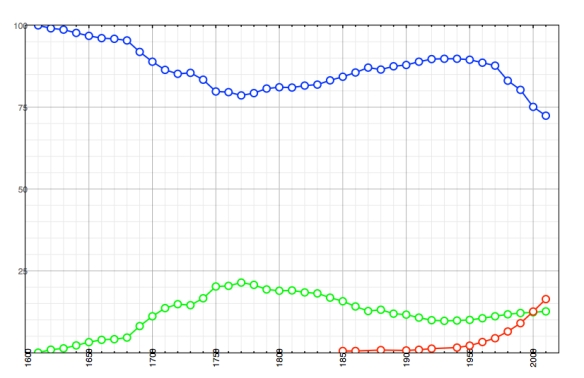
The first pair of charts (quantitatively identical, just with different data-set color schemes, for ease of viewing) show fractional populations as percents of the total US population, from 1610 to 2010. The top curve is for White people, the longer lower curve is for Black people, and the shorter lower curve, which begins at 1850, is for Latino (Hispanic) people.
This census data is not perfect. The United States Census has enumerated Whites and Blacks since 1790. Asians and Native Americans have been enumerated since 1860, though all Native Americans were not enumerated until 1890. A category enumerated since 1950 is “some other race,” and a category enumerated since 2000 is “two or more races.” Hispanics have been enumerated since 1940, with the exceptions of 1950 and 1960, but some estimates for the Hispanic population were made for certain years before 1940 as well as for 1950 and 1960.
The recorded percentages over time of the US population made up of Asian and Pacific Islander people are: 0 for 1610-1850; under 1% for 1860-1970; 1.5% for 1980; 2.9% for 1990; 3.8% for 2000; 4.9% for 2010.
The number of Native Americans in 1492 within the territory of the present day United States probably numbered 5 million people. By 1900 this population had dwindled to 237,196 (its minimum). It grew subsequently, reaching 1,420,400 in 1980, and 2,932,248 in 2010.
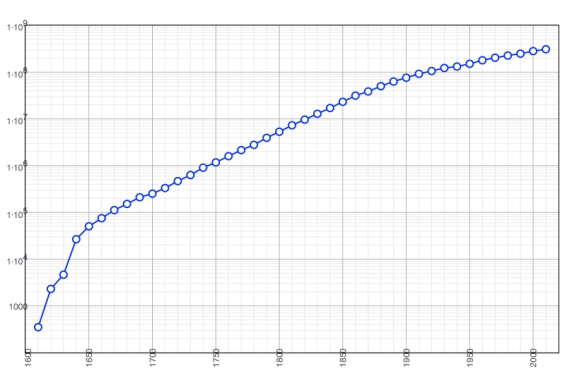
The growth of the total US population — as recorded by the imperfect census data — is shown in this next pair of charts.
The first chart of this second pair of graphics is best for visualizing the grow of population above 5 million people, after 1800. The recorded population grew from 350 in 1610 to about 5 million in 1800. The second chart of this pair of graphics is a logarithmic (linear-log) representation of the data, and makes it possible to see the quantitative trend, especially prior to 1800.
Returning to the fractional population charts, notice the following features:
1610-1770
The fractional population of Whites dropped from 100% in 1610, to under 80% in 1770; with a corresponding rise in the fractional population of Blacks from 0% (a relatively small number in actuality) in 1610, to over 20% in 1770. In the Colonial America of 1770, 1 out of very 5 people was Black (remember, Native Americans were not counted). This (20%) is the maximum that the fractional population of Blacks ever achieved in American history (but of course, the absolute Black population has grown throughout US history). This growth in Black population was a result of the importation of enslaved Blacks from Africa. The total Colonial American population during this period grew from 350 to 2,148,076.
1770-1850
The fractional population of Whites rose from its local minimum of less than 80% in 1770, to almost 85% in 1850. The fractional Black population dropped from its local maximum of over 20% in 1770, to about 16% in 1850. A law banning the importation of slaves into the United States took effect in 1808, but slavery itself was not outlawed. Blacks were born into slavery if their parents were enslaved, and the absolute population of Blacks in the U.S. grew. This period of 1770 to 1850 corresponds to the Industrial Revolution, which was the transition to new manufacturing processes in the period from about 1760 to sometime between 1820 and 1840. This transition included going from hand production methods to machines, new chemical manufacturing and iron production processes, the increasing use of steam power, the development of machine tools and the rise of the factory system. Immigrants from Europe added to the White population in the U.S., for example Irish people seeking escape from their Great Famine of 1845 to 1852. The total American population during this period grew from 2,148,076 to 23,191,876.
1850-1900
The recorded (estimated) percentage of the US population made up of Hispanic people was under 0.8% between 1850 and 1900. In 1845, the United States annexed the “Republic of Texas” (Mexican territory occupied by “illegal immigrant” American slave owners seeking to expand the slave plantation system of the Southern U.S., westward). Mexico’s defeat in the subsequent Mexican-American War of 1846-1848, resulted in the loss of one-third of its territory to the U.S. That new US territory is the present day American states of Texas, New Mexico, Colorado, Arizona, Utah, Nevada and California.
The fractional population of Whites rose from nearly 85% in 1850, to about 87% in 1900; while the fractional population of Blacks dropped from about 16% in 1850, to about 13% in 1900. This half-century period encompassed the Civil War, the Indian Wars in the American West, and the Spanish-American War, when the United States became an overseas empire. The total American population during this period grew from 23,191,876 to 75,994,575.
1900-1930
Between 1900 and 1930, the fractional White population rose from 87% to 90%, while the fractional Black population dropped from 13% to under 10%. This thirty year span included the latter Gilded Age, World War I, the Roaring Twenties, and the Crash of 1929, which was the beginning of the Great Depression. The total American population during this period grew from 75,994,575 to 122,775,046.
1930-1940
The years 1930 to 1940 spanned most of the Great Depression (which actually occurred from 1929 to 1942), and are a local maximum of fractional White population (~90%), and a local minimum of fractional Black population (~9%). The fractional Hispanic population during 1930 to 1940 rose from about 1.3% to 1.5%. The total American population during this period grew from 122,775,046 to 131,669,275.
1930-1950
Between 1930 and 1950, the fractional White population remained at close to 90%, while the fractional Black population remained at close to 10%. This twenty year period included the Great Depression, World War II, and the brief Cold War period just after World War II and just prior to the outbreak of the Korean War in 1950. The fractional population of Hispanics rose from about 1.3% to 2.1% during 1930 to 1950. The total American population during this period grew from 122,775,046 to 150,697,361.
1950-1970
Between 1950 and 1970, the fractional White population dropped from its highest proportion since 1700 (about 90%) to nearly 88%. The fractional Black population rose from 10% to 11%; and the fractional Hispanic population grew at an accelerating pace — more than doubling — from 2.1% to over 4.4%. The rapid increase in US Latino population was a result of their higher fertility, and increased immigration from Mexico, Central and South America, and the Caribbean.
The people on the island of Puerto Rico, captured during the Spanish-American War of 1898, were given US citizenship in 1917, but not the right to vote in US national elections, nor were Puerto Rico’s elected representatives allowed to vote in the U.S. Congress (to this day). But, that extension of US citizenship for Puerto Rico came just in the nick of time for the Wilson Administration to draft men from Puerto Rico to fight (and presumably some die) in World War I, and similarly in the subsequent wars of the United States. Puerto Ricans who want to vote in US elections have to migrate to the US mainland and settle there, which many did during the 1940s and 1950s, primarily to seek better economic opportunities. The musical “West Side Story” is an artistic artifact inspired by this wave of immigration from Puerto Rico to the US mainland.
The twenty year span of 1950 to 1970 included: most of the postwar boom (occurring primarily from 1948 to 1971), which encompassed the last two years of the Truman Administration, and the Eisenhower, Kennedy and Johnson Administrations, and the first two years of the Nixon Administration, as well as the Vietnam War up through the time of the American invasion of Cambodia, ordered by the Nixon-Kissinger Administration. The total American population grew from 150,697,361 in 1950, to 203,210,158 in 1970.
1970-2010
The total American population grew from 203,210,158 in 1970, to 308,745,538 in 2010.
During the 40 years between 1970 and 2010, the fractional White population dropped significantly from 88% to 72%. The fractional Black population rose modestly from 11% to 12.6%; and the fractional Hispanic population zoomed from 4.4% to 16.3%. In the year 2000, the fractional Black and fractional Hispanic populations were essentially equal (12.3% and 12.5%, respectively), and subsequently the fractional Hispanic population became larger, and continued growing faster.
The rapid rise of the fractional Hispanic population subsequent to 1950, and especially since 1970, is responsible for the accelerating drop in the fractional White population (since the fractional Black population has changed little, and other fractional populations, as for Asians, are still relatively small).
The increase of the Hispanic population beyond that of the Black population after 2000, along with the corresponding drop in the fractional White population, has fueled the racial tensions expressed today as the Trump Administration: widespread Black resentment of Latinos (“Mexicans”), and the overt exercise of political power by White Supremacy: anti-immigrant and deportation policies against “illegal” Mexicans and people from Muslim-dominant countries, as well as voter suppression efforts aimed at Blacks and poorer Hispanics (many ethnically Mexican and Central American).
Trumpism is the combination of fear of demographic dilution — held by previously dominant racial-ethnic sub-populations; and of insatiably desperate exclusionary avarice seeking climax before our Pompeii-like climapocalyptic termination — held by the traditional, dominant and uppermost classes of American wealth.
Most of the undocumented (“illegal”) Central American immigrants to the United States were and are actually refugees from countries whose economies have been withered by US corporate vampirism backed by both direct and indirect US military interventions propping up corrupt and viciously cruel oligarchic client regimes. This predatory US imperialism “south of the border” stretches back to the Mexican-American War of 1846-1848, and includes many US Marine invasions and occupations prior to World War II, as famously condemned by General Smedley Butler (who was awarded several Medals of Honor for his heroism during such actions, in his earlier years when he commanded troops in them).
During World War II, President Franklin Roosevelt instituted the “Good Neighbor Policy,” which amounted to the U.S. being nice to Latin America and buying its export products at good prices for the producers (for example buying the entire Cuban sugar output during the war years), so as to induce the countries of the Caribbean and Central and South America to remain neutral in that war, instead of cashing in by provisioning Germany, and allowing its submarines to harbor safely in Latin American ports, and thus be able to hunt for Allied (i.e., American) war supply ships close to US shores.
After World War II, the Good Neighbor Policy disappeared and it was back to the Monroe Doctrine modus operandi. And, Central American peasants fleeing economic starvation and political murder would go north (to this day). A particularly bad period in this regard was during the Nicaraguan Revolution (1962-1990), and during the Reagan Administration (1981-1988), which massively, overtly and surreptitiously prosecuted its proxy Contra War in Nicaragua, in support of the remnant army and police forces of the Somoza dictatorship, which had been deposed by Nicaraguan socialists during 1978-1979.
The Reagan Administration also carried on similar proxy wars in Guatemala and El Salvador. The neofascist forces the Reagan Administration backed and supplied were responsible for many excessively cruel and massively bloody deeds, which many people — including me — considered genocidal. After 1990, the Central American wars tapered off, but the fundamental struggle — of a peasantry seeking political freedom, economic control of their lives, social justice, and physical security from arbitrary exploitation, torture and murder by the death squads and militarized police forces employed by corrupt oligarchic client regimes — still continues in some Central American countries.
And so, streams of impoverished displaced living victims of American profiteering in Central America go north, hoping to find their personal salvations in the United States. Those that make it (legally or illegally) add to the Latino Population Tsunami that is altering the demographic layering of the US population.
How will our changing demographics change our future politics? Good question.