Friday, July 7, 2017

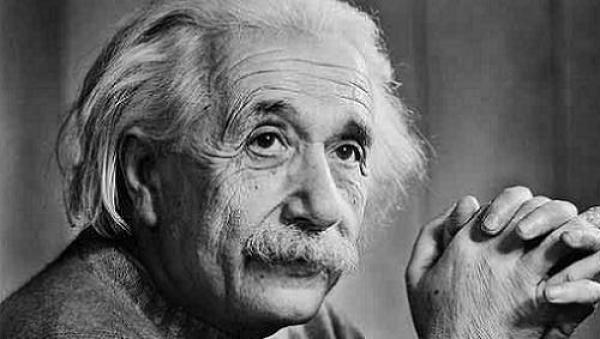
2651. Albert Einstein as a Philosopher of Science

By Don Howard, Physics Today, December 2005
Nowadays, explicit engagement with the philosophy of science plays almost no role in the training of physicists or in physics research. What little the student learns about philosophical issues is typically learned casually, by a kind of intellectual osmosis. One picks up ideas and opinions in the lecture hall, in the laboratory, and in collaboration with one’s supervisor. Careful reflection on philosophical ideas is rare. Even rarer is systematic instruction. Worse still, publicly indulging an interest in philosophy of science is often treated as a social blunder. To be fair, more than a few physicists do think philosophically. Still, explicitly philosophical approaches to physics are the exception. Things were not always so.
"Independence of judgment"
In December 1944 Robert A. Thornton had a new job teaching physics at the University of Puerto Rico. He was fresh from the University of Minnesota, where he had written his PhD thesis on “Measurement, Concept Formation, and Principles of Simplicity: A Study in the Logic and Methodology of Physics” under Herbert Feigl, a noted philosopher of science. Wanting to incorporate the philosophy of science into his teaching of introductory physics, Thornton wrote to Albert Einstein for help in persuading his colleagues to accept that innovation. Einstein replied:
I fully agree with you about the significance and educational value of methodology as well as history and philosophy of science. So many people today—and even professional scientists—seem to me like someone who has seen thousands of trees but has never seen a forest. A knowledge of the historic and philosophical background gives that kind of independence from prejudices of his generation from which most scientists are suffering. This independence created by philosophical insight is—in my opinion—the mark of distinction between a mere artisan or specialist and a real seeker after truth. 1
Einstein was not just being polite; he really meant this. He had been saying the same thing for nearly 30 years. He knew from his experience at the forefront of the revolutions in early 20th-century physics that having cultivated a philosophical habit of mind had made him a better physicist.
A few years after his letter to Thornton, Einstein wrote in a contribution to Albert Einstein: Philosopher-Scientist, “The reciprocal relationship of epistemology and science is of noteworthy kind. They are dependent upon each other. Epistemology without contact with science becomes an empty scheme. Science without epistemology is—insofar as it is thinkable at all—primitive and muddled.” 2
In a 1936 article entitled “Physics and Reality,” he explained why the physicist cannot simply defer to the philosopher but must be a philosopher himself:
It has often been said, and certainly not without justification, that the man of science is a poor philosopher. Why then should it not be the right thing for the physicist to let the philosopher do the philosophizing? Such might indeed be the right thing to do at a time when the physicist believes he has at his disposal a rigid system of fundamental concepts and fundamental laws which are so well established that waves of doubt can’t reach them;  but it cannot be right at a time when the very foundations of physics itself have become problematic as they are now. At a time like the present, when experience forces us to seek a newer and more solid foundation, the physicist cannot simply surrender to the philosopher the critical contemplation of theoretical foundations; for he himself knows best and feels more surely where the shoe pinches. In looking for a new foundation, he must try to make clear in his own mind just how far the concepts which he uses are justified and are necessities. 3
Already in 1916, just after completing his general theory of relativity, Einstein had discussed philosophy’s relation to physics in an obituary for the physicist and philosopher Ernst Mach:
How does it happen that a properly endowed natural scientist comes to concern himself with epistemology? Is there not some more valuable work to be done in his specialty? That’s what I hear many of my colleagues ask, and I sense it from many more. But I cannot share this sentiment. When I think about the ablest students whom I have encountered in my teaching—that is, those who distinguish themselves by their independence of judgment and not just their quick-wittedness—I can affirm that they had a vigorous interest in epistemology. They happily began discussions about the goals and methods of science, and they showed unequivocally, through a tenacious defense of their views, that the subject seemed important to them. 4
Concepts that have proven useful in ordering things easily achieve such authority over us that we forget their earthly origins and accept them as unalterable givens. Thus they come to be stamped as “necessities of thought,” “a priori givens,” etc. The path of scientific progress is often made impassable for a long time by such errors. Therefore it is by no means an idle game if we become practiced in analyzing long-held commonplace concepts and showing the circumstances on which their justification and usefulness depend, and how they have grown up, individually, out of the givens of experience. Thus their excessive authority will be broken. They will be removed if they cannot be properly legitimated, corrected if their correlation with given things be far too superfluous, or replaced if a new system can be established that we prefer for whatever reason. 4
Here Einstein is describing the kind of historical—critical conceptual analysis for which Mach was famous. This mode of analysis is at the heart of the arguments for the special and general theories of relativity, and of many of Einstein’s other revolutionary works. 5 How did he become this kind of philosophical physicist? Reading Mach was one way, but not the only way. 
Early Acquaintance with philosophy 
Einstein was typical of his generation of physicists in the seriousness and extent of his early and lasting engagement with philosophy. By the age of 16, he had already read all three of Immanuel Kant’s major works, the Critique of Pure Reason, the Critique of Practical Reason, and the Critique of Judgment. 6 Einstein was to read Kant again while studying at the Swiss Federal Polytechnic Institute in Zürich, where he attended August Stadler’s lectures on Kant in the summer semester of 1897. Stadler belonged to the Marburg neo-Kantian movement, which was distinguished by its efforts to make sense of foundational and methodological aspects of current science within the Kantian framework. 7
It was also at university that Einstein first read Mach’s Mechanics(1883) and his Principles of the Theory of Heat (1896), along with Arthur Schopenhauer’s Parerga and Paralipomena (1851). It was probably also there that he first read Friedrich Albert Lange’s History of Materialism (1873), Eugen Dühring’s Critical History of the Principles of Mechanics (1887), and Ferdinand Rosenberger’s Isaac Newton and His Physical Principles (1895). All those books were, at the end of the century, well known to intellectually ambitious young physics students.
A telling fact about Einstein’s acquaintance with philosophy at university was his enrollment in Stadler’s course on the “Theory of Scientific Thought” in the winter semester of 1897. The course was in fact required for all students in Einstein’s division at the Polytechnic. Think about that: Every physics student at the Polytechnic, one of the leading technical universities in Europe, was required to take a course in philosophy of science. Such an explicit requirement was not found at every good university, although in 1896 Mach was named to the newly created chair of the “Philosophy of the Inductive Sciences” at the University of Vienna, and students learning physics under Hermann von Helmholtz in Berlin got a heavy dose of philosophy as well. Even if not every university had a specific requirement in the philosophy of science, the Zürich curriculum tells us that good young physicists were expected to know more than just a smattering of philosophy.
Einstein’s interest in philosophy continued after graduation. At about the time he started his job in the patent office in Bern in 1902, Einstein and some newfound friends, Maurice Solovine and Conrad Habicht, formed an informal weekly discussion group to which they gave the grandiloquent name “Olympia Academy.” Thanks to Solovine, we know what they read. 8 Here is a partial list:

  • ▸ Richard Avenarius, Critique of Pure Experience (1888).
  • ▸ Richard Dedekind, What Are and What Should Be the Numbers? (2nd ed., 1893).
  • ▸ David Hume, A Treatise of Human Nature (1739; German translation 1895).
  • ▸ Ernst Mach, The Analysis of Sensations and the Relation of the Physical to the Psychical (2nd ed., 1900).
  • ▸ John Stuart Mill, A System of Logic (1872; German translation 1887).
  • ▸ Karl Pearson, The Grammar of Science (1900).
  • ▸ Henri Poincaré, Science and Hypothesis (1902; German translation 1904).
Those are titles one would have found on the bookshelf of many bright young physicists at the time. That Einstein and friends read them for pleasure or self-improvement shows how common it was in the scientific culture of the day to know such books and the ideas they held.
The philosophical seeds were sown at the Polytechnic and the Olympia Academy were soon to bear fruit in Einstein’s 1905 paper on the special theory of relativity and in many other places in his scientific work. But they would bear additional fruit in Einstein, himself, becoming an important philosopher of science.
RELATIONS WITH PHILOSOPHERS
Einstein’s philosophical education made a profound difference in the way he did physics. But his interest in the philosophy of science went further. By the 1930s he had become an active participant in the development of the freestanding discipline of the philosophy of science. His role evolved largely through his personal and professional relations with many of the era’s most important philosophers, mainly the founders of the tradition known as logical empiricism.
Einstein’s personal acquaintance with prominent philosophers of science began early and somewhat by accident. Friedrich Adler was also a physics student in Zürich in the late 1890s. 9 Although Adler studied at the University of Zürich, not the Polytechnic, he and Einstein became friends. The friendship was renewed in 1909 when Einstein moved back from Bern to Zürich to take up his first academic appointment, at the University of Zürich, a position for which Adler had been the other finalist.
By then, Adler had become a well-known defender of Mach’s empiricism, especially after the searing criticism that Max Planck leveled at Mach in a 1908 lecture on “The Unity of the Physical World Picture.” The close relationship with Mach led Adler to publish, in 1908, a German translation of Pierre Duhem’s influential 1906 book, Aim and Structure of Physical Theory .
From Duhem Einstein learned a version of what is known as conventionalism. Henri Poincaré, another well-known conventionalist, famously argued that the geometer’s conventional definition of “straight line segment” as “the path of a light ray” made Euclidean geometry safe from straightforward empirical refutation, say by line-of-sight triangulation of three mountain peaks, because anyone impressed by the simplicity of Euclidean geometry could save it by simply changing the definition of straight line.
Duhem’s conventionalism differed somewhat from Poincaré’s. He argued that what was conventional was not the choice of individual definitions, but rather one’s choice of a whole theory. According to Duhem, it is always whole theories and never individual scientific claims that one tests. Duhem’s “holistic” conventionalism was to become deeply woven into Einstein’s mature picture of the structure of theories and the way they are tested.
It was also in 1909 that Einstein’s fame made possible his first meeting with Mach. There was mutual respect on both sides. When Einstein left the German University of Prague in 1912, he nominated Philipp Frank as his successor. Frank was a Mach disciple who was to become an important member of the so-called Vienna Circle of logical empiricists. Frank’s 1947 Einstein biography is well known. 10
Hans Reichenbach, a student socialist leader in Berlin at the end of World War I, went on to anchor the Vienna Circle’s Berlin outpost and become logical empiricism’s most important interpreter of the philosophical foundations of relativity with books like his 1928 Philosophy of Space and Time. He had been Einstein’s student in Berlin, and Einstein was so impressed by his abilities as a philosopher of physics that when the conservative Berlin philosophy department refused Reichenbach a faculty post in the mid-1920s, Einstein contrived to have a chair in the philosophy of science created for him in the university’s more liberal physics department.
Without question, the most important new philosophical friend Einstein made during his Berlin years was Moritz Schlick. He was originally a physicist who did his Ph.D. under Planck in 1904. Schlick’s move to Vienna in 1922 to take up the chair in philosophy of science earlier occupied by Mach and Ludwig Boltzmann marks the birth of the Vienna Circle and the emergence of logical empiricism as an important philosophical movement. Prior to the work of Reichenbach, Schlick’s 1917 monograph Space and Time in Contemporary Physics was the most widely read philosophical introduction to relativity, and Schlick’s 1918 General Theory of Knowledge had a comparable influence on the broader field of philosophy of science. 11
Einstein and Schlick first got to know one another by correspondence in 1915, after Schlick published an astute essay on the philosophical significance of relativity. For the first six years of their acquaintance, Einstein showed high regard for Schlick’s work, but by 1922 the relationship had started to cool. Einstein was dismayed by the Vienna Circle’s ever more stridently antimetaphysical doctrine. The group dismissed as metaphysical any element of a theory whose connection to experience could not be demonstrated clearly enough. But Einstein’s disagreement with the Vienna Circle went deeper. It involved fundamental questions about the empirical interpretation and testing of theories.
Schlick, Reichenbach, and Einstein agreed that the challenge facing empiricist philosophers of physics was to formulate a new empiricism capable of defending the integrity of general relativity against attacks from the neo-Kantians. General relativity’s introduction of a hybrid spacetime with varying curvature was a major challenge to Kantianism. Some of Kant’s defenders argued that general relativity, being non-Euclidean, was false a priori. More subtle and sophisticated thinkers like Cassirer argued that Kant was wrong to claim a priori status for Euclidean geometry but right to maintain that there is some mathematically weaker a priori spatial form, perhaps just a topological form.
Mach’s philosophy was not up to the task. It could not acknowledge an independent cognitive role for the knower. Schlick, Reichenbach, and Einstein, on the other hand, agreed that the Kantians were right to insist that the mind is not a blank slate upon which experience writes; that cognition involves some structuring provided by the knower. But how could they assert such an active role for the knower without conceding too much to Kant? They were, after all, empiricists, believing that the reasons for upholding general relativity were ultimately empirical. But in what sense is our reasoning empirical if our knowing has an a priori structure?
Schlick and Reichenbach’s eventual answer was based mainly on Poincaré’s version of conventionalism. They argued that what the knower contributes are the definitions linking fundamental theoretical terms like “straight line segment” with empirical or physical notions like “path of a ray of light.” But, they contended, once such definitions are stipulated by convention, the empirical truth or falsity of all other assertions is uniquely fixed by experience. Moreover, since we freely choose only definitions, the differences resulting from those choices can be no more significant than expressing measurement results in English or metric units.
Einstein also sought an empiricist response to the Kantians, but he deeply disagreed with Schlick and Reichenbach. For one thing, he, like Duhem, thought it impossible to distinguish different kinds of scientific propositions just on principle. Some propositions function like definitions, but there was no clear philosophical reason why any one such proposition had to be so regarded. One theorist’s definition could be another’s synthetic, empirical claim.
As used by philosophers, “synthetic,” as distinguished from analytic, means an assertion that goes beyond what is already implied by the meanings of the terms being used. An analytic assertion, by contrast, is a claim whose truth depends solely on meaning or definitions. A central empiricist tenet is that there are no synthetic a priori truths.
A deeper reason for Einstein’s dissent from Schlick and Reichenbach was his worry that the new logical empiricist philosophy made science too much like engineering. Missing from the empiricists’ picture was what Einstein thought most important in creative theoretical physics, namely, “free inventions” by the human intellect. Not that the theorist was free to make up any picture whatsoever. Theorizing was constrained by the requirement of fit with experience. But Einstein’s own experience had taught him that creative theorizing could not be replaced by an algorithm for building and testing theories.
How would Einstein reply to Kant? He deployed Duhem’s holism in a novel way. When a theory is tested, something must be held fixed so that we can say clearly what the theory tells us about the world. But Einstein argued that precisely because theories are tested as wholes, not piecemeal, what we choose to hold fixed is arbitrary. One might think, like Kant, that one fixes Euclidean geometry and then tests a physics thus structured. But we really test physics and geometry together. Therefore, one could just as well hold the physics fixed and test the geometry. Better just to say that we are testing both and that we choose among the possible ways of interpreting the results by asking which interpretation yields the simplest theory. Einstein chose general relativity over rivals equally consistent with the evidence because its physics plus non-Euclidean spacetime geometry was, as a whole, simpler than the alternatives.
Such questions might seem overly subtle and arcane philosophical issues better left alone. But they cut to the heart of what it means to respect evidence in the doing of science, and they are questions about which we still argue. As theoretical physics moves ever deeper into realms less firmly anchored to empirical test, as experimental physics becomes ever more difficult and abstruse, the same questions over which Schlick, Reichenbach, and Einstein argued become more and more acute.
When theory confronts experience, how do we apportion credit or blame for success or failure? Can philosophical analysis supply reasons for focusing a test on an individual postulate, or should judgment and taste decide what nature is telling us? The logical empiricists were seeking an algorithm for choosing the right theory.But Einstein likened crucial aspects of the choosing to the “weighing of incommensurable qualities.” 12 In one sense, Einstein lost the argument with Schlick and Reichenbach. By mid-century, their logical empiricism had become orthodoxy. But Einstein’s dissent did not go unnoticed, and today it lives again as a challenge to another Kant revival 13
Philosophy in Einstein's Physics
ow did Einstein’s philosophical habit of mind lead to his doing physics differently? Did it, as he believed, make him a better physicist?
Most readers of Einstein’s 1905 special relativity paper note its strikingly philosophical tone. The paper begins with a philosophical question about an asymmetry in the conventional explanation of electromagnetic induction: A fixed magnet produces a current in the moving coil by an induced electromotive force in the coil. A moving magnet, on the other hand, is said to produce a current in a fixed coil through the electromagnetic field created by the magnet's motion. But if motion is relative, why should there be any difference? The paper goes on to fault the idea of objective determination of simultaneity between distant events for similarly philosophical reasons; nothing other than the simultaneity of immediately adjacent events is directly observable. One must, therefore, stipulate which distant events are deemed simultaneous for a given observer. But that stipulation must rest on a conventional assumption about, say, the equal speeds of outbound and inbound light signals.
There is a dispute among historians and philosophers of physics about exactly what philosophical perspective is involved here. Some explicitly conventionalist language in the paper suggests Poincaré as a source. Einstein himself credited principally Hume and secondarily Mach (see Einstein’s 1915 letter to Schlick on page 17 of this issue). In any case, the strikingly philosophical tenor of the 1905 relativity paper is unmistakable.
Einstein’s philosophical sources are less obscure with regard to his lifelong commitment to the principle of spatial separability in the face of quantum mechanical nonlocality. We know that Einstein read Schopenhauer while a student at the Zürich Polytechnic and regularly thereafter. He knew well one of Schopenhauer’s central doctrines, a modification of Kant’s doctrine of space and time as necessary a priori forms of intuition. Schopenhauer stressed the essential structuring role of space and time in individuating physical systems and their evolving states. Space and time, for him, constituted the principium individuationis, the ground of individuation. In more explicitly physical language, this view implies that difference of location suffices to make two systems different in the sense that each has its own real physical state, independent of the state of the other. For Schopenhauer, the mutual independence of spatially separated systems was a necessary a priori truth.
Did that way of thinking make a difference in Einstein’s physics? 14 Consider another famous paper from his annus mirabilis, the 1905 paper on the photon hypothesis, which explained the photoelectric effect by quantizing the way electromagnetic energy lives in free space. A photoelectron is emitted when one quantum of electromagnetic energy is absorbed in an illuminated metal surface, the electron’s energy gain being proportional to the frequency of the incident radiation. What most struck Einstein about the behavior of these energy quanta was that in the so-called Wien regime near the high-energy end of the blackbody spectrum, they behave like mutually independent corpuscles by virtue of their occupying different parts of space.
Einstein argued that assuming the validity of Boltzmann’s entropy principle (S = k log W) for radiation fields in the Wien regime implies a granular structure to such radiation. Thanks to the Boltzmann principle’s logarithmic form, the additivity of the entropyS is equivalent to the factorizability of the joint probability W for two spatially separated constituents of the radiation field to occupy given cells of phase space. The factorizability of a joint probability is one classical expression for the mutual independence of events.
But there was a problem: The same reasoning that implied a quantal structure for radiation in the Wien regime also implied that, outside that regime, the assumed mutual independence of photons must fail. The assumption of mutually independent photons does not yield a derivation of the full Planck formula for the energy density of blackbody radiation. Einstein realized that fact, and for nearly 20 years he sought to understand how it could be.
As early as 1909, Einstein toyed with assigning a wave field to each particle like photon to account for interference, an obvious failure of mutual independence. That’s where the idea of wave—particle duality began. Only late in 1924, when Einstein first read Satyendra Bose’s new derivation of the Planck radiation formula, did he grasp that what was implied was a new quantum statistics, in which particles fail to be independent not because of some exotic interaction but because their identity makes them indistinguishable.15
Thanks to Bose, Einstein realized that failure of the mutual independence of spatially separated light quanta would be an enduring feature of the emerging quantum theory. But from Schopenhauer he had learned to regard the independence of spatially separated systems as, virtually, a necessary a priori assumption. As the new quantum formalism appeared in the mid-1920s, Einstein sought either to interpret it in a manner compatible with spatial separability or to show that if quantum mechanics could not be so interpreted, it was fatally flawed. In 1927, Einstein produced a hidden-variables interpretation of Erwin Schrödinger’s wave mechanics. But he abandoned the effort prior to publication when he found that even his own hidden-variables interpretation involved the kind of failure of spatial separability that Schrödinger later dubbed “entanglement.”
Einstein’s most famous assault on the quantum theory was his 1935 “EPR” paper with Boris Podolsky and Nathan Rosen, which sought to demonstrate that quantum mechanics was an incomplete theory.Many readers find the EPR argument convoluted. Few are aware that Einstein repudiated the paper soon after publication, writing to Schrödinger in June of 1935 that the paper was actually written by Podolsky “for reasons of language,” and that he was unhappy with the result because “the main point was buried by excessive formalism.”
The argument Einstein intended starts from an assumption that he called “the separation principle.” Spatially separated systems have independent realities, and relativistic locality precludes superluminal influences between spacelike separated measurement events. Therefore quantum mechanics must be incomplete, because it assigns different wavefunctions, hence different states, to one of two previously interacting systems, depending on what parameter one chooses to measure on the other system. Surely a theory cannot assign two or more different states to one and the same physical reality unless those theoretical states are incomplete descriptions of that reality. 16
The important point here is that Einstein regarded his separation principle, descended from Schopenhauer’s principium individuationis, as virtually an axiom for any future fundamental physics. In later writings, he explained that field theory, as he understood it—after the model of general relativity, not quantum field theory—was the most radical possible expression of separability. In effect, such classical field theories treat all point events in the space-time manifold as mutually independent, separable systems endowed with their own separate, real physical states.
Einstein’s deep philosophical commitment to separability and his consequent lifelong disquiet about quantum mechanics is nowhere more clearly expressed than in a long note he wrote to Max Born in 1949. Einstein asks, “What must be an essential feature of any future fundamental physics?” His answer surprises many who expect him to say “causality.”
I just want to explain what I mean when I say that we should try to hold onto physical reality.
We are … all aware of the situation regarding what will turn out to be the basic foundational concepts in physics: the point-mass or the particle is surely not among them; the field, in the Faraday—Maxwell sense, might be, but not with certainty. But that which we conceive as existing (“real”) should somehow be localized in time and space. That is, the real in one part of space, A, should (in theory) somehow “exist” independently of that which is thought of as real in another part of space, B. If a physical system stretches over A and B, then what is present in B should somehow have an existence independent of what is present in A. What is actually present in B should thus not depend upon the type of measurement carried out in the part of space A; it should also be independent of whether or not a measurement is made in A.
If one adheres to this program, then one can hardly view the quantum-theoretical description as a complete representation of the physically real. If one attempts, nevertheless, so to view it, then one must assume that the physically real in undergoes a sudden change because of a measurement in A. My physical instincts bristle at that suggestion.
However, if one renounces the assumption that what is present in different parts of space has an independent, real existence, then I don’t see at all what physics is supposed to be describing. For what is thought to be a “system” is, after all, just conventional, and I do not see how one is supposed to divide up the world objectively so that one can make statements about the parts. 17
That is how a philosopher—physicist thinks and writes.
Too much philosophizing? 
One might respond to Einstein’s argument by saying that it proves what’s wrong with importing too much philosophy into physics.Einstein was probably wrong to doubt the completeness of quantum mechanics. The entanglement that so bothered him has emerged in recent decades as the chief novelty of the quantum realm.
But such a reaction would reflect a serious misunderstanding of the history. Einstein was wrong, but not because he was a philosophical dogmatist. His reasons were scientific as well as philosophical, the empirical success of general relativity being one among those scientific reasons. What the philosophical habit of mind made possible was Einstein’s seeing more deeply into the foundations of quantum mechanics than many of its most ardent defenders. And the kind of philosophically motivated critical questions he asked but could not yet answer were to bear fruit barely 10 years after his death when they were taken up again by another great philosopher—physicist, John Bell.
  1. 1.A. Einstein to R. A. Thornton, unpublished letter dated 7 December 1944 (EA 6-574), Einstein Archive, Hebrew University, Jerusalem, quoted with permission.
  2. 2.P. A. Schilpp , ed., Albert Einstein: Philosopher-Scientist, The Library of Living PhilosophersEvanston, IL (1949), p. 684. Google Scholar
  3. 3.A. Einstein , J. Franklin Inst. 221, 349 (1936)https://doi.org/10.1016/S0016-0032(36)91047-5Crossref
  4. 4.A. Einstein , Phys. Zeitschr. 17, 101 (1916).
  5. 5.A. Pais , ‘Subtle is the Lord …’: The Science and the Life of Albert Einstein, Oxford U. PressNew York (1982), is still the best intellectual biography of Einstein.
  6. 6.For details on Einstein’s early philosophical reading, see D. Howard , “Einstein’s Philosophy of Science,” in The Stanford Encyclopedia of Philosophy, E. N. Zalta , ed., http://plato.stanford.edu/archives/spr2004/entries/einstein-philscience/
  7. 7.M. Beller , in Einstein: The Formative Years, 1879-1909, D. Howard , J. Stachel , eds., BirkhäuserBoston (2000), p. 83;Google ScholarCrossref
    D. Howard , in Language, Logic, and the Structure of Scientific Theories, W. Salmon , G. Wolters , eds., U. of Pittsburgh PressPittsburgh, PA (1994), p. 45. Google Scholar
  8. 8.M. Solovine , ed., Albert Einstein. Lettres à Maurice Solovine, Gauthier-VillarsParis (1956). Google Scholar
  9. 9.D. Howard , Synthese 83, 363 (1990)https://doi.org/10.1007/BF00413422Crossref
  10. 10.P. Frank , Einstein: His Life and Times, KnopfNew York (1947).
  11. 11.See D. Howard , Philosophia Naturalis 21, 616 (1984).
  12. 12.A. Einstein , Autobiographical Notes: A Centennial Edition, P. A. Schilpp , trans. and ed., Open CourtLa Salle, IL (1979), p. 21. Google Scholar
  13. 13.A widely debated recent work of Kantian revival is M. Friedman , Dynamics of Reason, CSLI PublicationsStanford, CA(2001).
  14. 14.D. Howard , in The Cosmos of Science, J. Earman , J. D. Norton , eds., U. of Pittsburgh PressPittsburgh, PA (1997), p. 87. Google Scholar
  15. 15.D. Howard , in Sixty-Two Years of Uncertainty, A. Miller , ed., PlenumNew York (1990), p. 61https://doi.org/10.1007/978-1-4684-8771-8_6Google ScholarCrossref
  16. 16.A. Einstein to E. Schrödinger, unpublished letter dated 19 June 1935 (EA 22-047), Einstein Archive, Hebrew University, Jerusalem, quoted with permission; D. Howard, Stud. Hist. Phil. Sci. 16, 171 (1985);https://doi.org/10.1016/0039-3681(85)90001-9Crossref
    D. Howard , in Philosophical Consequences of Quantum Theory: Reflections on Bell’s Theorem, J. T. Cushing , E. McMullin , eds., U. of Notre Dame PressNotre Dame, IN (1989), p. 224. Google Scholar
  17. 17.M. Born , ed., Albert Einstein—Hedwig und Max Born. Briefwechsel 1916-55, NymphenburgerMunich (1969), p. 223

Wednesday, July 5, 2017

2650. A Palestinian Novel Unearths Dirty Secrets in the Arab World

By Joumana Haddad, The New York Times, July 3, 2017
Abbad Yahya facing a death threat and his book Crime in Ramallah.
We are a people of dirty secrets hiding beneath a veil of fake morality.


That’s the first thought that came to mind when I read about the banning of the novel “Crime in Ramallah,” by the Palestinian author Abbad Yahya, and about the death threats he has been receiving.

Published this year and the fourth book by Mr. Yahya, the novel narrates the everyday lives of three young men (Raouf, Nour and Wissam) in the West Bank city of Ramallah. The Palestinian Authority’s attorney general banned it in February because it “contained indecent texts and terms that endangered morality and public decency.” Some Palestinians have even threatened to burn bookstores selling the novel.

When I heard the news, I immediately went out and bought a copy. Because I live in Beirut, the “freedom haven” of the Arab Middle East, this proved easy.

That evening, I started reading “Crime in Ramallah” and did not stop until I finished it. It was refreshingly genuine. It did not shy away from exposing the ugliness, the desperateness, the corruption, the loss of purpose, the unavoidable wrong turns and the uncomfortable truths of life in Ramallah after the second intifada. The sexual fragments are quite graphic, which was surprising and exhilarating. An Arab author writing about a homosexual character (Nour) enjoying oral sex, to cite but one example, is not something we encounter often. But, as the response to the book has shown, there can be no homosexuals in a reality-obliterating Arab world, where “real” manhood is defined by a chauvinist heterosexuality.

Indeed, being an Arab today means you need to master the art of denial. It means deliberately confusing the lethal herd syndrome affecting most people with a false notion of virtue, allegedly protecting you against the glaring truth, against your human nature, against your critical judgment, against your individuality, i.e. against yourself.

When I started a literary magazine that specialized in the arts and literature of the body in Arabic in 2008, I encountered the same violent reactions and accusations being hurled at Mr. Yahya. You see, even in so-called progressive Lebanon, sex is still a taboo. It is equivalent to shame, something not to do, except if you’re doing it in secret, or have a special permit called a marriage license. As for gay sex, it is the ultimate transgression. Never mind that Abu Nawas, one of the greatest Arab poets of all times, had written, back in the eighth and ninth centuries, countless erotic poems about his gay sexual encounters.

This may come as a surprise but Abu Nawas is but one author contributing to the rich tradition of erotic Arabic texts that go back centuries. Many mention the Kamasutra as an absolute reference in matters of sexual manuals, but that handbook is tame compared with Arabic works like “Perfumed Garden of Sensual Delight” by Sheikh Muhammad Nafzawi (circa A.D. 1410) and “The Sexual Reinvigoration of an Old Man” by Ahmad bin Suleyman (circa 1534) and the guidebook on sexual pleasure for married couples often attributed to Imam Jalal Al Din Al Suyuti (circa 1480). Probably no language is richer than Arabic in sexual vocabulary, and probably no language, nonsensically, has become more resistant to it.

And things are getting only worse. This is not the first time that Mr. Yahya has written about sex. As he told NPR, “For me, as a writer, I always thought there was much space to write, to think, in Palestine and in Ramallah, especially.” The West Bank is largely secular and book banning there is practically unheard of. So what has changed?

As Mr. Yahya said, it is a reflection of the growing conservatism in his society. It’s a conservatism that Arabs everywhere — Lebanese included — are now facing.
Are those who banned Mr. Yahya’s novel even familiar with the provocative writings of their own intellectuals? Have they read any of Ghassan Kanafani’s inflamed love letters or Mahmoud Darwish’s erotic poems, I wonder? Do those who are speaking of the need to protect public decency realize, as some Palestinian officials have noted, how destructive this notion really is?

The passage the attorney general and many Palestinians seem to have found most egregious is the one where Nour spots a poster of Yasir Arafat carrying a machine gun and imagines the gun as a penis. In a culture so passionate about metaphors, this was a metaphor too far. Our political leaders are untouchable, beyond criticism, beyond defiling. But Mr. Yahya did not fear de-sanctifying a revered symbol like Mr. Arafat, and we are in dire need of de-sanctifications in the Arab world.

Mr. Yahya, who was in Qatar when the attack on his book unfolded, is too scared to go back to his native Ramallah. He told me that he’s still roaming around the Middle East and Europe, uncertain of his destiny, separated from his wife, Yara, who’s still in Ramallah. “My whole life is on hold,” he said. If he returns, he risks being arrested and jailed, or even murdered.

That could be me, I thought when I heard this, and could be any one of us defying the red flags if the situation of free speech in the few liberal Arab cities continues to degenerate. How can we counter this downfall? By killing that mischievous internal voice urging us to shut up. Some may call it suicide. I consider it to be our only survival plan.


Joumana Haddad is a Lebanese writer, journalist and public speaker. She is the author of several books, including “I Killed Scheherazade” and “Superman is an Arab.”

2649. Under an Elm-Tree, Or, Thoughts in the Country-Side

By William Morris, Commonweal, July 6, 1889
"William Morris, Poet, Artist, Socialist." 
Springfield Republican, 11 Oct. 1896: 13.
Midsummer in the country — here you may walk between the fields and hedges that are as it were one huge nosegay for you, redolent of bean-flowers and clover and sweet hay and elder-blossom. The cottage gardens are bright with flowers, the cottages themselves mostly models of architecture in their way. Above them towers here and there the architecture proper of days bygone, when every craftsman was an artist and brought definite intelligence to bear upon his work. Man in the past, nature in the present, seem to be bent on pleasing you and making all things delightful to your senses; even the burning dusty road has a look of luxury as you lie on the strip of roadside green, and listen to the blackbirds singing, surely for your benefit, and, I was going to say as if they were paid to do it, but I was wrong, for as it is they seem to be doing their best.

And all, or let us say most things, are brilliantly alive. The shadowy bleak in the river down yonder, which is — ignorant of the fate that Barking Reach is preparing for its waters — sapphire blue under this ruffling wind and cloudless sky, and barred across here and there with the pearly white-flowered water-weeds, every yard of its banks a treasure of delicate design, meadowsweet and dewberry and comfrey and bed-straw — from the bleak in the river, amongst the labyrinth of grasses, to the starlings busy in the new shorn fields, or about the grey ridges of the hay, all is eager, and I think all is happy that is not anxious.

What is that thought that has come into one’s head as one turns round in the shadow of the roadside elm? A country-side worth fighting for if that were necessary, worth taking trouble to defend its peace. I raise my head, and betwixt the elm-boughs I see far off a grey buttressed down rising over the sea of green and blue-green meadows and fields, and dim on the flank of it over its buttresses can see a quaint figure made by cutting the short turf away from the chalk of the hill-side; a figure which represents a White Horse according to the heraldry of the period, eleven hundred years ago. Hard by that hill-side the country people of the day did verily fight for the peace and loveliness of this very country where I lie, and coming back from their victory scored the image of the White Horse as a token of their valour, and, who knows? perhaps as an example for their descendants to follow.

For a little time it makes the blood stir in me as I think of that, but as I watch the swallows flitting past me betwixt hedge and hedge, or mounting over the hedge in an easy sweep and hawking over the bean-field beyond, another thought comes over me. These live things I have been speaking of, bleak and swallows and starlings and blackbirds, are all after their kind beautiful and graceful, not one of them is lacking in its due grace and beauty; but yesterday as I was passing by a hay-field there was an old red-roan cart-horse looking seriously but good-humouredly at me from a gap in the hedge, and I stopped to make his acquaintance; and I am sorry to say that in spite of his obvious merits he was ugly, Roman-nosed, shambling, ungainly: yet how useful he had been — for others. Also the same day (but not in the same field) I saw some other animals, male and female, with whom also I made acquaintance, for the male ones at least were thirsty. And these animals, both male and female, were ungraceful, unbeautiful, as ungainly as the roan cart-horse; yet they were obviously useful, for they were making hay before my eyes. Then I bethought me that as I had seen starlings in Hertfordshire that were of the same race as the Thames side starlings, so I had seen or heard of featherless two-legged animals of the same race as the thirsty creatures in the hay-field; they had been sculptured in the frieze of the Parthenon, painted on the ceiling of the Sistine Chapel, imagined in literature as the heroes and heroines of romance; nay, when people had created in their minds a god of the universe, creator of all that was, is, or shall be, they were driven to represent him as one of that same race to which the thirsty haymakers belonged; as though supreme intelligence and the greatest measure of gracefulness and beauty and majesty were at their highest in the race of those ungainly animals.

Under the elm-tree these things puzzle me, and again my thoughts return to the bold men of that very country-side, who, coming back from Ashdown field, scored that White Horse to look down for ever on the valley of the Thames; and I thought it likely that they had this much in common with the starlings and the bleak, that there was more equality amongst them than we are used to now, and that there would have been more models available amongst them for Woden than one would be like to find in the Thames-side meadows.

Under the elm-tree I don’t ask myself whether that is owing to the greater average intelligence of men at the present day, and to the progress of humanity made since the time of the only decent official that England ever had, Alfred the Great, to wit; for indeed the place and time are not favourable to such questions, which seem sheer nonsense amidst of all that waste of superabundant beauty and pleasure held out to men who cannot take it or use it, unless some chance rich idler may happen to stray that way. My thoughts turn back to the haymakers and their hopes, and I remember that yesterday morning I said to a bystander, ‘Mr So-and-so (the farmer) is late in sending his men into the hay-field’.
Quoth he, ‘You see, sir, Mr So-and-so is short-handed’.

‘How’s that?’ said I, pricking up my Socialist ears.

‘Well, sir,’ said he, ‘these men are the old men and women bred in the village, and pretty much past work; and the young men with more work in them, they do think that they ought to have more wages than them, and Mr So-and-so, he won’t pay it. So you see, he be short-handed.’

As I turned away, thinking over all the untold, untellable details of misery that lay within this shabby, sordid story, another one met my ears. A labourer of the village comes to a farmer and says to him that he really can’t work for 9s. a week any more, but must have 10s. Says the farmer, ‘Get your 10s. somewhere else then’. The man turns away to two month’s lack of employment, and then comes back begging for his 9s. slavery.

Commonplace stories of unsupported strikes, you will say. Indeed they are, if not they would be easily remedied; the casual tragedy cut short; the casual wrongdoer branded as a person out of humanity. But since they are so commonplace -

What will happen, say my gloomy thoughts to me under the elm tree, with all this country beauty so tragically incongruous in its richness with the country misery which cannot feel its existence? Well, if we must still be slaves and slaveholders, it will not last long; the Battle of Ashdown will be forgotten for the last commercial crisis; Alfred’s heraldry will yield to the lions of the half crown. The architecture of the crafts-gildsmen will tumble down, or be ‘restored’ for the benefit of the hunters of picturesque, who, hopeless themselves, are incapable of understanding the hopes of past days, or the expression of them. The beauty of the landscape will be exploited and artificialized for the sake of the villa-dweller’s purses where it is striking enough to touch their jaded appetites; but in quiet places like this it will vanish year by year (as indeed it is now doing) under the attacks of the most grovelling commercialism.

Yet think I to myself under the elm-tree, whatever England, once so beautiful, may become, it will be good enough for us if we set no hope before us but the continuance of a population of slaves and slave-holders for the country which we pretend to love, while we use it and our sham love for it as a stalking-horse for robbery of the poor at home and abroad. The worst outward ugliness and vulgarity will be good enough for such sneaks and cowards.

Let me turn the leaf and find a new picture, or my holiday is spoilt; and don’t let some of my Socialist friends with whom I have wrangled about the horrors of London, say, ‘This is all that can come of your country life’. For as the round of the seasons under our system of landlord farmer and labourer produces in the country pinching parsimony and dullness, so does the ‘excitement of intellectual life’ in the cities produce the slum under the capitalist system of turning out and selling market wares not for use but for waste. Turn the page I say. The hayfield is a pretty sight this month seen under the elm, as the work goes forward on the other side of the way opposite to the bean-field, till you look at the haymakers closely. 

Suppose the haymakers were friends working for friends on land which was theirs, as many as were needed, with leisure and hope ahead of them instead of hopeless toil and anxiety, need their useful labour for themselves and their neighbours cripple and disfigure them and knock them out of the shape of men fit to represent the Gods and Heroes? And if under such conditions a new Ashdown had to be fought (against capitalist robbers this time), the new White Horse would look down on the home of men as wise as the starlings in their equality, and so perhaps as happy.

2648. Extreme Weather Conditions and Climate Change Account for 40% of Global Wheat Production variability

By Science Daily, July 4, 2017

Joint Research Center (JRC) scientists have proposed a new approach for identifying the impacts of climate change and extreme weather on the variability of global and regional wheat production. The study analysed the effect of heat and water anomalies on crop losses over a 30-year period.
JRC scientists studied the relative importance of heat stress and drought on wheat yields between 1980 and 2010. They developed a new Combined Stress Index in order to better understand the effects of concurrent heat and water stress events.
The study 'Wheat yield loss attributable to heat waves, drought and water excess at the global, national and subnational scales' was published in Environmental Research Letters earlier this month. It finds that heat stress concurrent with drought or water excess can explain about 40% of the changes in wheat yields from one year to another.
One finding is that in contrast to the common perception, water excess affects wheat production more than the drought in several countries. Excessive precipitation and greater cloud cover, especially during sensitive development stages of the crop, are major contributors to reduced yields, as they help pests and disease proliferate and make it harder for the plants to get the oxygen and light they need.
In 2010, wheat contributed to 20% of all dietary calories worldwide. It, therefore, has a major role in food security worldwide, some countries being particularly reliant on it . As climate change is increasing the duration, frequency, and severity of extreme weather events, it has become increasingly urgent to identify their effects and provide early warnings, in order to ensure market stability and global food security.
This study helps to better understand the role of weather factors in wheat production and global yield anomalies. It shows, for the first time, the effect of individual extreme events and their impacts on particular development stages of the crop (for example, the effect of drought during key development periods such as flowering and grain-filling).
Compared to previous approaches, the Combined Stress Index has the advantage of being able to calculate the effect of single weather anomalies on total crop output at global and regional levels. Moreover, it offers a simple and practical tool to compute yield anomalies using seasonal, climate forecasts and projections, thereby allowing better adaptation studies and mitigation strategies to be established.
The model explicitly accounts for the effects of temperature and soil moisture changes (positive and negative) on global and regional wheat production fluctuations.
A specific case study was carried out at the subnational level in France, where wheat was found to be more sensitive to overly wet conditions. In other countries, heat stress and drought are the most important predictors of crop losses. For instance, in Mediterranean countries, drought has a bigger detrimental effect on wheat yields than heat stress.

Story Source:
Materials provided by European Commission, Joint Research Centre (JRC)Note: Content may be edited for style and length.

Journal Reference:
  1. M Zampieri, A Ceglar, F Dentener, A Toreti. Wheat yield loss attributable to heat waves, drought and water excess at the global, national and subnational scalesEnvironmental Research Letters, 2017; 12 (6): 064008 DOI: 10.1088/1748-9326/aa723b

Tuesday, July 4, 2017

2647. July 4: Not Our Independence Day

By William Hogeland and Jonah Walters, Jacobin, July 4, 2016
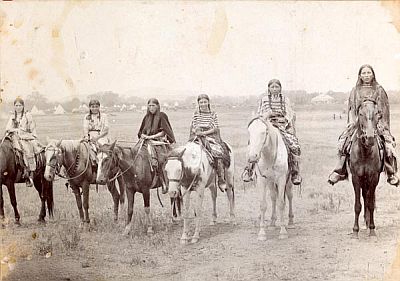
Female Native American warriors. Circa: 1895.  
Introduction. The American Revolution is celebrated by many as liberal democracy’s inaugural triumph, a conflict that, in Lincoln’s words, “brought forth on this continent a new nation conceived in liberty and dedicated to the proposition that all men are created equal.” This romantic narrative of the revolution still enjoys tremendous political currency, as the Right continues to deploy the memory of the Revolutionary War in the service of its agendas, from Tea Party tax paranoia to accusations of bureaucratic tyranny.

More than anything, the American Revolution is celebrated as confirmation of American exceptionalism — a moral, political, and military victory so absolute that it justifies (and indeed mandates) two hundred years of American expansion across the globe.

On the Left, as well, there is the temptation to claim the tradition of the American Revolution; the story of beleaguered colonists standing firm against the British monarchy’s economic tyranny makes for a convenient political allegory.

Even Eugene V. Debs saw in the Revolution something of a historical precedent for the socialist transformation he envisioned when he said in 1912, “I like the Fourth of July. It breathes the spirit of revolution. Today we affirm the ultimate triumph of Socialism.”

But the actual politics of the American Revolution are too often obscured by these kinds of self-serving reinterpretations, argues author William Hogeland. The American Revolution was not a noble war fought in the service of progressive democracy, destined to irrigate the entire planet with its ideology of inalienable freedoms. Nor was it a social revolution from below. Rather, it was the first chapter in an inter-imperial war between Great Britain and its dissident elites in North America. And the American state, even in its earliest incarnations, was more concerned with limiting popular democracy than securing and expanding it.
In his books, Hogeland makes strides towards demystifying this history, recovering the politics that have been evacuated from the American revolutionary mythology.

In recognition of the Fourth of July — a day marking the adoption of the Declaration of Independence by fifty-six prominent property owners — Jacobin‘s Jonah Walters spoke with Hogeland about taxation, the struggles of American Indians against the early US state, and the radical working-class movements that may have promised a better, more equitable America had they not been violently suppressed by the revolutionary elite.

Jonah Walters
To many on the Left, the American Revolution can be interpreted two ways — either as a reactionary power-grab by colonial elites who wanted to secure their control over a slave economy, or a bourgeois revolution in which the projects of economic liberalization and representative democracy were deeply intertwined and new state-formations innovated in the service of egalitarian goals, something of a clumsy rehearsal for the French Revolution.
Do any of these ring true to you?

William Hogeland
Our favored categories can start to look strange when we turn a light on the realities of the American Revolution. The revolution involved coalitions of people who were deeply divided regionally, economically, socially, politically, so anything the big-time founders did agree on will be pretty revealing.

I’d say they were largely agreed on the virtues of representative government — it’s what they’d had for generations, what they saw being threatened — but to question your question somewhat, I’d also note that across the board, from the planters to the financiers to the upper farmers and lawyers, the right of representation in no way equated with democracy, which at the time would have meant “manhood suffrage”: disconnecting the right of political participation from property ownership.

The founders who held power were agreed in their fear and loathing of that idea. Their ideology of rights and liberty was bound up, from ancient times — at least in their minds it was — with protecting property. So both the economic liberalization promoted by the high-finance Hamilton, and the more agrarian program that the slave-economy Madison advanced (once he realized what his old friend in nationalism Hamilton was up to), recoiled from democracy, a term the founders used negatively whenever they referred to placing power in the hands of the unpropertied.

That free yet unpropertied class was big, by the way, in founding-era America. In my view, egalitarian goals, as you’ve put it, were not on the minds of any of the well-known founders, for all of their other differences.  That includes mutually divided nationalists like Washington, Hamilton, Madison, and Adams and state-sovereigntist, anti-nationalists like Patrick Henry.

Jonah Walters
Is there a “revolutionary tradition” in the United States that the Left can somehow salvage? Can we draw any lessons from the American Revolution as we think about the possibility of radical transformation today?

William Hogeland
I find it impossible to draw the sort of lessons from the revolution that many on the Left seem to hope to draw. Most of the lessons I see are negative, which doesn’t make them useless, as far as I’m concerned — quite the contrary — but the American left generally hasn’t seen things that way. A lot of intellectual energy has been expended trying to ground the Left in a positive view of aspects of the American Revolution, and in other successes of American history, defining leftism itself as patriotically and even exceptionally American (“Communism is 20th Century Americanism,” etc).
It’s natural, in the face of a virulent attack from right and center, scourging the Left as un-American, to try to go hyper-American. But that’s only led to a lot of naïve and faux-naïve history, intellectually insupportable as far as I’m concerned. It’s hard for me to see how that kind of history could lead, long-term, to any new clarity in thinking, which I’d see as important to making real change.

When all the real lessons are so painful, what are you supposed to do with them? There’s a compelling quandary regarding the Left and our revolutionary and founding history, and it shouldn’t be wished away.

Here’s a negative lesson of the revolution. The elite founders I was discussing were by no means the only contributors to the revolution. Artisans, laborers both rural and urban, tenants, poor farmers, etc, were all key to the effort; often they led the way. They hoped the revolution would lead to improved political equality, as they defined it, which mostly meant for white men. They often cast their ideas and actions in the elite Whig terms of the day — liberty, rights, “ancient” charter freedoms — but in fact, they took a radical view, in that they wanted to disconnect political privilege from the property.

Radical, because that was a sharp and total break from the long past on which the elite leaders based the right of the revolution itself. Radical because these leaders of a working-class movement wanted new governments to limit the power of wealth, favor labor over capital, favor debtors over lenders. They were levelers, socialists. None of the famous founders agreed with them, and the movement, though crucial to the revolution, was crushed. I’ve analyzed the formation of the nation itself, at the end of the 1780s, as motivated almost exclusively by an elite program of crushing American socialist tendencies.
Well, that’s not a very happy story for the American left to tell about its early history. So we don’t talk much about leaders like James Cannon, Thomas Young, Christopher Marshall, or Herman Husband, or about the Committee of Privates, which organized the entire white working class of Pennsylvania in a successful revolution (briefly) against elite privilege in that state. Instead, we’re always trying to cast one of the Adamses or Hamilton or Madison or Franklin or Jefferson, those famous elite leaders, as half-unaware proto-leftists and arguing about which one to lionize. That story keeps eating its own tail.

Of course, some left historians do talk about the real leftism present at the founding. Without Gary Nash, Woody Holton, Terry Bouton, Wythe Holt, Ray Raphael, Jesse Lemisch and others, I wouldn’t know about this stuff. But few of those historians get across to the public, and those who do seem to me to turn away from the harshest conclusions of their stories, even while showing what really happened; they try to make that early leftism essentially, even exclusively, real-American, and they call for reviving it as such.
A colder-eyed view, inspired by a left economic critique, suggests that the crushing of that movement was in the end far more fully wired, structurally, into the national founding than the left ideas that got crushed.

So I prefer not to see anything as essentially American or un-American. I prefer to imagine we’re free, within reason, to do what we think is right. Having to cast every good idea as an expression of the American Revolution just wears us down.

Jonah Walters
In what ways, if any, was the American Revolution an anti-imperialist war or something of the first chapter in an inter-imperialist one?

William Hogeland
Regardless of some of the founders’ ideological preferences, the War of Independence certainly was the first chapter in the rise of American imperialist warfare. People like to cite Washington, when he was president, on avoiding foreign entanglements. That represents what I see as a widespread fantasy that there could ever have been an independent American nation without expansion driven by a concentration of wealth and military power. That’s what nationhood meant — and that’s why, if we want a radical transformation, we have to stop seeking it somewhere in our national origins.

Washington somehow managed not to see his conquest of the old Northwest in the 1790s as a foreign engagement, because the enemy was indigenous. Neat trick, but in fact many of the men who became revolutionaries, with Washington among the foremost, turned against England in the mid-1770s precisely because the mother country was blocking their expansion into Indian country, “robbing” the colonial speculators of their investments and of the massive potential profits to be made there. In the west, at least, the revolution was a war of American expansion.

Then the Northwest Territory, Indian country ceded by England in 1783, became the emerging nation-state in embryo: run by the federal government before the federal government could run anything within the states themselves. To really establish ownership of that territory took a new war against a mighty confederation that few talk about today. That Indian Confederation handed the new nation the worst defeat it ever suffered at native hands, far worse than what went at the Little Big Horn later on (Colin Calloway has a book out now on that early Indian victory).

In the context of that war, a US military establishment was born. A century or so later, the entire swatch of the continent was at last under US control and ownership, and the Caribbean and the Pacific beckoned. Teddy Roosevelt was not wrong, in my view, to see Anthony Wayne, the conqueror of what is now Ohio and Indiana, the first victorious US general, as a guiding spirit for vigorous global US expansion in the twentieth century.

I’m finishing a book right now on Wayne, the Indian confederation, that little-discussed, all-important founding war, and the politics of forming the US Army.

Jonah Walters
Let’s talk about taxation. “No Taxation Without Representation” has proved a lasting slogan, and the memory of the revolutionary war is routinely deployed by the Tea Party and other elements of the small government, anti-tax right.

But the Revolution also ultimately established a federal government with the power to levy taxes on goods and incomes (including the hated “whiskey tax”), established a national treasury, introduced tariffs and trade restrictions, etc. So what was the relationship between the rebelling colonists and taxes?

William Hogeland
In my view, pace Grover Norquist et al, the founders were not in favor of zero or little taxation, zero or low public debt, and “government small enough to drown in a bathtub.” Some of them were, but as you note, one of the main points of writing and ratifying the Constitution was to enable a powerful federal bureaucracy to collect taxes.

Unlike the late Edmund Morgan, who spent much of a long and important career trying to prove otherwise, I see the ideology of the revolutionary generation regarding British-imposed taxes as erratic. John Dickinson, however, expressed a consistent and meaningful position: even though Americans didn’t send elected representatives to Parliament, it was okay, Dickinson believed, for Parliament to lay taxes and tariffs on Americans for the purpose of balancing trade throughout its empire. But it was not okay to lay such levies for the purpose of raising revenue for the Treasury, unless those taxed consented to the tax, via representation.

That seems like an abstract distinction to us, but it wasn’t to them. While Dickinson opposed American independence, he was among many willing to fight and die for the principle, which goes back to the ineluctable relationship, for the elite revolutionaries, between property and liberty. The government can’t take your property without your consent, which is given through representation. If it does, you have a right of revolution within the English constitutional framework.

When Thomas Paine — one of the few founding-era radicals anyone remembers today — mocked the English constitution in “Common Sense,” he was mocking the very basis that the elites had claimed for fighting England. That’s one reason John Adams so loathed Paine.
Now, the first US tax, which the Constitution was created in large part in order to collect, was earmarked to support a large public debt. Hamilton saw nationhood in terms of public debt, and he’d worked hard throughout the 1780s to grow, not reduce, the domestic war debt: in that debt he rightly saw seeds of nationhood. He funded it, famously, which meant paying nearly 6 percent on the face value of multiple tiers of bonds bought from the federal and state government by a small group of wealthy American investors throughout the war.
Contrary to loose talk then and now, the blue-chip tier of that debt changed hands very little, as E.F. Ferguson showed long ago. Hamilton wanted to yoke those rich investors’ financial gains to the national interest, concentrating American wealth in big national projects. It was a huge bailout, and it worked.

Jonah Walters
But what about popular opposition to that plan? Today, we interpret populist opposition to taxes as an element of reactionary politics — anti-taxers align themselves with capital in opposition to a state they interpret as unfriendly to business. This has been true since at least the Civil War, when Lincoln briefly managed to implement a small income tax, despite massive opposition; a Radical Republican Congressman remarked at the time, “The clamor for the abolition of the income tax is . . . a manufactured cry. It does not come from the masses of the people,” but from “the men of gigantic capital . . . men of colossal fortunes and extraordinary incomes.”

But you claim the Whiskey Rebellion — a populist insurrection that took place during President George Washington’s first term in response to an excise tax on liquor — represents something else. What was the politics of the Whiskey Rebellion? And what does it tell us about the American state in its first years of its existence?

William Hogeland
The so-called “whiskey rebels” — Hamilton called them that, in order to erase their real critique — objected to Hamilton’s plan, which linked private gains to the national interest and thus preserved the status of the wealthy elite in the young republic. Like Dickinson, the rebels too are often wrongly viewed as objecting to taxation itself. They really objected to what they called “unequal taxation”; they wanted progressive tax rates. These were the 1790s version of the radicals of the 1770s whom few remember. Their industries in the west were being sewn up by local rich cronies of nationalists in Philadelphia. In some ways I think their rebellion should be seen as a very ambitious labor action.

It’s also important to know that the whiskey rebels were not diehard anti-federalists, as Pauline Maier presents them in her great book on ratification. In fact, many of the rebels harbored high hopes for a national government; they thought it would be progressive. When they saw that its tax provisions enabled a bailout of the wealthy few at their direct expense — they weren’t “paranoid,” Hamilton really was trying to shut them down economically — they ultimately threatened secession, hoping to start an economically radical state west of the Alleghenies. Washington and Hamilton took 19,000 troops to occupy western Pennsylvania, subjected the citizenry at large to door-kicking mass arrest without warrants, detained people without charge, extracted mass loyalty oaths, etc.

So there’s another weird tale of the fate of founding-era American leftism. When I say our early radicalism was crushed, I mean it literally. With that engagement against the whiskey rebels and the victory of Anthony Wayne over the Indian confederation — US sovereignty established — we might see the American Revolution as fully accomplished. The speculative capital investments of a small group of rentiers (and wannabe rentiers) and industrialists — some of that ambition dated back at least to the 1760’s — were now secured by the might of an emergent, expansionist nation state.

That’s depressing if we’re looking to our revolutionary origins for models of the kind of radical social and economic transformation we’d like to bring about. But I really think it’s our failure to live with the full range of painful founding realities — our constant efforts to explain them away or appropriate them ahistorically to our ends — that obstructs change, and I’d like to revolutionize that situation.

Oh, and Happy Fourth!

2646. Study Suggests Association Between Gut Bacteria and Emotion

By Science Daily, June 29, 2017
Credit: Scimat Scimat via Getty Images
Researchers have identified gut microbiota that interact with brain regions associated with mood and behavior. This may be the first time that behavioral and neurobiological differences associated with the microbial composition in healthy humans have been identified.
Brain-gut-microbiota interactions may play an important role in human health and behavior. Previous research suggests that microbiota, a community of microorganisms in the gut, can influence behavior and emotion. Rodent models have demonstrated the effects of gut microbiota on emotional and social behaviors, such as anxiety and depression. There is, however, little evidence of this in humans.
For this study, the researchers sought to identify brain and behavioral characteristics of healthy women clustered by gut microbiota profiles.
Forty women supplied fecal samples for profiling, and magnetic resonance images were taken of their brains as they viewed images of individuals, activities or things that evoked emotional responses. The women were divided by their gut bacteria composition into two groups: 33 had more of a bacterium called Bacteroides; the remaining seven had more of the Prevotella bacteria. The Bacteroides group showed a greater thickness of the gray matter in the frontal cortex and insula, brain regions involved with the complex processing of information. They also had larger volumes of the hippocampus, a region involved in memory processing. The Prevotella group, by contrast, showed more connections between emotional, attentional and sensory brain regions and lower brain volumes in several regions, such as the hippocampus. This group's hippocampus was less active while the women were viewing negative images. They also rated higher levels of negative feelings such as anxiety, distress, and irritability after looking at photos with negative images than did the Bacteroides group.
These results support the concept of brain-gut-microbiota interactions in healthy humans. Researchers do not yet know whether bacteria in the gut influence the development of the brain and its activity when unpleasant emotional content is encountered, or if existing differences in the brain influence the type of bacteria that reside in the gut. Both possibilities, however, could lead to important changes in how one thinks about human emotions.

Story Source:
Materials provided by University of California - Los Angeles Health SciencesNote: Content may be edited for style and length.

Journal Reference:
  1. Kirsten Tillisch, Emeran Mayer, Arpana Gupta, Zafar Gill, Rémi Brazeilles, Boris Le Nevé, Johan E.T. van Hylckama Vlieg, Denis Guyonnet, Muriel Derrien, Jennifer S. Labus. Brain structure and response to emotional stimuli as related to gut microbial profiles in healthy womenPsychosomatic Medicine, 2017; 1 DOI: 10.1097/PSY.0000000000000493