By Leonard Susskind, What Is the Universe? February 2026
Showing posts with label Physics. Show all posts
Showing posts with label Physics. Show all posts
Wednesday, April 22, 2026


Thursday, April 2, 2026

Wednesday, December 16, 2020
3458. Quantum Physics: A Very Short History
By Richard Webb, New Scientist,December 2020 What is quantum physics? Put simply, it’s the physics that explains how everything works: the best description we have of the nature of the particles that make up matter and the forces with which they interact.
Quantum physics underlies how atoms work, and so why chemistry and biology work as they do. You, me and the gatepost – at some level at least, we’re all dancing to the quantum tune. If you want to explain how electrons move through a computer chip, how photons of light get turned to electrical current in a solar panel or amplify themselves in a laser, or even just how the sun keeps burning, you’ll need to use quantum physics.
What is quantum physics? Put simply, it’s the physics that explains how everything works: the best description we have of the nature of the particles that make up matter and the forces with which they interact.
Quantum physics underlies how atoms work, and so why chemistry and biology work as they do. You, me and the gatepost – at some level at least, we’re all dancing to the quantum tune. If you want to explain how electrons move through a computer chip, how photons of light get turned to electrical current in a solar panel or amplify themselves in a laser, or even just how the sun keeps burning, you’ll need to use quantum physics.
The difficulty – and, for physicists, the fun – starts here. To begin with, there’s no single quantum theory. There’s quantum mechanics, the basic mathematical framework that underpins it all, which was first developed in the 1920s by Niels Bohr, Werner Heisenberg, Erwin Schrödinger and others. It characterises simple things such as how the position or momentum of a single particle or group of few particles changes over time.
But to understand how things work in the real world, quantum mechanics must be combined with other elements of physics – principally, Albert Einstein’s special theory of relativity, which explains what happens when things move very fast – to create what are known as quantum field theories.
Three different quantum field theories deal with three of the four fundamental forces by which matter interacts: electromagnetism, which explains how atoms hold together; the strong nuclear force, which explains the stability of the nucleus at the heart of the atom; and the weak nuclear force, which explains why some atoms undergo radioactive decay.
Over the past five decades or so these three theories have been brought together in a ramshackle coalition known as the “standard model” of particle physics. For all the impression that this model is slightly held together with sticky tape, it is the most accurately tested picture of matter’s basic working that’s ever been devised. Its crowning glory came in 2012 with the discovery of the Higgs boson, the particle that gives all other fundamental particles their mass, whose existence was predicted on the basis of quantum field theories as far back as 1964.
Conventional quantum field theories work well in describing the results of experiments at high-energy particle smashers such as CERN’s Large Hadron Collider, where the Higgs was discovered, which probe matter at its smallest scales. But if you want to understand how things work in many less esoteric situations – how electrons move or don’t move through a solid material and so make a material a metal, an insulator or a semiconductor, for example – things get even more complex.
The billions upon billions of interactions in these crowded environments require the development of “effective field theories” that gloss over some of the gory details. The difficulty in constructing such theories is why many important questions in solid-state physics remain unresolved – for instance why at low temperatures some materials are superconductors that allow current without electrical resistance, and why we can’t get this trick to work at room temperature.
But beneath all these practical problems lies a huge quantum mystery. At a basic level, quantum physics predicts very strange things about how matter works that are completely at odds with how things seem to work in the real world. Quantum particles can behave like particles, located in a single place; or they can act like waves, distributed all over space or in several places at once. How they appear seems to depend on how we choose to measure them, and before we measure they seem to have no definite properties at all – leading us to a fundamental conundrum about the nature of basic reality.
This fuzziness leads to apparent paradoxes such as Schrödinger’s cat, in which thanks to an uncertain quantum process a cat is left dead and alive at the same time. But that’s not all. Quantum particles also seem to be able to affect each other instantaneously even when they are far away from each other. This truly bamboozling phenomenon is known as entanglement, or, in a phrase coined by Einstein (a great critic of quantum theory), “spooky action at a distance”. Such quantum powers are completely foreign to us, yet are the basis of emerging technologies such as ultra-secure quantum cryptography and ultra-powerful quantum computing.
But as to what it all means, no one knows. Some people think we must just accept that quantum physics explains the material world in terms we find impossible to square with our experience in the larger, “classical” world. Others think there must be some better, more intuitive theory out there that we’ve yet to discover.
In all this, there are several elephants in the room. For a start, there’s a fourth fundamental force of nature that so far quantum theory has been unable to explain. Gravity remains the territory of Einstein’s general theory of relativity, a firmly non-quantum theory that doesn’t even involve particles. Intensive efforts over decades to bring gravity under the quantum umbrella and so explain all of fundamental physics within one “theory of everything” have come to nothing.
Meanwhile, cosmological measurements indicate that over 95 percent of the universe consists of dark matter and dark energy, stuffs for which we currently have no explanation within the standard model, and conundrums such as the extent of the role of quantum physics in the messy workings of life remain unexplained. The world is at some level quantum – but whether quantum physics is the last word about the world remains an open question.
Sunday, March 18, 2018
2850. The Mind that Roamed the Cosmos: Stephen Hawking Dies at 76
By Dennis Overbye, The New York Times, March 14, 2018
 |
| Dr. Hawking in his office at the University of Cambridge in December 2011. |
Stephen W. Hawking, the Cambridge University physicist and best-selling author who roamed the cosmos from a wheelchair, pondering the nature of gravity and the origin of the universe and becoming an emblem of human determination and curiosity, died early Wednesday at his home in Cambridge, England. He was 76.
A university spokesman confirmed the death.
“Not since Albert Einstein has a scientist so captured the public imagination and endeared himself to tens of millions of people around the world,” Michio Kaku, a professor of theoretical physics at the City University of New York, said in an interview.
Dr. Hawking did that largely through his book “A Brief History of Time: From the Big Bang to Black Holes,” published in 1988. It has sold more than 10 million copies and inspired a documentary film by Errol Morris. His own story was the basis of an award-winning 2014 feature film, “The Theory of Everything.” (Eddie Redmayne played Dr. Hawking and won an Academy Award.)
Scientifically, Dr. Hawking will be best remembered for a discovery so strange that it might be expressed in the form of a Zen koan: When is a black hole not black? When it explodes.
What is equally amazing is that he had a career at all. As a graduate student in 1963, he learned he had amyotrophic lateral sclerosis, a neuromuscular wasting disease also known as Lou Gehrig’s disease. He was given only a few years to live.
The disease reduced his bodily control to the flexing of a finger and voluntary eye movements but left his mental faculties untouched.
He went on to become his generation’s leader in exploring gravity and the properties of black holes, the bottomless gravitational pits so deep and dense that not even light can escape them.
That work led to a turning point in modern physics, playing itself out in the closing months of 1973 on the walls of his brain when Dr. Hawking set out to apply quantum theory, the weird laws that govern subatomic reality, to black holes. In a long and daunting calculation, Dr. Hawking discovered to his befuddlement that black holes — those mythological avatars of cosmic doom — were not really black at all. In fact, he found, they would eventually fizzle, leaking radiation and particles, and finally explode and disappear over the eons.Nobody, including Dr. Hawking, believed it at first — that particles could be coming out of a black hole. “I wasn’t looking for them at all,” he recalled in 1978. “I merely tripped over them. I was rather annoyed.”
That calculation, in a thesis published in 1974 in the journal Nature under the title “Black Hole Explosions?,” is hailed by scientists as the first great landmark in the struggle to find a single theory of nature — to connect gravity and quantum mechanics, those warring descriptions of the large and the small, to explain a universe that seems stranger than anybody had thought.
The discovery of Hawking radiation, as it is known, turned black holes upside down. It transformed them from destroyers to creators — or at least to recyclers — and wrenched the dream of a final theory in a strange, new direction.
“You can ask what will happen to someone who jumps into a black hole,” Dr. Hawking said in 1978. “I certainly don’t think he will survive it.
“On the other hand,” he added, “if we send someone off to jump into a black hole, neither he nor his constituent atoms will come back, but his mass energy will come back. Maybe that applies to the whole universe.”
Dennis W. Sciama, a cosmologist and Dr. Hawking’s thesis adviser at Cambridge, called Hawking’s thesis in Nature “the most beautiful paper in the history of physics.”
Edward Witten, a theorist at the Institute for Advanced Study in Princeton, said: “Trying to understand Hawking’s discovery better has been a source of much fresh thinking for almost 40 years now, and we are probably still far from fully coming to grips with it. It still feels new.”
In 2002, Dr. Hawking said he wanted the formula for Hawking radiation to be engraved on his tombstone.
He was a man who pushed the limits — in his intellectual life, to be sure, but also in his professional and personal lives. He traveled the globe to scientific meetings, visiting every continent, including Antarctica; wrote best-selling books about his work; married twice; fathered three children; and was not above appearing on “The Simpsons,” “Star Trek: The Next Generation” or “The Big Bang Theory.”
He celebrated his 60th birthday by going up in a hot-air balloon. The same week, he also crashed his electric-powered wheelchair while speeding around a corner in Cambridge, breaking his leg.
In April 2007, a few months after his 65th birthday, he took part in a zero-gravity flight aboard a specially equipped Boeing 727, a padded aircraft that flies a roller-coaster trajectory to produce fleeting periods of weightlessness. It was a prelude to a hoped-for trip to space with Richard Branson’s Virgin Galactic company aboard SpaceShipTwo.
Asked why he took such risks, Dr. Hawking said, “I want to show that people need not be limited by physical handicaps as long as they are not disabled in spirit.”His own spirit left many in awe.
“What a triumph his life has been,” said Martin Rees, a Cambridge University cosmologist, the astronomer royal of England and Dr. Hawking’s longtime colleague. “His name will live in the annals of science; millions have had their cosmic horizons widened by his best-selling books; and even more, around the world, have been inspired by a unique example of achievement against all the odds — a manifestation of amazing willpower and determination.”
Studies Came Easy
Stephen William Hawking was born in Oxford, England, on Jan. 8, 1942 — 300 years to the day, he liked to point out, after the death of Galileo, who had begun the study of gravity. His mother, the former Isobel Walker, had gone to Oxford to avoid the bombs that fell nightly during the Blitz of London. His father, Frank Hawking, was a prominent research biologist.
The oldest of four children, Stephen was a mediocre student at St. Albans School in London, though his innate brilliance was recognized by some classmates and teachers.
Later, at University College, Oxford, he found his studies in mathematics and physics so easy that he rarely consulted a book or took notes. He got by with a thousand hours of work in three years, or one hour a day, he estimated. “Nothing seemed worth making an effort for,” he said.
The only subject he found exciting was cosmology because, he said, it dealt with “the big question: Where did the universe come from?”
He moved to Cambridge upon his graduation from Oxford. Before he could begin his research, however, he was stricken by what his research adviser, Dr. Sciama, came to call “that terrible thing.”
The young Hawking had been experiencing occasional weakness and falling spells for several years. Shortly after his 21st birthday, in 1963, doctors told him that he had amyotrophic lateral sclerosis. They gave him less than three years to live.
His first response was severe depression. He dreamed he was going to be executed, he said. Then, against all odds, the disease appeared to stabilize. Though he was slowly losing control of his muscles, he was still able to walk short distances and perform simple tasks, though laboriously, like dressing and undressing. He felt a new sense of purpose.
“When you are faced with the possibility of an early death,” he recalled, “it makes you realize that life is worth living and that there are a lot of things you want to do.”
In 1965, he married Jane Wilde, a student of linguistics. Now, by his own account, he not only had “something to live for”; he also had to find a job, which gave him an incentive to work seriously toward his doctorate.
His illness, however, had robbed him of the ability to write down the long chains of equations that are the tools of the cosmologist’s trade. Characteristically, he turned this handicap into a strength, gathering his energies for daring leaps of thought, which, in his later years, he often left for others to codify in proper mathematical language.
“People have the mistaken impression that mathematics is just equations,” Dr. Hawking said. “In fact, equations are just the boring part of mathematics.”
By necessity, he concentrated on problems that could be attacked through “pictures and diagrams,” adopting geometric techniques that had been devised in the early 1960s by the mathematician Roger Penrose and a fellow Cambridge colleague, Brandon Carter, to study general relativity, Einstein’s theory of gravity.
Black holes are a natural prediction of that theory, which explains how mass and energy “curve” space, the way a sleeping person causes a mattress to sag. Light rays will bend as they traverse a gravitational field, just as a marble rolling on the sagging mattress will follow an arc around the sleeper.
Too much mass or energy in one spot could cause space to sag without end; an object that was dense enough, like a massive collapsing star, could wrap space around itself like a magician’s cloak and disappear, shrinking inside to a point of infinite density called a singularity, a cosmic dead end, where the known laws of physics would break down: a black hole.
Einstein himself thought this was absurd when the possibility was pointed out to him.Using the Hubble Space Telescope and other sophisticated tools of observation and analysis, however, astronomers have identified hundreds of objects that are too massive and dark to be anything but black holes, including a supermassive one at the center of the Milky Way. According to current theory, the universe should contain billions more.
As part of his Ph.D. thesis in 1966, Dr. Hawking showed that when you ran the film of the expanding universe backward, you would find that such a singularity had to have existed sometime in cosmic history; space and time, that is, must have had a beginning. He, Dr. Penrose and a rotating cast of colleagues published a series of theorems about the behavior of black holes and the dire fate of anything caught in them.
A Calculation in His Head
Dr. Hawking’s signature breakthrough resulted from a feud with the Israeli theoretical physicist Jacob Bekenstein, then a Princeton graduate student, about whether black holes could be said to have entropy, a thermodynamic measure of disorder. Dr. Bekenstein said they could, pointing out a close analogy between the laws that Dr. Hawking and his colleagues had derived for black holes and the laws of thermodynamics.
Dr. Hawking said no. To have entropy, a black hole would have to have a temperature. But warm objects, from a forehead to a star, radiate a mixture of electromagnetic radiation, depending on their exact temperatures. Nothing could escape a black hole, and so its temperature had to be zero. “I was very down on Bekenstein,” Dr. Hawking recalled.
Santi Visalli/Getty Images
To settle the question, Dr. Hawking decided to investigate the properties of atom-size black holes. This, however, required adding quantum mechanics, the paradoxical rules of the atomic and subatomic world, to gravity, a feat that had never been accomplished. Friends turned the pages of quantum theory textbooks as Dr. Hawking sat motionless staring at them for months. They wondered if he was finally in over his head.
When he eventually succeeded in doing the calculation in his head, it indicated to his surprise that particles and radiation were spewing out of black holes. Dr. Hawking became convinced that his calculation was correct when he realized that the outgoing radiation would have a thermal spectrum characteristic of the heat radiated by any warm body, from a star to a fevered forehead. Dr. Bekenstein had been right.
Dr. Hawking even figured out a way to explain how particles might escape a black hole. According to quantum principles, the space near a black hole would be teeming with “virtual” particles that would flash into existence in matched particle-and-antiparticle pairs — like electrons and their evil twin opposites, positrons — out of energy borrowed from the hole’s intense gravitational field.
They would then meet and annihilate each other in a flash of energy, repaying the debt for their brief existence. But if one of the pair fell into the black hole, the other one would be free to wander away and become real. It would appear to be coming from the black hole and taking energy away from it.
But those, he cautioned, were just words. The truth was in the math.
“The most important thing about Hawking radiation is that it shows that the black hole is not cut off from the rest of the universe,” Dr. Hawking said.
It also meant that black holes had a temperature and had entropy. In thermodynamics, entropy is a measure of wasted heat. But it is also a measure of the amount of information — the number of bits — needed to describe what is in a black hole. Curiously, the number of bits is proportional to the black hole’s surface area, not its volume, meaning that the amount of information you could stuff into a black hole is limited by its area, not, as one might think, its volume.
That result has become a litmus test for string theory and other pretenders to a theory of quantum gravity. It has also led to speculations that we live in a holographic universe, in which three-dimensional space is some kind of illusion.
Andrew Strominger, a Harvard string theorist, said of the holographic theory, “If it’s really true, it’s a deep and beautiful property of our universe — but not an obvious one.”
To ‘Know the Mind of God’
The discovery of black hole radiation also led to a 30-year controversy over the fate of things that had fallen into a black hole.
Dr. Hawking initially said that detailed information about whatever had fallen in would be lost forever because the particles coming out would be completely random, erasing whatever patterns had been present when they first fell in. Paraphrasing Einstein’s complaint about the randomness inherent in quantum mechanics, Dr. Hawking said, “God not only plays dice with the universe, but sometimes throws them where they can’t be seen.”
Many particle physicists protested that this violated a tenet of quantum physics, which says that knowledge is always preserved and can be retrieved. Leonard Susskind, a Stanford physicist who carried on the argument for decades, said, “Stephen correctly understood that if this was true, it would lead to the downfall of much of 20th-century physics.”
On another occasion, he characterized Dr. Hawking to his face as “one of the most obstinate people in the world; no, he is the most infuriating person in the universe.” Dr. Hawking grinned.
Dr. Hawking admitted defeat in 2004. Whatever information goes into a black hole will come back out when it explodes. One consequence, he noted sadly, was that one could not use black holes to escape to another universe. “I’m sorry to disappoint science fiction fans,” he said.
Despite his concession, however, the information paradox, as it is known, has become one of the hottest topics in theoretical physics. Physicists say they still do not know how information gets in or out of black holes.
Raphael Bousso of the University of California, Berkeley, and a former student of Dr. Hawking’s, said the present debate had raised “by another few notches” his estimation of the “stupendous magnitude” of Dr. Hawking’s original discovery.
In 1974, Dr. Hawking was elected a Fellow of the Royal Society, the world’s oldest scientific organization; in 1979, he was appointed to the Lucasian chair of mathematics at Cambridge, a post once held by Isaac Newton. “They say it’s Newton’s chair, but obviously it’s been changed,” he liked to quip.
Dr. Hawking also made yearly visits to the California Institute of Technology in Pasadena, which became like a second home. In 2008, he joined the Perimeter Institute for Theoretical Physics in Waterloo, Ontario, as a visiting researcher.
Having conquered black holes, Dr. Hawking set his sights on the origin of the universe and on eliminating that pesky singularity at the beginning of time from models of cosmology. If the laws of physics could break down there, they could break down everywhere.
In a meeting at the Vatican in 1982, he suggested that in the final theory there should be no place or time when the laws broke down, even at the beginning. He called the notion the “no boundary” proposal.
With James Hartle of the Institute for Theoretical Physics in Santa Barbara, Calif., Dr. Hawking envisioned the history of the universe as a sphere like the Earth. Cosmic time corresponds to latitude, starting with zero at the North Pole and progressing southward.
Although time started there, the North Pole was nothing special; the same laws applied there as everywhere else. Asking what happened before the Big Bang, Dr. Hawking said, was like asking what was a mile north of the North Pole — it was not any place, or any time.
By then, string theory, which claimed finally to explain both gravity and the other forces and particles of nature as tiny microscopically vibrating strings, like notes on a violin, was the leading candidate for a “theory of everything.”
In “A Brief History of Time,” Dr. Hawking concluded that “if we do discover a complete theory” of the universe, “it should in time be understandable in broad principle by everyone, not just a few scientists.”
He added, “Then we shall all, philosophers, scientists and just ordinary people, be able to take part in the discussion of why it is that we and the universe exist.”
“If we find the answer to that,” he continued, “it would be the ultimate triumph of
Until 1974, Dr. Hawking was still able to feed himself and to get in and out of bed. At Jane’s insistence, he would drag himself, hand over hand, up the stairs to the bedroom in his Cambridge home every night, in an effort to preserve his remaining muscle tone. After 1980, care was supplemented by nurses.
Dr. Hawking retained some control over his speech up to 1985. But on a trip to Switzerland, he came down with pneumonia. The doctors asked Jane if she wanted his life support turned off, but she said no. To save his life, doctors inserted a breathing tube. He survived, but his voice was permanently silenced.
Speaking With the Eyes
It appeared for a time that he would be able to communicate only by pointing at letters on an alphabet board. But when a computer expert, Walter Woltosz, heard about Dr. Hawking’s condition, he offered him a program he had written called Equalizer. By clicking a switch with his still-functioning fingers, Dr. Hawking was able to browse through menus that contained all the letters and more than 2,500 words.
Word by word — and when necessary, letter by letter — he could build up sentences on the computer screen and send them to a speech synthesizer that vocalized for him. The entire apparatus was fitted to his motorized wheelchair.
Even when too weak to move a finger, he communicated through the computer by way of an infrared beam, which he activated by twitching his right cheek or blinking his eye. The system was expanded to allow him to open and close the doors in his office and to use the telephone and internet without aid.
Although he averaged fewer than 15 words per minute, Dr. Hawking found he could speak through the computer better than he had before losing his voice. His only complaint, he confided, was that the speech synthesizer, manufactured in California, gave him a new vocal inflection.
“Please pardon my American accent,” he used to say.
His decision to write “A Brief History of Time” was prompted, he said, by a desire to share his excitement about “the discoveries that have been made about the universe” with “the public that paid for the research.” He wanted to make the ideas so accessible that the book would be sold in airports.
He also hoped to earn enough to pay for his children’s education. He did. The book’s extraordinary success made him wealthy, a hero to disabled people everywhere and even more famous.
The news media followed his movements and activities over the years, from visiting the White House to meeting the Dallas Cowboys cheerleaders, and reported his opinions on everything from national health care (socialized medicine in England had kept him alive) to communicating with extraterrestrials (maybe not a good idea, he said), as if he were a rolling Delphic Oracle.
Asked by New Scientist magazine what he thought about most, Dr. Hawking answered: “Women. They are a complete mystery.”
In 1990, Dr. Hawking and his wife separated after 25 years of marriage; Jane Hawking wrote about their years together in two books, “Music to Move the Stars: A Life With Stephen Hawking” and “Traveling to Infinity: My Life With Stephen.” The latter became the basis of the movie “The Theory of Everything.”
In 1995, he married Elaine Mason, a nurse who had cared for him since his bout of pneumonia. She had been married to David Mason, the engineer who had attached Dr. Hawking’s speech synthesizer to his wheelchair.
In 2004, British newspapers reported that the Cambridge police were investigating allegations that Elaine had abused Dr. Hawking, but no charges were filed, and Dr. Hawking denied the accusations. They later divorced.
His survivors include his children, Robert, Lucy and Tim, and three grandchildren.
‘There Is No Heaven’
Among his many honors, Dr. Hawking was named a commander of the British Empire in 1982. In the summer of 2012, he had a star role in the opening of the Paralympics Games in London. The only thing lacking was the Nobel Prize, and his explanation for this was characteristically pithy: “The Nobel is given only for theoretical work that has been confirmed by observation. It is very, very difficult to observe the things I have worked on.”
Dr. Hawking was a strong advocate of space exploration, saying it was essential to the long-term survival of the human race. “Life on Earth is at the ever-increasing risk of being wiped out by a disaster, such as sudden global nuclear war, a genetically engineered virus or other dangers we have not yet thought of,” he told an audience in Hong Kong in 2007.
Nothing raised as much furor, however, as his increasingly scathing remarks about religion. One attraction of the no-boundary proposal for Dr. Hawking was that there was no need to appeal to anything outside the universe, like God, to explain how it began.
In “A Brief History of Time,” he had referred to the “mind of God,” but in “The Grand Design,” a 2011 book he wrote with Leonard Mlodinow, he was more bleak about religion. “It is not necessary to invoke God to light the blue touch paper,” he wrote, referring to the British term for a firecracker fuse, “and set the universe going.”
He went further that year, telling The Guardian: “I regard the brain as a computer which will stop working when its components fail. There is no heaven or afterlife for broken-down computers; that is a fairy story for people afraid of the dark.”
Having spent the best part of his life grappling with black holes and cosmic doom, Dr. Hawking had no fear of the dark.
“They’re named black holes because they are related to human fears of being destroyed or gobbled up,” he once told an interviewer. “I don’t have fears of being thrown into them. I understand them. I feel in a sense that I am their master.”
Friday, July 7, 2017
2651. Albert Einstein as a Philosopher of Science
By Don Howard, Physics Today, December 2005

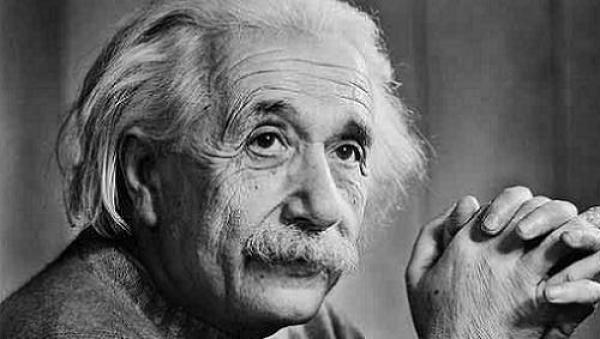
Nowadays, explicit engagement with the philosophy of science plays almost no role in the training of physicists or in physics research. What little the student learns about philosophical issues is typically learned casually, by a kind of intellectual osmosis. One picks up ideas and opinions in the lecture hall, in the laboratory, and in collaboration with one’s supervisor. Careful reflection on philosophical ideas is rare. Even rarer is systematic instruction. Worse still, publicly indulging an interest in philosophy of science is often treated as a social blunder. To be fair, more than a few physicists do think philosophically. Still, explicitly philosophical approaches to physics are the exception. Things were not always so.
"Independence of judgment"
In December 1944 Robert A. Thornton had a new job teaching physics at the University of Puerto Rico. He was fresh from the University of Minnesota, where he had written his PhD thesis on “Measurement, Concept Formation, and Principles of Simplicity: A Study in the Logic and Methodology of Physics” under Herbert Feigl, a noted philosopher of science. Wanting to incorporate the philosophy of science into his teaching of introductory physics, Thornton wrote to Albert Einstein for help in persuading his colleagues to accept that innovation. Einstein replied:
I fully agree with you about the significance and educational value of methodology as well as history and philosophy of science. So many people today—and even professional scientists—seem to me like someone who has seen thousands of trees but has never seen a forest. A knowledge of the historic and philosophical background gives that kind of independence from prejudices of his generation from which most scientists are suffering. This independence created by philosophical insight is—in my opinion—the mark of distinction between a mere artisan or specialist and a real seeker after truth. 1
Einstein was not just being polite; he really meant this. He had been saying the same thing for nearly 30 years. He knew from his experience at the forefront of the revolutions in early 20th-century physics that having cultivated a philosophical habit of mind had made him a better physicist.
A few years after his letter to Thornton, Einstein wrote in a contribution to Albert Einstein: Philosopher-Scientist, “The reciprocal relationship of epistemology and science is of noteworthy kind. They are dependent upon each other. Epistemology without contact with science becomes an empty scheme. Science without epistemology is—insofar as it is thinkable at all—primitive and muddled.” 2
In a 1936 article entitled “Physics and Reality,” he explained why the physicist cannot simply defer to the philosopher but must be a philosopher himself:
It has often been said, and certainly not without justification, that the man of science is a poor philosopher. Why then should it not be the right thing for the physicist to let the philosopher do the philosophizing? Such might indeed be the right thing to do at a time when the physicist believes he has at his disposal a rigid system of fundamental concepts and fundamental laws which are so well established that waves of doubt can’t reach them; but it cannot be right at a time when the very foundations of physics itself have become problematic as they are now. At a time like the present, when experience forces us to seek a newer and more solid foundation, the physicist cannot simply surrender to the philosopher the critical contemplation of theoretical foundations; for he himself knows best and feels more surely where the shoe pinches. In looking for a new foundation, he must try to make clear in his own mind just how far the concepts which he uses are justified and are necessities. 3
Already in 1916, just after completing his general theory of relativity, Einstein had discussed philosophy’s relation to physics in an obituary for the physicist and philosopher Ernst Mach:
How does it happen that a properly endowed natural scientist comes to concern himself with epistemology? Is there not some more valuable work to be done in his specialty? That’s what I hear many of my colleagues ask, and I sense it from many more. But I cannot share this sentiment. When I think about the ablest students whom I have encountered in my teaching—that is, those who distinguish themselves by their independence of judgment and not just their quick-wittedness—I can affirm that they had a vigorous interest in epistemology. They happily began discussions about the goals and methods of science, and they showed unequivocally, through a tenacious defense of their views, that the subject seemed important to them. 4
Notice that philosophy’s benefit to physics is not some specific bit of philosophical doctrine such as the antimetaphysical empiricism championed by Mach. It is, instead, “independence of judgment.” The philosophical habit of mind, Einstein argued, encourages a critical attitude toward received ideas:
Concepts that have proven useful in ordering things easily achieve such authority over us that we forget their earthly origins and accept them as unalterable givens. Thus they come to be stamped as “necessities of thought,” “a priori givens,” etc. The path of scientific progress is often made impassable for a long time by such errors. Therefore it is by no means an idle game if we become practiced in analyzing long-held commonplace concepts and showing the circumstances on which their justification and usefulness depend, and how they have grown up, individually, out of the givens of experience. Thus their excessive authority will be broken. They will be removed if they cannot be properly legitimated, corrected if their correlation with given things be far too superfluous, or replaced if a new system can be established that we prefer for whatever reason. 4
Here Einstein is describing the kind of historical—critical conceptual analysis for which Mach was famous. This mode of analysis is at the heart of the arguments for the special and general theories of relativity, and of many of Einstein’s other revolutionary works. 5 How did he become this kind of philosophical physicist? Reading Mach was one way, but not the only way.
Early Acquaintance with philosophy
Einstein was typical of his generation of physicists in the seriousness and extent of his early and lasting engagement with philosophy. By the age of 16, he had already read all three of Immanuel Kant’s major works, the Critique of Pure Reason, the Critique of Practical Reason, and the Critique of Judgment. 6 Einstein was to read Kant again while studying at the Swiss Federal Polytechnic Institute in Zürich, where he attended August Stadler’s lectures on Kant in the summer semester of 1897. Stadler belonged to the Marburg neo-Kantian movement, which was distinguished by its efforts to make sense of foundational and methodological aspects of current science within the Kantian framework. 7
It was also at university that Einstein first read Mach’s Mechanics(1883) and his Principles of the Theory of Heat (1896), along with Arthur Schopenhauer’s Parerga and Paralipomena (1851). It was probably also there that he first read Friedrich Albert Lange’s History of Materialism (1873), Eugen Dühring’s Critical History of the Principles of Mechanics (1887), and Ferdinand Rosenberger’s Isaac Newton and His Physical Principles (1895). All those books were, at the end of the century, well known to intellectually ambitious young physics students.
A telling fact about Einstein’s acquaintance with philosophy at university was his enrollment in Stadler’s course on the “Theory of Scientific Thought” in the winter semester of 1897. The course was in fact required for all students in Einstein’s division at the Polytechnic. Think about that: Every physics student at the Polytechnic, one of the leading technical universities in Europe, was required to take a course in philosophy of science. Such an explicit requirement was not found at every good university, although in 1896 Mach was named to the newly created chair of the “Philosophy of the Inductive Sciences” at the University of Vienna, and students learning physics under Hermann von Helmholtz in Berlin got a heavy dose of philosophy as well. Even if not every university had a specific requirement in the philosophy of science, the Zürich curriculum tells us that good young physicists
Einstein’s interest in philosophy continued after graduation. At about the time he started his job in the patent office in Bern in 1902, Einstein and some newfound friends, Maurice Solovine and Conrad Habicht, formed an informal weekly discussion group to which they gave the grandiloquent name “Olympia Academy.” Thanks to Solovine, we know what they read. 8 Here is a partial list:
- ▸ Richard Avenarius, Critique of Pure Experience (1888).
- ▸ Richard Dedekind, What Are and What Should Be the Numbers? (2nd ed., 1893).
- ▸ David Hume, A Treatise of Human Nature (1739; German translation 1895).
- ▸ Ernst
Mach, TheAnalysis of Sensations and the Relation of the Physical to the Psychical (2nd ed., 1900). - ▸ John Stuart Mill, A System of Logic (1872; German translation 1887).
- ▸ Karl Pearson, The Grammar of Science (1900).
- ▸ Henri Poincaré, Science and Hypothesis (1902; German translation 1904).
Those are titles one would have found on the bookshelf of many bright young physicists at the time. That Einstein and friends read them for pleasure or self-improvement shows how common it was in the scientific culture of the day to know such books and the ideas they held.
The philosophical seeds were sown at the Polytechnic and the Olympia Academy were soon to bear fruit in Einstein’s 1905 paper on the special theory of relativity and in many other places in his scientific work. But they would bear additional fruit in Einstein, himself, becoming an important philosopher of science.
RELATIONS WITH PHILOSOPHERS
Einstein’s philosophical education made a profound difference in the way he did physics. But his interest in the philosophy of science went further. By the 1930s he had become an active participant in the development of the freestanding discipline of the philosophy of science. His role evolved largely through his personal and professional relations with many of the era’s most important philosophers, mainly the founders of the tradition known as logical empiricism.
Einstein’s personal acquaintance with prominent philosophers of science began early and somewhat by accident. Friedrich Adler was also a physics student in Zürich in the late 1890s. 9 Although Adler studied at the University of Zürich, not the Polytechnic, he and Einstein became friends. The friendship was renewed in 1909 when Einstein moved back from Bern to Zürich to take up his first academic appointment, at the University of Zürich, a position for which Adler had been the other finalist.
By then, Adler had become a well-known defender of Mach’s empiricism, especially after the searing criticism that Max Planck leveled at Mach in a 1908 lecture on “The Unity of the Physical World Picture.” The close relationship with Mach led Adler to publish, in 1908, a German translation of Pierre Duhem’s influential 1906 book, Aim and Structure of Physical Theory .
From Duhem Einstein learned a version of what is known as conventionalism. Henri Poincaré, another well-known conventionalist, famously argued that the geometer’s conventional definition of “straight line segment” as “the path of a light ray” made Euclidean geometry safe from straightforward empirical refutation, say by line-of-sight triangulation of three mountain peaks, because anyone impressed by the simplicity of Euclidean geometry could save it by simply changing the definition of straight line.
Duhem’s conventionalism differed somewhat from Poincaré’s. He argued that what was conventional was not the choice of individual definitions, but rather one’s choice of a whole theory. According to Duhem, it is always whole theories and never individual scientific claims that one tests. Duhem’s “holistic” conventionalism was to become deeply woven into Einstein’s mature picture of the structure of theories and the way they are tested.
It was also in 1909 that Einstein’s fame made possible his first meeting with Mach. There was mutual respect on both sides. When Einstein left the German University of Prague in 1912, he nominated Philipp Frank as his successor. Frank was a Mach disciple who was to become an important member of the so-called Vienna Circle of logical empiricists. Frank’s 1947 Einstein biography is well known. 10
Einstein’s move to Berlin in 1914 further expanded his circle of philosophical colleagues. It included a few neo-Kantians like Ernst Cassirer, whose 1921 book, Einstein’s Theory of Relativity, was a technically sophisticated and philosophically subtle attempt to fit relativity within the Kantian framework. General relativity presented an obvious challenge to Kant’s famous assertion that Euclidean geometry was true a priori, the necessary form under which we organize our experience of external objects.
Hans Reichenbach, a student socialist leader in Berlin at the end of World War I, went on to anchor the Vienna Circle’s Berlin outpost and become logical empiricism’s most important interpreter of the philosophical foundations of relativity with books like his 1928 Philosophy of Space and Time. He had been Einstein’s student in Berlin, and Einstein was so impressed by his abilities as a philosopher of physics that when the conservative Berlin philosophy department refused Reichenbach a faculty post in the mid-1920s, Einstein contrived to have a chair in the philosophy of science created for him in the university’s more liberal physics department.
Without question, the most important new philosophical friend Einstein made during his Berlin years was Moritz Schlick. He was originally a physicist who did his Ph.D. under Planck in 1904. Schlick’s move to Vienna in 1922 to take up the chair in philosophy of science earlier occupied by Mach and Ludwig Boltzmann marks the birth of the Vienna Circle and the emergence of logical empiricism as an important philosophical movement. Prior to the work of Reichenbach, Schlick’s 1917 monograph Space and Time in Contemporary Physics was the most widely read philosophical introduction to relativity, and Schlick’s 1918 General Theory of Knowledge had a comparable influence on the broader field of philosophy of science. 11
Einstein and Schlick first got to know one another by correspondence in 1915, after Schlick published an astute essay on the philosophical significance of relativity. For the first six years of their acquaintance, Einstein showed high regard for Schlick’s work, but by 1922 the relationship had started to cool. Einstein was dismayed by the Vienna Circle’s ever more stridently antimetaphysical doctrine. The group dismissed as metaphysical any element of a theory whose connection to experience could not be demonstrated clearly enough. But Einstein’s disagreement with the Vienna Circle went deeper. It involved fundamental questions about the empirical interpretation and testing of theories.
Schlick, Reichenbach, and Einstein agreed that the challenge facing empiricist philosophers of physics was to formulate a new empiricism capable of defending the integrity of general relativity against attacks from the neo-Kantians. General relativity’s introduction of a hybrid spacetime with varying curvature was a major challenge to Kantianism. Some of Kant’s defenders argued that general relativity, being non-Euclidean, was false a priori. More subtle and sophisticated thinkers like Cassirer argued that Kant was wrong to claim a priori status for Euclidean geometry but right to maintain that there is some mathematically weaker a priori spatial form, perhaps just a topological form.
Mach’s philosophy was not up to the task. It could not acknowledge an independent cognitive role for the knower. Schlick, Reichenbach, and Einstein, on the other hand, agreed that the Kantians were right to insist that the mind is not a blank slate upon which experience writes; that cognition involves some structuring provided by the knower. But how could they assert such an active role for the knower without conceding too much to Kant? They were, after all, empiricists, believing that the reasons for upholding general relativity were ultimately empirical. But in what sense is our reasoning empirical if our knowing has an a priori structure?
Schlick and Reichenbach’s eventual answer was based mainly on Poincaré’s version of conventionalism. They argued that what the knower contributes are the definitions linking fundamental theoretical terms like “straight line segment” with empirical or physical notions like “path of a ray of light.” But, they contended, once such definitions are stipulated by convention, the empirical truth or falsity of all other assertions is uniquely fixed by experience. Moreover, since we freely choose only definitions, the differences resulting from those choices can be no more significant than expressing measurement results in English or metric units.
Einstein also sought an empiricist response to the Kantians, but he deeply disagreed with Schlick and Reichenbach. For one thing, he, like Duhem, thought it impossible to distinguish different kinds of scientific propositions just on principle. Some propositions function like definitions, but there was no clear philosophical reason why any one such proposition had to be so regarded. One theorist’s definition could be another’s synthetic, empirical claim.
As used by philosophers, “synthetic,” as distinguished from analytic, means an assertion that goes beyond what is already implied by the meanings of the terms being used. An analytic assertion, by contrast, is a claim whose truth depends solely on meaning or definitions. A central empiricist tenet is that there are no synthetic a priori truths.
A deeper reason for Einstein’s dissent from Schlick and Reichenbach was his worry that the new logical empiricist philosophy made science too much like engineering. Missing from the empiricists’ picture was what Einstein thought most important in creative theoretical physics, namely, “free inventions” by the human intellect. Not that the theorist was free to make up any picture whatsoever. Theorizing was constrained by the requirement of fit with experience. But Einstein’s own experience had taught him that creative theorizing could not be replaced by an algorithm for building and testing theories.
How would Einstein reply to Kant? He deployed Duhem’s holism in a novel way. When a theory is tested, something must be held fixed so that we can say clearly what the theory tells us about the world. But Einstein argued that precisely because theories are tested as wholes, not piecemeal, what we choose to hold fixed is arbitrary. One might think, like Kant, that one fixes Euclidean geometry and then tests a physics thus structured. But we really test physics and geometry together. Therefore, one could just as well hold the physics fixed and test the geometry. Better just to say that we are testing both and that we choose among the possible ways of interpreting the results by asking which interpretation yields the simplest theory. Einstein chose general relativity over rivals equally consistent with the evidence because its physics plus non-Euclidean spacetime geometry was, as a whole, simpler than the alternatives.
Such questions might seem overly subtle and arcane philosophical issues better left alone. But they cut to the heart of what it means to respect evidence in the doing of science, and they are questions about which we still argue. As theoretical physics moves ever deeper into realms less firmly anchored to empirical test, as experimental physics becomes ever more difficult and abstruse, the same questions over which Schlick, Reichenbach, and Einstein argued become more and more acute.
When theory confronts experience, how do we apportion credit or blame for success or failure? Can philosophical analysis supply reasons for focusing a test on an individual postulate, or should judgment and taste decide what nature is telling us? The logical empiricists were seeking an algorithm for choosing the right theory. But Einstein likened crucial aspects of the choosing to the “weighing of incommensurable qualities.” 12 In one sense, Einstein lost the argument with Schlick and Reichenbach. By mid-century, their logical empiricism had become orthodoxy. But Einstein’s dissent did not go unnoticed, and today it lives again as a challenge to another Kant revival 13
Philosophy in Einstein's Physics
ow did Einstein’s philosophical habit of mind lead to his doing physics differently? Did it, as he believed, make him a better physicist?
Most readers of Einstein’s 1905 special relativity paper note its strikingly philosophical tone. The paper begins with a philosophical question about an asymmetry in the conventional explanation of electromagnetic induction: A fixed magnet produces a current in the moving coil by an induced electromotive force in the coil. A moving magnet, on the other hand, is said to produce a current in a fixed coil through the electromagnetic field created by the magnet's motion. But if motion is relative, why should there be any difference? The paper goes on to fault the idea of objective determination of simultaneity between distant events for similarly philosophical reasons; nothing other than the simultaneity of immediately adjacent events is directly observable. One must, therefore, stipulate which distant events are deemed simultaneous for a given observer. But that stipulation must rest on a conventional assumption about, say, the equal speeds of outbound and inbound light signals.
There is a dispute among historians and philosophers of physics about exactly what philosophical perspective is involved here. Some explicitly conventionalist language in the paper suggests Poincaré as a source. Einstein himself credited principally Hume and secondarily Mach (see Einstein’s 1915 letter to Schlick on page 17 of this issue). In any case, the strikingly philosophical tenor of the 1905 relativity paper is unmistakable.
Einstein’s philosophical sources are less obscure with regard to his lifelong commitment to the principle of spatial separability in the face of quantum mechanical nonlocality. We know that Einstein read Schopenhauer while a student at the Zürich Polytechnic and regularly thereafter. He knew well one of Schopenhauer’s central doctrines, a modification of Kant’s doctrine of space and time as necessary a priori forms of intuition. Schopenhauer stressed the essential structuring role of space and time in individuating physical systems and their evolving states. Space and time, for him, constituted the principium individuationis, the ground of individuation. In more explicitly physical language, this view implies that difference of location suffices to make two systems different in the sense that each has its own real physical state, independent of the state of the other. For Schopenhauer, the mutual independence of spatially separated systems was a necessary a priori truth.
Did that way of thinking make a difference in Einstein’s physics? 14 Consider another famous paper from his annus mirabilis, the 1905 paper on the photon hypothesis, which explained the photoelectric effect by quantizing the way electromagnetic energy lives in free space. A photoelectron is emitted when one quantum of electromagnetic energy is absorbed in an illuminated metal surface, the electron’s energy gain being proportional to the frequency of the incident radiation. What most struck Einstein about the behavior of these energy quanta was that in the so-called Wien regime near the high-energy end of the blackbody spectrum, they behave like mutually independent corpuscles by virtue of their occupying different parts of space.
Einstein argued that assuming the validity of Boltzmann’s entropy principle (S = k log W) for radiation fields in the Wien regime implies a granular structure to such radiation. Thanks to the Boltzmann principle’s logarithmic form, the additivity of the entropy S is equivalent to the factorizability of the joint probability W for two spatially separated constituents of the radiation field to occupy given cells of phase space. The factorizability of a joint probability is one classical expression for the mutual independence of events.
But there was a problem: The same reasoning that implied a quantal structure for radiation in the Wien regime also implied that, outside that regime, the assumed mutual independence of photons must fail. The assumption of mutually independent photons does not yield a derivation of the full Planck formula for the energy density of blackbody radiation. Einstein realized that fact, and for nearly 20 years he sought to understand how it could be.
As early as 1909, Einstein toyed with assigning a wave field to each particle like photon to account for interference, an obvious failure of mutual independence. That’s where the idea of wave—particle duality began. Only late in 1924, when Einstein first read Satyendra Bose’s new derivation of the Planck radiation formula, did he grasp that what was implied was a new quantum statistics, in which particles fail to be independent not because of some exotic interaction but because their identity makes them indistinguishable.15
Thanks to Bose, Einstein realized that failure of the mutual independence of spatially separated light quanta would be an enduring feature of the emerging quantum theory. But from Schopenhauer he had learned to regard the independence of spatially separated systems as, virtually, a necessary a priori assumption. As the new quantum formalism appeared in the mid-1920s, Einstein sought either to interpret it in a manner compatible with spatial separability or to show that if quantum mechanics could not be so interpreted, it was fatally flawed. In 1927, Einstein produced a hidden-variables interpretation of Erwin Schrödinger’s wave mechanics. But he abandoned the effort prior to publication when he found that even his own hidden-variables interpretation involved the kind of failure of spatial separability that Schrödinger later dubbed “entanglement.”
Einstein’s most famous assault on the quantum theory was his 1935 “EPR” paper with Boris Podolsky and Nathan Rosen, which sought to demonstrate that quantum mechanics was an incomplete theory. Many readers find the EPR argument convoluted. Few are aware that Einstein repudiated the paper soon after publication, writing to Schrödinger in June of 1935 that the paper was actually written by Podolsky “for reasons of language,” and that he was unhappy with the result because “the main point was buried by excessive formalism.”
The argument Einstein intended starts from an assumption that he called “the separation principle.” Spatially separated systems have independent realities, and relativistic locality precludes superluminal influences between spacelike separated measurement events. Therefore quantum mechanics must be incomplete, because it assigns different wavefunctions, hence different states, to one of two previously interacting systems, depending on what parameter one chooses to measure on the other system. Surely a theory cannot assign two or more different states to one and the same physical reality unless those theoretical states are incomplete descriptions of that reality. 16
The important point here is that Einstein regarded his separation principle, descended from Schopenhauer’s principium individuationis, as virtually an axiom for any future fundamental physics. In later writings, he explained that field theory, as he understood it—after the model of general relativity, not quantum field theory—was the most radical possible expression of separability. In effect, such classical field theories treat all point events in the space-time manifold as mutually independent, separable systems endowed with their own separate, real physical states.
Einstein’s deep philosophical commitment to separability and his consequent lifelong disquiet about quantum mechanics is nowhere more clearly expressed than in a long note he wrote to Max Born in 1949. Einstein asks, “What must be an essential feature of any future fundamental physics?” His answer surprises many who expect him to say “causality.”
I just want to explain what I mean when I say that we should try to hold onto physical reality.
We are … all aware of the situation regarding what will turn out to be the basic foundational concepts in physics: the point-mass or the particle is surely not among them; the field, in the Faraday—Maxwell sense, might be, but not with certainty. But that which we conceive as existing (“real”) should somehow be localized in time and space. That is, the real in one part of space, A, should (in theory) somehow “exist” independently of that which is thought of as real in another part of space, B. If a physical system stretches over A and B, then what is present in B should somehow have an existence independent of what is present in A. What is actually present in B should thus not depend upon the type of measurement carried out in the part of space A; it should also be independent of whether or not a measurement is made in A.
If one adheres to this program, then one can hardly view the quantum-theoretical description as a complete representation of the physically real. If one attempts, nevertheless, so to view it, then one must assume that the physically real in B undergoes a sudden change because of a measurement in A. My physical instincts bristle at that suggestion.
However, if one renounces the assumption that what is present in different parts of space has an independent, real existence, then I don’t see at all what physics is supposed to be describing. For what is thought to be a “system” is, after all, just conventional, and I do not see how one is supposed to divide up the world objectively so that one can make statements about the parts. 17
That is how a philosopher—physicist thinks and writes.
Too much philosophizing?
One might respond to Einstein’s argument by saying that it proves what’s wrong with importing too much philosophy into physics. Einstein was probably wrong to doubt the completeness of quantum mechanics. The entanglement that so bothered him has emerged in recent decades as the chief novelty of the quantum realm.
But such a reaction would reflect a serious misunderstanding of the history. Einstein was wrong, but not because he was a philosophical dogmatist. His reasons were scientific as well as philosophical, the empirical success of general relativity being one among those scientific reasons. What the philosophical habit of mind made possible was Einstein’s seeing more deeply into the foundations of quantum mechanics than many of its most ardent defenders. And the kind of philosophically motivated critical questions he asked but could not yet answer were to bear fruit barely 10 years after his death when they were taken up again by another great philosopher—physicist, John Bell.
REFERENCES
- 1.A. Einstein to R. A. Thornton, unpublished letter dated 7 December 1944 (EA 6-574), Einstein Archive, Hebrew University, Jerusalem, quoted with permission.
- 2.P. A. Schilpp , ed., Albert Einstein: Philosopher-Scientist, The Library of Living Philosophers, Evanston, IL (1949), p. 684. Google Scholar
- 3.A. Einstein , J. Franklin Inst. 221, 349 (1936)https://doi.org/10.1016/S0016-0032(36)91047-5. Crossref
- 4.A. Einstein , Phys. Zeitschr. 17, 101 (1916).
- 5.A. Pais , ‘Subtle is the Lord …’: The Science and the Life of Albert Einstein, Oxford U. Press, New York (1982), is still the best intellectual biography of Einstein.
- 6.For details on Einstein’s early philosophical reading, see D. Howard , “Einstein’s Philosophy of Science,” in The Stanford Encyclopedia of Philosophy, E. N. Zalta , ed., http://plato.stanford.edu/archives/spr2004/entries/einstein-philscience/
- 7.M. Beller , in Einstein: The Formative Years, 1879-1909, D. Howard , J. Stachel , eds., Birkhäuser, Boston (2000), p. 83;Google ScholarCrossref
D. Howard , in Language, Logic, and the Structure of Scientific Theories, W. Salmon , G. Wolters , eds., U. of Pittsburgh Press, Pittsburgh, PA (1994), p. 45. Google Scholar - 8.M. Solovine , ed., Albert Einstein. Lettres à Maurice Solovine, Gauthier-Villars, Paris (1956). Google Scholar
- 9.D. Howard , Synthese 83, 363 (1990)https://doi.org/10.1007/BF00413422. Crossref
- 10.P. Frank , Einstein: His Life and Times, Knopf, New York (1947).
- 11.See D. Howard , Philosophia Naturalis 21, 616 (1984).
- 12.A. Einstein , Autobiographical Notes: A Centennial Edition, P. A. Schilpp , trans. and ed., Open Court, La Salle, IL (1979), p. 21. Google Scholar
- 13.A widely debated recent work of Kantian revival is M. Friedman , Dynamics of Reason, CSLI Publications, Stanford, CA(2001).
- 14.D. Howard , in The Cosmos of Science, J. Earman , J. D. Norton , eds., U. of Pittsburgh Press, Pittsburgh, PA (1997), p. 87. Google Scholar
- 15.D. Howard , in Sixty-Two Years of Uncertainty, A. Miller , ed., Plenum, New York (1990), p. 61https://doi.org/10.1007/978-1-4684-8771-8_6. Google ScholarCrossref
- 16.A. Einstein to E. Schrödinger, unpublished letter dated 19 June 1935 (EA 22-047), Einstein Archive, Hebrew University, Jerusalem, quoted with permission; D. Howard, Stud. Hist. Phil. Sci. 16, 171 (1985);https://doi.org/10.1016/0039-3681(85)90001-9, Crossref
D. Howard , in Philosophical Consequences of Quantum Theory: Reflections on Bell’s Theorem, J. T. Cushing , E. McMullin , eds., U. of Notre Dame Press, Notre Dame, IN (1989), p. 224. Google Scholar - 17.M. Born , ed., Albert Einstein—Hedwig und Max Born. Briefwechsel 1916-55, Nymphenburger, Munich (1969), p. 223
Subscribe to:
Posts (Atom)