Friday, January 6, 2017

2531. China to Invest at Least $360 Billion on Renewable Energy by 2020

By Michael Forsythe, The New York Times, January 5, 2017


China intends to spend more than $360 billion through 2020 on renewable power sources like solar and wind, the government’s energy agency said on Thursday.

The country’s National Energy Administration laid out a plan to dominate one of the world’s fastest-growing industries, just at a time when the United States is set to take the opposite tack as Donald J. Trump, a climate-change doubter, prepares to assume the presidency.

The agency said in a statement that China would create more than 13 million jobs in the renewable energy sector by 2020, curb the growth of greenhouse gasses that contribute to global warming and reduce the amount of soot that in recent days has blanketed Beijing and other Chinese cities in a noxious cloud of smog.

China surpassed the United States a decade ago as the world’s biggest emitter of greenhouse gasses, and now discharges about twice as much. For years, its oil and coal industries prospered under powerful political patrons and the growth-above-anything mantra of the ruling Communist Party.

The result was choking pollution and the growing recognition that China, many of whose biggest cities are on the coast, will be threatened by rising sea levels.

But even disregarding the threat of climate change, China’s announcement was a bold claim on leadership in the renewable energy industry, where Chinese companies, buoyed by a huge domestic market, are already among the world’s dominant players. Thanks in part to Chinese manufacturing, costs in the wind and solar industries are plummeting, making them increasingly competitive with power generation from fossil fuels like coal and natural gas.

Sam Geall, executive editor of Chinadialogue, an English- and Chinese-language website that focuses on the environment, said that the United States, by moving away from a focus on reducing carbon emissions, risked losing out to China in the race to lead the industry.

Mr. Trump has in the past called the theory of human-cased global warming a hoax and picked a fierce opponent of President Obama’s rules to reduce carbon emissions, Scott Pruitt, the Oklahoma attorney general, to lead the Environmental Protection Agency.

The investment commitment made by the Chinese, combined with Mr. Trump’s moves, means jobs that would have been created in the United States may instead go to Chinese workers.

Even the headline-grabbing numbers on total investment and job creation may understate what is already happening on the ground in China. Greenpeace estimates that China installed an average of more than one wind turbine every hour of every day in 2015, and covered the equivalent of one soccer field every hour with solar panels.

China may meet its 2020 goals for solar installation by 2018, said Lauri Myllyvirta, a research analyst at Greenpeace, who is based in Beijing.

But despite these impressive numbers, China’s push to clean its air and reduce its greenhouse gasses faces political pressure from the politically powerful coal industry.

Mr. Geall and Mr. Myllyvirta both said that Thursday’s announcement was missing any language on curtailment, or the amount of electricity generated by wind and solar that never finds its way to the country’s power grid. In China, wind power curtailment was 19 percent in the first nine months 2016, Mr. Myllyvirta said, many times higher than in the United States, where curtailment levels are often negligible.

The main reason for curtailment, he said, is that China is plagued by overcapacity in electricity generation and operators of China’s grid often favor electricity generated from coal.

In recent years the country has also been building coal-fired power plants at a furious pace, although that has recently slowed along with China’s economy. Another omission from Thursday’s announcements, Mr. Myllyvirta said, was the absence of any specific target to reduce coal consumption.

But both Mr. Geall and Mr. Myllyvirta said Thursday’s announcement set the stage for still more power generation from renewable energy and a gradual shift away from coal.

“My experience with China is when a numeric target gets written down, it gets implemented,” Mr. Myllyvirta said. “It doesn’t always get implemented in the way you like, but it does get implemented.”

2530. On Long Migrations, Birds Chase an Eternal Spring

By Carl Zimmer, The New York Times, January 5, 2017


Bird migrations have stumped the greatest minds for thousands of years. Aristotle thought that the robins living in Greece in the winter somehow turned into redstarts in the summer. In fact, robins migrate from Greece to Northern Europe around the time redstarts arrive from Africa.

Scientists have gotten a much better understanding of bird migration in recent centuries, but there’s a tremendous amount they have yet to learn. After tracking more than three dozen birds with sensors for thousands of miles, a team of researchers reported on Wednesday that their migration defied the expected course.

Instead of simply flying straight from their summer grounds in Denmark to their winter site in Africa, the birds stretched out their journey, stopping at several places along the way for weeks at a time.

“It’s more of a nomadic life,” said Kasper Thorup, a bird migration expert at the University of Copenhagen and co-author of the new study. “They hardly have a place to call home.”

The journey was exquisitely well timed to coincide with high levels of vegetation at each site, he and his colleagues found. These habits, honed by thousands of years of evolution, probably helped them enjoy a good diet of insects on their trip. This may be a common strategy among the world’s migratory birds, but Dr. Thorup and his colleagues warn that it may be threatened by climate change.

Previous generations of researchers could rely only on indirect clues to the travels of birds. Traditionally, ornithologists caught a bird at its summer breeding grounds, put an identifying band on its leg, and then waited for someone to spot it wherever it ended up for the winter. Such studies said little about where the birds went between points A and B.

Today’s migration researchers are finally filling in some of those gaps. Some are analyzing millions of crowdsourced bird sightings. Others are fitting birds with miniature tracking devices.

“We have all these resources coming online, and so we can replace speculation with observation,” said Frank A. La Sorte, a research associate at the Cornell Laboratory of Ornithology.

In 2002, the Cornell lab started a program called eBird with the Audubon Society. Amateurs fill out an online form each time they go birding, noting all the species they spot. Dr. La Sorte and his colleagues analyze the records, tracking a number of migratory birds that travel through North America each year.

The researchers have found that birds migrate in loops, rather than follow a straight line north and south. In summer, birds heading to eastern North America, for instance, catch tailwinds that help them get over the Gulf of Mexico.

The birds end up drifting to the west, but they still save energy despite the longer route. On the way back south, though, they take a more direct path across the Gulf.

In western North America, food plays a big part in the migration loop. Birds fly at night and then land to feed on insects during the day. In the spring, their routes take them to places where plants have put on a lot of growth. That’s probably also where the birds can find insect larvae to eat.

While eBird gives Dr. La Sorte information about millions of birds, it can show him only what birders are seeing. Other researchers are suiting up small squadrons of birds with tracking devices to follow them through their entire migrations.

For the new study, published in the journal Science Advances, Dr. Thorup and his colleagues put lightweight devices on common cuckoos. As the birds migrated between Denmark and Central Africa, they sent signals to satellites showing their location.

The researchers also tracked two smaller migratory species traveling from Denmark to sub-Saharan Africa: thrush nightingales and red-backed shrikes. These birds are too small to carry the weight of satellite transmitters, so Dr. Thorup and his colleagues fitted them with even tinier devices called geo-locators.

These sensors record only sunlight levels throughout each day. When the birds returned to Denmark, the scientists recovered the geo-locators and used each day’s data to plot the birds’ routes.

Studying 38 birds in total, the scientists found the animals didn’t move directly from their summer grounds to their winter grounds. Instead, the birds would fly for a few days, stop somewhere for a few weeks, and then move on again.

Red-backed shrikes, for example, leave Denmark and reach southeast Europe in August. In October, they go to East Africa. By December, they’re in southern Africa. And in April, they’re back in East Africa again.

Throughout their journey, the scientists found, the three species timed their flights so that they reached feeding grounds once they were abundant with vegetation. Dr. Thorup suspects that the birds are able to make meals of local insect larvae feeding on the plants.

The new data show that even though the birds ended up in the same places in Africa, they sometimes followed different routes. Dr. La Sorte and his colleagues have found similar flexibility in North American birds, which often adjust their route and speed when over the Gulf of Mexico or the Atlantic Ocean, perhaps to cope with changing weather conditions.

It’s possible that birds somehow combine short-range flexibility with a navigation system, hard-wired into the brain, that guides them to the places where they can find the most food to eat.

“You don’t cross the Sahara without knowing it’s good on the other side,” said Dr. Thorup.

That strategy works well when birds can be sure to find food at the same place at the same time each year. But climate change is altering the calculus.

In Northern Europe and North America, for example, plants are greening up earlier in the spring. In Africa, rainfall patterns are shifting, changing the times at which plants put on new leaves and fruit.

Dr. Thorup and his colleagues compared the migration routes of the birds to computer projections of how ecosystems will change in response to global warming over the next few decades.

They concluded that climate change may make migrations much harder on the birds.
In the summer, for instance, they will need to fly farther north to find food. “And when they arrive in Africa, there are no obvious places for them to go,” said Dr. Thorup.

Of course, birds have not migrated along the same paths for millions of years. Ice age glaciers gradually retreated from places like Denmark only about 11,000 years ago, allowing birds to colonize them for summer breeding.

But this change in bird migration was probably the result of natural selection acting on hundreds of generations of birds. Human-driven climate change is moving much more quickly.

“We’re worried that they won’t have the time to adapt,” Dr. Thorup said.

Wednesday, January 4, 2017

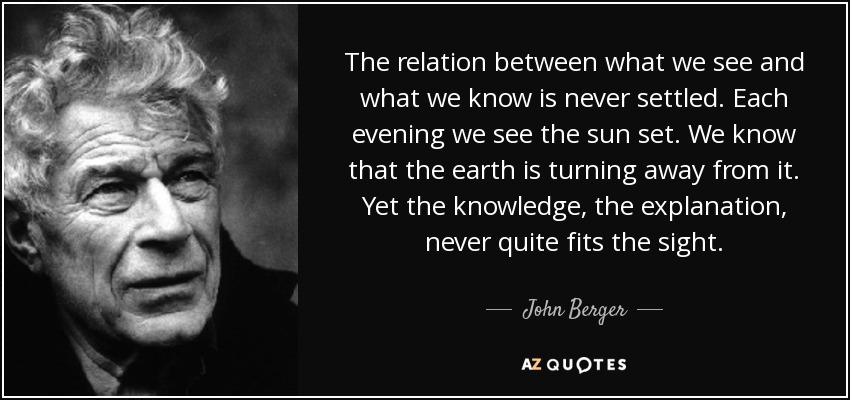
2529. John Berger's Theory of Art

By Robert Minto, Los Angeles Review of Books, January 2, 2017

EARLY IN HIS CAREER, John Berger’s weekly art criticism for the New Statesman provoked outraged letters and public condemnation. Once, the British Council issued a formal apology to Henry Moore because Berger had suggested his latest work showed a decline. Nor was the hostility limited to such comic passive-aggression. Berger’s politics were deemed so objectionable that his publisher was compelled to withdraw his first novel, A Painter of Our Time (1958), from circulation.
At 90, Berger is harvesting a sudden flowering of praise. It is well deserved. For more than half a century, he has been our greatest art critic — as well as a superior novelist, a poet, and the star and screenwriter of one of the best art documentaries ever made, Ways of Seeing. Most of the writers currently rushing to canonize him, however, avoid dwelling on the heart of Berger’s point of view — his Marxism. No doubt avoiding this disfavored topic makes eulogy easier, but it reminds me of something Berger wrote about Frederick Antal: “the importance of his Marxism tends to be underestimated. In a curious way this is probably done out of respect for him: as though to say ‘He was brilliant despite that — so let’s charitably forget it.’ Yet, in fact, to do this is to deny all that Antal was.” To make such a denial about Berger should no longer be possible after the publication of Landscapes: John Berger on Art.
Landscapes and its companion volume, Portraits: John Berger on Artists (Verso, 2015), are the best summation to date of Berger’s career as a critic. Both volumes were edited by Tom Overton. In Portraits, Overton made selections from decades of essays on the whole historical gamut of art, from the prehistoric cave paintings of Lascaux to the work of 33-year-old Randa Mdah, and organized them chronologically into a history and appraisal of the art of painting. To read it was to be reminded of Berger’s unique virtues: the clarity of his writing, the historical and technical erudition of his insight, and above all his unique focus on each artist’s way of looking. What Landscapes in turn makes clear, through its assemblage of more programmatic pieces — book reviews, manifestos, autobiography — is that Berger is a rigorous thinker with a theory of art. That theory evolved considerably between the 1950s and the 2010s. Yet two threads hold it together with the tenacity of spider silk: a critique of the political economy of art and a sophisticated account of its human value, each rooted in a committed but elastic Marxism.
A Marxist art criticism of any real subtlety has to be elastic, because it must deal with a problem Marx himself diagnosed but failed to solve. Berger puts it like this:
A question which Marx posed but could not answer: If art in the last analysis is a superstructure of an economic base, why does its power to move us endure long after the base has been transformed? Why, asked Marx, do we still look towards Greek art as an ideal? He began to answer the question […] and then broke off the manuscript and was far too occupied ever to return to the question.
Berger takes up the thread where Marx broke off. He is not, of course, the first Marxist to address the question of art, and he is familiar with most of those who tried before him, sorting through and furthering their legacy.
The most famous of Berger’s influences, Walter Benjamin, wrote the essay “Art in the Age of Mechanical Reproduction,” from which came most of the ideas in Berger’s documentary, Ways of Seeing. But Landscapes reveals that his most important influence as a practicing art critic was Max Raphael.
Raphael, an undeservedly obscure theorist, located the value of art in the activity of the artist. According to him, an artist performs two operations. On the one hand, the artist turns raw material into artistic material by shaping it to represent an idea or an object; this is true both of Michelangelo shaping a block of marble into David and of Jackson Pollock embodying the rhythms of jazz in drip paintings. On the other, the artist turns his perception into something external and objective, a representation. The work of art is the result of these two transformations, of raw stuff and of subjective perception into an art object. For Raphael, the point of art is these two transformations: they are the artist’s way of “undoing the world of things” and constructing “the world of values.”
So Raphael’s answer to Marx’s problem — why is art enduringly moving even though it merely reflects its social context? — is to say that art doesn’t merely reflect its social context. It does reflect it, because the artist’s material, style, the things they want to represent, even the way they see, are historically conditioned; but it doesn’t merely reflect it, because the transformed material speaks of something deeper and more voluntary. It speaks of humanity’s ability to make its own world, to become the subject and not merely the victim of history. “The function of the work of art,” Berger sums up Raphael, “is to lead us from the work to the process of creation which it contains.”
Anyone familiar with Berger’s own writing will sit up with a shock of recognition. Here is a theory of art directly correlated to his practice of criticism. Berger takes art out of the sanitizing temples where we store it and drops it firmly back onto the easel, in a messy studio, where a sweaty artist bites her lip and stores her way of looking in an object. Over and over again, he asks us to imagine the artist at work. Many have attributed this to his own training as a painter, which might have inspired his fascination with technique, as I, an amateur pianist, am fascinated by the technique of my favorite recording artists. But I think his admiring discussion of Raphael suggests a much deeper reason. If Berger believes that the most important meaning of art is what it shows us of our ability to create the world we want, it turns out that his criticism is connected to his Marxism much more fundamentally than through the borrowing of a few insights from Walter Benjamin.
For Berger, art criticism is a revolutionary practice. It prepares the ground for a new society. In Landscapes, Overton includes a translation by Berger and Anya Rostock of a poem by Bertolt Brecht. It includes this passage:
Yet how to begin? How to show
The living together of men
That it may be understood
And become a world that can be mastered?
How to reveal not only yourselves and others
Floundering in the net
But also make clear how the net of fate
Is knotted and cast,
Cast and knotted by men?
[…] only he who knows that the fate of man is man
Can see his fellow men keenly with accuracy.
How to begin? Berger answers: In art. There we find proof and prophecy of a different world. In another essay, he writes:
We can no longer “use” most paintings today as they were intended to be used: for religious worship, for celebrating the wealth of the wealthy, for immediate political enlightenment, for proving the romantic sublime, and so on. Nevertheless, painting is especially well suited to developing the very faculty of understanding which has rendered its earlier uses obsolete: that is to say, to developing our historical and evolutionary self-consciousness.
This is the promise, the positive function of art. By looking at it, we are, in effect, looking through an artist’s eyes, entering into a concretized instance of their gaze. We are looking at a looking. And from within an artist’s looking, we learn about the capacities of our kind and the possibilities of our future: “A classical Greek sculpture increases our awareness of our own potential physical dignity; a Rembrandt of our potential moral courage; a Matisse of our potential sensual awareness.”
At the same time, Berger is of the opinion that the modern history of art is a history of failure. He won’t compromise on this point, and it is undoubtedly the reason for the stiff resistance that he has often met.
In modern times, Berger believes, the art world has hosted a titanic battle between two conceptions of art. One conception declares that art is valuable because it bodies forth the vision of an artist; it is a good in itself just to the degree that it succeeds at this task. This is Berger’s conception, and it is large enough to embrace all the varying and contradictory proclamations and provocations of the successive factions of modern art. The other conception declares that art is valuable because it is expensive — that, fundamentally, art is property:
Since 1848 every artist unready to be a mere paid entertainer has tried to resist the bourgeoisation of his finished work, the transformation of the spiritual value of his work into property value. This regardless of his political opinions as such. […] What Constructivism, Dadaism, Surrealism, and so on, all shared was their opposition to art-as-property and art-as-a-cultural-alibi-for-existing-society. We know the extremes to which they went […] and we see that their resistance was […] ineffective.
In other words, artists, like all other workers, are victims of a capitalism that alienates them from the fruit of their labor. Berger has nothing but scorn for the commercialization of art: “If you could fuck works of art as well as buy them,” he writes, dealers “would be pimps: but, if that were the case, one might assume a kind of love; as it is they dream of money and honour.” Everything about the modern art world is constructed on the assumption that art is precious in proportion to its price. Even among those who profess a genuine love of art, that passion is often tainted by its ideological function:
A love of art has been a useful concept to the European ruling classes for over a century and a half. The love was said to be their own. With it they could claim kinship with the civilisations of the past and the possession of those moral virtues associated with “beauty”. With it they could also dismiss as inartistic and primitive the cultures they were in the process of destroying at home and throughout the world.
Museums, those seemingly democratic institutions for the dissemination of art appreciation, come in for withering critique: “Anybody who is not an expert entering the average museum today is made to feel like a cultural pauper receiving charity.” From a man who has spent so much time in museums, these are harsh words. Everything about our museums’ operations reveal a slavish dedication to the conception of art as property: from the choice of what to show and what to store, to the obsession with provenance. Provenance is an important question for owners of art-as-property, for whom the price of a work of art, which to them is equal to its value, is directly dependent upon its rarity and authenticity. The museum teaches us that we are paupers in two senses: too poor in money to do anything but stand abjectly before this display of wealth, and too poor in taste to grasp the reason these objects are so highly prized. Before museums can even begin to be useful, believes Berger, “it is necessary to see works of art freed from all the mystique which is attached to them as property objects.”
Berger’s opinion of museums reveals something: our greatest art critic for the last half-century has been conducting a smuggling operation. The bulk of his work as a critic has been a plainspoken attempt to enunciate the meaning of works of art — the process of their creation — under the eyes of their guards. From his perspective, the regime of property has an interest in suppressing his work, not just because art has functioned so well as a form of wealth and an ideological tool, but because its real meaning is dangerously emancipating.
Tom Overton and Verso have provided a real service by supplementing the praxis, the well-known criticism, of the increasingly famous John Berger with his theory. All those who love his writing and profess to take him as a teacher owe it to themselves to peruse Landscapes, and to grapple frankly with the discomforting, clear, and urgent message of his work:
[I]t is necessary to make an imaginative effort which runs contrary to the whole contemporary trend of the art world: it is necessary to see works of art freed from all the mystique which is attached to them as property objects. It then becomes possible to see them as testimony to the process of their own making instead of as products; to see them in terms of action instead of finished achievement. The question: what went into the making of this? supersedes the collector’s question of: what is this?
¤

Sunday, January 1, 2017

2528. Heidegger and Anti-Semitism Yet Again: The Correspondence Between the Philosopher and His Brother Fritz Heidegger Exposed

By Adam Soboczynski and Alexander Cammann, Los Angels Review of Books, December 25, 2016
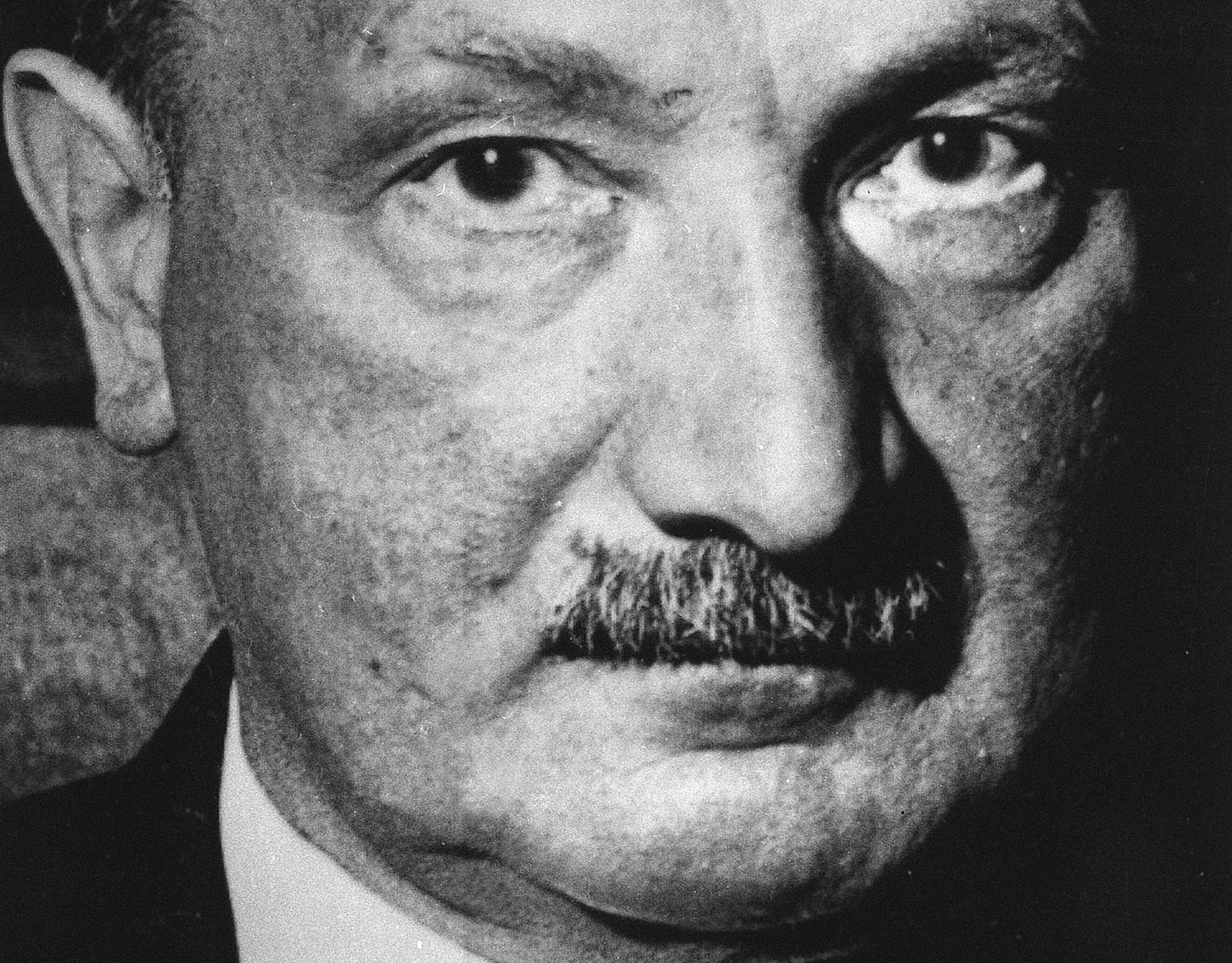
Martin Heidegger
FOR QUITE SOME TIME, there has been a fair bit of murmuring and speculation surrounding the letters exchanged between the philosopher Martin Heidegger and his brother Fritz. Those who had seen the more than 500 pieces of correspondence, which have been stored at the German Literature Archive in Marburg since 2014, knew how explosive they would be. But in accordance with the wishes of Heidegger’s family, they were not allowed to quote from them. But now — apparently in response to the intense international debate surrounding Heidegger’s anti-Semitism triggered by the publication of the Black Notebooksthree years ago — the family has agreed to release an abridged version of the letters, written between 1930 and 1946, in a newly published volume called Heidegger und der Antisemitismus (“Heidegger and Anti-Semitism”) (Verlag Herder, Freiburg 2016). Inside these pages one finds an unvarnished picture of the philosopher’s political disposition. In the Black Notebooks, a kind of diary of thoughts, Heidegger approached anti-Semitism from a philosophical remove, but these personal letters published expose him as a bona fide, unrepentant anti-Semite. They also show that — in contrast to prevailing beliefs — the Freiburg professor was politically well informed, and was an early and passionate supporter of National Socialism.
As early as the tail end of 1931, the 43-year-old Heidegger sent his brother a copy of Adolf Hitler’s Mein Kampf for Christmas, praising the future dictator’s “extraordinary and unwavering political instincts.” Heidegger interprets the right-wing conservative minority cabinet under Reich Chancellor Franz von Papen — which governed with the help of President Hindenburg between June and December 1932 — as a Jewish conspiracy. And he complains that the Jews are:
gradually extricating themselves from the mood of panic into which they had fallen. That the Jews were able to pull off such a maneuver as the Papen episode just shows how difficult it will be to push back against everything represented by Big Capital (Großkapital) and the like.
Just how strange Heidegger’s conspiracy theory was can be gathered from the fact that von Papen’s allegedly Jewish-controlled cabinet actually received support from another influential right-wing intellectual in the Weimar Republic, Carl Schmitt, an anti-democratic constitutional law expert whose intense anti-Semitism is now well established. Schmitt represented von Papen’s government in a Leipzig court case against the Prussian government in 1932.
On April 13, 1933, Heidegger writes enthusiastically:
It can be seen from one day to the next how great a statesman Hitler is becoming. The world of our people and the Reich finds itself in a process of transformation, and all those who have eyes to see, ears to hear, and a heart for action will be swept along and put in a state of extreme excitement.
Heidegger’s commitment to Hitler’s state and his membership in the NSDAP turn out to be based, quite logically, in his long-standing questionable convictions. As the letters now show beyond doubt, this was in no way the decision of an opportunistic careerist or the oblivious aberration of a political ignorant — as has been argued for decades in the philosopher’s defense. The familiar apologetic assumption that Heidegger adhered to a private, idiosyncratic notion of National Socialism, allegedly free from any form of racism, should be laid to rest.
The banker Fritz Heidegger (1894–1980) was always the philosopher’s most important confidant: “In reality, he has one friend only — his brother,” Hannah Arendt wrote in 1952. Far fewer of Fritz’s letters survive. In these, he also expresses hostility toward the Weimar Republic, but he seems to be quite persistent in his skepticism about National Socialism, to which his brother Martin is trying to win him over. Nevertheless, at least one of Fritz’s associations in the correspondence, made in April 3, 1933, is quite curious indeed:
I don’t know if it is pure delusion or not: Some of Hitler’s postures and his gaze in current pictures often remind me of you. This parallel alone sometimes leads me to the conclusion that Hitler is an exceptional individual.
The opprobrium Martin Heidegger directs at Jews in the letters may have been typical of the widespread anti-Semitic discourse and conspiracy theories of the time. As early as 1916, he complained to his future wife of the “Jewification of our culture and universities,” against which the “German race” must “summon inner strength” to “rise up.” Still, in the case of Heidegger, such baseness is particularly abhorrent; not only were his famous academic instructor Edmund Husserl and his student and lover Hannah Arendt Jewish, but so were many other students that sat with him in his classes, including Karl Löwith, Herbert Marcuse, Leo Strauss, Jacob Klein, Elisabeth Blochmann, Hans Jonas, and Werner Brock, his last assistant prior to 1933. Complaining about his growing workload on April 13, 1933, Heidegger explains coldly: “three Jews are disappearing from my department.”
Overt arguments for the Nazi regime disappear from Heidegger’s letters to his brother after 1934; the philosopher hadn’t managed to persuade Fritz and abandon his attempts. In the foreword to this correspondence volume, Martin’s grandson Arnulf Heidegger claims that students perceived his grandfather’s lectures during the war as critical and courageous. The letters themselves, however, suggest that Heidegger’s thinking never really shifted. Just like National Socialism itself, the war was, for Heidegger, a battle in defense of the “Occident” and “German-ness” against the “great threat” posed by “Bolshevism” and “Americanism” (Jan. 29, 1943). On June 7, 1942, the philosopher still wonders why “our propaganda” doesn’t reveal “Americanism in all of its excesses.” Ultimately, he was left befuddled: “What the Weltgeist (world spirit) has in store for the Germans is a mystery. Just as murky is why it is using the Americans and Bolsheviks as its servants” (Jan. 18, 1945).
After the end of the war, Heidegger stayed true to this victim mentality, both in regard to his country and to himself. On July 23, 1945, he writes of “KZ-people” — presumably referring to concentration camp survivors who were housed in Heidegger’s apartment — as being “not so nice,” just like the situation at his university, where “everything is dreadful and worse than during Nazi times.” The postwar expulsion of Germans (from regions east of present-day Germany) exceeds, Heidegger argues in April 1946, “all organized criminal atrocities” prior to 1945. And the Jews? “I find a Heinrich-Heine-Street to be completely unnecessary, because it makes no sense in Messkirch,” Heidegger writes to his brother Fritz on July 31, 1945. The newly published letters show clearly that it can no longer be denied: the case of Martin Heidegger has been both a scholarly and moral disaster in Germany’s intellectual history.
¤
Translated from the German by Charles Hawley. The review first appeared in Die Zeit on October 12, 2016.
¤

2527. Trump and Israel’s Anti-Semitic Zionists

By Uri Avery, Counterpunch, December 30, 2016
What do they hold in common? 
What really got me was the applause.
There they were sitting at the round table, the representatives of the entire world, applauding their own handiwork, the resolution they had just adopted unanimously. The Security Council, like the Knesset, is not used to applause or any other spontaneous outbursts. And yet they clapped their hands like children who had just received their Christmas gift.
(It was indeed a day before Christmas and the first day of Hanukkah, a coincidence that happens once in decades, since the Christians use the solar calendar and the Jews still use a modified lunar calendar.)
The delegates were deliriously happy. They had just achieved something that had eluded them for many years: the condemnation of a blatant breach of international law by the government of Israel.
Consecutive presidents of the US had used their anachronistic veto power to prevent the UN doing its duty. Now, President Barak Obama, at the very end of his presidency, dared to challenge the government of Binyamin Netanyahu, a person he detests with all his heart.
And so, after years of frustration, the highest international body could adopt a resolution on Israel according to its convictions. No wonder they behaved like schoolchildren let out for vacation. A vacation that may, alas, prove to be short.
On the face of it, the joy was exaggerated. The resolution has almost no practical meaning. It has no teeth. Netanyahu could use the old oriental adage: “The dogs bark and the caravan moves on.”
But Netanyahu’s immediate reaction was very different. He acted like a wounded animal: running berserk, thrashing around, biting everyone in reach.
Some of his reactions bordered on the ridiculous. He could have belittled the resolution and made fun of it, as Israeli leaders have done many times before. Instead he recalled his ambassadors from Senegal and New Zealand (traditionally friendly nations), canceled visits of foreign statesmen, called in foreign ambassadors for a dressing-down on Christmas day,  threw around insults and especially besmirched President Obama.
This was obviously a stupid thing to do. The President still has 21 days to go, 21 long days in which to hurt Netanyahu. He could, for example, allow the passage of an irrevocable UN resolution to recognize the State of Palestine as a full member of the UN. At the moment, all of official Israel is in a state of panic in anticipation of such a move.
If Netanyahu had read Machiavelli, he would have known that you do not challenge a lion, unless you are able to kill him. Especially, I would add, a lion you have insulted and wounded many times before. Even lions do sometimes get angry.
But Netanyahu’s behavior may not be as stupid as it looks. Actually, it may be quite clever. Depends on his aim.
As a diplomatic strategy, it is disastrous. But as a strategy to win elections, it is quite sensible. Here is the great hero, the new King David, fighting for his people, facing down the entire world. Is there anyone in Israel who can compare with him?
In the bad old days of Golda Meir, one of the Israeli army’s entertainment bands sang a jolly song which started with the words: “The whole world is against us / But we don’t give a damn…” The band danced around to the tune.
For some reason, Jews derive satisfaction from a world-wide condemnation. It affirms what we have known all the time: that all the nations of the world hate us. It shows how special and superior we are. It has nothing to do with our own behavior, God forbid. It is just pure anti-Semitism.
Netanyahu is out-Golda-ing Golda. The old lady now looks down on him from heaven (or up to him from elsewhere?) with envy.
Zioinism was supposed to liberate Israel from these old Jewish complexes. We were supposed to become a normal nation, Israelis instead of “exile” Jews, admired by other nations. Seems we have not quite succeeded.
But there is a great hope. Actually, a giant hope. It has a name: Donald Trump.
He has already tweeted that after he assumes power, everything regarding the UN will change.
But will it? Does anyone – including himself – really know what he has in mind? Can Netanyahu be quite sure?
True, he is sending a rabid Jewish-American ultra-right Zionist as his ambassador to Tel Aviv (or to Jerusalem, we shall see.) A person so right-wing that he makes Netanyahu himself almost look like a leftist.
But at the same time Trump has appointed as his closest assistant a radical white racist with full anti-Semitic credentials.
Perhaps, as some believe, it depends entirely on Trump’s moods. Who knows what his mood will be on the morning of the first important UN vote on Israel? Will he be Trump the Zionist or Trump the anti-Semite?
Actually, he can be both. No problem, really.
The avowed aim of Zionism is to ingather all the Jews in the world in the Jewish State. The avowed aim of the anti-Semites is to expel the Jews from all their countries. Both sides want the same. No conflict.
Theodor Herzl, the Founding Father of Zionism, recognized this right from the beginning. He went to Czarist Russia, which was governed by anti-Semites, and offered a deal: we take the Jews off your hands, you help us to convince them to leave. That was  in the heyday of the murderous pogroms. But the Jews who left Russia went en masse to America, very few to Ottoman-ruled Palestine.
This was not a unique chapter. Throughout Zionist history, many attempts have been made to enlist anti-Semites to help in the implementation of the Zionist project.
Even before the Zionist movement was born, American and British evangelists preached the ingathering of the Jewish exiles in the holy land. They may have been Herzl’s inspiration. However, this message of redemption for the Jews had a secret clause. The return of the Jews to Palestine would allow for the second coming of Christ. But then, the Jews would convert to Christianity. Those who refused would be annihilated.
In 1939, when the Nazi danger became obvious, the extreme Zionist leader Vladimir (Ze’ev) Jabotinsky called for a meeting of his followers in Poland. The leaders of the Irgun underground in Palestine attended. One of them was Abraham Stern, whose nom de guerre was Ya’ir.
The meeting decided to approach the anti-Semitic commanders of the Polish army and offer them a deal: you arm and train young Polish Jews, and we shall liberate Palestine and transport the Polish Jews there. The officers agreed and training camps were set up in Poland. World War II put an end to the plan.
With the outbreak of the war, Jabotinsky, an ardent Anglophile in spite of everything, ordered the Irgun to stop all such actions and cooperate with the British. Stern proposed the opposite approach. His credo was: our enemy is Britain. The war provides us an opportunity to drive them out. The enemy of our enemy is our friend. Adolf Hitler is an anti-Semite, but now he is our potential ally.
Stern’s approach caused a split in the Irgun. A furious debate broke out in all the secret cells. As a 16-year old member, I took part. Being a refugee from Nazi Germany, I rejected Stern’s thesis.
Stern created his own group (later called Lehi, Hebrew initials of Fighters for the Freedom of Israel, also known as the “Stern gang”.) He sent an emissary to neutral Turkey, where he delivered the German ambassador a letter for “Mr. Hitler”, offering cooperation. The Fuehrer did not reply. That was, of course, before the Holocaust.
Stern was caught by the British and “shot while trying to escape”. When the war ended, and Soviet Russia became the enemy of Britain and the West, Stern’s heirs approached Stalin and offered cooperation. Stalin, whose anti-Semitism was becoming more pronounced at the time, ignored the offer.
During the war, one of the architects of the Holocaust was Adolf Eichmann, the SS officer who was in charge of organizing the transport of Hungarian Jews to Auschwitz. In Budapest he established contact with a group of Zionists, led by Israel Kastner, with whom he made a deal. As a good-will gesture he allowed him to send a few hundred Jews to neutral Switzerland.
Eichmann sent one member of the group, Yoel Brand, to Istanbul, with a crazy-looking offer to the Zionist leadership in Jerusalem: if the allies provided the Nazis with a thousand trucks, the deportation of the Hungarian Jews would be stopped.
Contrary to his instructions, Brand crossed the border into British-occupied Syria and was arrested by the British. The deportation of the Hungarian Jews – ten thousand a day – went on.
What was the Nazis’ purpose in this bizarre affair? My own theory is that Heinrich Himmler was already determined to dethrone Hitler and make a separate peace with the Western allies. Eichmann served his plan to establish contact with the allies. As a dyed-in-the-wool anti-Semite, Himmler was convinced that the Jews control the world.
Some time after the war, in Israeli captivity, Eichmann wrote down his memories. He stated that he believed that the Zionists were the “biologically positive” element of the Jewish race.
Mahmood Abbas, by the way, as a student at Moscow University, wrote his doctoral thesis on Nazi-Zionist cooperation.
Can Trump’s assistants now include rabid Zionists and rabid anti-Semites at the same time?
Of course they can.
This week, our far-right Minister of Defense, Avigdor Lieberman, condemned the French plan to convene (in Paris in a few days from now) a conference on Israeli-Palestinian peace. The Israeli government fears that there, Secretary of State John Kerry will submit his detailed practical plan for a peace agreement, including the setting up of the State of Palestine. This plan would be adopted by the conference, and then by the UN Security Council.
This would be President Obama’s parting shot. No veto.
(By the way, Kerry’s plan is almost identical with a plan my friends and I published in 1957, 59 years ago, called “The Hebrew Manifesto”.)
Blazing with fury, Lieberman compared this to the Dreyfus Affair. Some 120 years ago, a Jewish captain in the French army was falsely convicted of espionage for Germany and sent to Devil’s Island off French Guiana. He was later acquitted. Zionist mythology has it that Theodor Herzl, then a Paris correspondent of a Viennese newspaper, was so shaken by the event that he was inspired with the Zionist idea.
The coming Paris conference, Lieberman asserted angrily, was the Dreyfus Affair all over again, only this time against the entire Jewish people.
But not to worry: Donald Trump and his anti-Semitic Zionists will put everything in order again.
URI AVNERY is an Israeli writer and peace activist with Gush Shalom. He is a contributor to CounterPunch’s book The Politics of Anti-Semitism.