Saturday, July 9, 2016

2367. On Decoupling of Economy and Nature: The Issues and Collective Evidence

By Ted Trainer, July 8, 2016

The issue.
The “Tech-fix” faith is widely held, i.e., that technical advances will enable continual economic growth without unsustainable increase demand for inputs, especially energy, materials and environmental “services”.  This is known as the “decoupling” claim; i.e., that economic growth can be separated from growth in inputs to the economy, thereby enabling continued increase in production, consumption, economic turnover and “living standards” without running into serious resource and environmental problems.

The term “relative decoupling” refers to growth in need for inputs that is less or slower than growth in GDP but still positive, while “absolute decoupling” means growth of GDP with no increase in inputs, or a fall.

The essential points here are,
·      If the big global problems are to be solved there must be enormous absolute decoupling, because if resource demands are to be brought down to sustainable levels they must fall a great deal from present levels, and,
·      The following about thirty pieces of evidence on past and present trends makes clear that this claim is, to be polite, extremely implausible…to be less polite, so utterly unlikely as to be ridiculous. All the evidence found here contradicts it and none has been found to support it.

The most elaborate statement of the Tech-Fix case is given by the Ecomodernists. It contains several examples of past and potential technical advances, and “might be” arguments, but gives an extremely weak overall case, and does not deal with the decoupling evidence. Their main statement is,
Ecomodernism: Nature Unbound, http://thebreakthrough.org/index.php/issues/decoupling/nature-unbound   Brief critical comment on this position is included in thesimplerway.info/TECHFIX.htm)
Another preliminary is that some indices, such as the common “national energy intensity” figures are misleading because,

·      They do not take into account the large and increasing amounts of energy and materials imported into a country in the form of produced goods as manufacturing is shifted to the Third World.  They only refer to “Domestic Materials (or energy) Consumption” whereas what matters is the “Material Footprint” of the nation, which recent studies have begun to analyse.
·      There has been considerable “fuel switching”, i.e., moving to forms of energy which are of “higher quality” and enable more work per unit. For instance a unit of energy in the form of gas enables more value to be created than a unit in the form of coal, because gas is more easily transported, switched on and off, or converted from one function to another, etc. (Cleveland et al., 1984, Kaufmann, 2004.)

            The record, the evidence on decoupling achievements.
 The historical record suggests that with respect to the crucial issue of materials use productivity or decoupling gains have been minor at best.  Consider the following notes on about thirty studies and reports.

Hattfield-Dodds et al. (2015) say that the efficiency of materials use has been improving at c. 1.5% p.a., but they give no evidence for this figure and other sources quoted below indicate that it is too high.

The OECD (2015) claims that materials used within its countries has fallen 45% per dollar of GDP, but this figure does not include materials embodied in the large volume of goods these countries import. When they are tallied rich countries typically show very low or worsening ratios.

Wiedmann et al. (2014) show that when materials embodied in imports are taken into account rich countries have not improved their resource productivity in recent years. They say “…for the past two decades global amounts of iron ore and bauxite extractions have risen faster than global GDP.” “… resource productivity…has fallen in developed nations.” “There has been no improvement whatsoever with respect to improving the economic efficiency of metal ore use.”

In another study Wiedmann et al. (2015) report on an input-output study of 186 nations.  They find that a 10% increase in GDP is accompanied by a 6% increase in materials use. The study takes into account “upstream” materials use, i.e., in production and transport and infrastructures needed to produce materials. This use is large… 40% of global raw materials extracted goes into producing goods to be exported. i.e., far more than the 10 Gt of goods traded.

Their main finding is that, “No decoupling has taken place over the past two decades for this group of developed countries.”  “…pressure on natural resources does not relent as most of the human population becomes wealthier.” 

Giljum et al. (2014, p. 324) report only a 0.9% p.a. improvement in the dollar value extracted from the world use of each unit of minerals between 1980 and 2009, and no improvement over the 10 years before the GFC. “…not even a relative decoupling was achieved on the global level.” They note that the figures would have been worse had the production of much rich world consumption not been outsourced to the Third World. Their Fig. 2, shows that over the period 1980 to 2009 the rate at which the world decoupled materials use from GDP growth was only one third of that which would have achieved an “absolute” decoupling, i.e., growth of GDP without any increase in materials use.

Diederan’s account (2009) of the productivity of minerals discovery effort is even more pessimistic. Between 1980 and 2008 the annual major deposit discovery rate fell from 13 to less than 1, while discovery expenditure went from about $1.5 billion p.a. to $7 billion p.a., meaning the productivity of expenditure fell by a factor in the vicinity of around 100, which is an annual decline of around 40% p.a. Recent petroleum figures are similar; in the last decade or so discovery expenditure more or less trebled but the discovery rate has not increased.

A paper in Nature by a group of 18 scientists at the high-prestige Australian CSIRO (Hatfield-Dodds et al., 2015) argued that decoupling could eliminate any need to worry about limits to growth at least to 2050. The article contained no support for the assumption that the required rate of decoupling was achievable and when it was sought (through personal communication) it was said to be given in the paper by Schandl et al. (2015.)  However that paper contained the following surprising statements, “ … there is a very high coupling of energy use to economic growth, meaning that an increase in GDP drives a proportional increase in energy use.”  (They say the EIA, 2012, agrees.) “Our results show that while relative decoupling can be achieved in some scenarios, none would lead to an absolute reduction in energy or materials footprint.” In all three of their scenarios “…energy use continues to be strongly coupled with economic activity...”

The Australian Bureau of Agricultural Economics (ABARE, 2008) reports that the energy efficiency of the nation’s energy-intensive industries is likely to improve by only 0.5% p.a. in future, and of non-energy-intensive industries by 0.2% p.a. This means they expect that it would take 140 years for the energy efficiency of the intensive industries to double the amount of value they derive from a unit of energy.

Alexander (2014) concludes his review of decoupling with respect to environmental impacts by saying, ”… decades of extraordinary technological development have resulted in increased, not reduced, environmental impacts.” 

Smil (2014) concludes that even in the richest countries absolute dematerialization is not taking place.

Beigler (2016) reports that efficiency improvements, which averaged 0.9% per year between 1990 and 2005, are about half those seen in previous decades. An analysis of 99 countries over 40 years showed no general decoupling. (It is not clear whether imports were included.)

Two cases where decoupling has been negative, i.e., growth has been accompanied by disproportionate increase in inputs… Cereal production since 1960 has multiplied by 3.4, but nitrogen application multiplied by 8.3 (FAOSTAT Database, Undated, Fig 2.9), and Alvarez found that for Europe, Spain and the US GDP increased 74% in 20 years, but materials use actually increased 85%. (Latouche, 2014.)

The IEA reports relative decouplings for per capita energy use in US, Canada, OECD. Fig 2.6.  Final energy use in the industry sector of the IEA21 increased by only 5% while output rose 39%, between 1990 and 2005. (p. 28), ( … but this was in a period when much heavy industry was moving overseas)

The IEA (2008) finds that there was little change for cement production (p 34.) The index for paper improved from 80 to 92. (Fig 3.5 p. 32, and aluminium went from c.16 kWh/kg to 15 over the period, but the future potential is limited. There was little improvement for cars, and slow improvement for electricity production.

Tverberg’s (2015) plot for the growth of energy and GWP shows parallel paths, with  energy a little lower. That is, energy does not fall away much from the GDP growth line.

Tverberg says, “In recent years, we have heard statements indicating that it is possible to decouple GDP growth from energy growth. I have been looking at the relationship between world GDP and world energy use and am becoming increasingly skeptical that such a decoupling is really possible.”

“Prior to 2000, world real GDP (based on USDA Economic Research Institute data) was indeed growing faster than energy use, as measured by BP Statistical Data. Between 1980 and 2000, world real GDP growth averaged a little under 3% per year, and world energy growth averaged a little under 2% per year, so GDP growth increased about 1% more per year than energy use. Since 2000, energy use has grown approximately as fast as world real GDP–increases for both have averaged about 2.5% per year growth.
Figure 10a for energy intensities for the world, shows little improvement since 1980. Fig 11 shows a drop from index 258 to 225 …and flat since 2000.”

Tverberg (2011) says the main cause for optimistic national claims would seem to have been outsourcing of heavy manufacturing.

 During the last century the global material supply has grown somewhat slower than primary energy supply.

The material and energy intensity of the global economy continuously declined towards 30% (materials) and 50% (energy) of its value calculated for 1900.

Krausmann et al. (2009) say that most of the reduction in material intensity was due to the declining intensity of biomass use, while the intensity of minerals use actually increased.

Energy intensity declined by 0.68% per year, and materialintensity even by 1% per year. (p. 10.) That is, energy needed per unit of GDP would take 106 years to halve.

Cloete (2015) says, “Some time ago, I plotted the fraction of the US economy comprised of manufacturing against energy intensity to find an almost perfect correlation (see below). It therefore appears as if the outsourcing of energy intensive labour to developing nations (and buying back the goods with dollars created out of thin air) is the primary cause of US energy intensity reductions.” 

Australian petroleum products consumption increased from 27,902 million litres in 1970 to 52,095 Ml in 2010,an approximately 1.75% p.a. exponential rate of growth.  In the same period GDP increased at 2.5%-3% p.a.  (Again around the 0.6 multiple above.) So at this rate by 2050 petroleum consumption would be about 87% higher than now.

World Steel Association, (2016), reports that the energy needed to produce 1 kg of steel in the US fell 13% between 2000 and 2014, i.e., at an average 0.325% p.a., meaning that it would take more than 200 years to halve.

Similar conclusions re stagnant or declining materials use productivity etc. are arrived at by Aadrianse, 1997, Dettrich et al., (2014), Schutz, Bringezu and Moll, (2004), Warr, (2004), Berndt, (1990), Schandl and West, (2012), and Victor (2008, pp. 55-56).

The significance of EROI.
This is probably the most important issue relevant to the tech-fix and decoupling claims. The Energy Return On Invested energy for overall energy production/supply is falling. The world EROI for the production of oil and gas has declined from 30:1 in 1995 to about 18:1 in 2006. (Hall, Lambert, and Balogh, 2014. See also Nafez, 2016, Murphy, 2010.), Values for the new fossil fuel sources such as via fracking are low; for tar sands and oil shale it is around 4 and 7. Values for renewables are also low; wind is best with an estimate around 18, biomass ethanol is c. 4 and biomass diesel about 2. PV is controversial, usually claimed to be 8 but some argue 2-3. These figures represent a “negative decoupling” for energy over time, i.e., technical advance has not been able to prevent the amount of energy produced per unit of effort from decreasing.
                                            
To summarise:
This evidence indicates that the best estimated decoupling rates indicate that as GDP rises 1% materials or energy used rise .6%.  This would mean that by 2050 normal 3% p.a. GDP growth would have multiplied it by 4, and that materials use would be 2.4 times as big as it is now. This is obviously far from keeping materials demand from increasing as GDP increases, let alone dramatically reducing it as is needed.

None of this evidence provides any support for the general tech fix faith with respect to demand for energy, materials or environmental impact. Ecomodernist claims assume very large increases in output can be achieved while resource demands are kept down to sustainable levels, but all the evidence found in this review shows that this is flatly contradicted by previous and present technical advance. It is very likely that normal economic growth will continue to be accompanied by marked increases in demand for materials and energy. Yet present demands are grossly unsustainable, and if all were to live as rich nations expect to resource demands are likely to be tens of times greater than they are now. (See the first two pages in Sustainability: The Simpler Way Perspective.

This constitutes a powerful case that technical advance isn’t capable of solving the big global problems and that for transition to some kind of Simpler Way is the only path to a just and sustainable world.

            Appendix: Would renewable energy make a difference?
The transition to renewable energy also seems likely to significantly increase energy needed to build the energy sector.  For wind to equal the output of a coal-fired power station, about 2,000 turbines of 1.5 MW capacity would be needed, and these might weigh 400,000 tonnes, (possibly 700,000+ tonnes) and most of this would be energy intensive steel, plastic and cement. The embodied energy might be 12 PJ. The power station might weigh only 10,000 tonnes, (?) Certainly supplying the perhaps 120 million tonnes of coal to the power station over a 40 year lifetime favours wind on the materials demand account.  However the energy needed to supply that amount of coal (if EROI = 46) might take 1/46 x 120M x 24 GJ, = only 4.26 PJ. So on the energy account transition to a renewable system would seem to greatly worsen the situation, not decouple.

References:
Aadrianse, A., (1997), Resource Flows, Washington, World Resources Institute.
ABARE, (2008), Australian Energy Projections to 2029-30.  http://www.abare.gov.au/publications_html/energy/energy_10/energy_proj.pdf
Alexander, S., (2014), A Critique of Techno-Optimism: Efficiency Without Sufficiency is Lost, Post Carbon Pathways, Working Papers.
Asafu-Adjaye, J., et al., (2015) An Ecomodernist Manifesto, April, www.ecomodernism.org
Australian Government Climate Change Authority, (2013), Targets and Progress Review.
Ayres, R. U., and B. Warr, (2009), The Economic Growth Engine: How Energy and Work Drive Material Prosperity, Cheltenham, UK and Northampton, Massachusetts, Edward Elgar.
Berndt, E. R., (1990), “Energy use, technical progress and productivity growth: a survey of economic issues”, The Journal of Productivity Analysis, 2, pp.  67-83.
Blomqvist, L., T. Nordhaus and M. Shellenbeger, (2015), Nature Unbound; Decoupling for Conservation, Breakthrough Institute.
Cleveland, C. J., R. Costanza, C. A. S. Hall, and R. K. Kaufmann, (1984), “Energy and the U.S. economy: A biophysical perspective”, Science, 225, pp., 890-897.
Cloete, S., (2015), comment on Cutler Cleveland., “The Decoupling of Energy, Carbon, and GDP in the United States”, March 20.
Diederen, A. M., (2009), Metal minerals scarcity: A call for managed austerity and the elements of hope, TNO Defence, Security and Safety, P.O. Box 45, 2280 AA Rijswijk, The Netherlands.
Dittrich, M., S. Giljum, S. Bringezu, C. Polzin, and S. Lutter, (2011), Resource Use and Resource Productivity in Emerging Economies: Trends over the Past 20 Years, SERI Report No. 12, Sustainable Europe Research Institute (SERI), Vienna, Austria.
FAOSTAT Database, (Undated), Food and Agriculture Organisation of the United Nations, http//:geodata.grid/unep.ch
Giljum, S., M. Dittrich, M. Lieber, and S. Lutter, (2014), “Global Patterns of Material Flows and their Socio-Economic and Environmental Implications: A MFA Study on All Countries World-Wide from 1980 to 2009”, Resources, 3, 319-339.
Hall, C. A. S., Balogh, S. Murphy, D.J.R., 2009.  What is the minimum EROI that a sustainable society must have? Energies, 2, 25–47.
Hattfield-Dodds, S., et al., (2015), “Australia is ‘free to choose’ economic growth and falling environmental pressures”, Nature, 527, 5 Nov., 49 –
Huebner, J., (2005), “A possible declining trend for worldwide innovation”, Technological Forecasting and Social Change, 72, 980-986.
IEA, (2008), Worldwide Trends in Energy Use and Efficiency; Key Insights from IEA Indicator Analysis.
IPCC, 2014.  Climate Change 2014: Mitigation of Climate Change.  Working Group 3 Report.     WMO and UNEP, Geneva.
Kaufmann, R. K., (2004), “A biophysical analysis of the energy/real GDP ratio: implications for substitution and technical change”, Ecological Economics , 6: pp. 35-56.
Krausmann,F., S. Gingrich, N. Eisenmenger, K. Erb, Haberl, H., and M. Fischer-Kowalski, “ Growth in global materials use, GDP and population during the 20th century”, Ecological Economics, 68 (2009) 2696–2705.
Latouche, S., (2014), Essays on Frugal Abundance; Essay 3. Simplicity Institute Report, 14c. simpicityinstitute.org
Lenzen, et al., (2012) “Biodiversity: Remote responsibility”, Nature, 486, 36–37, (07 June 2012), doi:10.1038/486036a
Murphy, D., (2010), What is the minimum EROI that a sustainable society must have? Part 2; The economic cost of energy, EROI and surplus energy. The Oil Drum, 24th March.
Nafeez, A., (2016), “We Could Be Witnessing the Death of the Fossil Fuel Industry—Will It Take the Rest of the Economy Down With It?, Resilience, April, 26.
OECD, (2015), Material Resources, Productivity and the Environment, Paris.
Phillips, L., (2014), Austerity Ecology and the Collapse-Porn Addicts; A Defence of Growth, Progress, Industry and Stuff, Zero Books, Winchester UK.
Schandl, H., et al., (2015), ”Decoupling global environmental pressure and economic growth; scenarios for energy use, materials use and carbon emissions”, Journal of Cleaner Production, http://dx.doi.org/10.1016/j.jclepro.2015.06.100
Schandl, H., and J. West, (2012), Material Flows and Material Productivity in China, Australia, and Japan, Journal of Industrial Ecology 06/2012; 16(3):352-364. DOI: 10.1111/j.1530-9290.2011.00420.x
Schütz, H., S. Bringezu, S. Moll, (2004), Globalisation and the Shifting Environmental Burden. Material Trade Flows of the European Union, Wuppertal Institute, Wuppertal, Germany.
Smil, V., (2014), Making the Modern World, Chichester, Wiley.
Steffen, W., W. Broadgate, L. Deutsch, O. Gaffney and C. Ludwig, (2015), “The Trajectory of the Anthropocene: The Great Acceleration.” The Anthropocene Review, 2, 1 81-98.
Tverberg, G., (2011),  “Is it really possible to decouple GDP Growth from Energy Growth?”, Our Finite World, November 15.
Tverberg, G., (2015), We are at Peak Oil now; we need very low-cost energy to fix it”, Our Finite World, December 21.
Victor, P., (2008), Managing without growth: Slower by design, not disaster. Cheltenham, Edward Elgar Publishing.
Warr, B.,  (2004), Is the US economy dematerializing? Main indicators and drivers, Economics of Industrial Ecology: Materials, Structural Change and Spatial Scales. MIT Press, Cambridge, MA.
Wiebe, C., M. Bruckner, S. Giljum, C. Lutz, and C. Polzin, (2012), “Carbon and materials embodied in the international trade of emerging economies: A multi-regional input-output assessment of trends between 1995 and 2005”, J. Ind. Ecol., 16, 636–646.
Weidmann, T. O., H. Shandl, and D. Moran, (2014), “The footprint of using metals; The new metrics of consumption and productivity,” Environ. Econ. Policy Stud.,  DOI 10.1007/s10018-014-0085-y
Wiedmann, T. O., H. Schandl, M. Lenzen, D. Moran, S. Suh, J. West, and K. Kanemoto, (2015), “The material footprint of nations”, PNAS, 6272 -6276.
Word Wide Fund for Nature, (2014), Living Planet Report,  WWF International, Switzerland.
World Steel Association, (2016), “Energy in the Steel Industry”, World Steel Fact Sheet.

2366. Marx and the Animal/Human Distinction

By Lawrence Wilde, Capital and Class, Autumn 2000
Karl Marx

‘The creatures, too, must become free’


The clarion call for the liberation of animals quoted in the title of this paper is cited approvingly by Marx in On the Jewish Question (Marx, 1975: 172). The words themselves belong to Thomas Münzer, the leader of the German Peasants’ Revolt in the early sixteenth century, and what attracted Marx was Münzer’s view that under the dominion of private property and money, nature is treated in such a contemptuous way that it is debased. Münzer had conduded: “...all creatures have been turned into property, the fishes in the water, the birds in the air, the plants on the earth; the creatures, too, must become free.”

As far as I know there is no further evidence to suggest that Marx was a champion of animal liberation, but his appreciation of Münzer’s position should at least lead us to expect from him a sympathetic view towards (non-human) animals. However, a number of prominent commentators, chief among them Ted Benton and Jon Elster (Benton, 1988 and 1993; Elster, 1985), claim that Marx completely lacked respect for animals, thinking of them as inferior beings. In this paper I will refute this position and argue that Marx has a respectful attitude towards animals and non-human nature in general. This is an intrinsic feature of his humanistic philosophy, which is grounded in defining the human essence by comparing humans with other animals. Shortly after endorsing Münzer’s sentiments Marx characterises his own brand of communism as the equation of humanism and naturalism (Marx, 1975: 296), but if Benton is correct in attributing a form of ‘species imperialism’ to Marx, it would seriously undermine his communist vision (Benton, 1993: 42).

I will argue that Marx’s discussion of the difference between humans and animals is entirely free of prejudice against animals and certainly does not treat them as inferior or deficient beings. Further, Marx’s brief discussions of animals, in particular his recognition of their specific needs and capabilities, indicates that his humanism seeks a harmony between humanity and nature, in which ‘nature’ comprises both human and non-human nature, as a number of commentators have appreciated (Grundmann, 1991; Vaillancourt, 1996; Wilde, 1998: ch.7). The primary political implication is that as the modern maltreatment of animals reflects the extent to which the capitalist accumulation process drives towards the disregard of all natural feelings, resistance to such maltreatment constitutes resistance to the mode of production. Animal welfare activism is, therefore, an antisystemic movement, albeit operating with a high degree of autonomy from anti systemic movements which are either explicitly socialist or else focused on other particular forms of oppression.

Marx’s Essentialism
It is important to clarify just why Marx felt the need to raise the issue of the distinction between humans and animals in the Economic and Philosophical Manuscripts and then return to it in his mature political economy. One of the aspects of alienation described in the Manuscripts is alienation from species being (Marx, 1975: 275-7), a Feuerbachian term for human essence. Like Feuerbach’s discussion of what it is that makes us human (Feuerbach, 1986: 69-71), Marx’s argument is couched in terms of what distinguishes us from other animals. In fact the influence of Aristotle’s De Anima is clear in the work of both Feuerbach (Wartofsky, 1977: 224, 374, 423) and Marx, who translated the text into German as early as 1840 (Meikle, 1985: 58). Whereas Aristotle focuses on ‘reason’ as the defining human quality, and Feuerbach emphasises ‘universality’, Marx argues for ‘conscious life activity’ (Marx, 1975: 276). We will look more closely at precisely what Marx means by this in the next section, but for now let us note that he shares with Aristotle the view that the human being is essentially a social being, a zoon politikon, and the human essence can be realised only in society (Aristotle, 1969: 5; Marx, 1986: 18). But the stress on activity introduces an emphasis on production which in turn brings in a developmental or historical dimension which is not to be found in Aristotle’s philosophy. Despite this important difference, both Aristotle and Marx should be regarded as essentialists (Meikle, 1985; Wilde, 1998, chs.2, 3; Pike, 1999). When they define the essence of the human species they are not simply making an empirical statement but also implying that this essence ought to be fulfilled.

In Marx’s case, he argues that it may be possible to define human uniqueness by such things as consciousness or religion or ‘anything else you like’, but humans really begin to distinguish themselves from other animals when they begin to produce their means of subsistence (Marx,1976a: 31). In other words focusing on consciousness or even language leaves us with the problem of understanding exactly what is going on when animals really think or communicate verbally, whereas the difference in our capacities to produce is tangible. In creating a world of objects humanity proves its species being, so that, in Marx’s view, the history of industry and the objective existence of industry constitute the ‘open book of man’s essential powers’ (Marx,1975: 302). Marx views human essence as creative social activity, something which is expressed throughout human history, but always in distorted ways insofar as the producers themselves are not experiencing work as their act of creation. Only in communist society would we see the ‘real appropriation of the human essence by and for man’ and the ‘true resolution of the strife between existence and essence’ (Marx, 1975: 296). Essentialism is roundly condemned in (post)modern social theory, usually on the grounds that it obstructs the recognition of difference and fails to grasp the rich pluralism of life (e.g. Young,1990: ch.8). But there is nothing in the view that all people should be able to realise their social creativity that stipulates any particular form which the free society should adopt.

I do not want to revisit the old arguments about whether the alienation theme persists in the writings of the mature Marx, or what parts of it may persist, but at this stage we should note that in his later writings Marx affirrns both the idea that there is a human essence, or human nature in general, and that humans can be distinguished from animals in the way they produce. It is absolutely clear in Capital that there are two sorts of human nature, the ‘general’ and the ‘historically modified’. Lambasting Bentham’s utilitarianism, he argues that it is necessary to understand human nature in general (human essence) in order to judge what is good for humans, just as if we are to know what is good for dogs we need to study dog-nature (Marx, 1996: 605n). As for what constitutes quintessentially human production, the discussion in one of Marx’s final works, the marginal notes on Adolph Wagner’s Lehrbuch der politischen Öconomie, closely follows that of the 1844 Manuscripts, as Terrell Carver has pointed out (Carver, 1975; 167). It is also very similar to the discussion in part one of The German Ideology (Marx, 1976a 44). The emphasis is again on the practical activities through which humans reveal their distinctiveness from other animals. Marx is impatient with Wagner’s formulation that the human ‘finds himself’ in relation to the outside world as a means of satisfying his needs. He objects that Wagner’s individualistic and idealistic conception of what it is to be human implies an ‘isolated juxtaposition with nature’ and pictures the human as a ‘non-gregarious animal’ (Marx, 1989: 538-9). They begin, ‘like every animal’, by satisfying their needs, but in constantly developing their needs in interaction with each other and with non-human nature they develop linguistic skills, naming goods because they are useful for themselves and thereby conferring utility on those goods.

We can gain further insight into Marx’s conceptualisation of the human-animal distinction in two separate and apparently ambivalent comments in Capital on Benjamin Franklin’s definition of man as a tool-making animal. His first citation approvingly acknowledges Franklin’s insight that our ability to make and use tools is a distinctively human capacity, although Marx acknowledges that the germ of this ability can be found in some other species (Marx, 1996: 189). Later on, however, he mocks Franklin’s definition as being typical of ‘Yankeedom’ (Marx, 1996: 331n). What is going on here? In the first instance Marx agrees with Franklin that the use of tools is characteristic of purely human productiveness, but ultimately he finds something profoundly wrong with the conclusion that we are therefore to be regarded as tool-making animals. For Marx, it is not acceptable to reduce the difference between humans and animals to a technical proclivity, for this obscures the range of distinctively human needs which go with our difference. ‘Yankeedom’ signifies the most advanced and energetic form of capitalist endeavour which drives towards the commodification of everything and, in the process, denies the workers control over their lives. According to Franklin’s definition there is no necessary problem with this, as long as our animal needs are met. For Marx, it represents an alienation of the human essence and is incompatible with the realisation of human freedom. However, it does not follow from this, as Benton suggests, that distinctively human needs are superior to animal needs, or that animal needs within humans are profaned and regarded as shameful residual features (Benton: 1993: 43-4). Unfortunately such views have been common enough in the past but they are not shared by Marx, for whom the different types of needs are not antagonistic, just different. I hope to make this clearer by examining what Marx says about the human/animal distinction in the Manuscripts, The German Ideology, and the first volume of Capital.

The Human-Animal Distinction in the Manuscripts
Let us take a closer look at what Marx says about the differences between humans and animals in the Economic and Philosophical Manuscripts in the discussion of estranged labour towards the end of the first manuscript. He begins by stating that as a result of alienation the worker feels freely active only in ‘animal functions’ such as eating, drinking and procreating, while in his human functions ‘he no longer feels himself to be anything but an animal’ (Marx, 1975: 275-6). He accepts that eating and drinking are genuinely human functions, but when they are separated from the sphere of all other human activity and turned into ‘sole and ultimate ends’, they are animal functions. So, humans share attributes with other animals, but to express their true humanity they must realise their human essence of social creativity. When their conditions of existence prevent them from doing so they experience a ‘loss of self’. Hence the prevailing discourse of the Manuscripts is one of dehumanisation, implying that capitalist production denies them something which is their due as human beings (Marx, 1975: 137, 212, 284, 303, 308).

Animals in their natural state do not feel this loss of self because the animal is immediately ‘at one’ with its life activity. Marx argues that humans make life activity the object and will of their consciousness; ‘conscious life activity distinguishes man immediately from animal life activity’ (Marx, 1975: 276). He contrasts human production, in its widest sense, with the way in which animals produce:

But an animal only produces what it immediately needs for itself or its young. It produces one-sidedly, whilst man produces universally. It produces only under the dominion of immediate physical need, whilst man produces even when he is free from physical need and only truly produces in freedom therefrom. An animal produces only itself, whilst man reproduces the whole of nature. An animal’s product belongs immediately to its physical body, whilst man freely confronts his product. An animal forms objects only in accordance with the standard and the need of the species to which it belongs, whilst man knows how to produce in accordance with the standard of every species, and knows how to apply everywhere the inherent standard to the object. Man therefore also forms objects in accordance with the laws of beauty (Marx, 1975: 276).

The theme here is the uniqueness of human universality, the capacity to produce according to plan on a grand scale, over and above what is required by natural necessity and with the knowledge of how the other species produce. Later in the Manuscripts he describes the specifically human natural being as a ‘being for himself,’ manifested by having a known history, ‘a conscious self-transcending act of origin’ (Marx, 1975: 337) Truly human production, then, transcends the instinctive response to immediate physical needs, and we are able to create things in accordance with the standards of other species and imbue our products with aesthetic qualities. The cave paintings of early homo sapiens provide a good illustration of Marx’s conception, for they were created beyond the requirements for physical survival and they often depict the struggle for survival in our relationships with other animals.

Marx’s ruminations on the human/animal distinction seem to me to be entirely without disrespect to animals, and, furthermore, as Erich Fromm has concluded, they constitute perhaps the most significant definition of the species characteristic of the human being (Fromm, 1968: 58, cf.Fromm, 1992, ch.4). However, it seems that any attempt to establish human uniqueness is likely to provoke a hostile response from those who consider that inevitably it degrades animals. Benton, for example, attributes to Marx arguments referring to the ‘merely animal’ or ‘merely existing’ seven times within two paragraphs of Natural Relations (Benton, 1993: 41), despite the fact that Marx does not use the word ‘mere’. Marx intends no slight against animals when defining human uniqueness, nor is it obvious that he operates from an underestimation of animal capabilities and needs. Indeed, as we shall see in the next section Marx does have a view on what constitutes natural needs for animals in general, but first we must deal with the objection that Marx’s emphasis on creative production does not work as a way of distinguishing humans from other animals.

Benton argues that Marx’s formulation ignores the wealth and complexity of social life in other species. It also, he claims, ignores the adaptability of many species in their relationships with the environment. Now it is clearly not Marx’s intention to write a disquisition on animal life, but his characterisations turn on the animals’ meeting of immediate physical needs and their unmediated relationship with their environment. These characterisations are not contradicted by any number of examples of co-operation and ingenuity displayed by many species as long as that activity remained directed towards the meeting of immediate needs. However, Marx’s characterisation of animals would indeed be refuted if Benton is correct in arguing that ‘inventing, making, using and inter-generational teaching of the use of tools are now well recognised as powers of non-human primates’ (Benton, 1993: 36-7). The research cited by Benton, conducted by Jane Goodall in Tanzania, refers to the use of stripped sticks to ‘fish’ termites from their mounds. This use of a stick as a tool is so rudimentary that it surely serves to confirm rather than rebut the fact that humans produce in radically different ways from other animals. Jon Elster falls into the same trap in seeking to minimise the differences in productive capacities between humans and other animals (Elster, 1985: 62-8). In both cases the rhetorical strategy is similar, citing a scientific source to blur the distinction in productive techniques without genuinely getting to grips with Marx’s argument. Do other animals fashion and use tools in the same way as humans? Do they make tools to make other tools? The answer to both questions is plainly ‘no’ and it seems to me that to argue otherwise does animals no favour.[1]

As animal intelligence expert Stephen Budiansky points out, attempts to show that animals can do some things almost like humans ignores the glaring discontinuities between humans and animals:

To play the game of trying to smash the pedestal of human uniqueness by showing that animals can, too (after a fashion), make tools, or create sentences or count, misses this fundamental point (Budiansky, 1999: 18).

To argue that animals use tools almost like humans encourages the view to which Benton rightly objects, that is, that animals are not properly human. Benton accepts that there is no evidence of generation-by-generation cumulative development of collective skills, but he claims this is a ‘purely contingent matter’; just because other animals have not shown this capability there is no a priori reason why they might not at some stage in the future (Benton, 1993: 41). Similarly Elster concedes that there are no documented cases of animals making tools to make other tools, but suggests that ‘such cases might yet be found’ (Elster, 1985: 66). This is sheer sophism. Marx’s claim that there is a qualitative difference in the productive capacities of humans and other animals does not mean that there is no development whatsoever in animal capabilities, as this passage from Capital makes clear:

The use and fabrication of instruments of labour, although existing in the germ among certain species of animals, is specifically characteristic of the human labour process (Marx, 1996: 188).

The fact that the ‘germ’ is present in other animals does not detract in the slightest from the force of Marx’s argument that, according to available empirical evidence, humans and other animals can be distinguished in essence by the way in which they produce. This carries no connotations of deficiency on the part of animals. Indeed his characterisation of the animal as immediately ‘one with its life activity’ suggests a simplicity and integrity which many humans might envy. It is possible to view any comparison of closely related forms in terms of inferiority or superiority, but it is not necessary to do so. If we compare a sparrow with an eagle and describe some of the differences in terms of size, speed, and physical power, this should not be taken to suggest that the sparrow is an inferior being. To identify a capability in humans by comparing them with animals does not imply a disability in animals; it states merely that they are different in essence. I think that is Marx’s position and that this is clearly demonstrated in the language he employs.

Animal Needs
Although Marx argues that animals live under the dominion of immediate physical need, this carries no implication that their needs are not to be respected. In the third manuscript of the Economic and Philosophical Manuscripts there is another reference to animals and their needs which is pertinent to the discussion. Marx launches into an indignant description of the way in which the satisfaction of those needs which we share with other animals is frequently denied to workers in capitalism.

The dwelling in the light, recognised by Prometheus as one of the greatest boons to humanity, is no longer available for the worker; ‘light, air etc.—the simplest animal cleanliness— ceases to be a need for man’ (Marx, 1975: 307-8). He then cites the plight of the Irish poor, forced to exist on a diet comprised exclusively of scabby potatoes, commenting that ‘it is not only that man has no human needs—even his animal needs cease to exist.’ He goes on to say that animals have at least the need to hunt, to roam, and to have companionship. The point of these remarks is to highlight the cruel insensitivity to human needs which capitalist production metes out to its workers, but there is a clear description of animal needs which have been systematically disregarded by twentieth century capitalist production methods—light, air, a varied diet, the freedom to roam and companionship. Marx is not simply concerned to emphasise the difference between humans and other animals but also to demonstrate the extent to which the needs they share are brutally disregarded even in a system devised by humans. The reference to hunting as a need for some animals also reminds us that the needs of different species are often incompatible.

In The German Ideology Marx provides examples in which the development of modern production methods prevents animals from meeting their essential needs. He discusses the effects of the pollution of a river, using an essentialist language which owes much to his Aristotelian philosophical background:

The ‘essence’ of the freshwater fish is the water of a river. But the latter ceases to be the ‘essence’ of the fish and is no longer a suitable medium of existence as soon as the river is made to serve industry, as soon as it is polluted by dyes and other waste products and navigated by steamboats, or as soon as its water is diverted into canals where simple drainage can deprive the fish of its medium of existence (Marx, 1976a: 58).

The context of these remarks is important, for the point Marx is making is that Feuerbach’s abstract naturalism tends to identify the essence of things, including the human essence, without reference to their historical evolution and their social context. Feuerbach is accused of failing to grasp that essences can be understood only in relation to existence. It is only by recognising the historicity and universality of human activity that we can begin to understand and change the nature of things. He considers that Feuerbach’s philosophy views problems such as the plight of the freshwater fish as ‘inevitable abnormalities’ rather than problems which can be resolved through radical change. A little further on in the German Ideology he argues that human needs are developed uniquely as part of a historical process, by which he means through the conscious creation of the means of production and exchange. He begins by saying that sheep and dogs are not historical in that way, but then says that in their present form, ‘in spite of themselves,’ they are products of a historical process (Marx, 1976a: 82). In other words the physical forms of these animals is altered by human intervention in their breeding. The object of these remarks is not to denounce human interference in nature per se, but to emphasise that what we term ‘nature’ is not pristine, that we are part of nature and have the unique ability to reconstruct our relationship with it. This refers to our relationship with our own nature as well as with non-human nature.

Lost in Translation
So far we have looked only at Marx’s comments on the human animal relationship made relatively early in his life, but we can identify a continuity of theme in two passages from his mature political economy. In the first volume of Capital Marx introduces his discussion of the labour process by arguing that although humans initially laboured instinctively like other animals, through social interaction with their environment they develop the exclusively human characteristic of conscious life activity whereby they are able to plan their work. I have argued that Marx’s formulations in the early writings do not impute a disability to animals when comparing their production to humans, but this reading is thrown in doubt when we read the popular Moore and Aveling translation of this part of Capital. They translate ‘Wir haben es hier nicht mit den ersten tierartig instinktmassigen Formen derArbeitzu tun’ (Marx, 1970: 192-3) as ‘We are not now dealing with those primitive instinctive forms of labour that remind us of the mere animal’ (Marx, 1996: 187). In fact Marx does not use the words ‘primitive’ or ‘mere’ and the speciesist connotations are entirely the product of the translators. The superior translation of Ben Fowkes has Marx talking about ‘those first instinctive forms of labour which remain on the animal level,’ but this reference to a lower animal level is not how Marx chose to express himself (Marx, 1976b: 283). The translation by Eden and Cedar Paul gives us ‘those primitive and instinctive forms of labour which we share with other animals,’ and despite the insertion of ‘primitive’ this at least captures Marx’s acknowledgment that there is much we share with other animals (Marx, 1957: 169). A more reliable translation suggested to me by Terrell Carver has Marx saying ‘We are not dealing here with the first forms of labour bounded by instincts as animals are’. Marx did not consider that the instinct-bound production of animals rendered them deficient, but the Moore and Aveling misreading of Marx is unfortunately all too common. It is diffficult for people who have known nothing other than the intensely competitive ethos of capitalist society to grasp that to establish a difference does not have to imply a deficiency on one side.

Indeed the different capacities of humans might well suggest that we are lacking some of the skills which develop in instinct bound production. Marx argues that the productions of spiders and bees put to shame the equivalent efforts of weavers and architects, but ‘what distinguishes the worst architect from the best of bees is this, that the architect raises his structure in imagination before he erects it in reality’ (Marx, 1996: 188). Marx selects the most intricate of animal productions to make his point, and in so doing reveals a respect for their endeavours and their nature. However, his concern in Capital is to explain what happens to human beings in the capitalist mode of production. 
Specifically, his purpose in the chapter on the labour process is to show how money was transformed into capital through the extraction of surplus value in the process of exploitation. The controlling power in the labour process shifts from the producer to capital. The formally free individuals enter a contract which deprives the producers of the freedom to exercise the creative power which defines their humanity. In the chapter on cooperation Marx reverts to his earlier humanist discourse when he contrasts this alienated world with the image of a cooperative, planned society, in which the worker ‘strips off the fetters of his individuality, and develops the capabilities of his species’ (Marx, 1996: 334). This is very close to his 1844 articulation of communism as the real appropriation of the human essence by and for humanity.

Marx argues that the ineluctable contradictions inherent in capitalism provide the opportunity to construct a social system in which humanity is able to fulfil its creative potential.[2] But of course Marx is no starry-eyed optimist. The sort of mastery of nature displayed in capitalism amounts to a tragic perversion of our species potential, as he laments in a speech given for the anniversary of the People’s Paper:

At the same pace that mankind masters nature, man seems to become enslaved to other men or to his own infamy... All our invention and progress seem to result in endowing material forces with intellectual life, and in stultifying human life into a material force (Marx, 1980: 655-6).

Clearly for Marx mastery of nature is not liberating until such time as we master our own nature and, in so doing, take sensitive and responsible control of the management of the interchange between human nature and non-human nature, including other animals. For Marx, humanity is always ‘part of nature’ (Marx, 1975: 276). In the third volume of Capital he speaks of humanity achieving freedom within the realm of natural necessity, whereby the associated producers govern the interchange with nature in a rational way under conditions ‘most worthy and appropriate for their human nature’ (Marx, 1981: 959) What does he mean by this? We fulfil our nature when we realise our potential for social creativity, when we create a world in which life is sustained harmoniously. It is unimaginable that we could manage our interchange with nature in a truly humane way without actualising our sense of compassion, through which we empathise with the suffering of other species and in doing so manifest our own uniqueness.

Political Implications
The tendency of advanced capitalism to stultify the lives of humans into nothing more than a material force has long been the fate of many species of animals. The logic of accumulation is indifferent to the feelings of the producers and the produced, and the inhumane treatment of animals in the production process bears this out. However, Marx did not simply reveal the logic of capitalist accumulation, he identified the contradictions within it and the social forces which could intervene in order to hasten its end. More often than not socialist resistance has been associated with direct confrontation with capital on economic issues or with the activities of socialist parties in the political sphere. Today, in addition to struggles of this sort, protest movements have developed on a range of issues conventionally termed non-class issues. However, it seems to me that the emergence of these issues and the mobilisation which has taken place as a result should be regarded as important phenomena from a socialist perspective. This is certainly true when it comes to the politics of animal protection.

The first set of issues raised is a particular form of the contradiction between the forces of production and the relations of production whereby the drive to accumulation actually destroys the very basis of production itself. Marx noted this in relation to soil exhaustion and was very interested in the scientific work in this area conducted by von Liebig and Fraas (Marx, 1996: 506-8; Marx, 1987: 558-9). With animal products it is not simply the animals who are killed but also some consumers. In the drive to minimise the cost of production unsafe feeding methods lead to disease breaking out on a wide scale, as in the recent examples of the salmonella and bovine spongiform encephalopathy. The beef crisis in Britain was not exceptional, it was the all-too predictable outcome of a scramble for profits. It carries with it a survivalist deregulatory ideology of frightening irrationality, expressed by one farmer in a radio interview who asked ‘why should we have to put up with all these regulations when the French get away with feeding their animals on shit?’. The logic of accumulation determines that capitalist farmers will go to any lengths to cheapen their product and increase profitability. That these lengths include the violation of natural laws and the chronic disregard for the natural needs of animals has now become a public issue. What is exposed in this instance is the vacuity of the usual justification for ‘efficient’ production. In this case there is no shortage of meat in the developed world and there is a limit to how much of it people can be persuaded to buy, there is simply no need for this disgusting perversion of nature.

A range of groups have attacked the cruelty inherent in all instances of factory farming, in which the natural needs of animals as described by Marx and others are disregarded. These groups, which have expanded dramatically in size since the 1970s, have used a variety of methods, including legal and illegal direct action (Garner, 1993, chs. 2 and 8). Sometimes the issues are raised in campaigns which are specifically aimed at the insidious nature of corporate power, as when the McLibel campaign exposed the appalling suffering of battery chickens. The furious response of corporations and the state to these campaigns indicates the extent to which the economic and political elites recognise that what is being questioned here are the rights of the owners of the means of production.

The second set of issues is around cruelty to animals outside the horrors of factory farming induding blood sports and circuses (Garner, 1993: 170-4 and 83-4). The campaign to have fox hunting banned has attracted widespread publicity in recent years, and although this issue may seem ‘peripheral’ to some socialists, its greater significance lies in the challenge to the values which society is prepared to tolerate. Interestingly, on this issue of compassion the battle lines are drawn along old-fashioned class lines, despite the claims of the Countryside Alliance to be up holding the interests of poor rural workers. Again, the sentences meted out to hunt saboteurs reveal the class nature of the legal system, just as the pusillanimous backpedalling of the Labour Government shows the mysterious strength of a pro-hunting lobby with little popular support. Other instances of pastime cruelty such as animal circuses, shooting birds and other animals, and bull fights have elicited opposition in recent years. From an essentialist philosophical standpoint, not only do those taking part show no respect for the essence of the animals concerned, but in doing so they betray their own human essence by failing to recognise the cruelty of what they are involved with.

The third set of issues is to do with experiments on animals (Singer, 1990, ch.2). On the question of animal experimentation for potentially life-saving treatments for humans there is an assumption on the humanist side that this is justified. But there can be no justification for all those experiments on animals conducted for other purposes, such as cosmetics. The relationship between humans and animals could never be rendered entirely non-conflictual. Marx’s formulation of communism in the Economic and Philosophical Manuscripts as ‘the genuine resolution of the conflict between man and nature and between man and man’ (Marx, 1975: 296) perhaps promises too much. Herbert Marcuse pointed out that the myth of Orpheus, who tamed the wild beasts by the power of his music, is not a realisable goal when it comes to complex matters about our relations with nature. Nevertheless, operating within a Marxist humanist framework, Marcuse asserts that ‘no free society is imaginable which does not...make the concerted effort to reduce consistently the suffering which man imposes on the animal world’ (Marcuse, 1972: 68).

If resistance to cruelty to animals in the production process is regarded as a struggle against that production process, then in a strong sense the groups involved in those struggles are new antisystemic movements. However, like many of the ‘old’ antisystemic movements, those involved may not see the wider picture and may not be able to link with movements concerned with different forms of oppression such as racism, sexism, or economic exploitation. However, in states where the electoral system permits ‘New Left’ parties to participate in parliament, the politics of animal welfare occupies an important place—Die Grunen in Germany are perhaps the best example. The development of these political forces, and their uneasy and uncertain links with older movements of the Left, is crucial to the development of a long, pluralistic movement for the democratic control of the regulation of all production, which will be a feature of the struggle of all humane forces against capital in the coming century. Marx’s conception of communist society was that of an ethical community operating democratically through free and equal individuals no longer under the tutelage of the law of value. To achieve the consciousness necessary to create this new world, Marx claimed that the alteration of humanity on a mass scale was required. When he talked of revolution it was an ethical as well as a social revolution, through which humanity rid itself of the ‘muck of all ages’ and became ‘fitted to found society anew’ (Marx, 1976a: 52-3). The realisation of our sense of compassion in our dealings with animals is a necessary part of that revolution.

Notes
1. Benton admits that there are ‘profound differences’ in production techniques between humans and other species, but tries to reduce the force of this argument by saying that there are profound differences between different groups of humans (p. 37). As Marx is talking about essential difference between whole species Benton’s objection is jejune. There are profound differences.
2. Of course we have a potential to be destructive, and Benton complains that Marx ignores this potential for ‘evil’. But, as Erich Fromm argues, this potential must be regarded as a ‘secondary potentiality’ which develops when creativeness is thwarted (Fromm, 1991, 37-8—for a detailed analysis see Fromm, 1997).

References
Aristotle (ed. & trans. Ernest Barker) ( 1969) Politics. Oxford University Press, Oxford & New York.
Benton,Ted (1993) Natural Relations: Ecology, Animal Rights and Social Justice. Verso, London.
Budiansky, Stephen (1999) ‘Cheap Imitations of Human Thought’ in The Times Higher Educational Supplement, January 1.
Carver, Terrell (1975) Commentary on Marx Texts on Method.Blackwell, Oxford.
Elster, Jon (1985) Making Sense of Marx.Cambridge University Press, Cambridge.
Feuerbach, Ludwig ( 1986) Principles of the Philosophy of the Future. Hackett, Indianapolis.
Fromm, Erich ( 1968) The Revolution of Hope: Toward a Humanised Technology. Harper & Row, New York.
- (1991 ) The Sane Society, Routledge, London.
- (1992) Marx’s Concept of Man. Continuum, New York.
- (1997) The Anatomy of Human Destructiveness. Pimlico, London.
Garner, Robert (1993) Animals, Politics and Morality. Manchester University Press, Manchester.
Grundmann, Reiner (1991) Marxism and Ecology. Clarendon Press, Oxford.
Marcuse, Herbert (1972) Counter-Revolution and Revolt. Beacon Press, Boston.
Marx, Karl (trans. E. & C. Paul)(1957) Capital, vol.1. Everyman Library, London.
- (1970) Werke, vol.23. Dietz Verlag, Berlin.
- (1975) Collected Works,vol.3. Lawrence & Wishart, London.
- (1976a) Collected Works,vol.5. Lawrence & Wishart, London.
- (trans. Ben Fowkes)(1976b) Capital vol.l. Penguin, Harmondsworth.
- (1980) Collected Works, vol.14, Lawrence & Wishart, London.
- (trans. David Fernbach) (1981) Capital, vol.3. Penguin, Harmondsworth.
- (1987) Collected Works,vol.42. Lawrence & Wishart, London.
- (1996) Collected Works, vol.35. Lawrence & Wishart, London.
Meikle, Scott (1985) Essentialism in the Thought of Karl Marx. Duckworth, London.
Pike, Jonathan E. (1999) From Aristotle to Marx: Aristotelianism in Marxist Social Ontology. Ashgate, Aldershot.
Singer, Peter (1990) Animal Liberation. Thorsons, London.
Vaillancourt, Jean-Guy (1996) ‘Marxism and Ecology: More Benedictine than Franciscan’, in Ted Benton (ed.) The Greening of Marxism. Guilford, New York & London.
Wartofsky, Marx (1977) Feuerbach. Cambridge University Press, Cambridge.
Wilde, Lawrence (1998) Ethical Marxism and its Radical Critics. Macmillan, Basingstoke.

Wednesday, July 6, 2016

2365. Fear of Native Americans and Enslaved Africans and American Indepedence

By Robert G. Parkinson, The New York Times, July 4, 2016


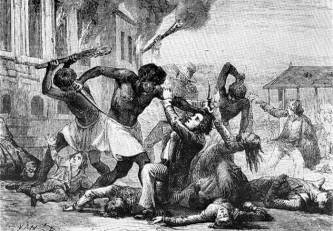
Binghamton, N.Y. — FOR more than two centuries, we have been reading the Declaration of Independence wrong. Or rather, we’ve been celebrating the Declaration as people in the 19th and 20th centuries have told us we should, but not the Declaration as Thomas Jefferson, Benjamin Franklin and John Adams wrote it. To them, separation from Britain was as much, if not more, about racial fear and exclusion as it was about inalienable rights.

The Declaration’s beautiful preamble distracts us from the heart of the document, the 27 accusations against King George III over which its authors wrangled and debated, trying to get the wording just right. The very last one — the ultimate deal-breaker — was the most important for them, and it is for us: “He has excited domestic insurrections amongst us, and has endeavored to bring on the inhabitants of our frontiers, the merciless Indian savages, whose known rule of warfare is an undistinguished destruction of all ages, sexes and conditions.” In the context of the 18th century, “domestic insurrections” refers to rebellious slaves. “Merciless Indian savages” doesn’t need much explanation.

In fact, Jefferson had originally included an extended attack on the king for forcing slavery upon unwitting colonists. Had it stood, it would have been the patriots’ most powerful critique of slavery. The Continental Congress cut out all references to slavery as “piratical warfare” and an “assemblage of horrors,” and left only the sentiment that King George was “now exciting those very people to rise in arms among us.” The Declaration could have been what we yearn for it to be, a statement of universal rights, but it wasn’t. What became the official version was one marked by division.

Upon hearing the news that the Congress had just declared American independence, a group of people gathered in the tiny village of Huntington, N.Y., to observe the occasion by creating an effigy of King George. But before torching the tyrant, the Long Islanders did something odd, at least to us. According to a report in a New York City newspaper, first they blackened his face, and then, alongside his wooden crown, they stuck his head “full of feathers” like “savages,” wrapped his body in the Union Jack, lined it with gunpowder and then set it ablaze.

The 27th and final grievance was at the Declaration’s heart (and on Long Islanders’ minds) because in the 15 months between the Battles of Lexington and Concord and independence, reports about the role African-Americans and Indians would play in the coming conflict was the most widely discussed news. And British officials all over North America did seek the aid of slaves and Indians to quell the rebellion.

A few months before Jefferson wrote the Declaration, the Continental Congress received a letter from an army commander that contained a shocking revelation: Two British officials, Guy Carleton and Guy Johnson, had gathered a number of Indians and begged them to “feast on a Bostonian and drink his blood.” Seizing this as proof that the British were utterly despicable, Congress ordered this letter printed in newspapers from Massachusetts to Virginia.

At the same time, patriot leaders had publicized so many notices attacking the November 1775 emancipation proclamation by the governor of Virginia, Lord Dunmore, that, by year’s end, a Philadelphia newspaper reported a striking encounter on that city’s streets. A white woman was appalled when an African-American man refused to make way for her on the sidewalk, to which he responded, “Stay, you damned white bitch, till Lord Dunmore and his black regiment come, and then we will see who is to take the wall.”

His expectation, that redemption day was imminent, shows how much those sponsored newspaper articles had soaked into everyday conversation. Adams, Franklin and Jefferson were essential in broadcasting these accounts as loudly as they could. They highlighted any efforts of British agents like Dunmore, Carleton and Johnson to involve African-Americans and Indians in defeating the Revolution.

Even though the black Philadelphian saw this as wonderful news, the founders intended those stories to stoke American outrage. It was a very rare week in 1775 and 1776 in which Americans would open their local paper without reading at least one article about British officials “whispering” to Indians or “tampering” with slave plantations.

So when the crowd in Huntington blackened the effigy’s face and stuffed its head with feathers before setting it on fire, they were indeed celebrating an independent America, but one defined by racial fear and exclusion. Their burning of the king and his enslaved and native supporters together signified the opposite of what we think of as America. The effigy represented a collection of enemies who were all excluded from the republic born on July 4, 1776.

This idea — that some people belong as proper Americans and others do not — has marked American history ever since. We like to excuse the founders from this, to give them a pass. After all, there is that bit about everyone being “created equal” in this, the most important text of American history and identity. And George Washington’s army was the most racially integrated army the United States would field until Vietnam, much to Washington’s chagrin.

But you wouldn’t know that from reading the newspapers. All the African-Americans and Indians who supported the revolution — and lots did — were no match against the idea that they were all “merciless savages” and “domestic insurrectionists.” Like the people of Huntington, Americans since 1776 have operated time and time again on the assumption that blacks and Indians don’t belong in this republic. This notion comes from the very founders we revere this weekend. It haunts us still.

Robert G. Parkinson, an assistant professor of history at Binghamton University, is the author of “The Common Cause: Creating Race and Nation in the American Revolution.”