Thursday, August 6, 2015

1964. Book Review: Beyond Words: What Animals Think and Feel

By Gregory Cowles, The New York Times, August 3, 2015


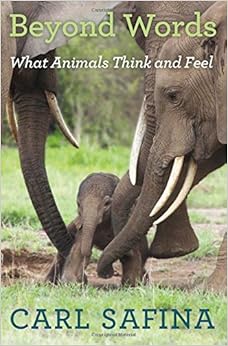
Given the subtitle of Carl Safina’s fascinating and expansive new book, “Beyond Words: What Animals Think and Feel,” it’s no surprise that Dr. Safina frequently discusses animal cognition.

The surprise is that he also talks about animal precognition. (Read an excerpt.)

“How do we explain certain remarkable stories about elephant communication?” he asks at one point, noting that a conservationist who has worked with the animals for decades flatly believes in pachyderm telepathy. The conservationist says she has seen free-living elephants in Kenya show up at a nearby reserve just before rescued orphans were scheduled to arrive, ready to meet and greet.

“I filed her claim in my mind’s ‘unlikely stories’ bin,” Dr. Safina acknowledges. “But that bin gets cluttered; there are many ‘unlikely’ stories about elephants.”

And not just elephants: In a chapter cheekily titled “Woo-Woo,” he entertains similar ideas about the psychic abilities of killer whales and other members of the dolphin family.

Dr. Safina, a marine conservationist and professor at Stony Brook University on Long Island, is clearly unafraid to challenge scientific orthodoxy. He accepts as a given that animals are capable of thought and emotion, a proposition that, as he notes impatiently and not a little defensively, is far from settled among animal behaviorists.

“Why do researchers judge the mental performance of other animals against a standard that humans could not possibly reach?” he asks. “You have to deeply deny the evidence to conclude that humans alone are conscious, feeling beings.”

This renegade spirit is a source of the book’s great charm, the pepper in its woo-woo sauce. Dr. Safina takes frequent droll pleasure in puncturing claims to human exceptionalism.
“Maybe more than anything, what ‘makes us human’ is our ability to generate wacky ideas,” he writes. And at another point: “There is in nature an overriding sanity and often, in humankind, an undermining insanity. We, among all animals, are most frequently irrational, distortional, delusional, worried.”

Dr. Safina is a terrific writer, majestic and puckish in equal measure, with a contagious enthusiasm for the complex social lives of the animals he’s observing — in this book, chiefly elephants, wolves and killer whales. If he pulls a bit of bait and switch, for long stretches abandoning his supposed theme of animal consciousness to focus instead on simple appreciation and advocacy, it’s hard to object because he brings his subjects so vividly to life.

Here he is, for instance, describing killer whales as they forage for salmon off Vancouver Island in British Columbia: “Several whales bow their backs and dive steeply. Below, the fish have their attention. A couple of other whales slice rapidly through the surface, quickly switching directions.”
“The closest whale, right behind us, is L-92. This big one over here with the high, wavy dorsal fin is K-25. He begins a series of high-arcing lunges, with lots of splashing and commotion. He’s after one large, isolated fish. He dives away. When he suddenly bursts through the surface, his mass and momentum startle me wide-eyed.”

The effect — and surely the intention — of such lively, physical description is to make Dr. Safina’s readers feel as strong a connection to these animals as he does. Again and again he follows the same formula, familiar from nature documentaries: Draw close to the animals, explain their habits and family structures and personalities until we perceive them as individual characters, then detail the ways human culture is destroying their way of life.

For elephants, that means ivory poaching; for wolves, the threat of hunters and trappers; for killer whales, everything from overfishing to underwater military explosions to the continued practice, in some places, of capturing young whales for use in aquarium shows.

The strategy of making us see animals as individuals is undeniably effective, as anybody who has followed the story of Cecil the lion can attest. And Dr. Safina draws out haunting resonances between animal lives and our own. “What I had not imagined,” he writes of a Yellowstone wolf pack that fractured after hunters killed its alpha member, “was the politics involved, the personalities, the vendettas and coalitions, the family turmoil following tragedy, the loyalties and disloyalties.” Dr. Safina describes the drama as “all too human.”

In the same section, he describes a legendary wolf from Yellowstone, the “superwolf” known by his tracking number 21, who never lost a fight and never killed an opponent.
“Can a wolf be magnanimous?” Dr. Safina asks. “And if so, why?”

But of course the nobility of animals is all a matter of perspective: Ask harbor seals how they feel about killer whales. And as persuasive as Dr. Safina is in calling for humans to tread more humanely on the earth — his desire for ecological harmony sometimes carries pleasing echoes of the poet Gary Snyder — “Beyond Words” remains most interesting when it focuses on the core question of nonhuman consciousness.

That question also leads him to the most scientifically grounded sections of the book, discussing for example the chemical and neurological bases of emotions: “Oxytocin drives bonding,” he reminds readers, “and it makes elephants and many other species act social or sexual. Block the hormone; many mammals and birds lose interest in socializing, pairing, nesting and contact.” Elsewhere he writes about brain size relative to body size, and the role of neuron density in determining mental dexterity.

Throughout, he demonstrates a keen grasp of the scientific literature across a range of disciplines and a refreshing skepticism about the terms of debate. “Only humans have human minds,” he concedes. “But believing that only humans have minds is like believing that because only humans have human skeletons, only humans have skeletons.”

Finally, though, you get the feeling that for Dr. Safina, human consciousness is at least as pressing a concern as animal consciousness, and possibly more in doubt. “The work,” he writes near the end of this captivating book, “is beautiful, and urgent, an almost holy quest for deeper intimacy. Not just with the whales. With the world.”

Wednesday, August 5, 2015

1963. The Wettest Rainforest in the United States Has Gone Up in Flames

By Subhankar banerjee, The Nation, July 30, 2015
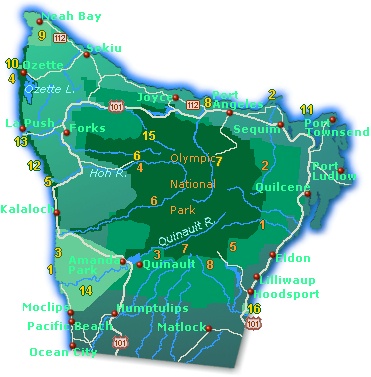
Olympic National Park in Washington State

The wettest rainforest in the continental United States had gone up in flames and the smoke was so thick, so blanketing, that you could see it miles away. Deep in Washington’s Olympic National Park, the aptly named Paradise Fire, undaunted by the dampness of it all, was eating the forest alive and destroying an ecological Eden. In this season of drought across the West, there have been far bigger blazes but none quite so symbolic or offering quite such grim news. It isn’t the size of the fire (though it is the largest in the park’s history), nor its intensity. It’s something else entirely—the fact that it shouldn’t have been burning at all. When fire can eat a rainforest in a relatively cool climate, you know the Earth is beginning to burn.

And here’s the thing: the Olympic Peninsula is my home. Its destruction is my personal nightmare and I couldn’t stay away.

SMOKE GETS IN MY EYES
“What a bummer! Can’t even see Mount Olympus,” a disappointed tourist exclaimed from the Hurricane Ridge visitor center. Still pointing his camera at the hazy mountain-scape, he added that “on a sunny day like this” he would ordinarily have gotten a “clear shot of the range.” Indeed, on a good day, that vantage point guarantees you a postcard-perfect view of the Olympic Mountains and their glaciers, making Hurricane Ridge the most visited location in the park, with the Hoh rainforest coming in a close second. And a lot of people have taken photos there. With its more than three million annual visitors, the park barely trails its two more famous Western cousins, Yosemite and Yellowstone, on the tourist circuit.

Days of rain had come the weekend before, soaking the rainforest without staunching the Paradise Fire. The wetness did, however, help create those massive clouds of smoke that wrecked the view miles away on that blazing hot Sunday, July 19. Though no fire was visible from the visitor center—it was the old-growth rainforest of the Queets River Valley on the other side of Mount Olympus that was burning—massive plumes of smoke were rising from the Elwha River and Long Creek valleys.

By then, I felt as if smoke had become my companion. I had first encountered it on another hot, sunny Sunday two weeks earlier.

On July 5, I had gone to Hurricane Ridge with Finis Dunaway, historian of environmental visual culture and author of Seeing Green: The Use and Abuse of American Environmental Images. As this countryside is second nature to me, I felt the shock and sadness the moment we piled out of the car. In a season when the meadows and hills should have been lush green and carpeted by wildflowers, they were rusty brown and bone-dry.

Normally, even when such meadows are still covered in snow, glacier lilies still poke through. Avalanche lilies burst into riotous bloom as soon as the snow melts, followed by lupines, paintbrushes, tiger lilies, and the Sitka columbines, just to begin a list. Those meadows with their chorus of colors are a wonder to photograph, but the flowers also provide much needed nutrition to birds and animals, including the endemic Olympic marmots that prefer, as the National Park Service puts it, “fresh, tender, flowering plants such as lupine and glacier lilies.”

Snow normally lingers on these subalpine meadows until the end of June or early July, but last winter and spring were “anything but typical,” as the summer issue of the park’s quarterly newspaper, the Bugler, pointed out. January and February temperatures at the Hurricane Ridge station were “over six degrees Fahrenheit warmer than average.”

By late February, “less than three percent of normal” snowpack remained on the Olympic Mountains and the meadows, normally still covered by more than six feet of snow, “were bare.” As the Bugler also noted, recent data and scientific projections suggest that “this warming trend with less snowpack is something the Pacific Northwest should get used to… What does this mean for summer wildflowers, cold-water loving salmon, and myriad animals that depend on a flush of summer vegetation watered by melting snow?” The answer, unfortunately, isn’t complicated: it spells disaster for the ecology of the park.

Move on to the rainforest and the news is no less grim. This January, it got 14.07 inches of precipitation, which is 26 percent less than normal; February was 17 percent less; March was almost normal; and April was off by 23 percent. Worse yet, what precipitation there was generally fell as rain, not snow, and the culprit was those way-higher-than-average winter temperatures. Then the drought that already had much of the West Coast in its grip arrived in the rainforest. In May, precipitation fell to 75 percent less than normal and in June it was a staggering 96 percent less than normal, historic lows for those months. The forest floor dried up, as did the moss and lichens that hang in profusion from the trees, creating kindling galore and priming the forest for potential ignition by lightning.

That day, I was intent on showing Finis the spot along the Hurricane Hill trail where, in 1997, I had taken a picture of a black-tailed deer. That photo proved a turning point in my life, winning the Slide of the Year award from the Boeing photography club and leading me eventually to give up the security of a corporate career and start a conservation project in Alaska’s Arctic National Wildlife Refuge.

As it happened, it wouldn’t be a day for nostalgia or for seeing much of anything. On reaching Hurricane Hill, we found that the Olympic Mountains were obscured by smoke from the Paradise Fire. Meanwhile, looking north toward the Strait of Juan de Fuca in the Salish Sea, all that we could see was an amber-lit deep haze. More smoke, in other words, coming from more than 70 wildfires burning in British Columbia, Canada. As I write this, there are 14 active wildfires in Washington and five in Oregon, while British Columbia recently registered 185 of them.

So if you happen to live in the drought-stricken Southwest and are dreaming of relocating to the cool, moist Pacific Northwest, think again. On the Olympic Peninsula, it’s haze to the horizon and the worst drought since 1895.

A RAINFOREST IN A NATIONAL PARK
For visitors to the Olympic Peninsula, it seems obvious that a temperate rainforest—itself a kind of natural wonder—should be in a national park. As it happens, getting it included proved to be one of the most drawn-out battles in American conservation history, which makes seeing it destroyed all the more bitter.

Two centuries ago, expanses of coastal temperate rainforests stretched from northern California to southern Alaska. Today, only about 4 percent of the California redwoods remain, while in Oregon and Washington, the forests are less than 10 percent of what they once were. Still, even in a degraded state, this eco-region, including British Columbia and Alaska, contains more than a quarter of the world’s remaining coastal temperate rainforest.

In the era of climate change, this matters, because the Pacific coastal rainforest is so productive that it has a much higher biomass than comparable areas of any tropical rainforest. In translation: The Pacific rainforests store an impressive amount of carbon in their wood and soil and so contribute to keeping the climate cool. However, when that wood goes up in flames, as it has recently, it releases the stored carbon into the atmosphere at a rapid rate. The massive plumes of smoke we saw at Hurricane Ridge offer visual testimony to a larger ecological disaster to come.

The old-growth rainforest that stretches across the western valleys of the Olympic National Park is its crown jewel. As UNESCO wrote in recognizing the park as a World Heritage Site, it includes “the best example of intact and protected temperate rainforest in the Pacific Northwest.” In those river valleys, annual rainfall is measured not in inches but in feet, and it’s the wettest place in the continental United States. There you will find living giants: a Sitka spruce more than 1,000 years old; Douglas fir more than 300 feet tall; mountain hemlock at 150 feet; yellow cedars that are nearly 12 feet in diameter; and a Western red cedar whose circumference is more than 60 feet.

The rainforest is home to innumerable species, most of which remain hidden from sight. Still, while walking its trails, you can sometimes hear the bugle or get a glimpse of Roosevelt elk amid moss-draped, fog-shrouded bigleaf maples. (The largest herd of wild elk in North America finds refuge here.) And when you do, you’ll know that you’ve entered a Tolkienesque landscape. Those elk, by the way, were named in honor of President Theodore Roosevelt who, in 1909, protected 615,000 acres of the peninsula, as Mount Olympus National Monument.

Why not include a rainforest in a national park? That was the question being asked at the turn of the 20th century and Henry Graves, chief of the US Forest Service, answered it in definitive fashion this way: “It would be great mistake to include in parks great bodies of commercial timber.”

Despite the power of the timber industry and the Forest Service, however, five committed citizens with few resources somehow managed to protect the peninsula’s last remaining rainforest. “They did it by involving the public,” environmentalist and former park ranger Carsten Lien writes in his Olympic Battleground: Creating and Defending Olympic National Park. He adds, “Preserving the environment through direct citizen activism, as we know it today, had its beginnings in the Olympic National Park battle.”

In 1938, the national monument was converted to Olympic National Park and a significant amount of rainforest was included. As Lien would discover in the late 1950s, however, the Park Service, despite its rhetoric of stewardship, continued to let timber interests log there. Today, such practices are long past, though commercial logging continues to play a significant part in the economy of the peninsula in national, state, and private forests.

A FIRE THAT JUST WON’T STOP
Once the fire began, I just couldn’t keep away. On a rainy July 10, for instance, listening to James Taylor’s “Fire and Rain,” I drove toward the Queets River Valley to learn more about the Paradise Fire so that I could “talk about things to come.”

At the Kalaloch campground, I asked the first park employee I ran into whether the rain, then coming down harder, might extinguish the fire? “It will slow down the fire’s spread,” she told me, “but won’t put it out. There’s too much fuel in that valley.”

The next morning, with the rain still falling steadily and the fire still burning, I stood at the trailhead to the valley thinking about what another park employee had told me. “The sad thing,” she said, “is that the fire is burning in the most primitive of the three river valleys.” In other words, I was standing mere miles away from the destruction of one of the most primeval parts of the forest. As Queets was also one of the more difficult locations to visit, less attention was being given to the fire than if, say, it were in the always popular Hoh valley.

In a sense, the Paradise Fire has been burning out of sight of the general public. Information about it has been coming from press releases and updates prepared by the National Park Service. Though it is doing a good job of sharing information, environmental disasters and their lessons often sink in most deeply when they are observed and absorbed into collective memory via the stories, fears, and hopes of ordinary citizens.

I had breakfast at the Kalaloch Lodge restaurant, not far from the Queets,while the rain was still falling. “When will the sun come out?” an elderly woman at the next table asked the waitress as if lodging a complaint with management. “The whole weekend we’ve been here it’s rained continuously.”

“I’m so happy that finally we got three days of rain,” the waitress responded politely. “This year we got 12 inches. Usually we get about 12 feet. It’s been bad for trees and all the life in our area.” In fact, the peninsula has received over 51 inches of rain, mostly last winter, but her point couldn’t have been more on target. “It has been so dry that the salmon can’t move in the river,” she added. Her voice lit up a bit as she continued, “With this rain, the rivers will rise and the salmon will be able to go upriver to spawn. The salmon will return.”

I asked where she was from. “Quinault Nation,” she said, citing one of the local native tribes dependent both nutritionally and culturally on those salmon.

“The Queets, the largest river flowing off the west side of the Olympics, is running at less than a third its normal volume,” the Seattle Times reported. “[B]ad news for the wild salmon runs, steelhead, bull trout, and cutthroat trout.” In addition to the disappearing snowpack and severe drought, the iconic glaciers of the Olympic Mountains are melting rapidly, which will likely someday spell doom for the park’s rivers and its vibrant ecology. According to Bill Baccus, a scientist at the park, over the last 30 years, those glaciers have shrunk by about 35 percent, a direct consequence of the impact of climate change.

After breakfast, I took off for the Hoh Valley. At its visitor center, a ranger described the battle underway with the Paradise Fire. Summing up how dire the situation was, he said, “Our goal is confinement, not containment.” Normally, success in fighting a wildfire is measured by what percentage of it has been contained, but not with the Paradise. 
“Safety of the firefighters and safety of the human communities are our two priorities right now,” the ranger explained. As a result, the National Park Service is letting the fire burn further into wilderness areas unfought, while trying to stop its spread toward human communities and into commercially valuable timberlands outside the park.

For firefighters, combating such a blaze in an old-growth rainforest with steep hills is, at best, an impossibly dangerous business. Large trees are “falling down regularly,” firefighter Dave Felsen told the Seattle Times. “You can hear cracking and you try to move, but it’s so thick in there that there is no escape route if something is coming at you.”

Besides, many of the traditional means of fighting wildfires don’t work against the Paradise. Dumping water from a helicopter, to take one example, is almost meaningless. As an NPR reporter noted, the rainforest canopy “is so dense that very little of the water will make it down to the fire burning in the underbrush below.” Worse yet, as The Washington Post reported, the large trees and thick growth “make it impossible to effectively cut a fire line” through the foliage to contain the spread of the flames.

With the moist lichens and mosses that usually give the rainforest its magical appearance shriveled and dried out, they now help spread the fire from tree to tree. When they burst into flames and fall to the ground, yet more of the dry underbrush catches, too. In other words, that forest, which normally would have suppressed a fire, has now been transformed into a tinderbox.

“Few people in our profession have ever seen this kind of fire in this kind of ecosystem,” Bill Hahnenberg, the Paradise Fire incident commander, told his crew. “The information you gather could be really valuable.” He didn’t have to add the obvious: its value lies in offering hints as to how to fight such fires in a future that, as the region becomes drier and hotter, will be ever more amenable to them.

So far, the fire is smoldering, but as the summer heats up, the Seattle Times reports, “there is still the potential for a crown fire that can spread in dramatic fashion as treetops are engulfed in flames.” According to several park employees I spoke with, the Paradise Fire is likely to burn until the autumn rains return to the western valleys. As of July 23, it had eaten 1,781 acres, which sounds modest compared to other fires burning in the West, but you have to remind yourself that it’s not modest at all, not in a temperate rainforest. It also poses a challenge to the very American idea of land conservation.

Throughout the late nineteenth and twentieth centuries, American environmentalists passionately fought to protect large swaths of public lands and waters. The national parks, monuments, wildlife refuges, and wildernesses they helped to create laid the basis for a new American identity. Nationalism aside, such publicly protected lands and waters also offered refuge for an incredible diversity of species, some of which would have otherwise found it difficult to survive at the edges of an expanding industrialized, consumerist society. Today, that diversity of life within these public lands and waters is increasingly endangered by climate change.

What, then, should environmental conservation look like in a twenty-first century in which the Paradise Fire could become something like the norm?

TANKERS AND RIGS
“This is not an anthropogenic fire,” the ranger I spoke with at the Hoh visitor center insisted. In the most literal sense, that’s true. In late May, lightning struck a tree in the Queets Valley and started the fire, which then smoldered and slowly spread across the north bank of the river. It was finally detected in mid-June and firefighters were called in. That such a lightning strike disqualifies the Paradise Fire from being “anthropogenic”—human-caused—would once have been a given, but in a world being heated by the burning of fossil fuels, such definitions have to be reconsidered.

The very rarity of such fires speaks to the anthropogenic nature of the origins of this one. After all, a temperate rainforest is a vast collection of biomass and so a carbon sink is only possible thanks to the rarity of fire in such a habitat. According to the World Wildlife Fund, “With a unique combination of moderate temperatures and very high rainfall, the climate makes fires extremely rare” in such forests.

The natural fire cycle in these forests is about 500 to 800 years. In other words, once every half-millennium or more this forest may experience a moderate-sized fire. But that’s now changing. Mark Huff, who has been studying wildfires in the park since the late 1970s, told Seattle’s public radio station KUOW that in the past half-century there have already been “three modest-sized fires” here, including the Paradise, though the other two were less destructive. According to a National Park Service map (“Olympic National Park: Fire History 1896–2006”) in the Western rainforest, during that century-plus, two lightning-caused fires burned more than 100 acres and another more than 500 acres.

If, however, fires in the rainforest become the new normal, comments Olympic National Park wildlife biologist Patti Happe, “then we may not have these forests.”
A team of international climate change and rainforest experts published a study earlier this year warning that, “without drastic and immediate cuts to greenhouse gas emissions and new forest protections, the world’s most expansive stretch of temperate rainforests from Alaska to the coast redwoods will experience irreparable losses.” In fact, says the study’s lead author, Dominick DellaSala, “In the Pacific Northwest…the climate may no longer support rainforest communities.”

Speaking of the anthropogenic, on our way back, Finis and I stopped in Port Angeles, the largest city on the peninsula. There we noted a Chevron oil tanker, the massive 904-foot Pegasus Voyager, moored in its harbor on the Salish Sea. It had arrived empty for “topside repair.” Today, only a modest number of oil tankers and barges come here for repair, refueling, and other services, but that could change dramatically if Canada’s tar sands extraction project really takes off and vast quantities of that particularly carbon-dirty energy product are exported to Asia.

That industry is already fighting to build two new pipelines from Alberta, the source of most of the country’s tar sands, to the coast of British Columbia. “Once this invasion of tar sands oil reaches the coast,” a Natural Resources Defense Council press release states, “up to 2,000 additional barges and tankers would be needed to carry the crude to Washington and California ports and international markets across the Pacific.” All of those barges and tankers would be moving through the Salish Sea and along Washington’s coast.

And let’s not forget that, in May, Shell Oil moored in Seattle’s harbor the Polar Pioneer, one of the two rigs the company plans to use this summer for exploratory drilling in the Chukchi Sea of Arctic Alaska (a project only recently green-lighted by the Obama administration). In fact, Shell expects to use that harbor as the staging area for its Arctic drilling fleet. The arrival of the Polar Pioneer inspired a “kayaktivist” campaign, which received national and international media coverage. It focused on drawing attention to the dangers of drilling in the melting Arctic Ocean, including the significant contribution such new energy extraction projects could make to climate change.

In other words, two of the most potentially climate-destroying fossil fuel–extraction projects on Earth more or less bookend the burning Olympic Peninsula.

The harbors of Washington, a state that prides itself on its environmental stewardship, have already become a support base for one, and the other will likely join the crowd in the years to come. Washington’s residents will gradually become more accustomed to oil rigs and tankers and trains, while its rainforests burn in yet more paradisical fires.

In the meantime, the Olympic Peninsula is still wreathed in smoke, the West is still drought central, and anthropogenic is a word all of us had better learn soon. 
1962. Protecting the Untamed Seas

By Ian Urbina, The New York Times, July 31, 2015


SUPPOSE a group of scientists wanted to dump 100 tons of iron dust into the sea based on a controversial climate-change theory that the ore might spur the growth of plankton that absorb carbon dioxide. They can — one businessman did that in 2012.

Imagine if entrepreneurial engineers hoping to save clients millions of dollars were able to launch rockets into space from a platform in the middle of the ocean, far away from curious onlookers, heavy taxes and strict on-land regulations. They can — a company has been doing this for over a decade.

And what if pharmaceutical companies decide to rake the ocean floor for the next wonder drug, with minimal environmental oversight and no obligation to make the profits, research or resulting medicines public? They can — the research is already happening.

All of this is possible because the waters farther than 200 nautical miles from shore are generally outside of national jurisdiction and largely beyond government control. More than 40 percent of the planet’s surface is covered by water that belongs to everyone and no one, and is relatively lawless and unregulated.

Over the next two years, though, the United Nations intends to change this reality. After nearly a decade of discussion, it ratified a resolution in June to begin drafting the first treaty to protect biodiversity on the high seas.

The agreement will create a formal process for setting aside protected marine areas in international waters. Unlike on land, there is no legal framework on the high seas for creating areas that are off-limits to commercial activity. The treaty will also create procedures for environmental impact assessments and establish a method for the public to be informed about large-scale projects in these waters, including fishing, seabed mining, shipping, research and other activities.

The broader philosophical debate over how to manage the oceans typically divides into two camps. On one side, advocates of a laissez-faire approach argue that at the core of modern maritime culture is a 17th-century notion known as mare liberum, Latin for freedom of the seas, which was popularized by a Dutch lawyer, Hugo Grotius. He contended that ships in passage should be unimpeded by governments, competitors or pirates. The sea, he argued, is international territory for use by all nations in passage or commerce.

Mare liberum has been central in fostering free trade and global commerce by keeping merchant routes unfettered by national rules or bureaucracies. Its proponents argue that the concept goes a long way toward explaining why roughly 90 percent of the goods we consume travel to market by sea. And mare liberum dictates that access to the oceans’ riches should remain on a first-come, first-served basis, they say.

The opposing view is that the high seas are one of several “global commons” (along with the atmosphere, Antarctica and outer space) that are shared by the public at large. Benefits derived from these commons should be distributed equitably. If, for example, the high seas offer up revolutionary new drugs, poorer countries should be able to access the research and share in the profits from their sale. The “tragedy of the commons,” some maritime experts say, is that since everyone is responsible, no one is willing or able to act. Often, this results in a free-for-all.

International waters have long been a magnet for unregulated activity. In many parts of the world, the waters beyond national jurisdiction represent an outlaw ocean, where crimes ranging from murder and slavery to dumping and illegal fishing occur with impunity. While larger shippers face tighter rules and more oversight because they typically operate out of bigger ports with more enforcement resources, this is far less true for the smaller and more numerous commercial vessels and fishing ships in regions like Southeast Asia and off the coast of Africa.

Meanwhile, advocates and entrepreneurs have turned to the open seas to circumvent prohibitions against abortion, gambling, prostitution and illicit drugs. Libertarians are courting venture capitalists to underwrite futuristic plans to create legally autonomous floating communities.

More recently, bigger and better-financed players, many of them industrial, have been stepping up their presence in global waters with potentially major environmental impacts. New drilling and mining technology has spurred a race to tap mineral resources that have been inaccessible because they were too far from shore or too deep underwater. The commercial fishing industry combs the world’s oceans with an efficiency never before seen. Bio-prospecting — or hunting for new medical breakthroughs — is a relatively recent addition to this list.

There are good reasons to be skeptical about the effectiveness of a global treaty. Enforcement of rules at sea is difficult and costly because the space is so vast. Even preventing slave labor on fishing boats or mandating traceability for seafood has proved to be a challenge. Intentional dumping, illegal fishing and other maritime crimes often occur with impunity.

But countries that previously opposed such a treaty — including Norway and the United States — now support the United Nations’ efforts. Creating marine reserves is increasingly popular and in the past six years the United States, Britain and smaller island nations, particularly in the Pacific, have set aside millions of miles of their waters. Secretary of State John Kerry is a vocal advocate for marine conservation. In March, the American government announced a plan to increase enforcement at ports by working with foreign partners to track fish from hook or net to plate.

There are also financial and scientific incentives to better manage the seas. Bio-prospecting has been held up by the lack of clear rules. Some investors have been reluctant to put money toward exploration because they fear they may later lose rights to the rewards.

As medicine hunters have run out of virgin frontiers on land, especially in the rain forests, they are increasingly turning toward the sea for the next wonder drug. In the past several years, the number of patents based on marine life has grown more than 10 percent annually. Sales of anticancer agents derived partly from marine organisms, for instance, have been estimated to be more than $1 billion per year.

Marcel Jaspars, a chemistry professor at the University of Aberdeen in Scotland, said one model for profit-sharing might involve creating a central pot — perhaps administered by the United Nations — either in the form of a fee paid for a license to carry out the exploration or as payments once the development of the drug begins. The money could then be directed back into ocean research, monitoring and enforcement.

Michele Kuruc, vice president of ocean policy at the World Wildlife Fund, added that there was reason for optimism about the treaty because its negotiators are paying more attention to mistakes made in the past. To ensure fuller participation they are considering a special fund, subsidized by wealthier countries, to help poorer countries comply with some of the agreement’s requirements. To avoid having countries with vested interests commandeering the process by blocking measures, they intend to limit the use of vetoes when an overwhelming majority supports a measure.

In the end, though, everyone involved agrees that the stakes are enormous. “We know more about the surface of the moon than we do about the bottom of the world’s oceans,” said Lisa Speer, the International Oceans Program director for the Natural Resources Defense Council, an environmental advocacy group.

Tuesday, August 4, 2015

1961. Murder of Cecil Shows Why All Trophy Hunting Should End

By Captain Paul Watson, August 4, 2015
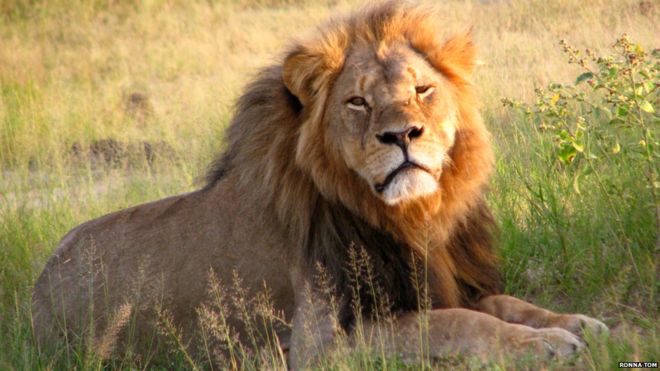
Cecil who was lured and murder by American trophy hunter Walter Palmer
Media is predictable. First there is the news, followed by the public reaction and if the public reaction hits a high enough exposure the effect is viral and quite damning. And then what follows is the backlash as people try to hijack the story to suit their own agendas. Such is the case with Dr.Walter Palmer, the man who murdered Cecil the lion.
First came the news and then the outrage. Now the backlash as the condemnation of Palmer is condemned by people with their agendas. What about the other animals? Big game hunters are conservationists? Leave the poor man alone? He's suffered enough? He thought he was doing everything legally? His guides were to blame? How is he supposed to return to his dental practise? Get over it? It's racist to oppose white hunters and not black hunters?
We should not get over it. We should not forget it. The man has not suffered enough. His crime was egregious, his lust for blood unacceptable. We need to use this vile individual to help pass laws to ban trophy hunting. We need to shame the entire trophy hunting community at every opportunity. We need also to end the perversion of blood sports, from bull fighting to the Faroese Grind.
Do I want the man to die? No, I do not wish death on any living being. Do I want to destroy the life that he had, his medical practise, his reputation? Yes I do. He robbed us of a living treasure. He robbed all of us. I take that personally. Do I hate him? No I do not hate anyone, but I hate what he represents and I hate what he has done.
And our outrage is having a positive impact. Delta, Air France, Emirates, Air Canada and United have banned the shipment of wildlife trophies. Zimbabwe has banned lion hunting. The U.S. Congress is considering a bill to ban wildlife trophies into the U.S. Botswana has banned big game hunting.
We need to keep this outrage alive and we need to focus on destroying the Safari Club International and their 50,000 sadistic members. We need to create an understanding that any one who puts a head of an animal on the wall as a trophy should be ostracized and publicly shamed.
Modern day head-hunting should be tossed on the dustbin of history where human head-hunting lies covered in the barbaric dust of historical travesties.
Decapitating noble animals like lions, elephants, pilot whales, giraffes, wolves, elk, moose, zebra, and so many more is a perversion that modern society should not tolerate. 
I took the liberty of making a few alternations to a few verses of Leonard Cohen's incredible poem Nevermind so that it suits Dr. Walter Palmer. 
NEVERMIND
The game was lost
The contract signed,
They did not catch me,
I crossed the line.
I was not caught.
Yet many tried
I live among you,
Well disguised.
I have to leave
My life behind
I have the bodies,
That you will find.
My stories told
With facts and lies.
I once had a name
But never mind.
The man is a serial killer who has lived amongst us well disguised. Even the nimrods at the Safari Club International have turned against him. Yet any suffering he may endure, if he is capable of being shamed at all, pales in comparison to the suffering he caused to Cecil and the other animals he stalked and murdered.
You turned me in
At least you tried
You side with them
Whom you despise.
This was my heart
This swarm of flies.
This is your mouth,
Your bowl of lies.
I served them well,
So I’m surprised,
I’m of their kin,
I’m of their kind.
Never mind.
The story’s told,
With facts and lies,
We own the world,
So never mind.
And I used the word murdered deliberately because I do not restrict the term to the killing of a human. Murder is the deliberate killing of a sentient, self aware, thinking, feeling being, capable of emotions and I believe the victims of this serial killer were all self aware, sentient beings who had thoughts, emotions and even dreams.
We must not let Dr. Walter Palmer fade into obscurity, his foul deeds forgotten nor should we allow ourselves to be side-tracked by those who would promote their own agendas over this despicable act.
This is an opportunity to strike hard at the perversity of trophy hunting and we should use it as best we can. Dr. Palmer is just one of many who practise this horrific crime, but he is now the face of this blood soaked perversion and we need to keep that face before the public so that neither her nor his victims are forgotten.

Sunday, August 2, 2015

1960. A Haven From the Animal Holocaust

By Chris Hedges, truthdig, August 2, 2015 


WATKINS GLEN, N.Y.—There are mornings when Susie Coston, walking up to the gate of this bucolic farm in her rubber boots, finds crates of pigs, sheep, chickens, goats, geese or turkeys on the dirt road. Sometimes there are notes with the crates letting her know that the animals are sick or injured. The animals, often barely able to stand when taken from the crates, have been rescued from huge industrial or factory farms by activists.

The crates are delivered anonymously under the cover of darkness. This is because those who liberate animals from factory farms are considered terrorists under U.S. law. If caught, they can get a 10-year prison term and a $250,000 fine under the Animal Enterprise Terrorism Act. That is the punishment faced by two activists who were arrested in Oakland, Calif., last month and charged with freeing more than 5,700 minks in 2013, destroying breeding records and vandalizing other property of the fur industry.

Only in the insanity of corporate America can nonviolent animal rights activists be charged as terrorists while a white supremacist who gunned down African-Americans in a South Carolina church is charged on criminal counts. Only in the insanity of America can Wall Street financers implode the global economy through massive acts of fraud, causing widespread suffering, and be rewarded with trillions of dollars in government bailouts. Only in the insanity of America can government leaders wage wars that are defined as criminal acts of aggression under international law and then remain, unchallenged, in positions of power and influence. All this makes no sense in an open society. But it makes perfect sense in our species of corporate totalitarianism, in which life, especially the life of the vulnerable, is expendable and corporate profit alone is protected and sanctified as the highest good.

The animal agriculture industry causes suffering, death and environmental degradation—to humans as well as animals—on a scale equaled only by the arms industry and the fossil fuel industry. And by eating meat and dairy products we aid and abet a system that is perhaps the primary cause of global warming and is pumping toxins and poisons into our bodies and the rest of the ecosystem.

Animal agriculture sends more greenhouse gas emissions into the atmosphere than worldwide transportation. The waste and flatulence from livestock are responsible for creating at least 32,000 million tons of carbon dioxide per year, or 51 percent of all worldwide greenhouse gas emissions. Livestock causes 65 percent of all emissions of anthropogenic nitrous oxide, a greenhouse gas 296 times more destructive than carbon dioxide. Crops raised to feed livestock consume 56 percent of the water used in the United States. Seventy percent of the crops we grow in the U.S. are fed to animals. 

Eighty percent of the world’s soy crop is fed to animals. It is a flagrant waste of precious and diminishing resources. It takes 1,000 gallons of water to produce one gallon of milk.
Farm Sanctuary in Watkins Glen—which the government briefly listed as an “extremist” animal rights group in the early 1990s—is probably the world’s most lavish retirement home for farm animals. Gene Baur and Lorri Houston founded it. They raised money to create Farm Sanctuary, and to pass out literature about the abuse of animals at the hands of factory farm operators, by selling vegan hot dogs from a Volkswagen van at Grateful Dead concerts. In all, they drove their van to the parking lots outside nearly 100 concerts across the country. The first animal they rescued was a sheep, later named Hilda, found lying in a pile of dead animals behind a stockyard.

“Farm Sanctuary begins with the idea that there’s this horrible system and most people are unwittingly supporting it by buying animal-based foods,” Baur said when I reached him by phone at his home in Arlington, Va.

“We can only rescue a small handful compared to the billions who deserve to be rescued,” he said. “So we try to model and encourage a new kind of relationship with animals. Rescuing individuals also helped us cope with the horrors of factory farming. Going into these places we would see atrocious abuse. We would witness thousands of animals confined in horrible conditions, held in crates where they couldn’t even turn around. This takes a toll on you emotionally. Being able to rescue a few individuals out of that system helped heal us. Farm Sanctuary is a place of hope. It is a place of transformation. Animals who had been terribly mistreated, and seen only as production units, as commodities, have their lives transformed. They become our friends, instead of our food. You can’t rescue them all, but you do what you can. Farm animal rescue is an immediate concrete response to an untenable chronic problem.”

Farm Sanctuary, which operates through donations, has a budget of $10 million a year and runs two farms in California besides the one in New York state.

There are 1,000 animals at the organization’s three farms—cows, sheep, goats, turkeys, pigs, geese, donkeys, chickens and ducks. The animals, which receive state-of-the-art medical care and are fed vegan food, roam the pastures unmolested. Cows are not impregnated in order to keep them producing milk. Eggs are not taken from chickens for human use. And all the creatures live out their natural lives liberated from the animal holocaust that defines the animal agriculture industry.

“It is very easy to love dogs and cats,” Coston, the sanctuary’s shelter director, said as we stood amid a flock of turkeys one rainy morning. “They are everywhere. They are in our world. But it is not easy to love turkeys because very few people get to meet turkeys. But look, they just followed us in,” she said as we stepped into a barn. “They love being around people. They love attention. They are no different from pets. They also like to be petted.”

Every animal [at the farm] has a different personality, every animal has a name, all have health records,” she went on as we walked to a barn that held rescued pigs. “We are saying they are as important as any other individual.”

The relationships between the animals, including two blind cows that are inseparable, and between the animals and the men and women who work at the sanctuary were evident, and often moving. Pigs, chickens, turkeys and cows often responded to those working in the barns the way pets respond to their human companions. The animals gathered around barn workers to be scratched or stroked. Coston often suspended our conversation to address a pig or a cow by name and explain the intricacies of their histories and personalities—some shy, some gregarious, some rebellious, some jealous of others in the herd or flock, some moody and some attached to a particular worker at the farm.   

Coston said the farm keeps the numbers small to maintain the relationships. “I won’t overcrowd,” she said. “I could go out now and save 5,000 spent layers [chickens]. But I would not see them, and many of them would die. They would no longer be individuals.”
Farm Sanctuary has been behind ballot initiatives to end the worst abuses in factory farming and has rescued pigs trapped by flooding in Iowa and more than 700 chickens at a Mississippi broiler factory struck by a tornado. Coston said that after storms hit factory farms—some of which can house more than a million chickens—the animals often are bulldozed alive into pits.

Yet the sanctuary movement is not without its critics within the animal rights community.

“Farm Sanctuary is a strong supporter of what I call ‘happy exploitation,’ or the idea that we can exploit nonhuman animals in a ‘compassionate’ way through welfare reforms that supposedly make animal exploitation more ‘humane,’ ” said the animal rights philosopher and author Gary Francione, whom I spoke with in New York City. “This sort of approach sends a most problematic normative signal and encourages people to be comfortable about their continued participation in the institutionalized exploitation of animals. For example—one of many—Farm Sanctuary joined with Peter Singer and others in publicly expressing ‘appreciation and support’ for the supposedly ‘pioneering’ effort of Whole Foods that has evolved into the Animal Welfare Rating program, which gives Whole Foods customers a choice of what level of animal torture they will purchase—and all with the stamp of approval of ‘animal advocates’ such as Farm Sanctuary. To the extent that Farm Sanctuary promotes veganism, it does so as a means to reduce suffering, along with ‘enriched’ caged eggs, crate-free pork and other supposedly more ‘humane’ foods, and not as a moral imperative required by fundamental justice. Indeed, Farm Sanctuary denigrates principled, consistent veganism as a moral imperative, characterizing it [instead] as involving ‘personal purity.’ ”

Farm Sanctuary’s Baur said he is more willing than strict abolitionists such as Francione to “meet people where they are.” He sees his organization’s farms as educational tools, a way for visitors to begin to recognize that food-stock animals are worthy of life.

“We are a vegan organization. We encourage people to eat plants, instead of animals, but we also understand that sometimes change happens incrementally,” Baur said.

“Proposition 2 in California was an initiative that was on the ballot in 2008 to ban the use of veal crates, gestation crates and battery cages in the state of California,” Baur said. “It was approved by voters. Gary sees this as a ‘welfare reform’ that only enables and further codifies this notion that animals are consumables and commodities. My belief is that it gets people thinking and talking about farm animals as living creatures who suffer. It begins a process and a discussion. If these are living, feeling creatures, don’t they deserve to be treated with compassion and respect? When you start thinking through those issues, the logical conclusion is that you don’t eat animals.”

Baur, like Francione, dismisses what he calls industry “marketing tools” that present cattle or chicken as free-range, grass-fed or naturally raised. “[These animals] basically still live on a factory farm,” Baur said. “And at the end of the day, there’s the fundamental question of whether or not we should be killing and eating animals. If we can live well without killing and causing unnecessary harm, why wouldn’t we? The words ‘humane’ and ‘slaughter’ don’t fit well together.”

“Our food system is a mess,” Baur said. “The vegan movement and the animal rights movement have focused largely on what happens to the nonhuman animals who are exploited. But the human beings in the system are also treated very badly,” he said in speaking of workers in the slaughterhouses and factory farms. “They too are treated as expendable commodities. To me, being vegan is about trying to live as kindly as possible. That includes how we relate to nonhuman animals, as well as to human animals, as well as to the planet. It’s about creating mutually beneficial relationships, instead of abusive and exploitive relationships.”

Related posts:  "How Veganism Can Help Save the World"