Sunday, February 15, 2015

1737. Humans Are Putting 8 Million Metric Tons of Plastic in the Oceans — Annually

By Chris Mooney, The Washington Post, February 12, 2015

Late last  year we learned that, thanks to human beings, the oceans are carrying at least 5 trillion pieces of floating plastic — or nearly 700 pieces per human alive on the planet. In weight, that’s some 250,000 tons of the stuff.
But new research suggests that even that haul is probably a serious underestimate. In a paper published this week in the journal Science, Jenna Jambeck of the University of Georgia and a group of colleagues tried to estimate the total amount of plastic going into the oceans annually from 192 coastal countries, whose total population is 6.4 billion. People in these countries within 50 kilometers of the coast, the study estimates, produced 99.5 million metric tons of plastic waste in 2010 — and 31.9 of those million tons, the study estimates, were in some way mismanaged.
Thus, the authors calculate, each year about 4.8 million to 12.7 million metric tons of plastic are entering the oceans — for a midpoint figure of around 8 million metric tons. This is vastly higher than the number cited above — and moreover, it’s an annual number.
“It’s much larger than what they’re finding in the water,” says Jambeck. “But of course, as you know, they only can count what they find, and they only can find where they look.”
Here’s an infographic, courtesy of the researchers, that takes you through the process of measuring global plastic production, refining the estimate down to plastic waste in coastal regions, and then eventually estimating how much plastic winds up in the oceans (and how much we measure at the surface):
So what does 8 million metric tons of plastic actually mean? And is there any way to state such a gigantic figure in human terms?
“It’s five bags filled with plastic for every foot of coastline in the world,” says Jambeck.
So, why is so much of this stuff getting into the ocean? The reason, the paper asserts, boils down to a massive global waste management problem. The countries estimated to have the greatest mismanagement issues for plastic waste tend to be developing nations — China, Indonesia, the Philippines, Vietnam — with large and growing coastal populations, where waste management hasn’t kept pace with the population explosion.
“Sixteen of the top 20 producers are middle-income countries, where fast economic growth is likely occurring but waste management infrastructure is lacking,” notes the paper.
In other words, this is not just a lot of plastic bags getting swept up by wind and deposited at sea. “You have, from the random plastic bag blows to … they pretty much dispose of it right there on the coastline, right there on the bank of a river,” says Jambeck. “That’s the variability that you might find.”
The United States comes in 20th on the global plastic dumping list. While this country does have advanced waste processing, it also has a very large coastal population. (The top 20 countries contribute 83 percent of the world’s total mismanaged plastic, the study estimates.)
Ocean plastic has many consequences. It can kill fish and birds through entrainment or strangulation and can also be ingested by marine creatures and enter into the food chain, where it may have many unknown effects.
This is not a new issue to the global plastics industry. A group of plastics associations from various countries recently released a declaration on the matter, outlining a number of potential solutions to the problem and noting that “plastics do not belong in the world’s oceans and should not be littered — plastics should be responsibly used, reused, recycled and finally recovered for their energy value.”
The Science paper also has a forward projection: The plastic problem is expected to get worse.  By 2025, U.S. mismanaged plastic waste is expected to grow by 22 percent, and in the five biggest countries for the problem, it’s expected to double.
“We will not reach a global ‘peak waste’ before 2100,” notes the paper.

1736. U.S. Funding for "Democracy" in Cuba: The National Endowment for Democracy Report

By Tracey Eaton, Along the MaleconFebruary 14, 2015


The National Endowment for Democracy is a major recipient of US government funds for channeling to democracy programs in Cuba. The NED, based in Washington, D.C., does a better job than most organizations in disclosing to the public how it spends its money.

NED states in the summary of its activities in Cuba:

“Programs in Cuba took advantage of the new migration law that lifted the ban on international travel for Cubans. Cuban activists and human rights defenders presented cases of violations of human and civil rights before the United Nations and Inter-American Commission of Human Rights and participated in trainings to improve their ability to document cases. Cuban activists attended international workshops to share information and experiences with counterparts who face similar challenges.

“Programs raised international awareness about repression on the island, provided ordinary citizens with access to uncensored information and legal support, trained young Cubans to use new social media, and defended the rights of Afro-Cubans and underrepresented communities.”

The following is the list of US Gov. funded grants through NED, published in its 2013 annual report

Afro-Cuban Alliance, Inc.
Freedom of Information
$132,701
ISLAS: Quarterly Afro-Cuban Journal
To encourage greater discussion and analysis about racial issues in Cuba. Afro-Cuba Alliance will publish a quarterly journal to inform readers on the island and in the international community about racial issues in Cuba, the experience of civil rights movements, and the efforts of civil rights activists towards greater racial equality.
Afro-Cuban Alliance, Inc.
Freedom of Information
$6,500 (Supplement)
Promoting Racial Equality in Cuba
To promote discussion about racial issues in Cuba and raise international awareness about the situation of Afro-Cubans.
Asociación de Iberoamericanos por la Libertad
Democratic Ideas and Values
$60,000
Promoting Political Unity for a Democratic Cuba
To promote greater consensus about the need to support democratic actors in Cuba. Asociación de Iberoamericanos por la Libertad (AIL) will convene a series of meetings between international actors that work in Cuba in order to identify opportunities to jointly promote greater respect for civil and political rights in Cuba. AIL will also raise international awareness about the state of democracy and human rights in the country today.
Asociacion Diario de Cuba
Freedom of Information
$262,480 (Supplement: $2,480)
Diario de Cuba
To strengthen the ability of Cuban civil society to articulate its concerns and to promote freedom of expression. Diario de Cuba, a Madrid-based organization, will engage independent journalists, artists, intellectuals and academics in Cuba to promote greater analysis on social, political, economic and cultural developments in Cuba. Diario de Cuba will showcase this information on its digital media platform at www.diariodecuba.com.
Center for a Free Cuba
Human Rights
$102,000
Promoting Democracy in Cuba through Support to Civil Society
To provide humanitarian assistance to political prisoners, their families, human rights activists, youth activists, lawyers, teachers, artists and victims of repression in Cuba. In addition to humanitarian assistance, the Center will provide independent, democratic activists with important material support that will permit them to carry out their work in a more effective manner.
Centro de Investigación y Capacitación de Emprendedores Sociales Asociación Civil
Democratic Ideas and Values
$58,576
Latin American Youth Network for Democracy in Cuba
To strengthen the leadership capacity of pro-democracy youth activists in Cuba. Based in Argentina, CICES will conduct a training program with up to 50 young activists focusing on democratic values and ideas, social entrepreneurship, and effective communication skills, and conflict resolution techniques. In addition, CICES will organize a network of young activists across Latin America to mobilize support in the region for youth activists in Cuba and raise awareness about the lack of fundamental rights on the island.
Centro Democracia y Comunidad
Democratic Ideas and Values
$49,184
Lessons from Chile for a Democratic Transition in Cuba
To share knowledge about the Chilean transition from dictatorship to democracy and to strengthen the organizational capacity of Cuban activists – particularly youth and union groups – through exchanges with Chilean counterparts. CDC will also advocate among Chilean policymakers and politicians for greater solidarity towards the pro-democracy movement in Cuba.
Centro para la Apertura y el Desarrollo de América Latina
Democratic Ideas and Values
$82,882
A Regional Approach to Promoting Democratic Values
To support and raise the visibility of pro-democracy actors and human rights advocates in Latin America. CADAL will promote greater international awareness about the efforts of democracy activists and their efforts to promote greater political pluralism in the region.
Clovek v tisni, o.p.s. – People in Need
Freedom of Information
$194,544
Changing Cuba’s Media Landscape
To promote greater freedom of information and freedom of expression. The Czech Republic-based group, People in Need, will provide independent journalists with training and technical assistance to produce uncensored media content on social, political, economic and cultural developments in Cuba. People in Need will provide grassroots organizations throughout Cuba with small grants to carry out community-based initiatives in support of freedom of expression.
Committee for Free and Democratic Cuban Unions, Incorporated
Freedom of Association
$100,000
International Project for Free and Democratic Cuban Unions
To promote greater awareness of conditions facing independent Cuban unionists. The Committee for Free and Democratic Cuban Unions, Incorporated (CFDCU) will bring together prominent labor leaders from around the world to lead a new global campaign to support independent workers in Cuba. By creating a dynamic web platform, leading an international awareness raising campaign, and coordinating a conference on independent unionism in Cuba, the CFDCU will work to reshape longstanding perceptions about the Cuban government’s record on labor and human rights violations.
Cuban Democratic Directorate
Freedom of Information
$700,000
Strengthening Civic Participation in Cuba
To promote greater freedom of information and civic activism in Cuba. Through its Radio Republic broadcasts, this Miami-based organization will provide programming that incorporates the views of democratic activists from Cuba and informs communities about local social, political, economic and cultural developments. Directorio will also provide training and technical assistance to local grassroots activists to carry out civic and community-building initiatives throughout Cuba.
Cuban Soul Foundation
Democratic Ideas and Values
$65,000
Independent Cuban Artist’s Freedom of Expression
To empower independent artists to produce and perform their work in uncensored community venues and events. Cuban Soul Foundation (CSF) will support independent artistic groups in their efforts to establish community arts centers and studios. CSF will also help coordinate a series of events to showcase the work of artists participating in this program.
Cubanet News, Inc.
Freedom of Information
$219,080
Supporting Independent Journalists in Cuba To promote greater freedom of information in Cuba. Cubanet will work with independent journalists throughout the island to produce uncensored media content on social, political, economic and cultural developments on the island. The Miami-based organization will showcase this information on its online media platform at www.cubanet.org and actively distribute it through an array of social media networks.
Fundación Hispano Cubana
Freedom of Information
$75,000
Communication and Technology For Strengthening Civil Society
To strengthen the work of civil society in Cuba and facilitate greater collaboration between independent organizations. Fundación Hispano Cubana will respond support Cuban civil society organizations with technical and material assistance in order to increase the impact of their work. Fundación Hispano Cubana will also help democratic activists in Cuba develop more effective strategies for disseminating information about their work and communicating with their fellow citizens.
Global Rights
Human Rights
$90,000
Strengthening the Capacity of Afro-Descendant Women to Promote their Rights at the OAS and UN
To increase the ability of Afro-Latino women, especially from Cuba, to defend their rights before the Organization of American States and the United Nations. Global Rights will train program participants on how to document human rights violations and develop strategies that promote greater international attention to the plight of Afro-descendant women in Latin America. Global Rights will also help activists engage the many offices at the OAS and UN that are dedicated to defending minority and gender rights in order to prompt greater action by the key multilateral institutions engaged in the region.
Global Rights
Human Rights
$7,800
Increasing the Knowledge of Human Rights Defenders on the Inter-American System
To strengthen the capacity of human rights defenders to advocate for their rights before the Inter-American Commission on Human Rights (IACHR). Global Rights will carry out an on-line training program to address the specific topics and areas of work of the IACHR. The human rights defenders will also receive technical assistance to draft a human rights report on the condition of minority and gender rights on the island to be presented during a public hearing at the Commission.
Grupo Internacional para la Responsabilidad Social Corporativa en Cuba
Freedom of Association
$270,267
Supporting Independent Unions in Cuba
To promote labor rights and defend Cuba’s independent labor movement. GIRSCC will provide independent labor activists in Cuba with technical and financial assistance in an effort to forge a more coordinated labor movement on the island. This Miami-based organization will also conduct a worldwide information dissemination campaign on the situation regarding labor rights in Cuba.
Grupo Internacional para la Responsabilidad Social Corporativa en Cuba
Freedom of Association
$30,000
Supporting Independent Unions in Cuba
To promote labor rights and defend Cuba’s independent labor movement. Supplemental funding will allow this organization to invite Cuban independent union leaders to participate at international labor union events where they can advocate for greater international support for free unionism in the island.
Instituto Cubano para la Libertad de Expresión y Prensa
Freedom of Information
$95,000
A Light for Cuba
To promote greater freedom of information in communities throughout Cuba. This new Miami-based organization will support five grassroots groups across the island and help them develop community based publications that can be distributed to local residents. Instituto Cubano para la Libertad de Expresión y Prensa (ICLEP) will provide its counterparts in Cuba with the equipment and technical assistance necessary to implement the design and printing of these documents entirely inside Cuba.
Instituto Político para la Libertad Peru
Freedom of Information
$90,000
Educating Activists on Democracy, Technology and Social Media
To provide Cuban pro-democracy activists with training on democracy and the use of the Internet and social networking media. Instituto Político para la Libertad Peru (IPL) will interact with youth and pro-democracy activists and provide them with training on democratic rights, access to information tools and international standards of freedom of expression.
International Platform For Human Rights In Cuba
Human Rights
$74,720 (Supplement: $12,000)
International Platform for Human Rights in Cuba
To raise greater awareness about and promote greater international action on Cuba’s continued non-compliance with human rights principles and standards. IPHRC will conduct a comprehensive analysis of international human rights instruments in order to document the many ways in which the Cuban government has systematically violated the rights of its citizens. This information will be presented to the diplomatic community in Europe and Latin America.
Lech Walesa Institute
Civic Education
$50,311
Polish Solidarity with Cuba
To provide young Cuban activists with training on democratic values and human rights. Based on the Polish experience, the Lech Walesa Institute will provide activists leadership tools to become more effective advocates for social and political change in their country. As part of the training program, the LWI will invite a small group of Cuban activists to travel to Poland to meet with a wide range of activists, academics, elected officials and political figures affiliated with the training program.
Observatorio Cubano de Derechos Humanos
Human Rights
$75,000
Human Rights Observation
To promote greater public awareness about human rights violations in Cuba. The Cuban Observatory on Human Rights will work with counterparts on the island to document ongoing human rights abuses. The Cuban Observatory on Human Rights will use this information to prepare reports for the United Nations and international media outlets.
Outreach Aid to the Americas, Inc.
Democratic Ideas and Values
$60,000
Advocating for Freedom of Religion in Cuba
To foster the development of activities that promote a freer practice of faith among Cubans and increase freedom of religion in Cuba. Evangelical Christian Humanitarian Outreach for Cuba (EchoCuba) will work with trusted partners in country to hold screenings of films that encourage discussion on freedom of religion and to produce and circulate a religious magazine that has gained traction in religious communities. Additionally, EchoCuba will organize an outdoor event for religious leaders, communities, and interested citizens and will provide organizers with information on successful religious movements and events in other countries.
People in Peril Association CVO
Democratic Ideas and Values
$93,800 (Supplement: $26,360)
Promoting Access to Unbiased Information
To enhance the capacity of pro-democracy activists to think critically about the prospects of a democratic transition in Cuba. Based in Slovakia, People in Peril Association (PIPA) will work with a network of independent educators, professionals, and youth leaders across the island to strengthen their institutional capacity and ability to provide members of their communities with uncensored and unbiased information.
Plataforma de Integración Cubana
Freedom of Information
$100,400
Promoting Racial Integration
To promote greater discussion on racial issues in Cuba. Working with academics and activists inside and outside the island, Plataforma will publish a journal on various issues affecting the Afro-descendent population in Cuba. In addition, Plataforma will conduct various public events to raise international awareness about the topic.
Civic Education
$18,224
Promoting LGBT Rights in Cuba
This organization will promote greater respect for LGBTI rights in Cuba.
$100,000
Promoting Democratic Leadership and Values in Cuba
To promote democratic values and ideas and strengthen the leadership skills of pro-democracy activists in Cuba. Grantee will conduct a leadership training program and a public awareness campaign on peaceful activism, community organizing, human rights, and democracy.
$14,729
Promoting Civic Education in Cuba
To enhance the knowledge and understanding of democratic values and ideas among Cuban citizens. The organization will carry out a training program on democracy, the corresponding role of citizens, and the importance of civic-minded individuals to bring about democratic change.
Human Rights
$60,000
Supporting Human Rights Activists
To provide humanitarian and logistical support to the human rights activists in Cuba.
Rule of Law
$32,970
Providing Legal Assistance in Cuba
To provide technical assistance and pro-bono legal advice to citizens seeking legal redress. This organization will also provide training to pro-democracy activists on the domestic and international mechanisms to address the arbitrary use of the law.
$16,000
Providing Legal Assistance in Cuba
To provide technical assistance to Cuban citizens.

Grant descriptions are from the 2013 NED Annual Report.

1735. Terrorism: The Ultimate Weapon of the World Elite

By Robert Burrowes, oximity.com, February 13, 2015
An anti-terrorism unit
The usual definition of a ‘terrorist’ is simple: a person who uses violence in the pursuit of a political objective.

By this definition, the two major categories of terrorist are those political leaders who perpetrate state terror by attacking other countries (ranging from launching a war, perhaps following a false flag operation, to conducting a drone strike) – see the classic book The Real Terror Network: Terrorism in Fact and Propaganda – and those political leaders who use military violence in defense of a political objective. For insight into the damaged psychology of violent political leaders, see Understanding Obama and other People Who Kill. For much greater detail, see Why Violence?.

However, the narrower Western public perception of a ‘terrorist’ is someone who attacks civilian targets usually, but not always, in the West (that is, far away from any war zone). This is why US drone strikes on civilians in countries like Afghanistan, Pakistan, Somalia and Yemen, for example, do not attract similar condemnation. Nor is there any condemnation of the Western use of terrorist groups as proxies in the war against the Syrian government. Consequently, groups like al Qaeda, Islamic State, al-Shabab and Boko Haram are labelled ‘terrorist’, essentially because they are presented as targeting and attacking ‘our’ civilians (or, as in the case of the girls kidnapped in Nigeria in 2014, ones with whom we are allowed to identify).

In his extensive research in the discipline of critical terrorism studies, Professor Richard Jackson recently concluded that ‘every major terrorist attack on Western targets since 2001, including the attacks in Bali, Madrid, London and Boston, has been claimed by the perpetrators to be revenge for Western military intervention in the Middle East. Even the beheadings of Western hostages were justified by Islamic State captors as a response to US bombing. In fact, every major academic study of the past ten years has confirmed that Western military intervention and its policies in the Middle East, including support for the state of Israel, is the primary motivation for anti-Western terrorist attacks. In 1996, a major study by the CATO Institute concluded that U.S. military intervention overseas was the primary driver of anti-American terrorism. The Chicago Project on Suicide Terrorism has drawn the same fundamental conclusion.’ See How not to tackle Islamic State.

Professor Jackson goes on to say ‘There is plenty of good research and information which could help to make reasonable and effective policies’. But, as Professor Jackson also knows, we would be naïve to believe that Western elites have any interest in such policies. And here’s why.

Terrorism is the global elite’s ultimate weapon and a primary instrument for achieving its policies. That is, terrorism enables the elite to manipulate geostrategic events in order to extend and consolidate its political, economic and social control over national societies and their resources. Here’s how it works.

Western elites and their allies wage war, in one form or another, on countries in other parts of the world (the Middle East and Africa being the preferred targets at the moment) specifically in order to induce a violent retaliation, including by groups which are secretly supported, materially and militarily, by these elites. See, for example, A Shameless Movement: Boko Haram and the Politics of Terror. Elites also conduct false flag operations, such as 9/11 – see, for example, The Destruction of the World Trade Center: Why the Official Account of 911 Cannot Be True– and the attack on Charlie Hebdo – see, for example, Charlie Hebdo Massacre: Another Staged Event to Incite War and Destroy Freedom? – to provoke public outrage. They then use the public outrage generated by these retaliations and the false flag operations to justify the continuation of their military attacks. This enables them to expand elite control both in the regions under attack and also domestically.

By harping on the ‘threat of terrorism’ to scare domestic populations, Western elites and their allies are able to maintain their perpetual war in pursuit of control of essential diminishing natural resources – particularly fossil fuels, strategic minerals and water – while increasing their social control of domestic populations through increasingly repressive domestic legislation that guts human rights and civil liberties, including those in relation to dissent, while increasing the powers of ‘intelligence’ services and the police as they consolidate the surveillance state. See, for example, How Australia just became a “national security state”.

Needless to say, the elite makes good use of its paid agents in academia, think tanks, the corporate media and elsewhere to make sure that you are kept carefully misinformed and told what to think and how to react.

If you are inclined to resist the elite use of terror against the rest of us, you are welcome to sign the online pledge of ‘The People’s Charter to Create a Nonviolent World’.

Terrorism is intended to frighten and kill fellow human beings. Those who conduct terrorism and those who endorse it are badly psychologically damaged.

Friday, February 13, 2015

1734. Climate geoengineering. Could we? Should we?

By Phil Williamson, igbp.net, January 1, 2011


“Only fools find joy in the prospect of climate engineering”. 

The author of that quote, Ken Caldeira of the US Carnegie Institution, is clearly no cheerleader for technological tinkering with the Earth system. Yet Caldeira strongly supports research into geoengineering. This apparent contradiction is central to an emerging debate: should we deliberately intervene in global processes to deliver planet-saving outcomes? Many environmental groups vehemently oppose the idea. The “Hands Off Mother Earth” campaign, the ETC Group (Action Group on Erosion, Technology and Concentration) and Greenpeace believe that precaution trumps all other concerns. To them, geoengineering is a dangerous illusion, a Pandora’s box that ought to remain closed. Nevertheless, some scientists, business leaders and politicians consider that technological solutions to engineer the climate might provide an insurance policy, in which case we urgently need to explore their strengths and weaknesses. Only then would we find out whether geoengineering might provide an effective and acceptable means to avoid − or at least reduce − the predicted dire consequences of global warming. 

The concept of engineering the climate (Box 1) is not new. Researchers suggested many of the basic ideas, such as mirrors in space and ocean fertilisation, more than 20 years ago. These approaches are now being revisited, and new ideas have recently been proposed, for two closely linked reasons. First, we recognise more clearly that future, human-driven climate change threatens global economic development, food supply and, for many people, survival. Second, we have collectively failed to address fully the cause underlying this change – the increase of greenhouse gases in the atmosphere.

We may still achieve international commitment to major emissions reductions, if not at Cancún in November (COP 16 of the UN Framework Convention on Climate Change), then over the next few years. But even the most optimistic scenarios for future action risk overshooting “safe” levels of climate forcing, resulting in environmental perturbations that gain a momentum of their own for hundreds if not thousands of years, and having a chaotic impact equivalent to changes between past geological epochs. Indeed, if the boundary between safe and dangerous is defined as either 350 parts per million of atmospheric carbon dioxide or an increase of 1 watt/m2 in radiative forcing, society has already exceeded those thresholds (Rockström et al. 2009). 

Prevention is undoubtedly better than cure: it is preferable to tackle problems, of whatever kind, at source rather than trying to deal with their consequences. Yet when prevention fails, a cure is needed. And if such a remedy does not yet exist, we should try to find one.  In a recent open discussion on geoengineering, Tim Kruger from the University of Oxford compared climate change and AIDS: many of the criticisms directed against geoengineering, including unintended consequences, misallocation of resources and moral hazard, could also be applied to efforts to treat HIV infection. Current antiretroviral therapies are expensive, have unpleasant side effects and do not provide a fully effective cure; nevertheless, they do dramatically increase survival rates. Kruger concluded that improved AIDS treatments and geoengineering should both be investigated, in addition to and not as a replacement for, the pursuit of preventive approaches. 

Dig deeper, though, and that medical analogy becomes less convincing. Individuals decide for themselves whether to be treated for a disease (assuming treatment is available and affordable); approval procedures require that drug efficacy has been convincingly demonstrated; and control-based trials are used to quantify the risks of any side effects. For geoengineering, equivalent informed consent is impossible: everyone everywhere has to take the medication, whether or not they agree to the action taken. Furthermore, success is inherently uncertain because comparative controls are impossible for treatments that involve the Earth system as a whole. 

Scrutinising the remedy 
Wide uncertainties about the effectiveness of proposed geoengineering schemes are undeniable; yet these can be reduced through science and increased understanding. A strong case can therefore be made that, at the very least, we should bring together existing information for expert evaluation − to assess the feasibility of the proposed technologies not only with regard to their mechanistic performance and impacts, but also their economic and political viability.

We lack detailed option-specific evaluations based on such considerations but there have been efforts in this direction.  For example, in 2009 the UK Royal Society provided an overview report, and Tim Lenton and Nem Vaughan published a preliminary assessment of the performance of geoengineering technologies in terms of their radiative forcing potential. There has also been a small UK study on the public acceptability of geoengineering (Box 2).  IGBP will make its own contribution to the evaluation of geoengineering through two workshops in 2011-12 associated with its second synthesis. These workshops will focus on the possible consequences, intended and unintended, of different geoengineering options on Earth’s ecosystems and biogeochemical cycles, and their findings will be reported at the global-change open science conference to be held in 2012 in London (Planet under pressure: New knowledge towards solutions).

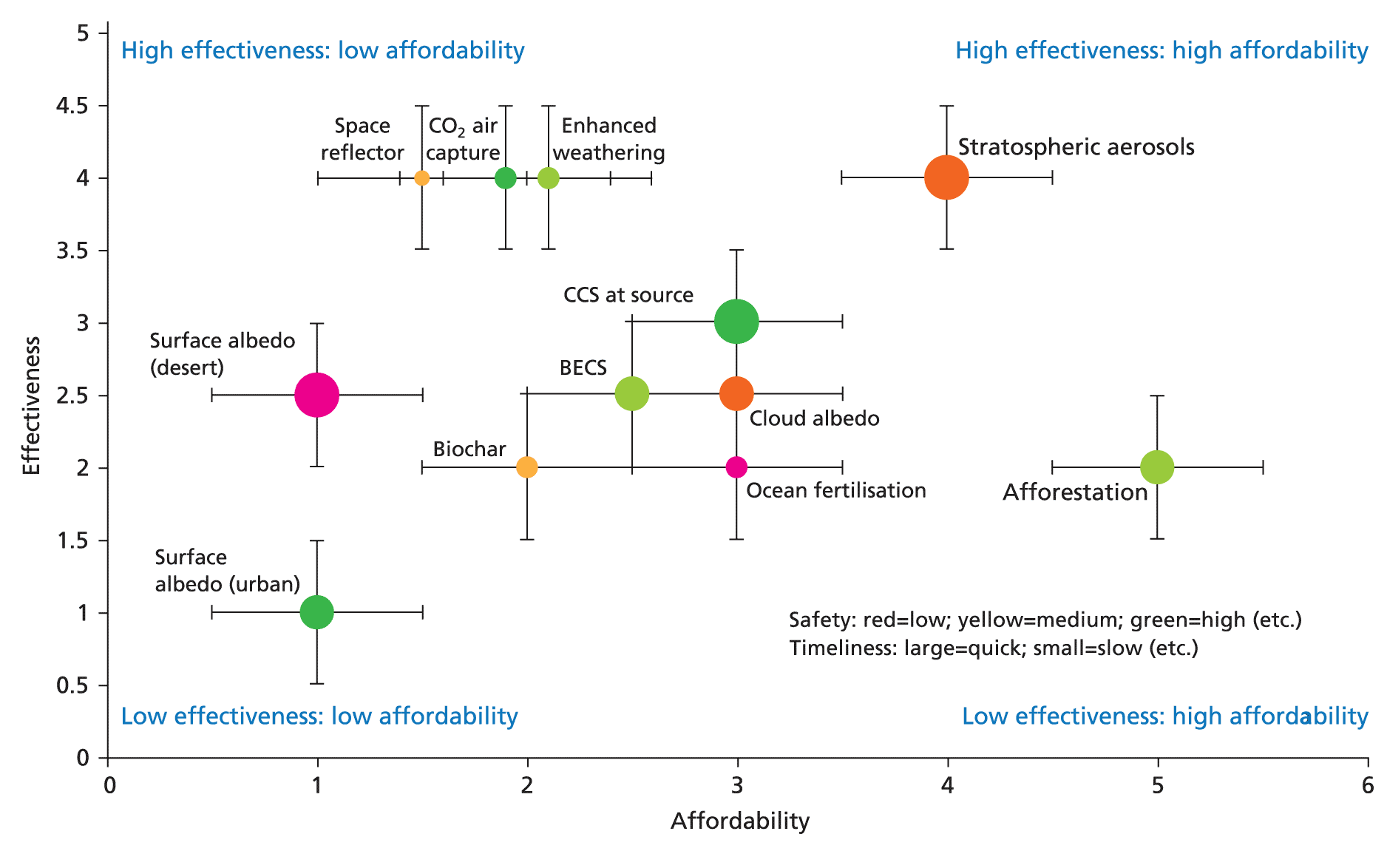
The Royal Society report considered seven geoengineering techniques based on solar radiation management and nine based on carbon dioxide removal (Figure 1; see also Box 1 for the options). The authors rated various schemes on the basis of effectiveness, affordability, safety and timeliness, with estimates of uncertainty for the first two parameters. There were no clear winners: options that scored highly on effectiveness scored low on safety or cost, whereas those that were affordable and safe were less effective (Figure 1). Safety considerations covered the risk of undesirable regional climate change, ecosystem impacts, termination effects – effects resulting from stopping a particular geoengineering project – and reduction in crop yields. Arguably all solar radiation management techniques should score low on safety because ocean acidification would continue unabated (although not strictly speaking a side effect). 
Figure 1
Figure 1. Evaluation of various geoengineering techniques on the basis of effectiveness and affordability.  CCS: Carbon capture and storage (CCS at source included for comparative purposes); BECS: Biomass with carbon sequestration. Figure from UK Royal Society (2009). Reproduced with permission.
Although the grouping of geoengineering technologies under solar radiation management and carbon dioxide removal has a strong scientific rationale, an arguably more pragmatic grouping would be governance-based, distinguishing: 1) where manipulations and potential adverse impacts are limited to national jurisdictions (for example, afforestation and air-capture of carbon dioxide); 2) manipulations that are nationally-based, but with the possibility of trans-boundary impacts (e.g. large-scale land-albedo changes, geoengineering in coastal seas); and 3) where both manipulations and impacts involve the use of globally-shared resources (for example, open-ocean fertilisation, and atmospheric- or space-based solar radiation management).  

Concerns that geoengineering is inherently undesirable and politically unworkable primarily relate to the third category, where one country might derive benefit at the expense of others. For example, a “sunshade” reduction in incoming solar radiation would produce regional disparities in its effects on mean temperature, while also changing the risk of floods, droughts or storms. The broad-scale impacts of such geoengineering, distinguishing winners and losers, can be investigated by modelling (see, for example, the recent work of Peter Irvine and colleagues). Negative effects on, say, crop production could, in theory, be compensated for.  But extreme weather events are difficult to predict even in a non-geoengineered climate, and the separation of natural disasters that might have happened anyway from those that were caused by geoengineering would become nearly impossible, risking considerable international tension.

The crunch issues
No country currently includes the riskier forms of geoengineering in its national strategy for tackling climate change, and research to date has been small-scale or indirect. But many less-developed nations are worried about what would happen if richer countries decided that such geoengineering were preferable to reducing their carbon emissions. Partly as a result of this, the regulation of geoengineering is rising up the political agenda, on the basis that international governance frameworks to address such scenarios are needed sooner rather than later.

The research community needs to be aware of, and preferably participate in, these governance discussions to ensure that legitimate scientific studies, without significant impacts, can continue. But this is not always easy. The case of ocean fertilisation – the addition of nutrients to the oceans to encourage biological productivity and thereby sequester carbon – is instructive in this regard, with controversy surrounding the legality of the 2009 Indo-German LOHAFEX iron-addition experiment.  Several international bodies and governance instruments are involved in the use and stewardship of the global ocean (including the Convention on Biological Diversity, the London Convention and London Protocol, and the Intergovernmental Oceanographic Commission). It is proving to be a long and complex process for such bodies to agree how ocean fertilisation research ought to be approved.  Formal international agreement on “the real thing”, with large-scale impacts potentially lasting years or centuries, could therefore be at least as difficult as negotiating carbon emissions reductions.  Or it may even be unobtainable.  

Not all geoengineering techniques present such problems. The air-capture of carbon dioxide and its subsequent storage would seem relatively benign, and could be carried out within existing national and international legal frameworks. In fact, storage is already under way in locations such as the Sleipner Field in the North Sea. But deployment of this technology would have to be on a massive scale to be globally effective, and that would be expensive.  If costs were covered by a carbon tax, energy costs could double, and participating countries would be at a competitive disadvantage. Similar economic factors are a fundamental reason why the switch to low-carbon energy has not been more rapid, with neither UN conventions nor carbon trading so far succeeding in providing the socio-economic drivers to seriously tackle climate change – preventing carbon emissions in the first place, rather than having to capture the carbon afterwards.  

It is highly unlikely that the various groups concerned with geoengineering will reach consensus. Yet, the research community is reaching a common understanding that deliberate climate control through geoengineering is not simply Plan B, providing an alternative to Plan A – reducing emissions. Instead, it may need to become Part 2 of Plan A, to be implemented in addition to very stringent carbon controls. We thus need to scrutinise the environmental risks, public acceptability and geopolitical constraints associated with different geoengineering approaches just as much as their technological feasibilities.

BOX 1. CLIMATE GEOENGINEERING SCHEMES: A WIDE SPECTRUM 
Geoengineering can mean different things to different people, covering a very wide spectrum of concepts and ideas. But broadly speaking we can group climate-altering technologies into two categories.
The first of these, solar radiation management (reflecting sunshine) includes technologies seeking to increase the brightness of clouds, land or the ocean surface, or reduce the solar radiation reaching the Earth.
The second category, carbon dioxide removal, involves drawing down carbon dioxide that is already in the atmosphere. The list below is not exhaustive but is aimed at giving an idea of the options being contemplated.  For additional details, see the Royal Society´s 2009 report. 
Solar radiation management techniques:
  • Enhancing surface brightness 
  • Enhancing cloud brightness 
  • Increasing stratospheric aerosols 
  • Placing reflectors in space 
Carbon dioxide removal techniques:
  • Afforestation, reforestation and avoidance of deforestation 
  • Biochar 
  • Enhancing weathering of carbonate or silicate rocks 
  • Air-capture of carbon dioxide
  • Ocean fertilization
BOX 2. THE PUBLIC WEIGHS IN
Opinion polls usually involve a representative sample size of around 1000.  But asking that number of people their views on geoengineering isn´t going to work: the overwhelming answer would be “don´t know". So instead a UK polling company invited 85 individuals to three public dialogue events, commissioned by the Natural Environment Research Council and other partners. Public participants were provided with basic information on nine geoengineering technologies; they then debated which approaches should be researched in the future and whether any might be needed at all. 
The outcome (Ipsos MORI 2010) was cautious public support, favouring research on those technologies (such as afforestation and biochar) that were perceived as most natural, but not those seen as expensive and risky (for example, mirrors in space).  Participants were keen that geoengineering should not conflict with mitigation, but should augment it as much as possible. 
The organisers of the public dialogue emphasised that its results were indicative rather than quantitative. Nevertheless, important understanding was gained on how non-scientists make judgements on scientific information. There was recognition that for potentially controversial topics such as geoengineering, decisions to fund research should take into consideration the views and concerns of common people around the world.
FURTHER INFORMATION
Bronson D, Mooney P, Wetter K J (2009).    www.etcgroup.org/en/node/4966
Irvine P J, Ridgwell A and Lunt D J  (2010) Geophysical Research Letters 37, L18702, doi: 10.1029/2010GL044447.
Lenton T M and Vaughan N E (2009) Atmospheric Chemistry & Physics 9: 5539-5561.
Rockström J et al. (2009) Nature 461: 472-475.
UK Royal Society (2009) Geoengineering the Climate: Science, Governance and Uncertainty
Phil Williamson is a Science Coordinator for the UK Natural Environment Research Council, based at the University of East Anglia. He is a co-author of Ocean Fertilization: A Scientific Summary for Policy Makers (Wallace D et al. in press; IOC/IGBP).  Email: p.williamson@uea.ac.uk