Friday, May 21, 2021

3506. Cosmotechnics and Ontological Turn in the Age of the Anthropocene

By Pieter Lemmens,  Angelaki: Journal of the Theoretical Humanities, August 2020


Heidegger’s 1949 Bremen lecture on “The Question Concerning Technology” has been enormously influential in its conceptualization of the ontological essence of modern technology as being less that of the originary classical Greek notion of technē, understood as a bringing-forth of beings, than of what Heidegger called “enframing” [Gestell], understood as a mode of revealing of beings that provokes or challenges them forth exclusively as standing reserves [Bestand]. Under enframing, “nature” is being reduced to a gigantic reservoir of energy and material resources for economic and technological exploitation. While this image and critique of modern technology has been widely if critically accepted in the West, what has often been missed in those criticisms of its detail or trajectory is its applicability when extended to non-Western technological developments, both historically and projectively, for if these are not reducible to either technē or enframing in the Western sense, how can we articulate their unfolding and what could this question of technology prior to the Heideggerian formulation contribute to the current debate on the Anthropocene and the profound ecological and geological mutations it entails?

One current way forward in this context of the Anthropocene is a reappraisal of the idea of nature. For example, some representatives of the so-called “ontological turn” in contemporary anthropology such as Philippe Descola (Beyond Nature) and Eduardo Viveiros de Castro (Cannibal Metaphysics and Relative Native) have proposed an unravelling of the concept of nature to show that nature as it is experienced in non-European cultures cannot be equated to naturalism, which is a product of modernity, characterized by an opposition between nature and culture, in which nature is conceived as a universal ground that is common to all particular cultures arising from it while each having a different view or conception of that nature, which is adequately conceived though only by Western science. This naturalist framework of one universal nature – mono-naturalism – and many particular cultures – multiculturalism – is being confronted by these anthropologists with an alternative framework, principally derived from Amerindian animism, of a commonly shared culture – mono-culturalism – giving rise to many different natures – multi-naturalism – as well as with other ontologies, to wit totemism and analogism, that each understand the relation between nature and culture in yet other ways.

This mobilization of the non-modern can be seen as an attempt to reconceptualize the relation between the human and the non-human, and hence to go beyond the nature–culture dichotomy that restricts all visions to a parochial Western worldview. It is in the same spirit, but as a more pragmatically realist and political gesture, that this special issue of Angelaki addresses a parallel question for technology, which is whether it is also possible to conceive of multiple technologies, understood specifically in the sense of multiple cosmotechnics and if so what form this may take? It is our belief that it is not only the notion of “nature” that has to be challenged as the anthropologists did, but also the efficacy of any “return to nature” should be questioned, and that it is rather more urgent today to rethink the question of technology and of its possibilities for humanity’s future existence and coexistence with non-human inhabitants on the planet.

Although the critique of modernism and Western naturalism from the viewpoint of non-modern and non-Western ontologies – such as practiced today by Descola and Viveiros de Castro but also others such as Tim Ingold, Eduardo Kohn and Robin Wall Kimmerer – is certainly worthwhile and fruitful for fostering the ontological imagination in our search for other, less destructive and less alienating modes of (co-)existence (cf. Weber), we share Clive Hamilton’s reservations about the ultimate value of what he aptly calls “‘going native’ ontologically” for confronting the problems of the Anthropocene (106). The fact of the matter is that non-Western cultures are just as overwhelmed and disoriented by the Anthropocene as Western culture itself, although it may very well be the case that the Earth’s indigenous populations are in some sense much better prepared for the impending breakdown of the capitalist world system than the well-pampered yet for the most part overly distressed, precarized and proletarianized inhabitants of the so-called “affluent societies” (Danowski and Viveiros de Castro 95–96), if only because they have already experienced the collapse of their cosmos (104). And the recent COVID-19 pandemic has demonstrated how fragile and arguably broken the global capitalist arrangement already is, with very dire prospects on the horizon.

More importantly still, the great majority of non-Western cultures have since long been enframed themselves by Western technology through colonization and imposed modernization such that the global technological condition has also become their destiny. Any “return” to native ontologies or conceptions of nature seems rather futile in this regard. All over the planet, a “second nature” that has been thoroughly affected by technology has come to replace the allegedly pristine “first nature” of yore. This is precisely the condition of the Anthropocene, where the technosphere – as the material condition of what Pierre Teilhard de Chardin and Vladimir Vernadsky have dubbed the noosphere in the 1920s – has come to overrule the biosphere. It is this development that is hardly if at all taken into account by the representatives of current anthropology’s ontological turn, who generally fail to appreciate the decisive role of technology in anthropogenesis as well as in cosmogenesis, such as it has been emphasized in the work of the French paleoanthropologist André Leroi-Gourhan and more recently by the French philosopher and social critic Bernard Stiegler (Technics and Time 1). The ideas of these two authors have been particularly important for Hui in the development of his project of cosmotechnics.

Just as the ontological turn wants to do away with the opposition between nature and culture, the concept of cosmotechnics is designed to overcome modernity’s opposition between nature and technology. Far from recommending a rehabilitation of pre-modern or non-modern ontologies or cosmologies though, the cosmotechnics project explicitly looks at the future and aims to be an imaginative and inventive discipline in search for new cosmotechnics, and that is to say a plurality of cosmotechnics for the age of the Anthropocene, in which the different cultural spheres that exist across the globe are not called to retreat into their ancient cosmological structures – or what Peter Sloterdijk calls their traditional symbolic “immuno-spheres” (Sloterdijk and Heinrichs) – but to imagine and invent new practices of technological world-formation, taking inspiration from the ideas behind these structures, not in the least the moral or ethical ideas. It may indeed be “too late to exhume the corpse of Confucius” as Hamilton argues (107), but that does not mean it makes no sense at all to consult the Confucianist tradition – and by extension other traditions of thought beyond those of the West – for cues of how to think differently about “the unification between the moral order and the cosmic order through technical activities,” as Hui’s preliminary definition of cosmotechnics has it. A further objective of the cosmotechnics project, which it shares with Gilbert Simondon’s genetic philosophy of technology, is to work towards a reconciliation of nature and technology.

When an anthropologist such as Descola develops an “anthropology of nature” (Die Ökologie der Anderen), it should also be possible to conceive of something like an “anthropology of technics,” and if there are indeed multiple natures then it should also be possible to think of multiple technics that are different from each other, and not just functionally and aesthetically different – say at the level of technical artefacts – but different at the ontological and onto-historical level in the Heideggerian sense, or as Hui prefers: at the level of cosmology or histories thereof.

The concept of cosmotechnics was initially introduced in Hui’s treatise The Question Concerning Technology in China. An Essay in Cosmotechnics, which understood itself first of all as a response to Heidegger’s original question concerning technology but aiming to expand this question beyond Heidegger’s still Eurocentric horizon and opening it up towards other, non-European cultures, such as Chinese culture which Hui, being Chinese himself, has taken as an example in his book. The concern that Hui shares with Heidegger is the fact that the Western technological trajectory has come to dominate nearly all other cultural spheres around the globe and has indeed become a planetary force – the gigantic, monolithic force foremost responsible for the arrival of the Anthropocene as the age of generalized psychic, social, cultural, economic and ecological deterioration or “entropization,” as Bernard Stiegler has put it, characterizing the Anthropocene as the Entropocene (Automatic Society).

According to cosmotechnics all technics are fundamentally cosmological and all cosmologies are fundamentally technical, and what it underlines is that technology is not a universal, transcultural category but essentially dependent in its unfolding on a non-technical cosmological factor that is culture-specific. As such it aims to rethink and re-orient the question concerning technology in terms of the question concerning technodiversity. Its emphasis on multiple cosmotechnics has to be distinguished from so-called multiculturalism, which is fundamentally a reactionary politics of cultural identity. The multiplicity of cosmotechnics implies multiple epistemologies and epistemes which can contribute to reflection on the development of technologies, opening up a discourse on technodiversity for overcoming the current homogenization and planetarization of enframing actualized in the Anthropocene. Hui, again, uses China as an example to demonstrate that it is not only possible but also necessary to elaborate on culture-specific histories of cosmotechnics, and to see how these different understandings can be reconsidered and reevaluated so as to re-orient and re-imagine current technological globalization with its nearly complete obliteration of technodiversity from a cosmotechnical perspective.

The ultimate concern of the cosmotechnics project, which is further developed by Hui in Recursivity and Contingency and in Art and Cosmotechnics (forthcoming in 2020), is to show the necessity of overcoming the current global dominance of Western or promethean technology, re-interpreted as one particular form of cosmotechnics (i.e., that of capitalism). Its ultimate objective is to encourage another, non-Eurocentric way of thinking about technology in order to bring about what Hui calls a bifurcation or rather fragmentation of World History such that it may open the future toward a plurality of heterogeneous technological trajectories, each driven by a different cosmotechnical imaginary. As such it projects a profound “reframing” of the current planetary enframing so as to “recosmicize the Earth” (Augustin Berque) and doing so in a variety of locally specific ways.

In this special issue, ten authors explore various dimensions of the cosmotechnics proposal, some in closer dialogue with Hui’s work, others by relating to it more tangentially and taking it into other, sometimes very different, directions. I have to confine myself here to an extremely concise exposition of the authors’ contributions.

Pieter Lemmens interprets Hui’s cosmotechnics in terms of a “critical synthesis” of Heidegger’s and Stiegler’s views of technology which updates them for the emerging post-Eurocentric epoch. Marco Pavanini situates cosmotechnics within an anthropotechnological and culture-historical perspective and shows that it, as an inevitably comparative discipline, requires reflexive awareness of the various “cultural techniques” that condition any culture’s self-understanding so as to guard itself against ethnocentrism, suggesting the cultural techniques approach developed among others by Thomas Macho to be the proper “organon” of cosmotechnics. Andrés Vaccari emphasizes the affinity of Hui’s cosmotechnics with that of Gilbert Simondon and then mobilizes both to offer a scathing critique of the hegemonic cosmotechnics of today’s hypercapitalist conjuncture, that of transhumanism/singularitarianism, interpreted as a corporate, neosubstantivist ideology serving the agenda of a rabid neoliberalism intent on totally controlling and colonizing the planet. Yuk Hui for his part argues that cosmotechnics can help to overcome the totalizing tendency of the currently dominant cybernetic paradigm structuring the relation between nature and technology, or between ecology and machines, by offering a more pluralistic, historical and regional understanding of this relation, enabling what he calls a genuine “political ecology of machines.” Bernard Stiegler, in an article that relates Hui’s concept of technodiversity to his own notion of noodiversity, argues for the necessity to develop an entirely new theoretical computer science with a view to countering the entropic tendencies inherent in the global digital milieus of contemporary “platform capitalism” so as to rethink the relation between the nervous and the logical and resurrect a new space for the exercise of reason, which is now in the process of being dissolved in a digitally automated understanding, itself completely reduced to calculation. Jason Tuckwell takes Hui’s idea of cosmotechnics as starting point for a critique of technicity conceived as a uniquely human characteristic, a viewpoint derived from Aristotle, arguing instead that technically mediated agency is constitutive for all species and showing that this articulates nicely with the non-universalist conception of technics embraced by Hui and allows for the possibility of non-humans also having a cosmotechnics. Sjoerd van Tuinen, in a historically informed reflection on the possible future(s) of artificial intelligence, more or less presents Leibniz as a cosmotechnic thinker of technological and noetic diversity avant la lettre, contrasting his proto-cybernetic idea of reason as distributive composition and unnatural common sense with Hegel’s collectivization of an artificial yet self-naturalizing good sense. Clive Hamilton argues that exploring ancient cosmological frameworks for conceiving new future cosmotechnics in the plural may be wrongheaded since they all originate from the definitively past epoch of the Holocene, whilst the development of what he calls a “fifth ontology” beyond those four currently held by humans on the planet (as distinguished by Philippe Descola) will necessarily originate from our progressive interactions with the entirely unprecedented Anthropocene Earth. Frédéric Neyrat responds to the cosmotechnics proposal affirmatively yet critically, from his own quite unique “Alienocene” perspective, by presenting “Afrofuturism” as an alternative, non-imperialist, non-colonialist and non-exploitative cosmotechnics countering the violent, acosmic cosmotechnics of capitalism. In this Afrofuturist cosmotechnics, the cosmos is not limited to our terrestrial abode though but designates the entire universe as a trajectory extending all the way to its an-archic origin in the so-called Big Bang, reminding us of the ultimate futility of any technological will-to-power. Peter Skafish finally relates to the cosmotechnics proposal by reflecting, from a more anthropologically or rather anthropotechnologically informed approach and in dialogue with anthropology’s contemporary ontological turn, on the body and on “techniques of the body” (a term coined by Marcel Mauss) from a pluri-ontological and “polyrealist” perspective, showing how the body and its technicity manifest in very different ways according to its ontological as well as cosmological embedding, illustrating this in particular with reference to Amerindian shamanism and – most extensively – traditional Chinese medicine.

It will be obvious from this all too brief preview that cosmotechnics is a concept that opens up many possible avenues for philosophical reflection, offering a fresh perspective for rethinking the human–nature–technology nexus in multiple ways. We hope that this special issue marks the beginning of the development of cosmotechnical thinking as a new direction for the philosophy of technology, that also allows for an enriched dialogue with other disciplines such as ethnology, anthropology, cultural history, social and political science, and not in the least also the arts. We thus hope that it may inspire future critical thinking about the human condition in the context of the Anthropocene and may support imagining a new technological modus vivendi on this planet or rather a multiplicity thereof, and we also hope, finally, that the cosmotechnics project will be taken up by different cultures and different localities on the planet.

bibliography

  • Danowski, Déborah, and Eduardo Viveiros de CastroThe Ends of the World. Trans. Rodrigo Guimaraes NunesCambridgePolity2017. Print. [Google Scholar]
  • Descola, Philippe. Beyond Nature and Culture. Trans. Janet LloydChicagoU of Chicago P2013. Print. [Crossref][Google Scholar]
  • Descola, Philippe. Die Ökologie der Anderen. Trans. Eva MoldenhauerBerlinMatthes2014. Print. [Google Scholar]
  • Hamilton, Clive. Defiant Earth. The Fate of Humans in the AnthropoceneCambridgePolity2017. Print. [Google Scholar]
  • Heidegger, Martin. The Question Concerning Technology and Other Essays. Trans. William LovittNew YorkHarper1977. Print. [Google Scholar]
  • Hui, Yuk. Art and CosmotechnicsMinneapolisU of Minnesota PForthcoming. [Google Scholar]
  • Hui, Yuk. The Question Concerning Technology in China. An Essay in CosmotechnicsFalmouthUrbanomic2016. Print. [Google Scholar]
  • Hui, Yuk. Recursivity and ContingencyLondonRowman2019. Print. [Google Scholar]
  • Ingold, Tim. The Perception of the Environment. Essays on Livelihood, Dwelling and SkillLondonRoutledge2011. Print. [Google Scholar]
  • Kohn, Eduardo. How Forests Think. Toward an Anthropology Beyond the HumanBerkeleyU of California P2013. Print. [Crossref][Google Scholar]
  • Leroi-Gourhan, AndréGesture and Speech. Trans. Anna Bostock-BergerCambridge, MAMIT P1993. Print. [Google Scholar]
  • Sloterdijk, Peter, and Hans-Jürgen HeinrichsNeither Sun Nor Death. Trans. Steve CorcoranCambridgeMASemiotext(e)2011. Print. [Google Scholar]
  • Stiegler, Bernard. Automatic Society Vol. 1. The Future of Work. Trans. Daniel RossCambridgePolity2016. Print. [Google Scholar]
  • Stiegler, Bernard. Technics and Time 1. The Fault of Epimetheus. Trans. Richard Beardsworth and George CollinsStanfordStanford UP1998. Print. [Google Scholar]
  • Viveiros de Castro, Eduardo. Cannibal Metaphysics. Trans. Peter SkafishMinneapolisUnivocal2014. Print. [Google Scholar]
  • Viveiros de Castro, Eduardo. The Relative Native. Essays on Indigenous Conceptual WorldsChicagoHau2015. Print. [Google Scholar]
  • Wall Kimmerer, Robin. Braiding Sweetgrass. Indigenous Wisdom, Scientific Knowledge and the Teachings of PlantsMinneapolisMilkweed2015. Print. [Google Scholar]
  • Weber, Andreas. IndigenialitätBerlinNicolai2018. Print. [Google Scholar]

Wednesday, May 19, 2021

3505. Twenty Firms Produce 55% of World’s Plastic Waste, Report Reveals

By Sandra Laville, The Guardian, May 17, 2021 

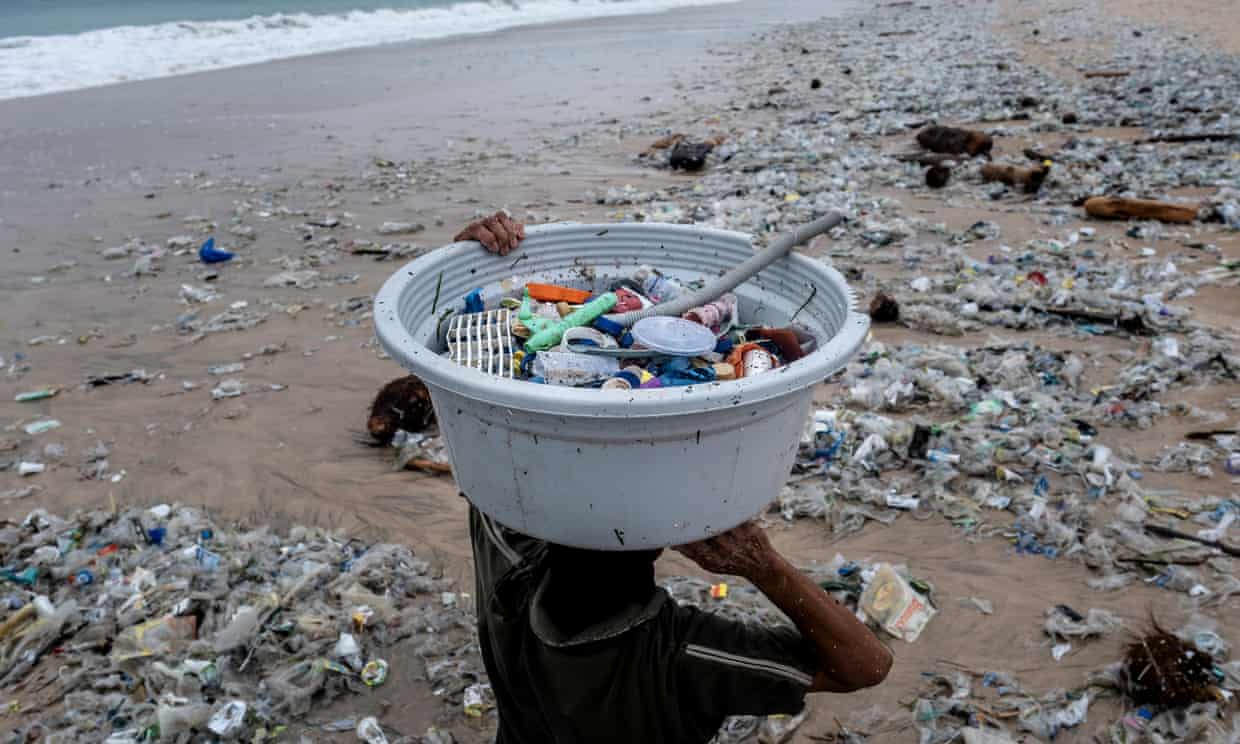
A woman collects recyclable plastics washed up on the beach in Bali, Indonesia. Photograph: Agung Parameswara/Getty Images


Twenty companies are responsible for producing more than half of all the single-use plastic waste in the world, fuelling the climate crisis and creating an environmental catastrophe, new research reveals.

Among the global businesses responsible for 55% of the world’s plastic packaging waste are both state-owned and multinational corporations, including oil and gas giants and chemical companies, according to a comprehensive new analysis.

The Plastic Waste Makers index reveals for the first time the companies who produce the polymers that become throwaway plastic items, from face masks to plastic bags and bottles, which at the end of their short life pollute the oceans or are burned or thrown into landfill.

It also reveals Australia leads a list of countries for generating the most single-use plastic waste on a per capita basis, ahead of the United States, South Korea and Britain.

ExxonMobil is the greatest single-use plastic waste polluter in the world, contributing 5.9m tonnes to the global waste mountain, concludes the analysis by the Minderoo Foundation of Australia with partners including Wood Mackenzie, the London School of Economics and Stockholm Environment Institute. The largest chemicals company in the world, Dow, which is based in the US, created 5.5m tonnes of plastic waste, while China’s oil and gas enterprise, Sinopec, created 5.3m tonnes.

Eleven of the companies are based in Asia, four in Europe, three in North America, one in Latin America, and one in the Middle East. Their plastic production is funded by leading banks, chief among which are Barclays, HSBC, Bank of America, Citigroup and JPMorgan Chase.

Barclays Bank lent more than $3bn to single-use plastics polymer producers
Total value of loans adjusted for share of business from SUP polymer production. January 2011 to December 2020
$bn
1
2
3
Barclays $3.1bn
HSBC 3.1
Bank of America 2.9
Citigroup 2.8
JPMorgan Chase 2.7
Mitsubishi UFJ Financial 2.1
SMBC Group 1.5
Mizuho Financial 1.5
UniCredit 1.1
Crédit Agricole 1.0
Guardian graphic | Source: KPMG
The enormous plastic waste footprint of the top 20 global companies amounts to more than half of the 130m metric tonnes of single-use plastic thrown away in 2019, the analysis says.

Single-use plastics are made almost exclusively from fossil fuels, driving the climate crisis, and because they are some of the hardest items to recycle, they end up creating global waste mountains. Just 10%-15% of single-use plastic is recycled globally each year.

The analysis provides an unprecedented glimpse into the small number of petrochemicals companies, and their financial backers, which generate almost all single-use plastic waste across the world.

Al Gore, the environmentalist and former US vice-president, said the groundbreaking analysis exposed how fossil fuel companies were rushing to switch to plastic production as two of their main markets – transport and electricity generation – were being decarbonised.

“Since most plastic is made from oil and gas – especially fracked gas – the production and consumption of plastic are becoming a significant driver of the climate crisis,” said Gore.

“Moreover, the plastic waste that results – particularly from single-use plastics – is piling up in landfills, along roadsides, and in rivers that carry vast amounts into the ocean.”

The plastic waste crisis grows every year. In the next five years, global capacity to produce virgin polymers for single-use plastics could grow by more than 30%.

By 2050 plastic is expected to account for 5%-10% of greenhouse gas emissions.

“An environmental catastrophe beckons: much of the resulting single-use plastic waste will end up as pollution in developing countries with poor waste management systems,” the report’s authors said. “The projected rate of growth in the supply of these virgin polymers … will likely keep new, circular models of production and reuse ‘out of the money’ without regulatory stimulus.”

The report said the plastics industry across the world had been allowed to operate with minimal regulation and limited transparency for decades. “These companies are the source of the single-use plastic crisis: their production of new ‘virgin’ polymers from oil, gas and coal feedstocks perpetuates the take-make-waste dynamic of the plastics economy.”

The report said this undermines the shift to a circular economy, including the production of recycled polymers from plastic waste, reusing plastic and using substitute materials. Just 2% of single-use plastic was made from recycled polymers in 2019.

“Plastic pollution is one of the greatest and most critical threats facing our planet,” said Dr Andrew Forrest AO, chairman of the Minderoo Foundation. “The current outlook is set to get worse and we simply cannot allow these producers of fossil fuel-derived plastics to continue as they have done without check. With our oceans choking and plastic impacting our health, we need to see firm intervention from producers, governments and the world of finance to break the cycle of inaction.”

Saturday, May 15, 2021

3504. The Cuban Government Denounces US Support for the Israeli Crimes in Gaza

By Resumen, May 12, 2021


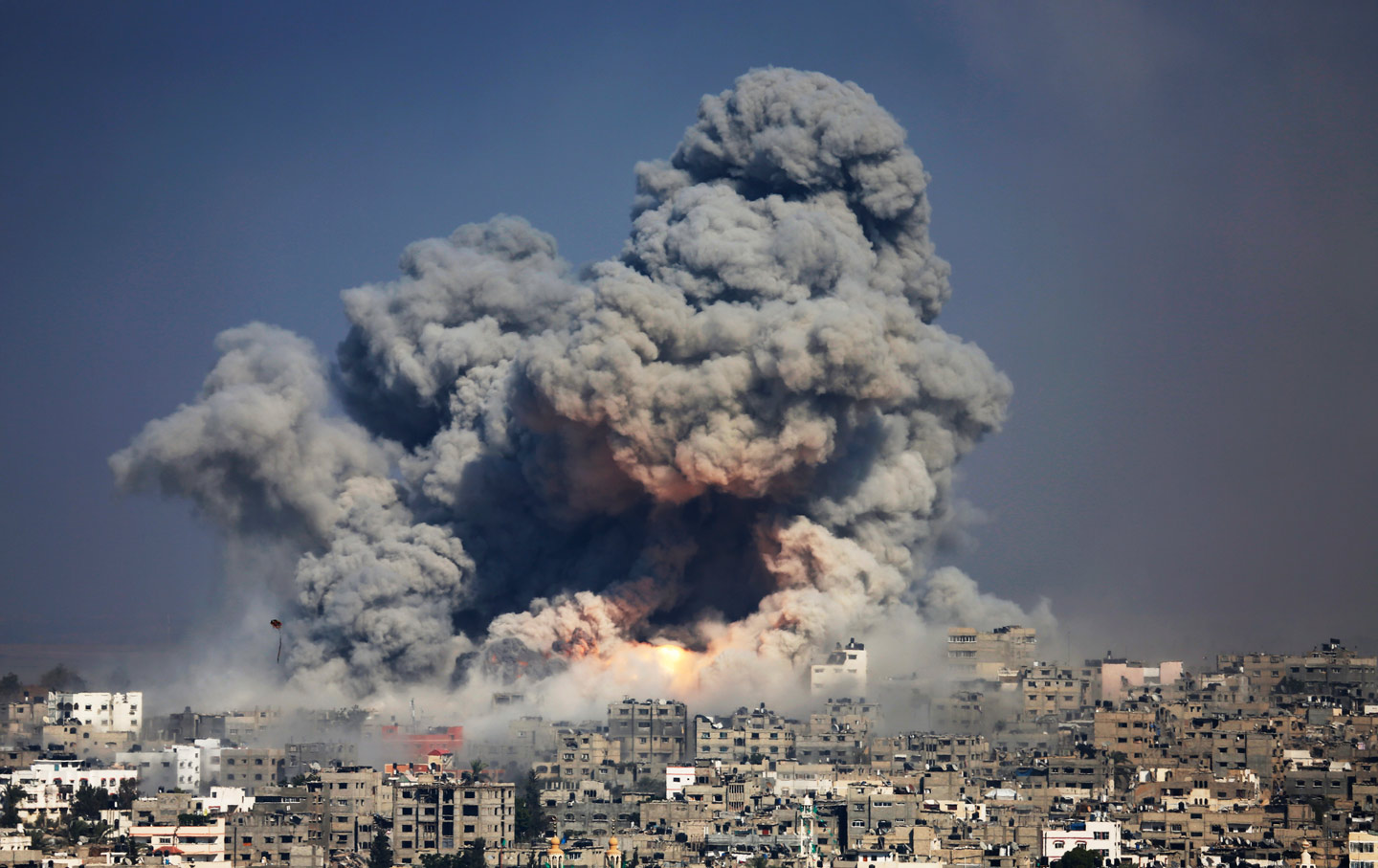
An Israeli strike over Gaza City. (AP Photo / Hatem Moussa)

Cuba has charged the United States with supporting the Israeli regime in their indiscriminate bombings of the Palestinian people. Yesterday Cuban Minister of Foreign Affairs Bruno issued Havana’s repudiation of the attacks carried out by the Israeli regime in the last two days, which have caused at least 48 deaths in Gaza, 14 of whom were children, according to the Gaza Ministry of Health.

“Cuba vigorously condemns the indiscriminate bombardments by Israel against the Palestinian population of Gaza,” Rodriguez wrote in his Twitter account.  The head of International Relations for Cuba also denounced the “consistent support of the United States for these crimes” perpetrated by the Zionist nation against the blockaded population of Gaza.

The Gaza Strip, a zone called by some as “the largest prison in the world” since its almost two million inhabitants are prevented from receiving food, fuel, and medical supplies by the Israeli blockade, was the target Tuesday of a fierce aerial bombardment directed against civilian structures, including homes.

In addition, in the occupied city of Al-Quds (Jerusalem) at least 500 Palestinians were wounded by the Israeli repression of the protests against the profanation of the Al-Aqsa Mosque, and the prohibition of Palestinian access to this site, one of the three most sacred Islamic sites.

In international forums, Cuba has always expressed repudiation of the Israeli aggression in Palestine and has denounced the role played by the US in the Israeli-Palestinian conflict. In this regard, Havana has rejected the so-called “Deal of the Century” crafted by the previous U.S. administration, and has warned that that the process of normalizing diplomatic relations with Israel constitutes a serious violation of the rights of the Palestinians.

This new wave of violence was provoked and fanned by the restrictions imposed by the Israeli regime on Palestinian access to the Al-Aqsa Mosque, located in the Trans-Jordan city of Al-Quds, and by the announcement of the expulsion of the Palestinian residents of the neighborhood of Sheikh Jarrah, to be replaced with Israeli colonizers.  However, the spark that has generated the cross-fire of rockets between Israel and the Palestinian Resistance was the Israeli repression against the Palestinians in Al-Quds on Monday.

The Palestinian resistance had been issuing warnings about the hostile acts of the Israelis against Palestinian civilians.  Nevertheless, the Israeli aggressions against Palestinians did not cease and they continued their attacks against the demonstrators in Al-Aqsa, in addition to carrying out air attacks against the Gaza Strip.  Among these attacks were the Israeli Air force bombings of Palestinian homes in Beit Hanun, in Gaza, on Monday, an attack that caused a number of deaths.  In addition to that, a night aerial bombing by the Tel Aviv regime on Tuesday caused the total destruction of a 13 story building in the Gaza Strip.  In retaliation, Hamas, the Palestinian Islamic Resistance Movement, as well as the Palestinian Islamic Jihad have launched hundreds of missiles against the occupied territories, including the heart of Tel Aviv.

3503. Mariela Castro: “I Am Convinced That the New Family Code Will Be Approved by the Majority of Cubans”

By , Cuba News, May 9, 2021

Mariela Castro Espín, director of the National Center for Sex Education (CENESEX), speaks at the press conference on the 14th Cuban Days against Homophobia and Transphobia, in Havana, on May 4, 2021. Photo: Ernesto Mastrascusa/EFE.


For 
Mariela Castro Espín, director of Cuba’s National Center for Sexual Education (CENESEX), there is no doubt that the new Family Code, currently in preparation and which will be taken to a popular referendum for final approval, will be endorsed by most Cubans.

“I am convinced that we are going to achieve it and we are going to celebrate it,” she assured this week at the press conference that began the 14th Cuban Days against Homophobia and Transphobia.

“They are conquests we have been working on for many years and of which we are already seeing results. Some indicators are telling us that our people are on the right track in this regard,” she said about the issues that should be reflected in the new norm, such as same-sex marriage and the recognition of a plural and inclusive concept of families, that includes those made up of LGTBIQ+ people and that guarantee their rights.

However, Castro Espín and her colleagues and activists championing this endeavor know that it is a thorny path, with many obstacles and challenges, and a source of controversy in Cuban society, as already happened in the popular debates on the current Magna Carta. So, although in the end the Constitution recognized the equality of all people regardless of their sexual orientation and gender identity and outlawed discrimination on this and other grounds, the controversy surrounding marriage led to the rewriting of a controversial article with its definition, 68, which was interpreted as a triumph of the most conservative sectors.

This, the director of CENESEX said, was due more to a “methodological error” in the collection and processing of the data resulting from the debates, than to the real opposition of the majority of Cubans to same-sex marriage and other demands for the LGTBIQ+ community. Therefore, she affirmed, this time it is necessary to be “very careful not to repeat the same methodological error as during the Constitution debates, which gave an idea that there were many people against article 68 and in reality it was not like that.”

To support her opinion, the also deputy to the National Assembly recalled her impressions about those popular debates and the entire process of construction of the current Magna Carta, as well as other consultation instruments on these issues applied in recent times on the island.

“As a deputy, I participated in the discussions that took place in the country to design the new Constitution, through debates, mechanisms for popular participation, and I was able to listen to many criteria in the areas where I was. I listened to the arguments and prejudices that prevailed in relation to that famous article 68, which was later transformed with constitutional language, and I was able to appreciate that the majority of the population is in favor of recognizing the rights of LGTBIQ+ people, especially in the family environment, which includes the option of marriage,” said Castro Espín.

“The 2016 national gender equality survey even states that 77% of the population between 15 and 74 years old considers that people who have sexual relations with others of the same sex should have the same rights as other people. The result in this survey is much higher than that of previous ones, which shows an evolution in the knowledge and capacity of our people to recognize these rights,” she added. “This survey was already giving us these clues in this regard, regardless of what I was able to verify in the debates on the Constitution and I was able to reach a consensus with other deputies. If more than 86% of the Cuban population voted in favor of the new Magna Carta, a Magna Carta that very clearly protects the rights of LGBTIQ+ people, I feel very hopeful that this Family Code will have the approval of the majority of the people and, of course, it will give rise to the recognition and guarantee of the plurality and diversity of families that exist in our country and that must be backed by the law.”

A long road and a pandemic

For the director of CENESEX, what is endorsed by the current Cuban Constitution represents “a moment of maturity” in terms of the recognition of the rights of the LGTBIQ+ community on the island, the result of the long road traveled by the defenders of these rights, including the institution that she heads and of which she assures “has worked intensively to position these issues on the Cuban political agenda.”

“We have been working for many years so that in Cuban society the political will of the State, the (Communist, PCC) Party, the government is explicitly positioned around the expansion of the rights of people so that they are not discriminated against because of their sexual orientation, gender identity and other reasons,” she told reporters. “Getting here is the result of an important work of dialogue, scientific research, communication, and effort, because rights are the result of social conquests. They are not recognized because it occurred to an institution or because it occurred to a politician or a deputy; they are the product of consensuses that are being built on scientific bases, on social practice, and that are maturing until they crystallize in a legislative project.”

Even so, Castro Espín acknowledged that the process that should lead to the presentation and popular consultation on the new Family Code has been delayed by the impact of the pandemic, which does not allow seeing a clear horizon for its presumed approval. “Regarding when the referendum is going to take place, I cannot confirm a date,” she replied to a question from OnCuba, although in statements to the Spanish agency EFE she estimated that the entire process could be concluded in less than two years.

“Due to the COVID-19 situation, the entire legislative agenda has been relatively postponed because it has been difficult to organize the meetings between all the people involved, with the deputies and specialists not only from Havana but from all the provinces, but even so work has continued on the Family Code, on the fundamental elements of the draft that must be presented in the ordinary session of the National Assembly in July, where the commission approved by the Council of State for the final drafting of the code must also be ratified, and there will be the possibility of making changes regarding its members,” she explained.

About this commission, of which she herself is a member, she explained that among the criteria followed by the Council of State for its formation—about which, she said, she herself inquired at the Secretariat of the Assembly, “because as a citizen I also had my concerns in this regard”—there was the inclusion of “people who are mostly deputies to the National Assembly,” as well as “some experts who have previously worked in the investigations and the organization of the processes that gave rise to the first document that is going to be presented to the commission,” and that in this commission “there would be a plural representation of the different sectors of Cuban society, such as mass organizations and others of civil society.”

“However, in my opinion as a deputy I consider that, as a practice of participation, a code like this, which has a group of new elements which are presented for the first time in our country, should have a representation or, at least, one slightly greater participation of some people who, based on their professional role and their activities in the field of activism, can make contributions in the debate that this draft will generate, in the Assembly first and then in the population. I will have the opportunity to raise these criteria and make my proposals in this regard as a deputy in July, in the ordinary session of the Assembly, which, of course, will be agreed upon with my colleagues,” she added.

After that moment, in which the preliminary draft of the code is supposed to be approved, “a process, also complex, is supposed to begin and the population will be explained how that process is going to be, whose main obstacle is the pandemic. It is being analyzed how it could be done, taking into account how COVID-19 is currently behaving in the country, which has been growing in terms of infections and mortality, and a difficult situation remains. Let’s hope that when mass vaccination begins that scenario will begin to change, but beyond that there is the will to create mechanisms for this process, which is fundamental for our country.”

Challenges ahead

Mariela Castro Espín is aware that the process around the new Family Code and other associated issues “has generated many concerns and proposals, which have come to us through comments, messages on social networks, and which must be taken into account,” and she reiterated the intention of the Cuban authorities to continue its preparation “with the same commitment and the same intention to advance in the protection, recognition and guarantee of the rights of the LGTBIQ+ community and of all people.”

In this regard, the also daughter of former President Raúl Castro, recognizes the importance of not standing idly by to achieve this goal, an endeavor in which the current days against homophobia and transphobia will emphasize, and in which, she maintains, It is imperative to continue working from various fronts and dimensions. “It is necessary to promote the understanding that families evolve over time and that only heterosexual families cannot continue to be accepted or privileged for reproductive purposes. That is something too archaic. And it is important to disseminate scientific research and arguments that can serve as a basis for people to reflect when voting in the popular consultation,” she stressed.

For his part, Manuel Vázquez Seijido, deputy director of the CENESEX, although he also claims to feel optimistic about the approval of the code, does not hide that there are challenges with the future referendum, “especially associated with people or groups of people who hide themselves in positions of any nature to oppose an inclusive Family Code, especially in relation to the issues of LGBTIQ+ people, although it may not be the only issue that is questioned about the code, because the main issues supported by fundamentalisms from anywhere are not pronounced only against the advancement of this community, but, and not only because of what we have seen in Cuba but also in similar experiences in the region, where they also do so, for example, on issues associated with women’s rights. And, without a doubt, a Family Code that is sufficiently inclusive and in tune with the current constitutional text should also move towards protecting the rights of women and other population groups.”

“With these challenges, which will surely exist, it will be necessary to deal intelligently with correct communication strategies, with the way to conduct the consultation process and position our messages,” he replied to a question from OnCuba.

Other challenges, in his opinion, are related to the way in which the authorities, organizations and activists favorable to the approval of the code, present and defend their arguments, and manage to promote an effective social dialogue that is later translated into greater awareness, a debate for which, he said, “we do not have much time, but is imminent.”

“We must be capable from the institutions not only of the State and the government but also from civil society organizations committed or connected with these issues, to generate intelligent and effective communication strategies with the objective of promoting the debate itself, creating spaces for dialogue. Strategies that not only involve the transmission of audiovisual materials or infographics, but that they serve as a pretext to generate spaces for exchange that contribute to the construction and necessary deconstruction on these issues,” he specified. 

For Vázquez Seijido “traditional communication strategies are not enough; we have another great challenge in how we work on social networks, on online platforms, because we are in a context where the primary stage has been virtual and this must also become an effective space for debate, for dialogue. And our mission as institutions and organizations in the networks, or as activists, must accompany this dialogue and contribute to it.”

In addition, in his opinion, “it is necessary to address the hard core of the issues, those that generate the main controversies, and not the sideline. These issues must be addressed clearly and directly. For example, those associated with homo-affective families, those related to reproductive decision-making by people with non-heteronormative sexualities, adoption by homosexual couples, among many other issues, but it is not enough to discuss these issues but the relevance of how they are approached. This is key to facing the process that lies ahead.”

Beyond the Family Code

The fight for the rights and claims of the LGTBIQ+ community does not end with the expected approval of the Family Code, as it did not before with the promulgation of the current Magna Carta.

“What is going to be contemplated in the Family Code does not logically encompass all rights, only those related to this issue,” said the director of CENESEX to OnCuba, “and there is a fairly broad and intensive legislative agenda until 2024, as a result of the legal reorganization after the approval of the new Magna Carta. It includes other regulations related, for example, to gender identity, which is an issue on which we have been insisting for many years and for which it was first necessary to have made the constitutional change."

Castro Espín commented that in this direction also they have also been “working for quite some time and, even exchanging ideas with specialists from other countries, to find out how they did it, what worked and what didn’t, what obstacles they had in the implementation, like our colleagues from Argentina, who have told us about the serious difficulties they have had in developing and implementing their gender identity law. We have done all of this to gain experience and not make the same mistakes, although perhaps we can make others.”


Vázquez Seijido, for his part, identifies patriarchy as the main obstacle both for the Family Code and for other legal norms that may come later, “which is a system of domination that, as in the entire region, we inherited from the colonizing processes.” The specialist explains that this obstacle is present not only in countries that advance in the elaboration of laws on these issues, but also in those that already have legal norms and in which the challenge, he affirms, is to guarantee the rights provided in those regulations.

“I am talking about countries like Argentina that have a gender identity law, a same-sex marriage law, and yet the hate crimes against members of the LGTBIQ community continue to increase. The same happens with the Mexican context, with the Colombian context. And these are references that we have to take into account, because it confirms that the norm per se does not automatically change behaviors and, therefore, does not ensure the enjoyment of the right,” he said.


Following this line, the deputy director of CENESEX insists that “the goal is the legal norm, yes, but above all the recognition of rights in practice, not only marriage but a much larger group, because there is no single agenda or a single interest for those who make up the LGTBIQ+ community, but there is a set of issues and needs that we have to attend to in Cuba, such as, for example, discrimination in areas such as family, work, school, in community spaces, and we have to work for the erosion of that patriarchy, from all the places where it is embraced, first to achieve a recognition of rights and second to guarantee that these are effectively exercised.”


For these future regulations, Vázquez Seijido asserts that legally the umbrella would not be the Family Code, but that this “has already been approved since 2019 and is the Constitution itself. Particularly Article 42, which specifies the principle of equality and non-discrimination, and prohibits any type of discrimination based on gender, sex, sexual orientation and gender identity. That would then be the benchmark for modifying our legal system.”


“The Family Code,” he specified to OnCuba, “will be an area of regulation, a space in which we must recognize and guarantee a group of rights, but, for example, regarding the so-called Gender Identity Law, which is actually a media term, not properly legal, we must explain that this, in all the contexts where it has occurred, has not been more than a law that has modified the legal norms related to civil registration in each of the countries, and if we review the Cuban legislative schedule, we will find that the Civil Registry Law and its regulations are part of it. And precisely addressing the issue of gender identity is, from my point of view, urgent when the process of building this law begins. It is important, it must be so, and it is also in harmony with this article 42 of the Magna Carta. Any contrary decision would be unconstitutional.”


“I feel that an important group of other legal norms will continue to move in this key, such as the Penal Code, which also, from the constitutional point of view, should protect the rights of all people, but particularly based on the subject we are talking about, that of people with non-heteronormative sexualities, defend them against any type of violence that is unlawful. And also, if you like, in the view on the Labor Code proposed by the legislative schedule, which prohibits discrimination based on sexual orientation but does not expressly include gender identity,” he reasoned. “In other words, the guideline in this regard has already been set by the new constitutional text. That is the umbrella, it is the base of the pyramid of our legal system and that is where we should be headed.”