By Eric Caraballoso, Cuba News, May 9, 2021
 |
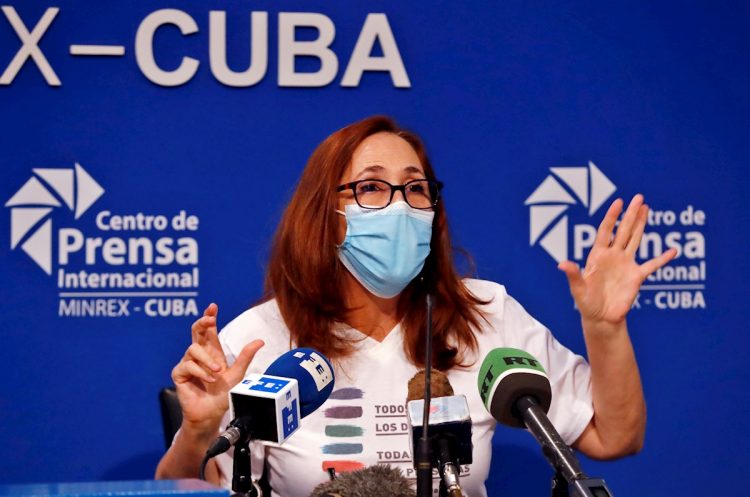
Mariela Castro Espín, director of the National Center for Sex Education (CENESEX), speaks at the press conference on the 14th Cuban Days against Homophobia and Transphobia, in Havana, on May 4, 2021. Photo: Ernesto Mastrascusa/EFE.
For Mariela Castro Espín, director of Cuba’s National Center for Sexual Education (CENESEX), there is no doubt that the new Family Code, currently in preparation and which will be taken to a popular referendum for final approval, will be endorsed by most Cubans.
“I am convinced that we are going to achieve it and we are going to celebrate it,” she assured this week at the press conference that began the 14th Cuban Days against Homophobia and Transphobia.
“They are conquests we have been working on for many years and of which we are already seeing results. Some indicators are telling us that our people are on the right track in this regard,” she said about the issues that should be reflected in the new norm, such as same-sex marriage and the recognition of a plural and inclusive concept of families, that includes those made up of LGTBIQ+ people and that guarantee their rights.
However, Castro Espín and her colleagues and activists championing this endeavor know that it is a thorny path, with many obstacles and challenges, and a source of controversy in Cuban society, as already happened in the popular debates on the current Magna Carta. So, although in the end the Constitution recognized the equality of all people regardless of their sexual orientation and gender identity and outlawed discrimination on this and other grounds, the controversy surrounding marriage led to the rewriting of a controversial article with its definition, 68, which was interpreted as a triumph of the most conservative sectors.
This, the director of CENESEX said, was due more to a “methodological error” in the collection and processing of the data resulting from the debates, than to the real opposition of the majority of Cubans to same-sex marriage and other demands for the LGTBIQ+ community. Therefore, she affirmed, this time it is necessary to be “very careful not to repeat the same methodological error as during the Constitution debates, which gave an idea that there were many people against article 68 and in reality it was not like that.”
To support her opinion, the also deputy to the National Assembly recalled her impressions about those popular debates and the entire process of construction of the current Magna Carta, as well as other consultation instruments on these issues applied in recent times on the island.
“As a deputy, I participated in the discussions that took place in the country to design the new Constitution, through debates, mechanisms for popular participation, and I was able to listen to many criteria in the areas where I was. I listened to the arguments and prejudices that prevailed in relation to that famous article 68, which was later transformed with constitutional language, and I was able to appreciate that the majority of the population is in favor of recognizing the rights of LGTBIQ+ people, especially in the family environment, which includes the option of marriage,” said Castro Espín.
“The 2016 national gender equality survey even states that 77% of the population between 15 and 74 years old considers that people who have sexual relations with others of the same sex should have the same rights as other people. The result in this survey is much higher than that of previous ones, which shows an evolution in the knowledge and capacity of our people to recognize these rights,” she added. “This survey was already giving us these clues in this regard, regardless of what I was able to verify in the debates on the Constitution and I was able to reach a consensus with other deputies. If more than 86% of the Cuban population voted in favor of the new Magna Carta, a Magna Carta that very clearly protects the rights of LGBTIQ+ people, I feel very hopeful that this Family Code will have the approval of the majority of the people and, of course, it will give rise to the recognition and guarantee of the plurality and diversity of families that exist in our country and that must be backed by the law.”
A long road and a pandemic
For the director of CENESEX, what is endorsed by the current Cuban Constitution represents “a moment of maturity” in terms of the recognition of the rights of the LGTBIQ+ community on the island, the result of the long road traveled by the defenders of these rights, including the institution that she heads and of which she assures “has worked intensively to position these issues on the Cuban political agenda.”
“We have been working for many years so that in Cuban society the political will of the State, the (Communist, PCC) Party, the government is explicitly positioned around the expansion of the rights of people so that they are not discriminated against because of their sexual orientation, gender identity and other reasons,” she told reporters. “Getting here is the result of an important work of dialogue, scientific research, communication, and effort, because rights are the result of social conquests. They are not recognized because it occurred to an institution or because it occurred to a politician or a deputy; they are the product of consensuses that are being built on scientific bases, on social practice, and that are maturing until they crystallize in a legislative project.”
Even so, Castro Espín acknowledged that the process that should lead to the presentation and popular consultation on the new Family Code has been delayed by the impact of the pandemic, which does not allow seeing a clear horizon for its presumed approval. “Regarding when the referendum is going to take place, I cannot confirm a date,” she replied to a question from OnCuba, although in statements to the Spanish agency EFE she estimated that the entire process could be concluded in less than two years.
“Due to the COVID-19 situation, the entire legislative agenda has been relatively postponed because it has been difficult to organize the meetings between all the people involved, with the deputies and specialists not only from Havana but from all the provinces, but even so work has continued on the Family Code, on the fundamental elements of the draft that must be presented in the ordinary session of the National Assembly in July, where the commission approved by the Council of State for the final drafting of the code must also be ratified, and there will be the possibility of making changes regarding its members,” she explained.
About this commission, of which she herself is a member, she explained that among the criteria followed by the Council of State for its formation—about which, she said, she herself inquired at the Secretariat of the Assembly, “because as a citizen I also had my concerns in this regard”—there was the inclusion of “people who are mostly deputies to the National Assembly,” as well as “some experts who have previously worked in the investigations and the organization of the processes that gave rise to the first document that is going to be presented to the commission,” and that in this commission “there would be a plural representation of the different sectors of Cuban society, such as mass organizations and others of civil society.”
“However, in my opinion as a deputy I consider that, as a practice of participation, a code like this, which has a group of new elements which are presented for the first time in our country, should have a representation or, at least, one slightly greater participation of some people who, based on their professional role and their activities in the field of activism, can make contributions in the debate that this draft will generate, in the Assembly first and then in the population. I will have the opportunity to raise these criteria and make my proposals in this regard as a deputy in July, in the ordinary session of the Assembly, which, of course, will be agreed upon with my colleagues,” she added.
After that moment, in which the preliminary draft of the code is supposed to be approved, “a process, also complex, is supposed to begin and the population will be explained how that process is going to be, whose main obstacle is the pandemic. It is being analyzed how it could be done, taking into account how COVID-19 is currently behaving in the country, which has been growing in terms of infections and mortality, and a difficult situation remains. Let’s hope that when mass vaccination begins that scenario will begin to change, but beyond that there is the will to create mechanisms for this process, which is fundamental for our country.”
Challenges ahead
Mariela Castro Espín is aware that the process around the new Family Code and other associated issues “has generated many concerns and proposals, which have come to us through comments, messages on social networks, and which must be taken into account,” and she reiterated the intention of the Cuban authorities to continue its preparation “with the same commitment and the same intention to advance in the protection, recognition and guarantee of the rights of the LGTBIQ+ community and of all people.”
In this regard, the also daughter of former President Raúl Castro, recognizes the importance of not standing idly by to achieve this goal, an endeavor in which the current days against homophobia and transphobia will emphasize, and in which, she maintains, It is imperative to continue working from various fronts and dimensions. “It is necessary to promote the understanding that families evolve over time and that only heterosexual families cannot continue to be accepted or privileged for reproductive purposes. That is something too archaic. And it is important to disseminate scientific research and arguments that can serve as a basis for people to reflect when voting in the popular consultation,” she stressed.
For his part, Manuel Vázquez Seijido, deputy director of the CENESEX, although he also claims to feel optimistic about the approval of the code, does not hide that there are challenges with the future referendum, “especially associated with people or groups of people who hide themselves in positions of any nature to oppose an inclusive Family Code, especially in relation to the issues of LGBTIQ+ people, although it may not be the only issue that is questioned about the code, because the main issues supported by fundamentalisms from anywhere are not pronounced only against the advancement of this community, but, and not only because of what we have seen in Cuba but also in similar experiences in the region, where they also do so, for example, on issues associated with women’s rights. And, without a doubt, a Family Code that is sufficiently inclusive and in tune with the current constitutional text should also move towards protecting the rights of women and other population groups.”
“With these challenges, which will surely exist, it will be necessary to deal intelligently with correct communication strategies, with the way to conduct the consultation process and position our messages,” he replied to a question from OnCuba.
Other challenges, in his opinion, are related to the way in which the authorities, organizations and activists favorable to the approval of the code, present and defend their arguments, and manage to promote an effective social dialogue that is later translated into greater awareness, a debate for which, he said, “we do not have much time, but is imminent.”
“We must be capable from the institutions not only of the State and the government but also from civil society organizations committed or connected with these issues, to generate intelligent and effective communication strategies with the objective of promoting the debate itself, creating spaces for dialogue. Strategies that not only involve the transmission of audiovisual materials or infographics, but that they serve as a pretext to generate spaces for exchange that contribute to the construction and necessary deconstruction on these issues,” he specified.
For Vázquez Seijido “traditional communication strategies are not enough; we have another great challenge in how we work on social networks, on online platforms, because we are in a context where the primary stage has been virtual and this must also become an effective space for debate, for dialogue. And our mission as institutions and organizations in the networks, or as activists, must accompany this dialogue and contribute to it.”
In addition, in his opinion, “it is necessary to address the hard core of the issues, those that generate the main controversies, and not the sideline. These issues must be addressed clearly and directly. For example, those associated with homo-affective families, those related to reproductive decision-making by people with non-heteronormative sexualities, adoption by homosexual couples, among many other issues, but it is not enough to discuss these issues but the relevance of how they are approached. This is key to facing the process that lies ahead.”
Beyond the Family Code
The fight for the rights and claims of the LGTBIQ+ community does not end with the expected approval of the Family Code, as it did not before with the promulgation of the current Magna Carta.
“What is going to be contemplated in the Family Code does not logically encompass all rights, only those related to this issue,” said the director of CENESEX to OnCuba, “and there is a fairly broad and intensive legislative agenda until 2024, as a result of the legal reorganization after the approval of the new Magna Carta. It includes other regulations related, for example, to gender identity, which is an issue on which we have been insisting for many years and for which it was first necessary to have made the constitutional change."
Castro Espín commented that in this direction also they have also been “working for quite some time and, even exchanging ideas with specialists from other countries, to find out how they did it, what worked and what didn’t, what obstacles they had in the implementation, like our colleagues from Argentina, who have told us about the serious difficulties they have had in developing and implementing their gender identity law. We have done all of this to gain experience and not make the same mistakes, although perhaps we can make others.”
Vázquez Seijido, for his part, identifies patriarchy as the main obstacle both for the Family Code and for other legal norms that may come later, “which is a system of domination that, as in the entire region, we inherited from the colonizing processes.” The specialist explains that this obstacle is present not only in countries that advance in the elaboration of laws on these issues, but also in those that already have legal norms and in which the challenge, he affirms, is to guarantee the rights provided in those regulations.
“I am talking about countries like Argentina that have a gender identity law, a same-sex marriage law, and yet the hate crimes against members of the LGTBIQ community continue to increase. The same happens with the Mexican context, with the Colombian context. And these are references that we have to take into account, because it confirms that the norm per se does not automatically change behaviors and, therefore, does not ensure the enjoyment of the right,” he said.
Following this line, the deputy director of CENESEX insists that “the goal is the legal norm, yes, but above all the recognition of rights in practice, not only marriage but a much larger group, because there is no single agenda or a single interest for those who make up the LGTBIQ+ community, but there is a set of issues and needs that we have to attend to in Cuba, such as, for example, discrimination in areas such as family, work, school, in community spaces, and we have to work for the erosion of that patriarchy, from all the places where it is embraced, first to achieve a recognition of rights and second to guarantee that these are effectively exercised.”
For these future regulations, Vázquez Seijido asserts that legally the umbrella would not be the Family Code, but that this “has already been approved since 2019 and is the Constitution itself. Particularly Article 42, which specifies the principle of equality and non-discrimination, and prohibits any type of discrimination based on gender, sex, sexual orientation and gender identity. That would then be the benchmark for modifying our legal system.”
“The Family Code,” he specified to OnCuba, “will be an area of regulation, a space in which we must recognize and guarantee a group of rights, but, for example, regarding the so-called Gender Identity Law, which is actually a media term, not properly legal, we must explain that this, in all the contexts where it has occurred, has not been more than a law that has modified the legal norms related to civil registration in each of the countries, and if we review the Cuban legislative schedule, we will find that the Civil Registry Law and its regulations are part of it. And precisely addressing the issue of gender identity is, from my point of view, urgent when the process of building this law begins. It is important, it must be so, and it is also in harmony with this article 42 of the Magna Carta. Any contrary decision would be unconstitutional.”
“I feel that an important group of other legal norms will continue to move in this key, such as the Penal Code, which also, from the constitutional point of view, should protect the rights of all people, but particularly based on the subject we are talking about, that of people with non-heteronormative sexualities, defend them against any type of violence that is unlawful. And also, if you like, in the view on the Labor Code proposed by the legislative schedule, which prohibits discrimination based on sexual orientation but does not expressly include gender identity,” he reasoned. “In other words, the guideline in this regard has already been set by the new constitutional text. That is the umbrella, it is the base of the pyramid of our legal system and that is where we should be headed.”