Wednesday, February 25, 2015

1748. U.S. Policies Enhances Market Reform Induced Income Inequity in Cuba

By Ronald C. Archibald, The New York Times, February 24, 2015
Cubans in the Havana shantytown El Fanguito, roughly translated as “Little Swamp,” rarely have relatives abroad who can send money to augment meager wages. Photo: Eliana Aponte for the New York Times.

HAVANA — The river where Jonas Echevarria fishes cuts through neighborhoods brimming with new fine restaurants, spas and boutiques, springing up in Cuba’s accelerating push toward private enterprise.

Tattered mansions and luxury apartment blocks speak of old wealth and new. A bounty of private restaurants known as paladares serve pork tenderloin, filet mignon and orange duck to tourists, Cuban-Americans visiting relatives and a growing pool of Cuban entrepreneurs with cash to spend.

These were things Mr. Echevarria, with only a few eggs, some plantains and a handful of rolls in his pantry, would not be having for dinner.

In his neighborhood, a shantytown called El Fanguito (roughly, “Little Swamp”) on the fringe of the Rio Almendares and the margins of society, few people have relatives sending money from abroad, food rations barely last the month, and homes made of corrugated tin, wood scraps and crumbling concrete fail to keep out floodwaters.

Nobody goes to paladares, much less has the money to start one.

“Never,” said Mr. Echevarria, whose livelihood depends on the catch of the day. “I guess I could not even afford the water.”

As Cuba opens the door wider to private enterprise, the gap between the haves and have-nots, and between whites and blacks, that the revolution sought to diminish is growing more evident.

That divide is expected to increase now that the United States is raising the amount of money that Americans can send to residents of the island to $8,000 a year from $2,000, as part of President Obama’s historic thaw with Cuba.

Remittances, estimated at $1 billion to nearly $3 billion a year, are already a big source of the capital behind the new small businesses. The cash infusion has been one of the top drivers of the Cuban economy in recent years, rivaling tourism revenue and mineral, pharmaceutical and sugar exports.

Raising the remittance cap, along with allowing more Americans to visit Cuba and other steps toward normal diplomatic relations, will help “support the Cuban people,” the Obama administration contends.

But some will enjoy that support more than others. Cuban economists say that whites are 2.5 times more likely than blacks to receive remittances, leaving many in crumbling neighborhoods like Little Swamp nearly invisible in the rise of commerce, especially the restaurants and bed-and-breakfasts that tourists tend to favor.

“Remittances have produced new forms of inequality, particularly racial inequality,” said Alejandro de la Fuente, director of the Afro-Latin American Research Institute at Harvard University. “Now the remittances are being used to fund or establish private companies, that is, not just to fund consumption, as in the past.”

The Cuban government argues that the shift to more private enterprise, a pillar of its strategy to bolster the flaccid economy, will allow it to focus its social programs on the neediest. As a billboard on a busy road in Havana proclaims, “The changes in Cuba are for more socialism.”

But many poorer Cubans are frustrated by what they see as the deteriorating welfare state and the advantage that Cubans with access to cash from outside the country have in the new economy.

“As Cuba is becoming more capitalist in the last 20 years, it has also become more unequal,” said Ted Henken, a professor at Baruch College who studies the Cuban economy. “These shantytowns are all over Latin America, and Cuba’s attempt with revolution to solve that inequality succeeded to a certain degree for a time. But as capitalism increases, you have some people more well positioned to take advantage and others who are not.”

At Starbien restaurant, one of the most popular in Havana, the owner, José Raúl Colomé, said it was not unusual for a majority of the clientele to be Cubans who live on the island, rather than tourists or expatriates.

“Some are artists who are doing well or entrepreneurs who have had luck,” Mr. Colomé said. “A lot are tourists, naturally, but we are getting more Cubans who might be called middle class.”

In poorer neighborhoods like Little Swamp, many describe feeling like foreigners in their own city, watching the emerging economy but lacking the means to participate in it.

They note the predominance of white Cubans in the new ventures but broach the subject carefully, noting the gains that the revolution brought to Afro-Cubans in education and health but also the hard economic times that darker-skinned Cubans continue to endure.

“I look in those new places and don’t see anybody like me,” said Marylyn Ramirez, who works at a tourist hotel in the Vedado neighborhood and passes new restaurants on the way to work.

Asked if she received financial help from relatives abroad, she smirked and swept her hand around her small living room, which floods repeatedly in heavy rains.

“If I had that,” she said, “do you think I would be living here?”

After the so-called special period of the 1990s, when the collapse of the Soviet Union plunged Cuba into an economic crisis, thousands of desperate people moved from the countryside to Havana without permission, hoping to find work.

Many still live as virtual refugees in their own country, in neighborhoods like Little Swamp, unable to register for government services like ration books because it is almost impossible to change addresses without prior authorization.

“Erosion of poverty has always been a concern, but they have not managed to eliminate these kinds of neighborhoods in the best years of the Cuban welfare state,” Mr. de la Fuente said, “and it is much less likely they can do it now.”

Many residents mention the free education and health care the government has provided but lament that both seemed better in years past, with shorter lines for care and better teachers. The few poor residents who do receive remittances are known to pay private tutors to ensure that their children advance to upper grades, several people in the neighborhood said.

One resident mentioned a government program that offered refrigerators to those without them, for a price of about $300. But the monthly payments, made with government salaries that are rarely more than $20 a month, can last for years, “longer than the refrigerator lasts,” he said.

Cuba’s two-tier currency puts residents at a further disadvantage. One currency, known as the convertible peso and used for tourism and foreign trade, is pegged to the dollar. But most Cubans are paid in the local peso, worth a fraction of the other. Many consumer goods and other amenities from abroad are paid for in convertible pesos, keeping such comforts out of reach for many.

A government program to build housing has not kept up with demand, and residents often refuse to leave their homes when floodwaters threaten because they fear that squatters will take over or the authorities will not let them return. Jerry-built electrical wiring sprawls along walls and rooftops, a clear fire hazard.

1747. Climate Change: The Planned Paris Conference and the Failure of the World Governments

By Gabriel Levy, People and Nature, February 25, 2015

March in Defence of Mother Earth at the climate talks in Lima, Peru, in December. Source: http://cumbrepuebloscop20.org/
March in Defence of Mother Earth at the climate talks in Lima, Peru, in December. Source: http://cumbrepuebloscop20.org/will not be able to put us on the path for two degrees. […] We are not going to get there with the Paris agreement … We will get there over time.” This month she reiterated that the Paris talks would only “set the pathway for an orderly planned transition over time to a low-carbon society”.

The officials in charge of the United Nations climate talks say that no deal will be done in Paris in December to avoid dangerous global warming.

After preparatory negotiations in Geneva, Switzerland, this month, Christiana Figueres, executive secretary of the UN Framework Convention on Climate Change (UNFCCC), confirmed that the target set previously, of limiting warming to 2 degrees centigrade above pre-industrial levels, would be missed.

Figueres had already said, in December, after a round of talks in Lima, Peru, that “the sum total of efforts [in Paris]

The EU climate commissioner, Miguel Arias Canete, claimed that “you can not say it is a failure” if, collectively, the world’s governments abandoned the 2 degrees target, as long as there is “an ongoing process”.

Diplomats at Geneva put together an 86-page document for political leaders to haggle over in December. (It’s downloadable here.) But it’s already clear that:

■ The approach adopted in Kyoto in 1997 – to require countries to cut greenhouse gas emissions by particular amounts, within specified timeframes under international law – has been abandoned. Instead, negotiators are reported to be saying, the
new agreement will rely on “peer pressure, national accountability and global cooperation” to “voluntarily” slow down global warming.

■ The USA, the European Union and China – who jointly account for more than half of all emissions from burning fossil fuels[1] – have already decided on their commitments. A group of academic researchers analysed the likely effect of countries’ promises, and concluded that if governments stick to them, the atmosphere would probably get 3 or 3.5 degrees warmer – rather than the 4-5 degrees of warming likely in a “business as usual” scenario.

Massimo Tavoni of the Politecnico di Milano, who led the research, acknowledged that “there’s a lot of uncertainty” with the countries’ targets and their exact effects. What is not uncertain is the relationship between carbon dioxide emissions and warming (see The global carbon budget, below).

Neither is there any doubt about the terrible human suffering that researchers associate with warming of 3 degrees or more. (You can get an idea from the latest Intergovernmental Panel on Climate Change (IPCC) Synthesis Report – downloadable here – which contains frightful descriptions of the likely consequences of 4 degrees of warming. And don’t forget, there are no exaggerations here: it’s all been signed off by representatives of all countries that have signed the convention, including Saudi Arabia and other oil producers.)
To summarise:

  1. The target of keeping global warming to 2 degrees has been repeatedly analysed by scientists, and accepted by politicians and even energy companies as essential to prevent what the UN framework convention calls “dangerous anthropogenic (human induced) interference with the climate system”. (The UNFCCC summary is here, and an excellent summary history is here.)
  2. The Paris deal, if it happens, will certainly miss this target by a long way, and will depend on the good will of governments, rather than any international enforcement mechanism.
  3. Diplomats and politicians are claiming that this is “not a failure”, as the EU’s Canete put it. But, measured in terms of the welfare of the world population, it clearly is.

This is a collective failure of the world’s large states. 
In 2009 at Copenhagen, Denmark, they acknowledged the 2 degrees target – and in 2010 at Cancun, Mexico, wrote it into an international agreement – but failed to make commitments to achieve it. This year in Paris, they will abandon any pretence of concerted action, rubber-stamp voluntary “commitments”, and use the diplomatic-media-NGO circus to try to spread the illusion of progress.

Some leftists portray Copenhagen as the outcome of neoliberalism and market fundamentalism. I see it differently.

The  response of the world’s leading capitalist states to the 2008 financial crash – that is, their economic policy since before Copenhagen – can not be described as market fundamentalism. In 2009-10 the USA invested hundreds of billions of dollars to support the banking system. It deepened its symbiotic relationship with the Chinese dictatorship, that advanced industrialisation and urbanisation – a counterbalance to the recession in the USA and Europe – with an approach that had little to do with neoliberalism.

Of course neoliberal dogma continued to be used to bolster trade arrangements that favoured the large capitalist states, and to justify “austerity” policies. But the large states continued to intervene in the economy. What they stopped far short of was policies that might have begun to address the threat of global warming.

Plenty has been said about a “green new deal” and “green growth”, by trade union leaders and left parties among others … but measures that might enhance the transition away from fossil fuels – ending subsidies, or state-supported investment in renewable technologies and decentralised energy systems – have been pathetically inadequate or non-existent.

Instead of a carbon tax (which, if you believe global warming could or should be addressed without tampering with capitalism, is at least logical), the EU launched the ridiculous emissions trading scheme. It has failed (as predicted) to produce any discernible movement away from fossil fuel burning. There has been some investment in solar and wind power, but only insofar as it fits in to the commercial electricity system dominated by coal, gas and nuclear.

Come December last year, the US and Chinese presidents, Barack Obama and Xi Jinping, agreed that the USA will by 2025 aim to cut greenhouse gas emissions by 26-28% of the 2005 level, and that China’s emissions will peak in 2030. The EU had previously set a target – which many observers believe it will miss – of cutting emissions levels by 40% of the 1990 level, by 2030. These political leaders – not neoliberals, but maybe market liberals, post-Stalinists, post-social democrats, whatever – have abandoned any effective action on warming.

The moment in the Hollywood movie, when the world’s leaders agree to overlook their differences to combat the shoal of meteors, alien spaceships, or whatever, has not happened.  

Copenhagen and Paris are not failures of neoliberalism, but failures of states, and a failure of the UN, the forum for cooperation between those states set up after the second world war.
Liberal writers on international relations have long assumed that in the long run modern capitalist states led by liberals would, and should, work together. This assumption underpinned Francis Fukuyama’s argument that the universalisation of western liberal democracy was the culmination of human achievement.[2]

At Paris, universalised western liberal democracy will complete its retreat, not before alien spaceships or shoals of meteors, but in front of a monster produced by capitalist economic growth.

It’s a frightening prospect. But it could also refocus the attention of social and labour movements on the need to recreate society ourselves.

How might social and labour movements react?

Here are three suggestions.

First. We should reject the false narratives being promoted around the talks … the stuff about “we” are making “progress”.

It’s worth noting what some big environmental NGOs are saying. After the Geneva talks, Climate Central reported that the Paris meetings “are being viewed [by NGOs] as an opportunity to launch a wholly new approach to global climate action […] that could do far more” than an international diplomatic agreement.

Alex Hanafi of the Environmental Defense Fund said that Paris will “put us not on an emissions trajectory for 2 degrees, but on an institutional trajectory that allows us to try to meet that goal”. For me that is false optimism gone mad.

Another illusion to be avoided is that the politicians are responding substantially to the pressure of civil society. The journalist Rebecca Solnit, commenting on the Obama-Xi deal in December, wrote: “Pressure works. The [US] president is clearly feeling it, and it’s reflected in the recent US-China agreement […] – far from perfect or adequate, but a step forward.” Really? I prefer Ben Adler’s sober judgment that Obama “shies away from using the levers of power” that he has. And I take Obama’s commitment as seriously as I would the promise of any politician about anything.

Second. We should reject the false narratives about technologies that tweak the fossil-fuel-based energy system but can not produce the necessary fundamental shift away from it.
The latest favourite among politicians is a technology known as BECCS: the attachment of carbon capture and storage (CCS) technology to power stations burning biomass, instead of fossil fuels. Theoretically, if plants, trees or crops are grown to replace those that are burnt, BECCS could actually reduce the amount of carbon dioxide going into the atmosphere.
The latest IPCC report includes many scenarios that make incredibly optimistic assumptions about the spread of BECCS plants – of which there is not yet a single one in operation. (There’s a good explanation by Carbon Brief here.) To me, the whole thing looks like a way of boosting CCS (beloved of power companies who want to keep burning coal or gas on the grounds that at some point in the future they will use CCS to reduce emissions) and of forgetting about deeper-going technological shifts.

Fixes that do not involve progress on renewable and decentralised technologies should be treated with suspicion, in my view.

Third. We should do more to develop discussions on the complex social, economic and technological issues in social and labour movements, and in civil society more broadly.

The implication of the failure of states so evident in the run-up to the Paris talks is that we must broaden and deepen discussion and action independently of and in opposition to those states. In December 2013, for example, the UK’s leading climate change research outfit, the Tyndall Centre, organised a “radical emissions reduction” conference that brought gogether academics and researchers with activists. Why don’t social and labour movement organisations pick that up and develop it further? 

The global carbon budget
The media circus around the climate talks generates huge quantities of numbers. These are often used to convince us that something is happening, rather than to describe things as they really are.

To push past the obfuscation, a good number to start with is the global carbon budget. This is the amount of carbon (contained in carbon dioxide) that can be released into the atmosphere without spoiling our chances of keeping global warming to less than 2 degrees above pre-industrial levels.

Research shows pretty accurately that, so far, about two-thirds of the budget has been spent, almost all of it since the industrial revolution. The rate at which the economy eats up the carbon budget has risen relentlessly for the last century or so. And it will only take a further 30 years, if greenhouse gas emissions carry on at the 2014 level, to use up the budget completely.

To say that another way: starting in 1870, the cumulative total of CO2 emissions into the atmosphere is a little over 2000 gigatonnes. To have a 66% chance of staying below 2 degrees of warming, the total budget available is 3200 gigatonnes (with uncertainty of 300 gigatonnes either way).

Those numbers were examined, tested and published in October last year by a team headed by Pierre Friedlingstein of Exeter University.[3] It was just the latest addition to a mountain of research. Friedlingstein and his colleagues looked at various complicating factors, such as the effect of non-CO2 greenhouse gases and aerosols, and emphasised that the dominant role of CO2 emissions, and their causal relationship with warming, is proven and measurable. A presentation by the Global Carbon Project, which cited the research, is downloadable here. Here’s one of the graphics, showing how the carbon budget is being used up:
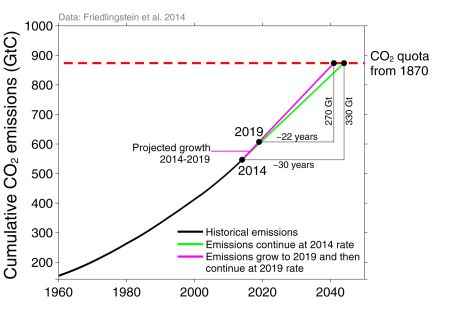
If emissions continue to grow as projected to 2019, and then continue at the 2019 rate, the remaining budget would be used about 22 years from 2019.

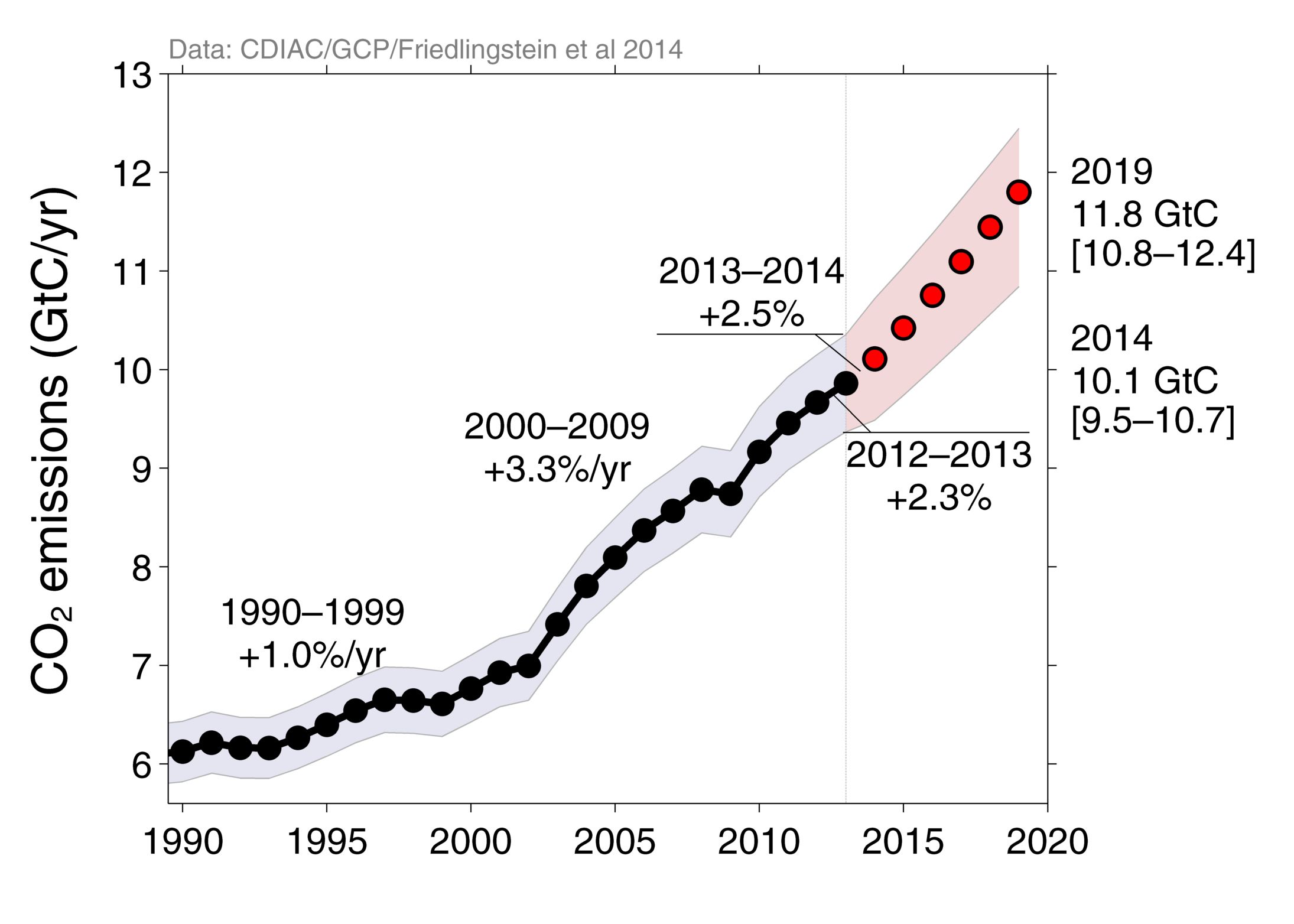
The second graphic, below, shows how the annual total emissions of carbon dioxide rose to about 37 gigatonnes in 2014 – and that, if the IMF’s projections about economic growth are correct, and if the gentle decline in the amount of emissions per unit of economic growth continues, the world economy will by 2019 be putting 43 gigatonnes of carbon dioxide per year into the atmosphere. Much too much.

The graphic also shows the complete failure of the Kyoto protocol, which was adopted in 1997 and entered into force in 2005, to make the slightest difference.
Carbon dioxide emissions 1990-2014, and projections by Friedlingstein et al, using economic growth estimates by the IMF and estimates of fossil fuel intensity based on a ten-year trend

The IPCC has accepted the idea of the carbon budget, and included it in its latest report. The table showing its view of the carbon budget is on page 61 of the Synthesis Report downloadable here.

There are a whole set of other issues – the uneven way that emissions produce warming (devilishly complex but getting clearer to scientists), factors both human-made and natural that counteract the warming effect, and the likely consequences of warming in terms of e.g. sea level rise, extreme weather eventsand damage to agriculture – and numbers that go with them.

Moreover, there is a fierce discussion between climate scientists about the 2 degrees target: many of them think it is too high, and that the risk of horrible consequences is already too great at 1.5 degrees.

Whatever your view of the dangers, the global carbon budget is the best measure of the speed at which the world economy is moving towards producing them, and the effectiveness (if any) of measures to slow that down and stop it.

Notes:
[1] In 2013, the shares of global emissions from burning fossil fuels and cement production were 28% by China, 14% by the USA and 10% by the EU (28 countries). Emissions from burning fossil fuels and cement production are about three-quarters of all emissions. (Sources: Global Carbon Project, IPCC Fifth Assessment Synthesis Report.)
[2] See Francis Fukuyama, The End of History and the Last Man (Free Press, 1992)
[3] P. Friedlingstein et al, “Persistent growth of CO2 emissions and implications for reaching climate targets”, Nature Geoscience vol. 7, October 2014, pp. 709-715.

Sunday, February 22, 2015

1746. Climate Change: U.S. Climate Denier Researcher Exposed with Ties to the Fossil-Fuel Industry

By Justin Gillis and John Schwartz, The New York Times, February 21, 2015
Wei-Hock Soon who holds a Ph.D. in aerospace engineering has been a vocal climate denier often cited by politicians and corporate tops who claim human caused climate change is a hoax 

For years, politicians wanting to block legislation on climate change have bolstered their arguments by pointing to the work of a handful of scientists who claim that greenhouse gases pose little risk to humanity.

One of the names they invoke most often is Wei-Hock Soon, known as Willie, a scientist at the Harvard-Smithsonian Center for Astrophysics who claims that variations in the sun’s energy can largely explain recent global warming. He has often appeared on conservative news programs, testified before Congress and in state capitals, and starred at conferences of people who deny the risks of global warming.

But newly released documents show the extent to which Dr. Soon’s work has been tied to funding he received from corporate interests.

He has accepted more than $1.2 million in money from the fossil-fuel industry over the last decade while failing to disclose that conflict of interest in most of his scientific papers. At least 11 papers he has published since 2008 omitted such a disclosure, and in at least eight of those cases, he appears to have violated ethical guidelines of the journals that published his work.

The documents show that Dr. Soon, in correspondence with his corporate funders, described many of his scientific papers as “deliverables” that he completed in exchange for their money. He used the same term to describe testimony he prepared for Congress.
Though Dr. Soon did not respond to questions about the documents, he has long stated that his corporate funding has not influenced his scientific findings.

The documents were obtained by Greenpeace, the environmental group, under the Freedom of Information Act. Greenpeace and an allied group, the Climate Investigations Center, shared them with several news organizations last week.

The documents shed light on the role of scientists like Dr. Soon in fostering public debate over whether human activity is causing global warming. The vast majority of experts have concluded that it is and that greenhouse emissions pose long-term risks to civilization.

Historians and sociologists of science say that since the tobacco wars of the 1960s, corporations trying to block legislation that hurts their interests have employed a strategy of creating the appearance of scientific doubt, usually with the help of ostensibly independent researchers who accept industry funding.

Fossil-fuel interests have followed this approach for years, but the mechanics of their activities remained largely hidden.

“The whole doubt-mongering strategy relies on creating the impression of scientific debate,” said Naomi Oreskes, a historian of science at Harvard University and the co-author of “Merchants of Doubt,” a book about such campaigns. “Willie Soon is playing a role in a certain kind of political theater.”

Environmentalists have long questioned Dr. Soon’s work, and his acceptance of funding from the fossil-fuel industry was previously known. But the full extent of the links was not; the documents show that corporate contributions were tied to specific papers and were not disclosed, as required by modern standards of publishing.

“What it shows is the continuation of a long-term campaign by specific fossil-fuel companies and interests to undermine the scientific consensus on climate change,” said Kert Davies, executive director of the Climate Investigations Center, a group funded by foundations seeking to limit the risks of climate change.

Charles R. Alcock, director of the Harvard-Smithsonian Center, acknowledged on Friday that Dr. Soon had violated the disclosure standards of some journals.

“I think that’s inappropriate behavior,” Dr. Alcock said. “This frankly becomes a personnel matter, which we have to handle with Dr. Soon internally.”

Dr. Soon is employed by the Smithsonian Institution, which jointly sponsors the astrophysics center with Harvard.

“I am aware of the situation with Willie Soon, and I’m very concerned about it,” W. John Kress, interim under secretary for science at the Smithsonian in Washington, said on Friday. “We are checking into this ourselves.”

Dr. Soon rarely grants interviews to reporters, and he did not respond to multiple emails and phone calls last week; nor did he respond to an interview request conveyed to him by his employer. In past public appearances, he has reacted angrily to questions about his funding sources, but then acknowledged some corporate ties and said that they had not altered his scientific findings.

“I write proposals; I let them decide whether to fund me or not,” he said at an event in Madison, Wis., in 2013. “If they choose to fund me, I’m happy to receive it.” A moment later, he added, “I would never be motivated by money for anything.”
The newly disclosed documents, plus additional documents compiled by Greenpeace over the last four years, show that at least $409,000 of Dr. Soon’s funding in the past decade came from Southern Company Services, a subsidiary of the Southern Company, based in Atlanta.

Southern is one of the largest utility holding companies in the country, with huge investments in coal-burning power plants. The company has spent heavily over many years to lobby against greenhouse-gas regulations in Washington. More recently, it has spent significant money to research ways to limit emissions.

“Southern Company funds a broad range of research on a number of topics that have potentially significant public-policy implications for our business,” said Jeannice M. Hall, a spokeswoman. The company declined to answer detailed questions about its funding of Dr. Soon’s research.

Dr. Soon also received at least $230,000 from the Charles G. Koch Charitable Foundation. (Mr. Koch’s fortune derives partly from oil refining.) However, other companies and industry groups that once supported Dr. Soon, including Exxon Mobil and the American Petroleum Institute, appear to have eliminated their grants to him in recent years.

As the oil-industry contributions fell, Dr. Soon started receiving hundreds of thousands of dollars through DonorsTrust, an organization based in Alexandria, Va., that accepts money from donors who wish to remain anonymous, then funnels it to various conservative causes.

The Harvard-Smithsonian Center for Astrophysics, in Cambridge, Mass., is a joint venture between Harvard and the Smithsonian Institution, housing some 300 scientists from both institutions. Because the Smithsonian is a government agency, Greenpeace was able to request that Dr. Soon’s correspondence and grant agreements be released under the Freedom of Information Act.

Though often described on conservative news programs as a “Harvard astrophysicist,” Dr. Soon is not an astrophysicist and has never been employed by Harvard. He is a part-time employee of the Smithsonian Institution with a doctoral degree in aerospace engineering. He has received little federal research money over the past decade and is thus responsible for bringing in his own funds, including his salary.

Though he has little formal training in climatology, Dr. Soon has for years published papers trying to show that variations in the sun’s energy can explain most recent global warming. His thesis is that human activity has played a relatively small role in causing climate change.

Many experts in the field say that Dr. Soon uses out-of-date data, publishes spurious correlations between solar output and climate indicators, and does not take account of the evidence implicating emissions from human behavior in climate change.

Gavin A. Schmidt, head of the Goddard Institute for Space Studies in Manhattan, a NASA division that studies climate change, said that the sun had probably accounted for no more than 10 percent of recent global warming and that greenhouse gases produced by human activity explained most of it.

“The science that Willie Soon does is almost pointless,” Dr. Schmidt said.
The Harvard-Smithsonian Center for Astrophysics, whose scientists focus largely on understanding distant stars and galaxies, routinely distances itself from Dr. Soon’s findings. The Smithsonian has also published a statement accepting the scientific consensus on climate change.

Dr. Alcock said that, aside from the disclosure issue, he thought it was important to protect Dr. Soon’s academic freedom, even if most of his colleagues disagreed with his findings.

Dr. Soon has found a warm welcome among politicians in Washington and state capitals who try to block climate action. United States Senator James M. Inhofe, an Oklahoma Republican who claims that climate change is a global scientific hoax, has repeatedly cited Dr. Soon’s work over the years.

In a Senate debate last month, Mr. Inhofe pointed to a poster with photos of scientists questioning the climate-change consensus, including Dr. Soon. “These are scientists that cannot be challenged,” the senator said. A spokeswoman for the senator said Friday that he was traveling and could not be reached for comment.

As of late last week, most of the journals in which Dr. Soon’s work had appeared were not aware of the newly disclosed documents. The Climate Investigations Center is planning to notify them over the coming week. Several journals advised of the situation by The New York Times said they would look into the matter.

Robert J. Strangeway, the editor of a journal that published three of Dr. Soon’s papers, said that editors relied on authors to be candid about any conflicts of interest. “We assume that when people put stuff in a paper, or anywhere else, they’re basically being honest,” said Dr. Strangeway, editor of the Journal of Atmospheric and Solar-Terrestrial Physics.

Dr. Oreskes, the Harvard science historian, said that academic institutions and scientific journals had been too lax in recent decades in ferreting out dubious research created to serve a corporate agenda.

“I think universities desperately need to look more closely at this issue,” Dr. Oreskes said. She added that Dr. Soon’s papers omitting disclosure of his corporate funding should be retracted by the journals that published them.

Friday, February 20, 2015

1745. Boston's Winter from Hell

By E. J. Graff, The New York Times, February 20, 2015


CAMBRIDGE, Mass. — BY now you’ve seen the starkly beautiful shots of Boston buried under snow: the panoramic city under a white blanket; snowbanks so high they crest over parked cars; piercing icicles glinting for two full stories from gutters dammed with ice; coat-muffled people dwarfed by snow-walled corridors that once were sidewalks.

You may have seen the funny images as well: the man snowboarding down an all-but-empty major boulevard, pulled by his friend’s snowmobile; drunk men diving out of second-floor windows into six-foot snowbanks; windows that merely frame a wall of snow.

But for those of us living here, it’s not a pretty picture. We are being devastated by a slow-motion natural disaster of historic proportions. The disaster is eerily quiet. There are no floating bodies or vistas of destroyed homes. But there’s no denying that this is a catastrophe.

In just three weeks, between Jan. 27 and Feb. 15, we have had four epic blizzards — seven feet of precipitation over three weeks — which crushed roofs, burst gutters, destroyed roads and sidewalks, closed schools and businesses, shut down highways, crippled public transit and trapped people in their homes. The infamous Blizzard of 1978 brought around 27 inches of snow and shut down the region for a week. In less than a month, we’ve seen more than three times as much snow. The temperature has hovered between 5 and 25 degrees, so the snow and ice haven’t melted.

Decades of underinvestment and alleged mismanagement of the Massachusetts Bay Transportation Authority, known as the T, have meant that the nation’s oldest subway system has been partly or entirely halted for nearly a month. (The head of the agency abruptly resigned last week amid criticism.)

On Twitter, a satirical map of the transit system has circulated, with entire subway and bus lines scribbled out with a black line, marked with “LOL,” and “Don’t even.” Across the region, mile-long lines of people stand for an hour or more, freezing in bitter winds, waiting for shuttle buses that are supposed to replace the trains and trolleys. Some have given up and walked home.

For workers paid by the hour, the impossibility of getting to work means disaster, especially since high housing prices have pushed poor people out of the city to outlying communities like Brockton, Lawrence and beyond. When I commiserated with a checkout clerk at my grocery store yesterday — he’s been missing work when the buses break down or just don’t come — thinly veiled panic showed in his eyes. “People will be losing their houses,” he said.

Even if you have a car, you can’t rely on it. Not everyone is spending the hours needed to dig it out, over and over again. Driving is a game of blind chicken, because the intersections are blocked by 12-foot mounds of plowed snow.

All roads are narrowed by plowed snow walls and snowed-under cars and deep slush that just can’t get cleared fast enough. And once a car turns into a putatively two-way street that’s now just one lane, who’s going to back up into traffic to let the other through? Once you arrive, where do you park?

Think about how annoying it is when one or two of your usual routes is temporarily shut down. That’s happened to every street here — with no end in sight. Car insurance companies are swamped with accident calls. Walking is treacherous: The Massachusetts Avenue Bridge over the Charles River, a major pedestrian artery that links Boston and Cambridge, is still inches deep with snow, but you can’t reach the railings because they are lined with snowbanks plowed in from earlier blizzards.

Working parents are desperate: When classes were canceled, they had to stay home, leave their kids alone or scramble to find child care. Even when the schools are open, many parents can’t work a full day: You drop off the child, spend two hours driving to work and have to leave early to get the child before after-school programs close.

But everybody is desperate. We’re all having to spend time and money we don’t have on plowing, car and house repairs, and heating because of the record-low temperatures. People who survive by holding down additional part-time jobs have had to skip those extra shifts.

Businesses have been hammered: Who’s going out to eat, shop or see a movie? How can businesses manufacture and deliver products or arrange deals if their workers just can’t show up? Some companies can let people work from home occasionally, but not every day for a month. Snow-removal services, roofers, chiropractors, and auto mechanics and body shops will profit — but that can’t possibly make up for what is drained from nearly every other business and household.

And it’s devastating for state and local governments. The City of Boston has spent $35 million on snow removal, more than twice what it had budgeted. That doesn’t include Cambridge or any of the surrounding towns, or the state. It doesn’t include how much it will cost to repair the devastated roads, sidewalks and bridges that will have been worn away by snow, freezing, salt and rust. Incoming tax revenues will fall because business and personal incomes are down. The state government expects to see a drop of $30 million in the next months.

Sure, it’s not the same as an earthquake: The snow will melt, eventually. But that will bring more woes. The flooding will hurt the T, ruin roofs and basements and clog roads still more.

Where are the federal disaster funds, the presidential visit, Anderson Cooper interviewing victims, volunteers flying in, goods and services donated after hurricanes and tornadoes? The pictures may be pretty. But we need help, now.

It’s snowing as I write this. We’re expecting more, along with freezing rain, this weekend. And the misery won’t end even when it all melts.

E. J. Graff is a senior fellow at the Schuster Institute for Investigative Journalism at Brandeis University.