Showing posts with label Climate deniers. Show all posts

Tuesday, July 14, 2015

1930. Exxon Knew About Climate Change In 1981 – And Covered It Up

By Caroline Reid, IFLScience!, July 10, 2015


It has recently come to light, thanks to one of Exxon's own climate experts, Lenny Bernstein, that this company knew about the connection between fossil fuels and climate change over 30 years ago. That's seven years before the dangers of climate change became a public issue. This shocking revelation came from an email sent by L. Bernstein to Alyssa Bernstein from Ohio University (no relation to Lenny Bernstein), and was reported in the Guardian.

L. Bernstein has been in the oil industry for 30 years, which included time as Exxon's in-house climate expert. He claimed that the possible effects that the company could have on climate change were first brought to their attention in 1981, when the company was debating whether to start farming Southeast Asia's largest gas field. The site, known as Natuna, included natural gas but also a large quantity of carbon dioxide (CO2), which is a significant contributor of climate change. “Exxon first got interested in climate change in 1981 because it was seeking to develop the Natuna gas field off Indonesia,” L. Bernstein wrote in his email to A. Bernstein.

“When I first learned about the project in 1989, the projections were that if Natuna were developed and its CO2 vented to the atmosphere, it would be the largest point source of CO2 in the world and account for about 1% of projected global CO2 emissions.”

L. Bernstein suggests that Exxon did not push ahead and mine the Natuna site, in order to limit the amount of greenhouse gases released into the atmosphere. ExxonMobile, however, has said that there could have been a “huge range of reasons” why they didn't pursue the site.

This means that Exxon could have known that humankind was having an impact on climate change a full 8 years before climate change was brought to the public eye. The first public announcement referencing climate change was in 1988, when a climate scientist called James Hansen announced to Congress that climate change was being caused by a build up of greenhouse gases in the atmosphere.

“What it shows is that Exxon knew years earlier than James Hansen’s testimony to Congress that climate change was a reality; that it accepted the reality, instead of denying the reality as they have done publicly, and to such an extent that it took it into account in their decision making, in making their economic calculation,” Alyssa Bernstein, the recipient of L. Bernstein's email, told the Guardian.

Federal Department of Justice lawyer Sharon Eubanks, who led a successful lawsuit against tobacco companies, noted the similarities between Exxon denying climate change and tobacco companies denying that smoking causes lung cancer. In both situations, the denial was opposed head-on with evidence to the contrary. Exxon's long history of publicly denying the links between climate change and human influence increases the company's liability for damage to the climate. 

“It starts to look like a much longer conspiracy. It's like what we discovered with tobacco – the more you push back the date of knowledge of the harm, the more you delay any remediation, the more people are affected. So your liability can grow exponentially as the timeline gets longer,” she said.

Exxon's denial of the connection between fossil fuels and climate change didn't stop at just brushing off a couple of claims. The company has spent millions on research that actively promotes climate change denial. 

“Instead of taking responsibility, they have either directly – or indirectly through trade and industry groups – sown doubt about the science of climate change and fought efforts to cut emissions,” wrote L. Bernstein.

Wednesday, June 17, 2015

1886. Naomi Oreskes: A Historian of Science Who Exposed Climate Deniers

By Justin Gillis, The New New York Times, June 15, 2015


The job interviewer scrutinized the young American geology student sitting across from him. She was about to graduate from the Royal School of Mines in London, and was trying to break into a field long unwelcoming to women.

What, he wanted to know, might she have to contribute to the geology of mining? Naomi Oreskes had a simple answer: “I want to find an ore deposit!”

She wound up in the Australian outback in the early 1980s — not to search for deposits, exactly, but to help work out the complex geology of one that had just been found. It would eventually become one of the world’s largest uranium mines.

Yet, in time, prospecting for ores could not hold her interest. Today, from a professorship at Harvard University, Dr. Oreskes is still in the mining business. But rather than digging for minerals, she tunnels into historical archives, and she is still finding radioactive nuggets.

Dr. Oreskes is fast becoming one of the biggest names in climate science — not as a climatologist, but as a defender who uses the tools of historical scholarship to counter what she sees as ideologically motivated attacks on the field.

Formally, she is a historian of science. Informally, this diminutive woman has become a boxer, throwing herself into a messy public arena that many career-minded climate scientists try to avoid.

She helps raise money to defend researchers targeted for criticism by climate change denialists. She has become a heroine to activist college students, supporting their demand that universities and other institutions divest from fossil fuels. Climatologists, though often reluctant themselves to get into fights, have showered her with praise for being willing to do it.

“Her courage and persistence in communicating climate science to the wider public have made her a living legend among her colleagues,” two climate researchers, Benjamin D. Santer and John Abraham, wrote in a prize-nomination letter in 2011.

Dr. Oreskes’s approach has been to dig deeply into the history of climate change denial, documenting its links to other episodes in which critics challenged a developing scientific consensus.

Her core discovery, made with a co-author, Erik M. Conway, was twofold. They reported that dubious tactics had been used over decades to cast doubt on scientific findings relating to subjects like acid rain, the ozone shield, tobacco smoke and climate change. And most surprisingly, in each case, the tactics were employed by the same group of people.

The central players were serious scientists who had major career triumphs during the Cold War, but in subsequent years apparently came to equate environmentalism with socialism, and government regulation with tyranny.

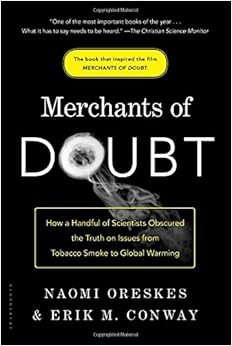
In a 2010 book, Dr. Oreskes and Dr. Conway called these men “Merchants of Doubt,” and this spring the book became a documentary film, by Robert Kenner. At the heart of both works is a description of methods that were honed by the tobacco industry in the 1960s and have since been employed to cast doubt on just about any science being cited to support new government regulations

Dr. Oreskes, the more visible and vocal of the “Merchants” authors, has been threatened with lawsuits and vilified on conservative websites, and routinely gets hate mail calling her a communist or worse.

Complaints about some of her research were filed at her previous employer, the University of California, San Diego, though never upheld. In leaked emails, one of the men she has targeted in her writing, the physicist S. Fred Singer, complained that she was protected at that institution by “a mostly feminist mafia.”

Who is the woman at the center of this whirlwind?

Born in 1958, Dr. Oreskes grew up in Manhattan, displaying keen musical abilities as well as an interest in following her father into scientific research. A high-school and college boyfriend, Jonathan Pershing, recalled watching her practice a piece of piano music endlessly until she nailed it. “She has always been incredibly intense,” he said.

She started at Brown University, but finished her undergraduate geology degree abroad, at the storied Royal School of Mines. A former faculty member, Richard H. Sibson, said the British educational system at the time was characterized by “benign neglect” of students, but he grew fond of watching this brash young American solicit a good education.

“She reminded me of Lucy in the Peanuts cartoon, stalking the corridors with a metaphorical softball bat on her shoulders, looking for faculty to slug if she thought we weren’t doing our jobs,” Dr. Sibson said.

After graduating with high honors, she won a job in 1981 as a young field geologist for Western Mining, an Australian company developing a site called Olympic Dam. The geology there was so complex that after three years she decided to return to the United States to pursue a doctoral degree at Stanford University as a way to better understand it.

But she felt a growing desire to plunge into more fundamental questions about the nature and history of science.

She established her career as a historian with a book-length study examining the role of dissent in the scientific method. As she put it a few months ago to an audience at Indiana University, she wanted to wrestle with this question: “How do you distinguish a maverick from a crank?”

Her subject was Alfred Wegener, the German scientist who proposed in 1912 that continents drifted around the earth. Initially rejected, his idea was revived decades after his death to become, in a modified form, the theory of plate tectonics.

Dr. Oreskes found that Wegener had been treated badly, particularly by American geologists. But he did not abandon his faith in the scientific method. He kept publishing until his death in 1930, trying to convince fellow scientists of his position, and was finally vindicated three decades later by oceanographic research conducted during the Cold War.

As she completed that study, Dr. Oreskes sought to understand how science was affected not only by the Cold War but by its end. In particular, she started wondering about climate science. Global warming had seemed to rise as an important issue around the time the Iron Curtain came down. Was this just a way for scientists to scare up research money that would no longer be coming their way through military channels?

By the early 2000s, she and her husband, Kenneth Belitz, had two daughters, and she had taken a permanent faculty position at San Diego, where she would stay until Harvard recruited her in 2013.

At the time, the widespread public impression was that scientists were still divided over whether humans were primarily responsible for the warming of the planet. But how sharp was the split, she wondered?

She decided to do something no climate scientist had thought to do: count the published scientific papers. Pulling 928 of them, she was startled to find that not one dissented from the basic findings that warming was underway and human activity was the main reason.

She published that finding in a short paper in the journal Science in 2004, and the reaction was electric. Advocates of climate action seized on it as proof of a level of scientific consensus that most of them had not fully perceived. Just as suddenly, Dr. Oreskes found herself under political attack.

Some of the voices criticizing her — scientists like Dr. Singer and groups like the George C. Marshall Institute in Washington — were barely known to her at the time, Dr. Oreskes said in an interview. Just who were they?

She had connected by then with Dr. Conway, an official NASA historian who, working on his own time, helped her dig into some important archives. It did not take them long to document that this group, which included prominent Cold War scientists, had been attacking environmental research for decades, challenging the science of the ozone layer and acid rain, even the finding that breathing secondhand tobacco smoke was harmful. Trying to undermine climate science was simply the latest project.

Dr. Oreskes and Dr. Conway came to believe that the attacks were patterned on the strategy employed by the tobacco industry when evidence of health risks first emerged. Documents pried loose by lawyers showed that the industry had paid certain scientists to contrive dubious research, had intimidated reputable scientists, and had cherry-picked evidence to present a misleading picture.

The tobacco industry had used these tactics in defense of profits. But Dr. Oreskes and Dr. Conway wrote that the so-called merchants of doubt had adopted them for a deep ideological reason: contempt for government regulation. The insight gave climate scientists a new way of understanding the politics that had engulfed their field.

Following Dr. Oreskes’s cue, researchers have in recent years developed a cottage industry of counting scientific papers and polling scientists. The results typically show that about 97 percent of working climate scientists accept that global warming is happening, that humans are largely responsible, and that the situation poses long-term risks, though the severity of those risks is not entirely clear. That wave of evidence has prompted many national news organizations to stop portraying the field as split evenly between scientists who are convinced and unconvinced.

The themes in “Merchants of Doubt” have hardly gone unchallenged, though, and the protests have not always originated on the far right. A vigorous objection has come from the family of William A. Nierenberg, one of the scientists singled out for criticism in the book. Dr. Oreskes and Dr. Conway accused Dr. Nierenberg of weakening two major scientific reports that he led in the early 1980s, one on acid rain and one on global warming.

Dr. Nierenberg died in 2000, but his son, daughter and son-in-law have compiled a detailed critique contending that the historians misrepresented Dr. Nierenberg’s activities. “If you read her writing on the subjects I am familiar with, you know less about the topic than before you started,” Nicolas Nierenberg said in an interview

A former staff officer at the National Research Council who helped oversee the preparation of the global warming report, John S. Perry, also said he felt that Dr. Oreskes had been unfair to Dr. Nierenberg. “That sort of bothers me, because her book ‘Merchants of Doubt’ is otherwise so good,’” he said in an interview, adding that in his view the 1983 climate report stands up to scrutiny even in hindsight.

Dr. Oreskes has disputed the specific complaints raised by the Nierenberg siblings, but she did say in an interview that she somewhat regretted the tone of one article on Dr. Nierenberg — a paper that compared him to Dr. Pangloss, the character in Voltaire’s “Candide” who is optimistic about the future to the point of delusion.

“I concede that the tone was somewhat aggressive,” Dr. Oreskes said. “We were still working out the argument at the time. But we stand by every fact in that paper.”

Dr. Oreskes’s critics have taken delight in searching out errors in her books and other writings, prompting her to post several corrections. They have generally been minor, though, like describing a pH of six as neutral, when the correct number is seven. Dr. Oreskes described that as a typographical error.

In the leaked emails, Dr. Singer told a group of his fellow climate change denialists that he felt that Dr. Oreskes and Dr. Conway had libeled him. But in an interview, when pressed for specific errors in the book that might constitute libel, he listed none. Nor did he provide such a list in response to a follow-up email request.

He said he had consulted with lawyers about suing Dr. Oreskes, but had ruled it out.

“I decided it was too expensive and too time-consuming,” Dr. Singer said. “She could probably outspend me. She’s made an awful lot of money out of this book and out of her lectures.”

Informed of this remark, Dr. Oreskes laughed aloud. “If I had wanted to make money, I would have stayed in the mining business,” she said.

However much she might be hated by climate change denialists, Dr. Oreskes is often welcomed on college campuses these days. She usually outlines the decades of research supporting the idea that human emissions pose serious risks.

“One of the things that should always be asked about scientific evidence is, how old is it?” Dr. Oreskes said. “It’s like wine. If the science about climate change were only a few years old, I’d be a skeptic, too.”

Dr. Oreskes and Dr. Conway keep looking for ways to reach new audiences. Last year, they published a short work of science fiction, written as a historical essay from the distant future. “The Collapse of Western Civilization: A View From the Future” argues that conservatives, by fighting sensible action to cope with the climate crisis, are essentially guaranteeing the long-term outcome they fear, a huge expansion of government.

The far right is unpersuaded, of course. People pushing climate denial on the Internet regularly issue new attacks on Dr. Oreskes, who is no longer surprised by them.

“Most people would think it’s a bad thing to be a lightning rod, and I cannot say I enjoy it,” she said. “But remember, the whole purpose of a lightning rod is to keep people safe.”

Tuesday, April 28, 2015

1827. Pope Francis Steps Up Campaign on Climate Change, to Conservatives’ Alarm

By Coral Davenport and Laurie Goldstein, The New York Times, April 27, 2015
Pope Francis
WASHINGTON — Since his first homily in 2013, Pope Francis has preached about the need to protect the earth and all of creation as part of a broad message on the environment. It has caused little controversy so far.

But now, as Francis prepares to deliver what is likely to be a highly influential encyclical this summer on environmental degradation and the effects of human-caused climate change on the poor, he is alarming some conservatives in the United States who are loath to see the Catholic Church reposition itself as a mighty voice in a cause they do not believe in.

As part of the effort for the encyclical, top Vatican officials will hold a summit meeting Tuesday to build momentum for a campaign by Francis to urge world leaders to enact a sweeping United Nations climate change accord in Paris in December. The accord would for the first time commit every nation to enact tough new laws to cut the emissions that cause global warming.

The Vatican summit meeting will focus on the links between poverty, economic development and climate change, with speeches and panel discussions by climate scientists and religious leaders, and economists like Jeffrey Sachs of Columbia. The United Nations secretary general, Ban Ki-moon, who is leading efforts to forge the Paris accord, will deliver the opening address.

Vatican officials, who have spent more than a year helping Francis prepare his message, have convened several meetings already on the topic. Last month, they met with the administrator of the Environmental Protection Agency, Gina McCarthy.

In the United States, the encyclical will be accompanied by a 12-week campaign, now being prepared with the participation of some Catholic bishops, to raise the issue of climate change and environmental stewardship in sermons, homilies, news media interviews and letters to newspaper editors, said Dan Misleh, executive director of the Catholic Climate Covenant in Washington.

But the effort is already angering a number of American conservatives, among them members of the Heartland Institute, a libertarian group partly funded by the Charles G. Koch Foundation, run by the billionaire industrialist Koch brothers, who oppose climate policy.

“The Holy Father is being misled by ‘experts’ at the United Nations who have proven unworthy of his trust,” Joseph Bast, the president of the Heartland Institute, said in a statement. “Though Pope Francis’ heart is surely in the right place, he would do his flock and the world a disservice by putting his moral authority behind the United Nations’ unscientific agenda on the climate.”

The institute plans to hold a news conference and panel event in Rome on Tuesday in protest of the Vatican summit meeting.

But climate policy advocates see a scheduled address by the pope to Congress in September as a potent moment — about 30 percent of members of Congress are Catholics, more than belong to any other religion, according to a study published this year by the Pew Research Center.

Speaker John A. Boehner, Republican of Ohio, invited the pope to speak to Congress, but some Catholics say that Mr. Boehner should prepare for some uncomfortable moments. Mr. Boehner, who is Catholic, has often criticized the Obama administration for what he calls its “job killing” environmental agenda.


“I think Boehner was out of his mind to invite the pope to speak to Congress,” said the Rev. Thomas Reese, an analyst at the National Catholic Reporter. “Can you imagine what the Republicans will do when he says, ‘You’ve got to do something about global warming’? ”

In addition, a number of Catholics — including Jeb Bush, Marco Rubio, Bobby Jindal, Chris Christie and Rick Santorum — are gearing up to compete for the Republican presidential nomination, and most of them question the science of human-caused climate change.

Several conservative Catholic intellectuals who expect the pope’s message to bolster the vast majority of scientists who hold that climate change is induced by human activity, including Robert P. George, a Princeton law professor, have published articles reminding Catholics that papal pronouncements on science are not necessarily sound or binding.

Maureen Mullarkey, a painter and writer, said in the conservative journal First Things that “Francis sullies his office by using demagogic formulations to bully the populace into reflexive climate action with no more substantive guide than theologized propaganda.”

Timothy E. Wirth, vice chairman of the United Nations Foundation, said: “We’ve never seen a pope do anything like this. No single individual has as much global sway as he does. What he is doing will resonate in the government of any country that has a leading Catholic constituency.”

Francis, however, is not the first pope to push an environmental message. His predecessor, Pope Benedict XVI, called the “green pope” by some, wrote about the environment and the impact of climate change in documents that have been collected in a book, “The Environment.” But Catholic and climate policy experts acknowledge that those works had little substantive impact on global warming policy.

Francis’ policy moves on climate change, particularly his use of the encyclical, go far beyond what has come before. Catholics point to other papal encyclicals that have had public policy impacts: Pope Leo XIII’s 1891 encyclical on labor and workers’ rights is believed to have spurred the workers’ rights movement and led to the creation of labor unions.

“I think this moves the needle,” said Charles J. Reid Jr., a professor at the University of St. Thomas School of Law. “Benedict was an ivory-tower academic. He wrote books and hoped they would persuade by reason. But Pope Francis knows how to sell his ideas. He is engaged in the marketplace.”

Francis, who chose the name of St. Francis of Assisi, the patron saint of animals and the environment, has had far more influence on the church and public. Born in Argentina, Francis draws cheering crowds from around the world and millions of followers to his social media accounts. He has been embraced for his humility, antipoverty agenda, progressive statements on social issues and efforts to reform the Vatican bureaucracy.

This month he said in a Twitter post: “We need to care for the earth so that it may continue, as God willed, to be a source of life for the entire human family.”

The pope’s influence on the Paris climate accord may be strongest in Latin America. In past years, Latin American countries have resisted efforts to enact climate policy, arguing that developing economies should not have to cut emissions while developed economies continue to pollute.

But over the past year, some Latin American governments have signaled a willingness to step forward on climate policy, and this year Mexico became one of the first nations to submit a plan ahead of the Paris talks.

“This pope is more than just a church leader — he is a political leader, particularly in Latin America,” said Romina Picolotti, president of the Center for Human Rights and Environment in Argentina. “Youth in Latin America are really following him closely.”

Sunday, February 22, 2015

1746. Climate Change: U.S. Climate Denier Researcher Exposed with Ties to the Fossil-Fuel Industry

By Justin Gillis and John Schwartz, The New York Times, February 21, 2015
Wei-Hock Soon who holds a Ph.D. in aerospace engineering has been a vocal climate denier often cited by politicians and corporate tops who claim human caused climate change is a hoax 

For years, politicians wanting to block legislation on climate change have bolstered their arguments by pointing to the work of a handful of scientists who claim that greenhouse gases pose little risk to humanity.

One of the names they invoke most often is Wei-Hock Soon, known as Willie, a scientist at the Harvard-Smithsonian Center for Astrophysics who claims that variations in the sun’s energy can largely explain recent global warming. He has often appeared on conservative news programs, testified before Congress and in state capitals, and starred at conferences of people who deny the risks of global warming.

But newly released documents show the extent to which Dr. Soon’s work has been tied to funding he received from corporate interests.

He has accepted more than $1.2 million in money from the fossil-fuel industry over the last decade while failing to disclose that conflict of interest in most of his scientific papers. At least 11 papers he has published since 2008 omitted such a disclosure, and in at least eight of those cases, he appears to have violated ethical guidelines of the journals that published his work.

The documents show that Dr. Soon, in correspondence with his corporate funders, described many of his scientific papers as “deliverables” that he completed in exchange for their money. He used the same term to describe testimony he prepared for Congress.
Though Dr. Soon did not respond to questions about the documents, he has long stated that his corporate funding has not influenced his scientific findings.

The documents were obtained by Greenpeace, the environmental group, under the Freedom of Information Act. Greenpeace and an allied group, the Climate Investigations Center, shared them with several news organizations last week.

The documents shed light on the role of scientists like Dr. Soon in fostering public debate over whether human activity is causing global warming. The vast majority of experts have concluded that it is and that greenhouse emissions pose long-term risks to civilization.

Historians and sociologists of science say that since the tobacco wars of the 1960s, corporations trying to block legislation that hurts their interests have employed a strategy of creating the appearance of scientific doubt, usually with the help of ostensibly independent researchers who accept industry funding.

Fossil-fuel interests have followed this approach for years, but the mechanics of their activities remained largely hidden.

“The whole doubt-mongering strategy relies on creating the impression of scientific debate,” said Naomi Oreskes, a historian of science at Harvard University and the co-author of “Merchants of Doubt,” a book about such campaigns. “Willie Soon is playing a role in a certain kind of political theater.”

Environmentalists have long questioned Dr. Soon’s work, and his acceptance of funding from the fossil-fuel industry was previously known. But the full extent of the links was not; the documents show that corporate contributions were tied to specific papers and were not disclosed, as required by modern standards of publishing.

“What it shows is the continuation of a long-term campaign by specific fossil-fuel companies and interests to undermine the scientific consensus on climate change,” said Kert Davies, executive director of the Climate Investigations Center, a group funded by foundations seeking to limit the risks of climate change.

Charles R. Alcock, director of the Harvard-Smithsonian Center, acknowledged on Friday that Dr. Soon had violated the disclosure standards of some journals.

“I think that’s inappropriate behavior,” Dr. Alcock said. “This frankly becomes a personnel matter, which we have to handle with Dr. Soon internally.”

Dr. Soon is employed by the Smithsonian Institution, which jointly sponsors the astrophysics center with Harvard.

“I am aware of the situation with Willie Soon, and I’m very concerned about it,” W. John Kress, interim under secretary for science at the Smithsonian in Washington, said on Friday. “We are checking into this ourselves.”

Dr. Soon rarely grants interviews to reporters, and he did not respond to multiple emails and phone calls last week; nor did he respond to an interview request conveyed to him by his employer. In past public appearances, he has reacted angrily to questions about his funding sources, but then acknowledged some corporate ties and said that they had not altered his scientific findings.

“I write proposals; I let them decide whether to fund me or not,” he said at an event in Madison, Wis., in 2013. “If they choose to fund me, I’m happy to receive it.” A moment later, he added, “I would never be motivated by money for anything.”
The newly disclosed documents, plus additional documents compiled by Greenpeace over the last four years, show that at least $409,000 of Dr. Soon’s funding in the past decade came from Southern Company Services, a subsidiary of the Southern Company, based in Atlanta.

Southern is one of the largest utility holding companies in the country, with huge investments in coal-burning power plants. The company has spent heavily over many years to lobby against greenhouse-gas regulations in Washington. More recently, it has spent significant money to research ways to limit emissions.

“Southern Company funds a broad range of research on a number of topics that have potentially significant public-policy implications for our business,” said Jeannice M. Hall, a spokeswoman. The company declined to answer detailed questions about its funding of Dr. Soon’s research.

Dr. Soon also received at least $230,000 from the Charles G. Koch Charitable Foundation. (Mr. Koch’s fortune derives partly from oil refining.) However, other companies and industry groups that once supported Dr. Soon, including Exxon Mobil and the American Petroleum Institute, appear to have eliminated their grants to him in recent years.

As the oil-industry contributions fell, Dr. Soon started receiving hundreds of thousands of dollars through DonorsTrust, an organization based in Alexandria, Va., that accepts money from donors who wish to remain anonymous, then funnels it to various conservative causes.

The Harvard-Smithsonian Center for Astrophysics, in Cambridge, Mass., is a joint venture between Harvard and the Smithsonian Institution, housing some 300 scientists from both institutions. Because the Smithsonian is a government agency, Greenpeace was able to request that Dr. Soon’s correspondence and grant agreements be released under the Freedom of Information Act.

Though often described on conservative news programs as a “Harvard astrophysicist,” Dr. Soon is not an astrophysicist and has never been employed by Harvard. He is a part-time employee of the Smithsonian Institution with a doctoral degree in aerospace engineering. He has received little federal research money over the past decade and is thus responsible for bringing in his own funds, including his salary.

Though he has little formal training in climatology, Dr. Soon has for years published papers trying to show that variations in the sun’s energy can explain most recent global warming. His thesis is that human activity has played a relatively small role in causing climate change.

Many experts in the field say that Dr. Soon uses out-of-date data, publishes spurious correlations between solar output and climate indicators, and does not take account of the evidence implicating emissions from human behavior in climate change.

Gavin A. Schmidt, head of the Goddard Institute for Space Studies in Manhattan, a NASA division that studies climate change, said that the sun had probably accounted for no more than 10 percent of recent global warming and that greenhouse gases produced by human activity explained most of it.

“The science that Willie Soon does is almost pointless,” Dr. Schmidt said.
The Harvard-Smithsonian Center for Astrophysics, whose scientists focus largely on understanding distant stars and galaxies, routinely distances itself from Dr. Soon’s findings. The Smithsonian has also published a statement accepting the scientific consensus on climate change.

Dr. Alcock said that, aside from the disclosure issue, he thought it was important to protect Dr. Soon’s academic freedom, even if most of his colleagues disagreed with his findings.

Dr. Soon has found a warm welcome among politicians in Washington and state capitals who try to block climate action. United States Senator James M. Inhofe, an Oklahoma Republican who claims that climate change is a global scientific hoax, has repeatedly cited Dr. Soon’s work over the years.

In a Senate debate last month, Mr. Inhofe pointed to a poster with photos of scientists questioning the climate-change consensus, including Dr. Soon. “These are scientists that cannot be challenged,” the senator said. A spokeswoman for the senator said Friday that he was traveling and could not be reached for comment.

As of late last week, most of the journals in which Dr. Soon’s work had appeared were not aware of the newly disclosed documents. The Climate Investigations Center is planning to notify them over the coming week. Several journals advised of the situation by The New York Times said they would look into the matter.

Robert J. Strangeway, the editor of a journal that published three of Dr. Soon’s papers, said that editors relied on authors to be candid about any conflicts of interest. “We assume that when people put stuff in a paper, or anywhere else, they’re basically being honest,” said Dr. Strangeway, editor of the Journal of Atmospheric and Solar-Terrestrial Physics.

Dr. Oreskes, the Harvard science historian, said that academic institutions and scientific journals had been too lax in recent decades in ferreting out dubious research created to serve a corporate agenda.

“I think universities desperately need to look more closely at this issue,” Dr. Oreskes said. She added that Dr. Soon’s papers omitting disclosure of his corporate funding should be retracted by the journals that published them.