Showing posts with label Capitalism and climate change. Show all posts

Sunday, August 15, 2021

3542. The UN Sounds Red Alert on the Climate Crisis: Interview with Kamran Nayeri (in Farsi)

By Kamran Nayeri and Arash Kamangar, Barbari TV, August 12, 2021

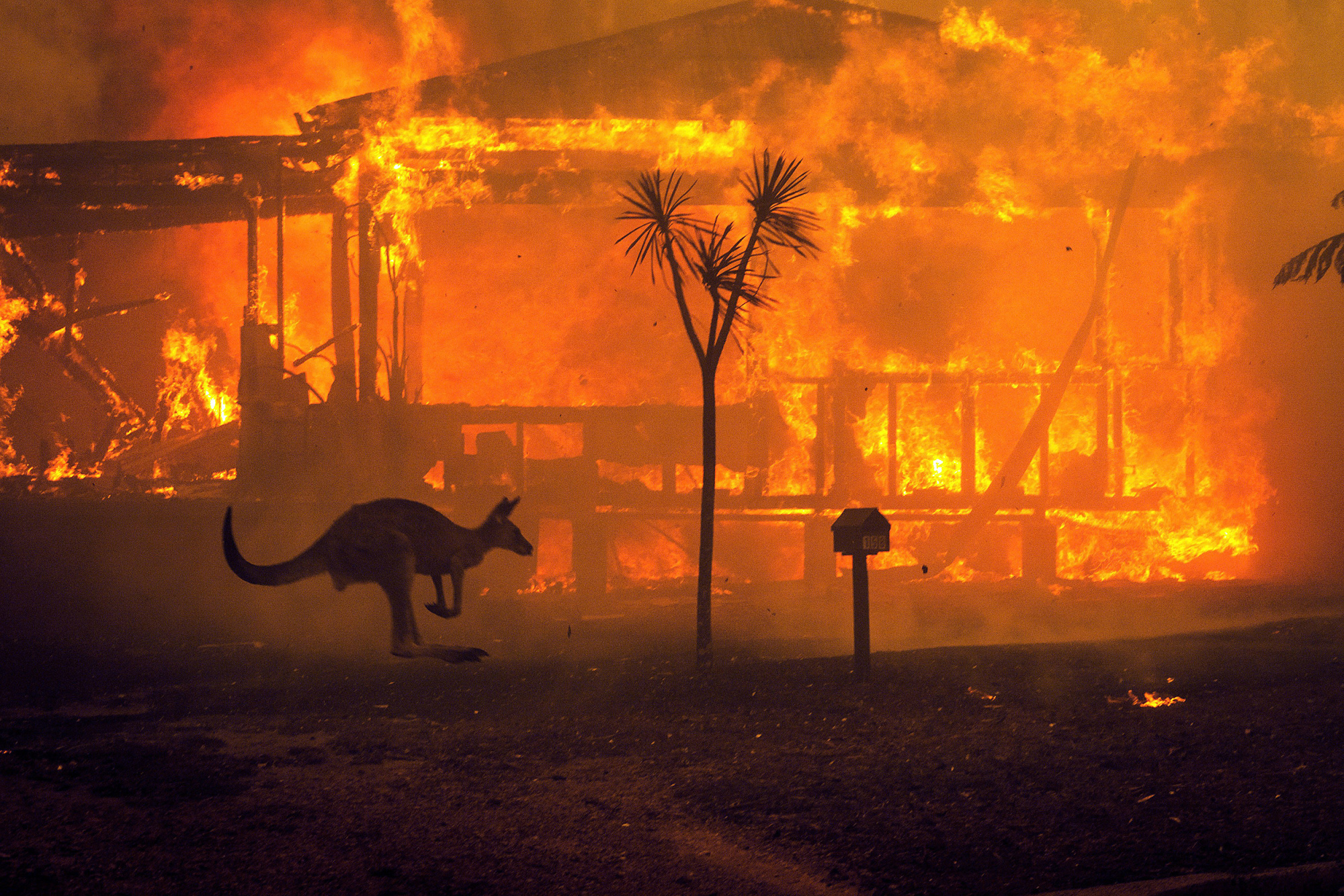
Wildfires in Australia, February 4, 2021

"Global greenhouse gas emissions must peak in the next four years, coal and gas-fired power plants must close in the next decade and lifestyle and behavioural changes will be needed to avoid climate breakdown, according to the leaked draft of a report from the world’s leading authority on climate science.

"Rich people in every country are overwhelmingly more responsible for global heating than the poor, with SUVs and meat-eating singled out for blame, and the high-carbon basis for future economic growth is also questioned.

"The leak is from the forthcoming third part of the landmark report by the Intergovernmental Panel on Climate Change, the first part of which was published on Monday, warning of unprecedented changes to the climate, some of them irreversible. The document, called the sixth assessment report, is divided into three parts: the physical science of climate change; the impacts and ways of reducing human influence on the climate."  (The Guardian, August 12, 2021) 

Meanwhile, The New York Times reports:

"Leaders of vulnerable countries, as well as activists, said Monday’s blistering United Nations report must galvanize global action. But major emitters are dragging their heels."


Sunday, November 18, 2018

3085. Brazil's Top Diplomat Calls Climate Change a Marxist Plot

by Jonathan Watts, The Guardian, November 15, 2018

Ernesto Araujo, right, has been nominated by President-elect Jair Bolsonaro, left, to be Brazil’s top diplomat. His appointment could undermine Brazil’s leading global role on climate change.
Ernesto Araujo, right, has been nominated by President-elect Jair Bolsonaro, left, to be Brazil’s top diplomat. His appointment could undermine Brazil’s leading role in climate change. Photograph: Sergio Lima/AFP/Getty Images


Brazil’s president-elect Jair Bolsonaro has chosen a new foreign minister who believes climate change is part of a plot by “cultural Marxists” to stifle western economies and promote the growth of China.

Ernesto Araújo – until recently a mid-ranking official who blogs about the “criminalisation” of red meat, oil, and heterosexual sex – will become the top diplomat of South America’s biggest nation, representing 200 million people and the greatest and most biodiverse forest on Earth, the Amazon.
His appointment, confirmed by Bolsonaro on Wednesday, is likely to send a chill through the global climate movement.
Brazil was where the international community first came together in 1992 to discuss reductions in greenhouse gas emissions. Its diplomats have played a crucial role in bridging the gap between rich and poor nations, particularly during the forging of the Paris agreement in 2015]

But when the new government takes power in January, the foreign ministry that leads that work will be headed by a man who claims climate science is mere “dogma”.
In his blog, Araújo states his goal is to “help Brazil and the world liberate themselves from globalist ideology”, which he sees as anti-Christian.
The 51-year-old diplomat – who has never served as an overseas ambassador – claims unnamed leftist politicians have hijacked environmentalism to serve as a tool for global domination.
“This dogma has been used to justify increasing the regulatory power of states over the economy and the power of international institutions on the nation states and their populations, as well as to stifle economic growth in democratic capitalist countries and to promote the growth of China,” he wrote in a post last month.
In another, he claimed the centre-left Workers party in Brazil was “criminalising sex and reproduction, saying that all heterosexual intercourse is rape and every baby is a risk to the planet as it will increase carbon emissions”. He then went on to accuse the party of criminalising red meat, oil, air conditioners and Disney movies.
The incendiary rhetoric echoes that of Bolsonaro, who won last month’s presidential election with about 57.7m votes. The former army captain has since moved to put in place one of the world’s most far-right administrations and promised to align Brazil more closely to Trump and the US.
Climate negotiation experts said the appointment was sad for Brazil and the world – though they held out hope that the new foreign minister will be more pragmatic when he comes to represent his country.
“Brazil has played a very significant role for the Paris agreement. It would be really bad for the country’s image if he brings with him his ideology,” said Carlos Rittl, the executive secretary of the Brazilian Climate Observatory.
He said climate was the one area where Brazil could proudly boast to be a global leader, and urged the new foreign minister and president not to isolate the country in this field.
“Bolsonaro is not Trump. Brazil is not the United States. We don’t have the same cards,” he said. “If Brazil becomes a pariah on the global climate agenda, it would be extremely bad for our business, especially agribusiness. When they go to Europe to negotiate a deal, climate safeguards will be on the table. ”
The risk of losing soya and beef sales in Europe is thought to be why Bolsonaro has backtracked on threats to quit the Paris agreement and merge the agriculture and environment ministries.
But he remains intent on opening up the Amazon to the farmers, miners and construction companies that supported his campaign.
His pick as agriculture minister is the head of the farming lobby, Tereza Cristina Dias, who conservationists have nicknamed the “Muse of Poison” due to her enthusiastic support for relaxing controls on agro-toxins.
She and her colleagues are said to be gutting the responsibilities of the environment ministry before its new head is appointed. The environment institution is likely to be so subservient that insiders joke there will soon be two agriculture ministries in Brazil.
The slim hope now for climate advocates is that the powerful agribusiness lobby will come to realise that the rain for their crops depends on a healthy Amazon and stable global environment. More than 80% of Brazil’s municipalities have experienced drought in the past five years, which scientists have linked to deforestation.
But loggers are not waiting. The latest deforestation figures showed a sharp rise in deforestation during the election campaign, suggesting protections for nature and indigenous land are already weakening.

Wednesday, October 17, 2018

3049. Is There Time to Stop Climate Catastrophe?

By Phil Gasper, SocialistWorker.org, October 16, 2018


 The latest report from the Intergovernmental Panel on Climate Change (IPCC) is dire. The headline in the New York Times said there is a “strong risk of crisis” by 2040. 
The Washington Post said we have “just over a decade to get climate change under control.” How bad is it, and what do these timelines mean?

The situation certainly is dire, though we’ve known that for the past 30 years. What we now have are more accurate models of how serious the consequences of global warming will be.
One thing to remember is that the IPCC is a body set up by the United Nations. It is staffed by leading climate change experts, but it only issues reports that are acceptable to the governments they represent. So IPCC predictions tend to be very conservative. Historically, they have consistently underestimated how quickly the climate is warming and how serious the effects will be.

With respect to how quickly the climate is warming, we have pretty good models. In particular, we know the effects of pumping more and more carbon into the atmosphere. It’s simple physics that this will result in average global temperatures going up due to the greenhouse effect.

What’s more difficult to model are the so-called “tipping points” and feedback loops. For instance, as the world warms, the polar ice caps start to melt. We’re already at the point where the Arctic is almost ice-free during the summer. With less ice, less sunlight is reflected back into space. Instead, it’s absorbed by the ocean, which in turn speeds up ice loss, so even less sunlight is reflected into space, and so on.

A further effect is that as global warming increases, permafrost — ground that is frozen — begins to thaw, releasing trapped methane. Methane is a greenhouse gas that has an even bigger impact on warming than carbon dioxide — in the short term, although it does dissipate much faster.

This is another feedback loop: More methane released into the atmosphere means warmer temperatures, which means more loss of permafrost, which means more methane in the atmosphere, and a continuing downward spiral.

All this means that warming may happen even faster than the IPCC predicts. But the dire predictions in the latest report have more to do with the consequences of warming.

When the Paris climate agreement was signed in December 2015, the prevailing wisdom was that it is essential to keep global warming to less than 2 degrees Celsius compared to the average pre-industrial temperature. The agreement said it would be better to keep the increase to less than 1.5 degrees Celsius, but 2 degrees was the goal.

The new report shows why even 2 degrees is too much. If we go above 1.5 degrees, the consequences will be devastating in terms of rising sea levels, more intense hurricanes, more severe heat waves, wildfires, droughts and flooding due to changing weather patterns, damage to agriculture, food shortages, accelerated rates of extinction and loss of biodiversity, the death of all coral reefs — the list goes on.

Of course, we’ve already begun to see these effects with only 1 degree Celsius of warming above the pre-industrial level. If warming reaches 2 degrees, the effects will be exponentially worse. If it reaches 3 or 4 degrees by the end of the century, the future of human civilization and even our survival as a species starts to come into question.

If fossil-fuel use continues on its current trajectory — which, incredibly, is still rising — then the consequences will already be catastrophic by 2040.

But we already know now what we need to do to address the problem, which is to eliminate all fossil-fuel usage by mid-century. If we haven’t taken substantial steps in that direction by 2030, then it will be too late to prevent warming from going over the 1.5-degree limit and probably much higher.

This will require enormous changes in how the economy is structured. The reports says, “There is no documented historic precedent” for what needs to happen, and that’s no exaggeration.

IS THERE any chance the new report will lead governments to take the drastic steps that are needed? This past weekend, Trump told CBS News that he doesn’t know if climate change is caused by human activity — and also that he believes the climate will change back again!
TRUMP IS an idiot, and so are the climate denialists who are running his administration. But the problem goes way beyond Trump.

The Paris climate accord — which Trump, of course, is planning to leave — is a non-binding agreement. The signatories made promises about reducing their greenhouse gas emissions, but there are no enforcement mechanisms, and even if every promise were kept — and we’re certainly not on target for that — it wouldn’t be enough to keep warming below 2 degrees Celsius.

The problem is that governments of every political complexion have prioritized the interests of the fossil-fuel industry.

Trump’s predecessor, Barack Obama, is remembered today as the opposite of Trump in every regard, but when he was president, he said he was following an “all of the above” energy policy — which meant some small steps toward encouraging the development of renewable resources, like solar and wind power, but at the same time, the expansion of fracking and the use of natural gas and oil.

Obama boasted that more pipelines were built under him than under any other U.S. president. The U.S. became the number-one fossil-fuel producer in the world when he occupied the White House.

Justin Trudeau’s Liberal government in Canada has followed a similar trajectory. Last year, Trudeau told a conference attended by oil and gas executives in Houston that “no country would find 173 billion barrels of oil in the ground and just leave them there.”

Leaving the oil in the ground is exactly what we need to do. But that runs counter to the interests of the fossil-fuel industry and the logic of the wider capitalist system in which it is embedded.

The size of the fossil-fuel industry is mind-boggling. There is more capital invested in it than any other industry. The major oil and gas companies make tens of billions of dollars in profits each year, and the total value of existing fossil fuel and nuclear power infrastructure is at least $15 trillion.

Most of this infrastructure has decades of possible further use. But in order to solve the climate crisis, we need to shut it down almost immediately and invest in renewable energy.

The people who own and profit from the existing system obviously won’t let that happen without a huge fight. That’s why they’ve been funding climate denialism for decades, both through sponsorship of think tanks and large campaign contributions to right-wing politicians.

As we now know, Exxon, Shell and other major oil companies knew of the risks of global warming as early as the 1970s from their own research, but they buried it in order to continue making profits.

GIVEN THE institutional opposition to change, is there any realistic way in which the kind of transformations necessary can actually happen?

I DON’T know what the chances are, but I do know that radical change only happens when mass movements demand it.

But we have to start by being clear that the problems are political, not technical. A study published in 2015 by a group of researchers at Stanford led by Mark Jacobson found that a transition to 100 percent wind, water and solar power for all purposes — electricity, transportation, heating/cooling and industry — could be achieved in the continental U.S. between 2050 and 2055.

The Jacobson study was criticized by another group of researchers, but they began by conceding that 80 percent of energy needs could be fulfilled by renewables by 2050.

Even if the lower figure is accurate, that’s enough, because the Jacobson plan is based on replacing current energy use, but we need, hand in hand with a transition to renewables, massive gains in efficiency and conservation.

But we should also be clear that the problem can’t be solved if we remain within the confines of our present economic system, which is based on maximizing profit. Green capitalism is a contradiction in terms.

Reducing emissions will require reducing the size of the global economy, and that runs headlong into the way that capitalist economies are organized.

The dynamic of capitalism is based on production for exchange, not for use. In capitalist economies, a small minority, driven by competition and the search for ever-greater profits, controls the means of production. The system imposes a drive to accumulate on individual capitalists, and this results in a focus on short-term gains that ignores the long-term effects of production, including its consequences for the natural environment.

The measure of success for capitalists is growth and accumulation. If any individual corporate executive tries to buck the trend, they will either be replaced, or their company will go out of business. Endless growth is built into the system.

The problem is that endless growth is impossible on a finite planet.

Capitalism has opened up what Karl Marx called a “metabolic rift” between human societies and the rest of nature — a disruption between social systems and natural systems. The processes necessary to sustain capitalist society put it at odds with the natural world.

What we need now is a revival of mass protest on a global scale with the immediate aim of ending fossil-fuel production, but which also understands the need to completely reorganize the way our economy works.

There are a lot of efforts today — a lot more than in the past, in fact — which are dedicated to climate justice, such as stopping pipelines and protesting coal plants, to name a couple. 

Those are vital struggles, not only for the short-term advances they would represent, but in building up a movement that can set its sights on an eco-socialist economy, in which sustainability and human need take priority over corporate profits.

Ultimately, the question is whether we can build that kind of movement fast enough.
One hundred years ago, Rosa Luxemburg said that we’re faced with a choice between socialism and barbarism. The details of capitalist barbarism may have changed, but I think that remains true today.
Saturday, February 17, 2018

2831. Too Little, Too Late: Climate Crisis and the OFF Act Bill of Congresswoman Tulsi Gabber


By David Jones, February 16, 2018

Editor's Note: Last week, someone from Food & Water Action Off Fossil Fuels campaign contacted me asking for Our Place in the World's support for Ms. Tulsi Gabber's OFF Act bill in U.S. Congress. Ms. Gabber is representative from the State of Hawai'i.  I was unable to reach the person who called to respond to his request. I decided to share the email with the appeal for endorsement and the text of the OFF Act bill with the System Change not Climate Change (SCnCC) ecosocialist listserv asking for comments.  David Jones wrote back with an interesting response which was expanded for publication below.  I invite response to Jones' critique from the readers.  KN


*       *      *


“It is easier to imagine the end of the world than the end of capitalism.”   Somebody


Because the task of critique is to make people uncomfortable, I will preface what I am about to say with some personal background I hope might ease some of the (necessary) tension. I am a laborer with little formal education. I have spent decades as a grass-roots organizer working with mainstream environmental and social justice non-profits canvassing neighborhoods, lobbying legislators, providing comments and testimony to rule making and regulatory processes, collaborating and building coalitions. In other words, trying to work through the institutions of liberal capitalist democracy. I am also the grandfather of a one year old and am anxious- no, outraged- about the future she will inherit. Therefore, in a deep, painful, reflective process I have had to confront the failure of my past activity. As a worker, I had to recognize our movement has imploded. As a citizen I had to recognize our democracy is a hollowed out farce. As an activist I had to accept our strategy was not building a mass movement for progressive change. And that when it came to climate change, time was running out and we had to get this one right. My only option was a total, critical re-evaluation; a questioning of every basic assumption (thankfully done with a supportive intellectual community). Thus was I radicalized. From the pain and ashes rose a systemic, anti-capitalist critique which is still evolving. Challenge me on any of these assertions, please, but that’s where I’m at. 

It is famously difficult to notice your range of options narrowing in real time, as it is happening. This shrinking is a nuanced, negative process that doesn’t become apparent until, (paradoxically, given the sense of urgency), we can stop acting and pause long enough to examine. This is the paradox the climate justice movement has failed to confront. With each moment that goes by and each new ton of CO2 emitted, the possible strategies for avoiding climate catastrophe are diminished. An action that might have produced results in time had it been implemented even five years ago, may now be useless, or even worse than useless in the sense of expending valuable energy and transmitting a false sense of security.
An example would be the climate legislation currently before Congress, a bill called the OFF Act  introduced to the House by Tulsi Gabbar of Hawaii and the 100 by 50 bill introduced by Merkley and Sanders in the Senate. Both contain measures and provisions long sought by progressive climate groups such as government investment in technology R&D, loan guarantees, incentives, subsidies, tax credits and start-up grants. They include a moratorium on new fossil fuel projects, a ban on crude and LNG exports, lots of “just transition” and “indigenous rights” language and emphasis on green transport and energy conservation. Money to pay for it to come from fossil fuel majors. Sounds pretty good if you could ignore this sub-section: 

“It is the duty of Congress to ensure that any transition to a 100% clean energy economy does not adversely affect the economy of the United States.” 

But even given their limitations, had bills such as this been passed and implemented just fifteen years ago, they might very well have lessened U.S. emissions and alerted a mostly passive citizenry to the imminent danger. Unfortunately, though the threat of climate change was well known then, no such legislation was implemented for the obvious reason (see sub-section above). And today, even with our expanded knowledge of climate-related extreme weather events and with climate models predicting catastrophic ecological consequences sans action, these bill are non-starters in the US Congress. 

What I am arguing, however, is that even were the movement to rally support and get the bills passed, that even were their provisions implemented, at this late date they won’t come close to the reductions those models say are necessary. In this race, winning slowly is the same as losing. Which is why such measures are simply too little too late. This applies to the provisions of the Paris Accord, to the Tax and Dividend proposal put forth by Citizens Climate Lobby and a host of other regulatory remedies. So why spend precious time and energy promoting them? Many point to past legislative gains such as Clean Air and Water Acts or Endangered Species and Wilderness Acts as positive outcomes resulting from dedicated organizing. Many say these efforts allow us to connect, to build alliances along a broad range of political positions. Many say even slow, incremental change is better than none.

I contend all these regulatory remedies and acts, those proposed as well as those enacted, are problematic in terms of both their content and their form. That beyond their lack of ambition they are easily subverted ( how “clean” is our air and water, how many species are endangered, how much wilderness exist?) and often shift responsibility and pollution to marginalized communities around the globe. And again, I welcome debate on any of these points. 

But I also believe the regulatory or policy approach is problematic at a deeper strategic level as well, what I have called their “form”. I would argue that these legislative, procedural, regulatory “fixes” convey to the general public that what they face is not an unfolding existential crisis, but yet another “concern”, one (among many) that the political class and technocrats will get around to fixing in due time. That you can go about your normal business and be an activist in your spare time. It transmits the message that “democratic” capitalism is a viable project that provides solutions, that the system is legitimate and, though perhaps slow and erratic, works for the benefit of most. That capitalism can be “greened” and given a “human face”.

 Which it isn’t and doesn’t and can’t. Despite the rosy proclamations of mainstream climate groups that the falling price of solar or action at the local level can keep catastrophe at bay, I contend the science tells us otherwise, at the same time admitting this is a subjective analysis, that it is impossible to prove definitively. I would also argue that due to inaction and delay, we have boxed ourselves into a corner time-wise. Climate change is imagined as an infinitely gradual linear process. In reality it is a steep downhill incline leading to a precipice.  That same subjective analysis leads to the conclusion that no amount of subsidies, credits, incentives or change in consumption choices will slow emissions in time to prevent those irreversible feed-back loops or “tipping points” from kicking in, much less bring us back down to 350 ppm. The only thing that will is an end to economic growth as measured by GDP and a whole reconfiguration of the global economy itself. But this necessary, and yes improbable restructuring won’t happen through legislation or local, incremental reform. Such actions will in fact prove counter-productive.

And it’s not as if climate change is the only ecological emergency the planet faced. We are flirting dangerously with other critical “planetary boundaries” which threaten existence (as we know it) every bit as much as global warming, though with differing time-lines. In this sense, endorsing small-scale reform, no matter how well meant, only reinforces the illusion that the problems are manageable under current systems of production and governance. It only further confuses a public inundated with mixed messaging as to the severity of the crisis. And I don’t believe it gets us where the science tells us we really need to be. 
 Which brings up another critical question: Is science the Truth and will scientists be the final authorities? I have made a number of assumptions based on my understanding of “the science” or “data” such as the timeline, the impending effects of warming, the resulting “catastrophe”, etc.. We know the science is based on modeling with a range of variability expressed in percentages; hence, an imperfect predictor. But it is in the subjective, non-empirical realm of the imagination that our vision of collapse or breakdown or catastrophe unfolds. In the time it has taken you to read this the situation has grown more desperate and the apocalyptic literature (film, artwork, research papers) multiplied exponentially. Tick toc.

It is at this point that I anticipate being accused of insisting upon, even fetishizing, ideological purity; of letting the perfect be the enemy of the good. Surely one has to “meet the people where they are at” and such radical prescriptions will be off-putting to many. 
Perhaps. Perhaps this is an unresolvable tension or “gap”. My rebuttal is that such candor might actually be refreshing to others, to those struggling with grief and information overload, with apathy or burnout or like myself not so long ago, a debilitating jumble of what Mark Fisher called “ideological rubble”. I would suggest the task of the radical then is to open up space foreclosed by the liberal imaginary. And to not make possibly condescending assumptions about one’s audience. By staking out a clear, concise and consistent position we take an authentically political stand, no matter how “marginalized”, one we can defend with empathetic, good-faith arguments, clear reasoning and where helpful, empirical data. What people will sense and be swayed by is the passion and strength of our convictions. Which we can only have if we speak our truth openly.

Saturday, September 3, 2016

2431. Making Progress: A Critical Assessment of Climate Action Plans by Bill McKibben and The Climate Mobilization

By Kamran Nayeri, September 3, 2016
The People's Climate March, New York, September 21, 2014. 

A potential breakthrough
I consider it a breakthrough of sorts. Last September a group of the leading members of the Canadian ecological and social justice movements, including Naomi Klein and David Suzuki, published The Leap Manifesto: A Call for a Canada Based on Caring for the Earth and One Another, which I characterized as “a welcome initiative towards a collective discussion for social change necessary to address the root causes of social and planetary crisis.”  Then last May E. O. Wilson published Half-Earth: Our Planet’s Fight for Life (2016), his last volume in a trilogy, in which he breaks ranks with the conservation movement’s piecemeal and reactive approach by proclaiming and defending the ambitious goal based on the best available science that the only viable way to save biodiversity on which human life depends is to set aside at least half of the planet’s land and oceans as protected areas for wildlife.  On August 15, Bill McKibben, co-founder of 350.org and the acknowledged public face of the climate justice movement, published a major policy essay, “A World at War”, in the New Republic in which he outlines an action program for transition to a post-carbon economy by 2050.  Four days later, on August 19, The Climate Mobilization (TCM), released an incomplete draft of its Victory Plan, which goes much further in scale and scope than McKibben’s essay.  As an activist who has been arguing for the need for a broad discussion in the climate justice movement leading to adoption of an action program to use for education, organization and mobilization of largest possible sections of the public (Nayeri, 2016a and 2016b) I see these as important steps forward.  The TCM’s example of proposing a draft action program for discussion and critique by its membership and the public must be commended.  What follows is my own critical assessment of these recent important steps.  While I focus my remarks on climate change and McKibben’s and TCM’s proposals, the reader will note that they are addressing the planetary crisis and all its manifestations that are in fact part and parcel of humanity’s socioeconomic and cultural crisis.  None of the current ecological/environmental crises exists that is not a manifestation of Our Way of Life. 

Highlights of the action plans
McKibben’s action plan is narrowly focused on replacing fossil fuels with clean renewable technologies largely relying on the work of Mark Z. Jacobson of Stanford and his colleagues (see, The Solutions Project). They have argued that from an engineering point of view in the United States renewable technologies could replace those based on fossil fuels by 2050. 

The TCM’s program is far more extensive relying on a broader intellectual basis with stated aim of not just restoring “a safe and stable climate” but also reversing the “ecological overshoot” and ending the sixth mass extinction. Here is an outline of what it proposes.

To restore a safe and stable climate, it calls for the mobilization of the federal government, including by establishing new agencies.  These include an All Products and Services (RAPS) system to administer “fair share rationing” of all products and services that emit greenhouse gases. Silk who is the author of the draft argues that this is preferable to taxing emissions since he believes it will ensure more equity (I have argued for an emissions tax with subsidies to low-income people; see, Nayeri 2015).  The plan also calls for rapid phasing out of fossil fuels and establishing clean renewable energy sources.  The transportation system would phase out reliance on cars and trucks in favor of mass transportation and railways running on clean renewables. It calls for a transformation of industrial agriculture (which depends on fertilizers from petroleum) to a carbon-sequestering agroecology and a plant-based diet. Other campaigns that are proposed include “overhauling the built environment,” launching a global forestry management program to stop deforestation and start reforestation, mobilizing the Department of Defense to fight the climate crisis, and a research and development program to study and implement near-term climate cooling approaches. The action plan also supports E. O. Wilson’s proposal to set aside vast parts of the land mass and oceans as protected nature reserves currently deemed by scientists as ecologically intact and crucial to stop the sixth mass species extinction.  It calls for restoration of oceans and research and development to end the ecological overshoot.  The TCM action plan wisely calls for shrinking the size of the economy and population to bring the global footprint to half of the Earth capacity to leave more resources for the remaining millions of species.

While collectively these action plans represent a step forward because they admit the need for the movement to adopt its own plan for transformative change and include some good ideas that in my view must be adopted universally, they are limited to dealing with the manifestation of aspects of the planetary crisis without addressing its root-causes.  In what follows, I will outline these root-causes and then close by highlighting some salient feature of an action plan that would address them. 

Causes of the climate crisis: The Anthropocene
A key problem with the broad sectors of the climate justice movement, including 350.org, is that they focus on the catastrophic climate change in isolation from the other manifestations of the planetary crisis. At least since 2000, scientists have increasingly argued and now earth system scientists agree that the geological epoch Holocene that began 11,700 years ago has given way to the Anthropocene (The Age of Man) (see, Angus, 2016, for a history and discussion; see, also, Foster's "Forward" to Angus' book).  Now even the stratigraphers who study the precise demarcation and time-tabling of the deposition of rock layers are increasingly of the same mind (see, Davies 2016).  While the Holocene was marked by a climate that was supportive of the rise and spread of agricultural based civilizations, the Anthropocene has brought us the planetary crisis that if left unchecked will undermine much of life on Earth, including the humanity.  Wilson (2016) provides a lucid account of how biodiversity that is the basis of human society and argues persuasively it will be lost by the end of the century due to the Anthropocene if the world does not act to prevent it in a timely fashion.  The Stockholm Resilience Center that published a study of the planetary crisis (Rockström, et.al., 2009) and an extensive update last year (Steffen, et.al., 2015a) has identified nine planetary boundaries ("thresholds for safe operating space for human societies"). Climate change and "biosphere integrity" (the sixth great mass extinction) are designated as core boundaries “because they both are affected by and drive changes in all the others.” (ibid.) The nine boundaries are:

1. Climate change
2. Change in biosphere integrity (biodiversity loss and species extinction)
3. Stratospheric ozone depletion
4. Ocean acidification
5. Biogeochemical flows (phosphorus and nitrogen cycles)
6. Land-system change (for example deforestation)
7. Freshwater use
8. Atmospheric aerosol loading (microscopic particles in the atmosphere that affect climate and living organisms)
9. Introduction of novel entities (e.g. organic pollutants, radioactive materials, nanomaterials, and micro-plastics).

McKibben’s “A World at War” is written as if this science does not exist. He defines climate change as a technological problem that can be fixed by technological change: replacing fossil fuels with renewable energy.  The TCM’s Victory Plan does not frame its action program with an explicit acknowledgement of the Anthropocene but borrows heavily from sources that do, including Wilson’s Half- Earth, and offers many good proposals for action to overcome the planetary crisis.  But we cannot hope to save the world if we cannot undo the Anthropocene.  

Why the Anthropocene?: The fossil fuel-based industrial capitalist world economy
But how have we landed in the Anthropocene? Clearly, it is Our Way of Life.  Most immediately, the post-war II has been a period of rapid economic growth and industrial capitalist development, partly to rebuild the war-damaged industrial capitalist economies of the West and Japan and partly to build the periphery of world capitalism, including countries in Asia and Africa liberated from Western colonialism. The  ratio of real GDP in 1995 to 1950 was 3.1 in the “more developed areas” with 20% of the world population and 2.9 in the “less developed areas” with 80% of the world population. (Easterlin, 2000, Table 3; also, see, “World Bank's The Statistical Appendix in The World Economy and Developing Countries, no date).

Will Steffen and his colleagues (2015b) have suggested that this rapid pace of economic growth is the cause of what the earth system scientists call the Great Acceleration (see the charts provided by the hyperlink; accessed August 23, 2016)   Also, take another look at the Stockholm Resilience Center’s nine planetary boundaries listed above that leave little doubt that fossil fuel-based industrial capitalism is responsible for them and for the Anthropocene.  Anyone seriously concerned with the planetary crisis or any aspect of it must conclude, as Noami Klein has in This Changes Everything: Capitalism vs. climate (2014), that the culprit is capitalism. But there is little discussion of how and why the climate crisis (and, of course, the Anthropocene) is the result of normal functioning of the industrial capitalist world economy in the ecological movement in general and the climate justice movement in particular. Historically, the ecological movement has blamed industrialization but not it prime-mover capitalism, leaving room for the fantasy of Green Capitalism).  In fact, prominent leaders like Bill McKibben have tried to focus attention awway for it to narrowly focus on the fossil fuel industry.   

Thus, we need an open and honest discussion of whether and how real solutions to the climate crisis, biodiversity crisis, and other planetary crisis require stopping and reversing the Anthropocene.  We humans can and do make our own history but we do not and cannot make or stop the laws of physics and biology.  Contrary to McKibben’s “We Are at War,” we are not at war with the laws of physics but with the laws of capitalism.  

Capitalism is a socioeconomic system driven by the pursuit of the highest profitability and most rapid accumulation of capital by private firms that own the means of social production (hence the ever-present concern with growth).  But accumulation of wealth is possible only by appropriation of nature through exploitation of human labor, in particular wage-workers, using the latest science and technology developed and employed for capitalism.  Capitalism thrives on the basis of domination and control of nature and society.  By its very nature capitalism is at olds with human needs and ecological and environmental health of the planet.  It is impossible to maintain the industrial capitalist system and end the planetary and social crisis it has created. 

Of course, the capitalist civilization cannot be the cause for the Anthropocene if it were not anthropocentric.  In fact, the ecological movement cannot succeed if it does not overcome anthropocentrism ingrained in the world dominant cultures (dominant cultures are combinations of those inherited from earlier anthropocentric class societies and the current dominant capitalist world culture).  Anthropocentrism also known as homo-centrism, human supremacism, and speciesism is the worldview that holds human beings as the central or most significant species on Earth in the sense that we are considered to have moral standing above all other beings.  Anthropocentrism and its historical opposite, ecocentrism, are key concepts in environmental philosophy and ethics.  For 95% of modern humans' life on the planet, when we were hunter-gatherers, humanity was ecocentric, that is, we did not view ourselves apart from the rest of the existence and superior to other species.  Hunter-gatherer bands were also highly egalitarian with the elders serving as the de facto leaders because of their experience. 

Anthropocentrism arose as alienation from nature during the long transition to farming that began about 10,000 years ago. Farmers live off land and domesticated plants and animals which they dominate and control.  With the rise of economic surplus in the early agrarian societies, social stratification, subordination, oppression and exploitation of all sorts began to emerge and with the rise of early civilizations they were institutionalized (for a more detailed discussion, see, Nayeri, 2013).  All human civilizations have been anthropocentric. Using modern science and technology, the capitalist civilization has taken this anthropocentric culture of domination and control of nature and society to a historically unprecedented scale, intensity and speed. Unfortunately, neither McKibben nor the TCM (nor Wilson) acknowledge the cause for the crisis they aim to resolve: the anthropocentric industrial capitalist economy While we must fight for every immediate reform (and do so to empower the movement in the process), in the longer-run (but not too long becaue of the severity of the existential crisis) we need to overcome and transcend the anthropocentric capitalist economy and society if humanity is to survive and thrive. 

Who will save the world?
There is much confusion in the climate justice movement about who will stop and reverse the climate crisis: much hope has been placed on "good" politicians (to act in the interest of the "common good"), "responsible" corporate leaders (who would do what is right), technocrats (who can find the right technological fixes) and bureaucrats (to enforce environmnetal laws). Until the recent set of action plans the movement simply has been raising the demand to keep fossil fuels in the ground and for a transition to a post-carbon economy by 2050. Who would do it and how was left hanging--presuming the policy "enablers" I cited above.  Proposing specific action plans for implementation through a massive and rapid mobilization of people and resources by the government is an advance in the sense of putting forward a climate mitigation policy proposal instead of leaving it to the government, corporate leaders, technocrats and bureaucrats.  But still the confusion about who will save the world continues—would it be the government to mobilize the people or the people who would force the reluctant government to act and in the process, perhaps, bring about a government of the working people, by the working people and for the working people?  

Let’s begin with the very appeal to the World War II U.S. government mobilization that is held by both McKibben and TCM as a role model.  Like World War I,  World War II was an imperialist carnage perpetuated by contending world capitalist powers to extend their respective sphere of influence to further their respective “national interests,” that is, of the interest of their capitalist class.  By 1914, both Germany and the U.S. had caught up with and surpassed Britain as the leading industrial power and the two world wars that followed were their respective bids for domination of the world. As it turned out, the American capitalist class was the ultimate winner and U.S. world hegemony followed.  Both McKibben and the TCM buy into the ruling class propaganda that World War II was a “just” war against fascism and that Franklin D. Roosevelt led it despite foot dragging by corporate America. The actual history of the United States during World War II is far more complex. It included corporate leaders who were sympathetic to fascism; American government's use of atomic bombs against Hiroshima and Nagasaki; anti-labor offensive that followed the conclusion of the war to reverse giant gains of the labor movement during the Great Depression, including the Taft-Hartley Act that that are still being used against the labor movement; internment of Japanese Americans; and continued Jim Crew laws in the South; and the anti-labor, anti-communism McCarthyism that followed. McKibben and TCM also forget that the American ruling class followed the “war against fascism” with the Cold War (which was really not "cold" at all if we recall the Koran and Vietnam war, the Cuban Missile Crisis, and many U.S. sponsored bloody coups and support for military dictatorships to “stop the spread of communism”), and since the collapse of the Soviet bloc and the Chinese and Vietnamese turn to capitalism, the “war against terrorism.”  In fact, we can trace back American wars to the colonial-settler ethnic cleansing of the Native Americans, imposition of slavery, which even colored the American War of Independence and the Civil War as recent scholarship shows.  The key point is this: It would be great to educate, organize and mobilize that American working people and the rich array of the country’s resources to fight the climate crisis. But to make it an effective and lasting social transformation, it must be aiming for self-organization and self-activity of the working people and the oppressed acting in their own best interest. And that stands in direct contradiction to the interests of American capitalism, it government and its two-party system. To acheive that we must base our movement on the true history of capitalism and not to prettify its key leaders such as Roosevelt or America's role in Wolrd War II.  The question is: would our climate justice leaders place the interest of the humanity and the planet above the interest of American (and world) capitalism, or the reverse? 

In an interview (April 2016) with an Australian website, Mckibben candidly recounts the evolution of his own strategic thinking: “I spent a lot of years getting it wrong…I thought we were engaged in an argument” with the fossil fuel industry. “We waited far too long to realise what a fight it was, and that there was an adversary on the other side.” Now, however, McKibben thinks that politicians are “pawns” in the hands of the fossil fuel industry and he has decided to go after the “real bosses” (the fossil fuel industry).  But isn't he still "getting it worng?" By narrowly defining the problem the climate justice movement faces, he comes up with a deficient strategy and tactics manifested recently in the “Break Free from Fossil Fuels” campaign.  McKibben has combined a series of vanguardist civil disobedience actions  targeting the “worse polluters” with supporting Senator Sanders campaign to reform the Democratic Party during the primary season, that is, a capitalist electoral strategy. Read his own account of this experience in his New Republic essay. (The electoralist illusion in 350.org is widespread; See, for example, Nayeri, 2014b).  

Astonishing neither in his interview or in his essay in the New Republic Mckibben ever mentions the strategy of mass movement as exemplified in The People’s Climate March of well over 300,000 people in New York in September 2014 (see, Nayeri, 2014a). But it is only through such large and even more massive mobilization of the working people that we can ever hope to stop and reverse the climate crisis and the Anthropocene.  

Unfortunately, the TCM strategy also is educating and winning over individuals to sign a pledge to ask the U.S. government to take action to reduce net emissions of greenhouse gases by 100% by 2025 and to vote only for candidates for all levels of government who would do the same. Again, this is a form of electoralism and an impossibility on its own terms: can anyone really believe than in 8 years (from now to 2025) we can elect enough politicians who can then have the U.S. government begin and implement the TCM action plan? TCM perspective does not include a vision for mass education, organization and mobilization in the streets or any specific orientation towards potentially powerful sectors of the population such as the labor movement even though the Victory Plan includes massive changes in the U.S. economy and some economic and social justice demands.  But it is not a proposal to educate, organize and mobilize the working people as an independent political force in charge of their own destiny. The climate justice movement must break with the illusions in capitalism and in electoralism.  

In “Strategy and Tactics for the Climate Justice Movement: A Critique of 350.org ‘Break Free from Fossil Fuels’ Campaign” (Nayeri, 2016), I offered a hypothetical example that if the climate justice movement had a mass movement strategy in September 2014 and would have mobilized the 300,000 (or more) who participated in The People’s Climate March in just four years we could have had about 38 million activists if each climate activist would educate, organize and mobilize a family member, friend, neighbor, co-worker, or someone else they knew every six month so they can join and do the same. The movement could then stage massive street actions in major cities of the country. With such massive power we could certainly make history by proposing and implementing measures to transition to a post-carbon economy in time to ward off the climate catastrophe. Remember it is not the U.S. capitalist class or the U.S. capitalist government we must convince of the need for radical social change, it is the working people of the country in their millions! 

Some key elements of an action program to save the world
As argued earlier any effective action plan for the climate justice movement must also be directed toward the goal of stopping and reversing the Anthropocene.  While McKibben’s action program is largely focused on an energy revolution, the TCM proposal actually included proposals for dealing with other aspects of the planetary crisis caused by the Anthropocene.  But to stop and reverse the Anthropocene which is the immediate cause for the planetary crisis, including climate change, our action program must include the following characteristics and actionable demands: 
  • For a globally informed action program.  While an action program for any specific country must primarily deal with the particular characteristics of its economy and society it must have a global dimension. Eventually, the entire global industrial capitalist economy must be transformed to an economy that would support harmony among peoples of the world and with the rest of nature.  However, it is also true that a relatively handful countries and regions of the world economy are responsible to the lion share of the planetary crisis historically and today.  These are mostly located in the Global North.  To tackle the climate crisis, for example, effective policies must be adopted by at least the top ten polluters that are responsible for more than 70% of the world greenhouse emissions: China, U.S., E.U., India, Russian Federation, Indonesia, Brazil, Japan, Canada, and Mexico.  This requires international collaboration of national climate justice movements.  To overcome the planetary crisis, we must coordinate efforts not only between national ecological movements but also with social justice movements within and between countries.  
  • For a mass movement strategy and participatory democracy.  The climate justice movement can only succeed if it adopts a mass movement strategy that embraces participatory democracy because even transitioning to a post-carbon economy will require massive transformations in the present-day industrial capitalist economy as TCM action program shows. But such massive transformation can happen if the bulk of the working people who would be its prime movers are educated, organized and mobilized as the social agency for transition to an economy and society that is in harmony with itself and with the rest of nature.  Clearly, such a mass movement will include participants from across the political and ideological spectrum. The key to unity and progress is to place the stated aims of the movement as codified in its action program above the sectional interests of all participating groups and individuals and independent of the capitalist system and its parties and politicians. 
  • For a just economy and society.   For transition to a post-carbon economy and society, the entire fossil fuel industry must be replaced with a clean renewable energy industry.  But the fossil fuel industry is at the core of the present-day industrial capitalist economy.  Petroleum, for example, is used in electricity generation, gasoline, jet fuel and heating oil, making of plastics, toys, computers, houses, cars and clothing, asphalt, rubber, wax, fertilizers, pesticides, herbicides, detergents, records, film, furniture, packaging, paints, fibers, upholstery and carpet foundations, among other things. Thus, we must also transform other industries such as transportation as well as agriculture.  But who will decide how this transformation occurs and that it would be just and ecologically sound?  Workers in the fossil fuel industry need to transition to good jobs with union rights in new industries that are ecologically sound.  Clearly, it must be the workers' own organizations that lead such transition in collaboration with the mass movement that demands such a transition.  History shows that in any such massive socioeconomic transition, working people will organize their dual power strucures such as workplace workers councils to control and eventually manage production. A government of working people can then arise based on such popular organizations. To leave the task of transition to the capitalist government, corporate leaders, technocrats and bureaucrats can only serve to undermine such emancipatory tendencies. 
  • For a sustainably sized population and steady-state ecologically-sound economy that serves basic needs.   The action programs under discussion not only assume that the U.S. economy will maintain its capitalist character but also its huge size and continued growth. The same is true for the world economy.  But to have an ecologically sustainable economy and society the size of the world economy and industrial capitalist countries must shrink substantially.  Currently, the world economy is appropriating most of life-sustaining resources of the planet, mostly consumed by the majority of people of the Global North and the capitalist class and upper-middle classes of the Global South.  For this purpose, a majority of productive land and fresh water is appropriated to meet the demands of the capitalist world economy.  About 80% of the world resources are consumed in the Global North with 20% of the population. Meanwhile, over 2.1 billion people in the Global South lived on less than US $ 3.10 a day in 2012.  Thus, we need a transition to significantly smaller economies in the U.S. and the Global North while supporting human development programs in the Global South that should continue to growth until parity is reached between the two. The transition will include de-industrialization (phasing out of industries such as fossil fuels, much of the chemical industry, nuclear and arms industries, advertising, marketing, much of international and long-distance transportation and travel amongs others as well as re-industrialization programs--finding ecologically friendly technologies for still necessary production sectors such as agroecology, health, education, culture, housing, transport, etc.).  The capitalist economies are concentrated driven by the needs of capital accumulation and world finance. The ecologically-sound and just economies of the future will focus on local and regional configulations that meet basic needs.  It must be stressed that to consume less in the hyper-consumerist societies of the Global North is not a sacrifice (as TCM tends to say).  It is indeed part of the process of human emancipation from commodity-worship culture which has replaced human natural needs with a capitalistic never ending hunger for having more. In fact, the process of detoxification of consumption actually can be a fun and liberating experience (Alexander, 2014; Trainer, 2015) Clearly, this effort must be led by the working people (workers and family farmers, consumer and cooperative, etc.) and by the ecology movement and consumer councils. Increasingly, production will be carried out by the self-organized and self-active ecologically conscious working people. At the same time, through empowerment of women and mass education volunteer family planning efforts will lead to a shrinking of the world population to reduce the use of life-sustaining resources to allow food, water and ample room for wildlife to reclaim lost territory and to thrive. The right to liberty and pursuit of happiness is not just a human right, it belongs to all species. There must be systematic withdrawal of humanity from regions already colonized without regard for the rest of life on Earth until an ecological balance is reached.  
  • For an ecocentric ecological socialist world. The capitalist society we are born into cultivates a culture of egoistic individualism and the insatiable desire for accumulation of possessions. In this we follow the mantra of the capitalist class: ceaseless capital accumulation that finds its reflection in the mass consumer culture. What we produce, how we produce them and how much we produce decide not just who we become and our relations with fellow human beings but also humanity’s relationship with the rest of nature.  In a capitalist economy, it is the capitalist class that decide these questions.  Working people have to follow the “market signals,” that is, to respond to the collective decisions of the capitalist class, in order to live. We spend the best years of our lives and increasingly the major part of it to become or remain employable because not only we need to work in order to live but also we find our worth in how employable we are.  This is one reason working people crushed under the capitalist machine tend to lose their sense of self-worth. The self-employed are also at the mercy of the market as are the most powerful governments in the world (hence the endless debate about how to respond to "the market"). Yet it is self-evident that the capitalist class’ primarily concern with their profitability and accumulation of capital gives the back seat to the health of the people or the planet (Although defenders of capitalism have argued that capitalist greed is good for common good the same economic profession admits to the problem of externalities such as pollution).  Social reformers have tried for as long as capitalism has existed to make it compatible with human needs and to a much lesser extent and more recently the ecological health of the planet.  It is self-evident that they have failed. Despite of some helpful reforms (patch work really) are we not facing the Anthropocene and its planetary crisis that can spell the end of the world as we know it?  The key problem has been the ideological hegemony of the capitalist class not only among the broad sections of the working people worldwide but also among those who have joined the resistance to manifestation of the crisis.  Many current in the ecological movements are still hoping for Green Capitalism and in the movement of the working people and the oppressed still awaits for a “benevolent leader,” a “pro-labor” politician, or a “lesser evil” candidate for office.   The just and ecological society we must built can only arise only if the working people in their multitude begin to lose their illusion in the capitalist system and start to self-organize and become self-active to overcome the capitalist power structure through their struggle for social and ecological justice.  Our education comes from these struggles as well as what we learn from the collective memory of the humanity. Only by replacing the capitalist egoistical culture of having with an ecologically conscious and socially just culture of being and caring can we overcome the crisis and open the way to unprecedented human development as human labor itself will become an act of cooperation of freely associated ecocentric producers that will be the herald of the ecocentric ecological socialist world. 
Dedication: This essay is dedicated to the activists of the Sonoma County 350.org who I have the pleasure to work with.  It was prepared in part as my contribution to our annual retreat next weekend.   

References:
Alexander, Samuel.“Ted Trainer and The Simpler Way,” Simplicity Institute, 2012.
Angus, Ian. Facing the Anthropocene: Fossil Fuel Capitalism and the Crisis of the Earth System. 2016.
Davies, Jeremy. The Birth of the Anthropocene. 2016. 
Easterlin, Richard E. “The Worldwide Standard of Living Since 1800.” Journal of Economic Perspective, volume 14, no. 1, Winter 2000—pp. 7–26.
Foster, John Bellamy. "Forward" to Ian Angus' Facing the Anthropocene: Fossil Fuel Capitasm and the Crisis of the Earth System.  2016. 
Klein, Naomi. This Changes Everything: Capitalism vs. Climate. 2014. 
Klein, Naomi; David Suzuki; Leonard Cohen; Donald Sutherland, Ellen Page September, et.al. The Leap Manifesto: A Call for a Canada Based on Caring for the Earth and for One Another. September  2015. Reprinted in Our Place in the World: A Journal of Ecosocialism
McKibben, Bill. “A Wold At War,” New Republic, August 15, 2016. Reprinted in Our Place in the World: A Journal of Ecosocialism.
Mitchel, Thom. “Sketching The Fight: Bill McKibben On How To Save The Planet,” newsmatilda.com, April 24, 2016. Reprinted in Our Place in the World: A Journal of Ecosocialism. 
Nayeri, Kamran. “Economics, Socialism and Ecology: A Critical Outline, Part 2.” Philosophers for Change. October 29, 2013. Reprinted in Our Place in the World: A Journal of Ecosocialism
-------------------. "People’s Climate March Was a Huge Success; What to Do Next?"Our Place in the World: A Journal of Ecosocialism. October 1, 2014a. 
-------------------.  “Why the San Francisco Bay Area 350.org's Call for "Getting Out the Vote" for Democrats Is a Grave Mistake.” Our Place in the World: A Journal of Ecosocialism. October 26, 2014b. 
-------------------.  “The Climate Movement Should Demand: ‘Tax Greenhouse Gases Emissions With Subsidies for Low-Income People’”, Our Place in the World: A Journal of Ecosocialism. June 26, 2015. 
-------------------.  “After Paris: To Succeed the Climate Justice Movement Must Lead.” Our Place in the World: A Journal of Ecosocialism. January 4, 2016a. 
-------------------.  “Strategy and Tactics for the Climate Justice Movement: A Critique of 350.org ‘Break Free from Fossil Fuels’ Campaign,” Our Place in the World: A Journal of Ecosocialism, March 31, 2016b. 
Rockström , Johan; Will Steffen, Kevin Noone, Åsa Persson, F. Stuart III Chapin , Eric Lambin , Timothy M. Lenton, Marten Scheffer, Carl Folke , Hans Joachim Schellnhuber, Björn Nykvist, Cynthia A. de Wit, Terry Hughes , Sander van der Leeuw, Henning Rodhe, Sverker Sörlin , Peter K. Snyder, Robert Costanza , Uno Svedin, Malin Falkenmark , Louise Karlberg, Robert W. Corell, Victoria J. Fabry , James Hansen, Brian Walker , Diana Liverman , Katherine Richardson, Paul Crutzen  and Jonathan Foley. “Planetary Boundaries: Exploring the Safe Operating Space for Humanity.” Ecology and Society, Vol. 14, Issue 2. 2009. 
Steffen, Will, Katherine Richardson, Johan Rockström, Sarah E. Cornell, Ingo Fetzer, Elena M. Bennett, R. Biggs, Stephen R. Carpenter, Wim de Vries, Cynthia A. de Wit, Carl Folke, Dieter Gerten, Jens Heinke, Georgina M. Mace, Linn M. Persson, Veerabhadran Ramanathan, B. Reyers1, Sverker Sörlin. “Planetary boundaries: Guiding human development on a changing planet.” Science, January 15, 2015a.
Steffen, Will. Wendy Broadgate, Lisa Deutch, Owen Gafffney, Cornelia Ludwig. "The trajectory of the Anthropocene: The Great Acceleration," Anthropocene Review, Januaray 16, 2015b.
Trainer, Ted. “The Case for Simplicity ,” Simplicity Institute, 2015.
Wilson. Edward O. Half-Earth: Our Planet’s Fight for Life. 2016.
Worl Bank. "The World Economy and Developing Countries Since World War II," Statistical Appendix. no date.