Showing posts with label fishing. Show all posts

Saturday, October 29, 2016

2483. The Anthropocene: The Case of Regulation of Fishing Menhaden

By Richard Schiffman, The New York Times, October 26, 2016
School of menhaden
Editor's note: This story is posted for reasons unrelated to the intentions of its author.  Attempts at regulating nature by human society that has reach its apex under industrial capitalist world economy motivated by the pursuit of profit and conditioned by anthropocentrism institutionalized by the Agricultural Revolution approximately10,000 year ago and agricultural-based class societies that followed has now brought us the Anthropocene and the systemic planetary and social. The article below demonstrates one approach in the bourgeois enviromentalist mindset: regulation.  A fancy yet contradictory term for this is "wildlife management" for which students are trained in universities to take jobs in the regulatory apparatus or in the bourgeois environmentalist establishment or academia.  The problem with wildlife management is that it attempts to regulated evolutionary process which typically take very long time to establish or modify ecological systems and its participating component parts through the best method available, trail-and-error. Indeed, it is the very act of social attempt to regulate nature that has brought us the Anthropocene. Yet, there are many sectional interests involved in stating the problem we face and propose "solutions" to it. The article below demostrates these. I urge you to read it with these concerns in mind.  KN

*     *     *

Branford, Conn. — In a bay near this coastal town, the sea was boiling with hundreds of herring-size shiners leaping to flee a marauding squad of bluefish. “These waters are coming back,” Bren Smith yelled above the shrieking din, as sea gulls plunged near our boat, scooping up fish. Mr. Smith grows seaweed and shellfish in Long Island Sound, and he says he’s seen a lot more action out here recently.

What thrilled me about this scene was that I was witnessing what happens when fishery managers set strict catch limits to stop overfishing.

Those leaping silvery fish were menhaden, also known as bunker, or pogies. To Mr. Smith and other fishermen I spoke to, there are encouraging signs that the menhaden population along the Atlantic Coast is healthy after decades of intensive commercial exploitation. Other sea creatures whose lives are intertwined with them also seem to be doing well. Sharks, whales, bluefish, tuna, osprey and other predators depend in part on these fish.

“There’s all this life that wasn’t there before,” John McMurray, who captains his own charter boat, told me. He said it’s been a boon for his sports fishing business off Long Island: “In the past four years, striped bass fishing has gotten a lot better, bluefish as well. We’re even getting bluefin tuna coming inshore to feed on the schools of menhaden.”

Menhaden are filter feeders. They swim in vast schools of hundreds of thousands of fish. Mouths agape as they feed, menhaden are living vacuum cleaners sucking up algae blooms that deplete inshore waters of oxygen and create biological deserts in the sea. A single adult menhaden can clean four to seven gallons of water in a minute.

The name menhaden is a corruption of “munnawhatteaug,” which means fertilizer in Algonquian. Native Americans taught the pilgrims to plant them with their corn, enabling colonists to coax a crop from rocky New England soils, according to Bruce Franklin, author of “The Most Important Fish in the Sea.” Bony and smelly, menhaden have rarely been caught for food. But their oil greased the wheels of America’s machine age after the Civil War, replacing whale oil as a cheaper alternative.

Today, menhaden oil continues to be sought, not as an industrial lubricant, but as a health supplement. Most of the 188,000-metric ton annual catch is rendered into heart-healthy omega-3 fatty acid fish oil. Much of the rest is used to produce fertilizers and high-protein feeds for chickens and pigs. In terms of weight, more menhaden are caught than any other fish on the East Coast.

But concerns that menhaden were being overfished led the Atlantic States Marine Fisheries Commission in 2012 to impose a quota that reduced the historic harvest by 20 percent. That limit was raised by 10 percent last year after regulators concluded that menhaden were not being over-harvested.

Now the fisheries commission is considering a proposal to expand the allowable catch by another 20 percent when it meets Wednesday in Bar Harbor, Me. The largest industrial menhaden harvester on the East Coast, Omega Protein, has suggested that the quota could easily be raised by up to 30 percent. The company points to the commission’s conclusion last year that menhaden were not being overfished. Critics of the 2012 quota decision say, moreover, that it was based on faulty methodology that identified a problem that didn’t exist; others argue that it understated the plight of the menhaden.

Regardless, the commission should keep the quota where it is and wait until a more comprehensive management approach is developed to safeguard this critically important fish.

That work is underway now. Scientists are developing reference points to measure the ecological role that menhaden serve as forage fish and how changes in their numbers would affect the predators that feed on them.

This would be a departure from the way most fish, including menhaden, are managed now. Regulators focus narrowly on how many fish of a particular species can be sustainably harvested. A decision on whether to adopt this more comprehensive approach is expected to be made next year.

Robert Ballou, the chairman of the commission’s Menhaden Management Board, said this method would enable “a new way of managing the fish that will credit them for their unique role in the environment and set quotas that are right, not just for menhaden, but for all of the species that depend on them.”

This is the right approach.

Setting quotas can be a messy process. Sports fishermen, commercial interests, state lawmakers and environmental groups often squabble over fishing quotas, and the limits that result can be split-the-difference compromises that leave nobody happy. And they can be environmentally catastrophic, when commercial considerations trump sound science. That’s what happened to New England’s groundfish fishery, including cod, which was declared a federal disaster in 2012.

This is why regulatory decisions need to be based not just on short-term profits but on the health of the ecosystem as a whole. This approach would be an enlightened departure for fisheries regulators, who typically see their job only as ensuring that specific fish stocks remain commercially viable.

Joseph Gordon, manager of mid-Atlantic Ocean Conservation for the Pew Charitable Trusts, said the commission’s effort to develop a holistic strategy for managing menhaden “is an incredibly exciting precedent. We are finally saying that we value this fish not just for what it provides when it is taken out of the ocean, but for what it provides when it is kept in the ocean.”

Until that approach is implemented, the commission should keep the menhaden quota where it is.

Richard Schiffman is a journalist coerving environmental issues. 

Monday, July 11, 2016

2368. Global Fish Production Approaching Sustainable Limit, UN Warns

By Arthur Nelson, The Guardian, July 7, 2016
Super trawlers are depleting oceans of fish
Global fish production is approaching its sustainable limit, with around 90% of the world’s stocks now fully or overfished and a 17% increase in production forecast by 2025, according to the UN Food and Agriculture Organisation (FAO).

Overexploitation of the planet’s fish has more than tripled since the 1970s, with 40% of popular species like tuna now being caught unsustainably, the UN FAO’s biannual State of the world’s fisheries report says.

Manuel Barange, the UN FAO’s fisheries director, told the Guardian that overfishing rates of around 60% in the Mediterranean and Black Sea regions were “particularly worrying”.

He said: “There is an absolute limit to what we can extract from the sea and it is possibly very close to current production levels, which have stabilised over last few years. They have grown a little in recent years but we don’t expect much more growth because of the rampant increase in aquaculture production.”

Aquaculture is now forecast to overtake wild-caught fish as the source of most fish consumption in 2021, for the first time.

The rise of aquaculture has also benefitted trade, employment and diets in the developing world, with global per capita fish consumption estimated at a record 20 kilograms.

“My personal view is that it is quite momentous to have reached this level of production,” Barange said. “In the struggle to make sure we have enough food to feed more than 9 billion people in 2050, any source of nutrients and micronutrients is welcome.”

Some campaign groups though fear that aquaculture may introduce invasive species, diseases and parasites. The potential for chemical pollution and use of transgenic species are also causes for concern, as are the impacts on wild fisheries and natural habitats.

Shrimp farming is thought to have led to the destruction of 3m hectares of coastal wetlands, including many mangrove forests, and the UN FAO is currently drawing up guidelines to reduce such environmental footprints.

Lasse Gustavssin, the director of Oceana, a marine conservation body, said that sustainable fisheries management should be prioritised instead.

“We now have a fifth more of global fish stocks at worrying levels than we did in 2000,” he said. “The global environmental impact of overfishing is incalculable and the knock-on impact for coastal economies is simply too great for this to be swept under the rug any more.”

For the UK, Brexit could have a big impact on fish-eating patterns. “One thing very likely to happen is that the drop in the value of the pound will makes fish imports into the UK more expensive, and exports cheaper,” said Barange, who lived in Britain for several years. “The UK is a net importer of fish so the fish we eat might cost us more. 
The fish our industries export will benefit as they will be more competitive pricewise.”
Globally though, some of the biggest beneficiaries of the growing fish industry will be found in the developing world, where fish exports in 2014 exceeded the combined net trade revenues from meat, tobacco, rice and sugar.

Of the world’s top 30 fish consuming nations, 22 were in the UN’s “low income, food deficit” category.

Twelve percent of the world’s population now relies directly or indirectly on the fisheries industry.

Tuesday, May 12, 2015

1840. When Humans Declared War on Fish

By Paul Greenberg and Boris Worm, The New York Times, May 8, 2015


On Friday we humans observed V-E Day, the end to one part of a global catastrophe that cost the planet at least 60 million lives. But if we were fish, we would have marked the day differently — as the beginning of a campaign of violence against our taxonomic classes, one that has resulted in trillions of casualties.

Oddly, the war itself was a great reprieve for many marine species. Just as Axis and Allied submarines and mines made the transportation of war matériel a highly perilous endeavor, they similarly interfered with fishing. The ability to catch staple seafoods, like cod, declined markedly. Freed from human pursuit, overexploited species multiplied in abundance.

But World War II also brought a leap in human ingenuity, power and technical ability that led to an unprecedented assault on our oceans. Not only did ships themselves become larger, faster and more numerous, but the war-derived technologies they carried exponentially increased their fishing power.

Take sonar. Before the 1930s, electronic echolocation was a barely functioning concept. It allowed operators to trace the vague contours of the seafloor topography and crudely track the pathway of a large moving object. But the war pushed forward dramatic advances in sonar technology; by its end, sophisticated devices, developed for hunting submarines, had grown infinitely more precise, and could now be repurposed to hunt fish.

Schools of fish could soon be pinpointed to within a few yards, and clearly differentiated from the sea’s bottom. Coupled with high-powered diesel engines that had been developed during the global conflict, the modern fishing vessel became a kind of war machine with a completely new arsenal: lightweight polymer-based nets, monofilament long lines that could extend for miles and onboard freezers capable of storing a day’s catch for months at a time.

Even human resources developed during the war were later redirected toward fishing: Japanese fighter pilots adept at spotting subsurface Allied submarines were later retrained to look for whales. Likewise, more than a few former Allied pilots found postwar employment hunting bluefin tuna and Atlantic menhaden.

In some ways, the “war machine” wasn’t a metaphor. Across South Asia, leftover explosives were “recycled” for “bomb fishing,” an obscenely destructive way of killing coastal fish, which turned many coral reefs into rubble fields. And the technological overkill continued into the Cold War era: Satellite imagery and GPS technology originally intended to track the movements of the Soviet nuclear arsenal eventually allowed well-populated fish habitats to be clearly identified from space.

Because the war incentivized the creation of ships with much longer oceangoing ranges, it also meant that fishing was transformed from a local endeavor into a global one. “Industrial fishing,” maybe the first globalized economic enterprise, meant the wholesale, permanent occupation of marine ecosystems, instead of the local raids practiced by previous generations.

In addition, emerging economies of scale meant that it wasn’t just the target fish that suffered. With the invention of postwar super trawlers that scooped up everything in their path, a sort of scorched-earth approach to fishing became commonplace.
Taken collectively, the rise of postwar fishing technology meant that the global reported catch rose from some 15 million metric tons at war’s end to 85 million metric tons today — the equivalent, in weight, of the entire human population at the turn of the 20th century, removed from the sea each and every year.

Only the turn of the third millennium saw a new kind of reprieve, this time not caused by human adversity, but by the insight that we need to make peace with other species as well. Growing signs of exhaustion and failure in global fisheries made humans reconsider the totality of their assault.

Marine protected areas, an environmental version of a demilitarized zone, started to spring up, and now cover some 3.5 percent of the ocean. Countries formerly at war began to work together to hammer out new deals for fish, exemplified by both the recent revision of the Common Fisheries Policy in Europe and new efforts underway at the United Nations to better regulate fishing on the high seas, the 60 percent of the oceans outside national control.

Collateral damage to sharks, turtles, whales and sea birds is increasingly becoming unacceptable. And some of those same technologies once used to kill fish with precision are now being used to save them: War-inspired satellite technology is being deployed to identify and pursue rogue vessels fishing illegally.

But in remembering the end of World War II and the deliberate steps that led to a lasting peace, we might contemplate a broader Marshall Plan, which would further restrain our destructive tendencies and technological powers elsewhere, not just in fishing the oceans, but in mining, drilling and otherwise exploiting them.

To be sure, the postwar assault on fish mostly sprang from an honorable intention to feed a growing human population that boomed in a prosperous postwar world. But as in war, everybody loses when there is nothing left to fight for. Only when we fully embrace that simple fact, and act accordingly, will our celebrations resonate among what the author Henry Beston called those “other nations caught with ourselves in the net of life and time.”

Paul Greenberg is the author, most recently, of “American Catch.” Boris Worm is a professor of marine conservation biology at Dalhousie University, Nova Scotia.

Wednesday, June 11, 2014

1440. Ecology: Tone Sap Lake and "Too Many People"

By Kate Murphy, The New York TimesJune 9, 2014
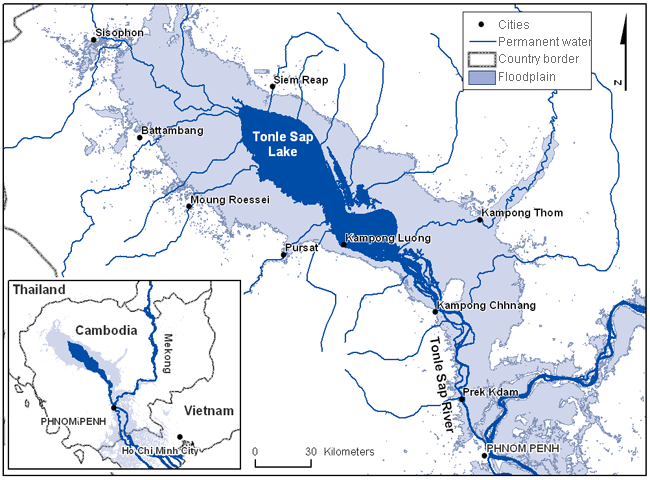
Lake Tonle Sap and its floodplain
AKOL, CAMBODIA — As the sun rises on Tonle Sap Lake, fishermen head out from floating villages like this one, past half-submerged mangroves and flooded shrub land, to check their nets, much as they have for centuries.
Every year, the lake yields about 300,000 tons of fish, making it one of the world’s most productive freshwater ecosystems. That and the floods that pulse through it in monsoon season, swelling it to as much as five times its dry-season size, have earned the lake the nickname “Cambodia’s beating heart.”
But the Tonle Sap is in trouble — from overfishing to feed a fast-growing population, from the cutting of mangrove forests that shelter young fish, from hydroelectric dams upstream, and from the dry seasons that are expected to grow hotter and longer with climate change.
Keo Mao, a 42-year-old fisherman from Akol, says he hopes his five children can find a way out of the life that has sustained his family for generations. “The lake now is not really so good,” he said. “There are too many people.”
Now an international team of researchers has joined local fishermen in an ambitious project to save the Tonle Sap. The scientists are building an intricate computer model that aims to track the vast array of connections between human activity and natural systems as they change over time. Begun in 2012, the model will take several years to complete, while threats to the Tonle Sap continue to mount.
But the hope is to peer into the lake’s future to predict how different developmental, economic and regulatory choices may ripple through this interconnected and fast-changing ecosystem, and to plan a sustainable way forward.
Charting a Changing Cambodia
Henri Mouhot, the 19th-century French explorer who crossed the Tonle Sap on his way to Angkor Wat, said the lake resembled a violin lying diagonally across Cambodia. At its neck, a tributary flows southeast to the Mekong River. On the laptop of Roel Boumans, an ecologist who helped develop the modeling project, the lake and its flood plain are divided into 16 watersheds that he fills with shades of green, yellow and brown, based on vegetation and land-use data from satellite images.
“The model tells us stories,” he said, “and it tests the stories we, as scientists, tell about the how different parts of the system work.”

Along with attributes like soil composition, elevation and vegetation, the digital Tonle Sap will soon have what the scientists call “agents,” including fish and people. Agents make choices. They change the lake and react to those changes, depending on factors like when enough fish swim into an area to attract predators and fishing boats. Local fishermen are critical to the Tonle Sap modeling project. They have been collecting fish from small research nets, jotting down their species, lengths and weights, and snipping tails for DNA testing. They will also take part in other fieldwork, including water and sediment sampling, household surveys and economic research.
Cambodia’s population is growing rapidly, at a rate of nearly 2 percent a year. Many rural Cambodians, including subsistence farmers displaced by land grants to large agribusinesses, have migrated to the Tonle Sap from upland areas. Others come after selling their farmland to pay off debt. From 1998 to 2008, the most recent period studied, the number of full-time Tonle Sap fishermen grew by 38 percent to 38,200, and the number of lakeside farmers, many of whom fish part time, increased 33 percent to 520,800.
The computer model does not yet account for the surging population, but it already has years of data on water levels. By sending blue pulses across the map on his laptop to simulate flooding, Dr. Boumans can calculate where floodwater sediments, shown in oranges and reds, are likely to settle.
He developed the modeling approach a decade ago with Robert Costanza, an environmental economist now at Australian National University. They called it Mimes, short for multiscale integrated models of ecosystem services.
It is among the most ambitious of several models to emerge from the movement among ecologists to assign economic values to nature and its processes. Critics warn that such models can lead scientists to discount important data that disagree with their forecasts; others say focusing on “services” puts price tags on nature, undervaluing things like biodiversity that aren’t bought and sold. The idea’s supporters, however, say it aligns nature’s interests with our own.
“In the past, it was a conservation and environmental argument pitted against the economic argument,” said Lewis Incze, a marine ecologist and oceanographer at the University of Maine who is not part of the Tonle Sap project. “You can still argue about valuation and importance, but these models recognize that this is not one class of argument against another, but a whole family of processes that need to be recognized and accounted for together.”
Dr. Boumans said the Mimes model “lets you explore the decisions you’re making about a landscape and seascape, showing you what’s gained and lost over space and time.”
One set of decisions involves the big dams planned upstream of the Tonle Sap, often portrayed as a trade-off between electricity and food. Fewer than half of Cambodians have reliable access to power; blackouts are common, and costly electricity slows business development and job growth.
But tropical dams typically generate power for just a few decades, while the Tonle Sap has been feeding Cambodia for centuries. Fish are carved in the walls at Angkor Wat, and they supply three-quarters of the animal protein in a country where nearly 40 percent of children are chronically malnourished.
About 60 percent of Cambodia’s inland fish catch comes from the Tonle Sap, which also supports migratory fish caught upstream, said Chheng Phen, acting director of Cambodia’s Inland Fisheries Research and Development Institute, which is taking part in the modeling project.
“If the Tonle Sap does not function,” he said, “then the whole fishery of the Mekong will collapse.”
The Coupling of People and Nature
Traditionally, ecologists have viewed humans in an ecosystem as something of a nuisance — contaminating samples, skewing data and clouding scientific analyses. “But the human aspect of an ecosystem is crucial,” said Jianguo Liu, who leads the International Network of Research on Coupled Human and Natural Systems, or Chans-net, a network of 1,300 ecologists, economists, and sociologists.
“The central message of Chans is that humans and nature are coupled, just like husband and wife,” says Dr. Liu, director of the Center for Systems Integration and Sustainability at Michigan State University. “They interact, work together, and the impacts are not just one way. There are feedbacks.”
The Tonle Sap project is designed to capture those interactions and look for their consequences, often unintended. For instance, increased fishing could actually lead to more fish in the lake, at least for a while. Kevin McCann, an ecologist at the University of Guelph in Ontario, says that if fishermen take everything they bring up in their nets, the species that suffer most will be the larger fish that grow and reproduce slowly. With fewer big fish eating the fast-multiplying, small fish, the results will be more fish over all, but reduced biodiversity.
Over the past decade, data suggest that the lake has been losing its biggest fish — quarter-ton catfish, stingrays with six-foot wingspans, Siamese carp bigger than the fishermen who caught them — while the catch of the tiny trey riel, or money fish, has risen slightly. (They are used primarily for prahok, the fermented fish paste that is a staple of Cambodian cooking.)
Climate models forecast longer, hotter dry seasons for Southeast Asia, and more intense monsoon floods. Both changes could disrupt the migration and spawning patterns of Tonle Sap fish, said Sovan Lek, an ecologist at Paul Sabatier University in Toulouse, France, who is a native of Cambodia and a principal investigator in the Tonle Sap project. “In Europe, the water can go from very cold to very warm, from winter to summer,” he said. “Here, the temperature is stable over the whole year, so adaptation to a change will be more difficult.”
1.5 Million Depend on the Lake
Thol Thoeun, a 27-year-old Tonle Sap fisherman, sat on the floor of his floating house and recounted how rats devoured his vegetable garden, how all his money goes to home repairs after monsoons, and how his rickety fishing boat continually takes on water.
His family came here in 2002, fleeing hard times inland, but times are hard here, too. More than 70 percent of households earn less than $1,000 a year, and many fishermen are in debt, owing nearly $780 on average, according to the Cambodian fisheries administration.
“Everyone faces difficulties,” Mr. Thoeun said. “Everyone is suffering.”
The 1.5 million people who depend directly on the Tonle Sap, mostly fishers, farmers and their families, are one of the biggest factors in forecasting the lake’s future. They can’t do much about the dams, most of which are planned beyond Cambodia’s borders, nor can they stop global warming.
But how they react to changes on the lake will be critically important. If fish catches were to drop by a third, for example, fishermen might have to spend even more time on their boats, or venture into illegal “no take” waters, or turn to rice farming. Each choice would affect the ecosystem in different ways.
Evan Fraser, a geographer at the University of Guelph, will explore these sorts of scenarios with Tonle Sap residents in surveys, interviews and workshops, to begin later this year. His findings will become part of the model. A food-security expert, Dr. Fraser has studied some of history’s worst famines, as well as those prevented by tactics like stockpiling food and distributing drought-resistant seeds. His research suggests that no matter how the Tonle Sap changes in the coming years, the right adaptive strategies could mean the difference between a tolerable transition and a disaster.

“The policy and development challenge is one of managing the transition,” he said. “There’s no way to stop it.”