By Mike David and Andy Hsiao, March 31, 2020
Showing posts with label Capitalism and ecology. Show all posts
Showing posts with label Capitalism and ecology. Show all posts
Tuesday, March 31, 2020


Saturday, October 29, 2016
2483. The Anthropocene: The Case of Regulation of Fishing Menhaden
By Richard Schiffman, The New York Times, October 26, 2016
 |
| School of menhaden |
Editor's note: This story is posted for reasons unrelated to the intentions of its author. Attempts at regulating nature by human society that has reach its apex under industrial capitalist world economy motivated by the pursuit of profit and conditioned by anthropocentrism institutionalized by the Agricultural Revolution approximately10,000 year ago and agricultural-based class societies that followed has now brought us the Anthropocene and the systemic planetary and social. The article below demonstrates one approach in the bourgeois enviromentalist mindset: regulation. A fancy yet contradictory term for this is "wildlife management" for which students are trained in universities to take jobs in the regulatory apparatus or in the bourgeois environmentalist establishment or academia. The problem with wildlife management is that it attempts to regulated evolutionary process which typically take very long time to establish or modify ecological systems and its participating component parts through the best method available, trail-and-error. Indeed, it is the very act of social attempt to regulate nature that has brought us the Anthropocene. Yet, there are many sectional interests involved in stating the problem we face and propose "solutions" to it. The article below demostrates these. I urge you to read it with these concerns in mind. KN
Branford, Conn. — In a bay near this coastal town, the sea was boiling with hundreds of herring-size shiners leaping to flee a marauding squad of bluefish. “These waters are coming back,” Bren Smith yelled above the shrieking din, as sea gulls plunged near our boat, scooping up fish. Mr. Smith grows seaweed and shellfish in Long Island Sound, and he says he’s seen a lot more action out here recently.
* * *
Branford, Conn. — In a bay near this coastal town, the sea was boiling with hundreds of herring-size shiners leaping to flee a marauding squad of bluefish. “These waters are coming back,” Bren Smith yelled above the shrieking din, as sea gulls plunged near our boat, scooping up fish. Mr. Smith grows seaweed and shellfish in Long Island Sound, and he says he’s seen a lot more action out here recently.
What thrilled me about this scene was that I was witnessing what happens when fishery managers set strict catch limits to stop overfishing.
Those leaping silvery fish were menhaden, also known as bunker, or pogies. To Mr. Smith and other fishermen I spoke to, there are encouraging signs that the menhaden population along the Atlantic Coast is healthy after decades of intensive commercial exploitation. Other sea creatures whose lives are intertwined with them also seem to be doing well. Sharks, whales, bluefish, tuna, osprey and other predators depend in part on these fish.
“There’s all this life that wasn’t there before,” John McMurray, who captains his own charter boat, told me. He said it’s been a boon for his sports fishing business off Long Island: “In the past four years, striped bass fishing has gotten a lot better, bluefish as well. We’re even getting bluefin tuna coming inshore to feed on the schools of menhaden.”
Menhaden are filter feeders. They swim in vast schools of hundreds of thousands of fish. Mouths agape as they feed, menhaden are living vacuum cleaners sucking up algae blooms that deplete inshore waters of oxygen and create biological deserts in the sea. A single adult menhaden can clean four to seven gallons of water in a minute.
The name menhaden is a corruption of “munnawhatteaug,” which means fertilizer in Algonquian. Native Americans taught the pilgrims to plant them with their corn, enabling colonists to coax a crop from rocky New England soils, according to Bruce Franklin, author of “The Most Important Fish in the Sea.” Bony and smelly, menhaden have rarely been caught for food. But their oil greased the wheels of America’s machine age after the Civil War, replacing whale oil as a cheaper alternative.
Today, menhaden oil continues to be sought, not as an industrial lubricant, but as a health supplement. Most of the 188,000-metric ton annual catch is rendered into heart-healthy omega-3 fatty acid fish oil. Much of the rest is used to produce fertilizers and high-protein feeds for chickens and pigs. In terms of weight, more menhaden are caught than any other fish on the East Coast.
But concerns that menhaden were being overfished led the Atlantic States Marine Fisheries Commission in 2012 to impose a quota that reduced the historic harvest by 20 percent. That limit was raised by 10 percent last year after regulators concluded that menhaden were not being over-harvested.
Now the fisheries commission is considering a proposal to expand the allowable catch by another 20 percent when it meets Wednesday in Bar Harbor, Me. The largest industrial menhaden harvester on the East Coast, Omega Protein, has suggested that the quota could easily be raised by up to 30 percent. The company points to the commission’s conclusion last year that menhaden were not being overfished. Critics of the 2012 quota decision say, moreover, that it was based on faulty methodology that identified a problem that didn’t exist; others argue that it understated the plight of the menhaden.
Regardless, the commission should keep the quota where it is and wait until a more comprehensive management approach is developed to safeguard this critically important fish.
That work is underway now. Scientists are developing reference points to measure the ecological role that menhaden serve as forage fish and how changes in their numbers would affect the predators that feed on them.
This would be a departure from the way most fish, including menhaden, are managed now. Regulators focus narrowly on how many fish of a particular species can be sustainably harvested. A decision on whether to adopt this more comprehensive approach is expected to be made next year.
Robert Ballou, the chairman of the commission’s Menhaden Management Board, said this method would enable “a new way of managing the fish that will credit them for their unique role in the environment and set quotas that are right, not just for menhaden, but for all of the species that depend on them.”
This is the right approach.
Setting quotas can be a messy process. Sports fishermen, commercial interests, state lawmakers and environmental groups often squabble over fishing quotas, and the limits that result can be split-the-difference compromises that leave nobody happy. And they can be environmentally catastrophic, when commercial considerations trump sound science. That’s what happened to New England’s groundfish fishery, including cod, which was declared a federal disaster in 2012.
This is why regulatory decisions need to be based not just on short-term profits but on the health of the ecosystem as a whole. This approach would be an enlightened departure for fisheries regulators, who typically see their job only as ensuring that specific fish stocks remain commercially viable.
Joseph Gordon, manager of mid-Atlantic Ocean Conservation for the Pew Charitable Trusts, said the commission’s effort to develop a holistic strategy for managing menhaden “is an incredibly exciting precedent. We are finally saying that we value this fish not just for what it provides when it is taken out of the ocean, but for what it provides when it is kept in the ocean.”
Until that approach is implemented, the commission should keep the menhaden quota where it is.
Richard Schiffman is a journalist coerving environmental issues.
Tuesday, March 15, 2016
2244. The Miracle of Kolkata's Wetlands – and One Man's Struggle to Save Them
By Patrick Barkham, The Guardian, March 9, 2016
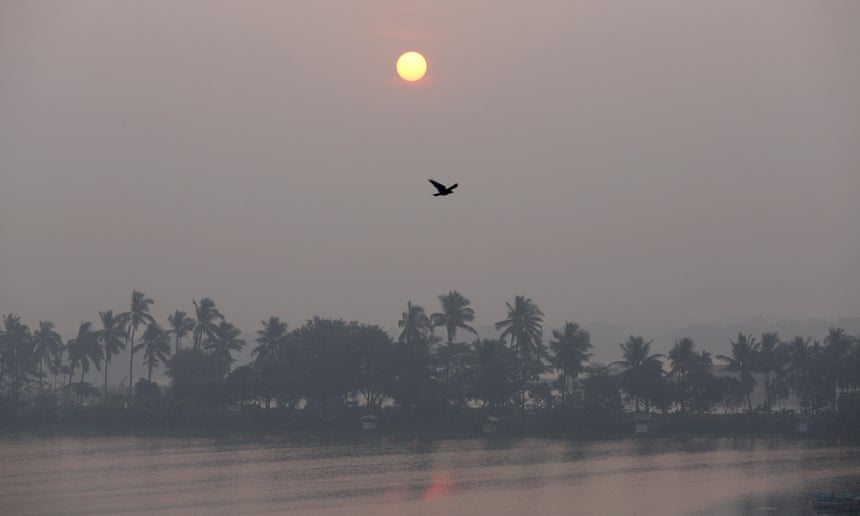 |
A bird flies over wetlands at sunrise on the outskirts of Kolkata. Photograph: Sean Gallagher/National Geographic Creative/Corbis
The trees on the streets of Kolkata in January are dusty, like neglected pot plants. At traffic lights, salesmen offer feather dusters for drivers to wipe their grimy cars. Shrubs are planted on the central reservation of the city’s new flyovers, surrounded by the implausible boasts on signs proclaiming a “clean and green” city. But the most frequently recurring poster, above almost every street corner, appeals for investors to “Come to Bengal – Ride the Growth”.
Kolkata, a famously cultured city of 14.5 million people – once the second city of the British empire after London – is keen to catch up with Delhi, Mumbai, Chennai and Bangalore, the dynamic and rapidly modernising megacities of the fastest growing major economy in the world.
Kolkata is also a low-lying city, on average it is barely five metres above sea level, served by two major rivers and surrounded by waterways. Its unique wetlands to the east are under pressure from developers like never before, just when they might prove most useful. Hundreds of buildings, from luxury apartments to colleges to more modest homes, are going up in an area which is supposedly protected from development by law.
Faced by the rising sea levels and increased storminess brought on by climate change, cities all over the world – a World Bank study named Guangzhou, Miami, New York, New Orleans and Mumbai at risk of most costly damage – are having to rethink their relationship with flood defences, both natural and artificial. According to the World Bank, an optimistic forecast of just 20cm of sea level rise by 2050 would still make Kolkata the third most exposed city in the world to the risk of flooding.
Such projections no longer belong to a distant future. In November last year, similarly low-lying Chennai experienced cataclysmic floods, which caused the displacement of 1.8 million people. Twenty years ago, Chennai had 650 wetlands in and around the city. Today it has 27. Chennai’s super-powered growth came at the expense of the marshes that could act as an effective natural flood defence; without them, flood water had nowhere to go except cascade into smart new homes.
From the air, Kolkata’s tower blocks are golden in the hazy, smoggy sunshine. To the east, right up against the city sparkles a vast expanse of water: a patchwork of tiny flooded fields bordered by green embankments, ponds, channels and much larger lakes. Take the road to the East Kolkata Wetlands and you’re met by a stream of motorbikes towing two-wheeled trailers, piled high with vegetables and fat silvery carp and tilapia being lugged from the wetlands to city markets.
These waterways are a part-natural, part-human phenomenon and their miraculous character is explained by Dhrubajyoti Ghosh, a slight, bespectacled engineer-turned-ecologist-turned-anthropologist, who speaks English extremely softly and very correctly. Ghosh was asked in 1981 to conduct an investigation into what happened to Kolkata’s wastewater. The city produced a lot of sewage, didn’t have a treatment plant, but didn’t seem to have a pollution problem, either. The waste just sort of disappeared.
“The only English word that suits is serendipity,” says Ghosh, who is now 69, as we stand beside one of its ponds, with the ruins of what resembles a temple behind us. As a young man, he made the short commute from Kolkata to examine these lakes almost every day. He found that the pond water “was beautiful”. To diagnose what was occurring didn’t really require a degree in biology, he says, it was simply common sense. Wastewater is 95% water and 5% problem – bacteria.
Carried by long channels towards the ponds, effluent was broken down by UV rays from the sun. (Ironically, Kolkata’s middle classes pay for UV treatment of their tap water to make it drinkable.) This nutrient-rich water is channelled into ponds where algae and fish thrive. Sewage-grown fish may sound gross but Ghosh and others have found them to be safe; Kolkata’s sewage contains very low levels of heavy metals.
I interrupt to ask about the ruined building behind us. Ghosh smiles slowly. He told local people to leave it standing as an important monument. It is the remains of a conventional sewage treatment plant built by the British, which didn’t work. In tropical countries, expensive water treatment plants struggle to banish bacteria. But Kolkata’s waterways clean its wastewater in less than 20 days. In a conventional water treatment works, thriving algae might become a problem. Here, the algae is removed by fishermen and fed to the fish that grow quickly in these nutrient-rich ponds. “An abundant population of fish growing on nothing,” says Ghosh. “You don’t need fish food.”
The wetlands serve two functions that at first glance seem contradictory: they are the city’s free sewage works and they are also a fertile aquatic market garden. As well as fish, wastewater is used in paddy fields and vegetables are grown on the verdant banks and on a long, low hill created by Kolkata’s organic waste. This recycling makes Kolkata the cheapest major city in India. You can enjoy a traditional breakfast for 30p, a third of the price of Delhi.
The wetlands produce 10,000 tonnes of fish each year and the wetland “garbage farms” provide 40 to 50% of the green vegetables available on the Kolkata’s markets. This food is fresh and cheap because there are almost no transport costs when it is brought by bicycle from these gardens so close to the centre. “I describe this as an ecologically subsidised city,” says Ghosh. “If you lose these wetlands, you lose this subsidy but Calcuttans are not interested to know why they are the cheapest city.”
Kolkata’s wetlands evolved over several human lifetimes and no public official – until Ghosh came along – grasped how it all functioned. But the fishermen knew. The wetlands were originally low-lying salt marshes and silted up rivers. During the days of the British empire, a Bengali engineer educated in Glasgow designed and built gently graded channels that transferred Kolkata’s wastewater from city to wetlands and on to the Bay of Bengal. In the early decades of the 20th century, local fishermen began using this wastewater to farm fish. Ponds were also converted into paddy fields to grow rice. Some 30,000 people make a living from the wetlands. Ghosh’s findings sound uncontroversial but they were not immediately recognised by the authorities.
“Everybody challenged it for at least 10 years,” he says, “but it’s such a simple principle that it cannot be challenged.”
Real estate in waiting
We walk into the wetlands on a grassy bank that contains a straight channel of water from the city. It is dark matte grey in colour and flows surprisingly quickly. I catch a whiff rather like an urban drain in high summer, a slight tang of sewage. “But it’s not much, is it?” says Ghosh, almost offended at the suggestion that these beautiful wetlands, full of palms, brilliant-white egrets and peacefully industrious human activity, might smell ever so slightly fruity.
After establishing the utility of the wetlands in the 1980s, Ghosh’s next task was to define their area. He drew up a map of these ponds and waterways. Around half the wetlands were taken and their ponds filled in so that a smart new suburb, Salt Lake City, could be built. Ghosh did not quibble. “There is no need to get emotional. The city had to grow. It was organised urbanisation. What’s happening now is not an organised urbanisation.”
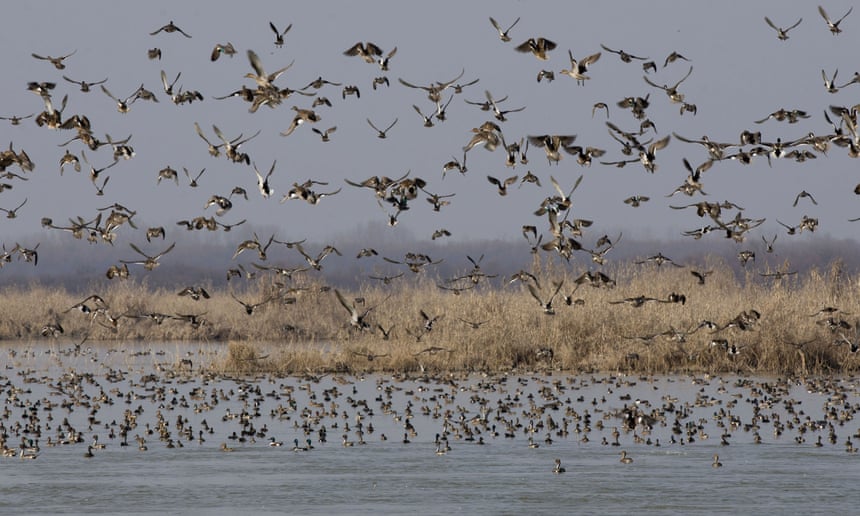 |
| Migratory birds fly above wetlands in Hokersar, another site with Ramsar status. Photograph: Dar Yasin/AP |
As Salt Lake City was built, Ghosh persuaded West Bengal’s then chief minister to accompany him on a trip to the remaining wetlands. He sought to demonstrate the effectiveness of Kolkata’s free filtration system to the politician. “I took a glass of water from the pond and I drank it. The chief minister was worried. I told him I do not have a lavatory as a backup,” says Ghosh drily. Of course he didn’t need one. The water was clean. This natural sewer and food bank is “unique in the whole world”, says Ghosh, “and yet we are ready to forget about it.”
In the early 1990s, West Bengal’s government wanted to build a towering world trade centre in the wetlands. Ghosh advised the opposition led by an NGO with the excellent acronym PUBLIC (People United for Better Living in Calcutta). After a judge visited the wetlands, Kolkata’s high court delivered the verdict in 1992 that Ghosh had been hoping for: the wetlands would be preserved for fishing and farming. It was the first major legal battle in India whereby the environment emerged victorious.
Ghosh was not finished, however. He was not confident that West Bengal’s state government would ever conscientiously protect the wetlands. So he sought a higher authority. Like zoologist Jane Goodall and Sir David Attenborough, Ghosh has been given a Global 500 Award, recognition from the UN for environmental achievement. This at least obliges politicians to acknowledge his letters even if, as he quietly points out, they then throw them in the bin.
Ghosh lobbied international conservationists, including officials working for the Ramsar Convention, which designates globally important wetlands. Ramsar understood wetlands to be places where you could watch birds. “Nothing wrong with that but it was incomplete,” says Ghosh. “They had no idea that a huge number of people depended on wetlands for their livelihoods. This was an unknown type of wetland.”
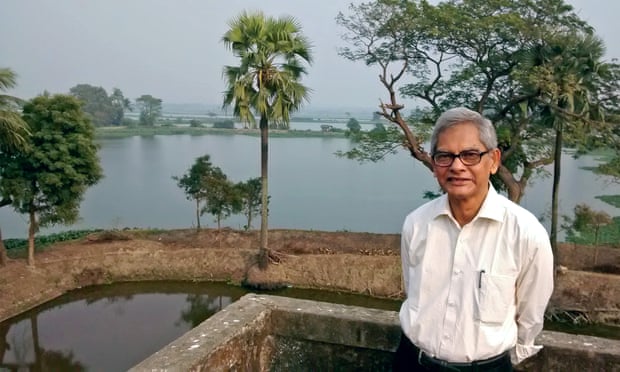 |
| Ecologist Dhrubajyoti Ghosh at the wetlands. Photograph: Patrick Barkham |
It took a long time to gain international recognition for Kolkata’s wetlands but they were finally given Ramsar status in 2002. It was the highpoint of Ghosh’s career – and he felt it came to mean nothing. Ghosh discovered that the Ramsar status gave no additional legal protection. Ramsar demands that the local government draws up a management plan for every wetlands area within six months of its designation; 14 years on, there is still no management plan for Kolkata’s wetlands.
Worse, says Ghosh, the West Bengal government displays no desire to enforce the 1992 high court ruling. Illegal developments are going up all over the wetlands, and staying up. “People have more confidence in a lack of law than in the law itself,” Ghosh says. And why is the government silent? “They also understand what real estate means to their election campaign. Wetlands are real estate in waiting.”
Today, a banner sign above the road to the wetlands tells travellers that the mangrove forests of Sundarbans, a Unesco World Heritage Site, are just 80km away. There are no signs announcing the East Kolkata Wetlands. They are, literally, off the map.
Your home in the clouds
Stalking the highway along the eastern edge of Kolkata are the new apartment blocks of Rajahat, a gleaming suburb built on soil excavated from the wetlands. “Atmosphere. Your home in the clouds,” boasts one billboard. Electronic advertisements for Vodafone blurt from tower block rooftops. Closer to the smartly dressed office workers sat in motionless rush hour cars are fly-posters for “scholarship tests” and mock exams to help you “learn, compete, succeed”.
Beside these aspirational invitations to personal growth are more appeals from West Bengal’s chief minister, Mamata Banerjee, to “Come to Bengal – Ride the Growth.” Banerjee, who faces an election this spring, came to power in 2011 as a populist, pro-market alternative to Bengal’s long-ruling Communist party. She is desperate to grow Kolkata, and declares she will turn the city into the London of India; by the airport road stands a replica of Big Ben, made from fibre-reinforced polymer, one-third of the size of the original.
Beyond the line of apartments marching out into the wetlands at Rajahat is a shanty town and then Aquatica – “a complete family water theme park and resort”. A dolphin leaping through a rubber ring is painted on its white gates. Beside these is a roadside shack where I drink tiny cups of salty tea with a middle-aged couple, Kartick Chandra Mandal and Shibani Mandal.
Kartick is a fisherman-turned-teacher; Shibani still works in the local fishing industry, packing fish. “The biggest threat to fishing is development,” says Kartick. The water park before us and the low-rise apartment block behind us, fortified with rolls of barbed wire on its walls, were both developments that should not have been permitted. According to Kartick and Shibani, they were paddy fields until a local politician redrew the map – an administrative sleight of hand to move this wetland area into a different parish, which was classified as outside the wetlands and therefore able to be built on.
Such ploys are occurring all over the wetlands, their long-term value trumped by their short-term price as prime real estate. Fishing families allege that ponds are being deliberately sabotaged, with channels blocked up, to force them to abandon their livelihoods. “Land sharks” working for developers use persuasion or intimidation to buy cheap wetland plots and build tower blocks on top. In some cases, the authorities themselves flout their own laws and build small corrugated dwellings on the wetlands for people cleared from the last slums in central Kolkata.
On the rare occasion that the struggle for the wetlands makes the news, its defence is portrayed as elitist. Kolkata’s mayor has declared that the conservation of the wetlands “means little to the common man”. Banerjee, a self-styled champion of the poor, last year stated her intent to find an amnesty for 25,000 illegal buildings within the wetlands area.
Education is usually trumpeted as a saviour of the environment; here, it seems to be the opposite. I wonder if the wetlands could be saved through education, but Ghosh says that no schools bring pupils on trips to the wetlands and no biology lessons are dedicated to understanding this marvellously useful system. Kartick, a teacher, believes that the younger generation are “not as interested or inspired” as his own in preserving the wetlands. “Let there be more ‘dropouts’” he says. “Those who are educated are trying to destroy them.”
Ghosh has dedicated his whole professional life to the wetlands. His wife is dead and his one child lives in Hong Kong, working in high finance. “I worked so hard for recognition from Ramsar and I have got no result. I have lost my life doing this.” It sounds despairing but Ghosh continues to fight for the wetlands. These days, he is less an environmental engineer and more an anthropologist, seeking to describe the unique lives and livelihoods of its residents. If the wetlands can be seen as “heritage”, he thinks, people might cherish them more.
There is one final hope. Aside from providing heritage, a free sewage system and an aquatic market garden, the wetlands’ other urban function – flood defence – is arguably the most indispensable. Chennai’s experience is a powerful lesson. Ghosh realises that it is myopic for his city to mimic Chennai and jeopardise its future by exploiting its wetlands for short-term profit. If Kolkata’s politicians and policymakers can be persuaded too, this famously thoughtful city might avoid the fraught path taken by so many other urban powerhouses who fail to grasp that the sea is always more unstoppable than their own development.
Subscribe to:
Posts (Atom)