Showing posts with label cuban economy. Show all posts

Wednesday, May 25, 2016

2333. Cuba to Legalize Small and Medium-Sized Private Businesses

By The Associated Press, The New York Times, May 24, 2016


HAVANA — Cuba announced Tuesday that it will legalize small- and medium-sized private businesses in a move that could significantly expand private enterprise in one of the world's last communist countries.

Cuban business owners and economic experts said they were hopeful the reform would allow private firms to import wholesale supplies and export products to other countries for the first time, removing a major obstacle to private business growth.

"This is a tremendously important step," said Alfonso Valentin Larrea Barroso, director-general of Scenius, a cooperatively run economic consulting firm in Havana. "They're creating, legally speaking, the non-state sector of the economy. They're making that sector official.”

While the government offered no immediate further details, the new business categories appear to be the next stage in reforms initiated by President Raul Castro after he took over from his brother Fidel Castro in 2008. While those reforms have allowed about half a million Cubans to start work in the private sector, the process has been slow and marked by periodic reversals.

The government has regularly cracked down on private businesses that flourish and compete with Cuba's chronically inefficient state monopolies. The latest backlash came after President Barack Obama met private business owners during his March 20-22 visit to Cuba, prompting hard-line communists to warn that the U.S. wants to turn entrepreneurs into a tool to overturn the island's socialist revolution.

The Communist Party documents, published in a special tabloid sold at state newsstands Tuesday, said a category of small, mid-sized and "micro" private business was being added to a master plan for social and economic development approved by last month's Cuban Communist Party Congress. The twice-a-decade meeting sets the direction for the single-party state for the coming five years.

The 32-page party document published Tuesday is the first comprehensive accounting of the decisions taken by the party congress, which was closed to the public and international press. State media reported few details of the debate or decisions taken at the meeting but featured harsh rhetoric from leading officials about the continuing threat from U.S. imperialism and the dangers of international capitalism.

That tough talk, it now appears, was accompanied by what could be a major step in Cuba's ongoing reform of its centrally planned economy.

"Private property in certain means of production contributes to employment, economic efficiency and well-being, in a context in which socialist property relationships predominate," reads one section of the "Conceptualization of the Cuban Economic and Social Model of Socialist Development.”

Vanessa Arocha, a 56-year-old architect who makes hand-made purses and bags at home under a self-employed worker's license, said she dreamed of forming a legally recognized small business that could import supplies and machinery and hire neighbors looking for extra income.

"I could import fittings, zippers, vinyl," she said. "Being a small business would be a new experience, one we know little about, but something very positive.”

The government currently allows private enterprise by self-employed workers in several hundred job categories ranging from restaurant owner to hairdresser. Many of those workers have become de-facto small business owners employing other Cubans in enterprises providing vital stimulus to Cuba's stagnant centrally planned economy.

The Cuban government blames the half-century-old U.S. trade embargo on Cuba for strangling the island's economy. Cuba's new class of entrepreneurs say the embargo is a major obstacle but also lodges frequent, bitter complaints about the difficulties of running a business in a system that does not officially recognize them.

Low-level officials often engage in crackdowns on successful businesses for supposed violations of the arcane rules on self-employment. And the government maintains a monopoly on imports and export that funnels badly needed products exclusively to state-run enterprises.

Due to its dilapidated state-run economy, Cuba imports most of what it consumes, from rice to air conditioners. Most private businesses are forced to buy scarce supplies from state retail stores or on the black market, increasing the scarcity of basic goods and driving up prices for ordinary Cubans. Many entrepreneurs pay networks of "mules" to import goods in checked airline baggage, adding huge costs and delays.

The latest change will almost certainly take months to become law. Such reforms typically require formal approval by Cuba's National Assembly, which meets only twice a year.

Wednesday, December 16, 2015

2120. Cuba, Creditors Reach Historic Multi-Billion Debt Relief

By The Associated Press, December 15, 2015


PARIS - Cuba has reached a landmark agreement with foreign creditors over billions of dollars in unpaid debt dating back 25 years.

The Paris Club of creditor nations announced a deal Monday under which creditors will cancel $8.5 billion in overdue interest payments, in exchange for a promise by Cuba to pay off $2.6 billion of the original debt over the next 18 years.

France, Cuba's biggest creditor, led the negotiations.

"This accord opens the way to a new era in relations between Cuba and the international financial community," Finance Minister Michel Sapin said in a statement.

Sapin said the deal "helps to definitively resolve the issue of Cuba's medium-term debt ... which has not been honored since the 1980s.”

President Raul Castro has been working to improve relations with creditors as he tries to modernize and open up the communist island's economy, which defaulted on its debts in 1986 and was devastated by the 1991 collapse of the Soviet Union.

The U.S. maintains an economic embargo against Cuba, and is not among the creditor nations, though President Barack Obama and Castro have opened ties.

As part of the debt agreement, France canceled $4 billion in late interest payments, which made up the bulk of the money Cuba owed. Of the remaining debt, Cuba agreed to pay $240 million in cash to France, and $230 million will be invested in development projects, the Finance Ministry said.

The creditors from the Paris Club said in a statement that they "welcomed progress made by Cuba toward the normalization of its relations with creditors and the international financial community.”

The group of Cuban creditors includes: Australia, Austria, Belgium, Canada, Denmark, Finland, France, Italy, Japan, the Netherlands, Spain, Sweden, Switzerland and Britain.

France agreed to resume its development activity in Cuba after French President Francois Hollande visited Castro and his brother, longtime Cuban leader Fidel Castro, earlier this year.

Tuesday, June 16, 2015

1882. Foreign Firms to Capitalize on Cuba’s Wealth of Scientific Expertise

By John Paul Rathbone, Financial Times, June 15, 2015

Skill mismatching represents the cost of misinvested human capital, and thus economic inefficiency. But the state and some foreign investors want to turn it into a boon, and the ground source of a future “knowledge economy”.

“Cuba’s knowledge economy is stronger than people often credit,” says Faquiry Diaz Cala, a Cuban entrepreneur now living in the US. “It has one of the hemisphere’s highest literacy rates, one of the highest college graduate rates, and PhDs in hard sciences . . . One should think of Cuba as a start-up nation, with some similarities to Israel.”

Even if the comparison is a big stretch, Cuba’s health sector holds immediate promise and other sectors, such as computing, have also drawn foreign interest.
The government has made medical services a money spinner: some 12,000 Cuban doctors work abroad in Africa, 30,000 in Venezuela and about 12,000 in Brazil and elsewhere in Latin America.

Their services are sold by Cuba, which pays the doctors a smaller fraction. This brings in billions of dollars a year — a system critics call a tacit form of indentured labour, although medics earn more abroad than at home and enjoy perks on their return. Some reportedly bribe officials to bump them up waiting lists to go.

Now, foreign health groups want to get in on Cuba’s commercially untapped pharmaceutical expertise. In May, US research centre Roswell Park agreed to begin clinical trials on a Cuban-developed lung cancer vaccine, Cimavax.

“We know [the drug] is not an easy one to develop clinically,” said Philippe Pouletty, chairman of French biotech company Abivax. “But it is good news that a US cancer institute evaluates it and that the FDA [US Food and Drug Administration] builds confidence in Cuban products.”

Abivax has operated in Cuba for five years, building relationships with research institutes, using investments and agreements to trial and commercialise Cuban drugs — such as a vaccine to help chronic hepatitis B sufferers — and also to develop new drugs.

Mr Pouletty, a venture capitalist and qualified doctor, says that if Cuba’s biotech capability was floated into a listed company, it might be worth $20bn. But he stresses: “We don’t think it is the biggest cheque that persuades the Cubans. They are looking for sustainable growth; short-term, medium-term and particularly long-term solutions.”

He says Cubans are slowly feeling their way into new language such as “spin-offs”, and are still getting used to notions such as foreign joint ventures requiring them to surrender full control.

But he adds that he is “pathologically optimistic” and points to a new “SiliCuban” advisory board, designed to help Cubans develop their drug industry and “where all things can be said without censorship”. Another positive sign is the separation three years ago of the three main research institutes into a holding group, BioCubaFarma, a move that freed them from the Ministry of Health’s heavy bureaucratic hand.

Computer programming is also promising. Local computers are so old and slow that Cubans have become adept at writing lean software programs that require little memory to run —a skill ideal for writing mobile apps. The state has commercialised some of this expertise through Datis, which sells computing and internal security expertise to allies such as Venezuela that use it for administration, such as identity cards.

Privately harnessing such knowledge is another matter. Difficulties are compounded by poor internet availability, a barometer of Cuba’s willingness to embrace the “knowledge economy”.

The government says it wants half the population wired by 2020, to boost productivity. Yet it is reluctant to permit such a powerful tool as it would mean ceding control. There have been small trials of public WiFi, but most Cubans can only get online for $4.50 an hour at internet cafés in hotels, a quarter of the average monthly state wage.

On a recent visit to Miami, organised by the Cuba Study Group, a US organisation that promotes US-Cuban engagement, island entrepreneurs were agog at the possibilities of online retail and rued Cuba’s poor connectivity. Airbnb’s Cuban operations, for example, are often run by a relative abroad, who communicates internet bookings with the guesthouse operator via telephone or SMS.

Thursday, May 28, 2015

1862. What We Know About Cuba’s Economy

By Drew Desilver, Pew Research Center, May 28, 2015

Two-thirds of Americans favor an end to the decades-long U.S. trade embargo on Cuba, a January Pew Research Center study found, and the two nations reportedly are making progress on re-establishing diplomatic relations. As the communist government continues to slowly reform Cuba’s economy, American businesses – from airlines to law firms – are exploring commercial opportunities on the island nation. But even if the embargo were to be lifted, it’s not clear just what sort of Cuban economy those businesses would find.
Getting a handle on even basic information about Cuba’s economy is difficult, for a number of reasons. The government still dominates economic activity on the island, both directly and through heavily subsidized state-owned enterprises. National statistics are not always complete or reliable. And Cuba’s system of two parallel currencies – one peso for everyday transactions among ordinary Cubans, and a “convertible peso” for the tourism industry, foreign trade and the private sector – combined with multiple exchange rates complicates any international comparisons or discussions about the relative size of different parts of the economy.
According to a survey conducted in March and published in The Washington Post, 79% of Cubans said they were dissatisfied with the country’s economic system; 70% said they wanted to start their own business. Nearly two-thirds of Cubans (64%) said normalizing relations with the U.S. would change the economic system, though only 37% thought the political system would change.
With so much change in the air, we decided to work our way as best we could through the data difficulties to put together a primer on what we know, and don’t know, about the Cuban economy.
1Despite the embargo, the U.S. does do business with Cuba. Last year, according to the Census Bureau, the U.S. exported nearly $300 million worth of products to Cuba; nearly all (96.2%) of that was in the form of meat and poultry, soybeans, corn, animal feed and other foodstuffs. The exports are permitted under a 2000 law that modified, but did not repeal, the U.S. embargo; under it, Cuba can buy certain agricultural products, medicines and medical devices from the U.S., but must pay in cash.
Cuba;s GDP slows
2Growth has slowed sharply in recent years. According to Cuba’s national statistical agency, the country’s gross domestic product in 2013 was 77.2 billion pesos – which, depending on which exchange rate one uses, could equate to anything from $77.2 billion (at the official rate of 1 convertible peso to $1) to $3.2 billion (at the internal rate of 24 regular pesos to 1 convertible peso). But either way, growth has slowed dramatically from the mid-2000s: The CIA estimates that Cuba’s GDP grew just 1.3% last year in real (inflation-adjusted) terms – 177th out of 222 countries ranked. One big reason: With global oil prices still well below their pre-recession highs, the heavily discounted oil that Venezuela sends Cuba – some of which Cuba re-exports – is less valuable.
Cuban GDP by sector3Despite economic reforms, the state still dominates. In a paper published last year by the Association for the Study of the Cuban Economy, former International Monetary Fund economist Ernesto Hernandez-Cata estimated that Cuba’s private and cooperative sector generated 25.3% of GDP in 2012, compared with just 5% in 1989. But the government, both directly and through state-owned enterprises, was still the source of more than three-quarters of Cuba’s economic activity. Government investment represented just 9.1% of GDP in 2012, versus 14.2% in 1989, which Hernandez-Cata said “reveals one of the most disturbing aspects of Cuba’s recent economic history: the weakness of capital formation.” (Official government figures put economy-wide fixed capital investment, from all sources, at 8.3% of GDP in 2013, considered low by international standards.)
Despite Reforms, Most Cubans Still Work for the State4More Cubans are working for themselves. In 2013, according to state figures, more than 424,000 Cubans (8.6% of all workers) were classified as self-employed; as recently as 2009, fewer than 144,000 Cubans (2.8%) were.
The “microenterprise” sector may be even bigger due to the hiring of unregistered full- and part-time workers. Ted Henken and Archibald Ritter, researchers at Baruch College and Carleton University, respectively, estimate that as many as half of small enterprises employ at least one unregistered worker.
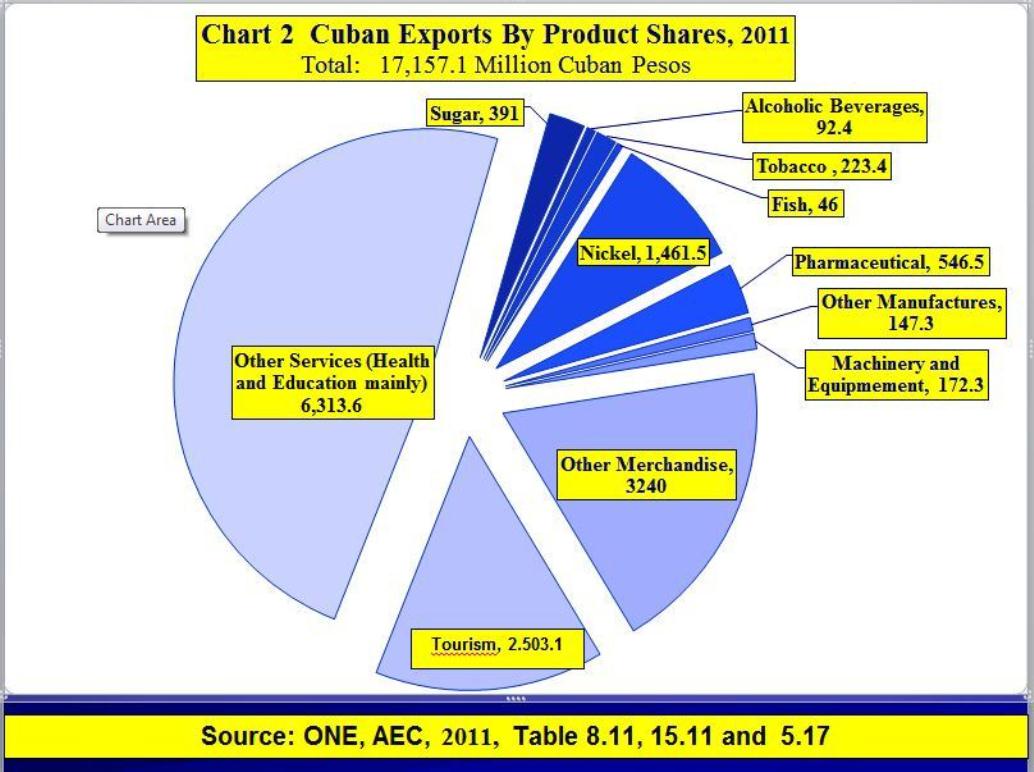
5Cuban imports and exportsCuba mostly imports goods and exports services. Getting a clear read on Cuban trade is especially tricky, not least because exports and imports are effectively valued using different exchange rates. As The Economist recently explained, state-owned firms and foreign joint ventures value each ordinary peso at one convertible peso – that is, at $1: “The massively overvalued rate … creates huge distortions in the economy, allowing importers to buy a dollar’s-worth of goods for one peso.” While most of Cuba’s exports are in the form of services (such as doctors and teacher working overseas), nearly all of its imports are goods (petroleum, foodstuffs, machinery and equipment, and chemicals).

Saturday, March 29, 2014

1364. Cuba Opens Its Economy to Foreign Investment, Carefully

By Adam Molon, CNBC, March 28, 2014
In this Nov. 6, 2013 photo, small fishing boats float anchored on the opposite shore of a port under construction in the Bay of Mariel, Cuba. Authorities have high hopes that Mariel could become a strategic economic center. Photo credit: Franklin Reyes, AP
The Cuban government said this week that it will open most of the nation's economic sectors to international investment and allow the existence of wholly owned foreign firms in Cuba, as part of a new foreign investment law that is expected to pass on Saturday.
The Cuban government is also expected to cut the profit tax it charges foreign enterprises operating on the island to 15 percent from the current 30 percent.
But experts like John Kavulich, a senior policy advisor at the U.S.-Cuba Trade and Economic Council, said that while these proposed initiatives have the potential to bring positive, liberalizing reform to Cuba's economy, international firms should still approach with cautious skepticism.
"What they've announced they'd do, does it sound progressive? Yes. Does it have the potential to be progressive? Yes," Kavulich said, referencing the Cuban government and the newly proposed foreign investment legislation.
"But Cuba's had a foreign investment law since the 1980s. And one of the problems has been that when the government feels that they've made enough progress, they reverse course and try to take back or eliminate the opportunities that they've presented to companies. Any changes announced now have to be looked at in that historical context."
Currently, international firms are allowed to operate in Cuba only as minority stakeholders in so-called mixed companies that are majority-controlled by the government.
Kavulich pointed to a lack of legal and procedural transparency as a key issue affecting Cuba's business environment, noting that some of the key challenges foreign firms face in Cuba include repatriation of profits, arbitration of conflicts and disputes, and regulations requiring that Cuban personnel be hired through a state-run employment agency.
"On a plate of appetizers, it's not going to be the first appetizer that you select," said Kavulich of Cuba's international investment environment. "There are many countries throughout the world that are far more transparent and have a less hostage-like relationship with cooperating partners."
John McAuliff, executive director of the Fund for Reconciliation and Development, a nonprofit organization advocating warmer relations between the U.S. and Cuba, said that a new foreign investment law enacted within an opaque and evolving system like Cuba's could lead to misunderstandings for international investors, and, in some instances, even something potentially as bad as jail time.
"In a transitional situation where not all the rules are clear or not all the laws are clear, people could, through overreach, or greed, or ignorance, get themselves into trouble with local laws," said McAuliff. "There have been serious issues with people cutting corners and getting into trouble with the law, and facing criminal charges in Cuba."
Robert L. Muse, an attorney who specializes in U.S. laws relating to Cuba, said that in order for new Cuban foreign investment policies to be effective, specificity of terms and clarity of process are key.
"I would encourage Cuba to go very quickly from the general to the highly specific. What are the timelines? What are the approval processes? How are they going to be enforced? Then, move on to specificity of rule-making and regulations," said Muse. "It's not going to be good enough to make broad pronouncements that Cuba is now seeking foreign investment. Some questions are going to have to be pre-emptively answered."
Muse cautioned that international companies considering investment in Cuba should do so with their eyes wide open to the opportunities and risks present in the island's economy and politics.
"This is a country that is opening up after 60 years of dormancy in the investment sectors," said Muse. "You're almost pioneering your way in, but there are risks associated with it."
Andrew MacDonald, director and chief executive of Esencia Group, said he finds those risks worth taking. His company plans to build biomass power plants in Cuba through a joint venture formed with a state-owned company in Cuba's Ministry of Sugar.
"There are some unique factors," said MacDonald of international investment in Cuba. "It can be a tad bureaucratic at times, but the country is developing economically in the right direction."
MacDonald said that while his company has been able to work effectively within Cuban joint ventures through considerable efforts, the prospect of being able to form a wholly owned venture in Cuba is appealing.
"One of the issues in Cuba is that it is a little bit chicken-and-egg. You've got to do a lot of prework and invest a lot of resources before you get the joint venture approved, and then you can actually do the real work," said MacDonald. "From a foreign investment point of view, it's an attractive proposition to be able to own 100 percent of your company and not have to form a joint venture."
Whether working in joint venture arrangements or as a wholly owned entity, MacDonald said his company has no plans to exit Cuba.

"The opportunity side is enormous, because Cuba is a country rich in natural resources," he said. "We believe in the Cubans, and we respect them for their technical abilities and the resources they have."