By Peter Waldman, Bloomberg News, June 13, 2019
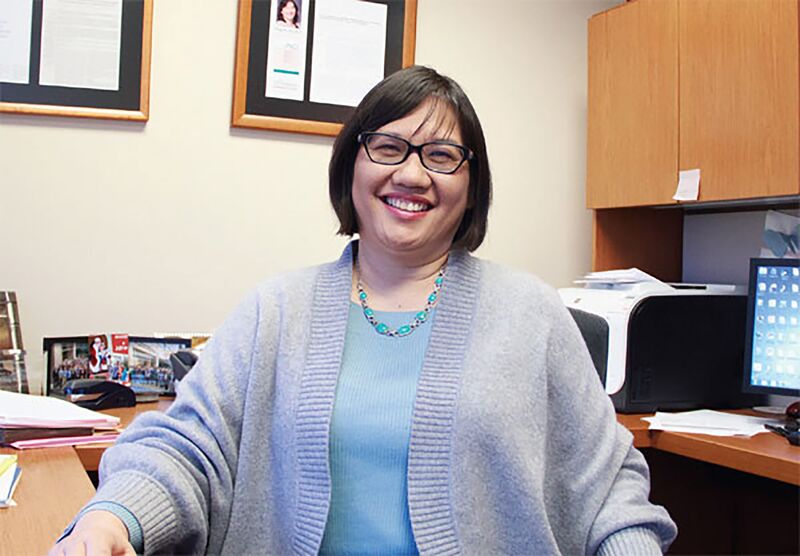 |
Wu in her former office at MD Anderson.
Photo: May Zhou/China Daily
|
The dossier on cancer researcher Xifeng Wu was
thick with intrigue, if hardly the stuff of a spy thriller. It contained
findings that she’d improperly shared confidential information and
accepted a half-dozen advisory roles at medical institutions in China.
She might have weathered those allegations, but for a larger aspersion
that was far more problematic: She was branded an oncological double
agent.
Except, it turns out, the borders around China. In January, Wu, an award-winning epidemiologist and naturalized American citizen, quietly stepped down as director of the Center for Public Health and Translational Genomics at the University of Texas MD Anderson Cancer Center after a three-month investigation into her professional ties in China. Her resignation, and the departures in recent months of three other top Chinese American scientists from Houston-based MD Anderson, stem from a Trump administration drive to counter Chinese influence at U.S. research institutions. The aim is to stanch China’s well-documented and costly theft of U.S. innovation and know-how. The collateral effect, however, is to stymie basic science, the foundational research that underlies new medical treatments. Everything is commodified in the economic cold war with China, including the struggle to find a cure for cancer.
Behind the investigation that led to Wu’s exit—and other such probes across the country—is the National Institutes of Health, in coordination with the FBI. “Even something that is in the fundamental research space, that’s absolutely not classified, has an intrinsic value,” says Lawrence Tabak, principal deputy director of the NIH, explaining his approach. “This pre-patented material is the antecedent to creating intellectual property. In essence, what you’re doing is stealing other people’s ideas.”
The NIH, the world’s biggest public funder of basic biomedical research, wields immense power over the nation’s health-research community. It allocates about $26 billion a year in federal grants; roughly $6 billion of that goes to cancer research. At a June 5 hearing, NIH officials told the U.S. Senate Committee on Finance that the agency has contacted 61 research institutions about suspected diversion of proprietary information by grant recipients and referred 16 cases, mainly involving undisclosed ties to foreign governments, for possible legal action. Ways of working that have long been encouraged by the NIH and many research institutions, particularly MD Anderson, are now quasi-criminalized, with FBI agents reading private emails, stopping Chinese scientists at airports, and visiting people’s homes to ask about their loyalty.
Wu hasn’t been charged with stealing anyone’s ideas, but in effect she stood accused of secretly aiding and abetting cancer research in China, an un-American activity in today’s political climate. She’d spent 27 of her 56 years at MD Anderson. A month after resigning, she left her husband and two kids in the U.S. and took a job as dean of a school of public health in Shanghai.
This is the first detailed account of what happened to Wu. She declined to be interviewed for this article, citing a pending complaint she’s filed with the U.S. Equal Employment Opportunity Commission. Her story is based on interviews and documents provided by 14 American colleagues and friends and records obtained through the Texas Public Information Act.
Historians will have to sort out whether Wu’s story and others like it marked a turning point when U.S. research institutions got serious about China’s avarice for American intellectual property, or a dangerous lurch down the path of paranoia and racial profiling. Or both. In any case, recent events in Houston and elsewhere indicate that Chinese people in America, including U.S. citizens, are now targeted for FBI surveillance.
In
an April speech in New York, FBI Director Christopher Wray described
the reason for the scrutiny of ethnic Chinese scientists. “China has
pioneered a societal approach to stealing innovation in any way it can
from a wide array of businesses, universities, and organizations,” he
told the Council on Foreign Relations. Everyone’s in on it, Wray said:
China’s intelligence services; its state-owned and what he called
“ostensibly” private enterprises; and the 130,000 Chinese graduate
students and researchers who work and study in the U.S. every year. “Put
plainly, China seems determined to steal its way up the economic ladder
at our expense.”
Wu graduated from medical school in Shanghai and earned her Ph.D. in 1994 from the University of Texas School of Public Health in Houston. She joined MD Anderson while in graduate school and gained renown for creating several so-called study cohorts with data amassed from hundreds of thousands of patients in Asia and the U.S. The cohorts, which combine patient histories with personal biomarkers such as DNA characteristics and treatment descriptions, outcomes, and even lifestyle habits, are a gold mine for researchers. (Some examples of the use of cohorts: Wu and her team showed that Mexican Americans who sleep less than six hours a night had a higher risk of cancer than Mexican Americans who get more sleep, and that eating charred meat such as barbecue raised the risk of kidney cancer.) In 2011, Wu leapfrogged over older colleagues and was named epidemiology chair, making her the top-ranked epidemiologist at the nation’s top-ranked cancer center.
Along the way, Wu developed close ties with researchers and cancer centers in China. She was encouraged to do so by MD Anderson. The center’s president in the early 2000s, John Mendelsohn, launched an initiative to promote international collaborations. In China, MD Anderson forged “sister” relationships with five major cancer centers, cooperating on screening programs, clinical trials, and basic research studies. Dozens of ethnic Chinese faculty members at MD Anderson participated, eager to visit family and friends and contribute their expertise to addressing China’s enormous burden of about 4.3 million new cancer cases a year. In 2015, China awarded MD Anderson its top honor for international scientific cooperation, in a ceremony attended by President Xi Jinping.
Wu was a model collaborator. She attended Chinese medical conferences, hosted visiting Chinese professors in Houston, and published 87 research papers with co-authors from 26 Chinese institutions. In all, she has co-authored some 540 papers that have been cited about 23,000 times in scientific literature. (Her papers are all easily retrievable with a few clicks on MD Anderson’s website.)
“MD Anderson was very much an open door. The mission was ‘End cancer in Texas, America, and the world,’ ” says Oliver Bogler, the cancer center’s senior vice president for academic affairs from 2011 to 2018 and now chief operating officer of the ECHO Institute at the University of New Mexico.
The globalization of science, in particular basic science, has been sweeping. “Faculty don’t see international borders anymore,” says Adam Kuspa, dean of research at Baylor College of Medicine in Houston. “If someone in another country has a piece of the puzzle, they want to work with them.” Relationships often begin at academic conferences, jell during invited visits for symposiums or lectureships, and culminate in the melding of research into scientific papers. Since 2010 the NIH itself has offered about $5 million a year in special grants for U.S.-China collaborations, with 20% going to cancer research, and a counterpart in China has pitched in an additional $3 million a year. The joint projects have produced a number of high-impact papers on cancer, according to an internal NIH review.
For Kirk Smith, a professor at the University of California at Berkeley who studies the health effects of air pollution, the benefits of collaboration have been surprising. He never imagined, back in the 1980s when he started researching Chinese air pollution with Chinese scientists, that one day his colleagues would become influential policymakers at home. In the past six years, Smith’s partners have pushed through standards that have led to air pollution reductions of 21% to 42% in China’s most populous areas. The results have borne fruit in the U.S., too. Twenty years ago scientists forecast that air pollution from China, blowing across the Pacific, would cause California to exceed its clean-air standards by 2025. Now that won’t happen, says Smith, who was granted an honorary professorship at Tsinghua University this spring.
Wu’s work, like a lot of the academic research now in danger of being stifled, isn’t about developing patentable drugs. The mission is to reduce risk and save lives by discovering the causes of cancer. Prevention isn’t a product. It isn’t sellable. Or stealable.
Suspicion of Chinese scientists at MD
Anderson began to take root around 2014. The year before, a Chinese
researcher at the Medical College of Wisconsin in Milwaukee had been
arrested on federal charges of economic espionage; prosecutors said he
stole three vials of a cancer drug in early-stage lab testing. (He
pleaded guilty to the far lesser charge of accessing a computer without
authorization and was sentenced to time served, four and a half months.)
At the time, MD Anderson was pushing to commercialize basic research
into cancer drugs; today the center has alliances and partnerships with
almost three dozen pharmaceutical makers and other private companies.
Security was enhanced. Foreign guests were kept on a short leash.
In November 2017 the FBI asked for more information. This time, no subpoena followed. Instead, the cancer center’s president, Peter Pisters—then on the job for barely a month—signed a voluntary agreement allowing the FBI to search the network accounts of what a separate document indicated were 23 employees “for any purpose … at any time, for any length of time, and at any location.” Did all of the network accounts handed over to the FBI belong to Chinese or Chinese American scientists? MD Anderson refuses to say.
“Because MD Anderson was cooperating with the FBI’s national security investigation, and because the FBI had the power to issue another subpoena, we chose to voluntarily provide the requested emails,” Peyton said.
In Wray’s telling, China’s challenge to the U.S. today is unlike any this nation has faced. Whereas the Cold War was fought by armies and governments, the contest is being waged, on China’s side, by the “whole of society,” the FBI director said, and the U.S. needs its own whole-of-society response. But what does that look like in a society with more than 5 million citizens of Chinese descent, many of whom work in the very science and technology fields said to be under assault?
The FBI is telling companies, universities, hospitals—anyone with intellectual property at stake—to take special precautions when dealing with Chinese business partners and employees who might be what Wray calls “nontraditional” information collectors. U.S. Department of Justice officials are doing roadshows to brief local governments, companies, and journalists about China’s perfidy. Visas for Chinese students and researchers are being curtailed, and more Chinese engineers and businesspeople, especially in the tech sector, are being detained at U.S. airports while border agents inspect and image their digital devices. The FBI is pursuing economic espionage investigations “that almost invariably lead back to China” in almost every one of its 56 field offices, Wray said.
They’ve made some big arrests. Last year the agency lured an alleged spymaster affiliated with China’s Ministry of State Security to Belgium, where he was arrested and extradited to the U.S. to face espionage charges. The suspected agent, named Yanjun Xu, allegedly disguised himself as an academic and used LinkedIn to entice a Chinese American engineer at GE Aviation in Cincinnati to come to China to give a presentation on composite materials for the aerospace industry. The engineer brought along some of his employer’s confidential documents. Xu pleaded not guilty in October and remains in custody in Ohio awaiting trial. The GE Aviation employee wasn’t charged.
Federal agents have also made an alarming number of spy arrests that proved unwarranted. From 1997 to 2009, 17% of defendants indicted under the U.S. Economic Espionage Act had Chinese names. From 2009 to 2015, that rate tripled, to 52%, according to a December 2018 article in the Cardozo Law Review. As the number of cases soared, evidence of actual espionage lagged behind.
One in five of the Chinese-named defendants was never found guilty of espionage or any other serious crime in the cases between 1997 and 2015—almost twice the rate of wrongful accusations among non-Chinese defendants. The disparity, wrote the paper’s author, Andrew Kim, a visiting scholar at South Texas College of Law at Houston, reflects an apparent bias among federal agents and prosecutors who assume ethnic Chinese scientists must be secretly working for China.
“In the same way racial profiling of African Americans as criminals may create the crime of ‘driving while black,’ ” wrote Kim, who practices law at the Houston office of Greenberg Traurig, “profiling of Asian Americans as spies … may be creating a new crime: ‘researching while Asian.’ ”
In 2015, FBI agents stormed the Philadelphia home of Xiaoxing Xi, a Temple University physicist, and arrested him at gunpoint in front of his wife and two daughters for allegedly sharing superconductor technology with China. The charges were dropped five months later, after Xi’s lawyers proved the system in question was old and publicly available. But Xi says his life will never be the same. He lost most of his graduate students and research funding and remains preoccupied with fears that the government is still spying on him. “Seeing how such a trivial thing could be twisted into felony charges has had a dramatic psychological impact,” he says. “I was doing academic collaboration that the government, the university, and all the funding agencies encouraged us to do.”
Last spring, FBI agents in
Houston, armed with a batch of emails from the 23 accounts, knocked on
the doors of at least four Chinese Americans who worked at MD Anderson,
asking whether they or others had professional links to China. The
agents were particularly interested in scientists connected to China’s
Thousand Talents Plan, a government initiative to lure back top scholars
from overseas with well-paid jobs in China. A report last year by the
U.S. National Intelligence Council said the recruitment program’s
underlying purpose is “to facilitate the legal and illicit transfer of
U.S. technology, intellectual property and knowhow” to China.
That June, MD Anderson gave the FBI another consent letter, this time permitting it to share any “relevant information” from the cancer center’s employee accounts with the NIH and other federal agencies. That signaled a new focus for the ostensible national security investigation: compliance with federal grant requirements. It was here that Wu became a target.
In five memos addressed last fall to Pisters, MD Anderson’s president, a top NIH official cited dozens of employee emails in claiming that Wu and four other scientists at the cancer center violated confidentiality requirements in grant reviews and failed to disclose paid work in China. “Because NIH awards generally are made to the institution and not the [researcher], we remind you of the gravity of these concerns,” wrote Michael Lauer, NIH’s deputy director for outside research. He gave Pisters 30 days to respond.
The investigations of the MD Anderson employees were handled by the center’s compliance chief, Max Weber, and his boss, general counsel Steven Haydon. On the advice of her lawyer, Wu, who had an often-combative relationship with the administration, declined to be interviewed by Weber but submitted written responses to questions. In them she acknowledged lapses, but maintained they weren’t duplicitous. She admitted sharing NIH grant proposals with U.S. colleagues—not to leak scientific secrets, she said, but to get help with her workload. Wu told Weber she used office administrators and more junior researchers to perform such tasks as downloading and printing grant proposals and typing and editing review drafts. Weber concluded that Wu’s use of others to help with grant reviews violated MD Anderson’s ethics policies.
If that’s true, the position is at odds with common practice in academia. “If you searched through MD Anderson or any large research institution, you’d find people with these kinds of compliance issues everywhere,” says Lynn Goldman, dean of the Milken School of Public Health at George Washington University. Assisting senior scientists with confidential grant reviews, a rite of passage for many younger researchers, is considered “part of the mentoring process” by older faculty members, Goldman says. “Is it wrong? Probably. Is it a capital offense? Hardly.”
Wu also admitted failing to disclose to the NIH all the names and affiliations of her Chinese collaborators, as required in grant filings. She told Weber that was because she’d worked with many of them there in Houston, when they were visiting scientists at MD Anderson. At any rate, their affiliations in China were clearly noted in published papers. Weber concluded, in the report he submitted to Pisters, that visiting scientists were still “foreign components” and must be disclosed.
In the end, Weber based most of his conclusions on “adverse inferences” he drew from Wu’s insistence on responding to his questions in writing. For example, he cited a 2017 article on the website of Shanghai’s Ruijin Hospital that said Wu had been honored at a ceremony after signing a contract to become a visiting professor. “Given Wu’s failure to appear at her interview, I infer that this fact is true,” Weber wrote.
Yet a week after that article appeared, Wu emailed Ruijin Hospital’s president to say she couldn’t accept the appointment before clearing it with MD Anderson’s conflict-of-interest committee. Twelve days later, she emailed him a draft consulting contract that specified the pact was subject to all rules and regulations of MD Anderson, including those related to intellectual property. “If you agree, I will submit it to our institution for review,” Wu wrote. The Chinese hospital did agree, and she submitted the draft contract to MD Anderson. She never heard back from the conflict-of-interest panel before resigning.
Weber didn’t mention either email in his report. Wu was placed on unpaid leave pending disciplinary action, including possible termination. She quit on Jan. 15. Wu didn’t exercise her right to challenge Weber’s findings at a faculty hearing, Peyton said. “Subsequent protestations of innocence are unfortunate.” Weber didn’t respond to a request for an interview.
To friends and many colleagues, Wu’s case represents overkill. There was no evidence, and no accusation, that she’d given China any proprietary information, whatever that term might mean in cancer epidemiology. She should have been given the chance to correct her disclosures without punishment, her supporters say. “Innocent yet meaningful scientific collaborations have been portrayed as somehow corrupt and detrimental to American interests. Nothing could be further from the truth,” says Randy Legerski, a retired vice chair of MD Anderson’s genetics department and former chair of its faculty senate. Adds Goldman of George Washington: “The only thing we’ve lost to China is our investment in Xifeng Wu.”
In an interview, Pisters wouldn’t comment on any of the five investigations of Chinese researchers, but said MD Anderson had to act to protect its NIH funding, which reached $148 million last year. The cancer center has a “social responsibility” to taxpayers and its donors to protect its intellectual property from any country trying “to take advantage of everything that is aspirational and outstanding in America,” he said.
On a Saturday this March, about 150 ethnic
Chinese scientists and engineers packed a University of Chicago
conference room for a panel discussion titled “The New Reality Facing Chinese Americans.”
Speakers from the FBI and U.S. attorney’s office assured everyone that
multiple layers of government review ensure agents follow the law, not
prejudices.
“That’s the kind of shit we deal with,” Sun said. “Don’t rush to judgment, and do your homework before you charge.”
Nancy Chen, a retired federal employee, closed the meeting by raising the unspoken dread in a room full of scholars familiar with the long history of U.S. laws and executive orders aimed at Asian immigrants. “The greatest fear is that history may repeat itself in this political climate, and Chinese Americans may be rounded up like Japanese Americans during World War II,” she said. “The fear and worry is real.”
The FBI agent thanked Chen for her comments and said the “atmospheric” information is always good to know.
So far, MD Anderson and Emory University, which fired two Chinese American professors in May, are the only U.S. research institutions known to have parted company with multiple scientists over alleged breaches of NIH disclosure rules. The University of Wisconsin at Madison rebuffed an FBI request for computer files of a Chinese American engineering professor without a subpoena, according to a person familiar with the matter. Yale, Stanford, and Berkeley, among other institutions, have published letters of support for Chinese faculty members and research collaborations. “An automatic suspicion of people based on their national origin can lead to terrible consequences,” wrote Berkeley Chancellor Carol Christ in February.
Baylor College of Medicine, located next door to MD Anderson at Houston’s Texas Medical Center, received NIH inquiries about four faculty members. It didn’t punish anyone, but used the opportunity to correct past disclosure lapses and educate faculty members about more rigorous enforcement going forward, says Kuspa, the school’s research dean. Local FBI activity has rattled enough nerves already, he says. “Chinese scientists have come to me shaking.”
After attending several FBI briefings on the China threat, Kuspa wonders if the bureau understands how long and painstaking cancer research is. It can take two decades from discovery of a promising molecule to approval of a chemotherapy drug. Even then, progress in cancer treatment is measured in months of life, seldom in years. How much basic cancer research could China really steal?
“I joke with my boss after those FBI meetings, ‘Darn, I guess the Chinese are going to cure cancer. I’ll buy that pill,’ ” Kuspa says. “Isn’t that what we’re supposed to do—educate the entire world to have a fact-based approach to health?”