Showing posts with label Yadullah Khosroshahi. Show all posts

Sunday, March 6, 2016

2235. Why You Cannot Learn about the Iranian Labor History from Wikipedia

by Kamran Nayeri, March 6, 2016
A protest rally in Tehran demanding a living wage.  Many labor activists are arrested and tortured by the Islamic Republic regime. 

Why Wikipedia?
I have been a supporter of Wikipedia from the beginning.  After all it is a non-profit volunteer-run open-source online encyclopedia with about 10 billion hits per month that promises to “compile the sum of all human knowledge.” 

So, I regularly used Wikipedia in  my own writing to provide easy access to references when possible even though I have been aware for some time that it does not always include accurate information. I argued that Wikipedia is inaccurate by designed in that it provides an ongoing and permanent corrective mechanism as a critical readership could continuously improved its entries.  I imagined Wikipedia as a democracy from below experiment to bring to the world a free and comprehensive online encyclopedia.  Wikipedia is built on a user-contributor-sustainer model.  I assumed it belonged to all. 

An Wikipedia entry for a central leader of the Iranian labor movement?
That is until I tried to help by providing an entry for Yadullah Khosroshahi, a central leader of the Iranian labor movement over the past half a century. 

Six years ago on February 4, Khosroshahi died of stroke in exile in London. I had the good fortunate of knowing and collaborating with him during the last 10 years of his life. When he died labor leaders and activists Iran and those in exile and some international labor organizations from the French CGT to the Canadian postal workers union as well as more than a dozen Iranian leftist parties and civil society groups joined in celebrating his life. 

At that time, many promised to collect his writings, interviews, speeches in audio and video formats and make them available to the public.  With two notable exceptions—the International Alliance in Support of Workers in Iran (IASWI) published an autobiographical interview of with Khosroshahi in Farsi (they did not provide the source or the date but it must have been soon after his arrival in London in 1987) and an English summary of tributes to him and Arash, an Farsi language magazine published in Paris provided a section of its issue 104 (March 2010) for tributes to him and another autobiographical interview with him in 2002—none of those promises have been fulfilled. There is still neither a biography of Khosroshahi or a collection of his contributions in Farsi.  If someone searched under his name on the web, many video clips and some writings can be found, but even some of these are infected with malware (Islamic Republic’s work?) In English there is practically nothing (except my own piece “The Yadullah I Knew: A Tribute to an Iranian Working Class Leader,” 2010) which simply outlines my encounters with him. 

So, I reasoned, Wikipedia could be a first step to introduce Khosroshahi to the world. 

The tyranny of a petty bureaucrat
Writing for Wikipedia is exceedingly and unnecessarily difficult the first time. But I suppose this can be easily addressed.  When I figured it out the hard way problems more difficult to fix surfaced. 

When I finally submitted a first draft imagine my surprise to see it rejected by a Wikipedia editor called One15969 who decided Khosroshahi was “Notable” enough to have a biographical entry! When I asked One15969 about his/her reasoning it came down to this: my biographical sketch relies on  his autobiographical interviews as well as tributes paid to him by fellow labor activists and workers organizations.  One15969 demanded mainstream published sources. 

I brought to One15969 attention that historically repressive conditions in Iran where freedom pf speech, organization and the press do not exists and labor movement leaders and activists have been routinely harassed, imprisoned, tortured and sometimes executed excludes that possibility of mainstream media and academic publications that recount Khosroshahi’s life. The international mass media attention and scholarly research is similarly lacking. One15969 was not moved by my argument.  When I asked how I can appeal his/her decision I received no response.  Apparently, there is not appeal process in Wikipedia.  

One15969 treatment reminded me of the tyranny of a petty bureaucrat in autocratic regimes, including in Iran.  Because the petty bureaucrat holds the “seal of approval” and there is no real “due process” they can deny citizens their rights at will. At least, in Iran the petty bureaucrat wields his power to extract a bribe.  Why would a volunteer editor in a non-profit anarchistic democracy realm of Wikipedia act as a petty bureaucrat? Why Wikipedia review process is so arbitrary and corruptible? 

Which editor has the final word?
After waiting for a few days in the hope of getting a response from One15969, I followed a tip to “consult” with Wikipedia editors on how to improve a given draft. 

This experience was like joining a chatroom with a number of editors and potential contributors like myself.  The monitor screen was filled with a number of conversations going on all at the same time—imagine about two dozen volunteer editors are talking to a similar number of potential contributors all at the same time!

To add to the madness, I received responses to my questions from more than one editor and sometimes they differed. Kikichugirl opined that a biography must be from a “neutral” point of view and wanted me to address that concern. She also seemed to agree with One15969 that I must draw on “secondary” “reliable” sources and “original research.”

LaMona wanted me to cite sources other than Khosroshahi to support statements such as "In 1968, Khosroshahi was elected as a delegate of the Abadan refinery workers" and that he had “arrive[d] in London and subsequently received political asylum.”  I have used Khosroshahi’s two autobiographical interviews—one published after his arrival in London in 1987 and another published in a reputable magazine in Iran in 2002— and confirmed by accounts from other Iranian labor activists for these and similar non-contentious statements.  LaMona also wanted me to cut the draft by 80%!

As I told some of these editors, there are many Wikipedia entries that do not follow their stringent demands. For example, the entry for the Islamic Labor Party of Iran which was formed and quickly set aside by the clerical capitalist Islamic Republic Party of Iran has no references at all.  Or, the Marxist-Leninist Labour Party of Iran has only one reference with a non-working linkNeither is notable and both are clearly self-serving entries.  The entry for George Meany, praise the man who presided over the bureaucratic control of the American AFL-CIO for decades as having “had a reputation for integrity and consistent opposition to corruption in the labor movement” with just one reference in the California Management Review! Critical point of view is cited.  Clearly, despite their best intentions these editors interpreted Wikipedia’s rules in a way they preferred and there is no mechanism for appealing their judgement. Had I come across a sympathetic editor, she/he could have signed off on my draft and it too could have become a Wikipedia entry. 

I signed off in despair to let myself cool off and consider my options.  I decided to address as many of these comments as possible even if it would make the draft excessively referenced. Also, I cut down the draft to bare bone. At the same time, in the opening summary section I quoted a number of Iranian and International labor leaders who spoke in praise of Khosroshahi’s contributions and referenced to well over a dozen Iranian leftist political parties and civil society groups that did the same. 

No Wikipedia editor could read Farsi sources
The submission was rejected again. But not because Khosroshahi was not “notable.” Two editors had already accepted that he was indeed a “notable person.”  So, I singed on the Wikipedia chatroom to see why the submission is rejected again.  After more than an hour of back-and-forth an editor named Huon told me that he/she cannot read my reference which were either not available online or were in Farsi.  Therefore, he argued, he cannot discuss the draft. He thought an editor that read Farsi was needed. Huon suggested I consult the Farsi section of Wikipedia. When I examined the Farsi Wikipedia I found it sparse and I found no option for submitting an English entry (or a Farsi entry for that matter). I felt I was in wild-goose  chase.

One idea that crossed my mind and I discussed with two Iranian-Canadian labor activists who are also former collaborators of Khosroshahi was to begin a petition drive to demand that Wikipedia provide a biographical entry for Khosroshahi. The conduct of volunteer Wikipedia editors were arrogant and discriminating against the labor movement particularly from the Global South (to deny a labor leader from Iran is not “notable”), unreasonable (to demand that routinely acceptable often personal facts be back up by “third party” sources), unprofessional (none of the editors I encountered showed any interest or expertise either in labor history or Iranian history) and none could read original sources in Farsi and still denied them (except for one editor who admitted to it). Both my labor activist collaborators of Khosroshahi welcomed the idea. We thought a petition could easily get dozens of signatures within a week from labor leaders in Iran and internationally as well as Iranian academics. 

On further reflection, I decided to not pursue this idea.  Who in Wikipedia should this petition be addressed to?  Even if we could find someone to received the petition and they acted as One15969 how would we escalate our campaign? To be sure Wikipedia itself include an entry for on Criticism of Wikipedia. Among such criticism is “uneven handling, acceptance, and retention of articles about controversial subjects” as well as 
“the factual reliability of the content; the readability of the prose; and a clear article-layout; the existence of systemic bias, of gender bias, and of racial bias among the editorial community that is Wikipedia. Further concerns are that the organization allows the participation of anonymous editors (facilitating editorial vandalism); the existence of social stratification (allowing cliques); and over-complicated rules (allowing editorial quarrels), which conditions permit the misuse of Wikipedia.”
In brief, what I have recounted above is nothing new and others have written about them well before my time.

So, I published my draft as “A Biographical Sketch of the Iranian Socialist Labor Leader Yadullah Khosroshahi” in Our Place in the World: A Journal of Ecosocialism which I edit. I plan to work with others to create a web-portal for Khosroshahi in the near future. 

The historical weakness of the Iranian labor movement
While reading and collecting material for my sketch of Khosroshahi’s labor activities I came across contributions made by other labor activists that unfortunately were void of anything concrete.  Tribute that praised Khosroshahi as if out of duty than offering any insight what made him the labor leader he was known to be—a subject of repression by two regimes and much loved by many labor and socialist currents that he did not always agree with. Other more helpful writings include inaccuracies or even lacked routine editorial attention.  Iranian labor and socialist journalism and research are still in their infancy.  The fact remains that the Iranian labor movement is still unable to learn from its own history because of a lack of systematic literature about labor struggles and leaders over the course of the past hundred years. 

Khosroshahi attributed the weakness of the Iranian labor movement to its lack of independent organizations. It should be obvious that independence of the labor movement presuppose a board knowledge of Iranian workers with their own history.  The fact remains that the Iranian labor movement has been overshadowed by the Iranian socialist movement from it's beginning in the aftermath of the Constitutional Revolution of 1906.

The history of the Iranian workers in the oil industry began with the discovery of oil in southwest of Iran in May 1908 and with migrant Iranian workers who worked in Baku’s oil fields. The latter were influenced by the Bolsheviks and the Iranian Edalat (Justice) Party that was reconstituted as the Iranian Communist Party in 1920. Given the fuzzy concept of the relationship between the Bolsheviks and the labor movement and in the conditions of War Communism the Communist Party (Bolshevik) essentially took over the control of workplaces to defend the revolution.  After the Stalinist degeneration of the Communist Party this approach to the labor movement became standard practice across the world. In Iran, the Stalinist Tudeh Party made the trade unions its axillary formation.  All independent labor activity was suppressed not only by the capitalist dictatorship but also by the Stalinist leadership. The same attitude towards the Iranian labor movement was followed by many split-offs from the Tudeh Party.  IN vanguavanguardistrdist parties of all kinds, it was common to assume “the party knows the best.” 

Khosroshahi represented a generation of trade unionists in Iran that emerged in the 1960s and the 1970s when no party controlled the labor movement because of the post-1953 consolidation of bloody repression against the leftist and nationalist forces and rapid capitalist industrialization doubled the size of the industrial working class in 15 years to 2.5 million by 1979. 

The demand for labor created a space for labor movement to organize itself and for leaders like Khosroshahi to help lead struggles that won concessions from the Shah’s regime. This gave the newly radicalizing working class self-confidence.  When the 1979 revolution arrived, it was on the basis of strike committees build on this basis.  However, neither the labor movement nor its leaders were ready to challenge Ayatollah Khomeini and his theocratic capitalist Islamic Republic.  Iranian labor leaders still lacked experience and self-confidence in realms of theory and history fell back on the Stalinist and centrist leftist parties for political guidance. Thus, the Islamic Republic was able to divide their ranks by organizing and mobilizing Muslim workers against the worker council movement that arose out of the strike committees of the pre-February 1979 period. The councils themselves were influenced by the leftist parties that were either giving political support to Khomeini or falling into the trap of armed conflict with the regime.  Thus, the workers council movement was crushed before it could understand and overcome its own internal problems. 

Today 37 years after the 1979 revolution, the Iranian labor movement has not recovered from its bloody defeat at the hands of the Islamic Republic.

To overcome marginalization by Wikipedia and the like, we need to build the Iranian labor movement using its own resources. 

Related post:
A Biographical Sketch of the Iranian Socialist Labor Leader Yadullah Khosroshahi

Saturday, February 27, 2016

2229. A Biographical Sketch of the Iranian Socialist Labor Leader Yadullah Khosroshahi

By Kamran Nayeri, February 27, 2016
Khosroshahi in center facing camera in a labor rally in London (date unknown)
Yadullah Khosroshahi (pronounced Yædolah Xosroʃæhi; birth certificate surname is Khosravi (Xosrævi)) who was born in Shahr-e Kurd Chaharmahal and Bakhtiari Province in Iran on October 28, 1942 and died in London, England, on February 4, 2010, was a central leader of the Iranian oil workers movement and a socialist leader of the Iranian labor movement. 

In 1968, Khosroshahi was elected as a delegate of the Abadan refinery workers. After the Tehran oil refinery began production he was transferred there. In 1971, he helped lead the effort to create the Oil Workers Union of the North (of Iran). In 1973, he was arrested and severely tortured by the Shah's secret police SAVAK and given a 10-year prison term for his labor and socialist activities. However, he was freed after four and half years because of international campaign to free political prisoners and mounting mass movement of millions that led to the February 1979 revolution that overthrew the Pahlavi dynasty. After his release from prison, Khosroshahi joined efforts to create underground strike committees of the oil workers. These efforts led to the general strike in the oil industry that began on October 21, 1978 as the backbone of the general strike that was enforced in large workplaces and proved decisive in defeating General Gholam Reza Azhari’s martial law decree of November 6. On December 10 and 11 millions of Iranians took to the streets of Tehran and other large cities to demand “Down With the Shah.” On January 16, 1979, the Shah and his family left Iran for good (He died of cancer in Egypt on July 27, 1980).  On February 11, 1979, in response to a military coup attempt by the high brass, a three-day armed insurrection overthrow the Pahlavi dynasty. Ayatollah Ruhollah Khomeini assumed power in the absence of any viable alternative and immediately set to work to establish the theocratic capitalist Islamic Republic. 

After the triumph of the February revolution, oil workers and workers in other key industries and large enterprises, organized workers councils (shoras) on the basis of already existing strike committees to fill the void left by state and private management that had mostly fled the country. Khosoroshahi was elected to the National Shora (Council) of the Oil Industry. As the workers shoras spread across the country, together with the peasant shoras, soldiers shoras, student shoras, and shoras of the oppressed nationalities they held the promise of a government of the people, by the people and for the people. However, by 1983 the clerical capitalist Islamic Republic had systematically undermined and suppressed all grassroots movements in Iran except in Kurdistan. Workers shoras were destroyed, their leaders and activists were imprisoned, tortured and some executed. In 1982 as part of a massive round up of opponents of the Islamic Republic regime Khosroshahi was imprisoned and tortured. He was released in 1987.  Upon his release, Khosroshahi tried to contact a group of oil workers who were under surveillance. When he learned that he was targeted for rearrest he escaped to Pakistan. However, life for Iranian refugees in Pakistan was harsh and dangerous.  On August 24, 1987, Khosroshahi managed to land in London and seek political asylum. After a period of settlement in London, he resumed  his tireless campaign for the cause of Iranian workers until death of stroke on February 4, 2010.

Social background
Khosroshahi was born into a poor working class family with several children in Shahr-e Kurd, Chaharmahal and Bakhtiari Province on October 28, 1942.  He was almost a year old when his father died. His mother moved the family to Ahmad Abad neighborhood of Abadan in Khuzestan Province.  Abadan was run by the British who controlled the exploration and production of oil and occupied the southern half of Iran during World War II. Later Khosroshahi wrote about social and labor history of Abadan characterizing life under the British rule as a form of Apartheid: "Foreigners and office employees lived in separate neighborhoods of the town. They had their separate buses, offices, bathrooms, clubs, cinemas, and restaurants. Workers were barred from going to their neighborhoods. Violators were arrested and jailed. The best things belonged to the foreigners and the worse to workers. For example, in the summer heat of Khuzestan drinking water was provided for everyone. But foreigners had water cooler in their offices, office workers had pitchers of iced water and workers were given bucks of water kept in shaded locations outdoors.” (Khosroshahi, no date; Ashori, 2002)

Because of his family's poverty, Khosroshahi was forced to seek employment after completing his elementary school education (sixth grade). At age 14 he was accepted as an unpaid apprentice in the maintenance department of the Abadan refinery. In 1958, after two years of apprenticeship he was hired as a maintenance worker at the National Iranian Oil Company (NIOC). Khosroshahi continued his education while working and received a high school diploma.

Leader of oil workers
While oil workers had a history of militancy, Khosroshahi characterized the conditions at the Abadan refinery as "similar to a military base.” (ibid.) Still, workers were able to press for reforms and Khosroshahi was elected as workers' delegate in 1968. (Ibid.; Safavi,2010)

In 1968, the newly built Tehran oil refinery began operations and over the next two years groups of 30-40 experienced workers were transferred from Abadan refinery to help with its operations. Aginst his expressed wishes, Khosroshahi was transferred to Tehran.

In 1970, he was elected as a delegate of Tehran refinery workers and in 1971 they were able to establish the Oil Workers Union of the North (of Iran) and he was elected as its first Secretary. (Arzhang, et. al., 2010; Safavi, 2010) In 1973, he helped lead a two-week strike during a major repair of the refinery. The workers won most of their demands including the reduction of work week from 48 hours to 40 hours and a 25% increase in hourly wages for overtime work. After an industrial "accident" killed a worker, Khosroshahi organized a protest strike that led to his arrest by the SAVAK. However, because of his popularity among his coworkers he was soon released. When he was taken in again by the SAVAK, workers campaigned for his release and printed a flyer in his defense using the refinery’s printshop.  Although Khosroshahi was quickly released, the SAVAK soon realized that a number of banned socialist books were also printed on the same press. This led to the arrest of Khosroshahi for the third time. Khosroshahi recalls that "for two years we were printing banned socialist books using the refinery press by a printshop worker who also had a friend in a bookstore that provided the original work and sold the banned books. I did not even know the bookstore contact." (Khosroshahi, ibid) (For a somewhat different account of this episode, see, Heshmat Reisi, 2010).

The SAVAK severely tortured Khosroshahi including by beating him with a cable, using electric shock, and by burning his fingers and toes with a smelting torch. The head of the Labor Section of the SAVAK personally burned candles on his back. At the same time, they tried to bribe him to work for the SAVAK. When he refused his initial sentence of two years was extended to a ten-year.

Leader of the National Council of the Oil Industry
However, Khosroshahi was freed after four and half years because of international campaign to free political prisoners and mounting mass movement of millions that led to the February 1979 revolution that overthrew the Pahlavi dynasty.

Upon his release Khosroshahi who was blacklisted from returning to his job at Tehran refinery worked with oil workers to organize underground strike committees in the oil industry. The underground strike committees helped prepare for the October 21, 1978, oil workers general strike that served as the backbone of the national general strike that paralyzed the Shah's regime and paving the road to the February 1979 revolution.  Because of the Shah's industrialization program there were 2.5 million industrial workers on the eve of the 1979 revolution twice as many as in 1965. (Curtis and Hooglund, 2008, p. 106) and oil workers had an outsized economic weight as oil revenue was the main source of government income as it had been since the 1950s. (ibid., p. 145).  Khosroshahi recalls how significant the general strike was: "We stopped oil exports. We denied oil to the army and the police during Marshall Law. The government tried to break our general strike but couldn't." (Khosroshahi, ibid.) Meanwhile, neighborhood committees that sprang up everywhere served as distribution networks leaving no Iranian household without fuel in cold winter months during the strike.

As pro-monarchist managers fled their jobs and sometimes the country after the February revolution workers councils spread across Iran in major industries and large workplaces to keep them running. In the oil industry, workers councils were formed everywhere and the National (Shora) Council of the Oil Industry was organized and Khosroshahi was elected to it. This council tried to improve health and safety at workplace and workers medical care, transportation, workers cafeterias, home mortgages without interest, college scholarship for workers with high school diploma and oil workers' children, increased vacation time, subsidies for travel, annual bonuses, establishing credit cooperatives, etc. But like other national workers councils in major industries it also had to take on national and international questions.

The Islamic Republic that assumed power after the Shah’s downfall came into conflict with grassroots movements in general and workers councils in particular. The Islamic Republic organized Islamic Associations in workplaces to undermine and destroy workers council by pitting Muslim workers who supported Ayatollah Khomeini against other workers. In the Tehran refinery where Khosroshahi worked and elsewhere in the oil industry Islamic Associations aided the government to harass, intimidate and arrest labor and socialist activists.

The critical blow to the workers council movement in the oil industry came when the Saddam Hussein army invaded Iran in September 22, 1980 (see, Iran-Iraq war). The Iraqi forces destroyed or seriously damaged oil industry instillations in Khuzestan. A large section of oil workers were forced out of their jobs almost overnight. Those who did not lose their life fighting Iraqi invaders were scattered around the country by the Islamic Republic and when they were able to take a job it was in other economic sector. Khomeini who had called the Iraqi invasion a "gift from God" supported repressive policies in workplaces in the name of increasing production to support the war effort. Independent workers organizations were forced to suspend activity and many were dissolved.  

After the leadership of the leadership of the People's Mujahedin of Iran decided on armed confrontation with the Islamic Republic regime in response to protracted government harassment and repression in the summer of 1981, the regime began a vicious and widespread campaign of repression, mass arrest, torture and executions that was extended to political groups that openly opposed Khomeini. By 1983, this wave of repression was extended to all independent organizations including leftist political groups that politically supported the Islamic Republic. All grassroots movement were destroyed. (The Kurdish region remained an exception for a short time but it was also subdued eventually).  

Khosroshahi was arrested in the summer of 1982 and tortured. He spent four years and three months in jail. Soon after his release from prison in 1987, he was targeted for arrest again because he contacted a group of oil workers who were under surveillance. He had to flee to Pakistan.

Campaigning from exile for independent workers organizations in Iran
However, life for Iranian refugees in Pakistan was harsh and dangerous. On August 24, 1987, Khosroshahi managed to arrive in London and was arrested in the airport. After a 48-hour investigation he was freed upon filing an application for political asylum. Two months later his application was approved. In an interview he granted about that time, while expressing gratitude for the more humane treatment he was offered by the British authorities compared to those in Iran Khosroshahi complained of new hurdles: "language problem, lack of funds, and non-existence of necessary and sufficient aid to the asylees." (Khosroshahi, ibid.)

Khosroshahi used his time in exile to broaden his horizon and to reflect on the experiences of the labor movement in the aftermath of the defeat of the 1979 revolution. A central conclusion was the need for independent organizations of the working class: "The independence of the working class in the current situation from all non-working class organs, from governments to management, to political parties of the left, or right, or center, is among the most important issues for consideration by the labor activists." (cited in Mohammad Safavi, 2010) Thus, Khosroshahi and a group of other exiled Iranian labor activists organized the "Association of Exiled and Immigrant Workers" that rallied around the slogan of "Long live independent workers organizations" and published a paper called "Exiled Worker" (Kargar-e Tæbeidi).

In 1999, Khosroshahi helped organize the Conference of Communist Activists of the Labor Movement in London that established the Labor Foundation (Bonyad-e Kar). The Labor Foundation worked to collect and publish "oral histories" of leaders and activists of the Iranian labor movement and organize solidarity with the independent labor movement that was taking shape in Iran. However, the Labor Foundation operated in Farsi and remained largely isolated from the labor movement in Europe and North America where its members lived. 

Khosroshahi was interested in learning about and participating in labor struggles in Britian and elsewhere and spoke fondly of the miners strike that he joined early on his arrival from Iran. In 2001, he travelled to Cuba as part of U.S.-Cuba Labor Exchange to observe the Congress of Central de Trabajadores de Cuba (CTC) in Havana, April 28-30, and to learn about the Cuban revolution. He participated in the May Day rally and march of approximately one million organized by the CTC. (Nayeri, 2010)

Upon returning from Cuba, Khosroshahi coedited an English language newsletter Labor Links to help organize solidarity with the Iranian labor movement in Western Europe and North America (Nayeri, ibid.). However, the Labor Foundation proved unable to organize labor solidarity among non-Iranians and Labor Link ceased publication after fiver issues. The Labor Foundation dissolved in 2007.

The last major organized activity Khosroshahi played a leading role in was the International Alliance in Support of Workers in Iran (IASWI). IASWI was founded in in Canada in 1999 and began work in 2000 with the explicit aim of increasing awareness about labor conditions in Iran and solidarity it in the Canadian labor movement. The founders reached out to the Iranian labor activists and Khosroshahi was soon working closely with them helping to organize its branch in England. This period coincided with the formation of independent unions among Tehran transit workers in Tehran and among Haft Tapeh sugar cane workers. Thus, Khosroshahi’s wish to see organization of independent unions in Iran was granted (Safavi, 2010)

However, he died when these organizations were under severe attack especially after the crushing of the mass protest movement of 2009. His life was celebrated by labor activists inside and outside Iran and many Iranian socialist organizations as well as some large European and Canadian unions (see, "Tributes and Articles About Yadullah Khosroshahi”). 

Khosroshahi contributed to a number of labor publications including Pazhohesh Kargari (Labor Research), Kar Mozd (Wages), and Andishe Jamehe (Social Thought). He left behind articles about labor policy and labor and social history as well as many interviews.

References: 
Arzhang, Majid, Nosrat Teimour Zadeh, and Ghlamreza Partovi. "An Honrable Man Who Joined History," Arash, no. 104, pp. 278-79, March 2010. 
Ashori, Mohammad Reza.“Let Me Speak!: A Conversation with Yadullah Khosravi
(Khosroshahi) Former Secretary of the Oil Workers Union of Tehran Refinery,” 
Andish-e Jamehe (Social Thought), no. 23, pp. 36-43, 2002. 
Curtis, Glenn E. and Eric Hooglund. Iran: Country Study, Fifth edition, Library of Congress, 2008. 
International Alliance in Support of Workers in Iran. “Tributes and Articles About Yadullah Khosroshahi,” no date. 
Khosroshahi, Yadullah. “Would Like Tea of Coffee?: A Biographical Sketch of Yadullah Khosroshahi.”  International Alliance in Support of Workers in Iran; in Farsi with no
publication name or date (but appears to have been conducted soon after Khosroshahi’s arrival in London)
Nayeri, Kamran. "The Yadullah That I Knew". Arash, no. 104, pp. 296–300, March 2010. For an English version see Our Place in the World: A Journal of Ecosocialism
Reisi, Heshmat. "Forty Years with Comrade Yadullah". Arash, no. 104, pp.  294–96. 
March 2010
Safavi, Mohammad. "Yadullah: Friend of Workers and Toilers". Arash, no. 104, pp. 282–83. March 2010. 

Related post:
Why You Cannot Learn about the Iranian Labor History from Wikipedia


Thursday, July 10, 2014

1475. The Yadullah I Knew: A Tribute to an Iranian Working Class Leader

By Kamran Nayeri, March 7, 2010
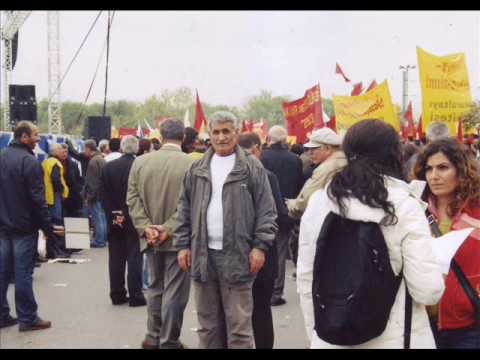
Yadullah Khosroshahi (center facing camera) at a demonstration (recent undated photo)

Introduction to the English translation: Yadullah Khosroshahi was a central leader of the Iranian oil workers movement in the 1979 revolution. He died in exile in London of  complications from stroke on February 4, 2010.  The Farsi language socialist journal Arash published in Paris devoted a section of its 104th issue (March 2010) to celebrate Yaddulah's life and contributions to the labor and socialist movements. The following essay is my contribution entitled “The Yadullah I Knew.”  It is translated from Farsi with slight additions to make it accessible to the English reader unfamiliar with certain individuals, places or events. In the same spirit, the rest of this introduction offers a brief biography. 

Yadullah Khosroshahi was born to a toiling family in Ahmad Abad neighborhood of Abadan known for its oil refinery in Khuzestan province in 1941.  Not only the London-based Anglo-Iranian Oil Company that paid a flat royalty to the Iranian government controlled the oil, during the World War II British forces occupied southern parts of Iran (northern parts were occupied by the Red Army).  Years later, Yaddulah described the conditions in Abadan as a form of apartheid. Workers could not go the the neighborhoods where the British employees of the oil company lived. Violators were arrested and jailed.  While the British had air-conditioning, swimming pools and golf courses, Iranian workers lived in shacks with no running water or swage system and children had to bath in the water collected in the gutters.  At work there was a similar hierarchy with Iranian employees being ranked below the Indian employees.  

However, the crisis that weakened the central government provided a democratic opening for mass movement of the Iranian people, oppressed nationalities (Azarbijanis and Kurds who briefly established their own autonomous governments), and workers, especially oil workers, that lasted for a dozen years.  In 1950 in response to popular demand the Iranian parliament (Majlis) voted for nationalization of the oil industry.  In April 1951, the Majlis nominated Mohammad Mossadegh, who led the nationalist Jebeh-ye Meli (National Front) representatives to become prime minster.  The young Mohammad Rezah Shah Pahlavi who was crowned in 1941, after his father Reza Shah Pahlavi was forced by the Allies to abdicate because of his pro-Nazi sympathies, was forced to appoint Moosadegh to the post.  However, a power struggle ensured Mossadegh and the Shah. On August 19, 1953, the CIA in collaboration with the M16 staged a coup that brought down the Mossadegh government and returned the Shah who had fled Iran in an earlier coup attempt to power. 

During the next quarter of century, Iran witnessed state-directed capitalist development and industrialization combined with increasing autocratic rule of the Shah.  As a result, social dislocations of vast proportion occurred.  Population grew and many displaced peasants circled large urban centers, especially Tehran, with shanty towns. The middle class and the intelligencia grew as modernization and tradition clashed.  The industrial working class more than doubled in size to 3 million. Meanwhile, due to its disastrous political course during the 1941-53 period and the bloody repression that followed the coup, the pro-Moscow Tudeh Party’s influence in the labor movement dwindled.  A new generation of workers began to learn from its own experiences and develop its own leaders. Yadullah Khosroshahi is a prime example of the leadership that emerged outside of the Stalinist orbit in the Iranian labor movement. And this reality explains the key role oil workers general strike played in the 1979 revolution and the emergence of workers shoras (factory councils) in the aftermath of overthrow of the monarchy.

Yaddulah worked for 13 years at the Abadan refinery where he was gradually recognized for his leadership qualities among oil workers was elected as a union delegate in 1967.  In 1968, he was forced to relocated to the Tehran refinery to keep him away from his base and to keep a closer watch on him.  However, Yadullah was quickly integrated among the fighting layer of the workers who soon took over the exiting management run-union and was elected as one of their leaders in 1969.  In 1972, Yadullah together with other worker-activists establish the Syndicate of Tehran Oil Refinery Workers and he was elected as it Secretary.  In 1973, after brief strike in Tehran refinery oil workers were able to win important benefits including 40 hour week and 25% pay increase.  

Yadullah was arrested three by the Shah’s secret police the SAVAK.  The second time SAVAK claimed to have found “banned books” in his possession and tortured Yadullah severely.  They demanded that Yadullah go before the oil workers and read a “confessionary note” prepared by the regime. Yaddulah agreed. But when he was reading the SAVAK prepared speech he took off his shoes and placed his bloody feet on the table for the workers to see.  The infuriated the SAVAK. He was arrested and after a number of failed attempts to buy him off the regime sentenced him to a 10 years in jail.  

Under the pressure of the mooting mass movement in 1978 Yadullah was freed from jail. He immediately joined the leadership of the oil workers who organized secret strike committees. Oil workers played a central role in the general strike that brought down the military state of siege government and forced the Shah to leave Iran in January. On February 11, 1979 an wave of urban insurrections centered in Tehran brought down the monarchy.   

After the February revolution strike committees in large workplaces were reorganized as factory committees (shoras) as most owners and managers either went into hiding or left the country and a wave of nationalization ensued.  One of the central goals of the newly established capitalist Islamic Republic was to re-establish capitalist authority in workplaces.  For this, it pursued a two-pronged tactic.  First, it encouraged emergence and establishment of Islamic Associations in workplaces to compete with shoras. Later, when the Islamic Associations failed to attract enough support, the regime aimed at establishing Islamic shoras or pressuring existing shoras to into serving as Islamic shoras.  When that happened, pro-regime workers demanded Islamic shoras to followed management and government dictates in the name of “Islam.” 

Again, because of strategic and historical reasons oil workers shoras were central to the shore movement.  When Saddam Hussein’s army invaded oil rich Khozestan province, one its early targets were shoras, they executed leaders of village shoras and by severely damaging the oil facilities, including the Abadan refinery, they in effect undermined the oil workers shoras.  The Islamic Republic used this opportunity to disperse oil workers across Iran as war refugees significantly weakening the oil workers shoras.

The final blow came after the massive waves of repression in the summer of 1981 and  late 1982 and early 1983. Many shora leaders and activists were arrested and some tortured and executed.  On November 26, 1981, the agents of the Islamic republic stormed Yadullah’s home in Tehran.  They arrested Yadullah, his son and some of his guests including a pregnant woman.  Yadullah spent four years and three months in Evin prison and was routinely tortured.  Unable to link Yadullah to political groups that were in conflict with the Islamic Republic, they released him on February 10, 1986 after posting a hefty bail. However, soon the Islamic Republic agents were after Yadullah again. He escaped to Pakistan. He found political asylum in England after he arrived in London on August 24, 1988.

However, Yadullah continued his campaign for the working class and the socialist cause.  In early 1990, he helped organized Iranian working class leaders and fighters in exile in the Association of Exiled and Immigrant Workers” that published Kargar Tabeidi (Exiled Worker).  In 1999, he helped organize a conference around the theme “Review of the Iranian Labor Movement in the Past 20 Years and Our Tasks.” Based on agreements reached with a majority of those who attended this conference, Yadullah helped establish Bonyad Kar (Labor Foudnation) that was active for eight years. Later he helped establish Labor Links, a English language newsletter of information and activities in solidarity with the Iranian labor movement and International Alliance in Support of Workers in Iran.  In his last years of life, Yadullah witnessed and campaigned for the independent unions of Tehran bus transit workers and of Haft Tapeh sugar cane workers.  He told his friends that “I wish to live long enough to see the formation of an independent labor organization in Iran.” He died in London of complications from stroke on February 4, 2010. He was 67 years old. 


*      *     *
A video clip with photos of Yadullah throughout his life. 

Introdution
I became acquainted with Yadullah Khosroshahi through Morteza Mohit in 1995. I had met Mohit in a demonstration in Whasington D.C. in the summer of 1994 soon after I returned from my first visit to Cuba in June.  Mohit was a pathologist by training who had been a socialist intellectual and activist since the late 1960s. We became friends and undertook series of political and journalistic collaborations that lasted until 2002. In our many conversations, Mohit sometimes related his experiences in Iran in the 1970s and various politically significant individuals he had met while living in Khozestan province or serving time as a political prisoner in Ahvaz and later in Qasr prison in Tehran. Of these, memories he shared about his contacts with the oil workers, especially Yadullah, were the most interesting to me.  A bit of context is necessary.

The 1978 Congress of the the Fourth International that I was active in its Iranian section had decided that where possible the majority of its leadership and cadre should join the mass organization of the working class, the trade unions.  This decision was based on our analysis that the long post-World War II capitalist boom had come to an end with the 1973-75 world recession and the immediate period facing us will be characterized by an international capitalist offensive against the working class.  Defensive struggle of workers could lead to their mass radicalization and possible challenge of reformism imposed on trade unions.  The Iranian revolution that triumphed in the following year and was characterized by mass mobilization of millions in urban centers, a general strike centrally led by the oil workers and urban insurrections that followed seemed to confirm our assessment.  However, our political tendency in Iran failed to form a lasting fraction of socialist workers in key industries in part because of the defeat of the shora (workers council) movement  that had emerged out of the February 1979 revolution.  Our movement split into three small parties that effectively dissolved by 1982 without drawing a political balance sheet of their experiences.  For me, getting to know Iranian working class leaders was like finding lost friends. I hoped that by learning from their experiences we could draw the lessons of the Iranian working class participation in the 1979 revolution, establish organic ties with the existing class struggle minded workers in Iran and to reestablish historical labor and socialist continuity.      

Yadullah’s early activities in exile
In the mid-1990s, Yadullah and a number of other militant Iranian workers living in exile in Europe published Kargar Tabeidi (Exiled Worker).  One key topic of discussion in this publication was independent workers organization. Yadullah was a key contributor to this discussion. There was also a side discussion through personal letters between Yadullah and Mohit about this issue.  Following some socialist currents in the U.S., Mohit argued that “white collared workers” should be considered part of the working class alongside the “blue collared workers.” Basing himself on his experiences in Iran, Yadullah was concerned about mixing up karmands (office workers) and kargars (laborers, including industrial workers). One was appealing to a sociological theory and the other to the experience of the labor movement. To what extent should the socialist workers movement relay on such “theory” and to what extent rely on the labor movement’s experience remained an open question. How much of the successes and failures of the working class movement in the period leading to the 1979 revolution was due to its understanding of theory or lack of it and how much was due to its reliance on its own practical experiences?  Without a doubt Yaddulah was a firm believer in relying on working class’s own historical class struggle experience. He also knew much less about “theory.”  However, my 15 years of personal friendship and political collaboration with him convinced me that he was not discounting theory and actively sought discussions with those he believed were well informed of theoretical issues.   

In the latter part of the 1990s, in consultation with and promise of collaboration from some Iranian socialists, including Yaddullah and Mohit, I was conducting a feasibility study for a publication that we tentatively called Barrasi-ye Sosialisti (Socialist Review). I wanted to avoid two types of problems associated with socialist publications. The first are those that claim to be research oriented but are actually socialist propaganda organs.  The second group are the publications that are essentially translations of well-known Western socialist intellectuals with no critical contributions from those who publish it.  I received a number of articles for the inaugural issue of Barrasi-ye Sosialisti. One was from Yadullah that was part of the history of the Iranian oil workers movement that he was writing at the time.  It was an excellent article that a friend in New York and I edited together.  But most other submissions were either not research articles or were not new research materials.  Based on this experience, we decided not to pursue the project. Yadullah’s article was later published in two installments in Pazhohesh Kargari (Labor Research) and Andishe Jameh (Social Thought).  

In this same period, Yadullah and some other Iranian labor leaders initiated a call for the formation of Bonyad Kar (Labor Foundation).  He invited me to attend the founding conference in London in November 1999.  However, I found the founding document unclear in its overall perspective and I was involved in other urgent activities that left me no time to spare.  I told Yadullah that I supported the idea of organizing militant Iranian workers aboard in order to collect their respective experiences and to coordinate solidarity with the Iranian labor movement and that I would be happy to help as needed. In the next 6 years when Bonyad Kar was active, I assisted it whenever yadullah asked but I never joined it as its platform remained ambiguous.

Visiting Cuba
In late April and early May 2001, Yadullah and I were guests of Central de Trabajadores de Cuba (CTC), the Cuban labor federation. At that time, CTC included 19 different trade unions with 3 million workers.  I was one of two representatives of the University Professional and Technical Employees (UPTE) of the University of California, Berkeley.  Yadullah was participating as an activist from the Iranian labor movement.  Both of us were part of the US/Cuba Labor Exchange delegation of about 60 people. This is a U.S. based labor solidarity group that had a Department of Treasury license to take groups of workers from the U.S. to meet with their Cuban counterpart.  The US/Cuba Labor Exchange enjoyed cordial relations with the CTC that hosted our visit as observers to its 18th Congress that took place April 28-30.  CTC congresses are organized every five years.  So, it is an infrequent event to observe.  Besides the congress, we participated in the May Day celebration and visited factories and labor, social and cultural centers.  

Yadullah and I had also planned to use this opportunity to talk to Cuban workers and workers from other countries about the situation of the Iranian workers whenever appropriate. Our main goal was to observe and learn about the Cuban labor movement.  Before we flew to Havana, in consultation with Yadullah I had prepared a two-page fact sheet about the role of the Iranian workers in the 1979 revolution and the repression that subsequently was leveled against them and the current struggle for labor rights in Iran.  A friend of mine in Havana prepared a Spanish translation of this fact sheet.  I copied a good number of these for distribution in Cuba.  

On the evening of April 24 when I stepped out of the customs in Jose Marti International Airport in Havana I ran straight into Yadullah who was waiting for me with a CTC host. This was the first time I saw Yadullah in person.  We embraced like two old time friends.   
When we arrived at Hotel Girasol in Centro Habana, I noticed that hotel workers talked to and joked with Yadullh as if they were old time friends as well!  Some of the invited guests in our company complained about the third class status of Hotel Girasol that belongs to the CTC. To the contrary, Yadullah was happy that the Cuban unions actually own their own hotel!  

During our stay in Havana, we visited a few factories and workplaces.  I should mention two of these in relation to Yadullah.  On April 25, we visited Quido Perez beer factory that is located outside of Havana.  It produces the well regarded Hatuey beer.  Hatuey was an Indian chief and a leader of the last wave of resistance to the Spanish occupation of Cuba. When he was captured, the Spanish burned him alive at stake.  The factory’s director and two leaders of the union greeted us.  They toured us around the plant part of which was under reconstruction and repair.  As we walked around the plant, a stocky man with a hand gun fasten to his belt followed us around.  Yadullah whispered in my ears that the man is “hefazati” (management/government guard). I noticed his faced turned red as he said that.  At the end of the tour, our group was taken to a conference room for question and answer about what we had seen.  There were a group of workers in the room as we intermingled.  Yadullah wanted me to find out who that stocky man with the gun was. I asked a group of workers who introduced him to us as the member of the union.  Yadullah’s attitude changed and he spent some time talking to that man. 

On the morning of April 28 we learned that because of overbooking for international observers at the CTC Congress it was not possible for our group to attend the proceedings until further notice.  Instead, that morning we went to visit the Lenin steel mill in Havana and that afternoon we visited the CTC cadre school. 

In Lenin steel mill our visit was limited due to safety concerns during production time. After a short tour, we gathered in the yard where a sound system was quickly put together and some from our delegation were asked to address steel workers who were taking a break. Yadullah was among the speakers.  In his brief talk that was translated into English and then Spanish Yadullah explained that he became an apprentice in the Iranian oil industry at age 14 (in 1955) and spend his life time organizing independent organizations of workers.  He noted the key role of the Iranian working class, especially the oil workers, in the 1979 revolution. And he explained that because of his uncompromising effort on behalf of the oil workers and the working class he spent five years in the Shah Mohammad Reza Pahlavi’s jail and five years in the prisons of the Islamic Republic of Iran. He was tortured by both regimes.  He ended his brief remarks by noting that in the few days he has been in Havana he has seen the power of workers.  He cried: “Long live the Cuban revolution!”  The Cuban television carried Yadullah’s speech in its mid-day news.  This was important because Cubans do not have a good knowledge of the Iranian working class and its revolutionary history.  

That afternoon we visited the CTC cadre school and witnessed graduation of a group of workers from other caribbean countries.  Yadullah remarked: “Would it not be nice to bring some labor leaders from Iran for training?”  

That evening after dinner, the leaders of US/Cuba Labor Exchange organized an gathering for Yadullah to speak about the situation of the Iranian labor movement.  Some sixty people attended and a good discussion ensued.

The CTC conference was being held in the Palacio de Convenciones de la Habana (Havana’s Convention Center).  On the third and last day of the congress, the organizers made available to us and a few other international delegations who had not yet observed its proceeding a very large conference room next to the main hall where the congress was in session.  The room had state of the art audiovisual equipments. A huge screen showed the front of the main hall where speakers could be seen and heard delivering their speeches. There was simultaneous translation available from Spanish into English and French.  Near where Yadullah and I sat were two rows of black women and men wearing red tee-shirts with the logo of oil workers trade union of Trinidad and Tobago.  During the break, yadullah introduced himself to them, talked briefly about their union and offered them our flier about the situation of the Iranian labor movement.  

We had our lunch and dinner in the huge dinning hall in the basement of the building.  After dinner, Yadullah and I found two seats in the front rows of the main hall.  Yadullah was able to tape some of the speech of the CTC General Secretary Pedro Ross Real who was re-elected to the leadership of CTC that night and of Fidel Casgtro’s speech that began just before midnight.  At the close of the Congress more than an hour past midnight, we could hear singing of the International in different languages by various groups of Cuban workers and international guests who were walking to their buses to go home and catch a few hours of sleep to return to the Plaza de la Revolución (Revolution Square) for the May Day celebration early in the morning.  

Early next morning, Yadullah was ready with his video camera in hand. We set off for the Revolution Square for the May Day celebration.   The CTC organizers assigned our delegation to a prime location close to the podium in the midst of a huge crowd.  We were all standing for the duration of the ceremony and speeches that lasted three hours.  After a relatively short speech by Fidel Castro, Pedro Ross Real invited everyone to march.  CTC estimated the crowd to be about one million people. Yadullah was so glad that the organization of the march, including security, was entirely with the CTC.  

On May 2, we participated in an international labor solidarity meeting of 600 international guests and leaders of the CTC.  Leaders of some major labor organizations, like the French CGT spoke. So did a number of CTC leaders.  Two key topics were resistance to neoliberalism and solidarity with the Cuban revolution.

In the remaining days of our stay in Cuba, we visited historical, social and cultural sites such as Bay of Pigs (Playa Girón) and the Che Guevara Mausoleum in Santa Clara.   The memorial is architecturally beautiful with a small museum that displays some of the surviving personal articles of Guevara and his comrades in the guerrilla campaign in Bolivia.  Yaddulah and others in our group were clearly moved with the spirit of sacrifice and internationalism of Che Guevara and his comrades that reflected the reality of the Cuban revolution. 

A portion of our time was spent on sightseeing and entertainment.  Yadullah really enjoyed music and dance performances that accompanied feast of Cuban cuisine prepared by the Girasol Hotel for us.  He videotaped those as well. One of the simple pleasures in Havana is to take long nightly walks, especially by the sea. One night we went to Hotel Ingelatera’s roof cafe that offered great music and dance performances each night except Tuesdays.  On our way back to Hotel Girasol, we stopped by a store to buy bottled water.  Havana’s water must be boiled to drink. Waiting in the queue we noticed several young men accompanied by an older man with an Islamic beard.  We heard them talk in Farsi about the physical features of some young women in the store.  Yadullah began talking to them in Farsi. We learned that they were the Iranian boxing team and the bearded older man was their coach. They had come to Cuba to learn from their rich boxing experience.  When the young boxers learned that Yadullah had come from London, they gathered around him to learn how they can secure an immigrant visa. To relieve Yadullah, I volunteered that I had come from California. Immediately, they dumped Yadullah and gathered around me asking similar questions about immigration to the United States.  At one point, to justify their overt comments about the young women's attractive bodies the Islamic coach proclaimed: “These Cubans have nothing to eat and yet they have such well formed bodies!”  

Collaborative projects
In the two weeks that Yadullah and I shared a room in Hotel Girasol our friendship deepened and we found much more common political grounds. Our conversation about Cuba were not based on abstract concepts but on specific gains we witnessed working people have made.  Unlike socialist intellectuals, as a labor leader from Iran Yadullah paid more attention to what Cuban workers have actually achieved than those things that they have not yet achieved.  And the fact that Yadullah found Cuban workers happy and engaged gave him hope that they will achieve more in the future.  More importantly, Yadullah was keenly aware that socialism in one island is an impossibility. A world revolution is necessary.  He observed first hand how Cuban revolutionaries are trying to deepen internationalism. It was in this context that at the end of our trip we reached a number of practical agreements. 

One of these was to write a report of the CTC congress. After we returned home with Yadullah’s input, I wrote a report for Andisheh Jamehe (“Workers and Trade Unions in Cuba: A Report from the 18th Congress of Central Organization of Cuban Workers, no. 20, pp. 56-61).  Also, I edited and published an interview I had conducted with three youth who were our CTC translators that was published in the U.S. Social Action newspaper.  Sosan Bahar translated this interview into Swedish and published it in an online youth site.  The University Professional and Technical Employees (UPTE) union at University of California, Berkeley, organized a report back for me and another UPTE delegate to the Congress.  Yadullah gave a report back to his comrades and friends in Europe. The following year he tried to gather 10-12 worker activists for another visit to Cuba, but that did not materialize.  

In our conversations in Cuba, I argued and Yadullah agreed that Iranian working class activists outside Iran have tuned inwards by ignoring the labor movement in their adopted country (This was not true of Yadullah himself despite his difficulty in communicating in English).  There was no reason why Iranian worker socialists should not follow Marx’s and Engels’ footsteps in integrating themselves in the labor movement of their adopted country.  If carried through they would be in much stronger position to carry out solidarity work with the Iranian labor movement inside unions. To facilitate this campaign we initiated the publication of Labor Links, an English language quarterly newsletter which Yadullah and I co-edited. Bonnie Weiss in Emeryville, California, helped me edit the final draft and Mansour Soltani in Stockholm, Sweden, published it on the Labor Foundation website.  

Visiting Yadullah in London
At the end of the summer of 2001 a small book of two of the early writings of Marx that that Morteza Mohit and I spent a lot of time translating and editing was published by Sonboleh Publication in Hamburg, Germany.  On this occasion, I travelled to Europe and stayed at Yadullah’s house in London at the beginning and the end of my tour.  Besides spending more valuable time with Yadullah, I truly enjoyed meeting Jahan, Yadullah’s wife, who is the unspoken and unseen part of Yaullah’s strength to endure the hardship in his exemplary life.  Jahan and I shared a love for all animals.  She had a very cute small dog, Huxley, and I had a cat I adored, Nuppy.  We talked about their personalities, our relationship with them, and their intelligence and emotions. Jahan worked hard to prepare vegetarian meals for me.  Yadullah loved his family and whenever he took me sightseeing we stopped by his children’s homes to say hello.  He also took me to Marx’s grave. Along the way he bought a bouquet of flowers. It was not for Marx but for his youngest son Saeed who had died at a young age.  We stopped at his grave as well. 

My return to the U.S. was a few days after September 11, 2001.  It was not certain if my flight would leave as scheduled. The night before my departure date, Yadullah asked if I wish to meet a “Trotskyist youth” nearby.  That is how I met Behzad Kazemi (Alireza Nassab who died prematurely and unexpectedly a year after Yadullah). He welcomed us with great hospitality although it was late in the night.  He gave me three copies of his book, a critical history of Mohammad Mosadegh’s nationalism and the events surrounding his coming to power and downfall. Yadullah and Behzad became close collaborators.  Behzad and I became good friends as well and he joined me in Cuba in my 2006 trip. 

International Alliance in Support of Workers in Iran
After five quarterly issues of Labor Link Yadullah and I decided to suspend its publication. Despite its prompt publication on the Labor Foundation website, there was not evidence that it was being used by Iranian labor activists in the way intended. The problem was not with the newsletter.  It was in getting Iranian worker-activists to engage in the union movement of the country the resided in.  

In the same period, Mehdi Kohestani Nejad and Farid Partovi were organizing the International Alliance in Support of workers in Iran (IASWI).  One advantage of this initiative was that both these labor activists were deeply involved in the labor movement in Canada and this gave the IASWI the potential to grow and succeed.  Yadullah and I discussed this initiative that was at its initial phase.  Kohestani Nejad and Partovi were organizing a conference in Toronto that Yadullah participated in (but I could not).  It was a success in getting Iranian labor solidarity activists collaborate better across countries.  The IASWI’s perspective emphasized that it is important to get international labor unions involved in solidarity campaigns.

However, in my view the IASWI’s perspective was left ambiguous at that time. Was this an effort to get to know and collaborate with union bureaucracies that as we know are a means of social control? Or is it a movement to join with militant workers in unions and outside of them to strengthen the labor movement in host countries as well as in Iran?  

An example of this lack of clarity surfaced when Labor Links was being published.  A large group of labor activists, including Yaddulah, had gone to the headquarters of the International Labor Organization (ILO) in Geneva to demand that the Iran delegation be expelled from it because it did not represent the Iranian workers.  Of course, this action was unfolding in the context of imperialist hostility towards Iran.  The problem with this action begin with the bourgeois character of the ILO.  Each country’s delegation is composed of two employer delegates, two government delegates and two “workers delegates.” In most cases as with the Iranian delegation, “workers delegates” are also handpicked by the employers and their government.  It becomes clear that expulsion of the Iranian delegation (which has never represented the Iranian labor movement) could not help advance class struggle.  Worse still, it is clear that asking the ILO to expel the Iranian delegation could have facilitated the imperialists campaign.

I discussed this problem with Yadullah in a phone call.  After thinking about it for a while, he agreed that this action did not advance workers’ interests. With his agreement, I wrote a short article for Labor Links explaining the class character of the ILO.  

This sort of error existed in the work of the IASWI as well.  In one instance, the General Secretary of a union called the British foreign secretary to press the Islamic Republic government on behalf of the Iranian workers.  Disagreements over this tactic became an issue of contention in the IASWI and Mehdi Kohestani Nejad split from it to continue such activities freely.  With this split, IASWI was strengthened. It deepened collaboration between Yadullah and Partovi and others and brought forth a series of successful campaigns.

Oral histories of the shora (workers council) movement
Yadullan and I had often talked about the dire need for the collection of the historical experiences of the Iranian labor movement.  A number of Iranian labor activists in recent years had published their memoir, granted interviews about their lives or lectured about their experiences. Sometimes, these sources were called “oral history.”  The Labor Foundation website had an “Oral History” page.  While all these effort were valuable oral history as a branch of the discipline of history has a clear and definite meaning.  From an historical point of view, its origin goes back to latter part of the nineteenth century.  However, as a new method of historical research it was established in the Western universities in the 1960s.  The American Oral History Association was founded in 1969.  Determination of sources (persons who were involved in the historical event of interest), recording, transcribing and interviewing techniques all followed a particular and increasingly well-defined methodology.  Analysis of the raw event histories is the work of specialized historians. in other words, raw event histories (what is related by the interviewee) is not history itself.  It is history as seen from one particular participant’s view.  It is necessary to “listen” to what is related and what is not, to silences as well as words of the interviewee to penetrate deeper into the event in question.  Oral history is a methodology most suitable for social groups in lower social hierarchy with little resources.  Social classes that enjoy power and/or are economically dominant have ample access to historians some of whom make their career writing about them.  But the lower echelons of society have little opportunity to leave their mark on historical writing. 

With Yadullah’s consent, as a research at the University of California, Berkeley I began to assess the possibility of funding a serious oral history project of the shora (workers council) movement in the 1979 revolution in Iran. To explore the possibilities, I contacted Professor Candida Smith who was the Director of Regional Oral History Office (ROHO) at U.C. Berkeley.  Professor Candida Smith who is a prominent oral historian in the United States welcomed my inquiry with great generosity of spirit. We agreed to jointly pursue funding for the project.  In the summer of 2002, I participated in the Oral History Institute that was taught by Professor Candida Smith. In the fall of the same year, with help from Professor Candida Smith and Yadullah, I drafted a proposal for funding.  During the summer, Professor Asef Bayat, whose research on the shora movement remains to this date the most comprehensive and authoritative was in Berkeley. He graciously agreed to join us in this research. Thus, we had assembled an impressive research team. 

I developed a 40 page draft proposal and with Yadullah’s help identified 30 labor leaders in Europe, Canada, and United States for oral history of the rise and fall of the shora movement.  Professor Candida Smith and I had decided to submit our funding proposal to the prestigious National Endowment for the Humanities (NEH).  To do so, we secured a $50,000 commitment by the UCB Office of Research. 

Although the NEH review committee rated our proposal “excellent” it did not fund it.  They cited two issues for this decision. First, they took the position that the ROHO’s cost per each interview was high. Second, one reviewer took the position that having no interviews with workers in Iran is a defect.  

Next year, we resubmitted the proposal to the NEH. We increased the number of interviews from 30 to 40 persons with ten interviews inside Iran.  ROHO also agreed to conduct the additional ten interviews at no costs, thereby addressing the concern that they charged higher than average costs for each interview.  To improve the chance of getting funding from the NEH, I asked Yadullah to see if we can get some funding no matter how symbolic from the international trade unions that worked with the International Alliance in Support of Workers in Iran. Yadullah agreed to talk to Mehdi Kohestani Nejad who was at that time the spokesperson for IASWI and held an official position in the University of Toronto’s employees union.  Also, I approached Professor Touraj Atabaki of the International Institute of Social History for supplementary funding.  With his help I discussed the matter with Professor Marcel van der Linden the Research Director at IISH.  While the IISH could not offer any supporting funding, Professor van der Linden wrote a letter of support for the project and offered to include oral histories obtained from this project to be housed at the IISH.  After several weeks, Yadullah told me that there was no hope of getting even a token financial support from the international unions.  This time around, the NEH panel ranked our proposal “excellent” except for one reviewer who ranked it “very good” arguing this time that interviewing sources in Iran is not a good idea because there can be no guarantee that they can speak freely!  It became clear that some in the NEH are not going to let this project get funded.  Thus one our key wishes remained unfulfilled. 

Yadullah as part of the working class revolutionary history
On April 2009, I along with nearly 600 other employees (two-third of the workforce) of the University of California Office of the President were laid off.  The excuse was typical; to restructure at the time of financial crisis for the university.  This was the fourth time I lost my university job in my 30 years of teaching and research (the first time was in Iran because of the Islamic Cultural Revolution that shut down universities for three years).  

However, this time I welcomed the opportunity.  I asked myself: could I work with Yadullah and other worker-activists to conduct the oral history project on a shoe-string budget?   Like myself, Yadullah who had a bypass surgery a year and half earlier was thinking about the sunset of his life.  Last fall, he sent me his memoir of the Evin prison to get my feed back.  But he did not follow up.  I too decided not to raise the issue and bring up a few suggestions I had for its improvement.  On January 1, 2010 when I called him to give him to offer best wishes for the new year Yadullah asked me about the events in Iran.  The 2009 mass demonstrations were defeated six months earlier and he was worried about the future of the labor movement and the Iranian people.  Nine years had gone by and we had not seen each other. I asked him if he would consider visiting me in California.  He welcomed the invitation and said “let us go sightseeing!”  I was so happy that I immediately called our common friend Nasser Rahmaninejad who lives near me.   Nasser was very happy and asked: “Should we organize a speak out meeting for him?” 

The most prominent feature of the 1979 Iranian revolution was the grassroots mass movements, in particular workers organizations.  If the motivation for the revolution was to resolve historical national democratic tasks, the entry of workers and toilers to the center stage of the revolution gave it an anti-capitalist dynamics.  It is clear now (if it was not to many before the defeat of the revolution) that any resolution to the national democratic tasks of the revolution is only possible with breaking through the capitalist social relations that both monarchy and shia clergy have historically guarded.  The rise of the workers movement that brought forth working class leaders like Yadullah Khosroshahi was the result of molecular economic and social changes of the post-CIA coup of 1953.   The rise of this layer of working class leaders and dual power in major workplaces and industries provided a path to the opening of the socialist revolution in Iran and the Middle East.  There lies the historical importance of Yadullah and other labor leaders that emerged in the large-scale industry during the Iranian revolution of 1979. 

But my friendship and collaboration with Yadullah were at the time of his exile.  I found him like a captain who was trying to guide a storm damaged ship to its destination.  That explained his continuous attention to the problem of independent organization of workers.  Because he had learned that the Iranian workers movement was defeated in large part because of lacking strong enough class independent organizations. Yadullah was completely aware that he faced a period of preparatory and defensive work.  And, it should be recognized that he and his fellow worker-activists were largely successful in their predatory work. One one hand the labor movement in Iran seems to be re-establishing its organizations despite its ups and downs and on the other hand the struggle for solidity with this movement is producing results.  

A few days ago an acquaintance sent me a short but professionally done and effective video clip about Mansour Osanloo, a leader of the trade union at the municipal United Bus Company of Tehran and Suburbs (UBCTS) that has 17,000 employees, including some 10,000 bus drivers.  The significant issue was that the person who sent the video clip is not political.  Nazila Fathi, who for a number of years was the New York Times reporter in Iran and usually wrote about issues of interest to the Iranian middle classes and recently was forced to migrate to Canada, wrote an article in NYT of March 2, 2010 that included reference to two militant labor actions, one by metal and machine tool workers and another by communication workers in Shiraz (It is rather odd that when this report was edited for the digital version  references to these labor actions were eliminated). But attention given to labor struggles in Iran by my acquaintance and the New York Times reporter reflect at least in part the renewed labor resistance in Iran and solidarity campaign that Yadullah and other worker-activists have been carrying out through the International Alliance in Support of Workers in Iran.  

Thirty five years ago we faced a similar situation.  Defenders of political prisoners in the Shah’s jails were able to overcome the wall of censorship in the mass media to expose the true face of dictatorship and make it difficult for the Western powers to support it.  At that historical juncture, the Iranian revolution arrived much sooner than anyone anticipated and swept aside the monarchy and its imperialists backers. Are we in the opening stages of another revolution to sweep aside the Islamic Republic? We do not know.  What we know for sure is that the new generation of workers that is getting ready for struggle will stand on the shoulder of Yadullah and his likes and will continue the path he embarked on long ago. 


Acknowledgment: I am grateful to Nasser Rahmaninejad for his encouragement and editing of the original Farsi version.