Showing posts with label Women's movement. Show all posts

Wednesday, November 4, 2020

3439. How the Strike for Equality Relaunched the Struggle for Women’s Liberation in the US

By Nancy Rosenstock and Ruthann Miller, Jacobin, November 1, 2020


Interview with Ruthann Miller

In August 1970, campaigners for women’s liberation mounted a huge demonstration that recharged feminism in the US. Ruthann Miller, the protest coordinator, was a socialist activist. She talks to Jacobin about the march, and the need to combine feminist and socialist politics.

The Women’s Strike for Equality in August 1970 was a landmark in the development of second-wave feminism. On August 26, fifty thousand women marched down New York City’s Fifth Avenue, defying the efforts of the police to confine them to the sidewalk as they mounted the largest feminist demonstration that the United States had seen.

The protest in New York was flanked by actions in ninety US cities, coming fifty years to the day after women had won the right to vote. This time, the Strike for Equality put forward three main demands: free abortion on demand — no forced sterilization; free, community-controlled twenty-four-hour childcare centers; and equal opportunities in jobs and education.

Ruthann Miller, a young socialist activist, was the coordinator of the New York march, but her role in the Strike for Equality has never received the attention it deserves. Now, telling her story for the first time, Miller describes the events leading up to the historic demonstration and on the day itself.

She also discusses the challenge of combining her socialist activism and her commitment to women’s liberation, in the face of criticism from “feminists who said I couldn’t be a feminist and a socialist, and socialists who said I couldn’t be a socialist and a feminist.”

You were the coordinator of the August 26, 1970 Women’s Strike for Equality in New York City. Can you tell us how that came about? What was your involvement in the women’s liberation movement prior to August 1970?

RM

In 1969, I joined Redstockings, a radical feminist group that organized small consciousness-raising groups. Being involved in this group gave me the insight, self-esteem, and self-confidence that carried me through my life.

In late 1969, I was the full-time staff person for a coalition of women’s groups in New York — People to Abolish Abortion Laws (PAAL) — which organized to support the legal case challenging the constitutionality of the New York State law that made abortion a crime. In February 1970, we organized a public demonstration that drew five thousand women, an astonishing number at the time, and the largest women’s rights march since the suffrage movement fifty years earlier. I was twenty-two years old, the mother of a beloved baby smiling at me from her basket in the office as I worked at organizing.

Betty Friedan, a feminist author, had the idea to have a one-day women’s strike and march down Fifth Avenue to commemorate the fiftieth anniversary of winning the right to vote and to demand equality for women. Initially, she went to NOW (National Organization for Women), an organization she had founded, to propose they organize it. NOW said no.

To say Friedan was annoyed at that would be putting it politely. She knew about the demonstration that PAAL had organized in February, and somehow she found out that I had been the staff organizer. She also knew that I was a member of the Young Socialist Alliance (YSA), a group of students and other youth that had played a huge role in organizing massive anti–Vietnam War demonstrations during those years.

Friedan invited me to her house to discuss “a proposal.” Along with myself, there were four other people at this meeting: Friedan; Ivy Bottini, president of NOW, although she was not officially representing it; Judy White from the Socialist Workers Party; and Rita Mae Brown, now a well-known author.

It was made clear to me that I was there representing young radical women whom Friedan decided were essential to making the march a success. I wasn’t sure which hat I wore that day — Redstockings, staff organizer for the abortion rights coalition, YSA, young mother, or conduit to those who organized the anti–Vietnam War demonstrations.

A diverse coalition of women’s organizations came together around the three demands for the march: free abortion on demand — no forced sterilization; free community-controlled twenty-four-hour childcare centers; and equal opportunities in jobs and education. Can you describe the challenges that were involved in getting agreement on these demands? What were some of the different groups that were involved?

RM

There were fifty-four groups that endorsed the August 26 coalition, including NOW. The biggest differences were between the radical feminists like Redstockings and the conservative feminists like NOW. The disagreements weren’t at all around the demands, although some disagreements arose around the modification of demands, such as adding “free” to the abortion demand as insisted on by Redstockings, or adding “community-controlled” to the childcare demand, which was championed by black women’s groups.

It turned out that we won support everywhere: Church Women United, suburban women, university women, stockbrokers — all types of women. Friedan did her best to get support from every segment of the Democratic Party.

For me personally, my role was to deepen everyone talking together in spite of differences. It was more the everyday small disagreements that, if not handled properly, could easily break apart this new, fragile coalition. I would go home each night with my head pounding, from getting Church Women United chatting happily with Robin Morgan — the radical feminist who authored the 1970 book, Sisterhood Is Powerful.

The disagreements came from a real difference in perspective. Betty Friedan and the NOW leadership were very concerned about public appearance — about promoting the idea that reasonable, educated, somewhat older women were for these ideas, and about getting the established political parties involved. The younger radical women, the university and high school women, were tired of pleasing everyone and wanted instead to convince the public of the fairness of the demand for women’s equality by bold, imaginative actions before the march.

For example, “Women of the World Unite” and “March on August 26 for Equality” were two forty-foot banners that were hung from the Statue of Liberty days before the march. “Freedom trash cans” were set up all over the city, where symbols of women’s denigration were thrown.

Women organized everywhere. We began a newsletter to communicate, which was put together by women in the media. This newsletter eventually morphed into Ms. magazine.

You worked full-time in the office organizing the demonstration. What was that like? What was your relationship with Betty Friedan, who had originally come up with the idea for the march?

RM

My relationship with Friedan was good. It was her choice to propose and champion me to be the coordinator. It turned out to be right, because August 26, 1970 was successful beyond our dreams. She seemed to see in me a skill, something I was just beginning to develop and see in myself, and she took a chance on it, giving me one of the most wonderful experiences of my life.

So I will always be grateful to her for that. She believed I could organize the young women, and she could organize the older women. It actually turned out that I was able to get all the women working together. Who knew? Friedan had wanted to propose to the coalition that money be raised for my childcare expenses. That was really very kind of her. But it wasn’t necessary. By that point, I would have done it for free.

NR

Having a small child at the time posed some significant challenges. How did that work out?

RM

My little baby, Jennie, came with me each day to the organizing office for August 26, 1970, which was in a church. She slept in a basket by my desk or played in her playpen. The church had a small daycare center, but she was too little.

The center was run by some great women who would take her on little outings with the older kids to give me a break. One of the Redstockings women, Alix Kates Shulman, an author, lived down the street. She would sometimes take Jennie to her apartment with her children when she picked them up from school and give me some time to concentrate on one thing at a time.

I was very lucky in the sense that Jennie’s dad is a wonderful father. Like a lot of men at that time, he was just beginning to try and walk the line between being the traditional good father that he had himself, and the new man that his raving feminist partner wanted. He also had to contend with me being a public spokesperson for the new women’s liberation movement. He was also at the time involved in politics around the clock.

NR

On the day of the march, despite having secured permits, the police tried to keep the protest on the sidewalk. What happened? How did the march end up taking to the streets?

RM

On the day itself, I held my breath. One of the many tasks I had on that day was to be in charge of the marshals. We had met with the mayor’s office and gotten all the permits, but they refused to agree to block off the road. “The girls” could march on the sidewalk with their signs.

Very early before the scheduled time, it was clear that large numbers were amassing. I was talking with the police commander, and he kept saying, “Hey lady,” as he insisted we march on the sidewalk. I was at first trying to be my quiet, usual, polite self, but I got so exasperated that finally I said to him, “Please just turn around and look behind you.”

I made a gesture pointing to the crowd. People around me started chanting, “Look behind, look behind!” The police commander turned his head and saw these thousands of women, and within two seconds, he gave the order to block off the street. Shortly after, I gave the signal, and the fifty-thousand-strong March for Equality began. Women once again marched into history.

NR

Can you describe the composition of the march? Were there contingents of union members? Was it mostly young? What was the participation from black and Puerto Rican women?

RM

In addition to NOW and Redstockings, there were numerous other groups involved in the coalition that organized the march and brought people to it. We even had women stockbrokers marching from Wall Street to join us.

Student groups like Barnard/Columbia Women’s Liberation were incredible organizers. Others included: New York Radical Feminists, Radical Lesbians, National Coalition of American Nuns, National Welfare Rights Organization, Older Women’s Liberation, Feminists in the Arts, Women’s Strike for Peace, WITCH (Women’s International Terrorist Conspiracy from Hell), High School Student Alliance, and the Third World Women’s Alliance.

NR

As one of the central women involved in organizing for this march, were you surprised by the turnout?

RM

I chaired the rally afterward. Congresswomen Shirley Chisholm and Bella Abzug spoke, as well as Gloria Steinem. There was a speaker from the Third World Women’s Alliance. Betty Friedan gave a speech. I also spoke — a twenty-two-year-old Irish-American young mother, having recently discovered that I had something to say. “Look around you and feel our power,” I told the crowd. Continuing on, I said: “What we see here today is the power of united struggle of thousands of women organized in our own movement.”

As I looked out from the stage that day at all the women united there, I couldn’t believe we had really done it. I was the youngest speaker that day, an unknown who has slipped out of the history of that day. But that day has never slipped out of my story.

After August 26, Betty Friedan got well-deserved credit. The National Organization for Women took public credit for organizing the march — which wasn’t true. I didn’t think it mattered, since we had accomplished our goal. Women’s equality was now a national discussion.

NR

In addition to having been a member of one of the early radical feminist groups in New York City, you were also a socialist. Was that in any way a conflict at the time?

RM

For me personally there was no conflict between feminism and socialism. But to others there was, and they were not shy about telling me and trying to convince me they were right — feminists who said I couldn’t be a feminist and a socialist, and socialists who said I couldn’t be a socialist and a feminist. You have to remember that back then, there were very few feminists in the traditional political parties, or in socialist political parties, or in the leadership of the anti–Vietnam War or civil rights movements.

Everyone was confused. There was a small minority of the feminist movement who thought they were the only ones who knew what a feminist must be. The rest of us ignored them. Some people even thought you could tell if a woman was a feminist just by looking at her. Many men found out to their surprise that this idea was definitely untrue.

But I was very used to contradictions: I had been a nonpolitical ballet dancer who joined the anti–Vietnam War movement. I was a young Irish-American working-class woman who got a scholarship to college and was heading to law school. I was a very young mother with an infant in a sling with whom I thought I could carry on doing what I wanted to do. I was a socialist and a member of the YSA.

NR

Having played such a central role in a historic moment, can you describe to us, fifty years later, the significance of this event for yourself?

RM

The only other thing I want to say is that in 1969, I was a very ordinary average American young woman. I was in the right place at the right time. Because of the Depression, World War II, and its aftermath in the United States, including the Civil Rights Movement and the anti–Vietnam War movement, the conditions were there for the rise of the second wave of the women’s movement, and I was lucky enough to be part of it.

The main significance to me personally was that for the rest of my lifetime, I have been very confident in my abilities, have had good self-esteem, and believed I could do what I wanted. My experiences in the women’s liberation movement and August 26 played a big role in producing that confidence. I have never forgotten August 26, 1970.

Today, as new young women organize, it does seem important to see clearly that we need to organize politically the largest number of women from different walks of life — different groups in coalitions around what we can agree on and leave our disagreements for another time. This is especially true now in these challenging times.


Thursday, February 2, 2017

2545. The Historic Women's Marches of January 21, 2017

By Kamran Nayeri, February 2, 2017

Historic actions
January 21, 2017, Women's Marches were historic in a number of ways. First, in the United States, more than 3.2 million persons participated--at least 500,000 in Washington D.C. alone.   There were more than 408 other marches, covering all 50 states. One out of every hundred people living in the country participated, making it the largest single-day street action in U.S. history.   

Second, there were 168 "solidarity" marches in 81 other countries on all seven continents which bring the world total participation to 4.8 million. Canada and Mexico, United States' neighbors, had 29 and 20 separate marches respectively.  


Third, these massive street actions were organized from the ground up. The Washington D.C. march was organized as follows. The day after the election of Donal J. Trump to the presidency, Teresa Shook from Hawaii created a Facebook event and invited friends to march on Washington in protest. During his election campaign, Trump's misogyny was on full display. Similar Facebook pages were created by Evvie Harmon, Fontaine Pearson, Bob Bland, Breanne Butler, and others quickly leading to thousands of women signing up to march. Soon, these individual efforts were conjoined and a National Co-Chairs including  Tamika MalloryCarmen Perez, and Linda Sarsour was selected to reflect the rising to prominence of women of color in the social justice movement in the U.S.  Organizers insisted that they were "not targeting Trump specifically" and that the event was "more about being proactive about women's rights."  A lively discussion ensued where the issue of "intersectionality" was discussed--the importance of expressing the multidimensional character of women's oppression today.  Sarsour, a Palestinian-American, called it "a stand for social justice and human rights issues ranging from race, ethnicity, gender, religion, immigration and health care."  Still, the marchers did target Trump, and his actions since inauguration have confirmed they were not wrong to do so. 


Sectarian critics of women's marches
V. I. Lenin, the central leader of the 1917 Russian socialist revolution, reminded us that "politics begin where millions of men and women are; where there are not thousands, but millions, that is where serious politics begin" ("Political Report of the Central Committee," March 7, 1918). Unfortunately, as long as there have been mass actions in the modern era, there have also been ultra-left sectarian critics of them. A sideline critic of the women's marches is the U.S. Socialist Workers Party (SWP) that attacked them as "bourgeois," characterize the marchers as "middle class," and claimed without proof that they were organized by supporters of Senator Sanders in the "Our Revolution" group and the Communist Part and "numerous" other forces that were disappointed by the defeat of Hillary Clinton in November 2016 elections.  As is typical with sectarian political groups, the SWP went to the marches "looking to debate and discuss political perspectives with those...who participated," and to join the SWP to further women's movement. (The Militant, February 6, 2017)  

For over two decades the SWP similarly has been denigrating the precious few mass actions in the United States to justify abstaining from building them. Given that in 2015, the number of wage and salary workers was just shy of 134 million in a population of about 320 million, it is quite likely that the majority of the 3.2 million participants in the marches were ordinary working people.  But even if there were a sizable "middle class" component to the marches, any way you like to define this vague term, it should not have deterred anyone seriously interested in radical social change from supporting and building them.  After all, women rights like other human rights are universal rights that socialists have always supported. Let us recall, that Marx's socialism is a theory and a movement for the emancipation of humanity, not just the emancipation of the working class.  The centrality of the working class in this theory is due to its social position as the agency that has nothing to lose and everything to gain for transcending capitalism and building a classless socialist society. The same is true for other important and even vital struggles which we face today and can attract people from all social classes such as the antiwar movement, the anti-nuclear movement, and the environmentalist/ecology movement. (See, endnote 1)

As we know from history, mass actions often erupt spontaneously or with little influence from any organized political force. Such was the case with the February 1917 revolution in Russia and the February 1979 revolution in Iran.  Again, we know from history that political forces that are more strategically placed, often because they correspond to the present consciousness of the masses initially become more influential in the mass movement.  But the mass movement itself provides the opportunity for the more consistent and better-organized forces to vie for leadership and succeed in radicalizing the movement forward. The Russian October 1917 revolution provide a positive and rich example of this (see, Trotsky, The History of the Russian Revolution, 1932, especially, Volume 1, Chapter 8). Often, the retrograde political forces manage to saddle the mass movement and defuse and/or crush it.  The defeat of the Iranian revolution at the hands of the clerical capitalist forces led by Ayatollah Khomeini provides such a negative example (see, Nayeri and Nasab, "The Rise and Fall of the 1979 Iranian Revolution: Its Lessons for Today," 2006).  

In real life, masses of working people will get their political educations not from tiny sectarian groups on the sideline but from participation in the mass movement.  It is through building mass actions that working people find confidence in themselves, network with each other, and potentially move on to bigger and more effective political action.  As I am writing, tens of thousands across the United States are protesting president Trump's racist selective ban on entry to the U.S. of refugees and others from seven largely Muslim countries (see, footnote 2) and his racist order to build a wall on the border with Mexico.  No doubt these actions are stronger because of the women's marches a week earlier. No doubt that many who are participating or supporting these protest actions were also participants in the women's marches. No doubt that both the immigrant rights movement and women's rights movement are stronger as the result. Would not these also strengthen the position of the working class in the United States? 

The Democratic Party is the graveyard of social movements
In an Op-Ed essay in The New York Times, Zeynep Tufekci ("Does the Size of a Protest Matter?") makes an important observation about the women's marches. "In the digital age," she writes, "the size of a protest is no longer a reliable indicator of a movement’s strength. Comparisons to the number of people in previous marches are especially misleading."   Her point is the following.  In the pre-digital age, organizers of mass actions had to work hard for a long time to spread the news, educate the public for many months, to ensure a successful protest.  She cites the March in Washington in August 1963 which brought together a quarter of a million people, considered a massive action at the time. The planning for it began nine months earlier in December 1962. "It represented much more effort, commitment and preparation than would a protest of similar size today," she adds.  

The truth is that today's mass actions also require much advance organizing.  The advantage offered by social media is to make the task of mass communication, mass education and mass organization easier and more cost and time effective.  Another factor to consider is the degree of political polarization and mass radicalization--we probably live in more polarized times now than in the early 1960s. Still, social media and degree of political polarization do not replace the need for effective strategy, tactics, and action program for the mass action. It is here where many mass movements have failed in the past as they ended up channeling the mass movement into the Democratic Party politics.  

Ms. Tufekci urges her readers to a Democratic Party version of the Tea Party model--that is, to organize local groups to question, pressure and elect politicians to adopt the movement's goals.  The same message is broadcasted by hundreds of liberal-minded organizations and personalities in the social justice and environmentalist movements.  (By "liberal," I mean persons who hold a liberal view on social issues and support government action to soften the blows of the capitalist system to the society and the environment).  Their strategy and tactics can be described as follows: resist the Trump government in the next two years while preparing for electing Democrats in the mid-term elections, and if a majority in the House and Congress is achieved then go on the offensive to implement a "liberal" or "progressive" agenda. 

There is a long history of social movements being dragged into supporting the Democratic Party, the graveyard of progressive movements in the U.S.  Witness the history of the labor movement, black liberation movement, women liberation movement, and the environmentalist movement. Every major victory for any of these movements had come when they mobilized mass actions in the streets not when they followed a policy of getting Democrats elected.  When the latter “strategy” dominated, the mass base of these movements was demobilized expect to get them to vote for Democrats on the election day. 

As such, social and environmentalist movements of the 1960s and early 1970s proved ill-prepared when the capitalist offensive by the corporate elite and their bipartisan government (Democrats and Republicans) began in the aftermath of the world recession of 1973-75 that signaled the end of the post-World War II capitalist prosperity.  The leadership of these movements that relied on the Democratic Party politicians to gain a few concession in exchange for political support for its capitalist policies proved unable to resist the class war that ensued and continues to this day.   Both Republican and Democratic parties participated in this class warfare, although they employed different tactics (Think of the Republicans as the Stick Party and the Democrats as the Carrot Party).   

Humanity cannot afford the continuation of the same historically proven bankrupt capitalist policies by the leadership of the social justice and environmentalist movements: the planetary crisis caused by the workings of the anthropocentric industrial capitalist world economy leaves humanity only a few decades before existential threats like catastrophic climate change or the sixth extinction reach the tipping points beyond which no human intervention can stop the existential disaster. 

There lies the most important historic aspect of today's mobilizations.  They provide an opportunity for a working class vanguard to emerge that will go beyond fighting anti-working class policies of Donald Trump, to break with the two-party system, and to form a mass labor party with a revolutionary program to resolve the social and ecological crisis by uniting working people in the U.S. and worldwide through a government of direct producers.

Endnotes:

1.  The Socialist Workers Party of the 1960s and 1970s not only upheld these views but played a leading role in the mass movements of those days, especially in the anti-Vietnam war movement.  However, in the early 1980s Jack Barnes, SWP's National Secretary, led a purge of the party's historical program, strategy and organizational norms that were accompanied by expulsions and forcing out of hundreds of leaders and members of the party.  

2. What most people do not realize is that this ban that affects more than 90,000 people is imposed on those who have already been "vetted" by multiple U.S. security agencies and have been given admission to the United States.  See, "Infographic: The Screening Process for Refugee Entry into the United States." 

Wednesday, December 14, 2016

2508. Forward to the Women’s March on Washington!

By Ann Montague, Socialist Action, November 29, 2016
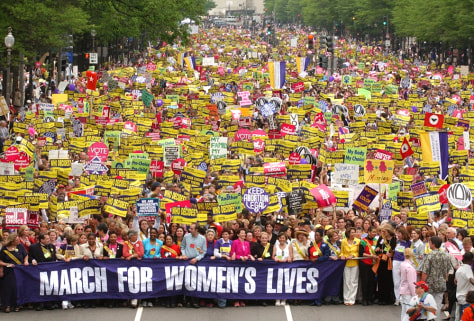
Supporters of women's reproductive rights march down Washington's  Pennnsylvania Avenue in April 2004. Photo: NBC News
A mass march of women will take place in the nation’s capital on Jan. 21, 2017. This is the first full day that Donald Trump will be president, and will follow demonstrations that are being called for Inauguration Day. The call states, “We will stand in solidarity with our partners and children for the protection of our rights, our safety, our health and our families”.
Although it focuses on women, the march and rally will also include and speak to the demands of other oppressed groupings: “We support the advocacy and resistance movements that reflect our multiple and intersecting identities.” This includes “immigrants of all statuses, those with diverse religious faiths, particularly Muslim, people who identify as LGBTQIA, Native and indigenous people, Black and Brown people, people with disabilities, the economically impoverished, and survivors of sexual assault.”
Women have responded in massive numbers to the call for a march on Washington. This is in response to decades of attacks on abortion rights, physical attacks on Planned Parenthood and murder of abortion providers. We have seen a rise in rape culture and increasing violence against women. Women continue to struggle to survive on poverty wages at the same time that many face the increasing burden of unpaid work in child care and elder care.
On top of all this has been the blatant misogyny waged throughout the presidential campaign that ended with the election of Donald Trump. Within days of hearing the election results, a grandmother in Hawaii invited 40 of her friends to march on Washington D.C. with her. Response was swift with an outpouring of enthusiasm. Once it hit social media, within two days 45,000 women said they were coming and the latest figure is 100,000.
“It is the most organic thing you have ever heard of,” noted Bob Bland, who was one of the first women to start organizing the march. The loose organizing structure quickly consolidated all the Facebook pages into a national page and added a page for all 50 states to coordinate transportation and lodging. This also has assisted many cities to have their own marches in concert with the actions in Washington.
Three prominent women of color have been added as national co-chairs. Tamika Mallory is the youngest executive director of the National Action Network and Carmen Perez is an activist with juvenile and criminal justice issues. Linda Sarsour is a Palestinian-American Muslim who is doing outreach nationally to Muslim women. The three of them led a march from New York City to Washington D.C. in 2015 demanding changes in the criminal justice system.
The co-chairs issued a statement indicating that the work of the march will reach far beyond Jan. 21. They emphasized, “The work of this march is not only to stand together in sisterhood and solidarity for the protection of our rights, our safety, our families and our environment—but it is also to mend the divides between our communities, and it will be ongoing.”
The Washington march will follow on the heels of militant actions around the world that have resulted in important victories. In October and November, there were mass women’s strikes in Poland, Iceland, France, and Argentina. As a result, Poland’s Prime Minister Beata Szudlo, who had previously expressed strong support for a draconian abortion ban, told the BBC, “I want to state very clearly that the Law and Justice government is not working on any legislation changing the rules on abortion in Poland.”
The bill, introduced by the Law and Justice Party, had strong support from the Catholic Church. But even the Conference of the Polish Episcopate, the central organ of the Catholic Church in the country, had an abrupt turn around. The bill had once been a high priority for them, but after the strikes they posted a statement on their website saying they do not support any legislation that calls for punishing women who have an abortion. Both houses in the parliament voted it down, and there are no plans for a compromise bill.
In November, women in Turkey won a victory after angry protesters took to the streets across the country. As a result Prime Minister Binali Yildirim withdrew a bill that would have pardoned men who have been convicted of having sex with girls if they have married them. Women said that it would legitimize statutory rape and encourage the taking of child brides.
The government had claimed it was meant to free men who had been imprisoned for marrying an underaged girl even though she or her family had given their consent to the marriage. Women were particularly outraged with the word, “consent.” Elif Shafak, one of Turkey’s best selling novelists, spoke to the BBC about consent: “What does that mean? We’re talking about children here. So if the rapist negotiates with the family, if he bribes or threatens the family, the family can withdraw their complaint and say there was consent, no force involved?”
The bill was withdrawn just hours before a final vote had been scheduled. One woman tweeted, “As long as there is solidarity among women, we are powerful”. This was the same sentiment expressed in Poland when the abortion bill was defeated.
In an article in the New Yorker magazine, Ariel Levy spoke with Francesca Comencini, who spearheaded the women’s movement against the misogynist leader of Italy, Silvio Berlusconi. In 2011, she and her sister created massive feminist “manifestaziones,” a series of impassioned demonstrations throughout cities and villages across Italy. Burlesconi resigned nine months after her group, “Se Non Ora, Quando,” (If Not Now, When) held demonstrations that involved more than a million people. She believes mass demonstrations can send the message, “women are the nation!”
In the United States, in 2004, a million people marched on the Washington D.C. mall in the March For Women’s Lives, which focused on women’s reproductive freedom. Since that time, however, attacks on reproductive rights have increased. Misogynists have become further emboldened by the election of Donald Trump. What were micro-aggressions and individual attacks during the campaign will likely become magnified into legal and policy changes that affect the lives of all women—unless we protest.
It has been 12 years since the last mass women’s march in the United States, and now it is time for women to hit the streets of Washington D.C. and other cities across the country on Jan. 21 to send the message that women will fight for their rights.