Showing posts with label Women rights. Show all posts

Thursday, September 28, 2017

2712. Women and Driving in Saudi Arabia

By Manal Al-Sharif, The New York Times, September 27, 2017

In May 2011, I drove a car in the city of Khobar, Saudi Arabia, to protest the kingdom’s ban on women driving. As a result, I was arrested, taken from my home in the dark of night and jailed for nine days, during which time I was interrogated, strip-searched and accused of being a traitor and a spy. I was released only after my father begged King Abdullah, the ruler at the time, to pardon me.

Many people in my country shunned me afterward. Clergymen called for me to be whipped, stoned, even killed. Within a year, I was forced to leave my job. Then, fearing for my safety, I left the country where I had been born and grew up, and where I had begun to raise a family of my own.

Women before and after me have also been arrested, lost their jobs and been jailed for the simple act of getting behind the wheel of a car.

We protested the ban on driving by women because its effects went far beyond cars and roads. The prohibition meant that we were unable to take our children to school; we could not drive loved ones to a doctor or hospital; we could not commute to a job or go to the grocery store on our own. The ban meant the loss of the most basic form of dignity and control over our lives.

This is why for the women of Saudi Arabia, Sept. 26, 2017, the day the monarchy announced that it plans to overturn the driving ban, will be remembered as our Emancipation Day. It is every bit as monumental for us as Aug. 18, 1920, was for American women, the date the 19th Amendment giving them the right to vote was ratified.

At last, Saudi women will have freedom of movement — and their say. Saudi society will never be the same again. From my friends living inside the kingdom, I hear a mixture of disbelief and joy. My email inbox is overflowing with messages of wonder. On my Facebook feed, I see my friends’ excitement. “Finally come true,” one friend wrote. Another dreamed bigger: “I hope all the laws would be reformed until we observe full equality between the sexes.”

American women fought for their basic emancipation during the heyday of the bicycle. The great women’s rights pioneer Susan B. Anthony said that bicycling “has done more to emancipate women than anything else in the world.” The bicycle freed 19th-century women from their homes and from their dependence on men. I hope that in Saudi Arabia, the car will do the same.

In the Saudi system, women are considered inferior. No matter our age, we have male guardians. We must get permission from men to attend school, to work, to marry, to travel overseas — even to have basic medical procedures. My mother gave birth to me on the floor of our apartment in Mecca with only my toddler sister to help her because my father was at work and no male guardian was available to take her to a hospital.

I am certain that some parts of Saudi society will vehemently oppose women driving. In the last six years, official studies commissioned by the government have declared that women will damage their ovaries from sitting in the driver’s seat and will give birth to children “with clinical problems.”

In 2011, the year that I drove, an academic report prepared for the Saudi Legislature, the Shura, concluded that allowing women to drive would lead to societal rot, including “pornography, prostitution, homosexuality, and divorce.” And just last week, a Saudi cleric, warning against women as drivers, claimed that women have only “half the brains of men,” adding that the figure drops to one-quarter “when they go to market.”

This language may be shocking until you consider that 100 years ago, American suffragists peacefully asking for the right to vote were arrested, tortured, beaten, force-fed and locked in mental institutions. But they persisted, and they won. Like their American sisters, Saudi women have persisted, too.

We, Saudi women, have been like birds with clipped wings, full of song, but unable to take flight. That will change. Now we must become the driving force of our own destinies, able to make our own decisions. Our brains are 100 percent strong. We are fully capable of being our own guardians.

When I was forced to leave my country and my family, I dreamed of the day when I might return, not in an airplane, but by driving across the border and up through the desert to my home. Today I no longer have to dream. Next June, when the change in policy comes into effect, I plan to make that drive.

But for now, let us take a moment to appreciate every woman who has done the impossible and gotten behind the wheel.

Manal Al-Sharif is a women’s rights campaigner and the author of the memoir “Daring to Drive: A Saudi Woman’s Awakening.”

Wednesday, December 14, 2016

2508. Forward to the Women’s March on Washington!

By Ann Montague, Socialist Action, November 29, 2016
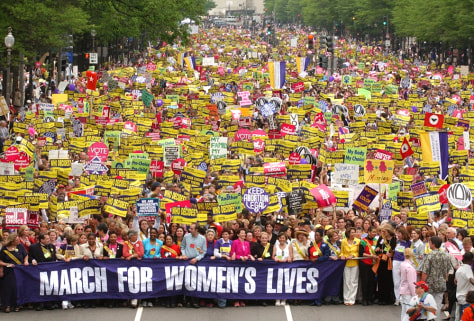
Supporters of women's reproductive rights march down Washington's  Pennnsylvania Avenue in April 2004. Photo: NBC News
A mass march of women will take place in the nation’s capital on Jan. 21, 2017. This is the first full day that Donald Trump will be president, and will follow demonstrations that are being called for Inauguration Day. The call states, “We will stand in solidarity with our partners and children for the protection of our rights, our safety, our health and our families”.
Although it focuses on women, the march and rally will also include and speak to the demands of other oppressed groupings: “We support the advocacy and resistance movements that reflect our multiple and intersecting identities.” This includes “immigrants of all statuses, those with diverse religious faiths, particularly Muslim, people who identify as LGBTQIA, Native and indigenous people, Black and Brown people, people with disabilities, the economically impoverished, and survivors of sexual assault.”
Women have responded in massive numbers to the call for a march on Washington. This is in response to decades of attacks on abortion rights, physical attacks on Planned Parenthood and murder of abortion providers. We have seen a rise in rape culture and increasing violence against women. Women continue to struggle to survive on poverty wages at the same time that many face the increasing burden of unpaid work in child care and elder care.
On top of all this has been the blatant misogyny waged throughout the presidential campaign that ended with the election of Donald Trump. Within days of hearing the election results, a grandmother in Hawaii invited 40 of her friends to march on Washington D.C. with her. Response was swift with an outpouring of enthusiasm. Once it hit social media, within two days 45,000 women said they were coming and the latest figure is 100,000.
“It is the most organic thing you have ever heard of,” noted Bob Bland, who was one of the first women to start organizing the march. The loose organizing structure quickly consolidated all the Facebook pages into a national page and added a page for all 50 states to coordinate transportation and lodging. This also has assisted many cities to have their own marches in concert with the actions in Washington.
Three prominent women of color have been added as national co-chairs. Tamika Mallory is the youngest executive director of the National Action Network and Carmen Perez is an activist with juvenile and criminal justice issues. Linda Sarsour is a Palestinian-American Muslim who is doing outreach nationally to Muslim women. The three of them led a march from New York City to Washington D.C. in 2015 demanding changes in the criminal justice system.
The co-chairs issued a statement indicating that the work of the march will reach far beyond Jan. 21. They emphasized, “The work of this march is not only to stand together in sisterhood and solidarity for the protection of our rights, our safety, our families and our environment—but it is also to mend the divides between our communities, and it will be ongoing.”
The Washington march will follow on the heels of militant actions around the world that have resulted in important victories. In October and November, there were mass women’s strikes in Poland, Iceland, France, and Argentina. As a result, Poland’s Prime Minister Beata Szudlo, who had previously expressed strong support for a draconian abortion ban, told the BBC, “I want to state very clearly that the Law and Justice government is not working on any legislation changing the rules on abortion in Poland.”
The bill, introduced by the Law and Justice Party, had strong support from the Catholic Church. But even the Conference of the Polish Episcopate, the central organ of the Catholic Church in the country, had an abrupt turn around. The bill had once been a high priority for them, but after the strikes they posted a statement on their website saying they do not support any legislation that calls for punishing women who have an abortion. Both houses in the parliament voted it down, and there are no plans for a compromise bill.
In November, women in Turkey won a victory after angry protesters took to the streets across the country. As a result Prime Minister Binali Yildirim withdrew a bill that would have pardoned men who have been convicted of having sex with girls if they have married them. Women said that it would legitimize statutory rape and encourage the taking of child brides.
The government had claimed it was meant to free men who had been imprisoned for marrying an underaged girl even though she or her family had given their consent to the marriage. Women were particularly outraged with the word, “consent.” Elif Shafak, one of Turkey’s best selling novelists, spoke to the BBC about consent: “What does that mean? We’re talking about children here. So if the rapist negotiates with the family, if he bribes or threatens the family, the family can withdraw their complaint and say there was consent, no force involved?”
The bill was withdrawn just hours before a final vote had been scheduled. One woman tweeted, “As long as there is solidarity among women, we are powerful”. This was the same sentiment expressed in Poland when the abortion bill was defeated.
In an article in the New Yorker magazine, Ariel Levy spoke with Francesca Comencini, who spearheaded the women’s movement against the misogynist leader of Italy, Silvio Berlusconi. In 2011, she and her sister created massive feminist “manifestaziones,” a series of impassioned demonstrations throughout cities and villages across Italy. Burlesconi resigned nine months after her group, “Se Non Ora, Quando,” (If Not Now, When) held demonstrations that involved more than a million people. She believes mass demonstrations can send the message, “women are the nation!”
In the United States, in 2004, a million people marched on the Washington D.C. mall in the March For Women’s Lives, which focused on women’s reproductive freedom. Since that time, however, attacks on reproductive rights have increased. Misogynists have become further emboldened by the election of Donald Trump. What were micro-aggressions and individual attacks during the campaign will likely become magnified into legal and policy changes that affect the lives of all women—unless we protest.
It has been 12 years since the last mass women’s march in the United States, and now it is time for women to hit the streets of Washington D.C. and other cities across the country on Jan. 21 to send the message that women will fight for their rights.