Showing posts with label Wildlife as luxury food. Show all posts

Saturday, April 18, 2020

3346. Is Factory Farming to Blame for Coronavirus?

By Laura Spinney, The Guardian, March 28, 2020
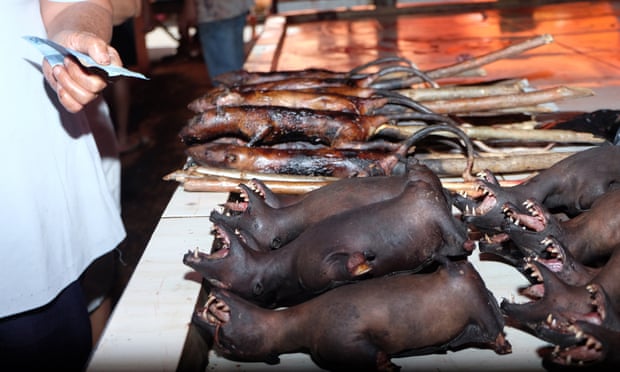
Traders selling bat meat at a market in Tomohon City, Indonesia. Photograph: Ronny Adolof Buol/Sijori Images via Zuma Wire/Rex/Shutterstock
Where did the virus causing the current pandemic come from? How did it get to a food market in Wuhan, China, from where it is thought to have spilled over into humans? The answers to these questions are gradually being pieced together, and the story they tell makes for uncomfortable reading.
Let’s start at the beginning. As of 17 March, we know that the Sars-CoV-2 virus (a member of the coronavirus family that causes the respiratory illness Covid-19) is the product of natural evolution. A study of its genetic sequence, conducted by infectious disease expert Kristian G Andersen of the Scripps Research Institute in La Jolla, California, and colleagues, rules out the possibility that it could have been manufactured in a lab or otherwise engineered. Puff go the conspiracy theories.
The next step is a little less certain, but it seems likely that the original animal reservoir for the virus was bats. Andersen’s team showed – like the Chinese before them –that the sequence of Sars-CoV-2 is similar to other coronaviruses that infect bats.
Since other bat coronaviruses have transited to humans via an intermediate animal host, it seems likely that this one did too. That animal was probably one that some Chinese people like to eat, and that is therefore sold in “wet” markets (those that sell fresh meat, fish, seafood and other produce). This animal may have been the scaly mammal called a pangolin. That can’t be conclusively proved, but several groups have found sequence similarities between Sars-CoV-2 and other coronaviruses that infect pangolins.
If this is indeed the route the virus took to humans, it has two critical interfaces: one between us and the intermediate host, possibly a pangolin, and one between that host and bats. Most of the attention so far has been focused on the interface between humans and the intermediate host, with fingers of blame being pointed at Chinese wet markets and eating habits, but both interfaces were required for the pandemic to ignite. So where and how did the spillover from the bat to the pangolin – or other wild or semi-wild intermediate host – occur?
“Our study does not directly shed light on the geographical origin of the virus,” says Andersen. “However, all the available evidence shows that it was inside China.”
Case closed then, and President Trump is right to call Sars-CoV-2 the “Chinese virus”. Well, no, because if you want to understand why this pandemic happened now and not, say, 20 years ago – since Chinese people’s taste for what we in the west consider exotic fare is not new – you have to include a number of other factors. “We can blame the object – the virus, the cultural practice – but causality extends out into the relationships between people and ecology,” says evolutionary biologist Rob Wallace of the Agroecology and Rural Economics Research Corps in St Paul, Minnesota.

Starting in the 1990s, as part of its economic transformation, China ramped up its food production systems to industrial scale. One side effect of this, as anthropologists Lyle Fearnley and Christos Lynteris have documented, was that smallholding farmers were undercut and pushed out of the livestock industry. Searching for a new way to earn a living, some of them turned to farming “wild” species that had previously been eaten for subsistence only. Wild food was formalised as a sector, and was increasingly branded as a luxury product. But the smallholders weren’t only pushed out economically. As industrial farming concerns took up more and more land, these small-scale farmers were pushed out geographically too – closer to uncultivable zones. Closer to the edge of the forest, that is, where bats and the viruses that infect them lurk. The density and frequency of contacts at that first interface increased, and hence, so did the risk of a spillover.

It’s true, in other words, that an expanding human population pushing into previously undisturbed ecosystems has contributed to the increasing number of zoonoses – human infections of animal origin – in recent decades. That has been documented for Ebola and HIV, for example. But behind that shift has been another, in the way food is produced. Modern models of agribusiness are contributing to the emergence of zoonos

Take flu, a disease that is considered to have high pandemic potential, having caused an estimated 15 pandemics in the past 500 years. “There is clearly a link between the emergence of highly pathogenic avian influenza viruses and intensified poultry production systems,” says spatial epidemiologist Marius Gilbert of the Université Libre de Bruxelles in Belgium.
The reasons, many of which were documented in Wallace’s 2016 book Big Farms Make Big Flu, include the density with which chickens, turkeys or other poultry are packed into factory farms, and the fact that the birds in a given farm tend to be near genetic clones of one another – having been selected over decades for desirable traits such as lean meat. If a virus gets introduced into such a flock, it can race through it without meeting any resistance in the form of genetic variants that prevent its spread. Both experimental manipulations and observations in the real world have demonstrated that this process can result in a ratcheting up of the virus’s virulence. If it then spills over into humans, we are potentially in trouble.
In a paper published in 2018, Gilbert’s group reviewed historical “conversion events”, as they call them – when a not-very-pathogenic avian flu strain became much more dangerous, and found that most of them had occurred in commercial poultry systems, and more frequently in wealthy countries. Europe, Australia and the US had generated more of them than China.
That doesn’t let China off the hook. Two highly pathogenic forms of avian flu – H5N1 and H7N9 – have emerged in that country in recent decades. Both infect humans, though not easily (yet). The first human cases of H7N9 were reported in 2013, and there were small annual outbreaks thereafter. But, says Gilbert, “nothing was done until the virus turned out to be pathogenic for chickens as well. Then it became an important economic issue and China started to mass-vaccinate its poultry against H7N9, and that ended the transmission to humans.”
China is one of the world’s major exporters of poultry, but its poultry industry is not wholly Chinese-owned. After the recession of 2008, for example, New York-based investment bank Goldman Sachs diversified its holdings and moved into Chinese poultry farms. So if China has its share of responsibility for spillover events, it isn’t alone. That is why Wallace insists on talking about relational geographies rather than absolute geographies, when it comes to identifying the causes of disease. Or as he puts it: “Follow the money.”

Not everybody sees a straightforward link between factory farming and new and dangerous forms of flu. Michael Worobey, an evolutionary biologist at the University of Arizona, points out that before they were brought into factory farms, poultry were kept outside. The factory model may ramp up virulence, he says, but it probably protects a flock from being infected by a virus in the first place.
Still, Worobey doesn’t doubt that farming and other human-animal interactions have shaped our disease ecology. His group collects the sequences of flu viruses from a range of animal hosts, including humans, and plots them on a family treeto try to understand how flu has evolved over time. Flu is constantly mutating – that’s the reason the seasonal flu vaccine has to be updated each year – but it mutates at different rates in different hosts, which means that his flu family tree is informative both about the parentage and intermediate host of each strain and about the approximate timing of past spillover events.
It’s possible – though by no means certain – that flu first became a disease of humans after the Chinese domesticated ducks about 4,000 years ago – drawing that animal reservoir into human communities for the first time. But humans can also catch flu from, and give flu to, pigs – another animal we have lived alongside for millennia. A few years ago, Worobey suggested – controversially – that birds might not always have been the main intermediate host for human flu viruses. Until about a century ago, he reported, people may have caught flu from horses. Around the time that motor vehicles supplanted horses as transport, poultry farming was expanding in the western hemisphere, and it’s possible, Worobey argued, that birds then took over as the main intermediate host of flu for humans.

Not everyone buys that scenario. Wendy Barclay, a virologist at Imperial College London, says that if horses were once the main intermediate host for flu, “most avian viruses would contain the mammalian adaptation”, and they don’t. David Morens of the US National Institute of Allergy and Infectious Diseases in Bethesda, Maryland, thinks that it is more likely that the horse was a temporary detour, and that the main intermediate host of flu for humans has always been birds – especially wild ones. But all agree that humans have shaped these host-pathogen relationships, through our use of land and other animal species. And as Worobey points out, the sheer size of the human population today means that in the 21st century, we are doing so on an unprecedented scale. He estimates, for example, that domesticated ducks probably outnumber wild ones by now.
And we’re not just talking about birds. Gilbert believes a ratcheting up of viral virulence is happening in pig herds, too. Porcine reproductive and respiratory syndrome (PRRS), a disease of pigs that was first described in the US in the late 1980s, has since spread to herds across the worldand strains detected recently in China are more virulent than the early American ones. A 2015 study carried out by Martha Nelson of the US National Institutes of Health and colleagues mapped the genetic sequences of swine flu viruses and found that Europe and the US – the largest global exporters of pigs – are also the largest exporters of swine flu.

There have been claims on social media, sometimes posted by vegans, that if we ate less meat there would have been no Covid-19. Interestingly, some of these have been blocked by mainstream news organisations as “partly false”. But the claims are also partly true. Though the links they draw are too simplistic, the evidence is now strong that the way meat is produced – and not just in China – contributed to Covid-19.
It is clear that to prevent or at least slow the emergence of new zoonoses, as Fearnley and Lynteris have argued, China’s wet markets will need to be better regulated. But we also need to look behind those markets, at how our food is produced globally.
Though it may not feel like it now, Wallace says, we have been lucky with Sars-CoV-2. It appears to be far less lethal that either H7N9 – which kills around a third of those it infects – or H5N1, which kills even more. This gives us an opportunity, he says, to question our lifestyle choices – because chicken isn’t cheap if it costs a million lives – and vote for politicians who hold agribusiness to higher standards of ecological, social and epidemiological sustainability. “Hopefully,” he says, “this will change our notions about agricultural production, land use and conservation." 

Tuesday, March 31, 2015

1792. From Trap to Table: Wildlife in Vietnam

By Rachel Nuwer, The New York Times, March 30, 2015
Restaurant workers cutting the heart from a live cobra in front of customers at a restaurant in Ho Chi Minh City.  Photo: Rachel Nuwer for the New York Times.

U MINH, Vietnam — Luc Van Ho slips through a tangled thicket of jungle, graceful as a dancer. A blanket of dried bamboo and melaleuca leaves on the forest floor barely crackles beneath his bare feet. Only the smell of cigarette smoke betrays his presence.

A hunter, Mr. Luc, 45, set out at dawn from his family’s bamboo-thatched home in Vietnam’s U Minh forest to check a half dozen homemade traps rigged along animal trails in the underbrush and on canal banks frequented by snakes and turtles.

He stops at a snare trap made of wood and bicycle brake wire, nearly invisible beneath leaves. The trap is empty, not unusual.

“Before, this forest was very different,” Mr. Luc said. “Now, the animals are so few that most hunters are changing their jobs.”

Still, in the previous two weeks, Mr. Luc had caught nine Southeast Asian box turtles and Malayan snail-eating turtles, five elephant trunk snakes, a handful of water birds and two rare Himalayan griffon vultures. For safekeeping, Mr. Luc stashed the vultures in his brother’s house, leaving them tethered in the bedroom until he can figure out what to do with them.

Restaurant workers cutting the heart from a live cobra in front of customers at a restaurant in Ho Chi Minh City.

In the past, Mr. Luc’s hunting trips often yielded wildlife bonanzas, including prized pangolins. Also known as scaly anteaters, they are among the most trafficked mammals in the world. Mr. Luc works with traders willing to buy live pangolins for $60 a pound.
Although he caught just two pangolins last year, that price makes it well worth the effort to keep seeking them out. He knows, however, that this lucrative resource is finite.

“Pangolins will be extinct soon,” he said. Still, he expresses no plans to retire.

Mr. Luc is one of thousands of illegal hunters draining Vietnam, one of the most biodiverse countries in the world, of its animals. Its rhinoceroses have already gone extinct, and conservationists estimate that just a couple of its tigers, if any, remain. Even lesser known species like soft-shell turtles and civets are sought out for traditional medicines, food, trophies and pets.

Illegal wildlife is one of the world’s largest contraband trades, netting an estimated $19 billion a year, not including illegal fisheries and timber. While all Southeast Asian countries and many others outside of the region are involved, Vietnam plays a paramount role. The country is a major thoroughfare for wildlife goods bound for China, which arrive overland from Cambodia, Thailand and Laos; by ship from Malaysia and Indonesia; or by air from Africa.

“After China, Vietnam is the next port of call in terms of where to look to figure out what’s going on with wildlife trade,” said Dan Challender, a co-chairman of the pangolin specialist group at the International Union for Conservation of Nature.

Vietnam is also a significant consumer of wildlife, especially those yielding the ingredients for traditional medicine, such as rhino horn, which is used to treat everything from cancer to hangovers. The exotic meats of rare animals are seen as luxuries by a rising middle class eager to advertise its prosperity.

“Pangolin is frequently the most expensive item on the menu, so ordering it is an obvious way to show off to friends and colleagues,” Dr. Challender said. “The fact that it’s illegal isn’t played down and is even attractive, because it adds this element that you live beyond the law.”

International concern about the trade has never been greater, but conferences, new enforcement strategies and ivory crushes have yet to make a dent.

In February, the Obama administration issued a plan to curb illegal wildlife trade by strengthening enforcement, reducing demand and sending a handful of agents abroad. The United States is the second-largest market for illegal wildlife products, but only an estimated 10 percent of traffickers are caught because of inadequate resources supporting enforcement, as well as legal loopholes pertaining to certain products, such as ivory.

“Wildlife trade is higher profile now than it’s ever been, and that’s great,” said Chris Shepherd, regional director in Southeast Asia of Traffic, a wildlife trade monitoring network. “But all of the talk about this issue by world leaders is not trickling down to the ground yet.”

In January of this year, officials intercepted more than 7,500 protected pig-nosed turtles in Indonesia, a frozen tiger in Vietnam and 190 endangered black pond turtles in Singapore. As wildlife disappears in Southeast Asia, poachers increasingly turn to Africa.

More than 1,500 pounds of ivory and two tons of pangolin skins were intercepted in Uganda in January. Last year in South Africa alone, a record 1,215 rhinos were killed for their horns.

The illegal wildlife products that officials manage to interdict account for an estimated 10 to 20 percent of the total trafficked.

“We may be disrupting criminal networks, but we’re certainly not dismantling any of them,” said Scott Roberton, Vietnam country representative and regional coordinator for wildlife trafficking programs for the Wildlife Conservation Society. “The situation is going to get worse before it gets better.”

While China recently increased its arrests and prosecutions for wildlife crimes, those caught trafficking wildlife in Vietnam or other transit countries almost always escape punishment. Dealing in protected species is a criminal offense under Vietnamese law, as is selling wild-caught animals of any kind.

But even when trafficking kingpins are taken into custody, prosecution often depends on finding unrelated charges that are taken more seriously than wildlife crime, such as car smuggling. Poachers like Mr. Luc — who says he has never run into legal trouble — are rarely reprimanded, and punishment, if any, usually entails a small fine.

“Very few criminals caught for major violations like tiger or rhino horn possession ever do a day in prison,” said Douglas Hendrie, chief technical adviser for Education for Nature-Vietnam, a nonprofit organization based in Vietnam.

Wild-caught and protected animal products are easily procured in Vietnamese cities. “It’s not an enforcement priority yet, largely due to corruption, collusion and an absolute lack of concern,” Dr. Shepherd said. “People just do not care.”

Thien Vuong Tuu (“The Alcohol of the Gods”), a fancy restaurant in Ho Chi Minh City, advertises pangolin, bear, porcupine, bat and more on its illustrated menu. Customers interested in pangolin — sold for $150 a pound — must order it two to three hours in advance and place a deposit based on its weight.

When the customer returns for dinner, the manager presents the live pangolin to the table, then slices its throat on the spot to prove that the meat is fresh and has not been substituted.

“Pangolin is very popular with customers, because it treats a lot of sicknesses,” said Quoc Trung, the restaurant manager. His staff will also dry and package pangolin scales left over from dinner — a popular ingredient in traditional medicines that are still covered by Vietnamese health insurance.

On a Sunday night, families with young children and groups of middle-aged men fill the restaurant. At one table, two French-speaking men order a cobra to the delight of their female companions. Two young servers bring out a large, writhing snake, its mouth bound tightly shut with plastic twine.

As the customers film with their smartphones, one server holds the snake taut. The other carefully feels along the animal’s abdomen until he locates the heart, then opens it up with a pair of scissors and removes the beating organ with his bare fingers.
As the servers wring out the animal, the blood drips into a ceramic bowl to be mixed later with alcohol and drunk.

“The government doesn’t allow exotic meat, but we have our sources and good connections with the police,” Mr. Quoc said after the show concluded. “The demand is so high for these things, so we have to supply them.”

Given the widespread lack of enforcement, grass-roots conservation organizations in Vietnam increasingly find themselves on the front lines. Education for Nature-Vietnam recently conducted a survey of restaurants, hotels and shops in 12 districts in Hanoi and Ho Chi Minh City, recording each violation of wildlife laws and insisting that authorities follow up.

Several months later, the group repeated the survey and found the availability of illegal products ranging from snake “wine” to bear bile had fallen by nearly 60 percent in eight of the districts. “When authorities put us out of work by doing their job effectively and consistently, then we’ll no longer have to do this,” Mr. Hendrie said.

Save Vietnam’s Wildlife, a nonprofit based at Cuc Phuong National Park, organizes training sessions across the country for park rangers and the police, conducts community education programs and operates one of the country’s only rehabilitation centers for confiscated animals.

In Vietnam, much of the wildlife intercepted from illegal traders is sold by officials back into the black market. Nguyen Van Thain, Save Vietnam’s Wildlife’s founder, often must race to the sites of recent confiscations to try to recover animals before that can happen.
“Corrupt rangers still want to sell animals back to the trade,” Mr. Nguyen said. Even if the animals are not sold, very few return to the wild, because of a lack of rehabilitation facilities.

Animals not sent to a specialized rescue center often “just sit around until they die,” Dr. Shepherd said.

Over the last three months, Mr. Nguyen has helped rescue 20 pangolins, but the maximum capacity at his center — one of only two in Vietnam that can care for pangolins — is less than 50. With a budget of just $90,000 a year, he has few resources with which to expand the center and hire additional staff.

Mr. Nguyen says he is not confident that attitudes will change in time to spare his country’s wildlife.

“The problem in Vietnam is that conservation is a new way of thinking,” he said. “Vietnamese people need to learn to take seriously what we have now. We need to take care of our own environment and wildlife if we want it to be around in the future.”