Showing posts with label Western imperialism. Show all posts

Tuesday, March 4, 2025

3662. A Blow up in the White House: Factional Differences in the U.S. Governing Class and Cracks in NATO

 By Kamran Nayeri, March 3, 2025


Note: This essay was originally published today in the socialist Critique of Political Economy (نقد اقتصاد سیاسی) edited by Parviz Sedaghat in Iran. The free translation is by the author. 

*.    *.    *

The blow-up of the prearranged signing meeting of a treaty between President Donald Trump and President Volodymyr Zelensky on Friday afternoon, February 28, dramatically demonstrated that the war in Ukraine has never been about the right to self-determination of the Ukrainian people; rather it has been a proxy war between Western imperialism and Russian imperialism to maintain and expand their sphere of influence. Zelensky had been invited to the White House to sign an economic agreement that Trump views as a precondition for continued U.S. aid to Ukraine. Under the agreement, Ukraine would have committed to give the United States access to rare earth minerals. Trump is seeking to secure a stable source of them for U.S. industries including electronics, space, nuclear, and defense industries. The United States itself lacks a significant amount of rare earth and China is the world’s main supplier. However, China is also the main rival of United States.  For his part, Zelensky wanted to include in the treaty language that would commit the United States support from military threats from Russia. The signing of the treaty was generally thought of to pave the way for a ceasefire and to an end to the war in Ukraine. However, differences of opinion about the causes of the war between Zelensky and Trump, as well as Zelensky's demand for the U.S. military support for Ukraine, led to a dispute between them, which I will in a moment. 

But first, let’s consider that Zelensky’s general acceptance of Trump’s demand regarding U.S. access to Ukraine’s minerals negates his claim that the Ukrainian government is an independent actor representing self-determination of Ukrainian, specifically in its war with Russia. The language and intent of the treaty and the blow up between the two parties at the White House showed that Zelensky had been and remains dependent on U.S. imperialism in the war and even before it. Essentially, the start of this war, as I have documented it (Nayeri 2022) was due to Zelensky’s insistence backed up by Washington that Ukraine should be admitted into NATO, the military arm of Western imperialism. The Democratic Party and the mainstream of the Republican Party follow the Wolfowitz Doctrine first formulated on February 18, 1992, in response to the collapse of the Soviet Union which argued for continued Cold War policies against Russia after the collapse of the Soviet Union, including by NATO expansion. However, Trump represents a dominant trend in today's Republican Party that does not adhere to this doctrine and in fact want to do away with tensions with Russia. The dispute in the White House revolved around this disagreement between Trump and Zelensky, who had enjoyed the support of the Biden administration under this doctrine. 

The main reason for the start of the war

Putin cited the expansion of NATO during a speech at the start of the invasion of Ukraine on February 24, 2022. 

On February 24, Vladimir Vladimirovich Putin ordered an invasion of Ukraine in a speech in which he outlined the key reason as follows:

“…the expansion of the NATO to the east, moving its military infrastructure closer to Russian borders. It is well known that for 30 years we have persistently and patiently tried to reach an agreement with the leading NATO countries on the principles of equal and inviolable security in Europe. In response to our proposals, we constantly faced either cynical deception and lies or attempts to pressure and blackmail, while NATO, despite all our protests and concerns, continued to steadily expand. The war machine is moving and, I repeat, it is coming close to our borders.”

Encouraged by the U.S. and European allies, Zelensky has been pushing for membership of Ukraine in European Union and NATO. At the of Munich Security Conference on February 19, 2022, five days before the Russian invasion, he asked  once again for NATO membership. 

Founded in 1949 with 12 member states, it was a critical part of Western imperialism’s Cold War against the Soviet Union.  In response, the Soviet Union and seven other Eastern Bloc self-proclaimed socialist republics of Central and Eastern Europe formed Warsaw Pact military alliance in May 1955. 

After the collapse of the Soviet Union, the Warsaw Pact was also dissolved. Still, the United States not only did not dissolve NATO, but also expanded it to the borders of Russia and even used it in its occupation and war in Afghanistan. NATO today is the armed arm of Western imperialism. This anti-Russian policy is as Wolfowitz Doctrine that was formulated after the collapse of the Soviet Union (Goldgeier 2016). A number of American foreign policy experts, including John Mearsheimer (2019), an American political scientist and international relations scholar had warned that this doctrine was particularly dangerous in Ukraine, where the U.S. in 2014 manufactured the overthrow of Viktor Fedorovych Yanukovych, pro-Russia president.

Biden's foreign policy was in continuation of Wolfowitz Doctrine in n the Ukraine war as the U.S. gave full political, diplomatic, and military support to Zelensky. The US goal was to isolate Russia politically and inflict economic and military damage on it under the guise of defending democracy and confronting Putin painted as a threat to all of Europe. The Russians themselves have a favorable view of Putin and he has enjoyed greater popularity in Russia than his contemporary U.S. presidents have had in their country (Statistica, February 24, 2024).

The United States and NATO have been involved in all strategic aspects of the Ukraine war, and the United States has mainly provided advanced weapons to the Ukrainian army ( see the list of US military assistance provided by the State Department (State Department , January 20, 2025). To ensure public support, Zelensky was provided with numerous opportunities to attend policy forums in the United States, Europe, and elsewhere. Zelensky, in turn, claimed that his country was being attacked and occupied by “unprovoked” Russia and requested numerous assistance, especially military assistance with increasingly advanced and aggressive weapons. Then Biden and his European allies in NATO provided what Zelensky had asked for. In this way, the war in Ukraine continued with the U.S. and NATO providing Ukraine with strategic guidance and intelligence and arms while the Ukrainians did the fighting and dying. All doors to diplomatic solution to the war , Ukraine in this war were shut donw as Putin was demonized as another Hitler and a menace to world peace. 

In  the U.S. policy circles there has never been a unanimous agreement on Wolfowitz Doctrine. A small group of Republicans in the US Congress preferred what has been termed by their opponent as isolationism. Instead, imperialist “internationalism” that required U.S. military intervention around the world had the upper hand with influential Democrats being its main proponents (Stephenson 2023). 

Trump is seeking to reshape U.S. foreign policy that combined deliberate and blatant threat of use of economic and military power on the one hand  and on the other attempts to reduce tensions with adversaries as he did with North Korea.  resolve regional crises. He also wants to de-escalate tensions with Russia.

On February 13, Trump called for talks with Russia and China on nuclear disarmament, citing the "enormous costs and dangers of nuclear weapons" (Ruiz, Lucas and Geoff Wilson). It is clear that such negotiations, whether on nuclear disarmament or on the Ukrainian war with Russia and China were not even conceivable with Democrats during the Biden presidency .

The differences between these two wings of American imperialism are also visible in the economic arena. Democrats want economic modernization based on new industries and technologies that rely on greater capitalist state intervention in the economy. Republicans oppose state intervention in the economy, and Trump, in his second term, has pursued efforts to shrink the government bureaucracy by imposing tariffs to protect old domestic industries (Nayeri 2019, section 3). The New York Times, in some of its articles, has with some justice called these policies mercantilist.

At the White House meeting Zelensky as usual called for the U.S. and Trump to guarantee Ukraine's security. However, Trump refused had already indicated his intention to de-escalate tensions in US-Russia relations and his opposition to Ukraine's membership in NATO (which is also one of Putin's demands in any peace negotiations). In his dispute with Zelensky at the White House meeting, Trump reminded Zelensky that he was not in a position to impose demands on him or on Putin. He recounted that Zelensky has problems recruiting to his army to fight Russian and that Ukraine would not have been able to fight Russians without U.S. backing “even for two weeks.” "You put yourself in a bad position. You don't have all the cards in your hands. You are gambling with the lives of millions of people. You are gambling with World War III."

The divide in Western imperialism and NATO

After the dispute between Trump and Zelensky, many European leaders announced their support for Ukraine in the war. But the European Union is economically smaller than the United States and has a lower per capita income, thus much less ability to help finance the war, and more importantly, militarily, the militaries of the European countries combined are not comparable to that of the the United States. Zelensky even faces problems at home. Half of the Ukrainian people want the war to end (Vigers 2024). It is not without reason that NATO Commander General Mark Rutte immediately urged Zelensky to establish good relations with Trump. The British Prime Minister announced during a meeting with Zelensky that they would jointly with France will prepare a proposal for a ceasefire in Ukraine for Trump. 

The dispute in the White House is a sign of the intensification of the governmental crisis in the United States, which itself is due to the relative decline of U.S. imperialism. In the recent period, every four-years when power has been transferred from one party to another, the new president has changed key policies of the previous president in the opposite direction. This creates instability for building an economic infrastructure for the future of U.S. capitalism. For example, Biden created subsidies for buyers of electric cars to increase demand to smooth the transition to an economy based on new industries and goods. Automakers have spent billions of dollars building capacity to produce electric vehicles. But Trump eliminated these subsidies and withdrew the United States from the toothless Paris Agreement to combat the climate crisis. 

The crisis of global leadership and the future of humanity

At the beginning of the Ukrainian war, I argued that it is a crossroad for humanity. The working people have no interest in this inter-imperialist war.  The Russian army must withdraw from Ukraine and the Ukrainian government must adopt a neutrality policy focusing on its internal sources of development. Scientists in relevant fields have warned that if humanity does not solve the existential crises of climate chaos, the Sixth Extinction, recurrent pandemics, and nuclear holocaust, it will face the risk of the collapse of civilization and possibly the end of humanity. However, solving these crises requires the cooperation of the entire world, especially the most powerful countries that contribute to these crises the most. The crisis of the decline of U.S. imperialism and the emergence of a multipolar world has made the possibility of world capitalist governments to cooperate in solving these existential crises. To the contrary, along with the rise of China on the global level and other regional powers, it has increased rivarly between capitalist/imperialist powers. The only hope for humanity is to create independent power for the working people throughout the world, especially in key countries in North America, Europe, and Asia. To create such a power, it is necessary to politically break with capitalist governments, institutions, parties, and create independent self-organized and self-mobilized organizations to address these crises and aim toward a post-capitalist world. I have argued that Ecocentric Socialism provides a vision for such action and transition. 

References:

Gallup. " Half of Ukrainians Want Quick, Negotiated End to War ." November 19, 2024.

Mearsheimer, John J. “ Why the Ukraine Crisis Is the West's Fault : The Liberal Delusions That Provoked Putin .” June 2019.

Nayeri, Kamran. " A Future for American Capitalism or The Future of Life on Earth?: An Ecosocialist Critique of the 'Green New Deal .'" Our Place in the World: A Journal of Ecosocialism. March 25, 2019.

Goldgeier, James M. The U.S. Decision to Enlarge NATO.” 2016.

Ruiz, Lucas and Geoff Wilson. "What Trump Got Right about Nuclear Weapons—and How to Step Back from the Brink." Bulletin of Atomic Scientists. February 24, 2025

State Department. US Security Cooperation with Ukraine. Fact sheetJanuary 20, 2025.

Statistics. Vladimir Putin's approval rating in Russia monthly 1999-2025February 24, 2025.

Stephenson, Heather. "US Foreign Policy Increasingly Relies on Military Interventions."

Vigers, Benedict. “Half of Ukrainians Want Quick, Negotiated End to War.” Gallup, November 19, 2024. 

Tuesday, March 17, 2015

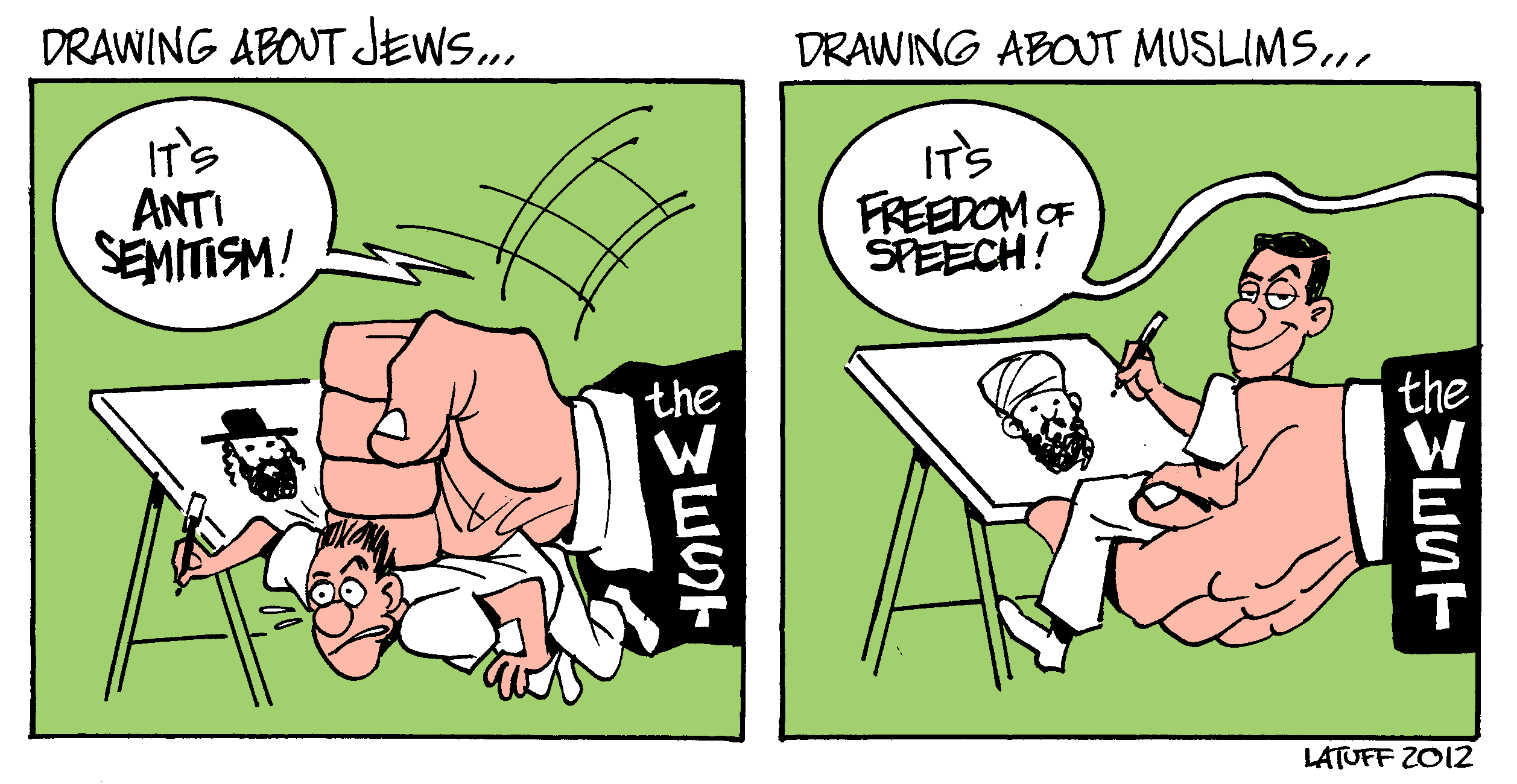
1767. Charlie Hebdo Massacre: Right to Insult or the Responsibility Principle?

By Saral Sarkar, March 8, 2015


The murderers of the Charlie-Hebdo-cartoonists got their deserved punishment. In terms of popular sentiment, it was okay that they were killed by the security forces. From their own point of view and from that of their spiritual kin, however, the murderers were highly successful. They could not only avenge the insult to their Prophet – for them a great cause – but they also died as martyrs, what they probably themselves also wanted to.

    But the murdered cartoonists did not die as martyrs. They did not want to die. They had applied for and received police protection. The chief editor had, of course, once said that he would rather die standing upright than live kneeling. But that rather testifies to his stubbornness, nothing else. For what he and his colleagues died for – namely the right to insult Prophet Muhammad and millions of Muslims – is truly not a great cause. Compare this with the bloggers in Bangladesh (one in Saudi Arabia) who are being persecuted, even murdered, for trying to make their country a secular state.

    How should one, for example, characterize a person who wants to play football on a known minefield other than by the word "stubborn" or “reckless”? You can after all play football on a different pitch! Or was it supposed to be a serious and important political cause? For example, criticism of religious superstition or criticism of the status of women in Islam? Moreover, you can criticize Islam, or religion in general, in other ways, in ways that that do not lead straight onto a minefield! It's after all known at the latest since 2005, when the Danish newspaper Jyllands-Posten published its notorious Muhammad cartoons, how furiously Muslim masses all over the world react to such things. Since that time, all people know that particularly insulting Mohammed cartoons deeply hurt the feelings of devout Muslims and that at least some of them are ready to avenge the insult to their Prophet through murder.

    Given this history, CH’s Muhammad cartoons were a pure provocation, nothing else. For before this event, the right to freedom of expression was not at all in danger, neither in France nor elsewhere in Europe. These bad Mohammed cartoons are also no expressions of free speech; they are only insults. One had almost forgotten the Salman Rushdie case (1988), even the cartoons of Jyllands-Posten. Through their infantile provocations, the CH-cartoonists have not only caused their own death, but also that of three policepersons and four Jewish hostages. Indirectly they have also further deepened the already existing deep divide between Christians and Muslims.

    In many of the media comments it was, inter alia, insisted that one who lives in France must also accept the constitution and the laws of the country. I agree one hundred percent, although I do not exactly know whether also insulting Islam and the Muslim community by means of Muhammad cartoons is really covered by the laws. In Germany, probably also in France, it is a criminal offense to voice the opinion that the Holocaust did not really happen. In France, you are not allowed to express the opinion that in 1915 the Armenians had not suffered a genocide, but only, as the Turks maintain, a few hundred thousand deaths through war events. I have heard that in France it is not allowed to insult the tricolor and the Marseillaise. And almost everywhere in Europe the police also sometimes prohibit, for security reasons, the freedom of expressing one’s opinion by means of a demo. One could of course say: such simply is the legal position, that’s that, end of discussion. But that is a legalistic attitude, not a political one. Is the discussion really over? In view of the seventeen-fold revenge murder in Paris, and the revenge murders that may happen in the future, it is necessary to remember an English proverb: "When the law is an ass, someone has to kick it". 

The Responsibility Principle
But isn’t there, apart from constitutions and laws, also the common sense precept that everybody should act reasonably and responsibly? On a stretch of autobahn without speed limit one is allowed to drive as fast as one wants to. But is it responsible behavior to drive there tempo 280? No doubt, the producers of CH acted within the limits of what is legal, but they acted irresponsibly. Their murderers have virtually said: Yes, we know the constitution and the laws of the country; with our action we are going to contravene these; we know that we shall be punished for this action; OK, we accept any punishment for our decision to follow the laws of our religion and violate those of the state. Stubborn mule against stubborn mule. In any constellation that would lead to disaster. That simply is the reality. The constitutions of the world are after all nothing more than so many often questionable principles that just stand on paper.

    There is a famous Kant quote that one could here use as a criterion for right, as opposed to lawful, action: “I ought never to act except in such a way that I could also will that my maxim should become a universal law.” (Alternative translation: "Act only on that maxim which you can at the same time will that it should become a universal law.” German original: „Handle so, dass die Maxime deines Willens jederzeit zugleich als Prinzip einer allgemeinen Gesetzgebung gelten kann.)1 This was written in the age of Enlightenment. I remember from my student days that the Enlightenment comprised reason and tolerance as two of its most important values – both absolutely necessary for social peace. This Kant-quote lays down the moral rule for right action. It does not speak of one’s right to act within the framework of current legislation of a particular country, it speaks of maxims of one’s actions that could also at any time be valid as the principle of a universal legislation. What can be a higher principle of universal legislation than the maintenance of social and international peace?

    I can here also quote a modern philosopher. In his book The Imperative of Responsibility (Das Prinzip Verantwortung), Hans Jonas wrote about our responsibility for peace with nature. In a conversation with an interview partner he showed he had little faith in democracy. He said: "The philosopher must certainly have the courage to say that democracy, of course, is highly desirable, but it cannot itself be the indispensable condition for making human life on earth worth the trouble."1a In the same sense, we can say that the democratic political order and constitutions and laws adopted by democratically elected parliaments cannot by themselves be enough for maintaining social peace. Jonas wrote in the aforementioned book:
" 'Act in such a way that the effects of your action are compatible with the permanence of genuine human life on earth'; or expressed negatively: ‘Act in such a way that the effects of your action are not destructive to the future possibility of such life'; or simply: 'Do not endanger the conditions for the indefinite continued existence of mankind on earth'; or again expressed positively: 'Include in your current choice the future integrity of humans as co-objects of your willing.' "2
    Jonas wrote these sentences out of concern for the state of our natural environment. We know that the greater part of mankind’s current economic activities – even those that are covered by the constitutions and laws – is continually destroying our natural environment. Therefore, we must also appeal to the sense of responsibility of all economic actors. Following Jonas, we should be allowed to tell all people – especially the political leaders of society, Intellectuals, creative artists etc. – : Act in such a way that the effects of your action are compatible with the permanence of genuine human social existence; or in negative terms: Act in such a way that the effects of your action are not destructive to social peace.

    The CH-cartoonists knew that their Mohammed cartoons deeply offend their five million Muslim fellow citizens – many of whom had been highly welcome as they once came as guest workers. They also knew that these cartoons could provoke some among these fellow citizens to commit murder. Five million are about 8 percent of the French population, not a negligible size. In spite of that they published their offensive cartoons. What is worse, many political leaders of the world and one million French people reinforced through their subsequent demonstration in Paris the destructive effects of the cartoon publication. This is evidenced by the fact that about five weeks later (February 14), in Copenhagen, an assassination attempt was made on a public meeting in which the same person participated, who had in 2005 published the first Mohammed cartoons in Jyllands Posten (one of them depicted Mohammed as a dog.)

    Don’t such people have more important and more urgent things to do? By the end of this year, in Paris, the political leaders of the world must decide on measures for preventing further climate disasters. (Till now, Paris has not seen a demonstration of one Million people for climate protection.) The wars in Syria, Iraq, the Ukraine etc. must be ended. Adequate answers to the problem of millions of refugees all over the world must be found. The rise of radical right-wing parties and xenophobic groups must be contained. And there are many more such important and urgent tasks. But the European states are currently totally busy trying to enlarge and strengthen their anti-terror apparatus. Such a petty thing, the right to publish Mohammed cartoons, has pushed the said great and difficult tasks away from the stage.

What To Do?
We know that Islamist militants have in the past not only reacted with violence to Mohammed cartoons. They reacted to Salman Rushdie's novel The Satanic Verses (1988) and to some texts and statements of Taslima Nasreen (Bangladeshi writer) (1994) with Fatwas and calls for killing them. It cannot go on like this. It is not acceptable that the one minority again and again insults and provokes and the other minority reacts with murder and death threats. But you cannot also always exercise self-censorship in the interest of social peace, especially since not every criticism is an insult or provocation. How should we – leftists, progressives or simply secular-minded people – behave in such cases?

    Unfortunately, what Richard Dawkins calls “God delusion"3, continues to exist in the world. Most people in the world practice, seriously or not so seriously, one or another religion. The aggression of militant Islamists against infidels and people of other faiths, or their aggressive response to certain acts of the latter, has parallels in other religious communities. Among Christians, the days of the belligerent/murderous version of aggressive religiosity, are, thank God, largely over. The conflicts in Northern Ireland and Nagorno-Karabach are two exceptions, which, however, are also cases of territorial disputes. Unfortunately, in two other major religious communities – the Hindus and the Buddhists – that is not the case yet. In India, mutual violent aggression between Hindus and Muslims do not belong to past history yet. Of late, even Buddhists, namely Burmese and Sri Lankan Buddhists, are persecuting their Muslim compatriots – citing the Buddhist identity of their country. In addition to actions of the police and security forces against violent fundamentalists, as they are required by law, any sensible person should, in the sense of civil society activities, fight against such aggressive religiosity. But how do you do that? How can we bring the militant fundamentalists of any religion to their senses?

    One thing can probably be regarded as indisputable: One cannot get any positive results through insults and provocations. On the contrary, they only stir up hatred and violence. We have observed that in the last 25 years. With this method one can only start a new conflict again and again. This is true even if the victim of insult is not a religion. Not all people react to an insult by going to a court. Even among non-religious people, for example, if X tells Y that the latter’s father was a thief and mother a prostitute, then, make no mistake, Y will first give X a sound spanking – regardless of the veracity of the assertion. That is the reality.

    It is also not possible for the security forces to finally win the fight against religiously motivated violence and terrorism. After every single success in this fight, they are and they will be confronted with new acts of violence and new threats from new militant groups. This too is a part of our experience of the last 25 years. Militant jihadists, who are not afraid to die, who are even prepared to blow themselves up in order to kill the enemy – the usual threats of punishment have little effect on such people. In such situations, the security forces of the world are at a loss.

    So we have to get to the root of the problem. But for this we must recognize the root first. I first published a short article on this subject ten years ago. The occasion at that time was the assassination of Amsterdam filmmaker Theo van Gogh, who had insulted Islam. I ask my readers to read that article. Here is the link:

http://eco-socialist.blogspot.de/2012/08/the-power-of-religions-and-helplessness.html

As to the question "what to do?", I set out my current and preliminary thoughts below:

It is a fact that most people are religious – that is, roughly speaking, they believe in the existence of one or several more or less powerful supernatural beings/agents (God, gods, goddesses, spirits, ancestors etc.). According to scientists such as Richard Dawkins3 and Pascal Boyer4, this is rooted in the phylogenetic inheritance of the human species. The proof of this assertion is the fact that religion in its broadest sense is a universal phenomenon. So we atheists and leftists cannot hope that the phenomenon religion will one day cease to exist all by itself. Moreover, our experience shows that, generally, when a person is born into a religious community, this religion has become, at least to some extent, an integral part of the identity of this person, which can be extremely difficult to strip away. This explains why, for example, recently the Yezidis in northern Syria refused to be converted to Islam and accepted to be killed by IS fighters.

    We must then work in the long term to at least contain the influence of the radical-fundamentalist versions of the big religions. We should not criticize this or that religion, not Allah, Jehovah, Jesus or Shiva. We should try to reduce, actually question, the relevance of religion per se – especially in practical life. We can quote the ancient Greek philosopher Epicurus. He is reported to have said:
„Is God willing to prevent evil, but not able? Then he is not omnipotent. Is he able, but not willing? Then he is malevolent. Is he both able and willing? Then whence cometh evil? Is he neither able nor willing? Then why call him God?”5
    We can tell our fellow humans who are religious: Dear friends, you pray to God so many times a day. Nothing against that. But your God, as we know, does not help you. So let's leave our gods and our religions in our private prayer room, and let us together try to make this bad world a little more bearable. Salvation can wait, but we must eat everyday. 

    This is a very difficult job. For all religions are interpretable and applicable in a fundamentalist way. As Klaus Kienzler, scholar of comparative theology, writes on the major religions:
"We have seen that a number of indispensable fundaments belong to the essence of religion: inter alia the religious sources such as scripture and tradition, orthodoxy and orthopraxy, ... [So] it can also be said here that all religions are in danger of being turned in a fundamentalist manner. .... ".5a
    It is especially so, because it is claimed (except in Buddhism) that the scriptures or at least the more important parts of them were directly revealed, even dictated (the Qur'an) or handed over (the Ten Commandments) by God. Of course, modern Christian theology does not understand revelation in the scriptures in this way. But "in the Chicago Statement on Biblical Inerrancy of 1978 it is stated ...: 'We profess that the scriptures as a whole and in all their parts up to the individual words of the original writings were inspired by God.' "6 With such understandings of the respective scriptures, a person with a militant character, whose main identity is his religion, may not find it difficult to persecute non-believers or even to kill them, or to blow up an abortion clinic with a bomb. We must bear in mind that, of course, the spectacular attacks are perpetrated by individual culprits or small groups of militant fundamentalists, but they draw their inspiration and courage from a large field of hundreds of thousands of fundamentalists. That is why it is not enough that security authorities monitor potential assassins and render them harmless. The problem must also be dealt with broadly, i.e. macro-psychologically.

    What we can certainly do is to tell our devout fellow citizens of the world in a friendly and polite manner that they should not take their scriptures as clear words of God. Believers know that all their holy books were finally written down by humans. All prophets, also Prophet Muhammad, were humans, fallible like any other. The texts of "God's words" are far from clear. That's why there are so many places in the holy books that are in need of interpretation and have also been variously interpreted. Fundamentalist interpretations and moderate/liberal interpretations stand opposite to each other. Let me give here an example. Asghar Ali Engineer, a devout Muslim and an Islam scholar, writes about the term Kafir (infidel, heretic):
„The Qur’an … created a category of Ahl al-kitab (people of the book). All those to whom Allah sent His messenger and the book were called people of the book. The Qur’an mentions Christians, Jews and Sabaens in this category. However, it does not exclude those who have not been mentioned in this category by the Qur’an. Many others like Zoroastrians were included in this [second] category. The Sufi saints like Mazhar Jan-i-Janan included the Hindus in this [second] category, arguing that how can Allah forget to send His messengers to India as He had promised to send His messengers to all the nations. He accepts the Vedas [of Hinduism] as revealed scriptures. He also felt that Hindus were monotheists as they believe in God who is nirgun and nirakar (i.e. without attributes and shape) which is the highest form of tawhid (monotheism).”7 
This shows that Islam too is amenable to reform and liberal interpretations. That is the reason why there are in Islam, just as in Christianity, so many movements and sects.

    However, to be able and allowed to say that to believers and persons of other faiths presupposes that we have and care about maintaining regular social contacts with them. Only through such contacts can we – atheists, secularists, and leftists – succeed in promoting the values of Enlightenment, tolerance, and a minimum of mutual respect. Only thus can we overcome the existing mental barriers. It is counterproductive to promote or accept a multicultural society. That would mean to promote and accept the separate existence of parallel societies. The people of other faiths must instead be included in the social life of the majority community.

    It is clear, to take up and maintain regular contact with established radical and militant fundamentalists is simply not possible for us. But the vast majority of people in any religious community, including the Islamic one, is anything but having a fundamentalist mindset. They believe in the principle live and let live and they do not comply with all the commandments of their scriptures. Moreover, there are in the world, even in Muslim majority countries, many liberal, modern, progressive and even leftist Muslims. They are culturally Muslims, even though they may not pray five times a day. In Egypt and Tunisia, recently, several million Muslim citizens ended the rule of the Muslim Brotherhood. By working with such people we may be able to create an atmosphere in which all devout Muslims would react to an insult to Islam or the Prophet with the sentence: "That leaves me cold." I actually heard this sentence in a TV show; an Islam scholar, who teaches this religion in a school, said that. This gives us hope.

    What would help even more is that liberal-Muslim Islam scholars, who also practice their religion, dare to publish historical-critical works on the scriptures of their religion. Above I have given an example of this: the quote from Asghar Ali Engineer. If in real life and in a given situation it is too dangerous, such works could be published anonymously. There is no sense in attracting the wrath of murderous fanatics. In political movements it is (has been) common practice to publish anonymous pamphlets. A few days ago I heard on TV some good news: A French Muslim academic has given a call for reform of Islam. He has also called for a historical-critical study of his religion. I heard roughly the same in TV news on 23rd February: Also Islam scholars of the famous Al-Azhar University of Cairo spoke of the need to reform Islamic education.

    One thing we cannot do is to mitigate the hatred of all kinds of Muslims for the Euro-American imperialists and Israeli colonialists, who have since long been subjugating and humiliating Muslim peoples politically and economically. A byproduct of this is that most, if not all, Westerners are generally suspected of being enemies and haters of Islam and the Muslim world. History also gives enough reason for this suspicion. Just think of the Crusades, the second Iraq war of 2003, Abu Ghraib, Guantanamo Bay, the treatment of the Palestinians, etc. Clearly, Muslims cannot maintain any friendly contact with actual Islam-haters among Westerners. That is why it is extremely important that Westerners who are willing to establish friendly contacts with Muslims demonstrate anti-imperialist sentiments. 

    But mere anti-imperialist politics is not sufficient. What is needed is a great cause, a positive one, to which young people may feel inspired to commit themselves. Their hatred for the imperialists led thousands of young Muslims into the camp of Al Qaeda and ISIS, where their great cause is an Islamic “state of God”. The energetic Muslim youth who stomped the Arab Spring out of the ground with as much vigor, need a great cause for which they could engage themselves again. I can offer them the following sentences of Asghar Ali Engineer:
„Qur’an uses … the word jihad for moral struggle. It is every Muslim’s duty to continue the struggle for moral excellence, of his own as well as of the society he lives in. To fight against corruption, against environmental pollution, for human rights, for justice for weaker sections of society and such other noble causes is part of jihad. Anything, which brings relief to suffering humanity, is part of jihad in the way of Allah.”8
Without the reference to Allah, one could call it the struggle for an eco-socialist society.

References
1. Immanuel Kant (quoted from the internet).
1a. Jonas, Hans : Gespräch mit Eike Gebhardt, in: Ethik für die Zukunft - Im Diskurs mit Hans Jonas, Ed. by Dietrich Böhler, Verlag C. H. Beck, Munich 1994. P. 210-211. ISBN 978-3406386558, quoted in: br-online.de. (quoted from the internet).
2. Jonas, Hans :The Imperative of Responsibility. (quoted from the internet).
3. Dawkins, Richard (2007) The God Delusion. London: Black Swan.
4. Boyer, Pascal (2002) Religion Explained – The Human Instincts that Fashion Gods, Spirits and Ancestors. London: Random House.
5. Epicurus (quoted from the internet).
5a. Kienzler, Klaus (1999) Der religiöse Fundamentalismus – Christentum Judentum Islam. Munich: C.H. Beck. P. 23.
6. ibid. P. 41.
7. Engineer, Asghar Ali (2008) Islam – Misgivings and History. New Delhi: Vitasta Publishing. P. 222f.
8. ibid. P. 227.