Showing posts with label Universe. Show all posts

Monday, November 2, 2020

3437. New Research of Oldest Light Confirms Age of the Universe

By Science Daily, July 20, 2020

A view of part of the universe

Just how old is the universe? Astrophysicists have been debating this question for decades. In recent years, new scientific measurements have suggested the universe may be hundreds of millions of years younger than its previously estimated age of approximately 13.8 billions of years.

Now new research published in a series of papers by an international team of astrophysicists, including Neelima Sehgal, PhD, from Stony Brook University, suggest the universe is about 13.8 billion years old. By using observations from the Atacama Cosmology Telescope (ACT) in Chile, their findings match the measurements of the Planck satellite data of the same ancient light.

The ACT research team is an international collaboration of scientists from 41 institutions in seven countries. The Stony Brook team from the Department of Physics and Astronomy in the College of Arts and Sciences, led by Professor Sehgal, plays an essential role in analyzing the cosmic microwave background (CMB) -- the afterglow light from the Big Bang.

"In Stony Brook-led work we are restoring the 'baby photo' of the universe to its original condition, eliminating the wear and tear of time and space that distorted the image," explains Professor Sehgal, a co-author on the papers. "Only by seeing this sharper baby photo or image of the universe, can we more fully understand how our universe was born."

Obtaining the best image of the infant universe, explains Professor Sehgal, helps scientists better understand the origins of the universe, how we got to where we are on Earth, the galaxies, where we are going, how the universe may end, and when that ending may occur.

The ACT team estimates the age of the universe by measuring its oldest light. Other scientific groups take measurements of galaxies to make universe age estimates.

The new ACT estimate on the age of the universe matches the one provided by the standard model of the universe and measurements of the same light made by the Planck satellite. This adds a fresh twist to an ongoing debate in the astrophysics community, says Simone Aiola, first author of one of the new papers on the findings posted to arXiv.org.

"Now we've come up with an answer where Planck and ACT agree," says Aiola, a researcher at the Flatiron Institute's Center for Computational Astrophysics in New York City. "It speaks to the fact that these difficult measurements are reliable."

In 2019, a research team measuring the movements of galaxies calculated that the universe is hundreds of millions of years younger than the Planck team predicted. That discrepancy suggested that a new model for the universe might be needed and sparked concerns that one of the sets of measurements might be incorrect.

The age of the universe also reveals how fast the cosmos is expanding, a number quantified by the Hubble constant. The ACT measurements suggest a Hubble constant of 67.6 kilometers per second per megaparsec. That means an object 1 megaparsec (around 3.26 million light-years) from Earth is moving away from us at 67.6 kilometers per second due to the expansion of the universe. This result agrees almost exactly with the previous estimate of 67.4 kilometers per second per megaparsec by the Planck satellite team, but it's slower than the 74 kilometers per second per megaparsec inferred from the measurements of galaxies.

"I didn't have a particular preference for any specific value -- it was going to be interesting one way or another," says Steve Choi of Cornell University, first author of another paper posted to arXiv.org. "We find an expansion rate that is right on the estimate by the Planck satellite team. This gives us more confidence in measurements of the universe's oldest light."

As ACT continues making observations, astronomers will have an even clearer picture of the CMB and a more exact idea of how long ago the cosmos began. The ACT team will also scour those observations for signs of physics that doesn't fit the standard cosmological model. Such strange physics could resolve the disagreement between the predictions of the age and expansion rate of the universe arising from the measurements of the CMB and the motions of galaxies.

The ACT research is funded by the National Science Foundation (NSF), and the NSF also funds the work of Professor Sehgal and colleagues at Stony Brook.

Editor's Note: The papers from the Atacama Cosmology Telescope researchers are available online at: https://act.princeton.edu/publications

Sunday, July 12, 2020

3397. Beyond the Milky Way, a Galactic Wall

By Dennis Overbye, The New York Times, July 10, 2020
The starry core of our spiral Milky Way galaxy, in an infrared image from NASA Spitzer Space Telescope. Obscured behind it is the South Pole Wall, a curtain of thousands of galaxies across at least 700 million light-years. Photo: NASA. 
Credit...NASA

Astronomers have discovered that there is a vast wall across the southern border of the local cosmos.

The South Pole Wall, as it is known, consists of thousands of galaxies — beehives of trillions of stars and dark worlds, as well as dust and gas — aligned in a curtain arcing across at least 700 million light-years of space. It winds behind the dust, gas and stars of our own galaxy, the Milky Way, from the constellation Perseus in the Northern Hemisphere to the constellation Apus in the far south. It is so massive that it perturbs the local expansion of the universe.

But don’t bother trying to see it. The entire conglomeration is behind the Milky Way, in what astronomers quaintly call the zone of avoidance.

An international team of astronomers led by Daniel Pomarède of Paris-Saclay University and R. Brent Tully of the University of Hawaii announced this new addition to the local universe on Friday in a paper in Astrophysical Journal. The paper is festooned with maps and diagrams of blobby and stringy features of our local universe as well as a video tour of the South Pole Wall.

It is the latest installment of an ongoing mission to determine where we are in the universe — to fix our neighborhood among the galaxies and the endless voids — and where we are going.

“The surprise for us is that this structure is as big as the Sloan Great Wall and twice as close, and remained unnoticed, being hidden in an obscured sector of the southern sky,” Dr. Pomarède said in an email.


“The discovery is a wonderful poster child for the power of visualizations in research,” Dr. Tully said.
The new wall joins a host of other cosmographic features: arrangements of galaxies, or a lack of them, that astronomers have come to know and love over the last few decades, with names like the Great Wall, the Sloan Great Wall, the Hercules-Corona Borealis Great Wall and the Bootes Void.

The new paper was based on measurements, performed by Dr. Tully and his colleagues, of the distances of 18,000 galaxies as far away as 600 million light-years. By comparison, the most distant objects we can see — quasars and galaxies that formed shortly after the Big Bang — are about 13 billion light years away.

The galaxies in the wall cannot be seen, but Dr. Pomarède and his colleagues were able to observe their gravitational effects by assembling data from telescopes around the world.

In the expanding universe, as described in 1929 by the astronomer Edwin Hubble and confirmed for almost a century, distant galaxies are flying away from us as if they were dots on an inflating balloon; the farther they are, the faster they recede from us, according to a relation called the Hubble law.

That motion away from Earth causes their light to be shifted to longer, redder wavelengths and lower frequencies, like retreating ambulance sirens. Astronomers use this “redshift,” which is easily measured, as a proxy for relative distance in the universe. By measuring the galaxy distances independently, the “Cosmicflows” team, as Dr. Pomarède and his colleagues call themselves, was able to distinguish the motion caused by the cosmic expansion from motions caused by gravitational irregularities.

As a result, they found that the galaxies between Earth and the South Pole Wall are sailing away from us slightly faster than they otherwise should be, by about 30 miles per second, drawn outward by the enormous blob of matter in the wall. And galaxies beyond the wall are moving outward more slowly than they otherwise should be, reined in by the gravitational drag of the wall.

One astonishing aspect of the wall is how big it is compared to the volume that the team was surveying: a contiguous filament of light 1.4 billion light-years long, packed into a cloud maybe 600 million in radius. “There is hardly room in the volume for anything bigger!” Dr. Tully said in an email. “We’d have to anticipate that our view of the filament is clipped; that it extends beyond our survey horizon.”

And yet the South Pole Wall is nearby in cosmological terms. “One might wonder how such a large and not-so-distant structure remained unnoticed,” Dr. Pomarède mused in a statement issued by his university.

But in the expanding universe, there is always something more to see.

On the largest scales, cosmologists attest, the universe should be expanding smoothly, and the galaxies should be evenly distributed. But on smaller, more local scales, the universe appears lumpy and gnarled. Astronomers have found that galaxies are gathered, often by the thousands, in giant clouds called clusters and that these are connected to one another in lacy, luminous chains and filaments to form superclusters extending across billions of light-years. In between are vast deserts of darkness called voids.

From all of this has emerged what some astronomers call our “long address”: We live on Earth, which is in the solar system, which is in the Milky Way galaxy. The Milky Way is part of a small cluster of galaxies called the Local Group, which is on the edge of the Virgo cluster, a conglomeration of several thousand galaxies.

In 2014, Dr. Tully suggested that these features were all connected, as part of a giant conglomeration he called Laniakea — Hawaiian for “open skies” or “immense heaven.” It consists of 100,000 galaxies spread across 500 million light-years.

All this lumpiness has distorted the expansion of the universe. In 1986, a group of astronomers who called themselves the Seven Samurai announced that the galaxies in a huge swath of the sky in the direction of the constellation Centaurus were flying away much faster than the Hubble law predicted, as if being pulled toward something — something the astronomers called the Great Attractor. It was the beginning of something big.

“We now see the Great Attractor as the downtown region of the supercluster that we live in — an overall entity that our team has called the Laniakea Supercluster,” Dr. Tully said. All the different parts of this supercluster are tugging on us, he added.

As a result, the Great Attractor and its relatives are shedding light on another enduring cosmic mystery — namely, where we are headed.

Astronomers discovered in 1965 that space is suffused with microwave radiation, a bath of heat — with a temperature of 2.7 degrees Kelvin, or minus 455 degrees Fahrenheit — left over from the birth of the universe 14 billion years ago. Subsequent observations revealed that this bath is not uniform: It is slightly warmer in one direction, suggesting that we — Earth, our galaxy and the Local Group — are moving through the microwaves, like a goldfish in a fishbowl, at about 400 miles per second in the approximate direction of Centaurus, but aiming far beyond.

Why? What is over there, on the other side of the fishbowl, compelling us? That is the kind of question that would come up in an Arthur C. Clarke novel, where humanity is always gearing up for some definitive expedition around the curve of the universe.

“A major goal in cosmology is to explain this motion,” Dr. Tully said in a series of emails. In theory, the motion arises from the lumpy distribution of matter that grew out of tiny ripples in the density of the early universe.
“The Great Attractor is certainly an important part of the cause of our motion,” Dr. Tully said. “The South Pole Wall also contributes but, again, only in part,” he added, listing more local galaxy clusters and voids. “Every hill and valley in the density distribution makes itself felt.”
A projection of the South Pole Wall in celestial coordinates. The plane of the Milky Way is shown by a dust map in shades of grey; what lies behind it is obscured from direct observation.Credit...Daniel Pomardède

Most of that is stuff that we cannot see directly. According to the prevailing theory of a confoundingly preposterous universe, the cosmos contains about five times as much invisible dark matter as luminous atomic matter.

Nobody knows exactly what dark matter is made of, but according to cosmologists it provides the gravitational scaffolding for the luminous structures in the universe — galaxies, galaxy clusters, superclusters, voids and chains like the South Pole Wall, all connected by spidery filaments in what’s known as the cosmic web. The visible universe of stars and galaxies, cosmologists like to say, is like snow on mountaintops or lights on dark, distant Christmas trees.

But by following the lights and how they are moving, astronomers like Dr. Tully and his cosmographers have now been able to probe the shadows on which they sit: galumphing clouds of mass whose gravity shapes the destiny of the visible cosmos, arranging it into shapes and neighborhoods, walls, valleys and voids.

Friday, May 24, 2019

3253. New Research Suggests that the Big Bang Occurred 12.5 Billion Years Ago

By Corey S. Powell, NBC News, May 18, 2019

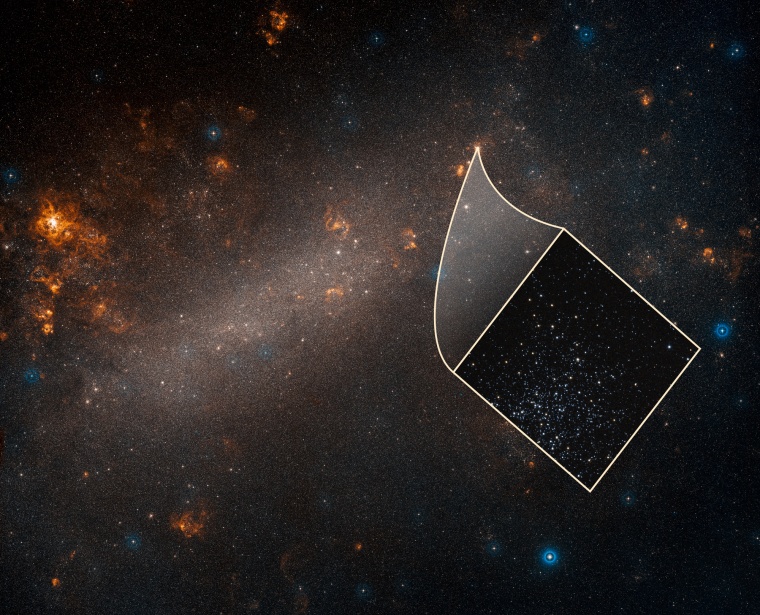
A ground-based telescope's view of the Large Magellanic Cloud


Studies of star clusters in a neighboring galaxy (inset) add to the evidence that the universe is younger and faster-expanding than expected.Space Telescope Science Institute Office of Public Outreach / NASA, ESA, A. Reiss (STScI/JHU)
We've all lost track of time at one point or another, but astronomers really go all in. Recent studies show they may have overestimated the age of the universe by more than a billion years — a surprising realization that is forcing them to rethink key parts of the scientific story of how we got from the Big Bang to today.

The lost time is especially vexing because, in a universe full of mysteries, its age has been viewed as one of the few near-certainties. By 2013, the European Planck space telescope's detailed measurements of cosmic radiation seemed to have yielded the final answer: 13.8 billion years old. All that was left to do was to verify that number using independent observations of bright stars in other galaxies.

Then came an unexpected turn of events.

A few teams, including one led by Nobel laureate Adam Riess of the Space Telescope Science Institute in Baltimore, set out to make those observations. Instead of confirming Planck's measurements, they started getting a distinctly different result.

"It was getting to the point where we say, 'Wait a second, we're not passing this test — we're failing the test!'" says Riess, co-author of a new paper about the research to be published in Astrophysical Journal.

He estimates that his results, taken at face value, indicate a universe that is only 12.5 billion to 13 billion years old.


At first, the common assumption was that Riess and the other galaxy-watchers had made a mistake. But as their observations continued to come in, the results didn't budge.

Reanalysis of the Planck data didn't show any problems, either.

If all the numbers are correct, then the problem must run deeper. It must lie in our interpretation of those numbers — that is, in our fundamental models of how the universe works. "The discrepancy suggests that there's something in the cosmological model that we're not understanding right," Riess says. What that something could be, nobody knows.

Discovery of the dawn of time


The current discrepancy traces its origin way back to 1929, when astronomer Edwin Hubble discovered that galaxies are fleeing from Earth in all directions. More shocking, Hubble found that the farther away the galaxies are, the faster they're moving apart. That pattern means they're all fleeing from each other as well. "The only way all of this can be true is if space is expanding," Riess says.

If the idea of an expanding universe seems bizarre to you, welcome to the club.
"It's still bizarre to me, too," Riess says. "But that's what all of the data show, and that's what our theory predicts." Even Hubble never fully accepted the implications of his own work.
An expanding universe implies that the universe has a definite age, because you can retrace the action back to a time when everything in the cosmos was crammed together in an extremely dense, hot state: what we call the Big Bang.


"This is another hard concept for people to get their heads around," University of Chicago cosmologist Wendy Freedman said, adding that the Big Bang didn't go off like a kind of bomb. "The Big Bang is an explosion of space, not into space," she said.

In other words, galaxies are not flying away from each other through space. Space itself is stretching between them, and it has been ever since the Big Bang. So it's meaningless to ask where the Big Bang occurred. It occurred everywhere. As Freedman puts it, "There is no center or edge to the explosion."

But in the expanding universe, there is a beginning of time — at least, time as we know it. 

By measuring the rate at which galaxies are moving apart, astronomers realized, they could figure out the moment when the cosmos blinked into existence. All they had to do is figure out how to get their galactic measurements exactly right.

Clocking the cosmos


Freedman has been working on that problem for more than three decades, far longer than she ever expected. "This is an incredible challenge," she says. "Imagine making measurements out to hundreds of millions of light years to 1-percent accuracy!"

Hubble himself flubbed the test. His original calculations implied a universe younger than Earth, because he had drastically underestimated the distances to other galaxies.

The difficulty of making direct observations of other galaxies is one of the reasons why scientists created the Planck space telescope. It was designed to detect radiation left over from the Big Bang. The pattern of that radiation indicates the exact physical state of the early universe, if you know how to decode it. In principle, then, the Planck readings should tell us everything we want to know about what the universe is made of, and how old it is.

Planck has been a resounding success, pinning hard numbers onto the soft riddles of the cosmos. It indicated that 26 percent of the universe consists of dark matter, invisible material that helps hold galaxies together. It also confirmed the surprise discovery that the universe is dominated by dark energy, an unknown force that permeates all of empty space. (The detection of dark energy is what earned Riess a shared 2011 Nobel Prize.)

The likely implication of these findings is that the universe will keep expanding forever, faster and faster, into an ever-deeper darkness. It's an uncomfortable thought, one that Riess would rather not dwell on: "The scale of time is so beyond that of humanity, I don't think of it in human terms."
Most satisfying, perhaps, Planck finally completed the job that Hubble began, determining how quickly the universe is expanding and how long it has been around. Or so it seemed.

Something big is missing


Fortunately, Freedman and Riess and their colleagues didn't give up on their alternate approach to determining the age of the universe. They kept improving their observations, and are now getting close to that ambitious target of 1 percent accuracy. Which brings us to the current dispute — what the scientists politely refer to as "the tension."

The latest galaxy studies indicate an expansion rate about 9 percent faster than the answer from Planck. That might not sound like much of a disagreement, but over cosmic history it adds up to that full billion years of lost time.

Given the stakes, everyone involved is checking and rechecking their results for possible sources of error. Increasingly, though, it looks like the problem lies not with the observations but with the theories of cosmology that underpin them. If those theories are wrong or incomplete, the interpretation of the Planck readings will be flawed, too.

"There's currently no consistent story that works for all our cosmological data," says Princeton University astrophysicist Jo Dunkley, who has extensively analyzed the Planck results. "That means there is fascinating work to be done, to see if there is something out there that can explain all of it."

The "tension" reminds scientists of just how much they still don't understand about the underlying laws of nature. Dunkley points to the ghostly particles known as neutrinos, which are extremely abundant throughout space. "We measure neutrinos in the lab and put them in our cosmological model assuming that they are behaving just as we expect them to, but we simply don't know if that's true," she says. "I wouldn't find it surprising if dark matter turned out to be more complicated than we think, too."

Then there's the enigma of dark energy. "We have no good ideas for what it is. Perhaps there are also elements completely missing from the model side, still to be discovered," Freedman says. Theorists have no shortage of ideas: new types of dark energy, new fields, new particles.
Figuring out which explanation is correct — if any — will require another vast improvement in how we measure what the universe is actually doing. Freedman isn't coy about the magnitude of our ignorance: "The question is, what do we have yet to learn? I'd love to come back in a hundred or a thousand years and find out!"

Wednesday, November 25, 2015

2096. A Century Ago, How Einstein’s Theory of Relativity Changed Everything

By Dennis Overbye, The New York Times, November 24, 2015


PRINCETON, N.J. — By the fall of 1915, Albert Einstein was a bit grumpy.

And why not? Cheered on, to his disgust, by most of his Berlin colleagues, Germany had started a ruinous world war. He had split up with his wife, and she had decamped to Switzerland with his sons.

He was living alone. A friend, Janos Plesch, once said, “He sleeps until he is awakened; he stays awake until he is told to go to bed; he will go hungry until he is given something to eat; and then he eats until he is stopped.”

Worse, he had discovered a fatal flaw in his new theory of gravity, propounded with great fanfare only a couple of years before. And now he no longer had the field to himself. The German mathematician David Hilbert was breathing down his neck.

So Einstein went back to the blackboard. And on Nov. 25, 1915, he set down the equation that rules the universe. As compact and mysterious as a Viking rune, it describes space-time as a kind of sagging mattress where matter and energy, like a heavy sleeper, distort the geometry of the cosmos to produce the effect we call gravity, obliging light beams as well as marbles and falling apples to follow curved paths through space.

This is the general theory of relativity. It’s a standard trope in science writing to say that some theory or experiment transformed our understanding of space and time. General relativity really did.

Since the dawn of the scientific revolution and the days of Isaac Newton, the discoverer of gravity, scientists and philosophers had thought of space-time as a kind of stage on which we actors, matter and energy, strode and strutted.

With general relativity, the stage itself sprang into action. Space-time could curve, fold, wrap itself up around a dead star and disappear into a black hole. It could jiggle like Santa Claus’s belly, radiating waves of gravitational compression, or whirl like dough in a Mixmaster. It could even rip or tear. It could stretch and grow, or it could collapse into a speck of infinite density at the end or beginning of time.

Scientists have been lighting birthday candles for general relativity all year, including here at the Institute for Advanced Study, where Einstein spent the last 22 years of his life, and where they gathered in November to review a century of gravity and to attend performances by Brian Greene, the Columbia University physicist and World Science Festival impresario, and the violinist Joshua Bell. Even nature, it seems, has been doing its bit. Last spring, astronomers said they had discovered an “Einstein cross,” in which the gravity of a distant cluster of galaxies had split the light from a supernova beyond them into separate beams in which telescopes could watch the star exploding again and again, in a cosmic version of the movie “Groundhog Day.”

Hardly anybody would be more surprised by all this than Einstein himself. The space-time he conjured turned out to be far more frisky than he had bargained for back in 1907.

It was then — perhaps tilting too far back in his chair at the patent office in Bern, Switzerland — that he had the revelation that a falling body would feel weightless. That insight led him to try to extend his new relativity theory from slip-siding trains to the universe.

According to that foundational theory, now known as special relativity, the laws of physics don’t care how fast you are going — the laws of physics and the speed of light are the same. Einstein figured that the laws of physics should look the same no matter how you were moving — falling, spinning, tumbling or being pressed into the seat of an accelerating car.

One consequence, Einstein quickly realized, was that even light beams would bend downward and time would slow in a gravitational field. Gravity was not a force transmitted across space-time like magnetism; it was the geometry of that space-time itself that kept the planets in their orbits and apples falling.

It would take him another eight difficult years to figure out just how this elastic space-time would work, during which he went from Bern to Prague to Zurich and then to a prestigious post in Berlin.

In 1913, he and his old classmate Marcel Grossmann published with great fanfare an outline of a gravity theory that was less relative than they had hoped. But it did predict light bending, and Erwin Freundlich, an astronomer at the Berlin Observatory, set off to measure the deflection of starlight during a solar eclipse in the Crimea.

When World War I started, Freundlich and others on his expedition were arrested as spies. Then Einstein discovered a flaw in his calculations.

“There are two ways that a theoretician goes astray,” he wrote to the physicist Hendrik Lorentz. “1) The devil leads him around by the nose with a false hypothesis (for this he deserves pity) 2) His arguments are erroneous and ridiculous (for this he deserves a beating).”

And so the stage was set for a series of lectures to the Prussian Academy that would constitute the final countdown on his quest to grasp gravity.

A Breakthrough Moment
Midway through the month, he used the emerging theory to calculate a puzzling anomaly in the motion of Mercury; its egg-shaped orbit changes by 43 seconds of arc per century. The answer was spot on, and Einstein had heart palpitations.

The equation that Einstein wrote out a week later was identical to one that he had written in his notebook two years before but had abandoned.

On one side of the equal sign was the distribution of matter and energy in space. On the other side was the geometry of the space, the so-called metric, which was a prescription for how to compute the distance between two points.

As the Princeton physicist John Wheeler later described it, “Space-time tells matter how to move; matter tells space-time how to curve.” Easy to say, but hard to compute. The stars might be actors on a stage set, but every time they moved, the whole stage rearranged itself.

It wasn’t long before Einstein received his first comeuppance.

In December 1915, he received a telegram from Karl Schwarzschild, a German astrophysicist serving at the front in the war, who had solved Einstein’s equation to describe the gravitational field around a solitary star.

One strange feature of his work was that at a certain distance from the star — to be known forever as the Schwarzschild radius — the equations would go kerblooey.
“If this result were real, it would be a true disaster,” Einstein said. This was the beginning of black holes.

That Einstein’s equations could be solved at all for a single star baffled him. One of his guiding lights had been the Austrian physicist and philosopher Ernst Mach, who taught that everything in the universe was relative. Einstein took Mach’s Principle, as he called it, to mean that it should be impossible to solve his equations for the case of a solitary object.

“One can express it as a joke,” he told Schwarzschild. “If all things were to disappear from the world, then according to Newton Galilean inertial space remains. According to my conception, however, nothing is left.”

And yet here was a star, according to his equations, bending space all by itself, a little universe in a nutshell.

Designing a Universe
Like most of his colleagues at the time, Einstein considered the universe to consist of a cloud of stars, the Milky Way, surrounded by vast space. What was beyond? Was the universe infinite? And if so, what stopped a star from drifting so far that it would have nothing to relate to?

To avoid such problems, Einstein set out in 1917 to design a universe without boundaries. In his model, space is bent around to meet itself, like the side of a tin can.

“I have committed another suggestion with respect to gravitation which exposes me to the danger of being confined to the nut house,” he confided to a friend.

This got rid of the need for troublesome boundaries. But this universe was unstable, and the cylinder would collapse if something didn’t hold its sides apart.

That something was a fudge factor added to the equations Einstein called the cosmological constant. Physically, this new term, denoted by the Greek letter lambda, represented a long-range repulsive force.

The happy result, Einstein thought, was a static universe of the type nearly everybody believed they lived in and in which geometry was strictly determined by matter.

But it didn’t last. Willem de Sitter, a Dutch astronomer, came up with his own solution describing a universe that had no matter at all and was flying apart.

“It would be unsatisfactory, in my opinion,” Einstein grumbled, “if a world without matter were possible.”


If the cosmological constant couldn’t keep the universe still, then forget about it and Mach’s Principle, Einstein said. “It dates back to the time in which one thought that the ‘ponderable bodies’ are the only physically real entities,” he later wrote to the British cosmologist Felix Pirani.

But it was too late. Quantum mechanics soon invested empty space with energy. In 1998 astronomers discovered that dark energy, acting just like the cosmological constant, seems to be blowing space-time apart, just as in de Sitter’s universe.

In fact, most cosmologists agree today that not quite all motion is relative and that space-time does have an existence independent of matter, though it is anything but static and absolute. The best example are gravitational waves, ripples of compression and stretching speeding through empty space at the speed of light.

Einstein was back and forth on this. In 1916, he told Schwarzschild they did not exist, then published a paper saying they did. In 1936, he and his assistant did the same flip-flop again.

Nobody said this was easy, even for Einstein.

He set out to do one thing, namely make all motion relative, Michel Janssen, a science historian at the University of Minnesota, told a Princeton gathering this month. He failed, but in the process succeeded in doing something very interesting, unifying the effects of acceleration and gravity.

The story goes to show, he said, that Bob Dylan was right when he sang “there’s no success like failure,” but wrong that “failure is no success at all.”

Einstein’s greatest success came in 1919, when Arthur Eddington did the experiment that Freundlich had set out to do, and ascertained that lights in the heavens were all askew during an eclipse, bent by the sun’s dark gravity, just as Einstein had predicted.
Asked what he would have done if general relativity had failed, Einstein said, “Then I would have been sorry for the dear Lord. The theory is correct.”

And still the champ.

Thursday, April 16, 2015

1812. Einstein's Universe Turns 100

By Marcel Gleiser, NPR, April 15, 2015


One hundred years ago, a 36-year-old Albert Einstein presented the complete formulation of the General Theory of Relativity to the Prussian Academy of Sciences. Across the world, events and conferences will be celebrating what is considered, without hyperbole, the most beautiful of physical theories, marrying mathematics with physical concepts in deeply meaningful and elegant ways. Some consider it the highest intellectual achievement in history.

Whatever your take, it is undeniable that Einstein's theory is a magnificent example of the power of the human imagination as it attempts to decipher nature's most hidden secrets: Welcome to the universe of curved spaces, black holes, the Big Bang, wormholes and even multiple universes.

First, why "general"? It distinguishes it from Einstein's "special" theory of relativity, proposed in 1905, which focused on motions with constant speeds. The special theory revolutionized our views of space, time and matter. Einstein showed that our perception of reality is myopic, distorted due to our sluggishness; could we perceive motions with speeds close to the speed of light (186,000 miles per second), we would see objects shrinking in the direction of their motion, clocks slowing down, and masses increasing with speed. These weird effects are all around us, but imperceptible for the speeds we are used to. (Consider this: If you blink your eye, light goes about 7 1/2 times around the Earth.) They are routinely observed in high-energy physics, where subatomic particles collide with speeds close to the speed of light. Even a GPS corrects for relativistic effects: The satellites that provide us the service move fast enough in their orbits to justify the small correction for improved accuracy. (They also use general relativistic effects due to Earth's curving of space around it.)

Einstein knew that the special theory was not the final word. After all, objects don't move at constant speeds in straight lines, but accelerate and turn corners. His general theory was designed to include all motions. To his surprise, and in a moment of spectacular intuition, Einstein realized that any theory that includes accelerated motion must also be a theory of gravity. Why? Because accelerated motion can mimic gravity and vice-versa. We know this from riding fast elevators. As you start going up you feel heavier. But how could that be? You didn't gain weight by stepping into the elevator! The accelerated motion upwards acts just as gravity, as if Earth had suddenly become more massive. Conversely, as the elevator goes down fast you feel lighter. If it simply fell down, you would float in mid-air, without any feeling of weight.

This weightlessness, by the way, is what astronauts feel when they are in orbit. It's not absence of gravity that makes them float; they are effectively falling down as they circle the Earth. The circular orbit is a product of Earth's gravity pulling them downwards and the tangential motion with constant speed that keeps them moving around.

Einstein struggled to get his theory right; the math was really hard. At the time, the Theory of Gravity was due to Isaac Newton, who figured that gravity could be described as a force that fell with the square of the distance. Newton assumed gravity was instantaneous and that it acted across space like a ghost. Although mysterious, the theory worked really well, for must purposes. Einstein proposed something completely different. Instead of an action at a distance, gravity was due to the curvature of space around an object: The more massive the object the more curved the space around it. It's like when you sit on a mattress: Close to you, the mattress gets deformed, and it will get more deformed the heavier you are. If you now picture space as the mattress (you need to add an extra dimension, as the surface of the mattress is two-dimensional and we live in three dimensions) you see what Einstein imagined.

Space became elastic, malleable; it responded to the distribution of matter in it. Conversely, an object travelling in a curved space would have its trajectory deviate from a straight line. As the physicist John Wheeler quipped, "Mass tells space how to bend and space tells matter how to move.”

Being a physicist, Einstein knew that his wild idea would only be taken seriously if he could provide real-world examples where the new effects could be verified. Testability, the core of the physical sciences! He proposed three tests of his new theory. One was a correction to the orbit of Mercury, which precessed mysteriously around the sun like a wobbling top. Newtonian theory couldn't get the numbers right, but Einstein, using the idea that Mercury felt the curvature of space around the sun, got it right. Another effect was the bending of starlight as it passed near the sun. In 1919, astronomers set off to the western coast of Africa and to the city of Sobral in Brazil to measure the deviation of the light from stars during a solar eclipse. (This way they could compare the two situations, with the sun nearby, and far from, the path of the starlight). The results were convincing enough to validate Einstein's theory. Newton's theory was an approximation valid for weak gravity. In the new theory of gravity, the shape of space and the flow of time respond to the distribution of mass in the universe.

Within weeks of the announcement of the eclipse measurements, Einstein became a superstar. On Nov. 7, 1919, Londoners woke up to dramatic headlines from the Times: "Revolution in Science. New Theory of the Universe. Newtonian Ideas Overthrown." Likewise, The New York Times reported three days later: "Lights All Askew in the Heavens; Men of Science More or Less Agog over Results of Eclipse Observations. Einstein Theory Triumphs. Stars Not Where They Seemed or Were Calculated to Be, but Nobody Need Worry." The "worry" here presumably refers to the fear that the stars would fall on our heads. Indeed, there is no need to worry about that. Time magazine would elect Einstein "Person of the Century."
Perhaps the greatest lesson from Einstein and his theories of relativity is that reality is not what it seems. What we perceive as real is a distortion, a cognitive fabrication due to how our brains take in the world around and within us. Science expands our vision of reality, revealing what often appears to be strange — and unforeseen connections and possibilities. As we continue our struggle to understand nature and its mysteries, it is good to remember Einstein's immortal words: "What I see in Nature is a magnificent structure that we can comprehend only very imperfectly, and that must fill a thinking person with a feeling of humility."

Marcelo Gleiser is a theoretical physicist and cosmologist — and professor of natural philosophy, physics and astronomy at Dartmouth College. He is the co-founder of 13.7, a prolific author of papers and essays, and active promoter of science to the general public. His latest book is The Island of Knowledge: The Limits of Science and the Search for Meaning. You can keep up with Marcelo on Facebook and Twitter: @mgleiser.