Showing posts with label U.S. embargo of Cuba. Show all posts

Saturday, May 30, 2026

3687. End the U.S. Blockade of Cuba and Threats of Military Intervention NOW!


By Kamran Nayeri, May 30, 2026


In recent days, the U.S. government has been making threats of military attack against Cuba. Two weeks ago, the Justice Department filed an indictment against Raul Castro, the historic leader of the Cuban Revolution, and five others in the U.S. Court for the Southern District of Florida. The main charge in this indictment is the decision to shoot down three airplanes belonging to Brothers to the Rescue on February 23, 1996. This group had been flying over Cuba to drop leaflets encouraging Cubans to revolt against the government.

Cubans' demand for U.S. immigration has always outstripped the supply of immigrant visas granted by the U.S. embassy. As a result, one of the problems the Cuban government has faced has been illegal immigration through the Florida Strait by often self-made boats, putting them in danger of dehydration and drowning in treacherous waters.

Brothers for the Rescue was formed in May 1991 by a group of Cuban pilots who immigrated to the United States. Its initial goal was to help Cubans who were sailing from Cuba to Florida. However, its founder, Jose Basulto, had a history of working for the CIA. This group increasingly worked to help overthrow the Cuban government, including by propaganda through dropping leaflets in Cuba (Robles, May 20, 2026).  Prior to the targeting of the "Brothers for the Rescue" planes, the Cuban government had repeatedly complained to the US government about the activities of this group based in Florida, which was made up of U.S. nationals or legal residents. Several negotiation meetings were held between the diplomats of the two countries, but the U.S. government took no action to stop these illegal flights that contributed to a counter-revolution in Cuba.

Trump's anti-Cuba policies escalated after his success in the imperialist campaign against the government of Nicolás Maduro in Venezuela, which led to the kidnapping of him and his wife, Celia Flores, on January 3 of this year, and replacing him with Vice President Delcy Rodríguez. Rodriguez and the leadership of the United Socialist Party of Venezuela abandoned the socialist language used by the Maduro government, replacing senior officials, mainly from the military, in 13 of the 32 ministries.

From the first day after Maduro's abduction, Trump declared his main goal of controlling Venezuela's resources and oil industry.  With 303 billion barrels of oil estimated in 2023, Venezuela has the largest known oil reserves in the world. Oil was discovered in Venezuela in the late 19th century, but its extraction began in 1922 by American and European companies. In 1976, Venezuela nationalized the oil industry.

On January 29, Rodríguez, with the cooperation of parliament, where the United Socialist Party holds a majority, enacted a law to privatize oil production and sales.  At the same time, the United States lifted sanctions on Venezuela's oil industry and issued licenses to American oil companies to enter the Venezuelan oil industry. According to U.S. Energy Secretary Chris Wright, who visited Venezuela in February, Venezuela's oil sales had reached $1 billion after Maduro's abduction, and another $5 billion is expected in the coming months.

U.S. action against Cuba after Maduro's abductionThe day after Maduro was kidnapped from Venezuela, Trump turned his attention to Cuba as a “trouble spot” and threatened it to "make a deal" with him before it was too late. Cuban President Miguel Díaz-Canel responded by saying that those who turn everything, even human lives, into business, lack the moral credibility to criticize Cuba. 

By declaring a state of emergency, Trump used his executive power to warn that any country that sells or gives oil to Cuba will be subject to tariffs (Robles, January 30, 2026).  On February 27, the day before the start of the war against Iran, Trump said in his speech that he would take Cuba in a “friendly way."

The crisis caused by the ban on oil exports to Cuba

The blocking of oil imports to Cuba quickly turned into a full-blown crisis. The New York  Times compared it to the blockade of Cuba during the 1962 Missile Crisis.

According to the UN Human Rights Office, the oil blockade of Cuba has caused severe fuel shortages, threatened the country's food supply and water system, and affected hospitals. According to the UN World Food Program, along with Hurricane Melissa, fuel shortages have hurt crops in agriculture. The Cuban government has been forced to close down schools, universities and some transportation services. Due to the lack of fuel for vehicles, garbage has accumulated in Havana neighborhoods, posing a risk of disease spread. Electricity is rationed in all cities, and in some cases there is only two to four hours of electricity per day.

On March 13, 2026, Dias Canel announced that Cuba was in negotiations with the United States (Duran, March 13, 2026). Of course, the people of Cuba and the rest of the world knew nothing about these negotiations. At the end of March, reports emerged about these secret negotiations, suggesting that Trump's goal was to replace Díaz-Canel (Cotto, March 24, 2026). Canel was elected president on April 19, 2018, at the suggestion of Raúl Castro, and by his proposal at the party Congress on April 16, 2021, he was elected First Secretary of the Communist Party.  Before him, Raúl Castro held both positions.

On April 9, Canel said he would not resign in a rally.

Before formal negotiations between the two countries began, Trump's representatives secretly met with Raúl Castro's grandson, Rodrigo Castro. During these talks, Trump apparently called for the release of "political prisoners."

In  an interview on April 23, Cuba's ambassador to the United Nations, Ernesto Sobron Guzmán, said Cuba's internal affairs, including those in detention, would not be negotiated with the United States.

On April 28, Republican senators holding a majority blocked a bill introduced by Democratic senators to end oil blockade of Cuba.

While negotiating, Trump threatened Cuba with military intervention. At the same time, Secretary of State Marco Rubio offered $ 100 million in “humanitarian aid” to the Cuban people, along with two years of free Starlink service!

In the past, the same kind of offers have been made to Cuba by the U.S. government. On the one hand, they have tried to harm the Cuban economy and people's daily lives with sanctions and a blockade, and on the other hand, they have offered "humanitarian aid" on the condition that they directly distribute it to “the Cuban people,” bypassing the Cuban government!  Of course, the Cuban government has never accepted such "aid."

On May 14, CIA Director John Ratcliffe traveled to Cuba to deliver a "message" to the Cuban government while U.S. spy planes reportedly increased their flights around Cuba.  According  to "anonymous" CIA officials quoted in the US press, the Trump administration will only "seriously engage in dialogue" if Havana makes "fundamental changes."

The United States has increased the possibility of military action. On May 17, Axios published a report claiming that  Cuba had received about 300 military drones from Iran and Russia  and intends to  use them to attack "the U.S. base at Guantanamo, U.S. military ships, and possibly Key West, Florida."

Cuban Foreign Minister Bruno Rodríguez responded, "Without any legitimate excuse, the U.S.  government is building a fabricated dossier day in  and day out to justify its brutal economic war against the Cuban people and ultimately military aggression." He added, "Certain media outlets write in their favor and promote slanders."

The Cuban government issued a statement after meeting with Ratcliffe, saying Cuba "does not pose a threat to the national security of the United States, and there is no valid reason to put it on the list of countries that allegedly support terrorism."

The Cuban government reiterated that Cuba "does not host, support or finance terrorist or extremist organizations, and does  not allow any foreign military or intelligence bases to exist on its territory" and that it "has never supported and  will not allow any hostile action against the United States.”

The need for solidarity with Cuba

As I have emphasized earlier,

“Today's crisis-ridden Cuba has no resemblance to a society in transition to socialism; rather, Cuba seems more like a peripheral country under economic sanctions and threats from imperialism. Of course, working people must oppose these imperialist actions and threats. However, the one-party system dominated by Stalinist ideology has made it impossible for any form of socialist democracy to develop and for a much-needed democratic public discussion in Cuba on how to get out of the crisis. Instead, the Communist Party (PCC) leadership has for six decades tried to avert the systemic crisis rooted in the lack of socialist motivation of the working people by using administrative measures and market incentives (Nayeri, 2024).”

Still, Trump administration's filing of a case against Raul Castro is an attempt to create a political atmosphere for the purpose of toppling the Cuban government. The aim of this invasion is to crush all the achievements of the Cuban national democratic revolution of 1959, which ended half a century of U.S. imperialist domination of the country, and paved the way for a better society for all Cubans, especially workers, peasants, women and blacks, by adopting a measure of of social justice. 

U.S. Hands off Cuba!

References:

Coto, Danicia. Associated Press. As US pressure grows for leadership change in Cuba, a Castro could be the next president.” March 24, 2026.

Duran, Milexy, Danica Coto, Matthew Lee, and Aamer Mahani.Cuban President Confirms US Talks as Island’s Energy and Economic Crises Intensify.” Associated Press. March 13, 2026.

Kelley, Laura.Trump Floats ‘Friendly Takeover’ of Cuba.” The Hill, February 27, 2026.

Nayeri, Kamran. The Cuban Revolution and Other Socialist Revolutions of the Twentieth Century: A Reassessment.” Our Place in the World: A Journal of Ecosocialism. October 16, 2024.

Robles, Frances. Trump Moves to Cut Off All Oil to Cuba as U.S. Takes Aim at Its Government.” The New York Times, January 30, 2026. 


Monday, October 26, 2015

2065. Washington Strengthens Economic Blockade of Cuba in 2015

By Prensa Latina, October 25, 2015


Havana Oct 25 (Prensa Latina) The US Government strengthened the economic, trade and financial blockade of Cuba in 2015, a policy that contributed to deteriorate the Caribbean island''s economy and worsened the shortage the population is going through.
The damage reach Cuban and foreign entities, as the US company Gen Tech Scientific, which refused to sale chromatographs of Agilent 5975C gas, used for research and diagnosis in the biochemistry, pharmaceutics, and medical areas, putting forward a prohibition of sales ordered by the US State Department.

This answer was given three days after the decision of reestablishing the relations between the United States and Cuba was announced on December 17, said a draft resolution entitled "Need to Put and End to the Economic, Trade and Financial blockade of Cuba Imposed by the United States of America," to be presented at the United Nations.

On March 12, 2015, the German bank Commerzbank agreed, with the Treasury and Justice departments, the Federal Reserve, the New York State Department of Financial Services, the Attorney's Office for the Southern District of New York and the Manhattan District Attorney's Office, to pay a fine of millions of US dollars.

According the the US authorities, such measure was adopted,. Due to violations of the regulations against Iran, Sudan, Myanmar, and Cuba.

According to the report by the Office of Foreign Assets Control, between September, 2005 and December, 2007, Commerzbank processed 56 transactions related to Cuba, with a value of $2,283,456 USD.

On June 1, 2015, the US Sigma-Aldrich Corporation, one of the world leaders in chemical and biochemical products, refused to supply essential chemical products for the development of the Cuban chemical industry to the Cuban company Quimimpex.

Sigma-Aldrich put forward that it can not provide products, services or technical information, because Cuba was a country under sanctions, to which they can not export, reexport, sell or supply goods, technology or services directly or indirectly from the United States or by any people from that country, regardless of his/her location.

On June 2, 2015, US Columbiana Boiler Company, LLC, specializing in manufacturing pressurized containers, refused to supply to the Cuban company Quimimpex the necessary cylinders to bottle the chloride used to make water drinkable for the aqueduct system 

The entity said that it was not allowed to send products to Cuba.

On September 5, 2014, three months before the historic announcement on December 17, President Barack Obama renewed the sanctions against Cuba.

Such action, was taken under the 1917 Trading with the Enemy Act, on which the laws and regulations that compose the blockade of Cuba are based, citing foreign-policy interests.

The blockade continues to be an absurd policy and morally unsustainable and as the US president recognized, did not serve the purpose of crushing the Cuban people's decision of choosing their political system and controlling their future.

Friday, January 16, 2015

1699. The Cuban Revolution and the Decline of the American Empire: Opportunities and Challenges, Part 1

By Kamran Nayeri, January 16, 2015
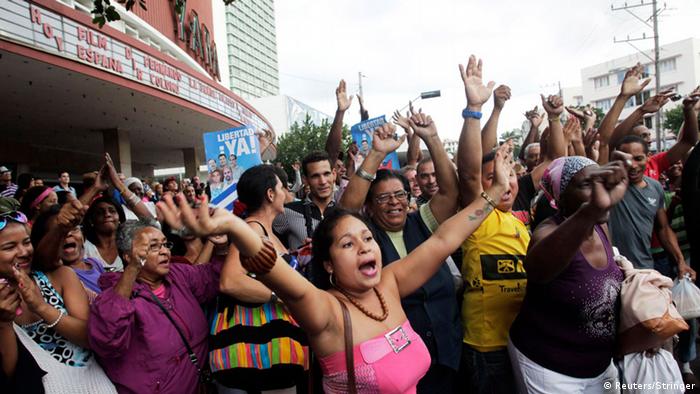
Cubans celebrate freedom of The Five Heroes (Cuban Five) as part of the agreement reached between with the United States and announced on December 17, 2014.


1. Introduction
Soon after the announcement of the U.S.-Cuba agreement on December 17, 2014, an ecological socialist fellow expressed his concern about the future of the Cuban revolution and asked for my opinion.  In response in this essay I will evaluate the agreement to resume full diplomatic relations cut unilaterally by the United States 53 years ago and what it signifies for the Cuban revolution.  Needless to say, it is not only some on the left who believe normalizing of relations with the Untied States will undermine the Cuban revolution by flooding the island with American capital, commodities and tourists as well as an embassy full of spies working together to subvert “the socialist system;” a section of imperialist enemies of the revolution argue similarly.

In sections 2, 3 and 4 I will argue that the agreement reached registers both an immediate victory and a historic gain for the Cuban revolution.  The agreement resulted in freedom for the last three of the Cuban Five (known in Cuba as the Five Heroes) who were sentenced to very long prison terms after a frame up trial in Miami, Florida.  This victory was celebrated in Cuba and by friends of the Cuban revolution and justice for all across the world who have joined the defense during the past 16 years.  As President Obama underscored in his own remarks, agreement comes from the realization that over five decade of active policy to isolate and destroy the Cuban revolution has failed.  While the agreement does not and cannot change the fundamental hostility of imperialism, in particular United States, towards the Cuban revolution (Washington and American mass media continue to lecture Cubans about how they should conduct themselves), the agreement makes it easier not harder for the Cuban people and leadership to work towards developing their economy and society in pursuit of socialism.  

In section 5 and 6, I will discuss the revolutionary calibre of the Cuban leadership and the tenacity of the Cuban people that explain U.S. imperialism’s failure and cite some aspects of the institutionalization of the Cuban revolution.  Contrary to the Stalinist leadership in former Soviet Union and Eastern Europe, and in China, Vietnam, and North Korea, the Cuban leadership emerged on the basis of the revolutionary heritage of Cuba and Latin America.  The Cuban people and their leadership have been tested for over six decades in extreme political, economic and military conditions. 

In Part 2, I will discuss opportunities and challenges facing the Cuban revolution in the twentieth first century when U.S. imperialism is in decline and argue that given its impressive advance Cuban socialists are in a good position to be in the forefront of the world transformations necessary to overcome the anthropocentric capitalist crisis to save humanity and much of life on Earth by inaugurating a worldwide ecological socialist society.

2. Cubans celebrate freedom of the Five Heroes
On noon December 17, Presidents Raul Castro Ruiz and Barak Obama spoke to their respective nations about their decision to chart a course towards normalization of diplomatic relations. For the past 53 years diplomatic relations were suspended on the initiative of the United States government and a “regime change” policy pursued.  As a “gesture of goodwill” United States had already released the last three of the Cuban counter-intelligence officers in the U.S. jails (The Cuban Five or the Five Heroes as they are knows in Cuba). Arrested in September 1998, Gerardo Hernández was given two life-terms, Ramón Labañino a life-term, and Antonio Guerrero a 19-year sentence. Their “crime” was to observe and infiltrate Cuban-American paramilitary or terrorist groups like Alpha 66, the F4 Commandos, the Cuban American National Foundation, and Brothers to the Rescue. Two other Cuban Five, Fernando González, and René González, had been released earlier after serving their terms. The Cuban government and Cuba solidarity groups in the U.S. and elsewhere have campaigned for 16 years against the frame-up trial of the Cuban Five and for their release and return to Cuba.

In exchange the Cuban government released to Washington Rolando Sarraff Trujillo, a Cuban intelligence agent who was recruited by the CIA. Over two decades ago, Trujillo had given the CIA crucial information for decoding communications between Havana and its counter-intelligence operatives in the United States. The Cuban Five were arrested using this information. Trujillo was tried and given a 25-year jail term of which he served 20 years. In addition, Cuba agreed to release 53 individuals the United States called “political prisoners” (their names have not been made public on U.S. demand). The USAID contractor Alan Gross who was convicted and sentenced to 15 years in jail five years ago for repeatedly breaking Cuban law by importing sophisticated telecommunication systems into Cuba as part of the U.S. regime change policy was released as on “humanitarian grounds.”  

3. A victory for the Cuban revolution
 President Raul Castro’s statement to the Cuban people appropriately placed the agreement in the context of the Cuban revolutionary history:
The heroic Cuban people, in the wake of serious dangers, aggressions, adversities and sacrifices has proven to be faithful and will continue to be faithful to our ideals of independence and social justice. Strongly united throughout these 56 years of Revolution, we have kept our unswerving loyalty to those who died in defense of our principles since the beginning of our independence wars in 1868.
Anyone familiar with the Cuban history understands that this is not propaganda boast.  The history of Cuba is a history of heroic struggle against colonialism and imperialism.  To correctly analyze the significance of the agreement Cuba has reached with the U.S., it is necessary to place it in its historical context. However, Castro also pointed to what has not been achieved.  Castro warned the Cuban people: “This in no way means that the heart of the matter has been solved. The economic, commercial, and financial blockade, which causes enormous human and economic damages to our country, must cease.” (my emphasis)

Set in its the context of the recent U.S.-Cuba relations, the agreement Cuban leadership reached with the Obama administration registers a victory for the Cuban people and their revolution.  President Obama’s admitted to as much in his own statement—five decades of bipartisan punishing economic embargo and regime change policies under twelve American Presidents including Obama himself have failed.  Not only these policies have not succeeded to destroy the Cuban revolution and its leadership, they have politically weakened the United States’ influence in Latin America and the Caribbean (that not long ago was taken to be “the backyard” of United States).  Americans’ view of the Cold War style policies towards Cuba , including among Cuban Americans in Florida, has changed in favor of normalization of relations.  American businesses that feel excluded from the Cuban market also want normalization of relations with Cuba. 

On the other hand, Cuba that was excluded from the Organization of Latin American States (OLAS) on January 31, 1962 was asked to return to its meetings in 1998 despite U.S. protest. President Raul Castro has been invited and is scheduled to attend the next OLAS meeting before the agreement was reached with Washington.  Since the rise of Hugo Chavez in Venezuela in the late 1990s and changing balance of class forces in favor  of working people in Latin Americana that has brought to power a number of populist regime, Bolivarian Alliance for the Peoples of Our America (Alianza Bolivariana para los Pueblos de Nuestra América—ALBA) has been formed with Cuba as a leading member state. 

Meanwhile, Cuba’s diplomatic campaign to isolate United States for its embargo has registered success at the United Nations for the twenty-third consecutive year.  In 2014, the UN General Assembly overwhelmingly voted for the non-biding resolution "Necessity of Ending the Economic, Commercial and Financial Embargo imposed by the United States of America against Cuba.”  188 out of 193 government voted for the resolution. Only the United States and Israel voted against it. The Pacific island-nations Palau, Marshall Islands and Micronesia abstained. 

Add to the above the general decline of the United States hegemony (see, Nayeri, "War and Peace at the End of the American Century," Negah, 2002, in Farsi) and the debate among  its policy elite on how to confront it. While the Republican neocons have argued that the best defense is a muscular offense and failed miserably in their “war without end” policies, a more far-sighted group including “Progressive Democrats” (see, for example, Paul Krugman’s “Conquest Is for the Losers” or proposed policies of the former Democratic Senator Jim Webb who may run as candidate for presidency) argue for scaling-back ineffective and wasteful militarism and interventionism in favor of rebuilding the American infrastructure and economy to make United States more competitive. 

4. Why is this agreement historic
Let us place the agreement reached in its longer historical context. From early 1500s to 1898 Cuba was a colony of Spain. Despite heroism of independence fighters, Cuba became a U.S. semi-colony from 1898 until the revolution of 1959.  To understand this long history of domination and resistance I know of no better single source than Louis A Pèrez’s Cuba: Between Reform and Revolution (Oxford University Press, 1988, 1995) that is also a superb example of fine historiography. It covers the entire history of Cuba, including a chapter dealing with post-1959 revolution until 1990. A much shorter account published in Cuba and awarded with the Social Science National Prize that covers the same period and is available in English is Julio Le Riverend’s Brief History of Cuba (Editorial Josè Marti, Havana, 1997).  In what follows, I highlight some notable junctures that place the Cuban revolution in its historical context.

In July 1898 United States intervened in Cuba as part of its war with Spain that included Puerto Rico and the Philippines.  However, in Cuba after a long armed campaign that began in 1868 independence fighters had just won autonomy from Spain in October 1897.  The U.S. intervention in Cuba was largely an attempt to snatch Cuba not from Spain but from its independence fighters.  Within a month of U.S. intervention Spain conceded defeat.  By January 1, 1901, formal U.S. military occupation of Cuba commenced and a month later U.S. Congress enacts the Platt Amendment that gave a veto power over Cuban internal affairs to the Untied State turning Cuba into a semi-colony.   In fact, U.S. military base in Guantanamo Bay—the only place in Cuba where political prisoners are held and tortured—was “leased” to the United States based on a U.S.-Cuba agreement of 1903 (the lease money which was increased in 1938 to $4085 a year is sent to Cuba but not accepted by the revolutionary government that considers it illegally occupied by the  United States).

Thus, the first thing to understand about the 1959 revolution is that it finally accomplished a historical task of the Cuban people— the right to self-determination and sovereignty.  Hence, the battle cry of Cuban independence fighters: Patrio o murte! Venceremos (Homeland or death! We shall win). 

But the 1959 revolution was also a democratic revolution.  The program of the Fidel Castro-led July 26 Movement was based on his courtroom defense speech in 1953 (later published as History Will Absolve Me).  It called for land reform and aimed to address problems of housing, unemployment, education, health and industrialization. Soon after the 1959 victory, the Castro leadership realized that to carry out their program they had to take on landlords and capitalists who were linked to and protected by American imperialism.  American multinationals (in today’s terminology, transnational corporations) controlled the modern secretor of the Cuban economy such as 90% of mining and 80% of power generation capacity.  All oil related industry were American or British. More than 40% of sugar production was in U.S. multinational hands.  Comprising a third of the Gross National Product, sugar was the main economic sector and the key foreign exchange earner for the country.  Eighty percent of sugar was exported to the U.S. and the industry employed a quarter of the workforce. Sugar companies possessed more than 70% of the arable land and two-third of railways.  

However, agrarian reform proclaimed on May 17, 1959 and nationalizations that followed drove the last of Cuban bourgeoise into the counter-revolution camp that was being actively organized by the United State.  By October 1960 the Eisenhower administration began to impose a trade embargo on Cuba.  As soon as the Kennedy administration came to power in January 1961 it cut all diplomatic relations with Cuba and organized the Bay of Pigs invasion in April. When the Cuban people defeated the invasion in 72 hours and took some 1,200 expeditionaries prisoners, Kennedy organized a naval blockade of Cuba leading to the October 22-28 missile crisis (in an agreement reached with the U.S., the revolutionary government exchanged 1,113 prisoners for $53 million in food and medicine sourced from private donations and from companies expecting tax concessions).  The idea of using nuclear arms against Cuba was seriously considered but Cubans did not backdown.  In 1961, the CIA began its assassination program and within the next two years five plots to kill Fidel Castro were uncovered.  By 2006, the CIA “had mulled 638 assassination schemes against former Cuban President Fidel Castro, ranging from a simple exploding cigar to strapping a mollusk with explosives to catch him while scuba diving.” (Belén Fernández).  

While there was a period during Carter administration that hostility towards Cuba lessened briefly, after the collapse of the Soviet bloc and the Council for Mutual Economic Assistance (COMECON) that almost overnight deprived Cuba of 75% of its imports and 80% of its exports and caused a drop of 35% in the GDP between 1990 and September 1993, Washington tightened the embargo to bring the downfall of the revolutionary government.  In October 1992 the Cuban Democracy Act (the "Torricelli Act") and in 1996 the Cuban Liberty and Democracy Solidarity Act (known as the Helms–Burton Act) which penalizes foreign companies that do business in Cuba by preventing them from doing business in the U.S. were signed into law.  Meanwhile covert regime change activities including a series of terrorist activities continued into this fall as the two governments were secretly negotiating normalization of diplomatic relations.  The Cuban government estimates that by 2010 the economic cost of U.S. embargo was about 1 trillion dollars. (CBS News, September 14, 2011).  To understand the scope of the damage of such magnitude it is useful to recall that in 2012, the Cuban GDP was estimated to be $72.3 billion or $121 billion in purchasing power parity (PPP) terms.  

Thus, U.S. government’s admission that more than half a century outright aggression towards Cuba has failed to achieve a counter-revolution in Cuba registers a historical victory for the Cuban revolution and Cuban people who have been defending themselves against American imperialists since 1898, and especially since 1959.

5. The revolutionary calibre of the Cuban leadership
Key to understanding the Cuban revolution is an appreciation of the revolutionary origins and calibre of its leadership.  The July 26 Movement originated outside the world Stalinist tradition that prevailed in revolutions in Yugoslavia, Albania, China , Vietnam and North Korea and were in power in the Soviet bloc countries. Despite their sometimes contentious relations with Moscow, these leaderships were trained in the Stalinist Comintern (Communist International) tradition.  As the ideology of the conservative bureaucratic caste in the Soviet Union, Stalinism defeated Bolshevism and took over the party and state in the latter part of the 1920s.  In the process, Stalinists murdered the leadership of the Bolshevik party and an entire layer of communist workers and suppressed masses of Russian workers and peasants, stifling scientific, artistic and cultural life.  In the Sixth Congress of Comintern in 1928, the Stalinist bureaucracy replaced the proletarian internationalist policy of the Bolshevik party with the doctrine of Socialism in One Country paving the way for supporting bourgeois parties and governments (as it had done in the Chinese revolution of 1925-27) and to pursue "peaceful coexistence" with imperialist powers, including with a pact with Hitler in 1939 to divide up Poland (for a detailed discussion of these set of issues see Leon Trotsky’s The Third International After Lenin, 1928, and The Revolution Betrayed: What Is the Soviet Union and Where Is It Going?, 1936).  This was followed by purging all parties of the Comintern of any revolutionary current that defended the Bolshevik tradition (for a discussion of the case of Cuba see, Gary Tennant’s The Hidden Pearl of the Caribbean: Trotskyism in Cuba published as a collection of articles in Revolutionary History, Volume 7, no. 3, Porcupine Press, 2000).

The key leaders of the July 26 Movement, including Fidel Castro and Ernesto Che Guevara, were educated in the internationalist socialist ideas of Marx, Engels and Lenin.  At the same time, the July 26 Movement was in political continuity with the Cuban independence movement of the 19th century and its leaders such as Felix Valera, Maximo Gomez, Carlos Manuel Céspedes and José Martí.  It was this combination of Cuban and Latin American revolutionary heritage with key ideas from Marx, Engels and Lenin that informed the thinking and action of the revolutionary team built by Fidel Castro.  From Marx’s perspective, what defines the socialist character of a revolution is the participation of direct producers in expropriation of the capitalist and landlord classes (Egypt under Nasser had more nationalizations carried out than Russia under Lenin—except the former were administrative and the latter revolutionary change). By this criteria the Cuban revolution had already inaugurated the socialist revolution in the western hemisphere before Fidel Castro declared it in the aftermath of the Bay of Pigs invasion in April 1961.  

The historical specificity of the Cuban revolution and its leadership provided a new pattern of socialist development.  Fidel Castro became the main voice of the working people of Cuba as his often very long speeches addressed the urgent tasks facing them. He not only explained these in an eloquent but also accessible language, he aimed to win their support and empowered them to act in their own interest.  In the liberal, social democratic and Stalinist circles it is common to refer to the gains of the Cuban revolution including especially education, health care  and relative equality of the Cuban people (for education see Martin Carnoy’s, Cuba’s Academic Advantages: Why Students in Cuba Do Better in School comparative study, Stanford University Press, 2007; for a discussion of the Cuban health care system at the depth of the economic crisis of the early 1990s see my “The Cuban Health Care System and Factors Currently Undermining It,”  Journal of Community Health, 1994, and a ten year reassessment, “Economic Crisis and Access to Care: Cuba’s Health Care System Since the Collapse of the Soviet Union,” with Professor Candido M. Lopez-Pardo, International Journal of Heath Services, 2004).  While these and many others gains are admirable results of the Cuban revolution, its socialist character is defined by the way they have been achieved—through mass participation and mobilization.  Ernesto Che Guevara discussed this dialectic of the Cuban revolution in Socialism and Man in Cuba (1965).  

By focusing merely on the indisputable leadership of Fidel Castro (and a few of the historical leaders of the revolution, like Raul Castro or Ernesto Che Guevara) the imperialist enemies of the Cuban revolution and its “leftist” critics and fellow travelers have deterred attention from the popular nature of the Cuban revolution. In fact, while they claim their concern for the masses of Cuban people they deny their tenacity or discount their essential role in the revolution.

In fact, mass organizations have been a permanent feature of the Cuban revolution from the very beginning.  During the revolutionary war from 1956-1958 wherever the July 26 Movement was able to liberate a territory of Batista forces it helped organize the working people and institute elementary functions of the new proletarian state.  After the 1959 victory abolished Batista’s police and the Rebel Army backed by Cuban masses became the armed revolutionary state.  People’s courts were organized to try those who committed crimes against the Cuban people (some were executed based on the judgment of these courts. In general, those executed had committed atrocities against the Cuban people either during the war or later as armed counter-revolutionary bands supported by the United States). 

Immediate economic measures were taken to aid the poor. Electricity charges were halved in the countryside, mortgage interests, costs of medicine and telephone were reduced, a mortgage bank to lend for housing established, a law was passed to give unimproved land to those who need it.  The first land reform law was passed on May 17, 1959. The reform immediately handed over 1 million hectors of land to 100,000 peasants families. Industry, finance and foreign trade were nationalized.   1961 was declared the year of literacy and teachers and students were mobilized to teach everyone who wanted how to read and write.  707,000 people benefited (The literacy campaign is the subject of the documentary Maestra by film maker Catherine Murphy). 

For 56 years the Cuban revolution has been able to defend itself against the ever-present military danger from the imperialist super power 90 miles from its shores.  This has been made possible with the formation of the Revolutionary National Militia on October 26, 1959 that was based on the Rebel Army.  From that day on the Cuban people have continuously been organized, trained, armed and when necessary mobilized in defense of their country and revolution.  The Fuerzas Armadas Revolucionarias, (FAR—Revolutionary Armed Forces) numbers about 55,000 —a very small army given the size and sophistication of the United States armed forces.  However the Cuban revolution follows the doctrine of the “war of the entire people” in a country with 11 million.  Committees in Defense of the Revolution (CDRs) were formed in September 28, 1960 to fight against armed counter-revolutionary bands.  Later, when such threats disappeared CDRs participated in blood drive campaigns, vaccination campaigns, mobilization for volunteer work, military training in neighborhoods. In 1996 CDRs had 7 million members.  There are other popular defense forces including the Territorial Troops Militia (Milicias de Tropas Territoriales—MTT), Youth Labor Army (Ejército Juvenil del Trabajo—EJT), and the Defense and Production Brigades (Brigadas de Producción y Defensa—BPD).

In May 1961,  the National Association of Small Farmers (ANAP) was formed and continues to play a leading role in Cuban agriculture.  Later, Agricultural Production Cooperatives (CPAs) were formed—large units of production that were cooperatively owned and worked.  On September 20, 1993, in response to the severe economic crisis caused by the collapse of trade, finance and credit relations with the Council of Mutual Economic Assistance, Many state farms were converted into Basic Unit of Cooperative Production (UBPC).  In UBPCS workers own machinery and fruit of their labor but in contrast to CPAs not the land which they held in usufruct.  In recent years, the government is offering unproductive land held in usufruct to those who qualify to work it productively to encourage food production (see, Laura J. Enriquez, Reactions to the Market: Small farmers in the Economic Reshaping of Nicaragua, Cuba, Russia and China, The Pennsylvania State University, 2010; for a discussion of agricultural cooperative see Frederick S. Royce, “Agricultural Production Cooperatives: The Future of Cuban Agriculture?”, 2004).  There are also Credit and Service Cooperatives (CCSs). Ecologically aware production such as  organic urban gardens, agroecology and permaculture are practiced in Cuba. While they are exemplary on a world-scale they are not yet dominant in Cuba (for a discussion of agroecology in Cuba see Sustainable Agriculture and Resistance: Transforming Food Production in Cuba, Fenando Funes, Luis Garcia, Marin Bourque, Nilda Perrez and Peter Rosset, Food First Books, 2002 and Miguel Altieri and Fernando R. Funez-Monzote, “The Paradox of Cuban Agriculture,” 2012). 

Cuban workers formed their first unions in the 1920s. In 1930, Central de Trabajadores Cubanos (CTC—Cuban workers federation) was organized.  For much of their history, Cuban unions were either controlled pro-government and pro-employer leaders or by the Stalinists.  In either case, union democracy and worker militancy suffered.  After the 1959 revolution the trade union movement expanded.  In 1970, CTC rewrote its constitution and elected a new leadership and has held its congresses every five years since.  Three million due paying workers belong to CTC—paying union dues in Cuba is voluntary (dues are not automatically deducted from paychecks).  In general, there is no doubt that Cuban workers have registered historical advances.  Anyone interested in learning more about their conditions at work can consult Debra Evenson’s Workers in Cuba: Unions and Labor Relations (2002).  I will discuss the question of workers and socialist democracy in Cuba in the second part of this essay.  However, as Evenson documents in her book (for my two-part review see here and here) and I have had occasion to see for myself, Cuban workers are involved not only in their work places but also in the affairs of the industry they work in and in national decisions.  For example, when the Cuban leadership in consultation with the CTC decided that the sugar industry would have to be downsized by almost half in 2002-03, all workers in the sugar industry were consulted, the affected workers who numbered over 100,000 were given their wages while being retrained for another occupation of their choice, offered jobs at the same pay level or more and assisted in relocation if that was necessary.  Nowhere else in the world workers have similar opportunity to leave their mark on policy and be treated with full respect and solidarity (see, The Militant, Number 9 and Number 16, 2004).

Federation of Cuban Woman (FMC) was formed in August 1960.  In 2000, women comprised 40% of the workforce, 62% of technical workers, 29% of managers, 23% of Poder Popular (legislatives bodies) members and almost 60% of university graduates.  There are many other popular organizations in Cuba such as the union of elementary students, federation of high school students, federation of university students, and National Union of Artists and Writers and Union of Journalists.  Cubans are a highly organized society (data presented in this paragraph and the following few are taken from my "The Cuban Revolution in Historical Perspective,” Negah, 2000, in Farsi.  I know more recent data would confirm the same trend in Cuban development but to obtain the precise number would have delayed this writing. I will update this section with new data as soon as I find the time).

In 1973, the first provincial Poder Popular (People’s Power) assembly was formed in Matanzas and by 1975 local, provincial and national People’s Power Assemblies were elected across the country.   Typically, Poder Popular members are volunteers—meaning they are not professional politicians. Candidates for local and provincial Poder Popular assembles are selected by the Association of Small Farmers (ANAP), Cuban workers federation CTC, Committees for Defense of the Revolution (CDRs), Federation of Cuban Women (FMC), and Federation of Cuban Students. All Cubans 16 years of age and older can vote.  Participation in elections is high. In February 1993 in the midst of the Cuban Great Recession caused by the collapse of trade, financial and credit relations with the Soviet bloc 99.57% of eligible voters participated in the elections.  Of those 97.1% cast a legitimate ballot despite a major campaign by the counter-revolution not to vote or cast a blank vote. The task of observing and counting the vote is with the Young Pioneers (children organization).  Local elections are held every two and half years and provincial and national elections every five years.  The national Poder Popular elects the Council of the State (cabinet) and the President who are responsible to it.   

The Cuban Communist Party was organized on the initiative of the July 26 Movement in merger with the Partido Sosialista Popular (PSP—pro-Moscow party in Cuba), and Student Directorate (a revolutionary student group that organized urban struggle against the Bastista government).   While Cuba has a one-party system, its origin differs from the Stalinist one-party systems.  The idea of a single revolutionary party was proposed by Jose Marti in the nineteenth century and has its roots in the desire for national unity against colonialism and imperialism that have been the main enemy of Cuba for its entire history.  The Union of Communist Youth (Union de Joven Communistas) was organized in 1963.  Neither of these two organizations are electoral parties. Their role in the Cuban society is ideological and political. To join them, the candidate must be nominated by their cohort based on their work and contributions to society. In 1994, there were 704,132 members of the Communist Party. 

6. The resilience of the Cuban revolution
The reader who has followed my exposition surely understand now why normalization of relations with the U.S. would strengthen the Cuban revolution, not undermining it.   

The Cuban people and leadership have faced many challenges in the past six decades always in the face of extreme hostility from their imperialist neighbor 90 miles to the north.   In the 1950s,  handful of revolutionaries that formed the backbone of the current leadership in Cuba rebelled against the U.S. backed Batista dictatorship and won against all odds.  In the 1960s, a broader leadership at the head of the increasingly organized and mobilized masses of Cuban working people uprooted armed counter-revolutionary bands supported by the United States, defeated the Bay of Pigs invasion, stood up to Kennedy’s naval blockade of Cuba and threat of nuclear weapons in the October Crisis.  In the same decade, the Cuban leadership was able to reorganize and reorient the economy heavily dependent on the United States and a cadre of middle class professionals who left for the United States towards the Soviet bloc countries in order to survive and develop.  Key to their success was mass organization and mobilization.  As exemplified by Che Guevara’s campaigns in the Congo and in Bolivia revolutionary internationalism has been part and parcel of the Cuban socialism.

In the 1970s and 1980s the Cuban revolution became a beacon of support for revolutionary struggles especially in Latin America and Caribbean and in Africa.  The revolutions in Granda and in Nicaragua in 1979 opened the possibility of the extension of the socialist revolution in the Western hemisphere ending Cuba’s exceptionalism. Unfortunately, both these revolutions failed. This period was closed by the triumphant Cuban armed forces in Angola fighting the South African apartheid army and its Washington backers.   Not only the Cubans helped Angola defend itself against apartheid and imperialism, they were instrumental in Namibia achieving its independence and in the fall of apartheid in South Africa as recognized by Nelson Mandela (see, How Far We Slaves Have Come, Pathfinder, 2010, also Piero Gleijeses, Visions of Freedom: Havana, Washington, Pretoria, and the Struggle for Southern Africa, 1976–1991.2013). 

In 1990 with the collapse of the Soviet bloc Cuba entered what they called “Special Period at Time of Peace” (war-like conditions at time of peace). Almost overnight Cuba had to reinsert itself into the capitalist world market with U.S. embargo tightening. In about a decade Cuban economy was stabilized and resumed growth. A new wave of anti-neoliberal mobilizations in Latin America  brought to power Hugo Chavez in Venezuela in 1998 and then populist governments in Bolivia and Ecuador. In combination with Argentina, Nicaragua and Brazil and some countries of the Caribbean and with the Cuban revolution as an inspiration the Bolivarian Alliance for Peoples of Our Americas (ALBA) was formed that has challenged American domination and neoliberalism. 

In the aftermath of the announced agreement between U.S. and Cuba commentators have played up the notion that American capital and tourists will overwhelm the Cubans. They forget that Cuba has been open to foreign capital since the early 1990s and tourism was the key source of foreign exchange—in recent years 3 million tourists visit Cuba each year spending an average of $1,000 per person there.   Also they forget that Cuba benefits from a central planning, nationalized industry and finance sectors and monopoly of foreign trade.  If the U.S. embargo is lifted overnight Cubans will see their cost of doing business with the capitalist world reduced significantly resulting in higher economic benefits from trade.  If more tourists visit Cuba more currency is funneled into the state treasury supporting the revolution's policies financially and Cuban per capita income will rise.  

Would the U.S. embassy spy on Cuba and instigate against the revolution? Of course. But that is nothing new and has been happening since 1898, especially since 1959.  We know that the Cuban revolution has not caved in either because of exposure to the capitalist world economy or Washington’s unceasing interventions.  Despite talks of normalization and a reset in relations from the White House and bourgeois opponents the policy of embargo (like the editors of the New York Times), the imperialist masters cannot stop telling others, including Cubans, how they should live and run their public affairs.  These imperialist habits are ingrained in in their internationalized economies—to stop and uproot them socialist revolutions in the capitalist heartland are necessary.  

Thus, friends of the Cuban revolution and any revolutionary, especially those who live in the imperialist countries in North America, Western Europe and Japan, Australia and New Zealand, could help defend the Cuban revolution and indeed strengthen it by making an ecological socialist revolution in their own countries.  Imagine how advance the Cuban revolution could have been if the Soviet Union was truly socialist or the French working class had seized power in May-June 1968, or the U.S. working class had waged a serious defense against four decades of capitalist offensive.  

In Part 2 of this essay, I will discuss the opportunities and challenges Cuban socialists face today.  

Friday, December 26, 2014

1695. The Cuban Five Are Free!

By Jeff Mackler, Socialist Action, December 22, 2014

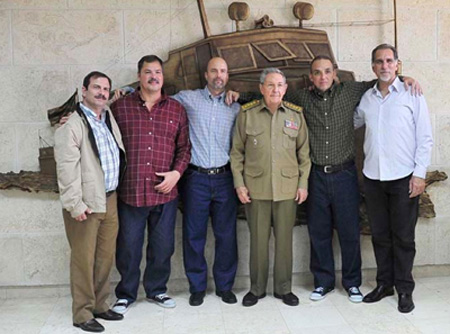
The Cuban Five and President Castro pose for a photo in Havana on December 17: Fernando González, Ramón Labañino, Gerardo Hernández, Antonio Guerrero and René González; Cuban President Raúl Castro is in uniform.


In simultaneous press conferences in Washington, D.C., and Havana on Wednesday, Dec. 17, President Barack Obama and Cuban President Raul Castro announced an agreement that included the immediate release of the three remaining Cuban political prisoners held in U.S. jails since 1998—Gerardo Hernández, Ramón Labañino, and Antonio Guerrero. Two other Cubans, Fernando González, and René González, having completed long jail terms, had been released in recent years.

The Cuban Five, as they are known with great admiration worldwide, were charged in 1998 and convicted in 2001 in Miami of conspiracy to commit espionage, conspiracy to commit murder, and acting as agents of a foreign government. The U.S. government-orchestrated trial included the illegal manipulation of reporters and the media more generally, forged documents, and the exclusion of exculpatory evidence. It was a classic U.S. political frame-up, aimed at poisoning public opinion and the jury pool while characterizing Cuba, the victim of U.S. terrorism for decades, as a terrorist state.

A Dec. 19 statement by the National Lawyers Guild (NLG), which has been monitoring U.S.-backed terrorist attacks on Cuba, stated, “For more than 30 years after Fidel Castro took power, over 3400 Cubans have died and over 2000 have been wounded in terrorist attacks by extremist anti-Castro exile groups based in South Florida. In 1990, the Cuban government sent the five men to Miami to monitor and disrupt such groups and prevent future attacks.” The Cuban Five [long ago granted Cuba’s highest award, “Heroes of the Revolution”], remained nonviolent throughout their mission.”

Amy Goodman’s “Democracy Now!” radio and television program described one such U.S.-trained terrorist, Luis Posada Carriles, as “one of the most notorious Cuban exiles who applied for political asylum in the United States several years ago.” Goodman reported that Carriles, a former CIA operative trained by the U.S. Army at Fort Benning, Ga., “has been trying to violently overthrow Fidel Castro’s government for four decades. … Posada was responsible for the 1976 downing of a civilian airliner that left Venezuela bound for Cuba. The bombing killed 73 passengers, including the gold medal-winning Cuban Olympic fencing team.”

In 1998 Posada told The New York Times, “The C.I.A. taught us everything. … They taught us explosives, how to kill, bomb, trained us in acts of sabotage.”

The Cuban government transmitted the information obtained by The Five to various U.S. intelligence agencies that supposedly exist to prevent such terrorist activities from being initiated from U.S. soil. It was these communications to the U.S. that led to the arrest of the Cuban Five, via a deeply implanted Cuban intelligence officer in the employ of the CIA. This was Rolando Sarraff Trujillo, subsequently imprisoned in Cuba for almost 20 years.

Trujillo was part of the prisoner swap, along with Alan Gross, an American working in association with the U.S. Agency for International Development, a notorious instrument used by the CIA and other such institutions aimed at undermining governments whose policies the U.S. government opposes. Gross had been imprisoned in Cuba for the past five years. Also, Cuba has reportedly freed 53 other “political prisoners” as part of the deal with the United States.

No U.S. government action was taken against the terrorists that the Five had exposed! Indeed, U.S. spy and terrorist operations continued with abandon, all focused on the organization of an internal opposition to topple the leadership of the Cuban Revolution.
In recent years the U.S. ruling class has been divided on the issue of the most effective methods to employ to bring down the Cuban workers’ state, established in 1959 when the forces led by Fidel Castro organized a popular revolution that removed the hated U.S.-backed dictatorship of Fulgencio Batista and opened the way to a socialist revolution in Cuba.

One wing of the U.S. ruling class, including former Secretary of State Hillary Clinton and a number of “liberal” Democrats, as well as Midwest Republicans who wish to sell cheap grain and other foodstuffs to Cuba, argue that a healthy dose of American capitalist investment aimed at undermining and underselling Cuba’s largely nationalized economy, is the best way to proceed. Clinton’s view is clearly stated in her new book, “Hard Choices.”

A Dec. 18 Bloomberg View article entitled “Hillary Clinton Secretly Pushed Cuba Deal for Years” notes: “Although President Barack Obama is taking the credit for Wednesday’s historic deal to reverse decades of U.S. policy toward Cuba, when Hillary Clinton was secretary of state, she was the main architect of the new policy and pushed far harder for a deal than the Obama White House.”

The Bloomberg article continues, “From 2009 until her departure in early 2013, Clinton and her top aides took the lead on the sometimes public, often private interactions with the Cuban government. According to current and former White House and State Department officials and several Cuba policy experts who were involved in the discussions, Clinton was also the top advocate inside the government for ending travel and trade restrictions on Cuba and reversing 50 years of U.S. policy to isolate the Communist island nation.”

While Obama officials asserted that the secret negotiations with the Cuban government that resulted in the present agreement were facilitated by Pope Francis and Canadian diplomats, presumably those with interests in exploiting Cuba’s significant nickel resources, ruling-class debates over the effectiveness of the Cuban embargo/blockade have been underway for decades.

Today, with the same intentions, the Obama administration has come on board. The president made clear in a Dec. 19 press conference that “the whole point of normalizing relations is that it gives us a greater opportunity to have influence with that government.” That “influence” includes U.S. corporate intentions to penetrate Cuban markets with an ongoing flow of cheap commodities aimed at undermining Cuban government enterprises.

U.S. imperialism’s relations with Cuba, and all other poor nations, always include such economic penetration based on imperialism’s capacity to set prices for vital resources far cheaper than their actual value. U.S. imperialism, for example, was able to effectively reduce the world market price of nickel, previously an important component of Cuba’s income, by 50 percent.

This kind of economic robbery is inherent in the imperialist system, wherein the nation that employs the highest levels of technology in the production of any commodity effectively devalues competing products produced with considerably more labor input. U.S. agri-business, utilizing the most advanced technologies in the world and very few workers, regularly produces rice more cheaply than any nation on earth. In every instance, the threat or actual export of rice in significant quantities has the effect of undermining the national rice markets worldwide.

The “liberal” advocates of opening Cuba to U.S. economic investments and commodity exports often cite the great economic gains obtained by U.S. multi-national corporations in China and Russia as a prime example. They have found a regular voice in the editorial pages of The New York Times, which repeatedly champions an end to the embargo in order to advance U.S. economic penetration of Cuba as the most effective way to bring down the Cuban workers’ state.

The more hard-bitten sectors of the U.S. ruling class prefer the traditional stick to Obama’s carrot. They remain in accord with the 1960 State Department memo—continuing in essence to this day—to “bring about hunger, desperation and [the] overthrow of [the Cuban] government.”

The National Lawyers Guild statement also noted that “under the current [Obama] administration, the US Agency for International Development (USAID) had secretly attempted to build an opposition movement in Cuba which it acknowledged had no significant support from within the island. These covert actions as documented several months ago by the Associated Press include: (1) sending undercover Latin American youth to Cuba posing as health workers; (2) establishing a fake “Cuban Twitter” program, [the now-abandoned ZunZuneo (the sound of the hummingbird) program], the collecting the data of 50,000 unsuspecting Cubans; and (3) infiltrating the underground hip-hop scene and co-opting artists.”

These more “subtle” programs were, of course, accompanied by the ongoing and illegal 52-year U.S. embargo/blockade that has caused Cuba billions of dollars in lost revenue and has been central to the U.S.-imposed misery inflicted on the Cuban people. Despite the embargo/blockade and all other illegal measures employed by U.S. imperialism, revolutionary Cuba has persevered, including maintaining one of the world’s finest and free systems of health care, public education, and other vital social services that are universally admired.

In recent years, and following a massive consultation process with the Cuban people, Cuba has implemented series of reforms, within the context of maintaining its socialist ideals, aimed at improving the efficiency of the Cuban economy. These include granting licenses for the operation of small businesses that involve just a few people, usually family members, in their operation. In 2013, these enterprises employed some 400,000 Cubans.

This fall, the government announced 246 projects that will be added to the number of industries that are open to foreign investment. This effort focuses on the special development zone that is being developed in an expanded Port of Mariel. The new zone will offer the possibility of 100 percent private ownership, although enterprises will be subject to government, labor, and other regulation.

Additionally, modest parcels of state land have been distributed on a renewable-lease basis to Cuban workers and agricultural laborers. Here again, the objective was to improve efficiency and avoid bureaucratic abuse. The latter has been periodically and publically noted and condemned by the Cuban leadership, especially with regard to the state agriculture system, where theft and corruption have been rampant. In cases of imperialist-imposed and massive shortages of basic necessities, bureaucratic abuse is well known. Combating this abuse was been a critical part of the legacy of the Castro team.

Socialist Action has documented Cuba’s economic reforms in significant detail in the resolution in solidarity with Cuba adopted by our 2012 national convention and published in the pamphlet entitled, “The Politics of Revolutionary Socialism.” We noted that unlike the process of capitalist restoration that has been completed in Russia and China, no significant portion of Cuba’s economy has been granted to any section of the Cuban leadership or to international corporations. Indeed, before implementation, the proposed economic reforms were presented for discussion, debate, and modification to well-organized and massive assemblies of workers and farmers that included millions of Cubans.

While Cuba still lacks formal and vitally necessary institutions of workers’ democracy, such as the soviet (council) system under the revolutionary leadership of Lenin and Trotsky in the early period of the Russian Revolution, the present Cuban leadership has not developed into a hardened caste whose interests can only be preserved by repression. To the contrary, despite the incredible hardships imposed on Cuba by U.S. and world imperialism, the Castro team has struggled valiantly to maintain the social gains of the 1959 revolution and to foster social equality to a greater extent than anywhere on earth.

The Cuban example in sending hundreds of doctors and medical workers to fight the scourge of Ebola in Africa and similar humanitarian efforts across the globe is testimony to its ongoing revolutionary and socialist orientation.

The heinous U.S. embargo/blockade of Cuba has been annually condemned as illegal in United Nations General Assembly resolutions in each of the past 23 years. The most recent vote on this issue was 188-2, with only the U.S. and Israel voting against.

Commenting on the embargo/blockade and the new U.S.-Cuba agreement, and reaffirming Cuba’s socialist course, Raul Castro stated emphatically, “An important step has been taken, but the essential thing remains—the end of the economic, commercial and financial blockade against Cuba, which has grown in recent years particularly in terms of financial transactions.” In short, Cuba, unlike virtually every nation on earth, has been denied credit from almost all of the world’s major banking institutions.

While Obama declined to lift the embargo, with the assertion that this required congressional action—that is, rescinding the Helms-Burton Law and other anti-Cuba legislation—what will soon become clear is that the U.S. government will seek to use its embargo leverage to extract important concessions.

Similarly, after a century of colonial occupation, including torture of so-called terrorists captured in the course of U.S. wars in the Middle East and Afghanistan, Obama made no reference to the U.S.-occupied naval base at Guantánamo Bay, Cuba. The Cuban government continues to demand an end to this colonial occupation, a product of the 1898 American war and occupation of Cuba based on the infamous “Remember the Maine!” pretext, when Spanish authorities were charged with blowing up the U.S. battleship Maine in Havana harbor.

Obama’s press conference also announced several additional executive orders aimed softening relations with Cuba.

Dependent on expected new and soon to be enacted Treasury and Commerce Department revisions of current policy and their formal publication in the Federal Register, Obama and his administration officials indicated that rules on visits to Cuba by Americans will be liberalized to allow for travel in categories that have in the past required special licenses. These include family visits, as well as travel regarding official U.S. or foreign government business, journalism, research and professional meetings, educational and religious activities, performances workshops, competitions, expeditions, and humanitarian support. Specific licenses will no longer be required for business related to telecommunications and Internet linkages with Cuba.

Further, remittances by Americans with family members in Cuba will now increase to $2000 every three months, up from $500. Americans visiting Cuba will be allowed to legally import merchandise bought there with a value of up to $400, including up to $100 in tobacco and alcohol purchases.

In the same vein, Obama—declaring the U.S. approach to Cuba “outdated” and stating that “these 50 years have shown that isolation has not worked”—proclaimed that his objective was the normalization of relations with Cuba, including the construction and establishment of a U.S. embassy in Havana and an Obama administration effort to remove Cuba from the U.S. terrorist list. Secretary of State John Kerry indicated his intention to pay a formal visit to Cuba along with other top administration officials.

Liberal apologists for U.S. imperialism have been effusive with praise for Obama’s recent policy initiatives, characterizing them as sincere efforts to portray his “legacy” as that of a progressive, liberal-minded—if not humanistic—head of state.

Mindful of the need to attract to its 2016 electoral efforts the unprecedented millions who did not vote in the recent mid-term elections—two-thirds of the eligible electorate and especially Blacks, Latinos, and youth who saw no significant difference between the twin parties of the ruling rich—the president has engaged in a flurry of executive pronouncements aimed at burnishing his tattered image. These include his fraudulent immigration reforms, his “success” in negotiating the new $1.1 trillion congressional funding bill (that granted additional billions to the corporate elite), his tepid criticisms of the now internationally exposed CIA torture practices, and his most recent release/transfer of four Guantanamo prisoners who had been held for decades without charges or legal representation.

All these measures, as with Obama’s “new” Cuba policies, are in their essence the dressing of the government’s ongoing reactionary policies in more presentable garb. They are aimed at maintaining and advancing the interests of the U.S. rulers at the expense of the world’s people, including the American working class.


The classic maxim of over 3000 years past applies with full force today: “Beware of Greeks bearing gifts!” Obama’s Trojan Horse belies wicked intentions. Nevertheless, the hard-fought winning of the freedom of the Cuban Five, and all other measures aimed at ending the monstrous imperialist embargo/blockade, are important victories for revolutionary Cuba and all humanity.