Showing posts with label Trees. Show all posts

Thursday, August 18, 2022

3603. Climate Change: 'Staggering' Rate of Global Tree Losses from Fires

By Matt McGrath, BBC, August 17, 2022

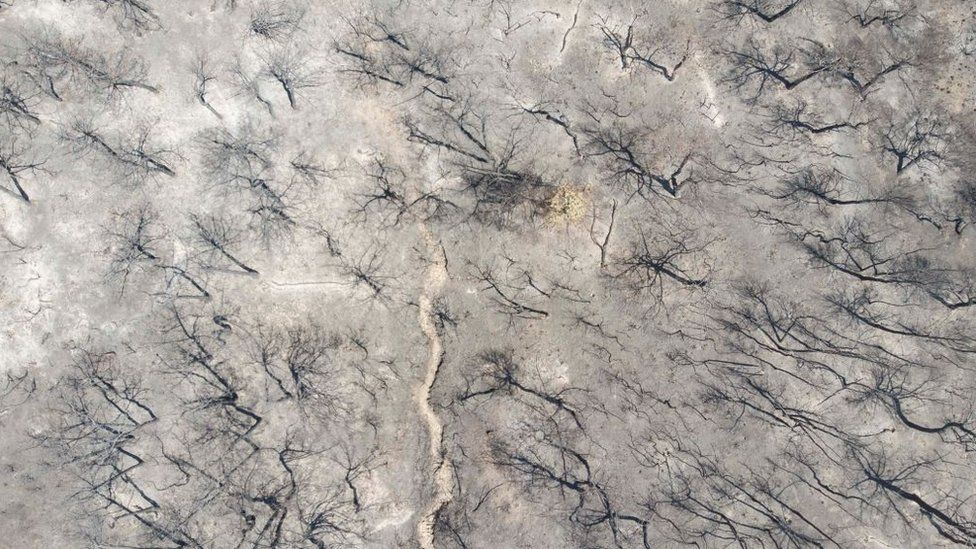
The remnants of a forest after a fire


Data from Global Forest Watch suggests that across the globe, the amount of tree cover being burned has nearly doubled in the past 20 years.

Climate change is a key factor in the increase as it leads to higher temperatures and drier conditions.

Of the 9 million hectares of trees consumed by fire in 2021, over five million were in Russia.


In 2021, the second worst year for fires on record, an area the size of Portugal was lost.

"It is staggering," says James MacCarthy, an analyst with Global Forest Watch.

"It's roughly twice what it was just 20 years ago. It is kind of astonishing just how much fire activity has increased over such a short amount of time."

The impacts of fire-related losses are being felt primarily in forests in more northerly countries like Canada and Russia.

While fire is a natural part of how these forests have long functioned, the scale of destruction seen in Russia in 2021 was unprecedented.

Of the 9.3 million hectares (23 million acres) burnt globally, Russia accounted for more than half.

"What's most concerning is that fires are becoming more frequent, more severe and have the potential to unlock a lot of the carbon that's stored in soils there," said James MacCarthy.

Trees and soils store carbon dioxide - one of the key gases warming our atmosphere - and experts say they are crucial in tackling climate change.


Climate change is seen as a key driver of these fires, with rising temperatures creating the drier conditions in which more trees burn.

Northern regions of the world are warming at a faster rate, leading to longer fire seasons.

In Russia, the 31% increase in fire losses in 2021 was due in part to the prolonged heatwaves that experts believe would have been practically impossible without human-induced warming.

"Climate change is increasing the risk of hotter, faster and larger fires," said Dr Doug Morton, who's chief of the Biospheric Sciences Laboratory at Nasa.

"And that's nowhere more visible than forests and woodlands where you have plenty of fuel to burn."

In other parts of the world, the impact of deforestation is also leading to more fires.

In the Brazilian Amazon, which recently saw the number of trees felled climb to a six year high, the losses due to agricultural clearing and logging are having a knock-on effect.

"Deforestation changes local and regional climates and removes a lot of the evapotranspiration that help keep temperatures low and more humid," said James MacCarthy.

"So cutting down these forests is actually making them hotter and drier, and making them more prone to fires."

While many of the trees that burn down will grow back over a period of 100 years or so, there are significant associated impacts of these losses on biodiversity, on water quality and soil erosion.

The UN says that the outlook for forest fires in the decades ahead is grim. There is an expected increase of 50% in extreme fires by the end of this century.

To address this problem, scientists say that rapid and deep cuts in global carbon emissions are key.

Global leaders at the climate change conference COP26 in Glasgow last year pledged to end deforestation, but the promise must be honoured if it's to make a difference.

More focus on preventing forest fires, rather than fighting them, is still needed, according to Mr MacCarthy.

"About 50% of national fire budgets are for responding to fires and less than 1% is really for preparing and planning," he says.

Monday, October 1, 2018

3039. Baobab Trees in Senegal Are Threatened by Climate Change, Urbanization, and Human Population Growth

By Dionne Searcey, The New York Times, September 30, 2018
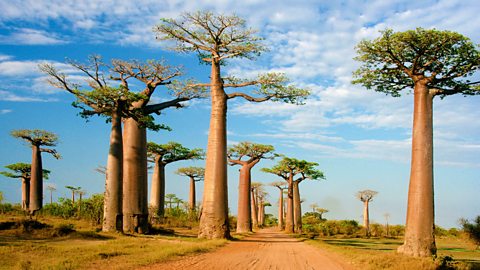
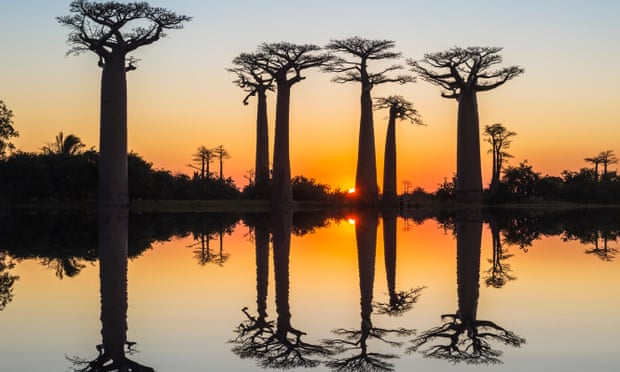
Baobab trees can live to 2,000 years.

DAKAR, Senegal — Wide, awkward baobab trees blend into the cityscape of Dakar, the busy capital of Senegal, almost without notice.

Drivers wash a fleet of taxis parked beneath one giant tree near a freeway on ramp. Rusting cars with open hoods are parked in a mechanic’s shop under the shade of another. A leathery trunk is a community billboard, with ads nailed to it for a plumber and an apartment for rent.

Aliou Ndour stood on a crowded corner, pulled out his phone and scrolled past the pictures of friends and family to another precious photo: the baobab in his home village.
Fat baobabs, some more than half a millennium old, have endured across Senegal, passed over for lumber largely because their wood is too brittle and spongy for use in furniture. Baobab leaves are mixed with couscous and eaten, the trees’ bark stripped to make rope, their fruit and seeds used for drinks and oils.

“This,” said Adama Dieme, craning his neck to look up at the spread of branches of the baobab on his block, “is the pride of the neighborhood.”
But baobabs, like many of the region’s trees, are in jeopardy, threatened by the same forces upending numerous facets of society — climate change, urbanization and population growth.

West Africa has lost much of the natural resources once tied so closely to its cultural identity. Poaching has stolen most of its wildlife; lions, giraffes and desert elephants are sorely endangered.

Huge swaths of forest are being razed to clear space for palm oil and cocoa plantations. Mangroves are being killed off by pollution. Even wispy acacias are hacked away for use in cooking fires to feed growing families.

One of the largest baobab trees in Senegal is in the Fatick region, southwest of the capital.

In recent years, rainy season has started later than usual. But a welcome shower arrived last month near the coastal community of Joal, Senegal.

A recent study said climate change might be blamed for the deaths of some of Africa’s oldest and biggest baobabs. In Senegal, local researchers estimate the nation has lost half its baobabs in the past 50 years to drought and development.
One of the biggest developments in the country is outside Dakar, where Senegal’s president is building an entirely new city, in the middle of a baobab forest. Officials have pledged to replant any trees they raze.

On the far edges of the development, construction workers were building new homes. The corpse of one baobab lay on the ground, a musty smell lingering at its exposed hollow interior. The smooth marks of an ax scarred its trunk.

Other charred carcasses of baobabs lay nearby. A worker said those had been torched with gasoline.

“Whenever you see a baobab that has fallen down, you’re sad,” said Gorgui Kebbe, the worker. “It’s a symbol of our country. But having a house to live in takes priority.”

In Senegal an image of a baobab is on the presidential seal. Baobabs are painted on the sides of buildings and on billboards. A fancy seaside hotel is named after them. So is a famous wrestler.

One baobab, which locals say is 850 years old with a 100-foot-circumference trunk, is a tourist attraction. You can sleep in a baobab tree house hotel or ride a zip-line course from baobab to baobab.

Senegal has few rivers and no mountains so baobabs sprout from the scrubby landscape as majestic way points. Throughout history, entire communities were constructed around these trees.

Baobabs serve as town halls — gathering places where municipal decisions are made, babies named and scores settled. Their bulging, python-like roots serve as La-Z-Boys for the tired. Their branches offer refuge for the overheated.

The trunks of some trees are covered in trinkets — a rooster’s claws, a bracelet, a plastic flip-flop, all for good luck. Pilgrims come to a stubby baobab on ÃŽle de Madeleine, a small island off Dakar, to insert money into the folds of its trunk or nail a message there, as a prayer of last resort.

The rainy season here has been starting later in recent years, and the downpours are fewer. As drought becomes a new way of life, the baobab in many communities is where people gather to pray for rain.

In Diock, a village about three hours outside the capital, the rainy season should be in full swing by now, but by early August it had rained only four times. The millet plants in the surrounding fields were only ankle high.

“We watch on television what is going on in Europe and in the world,” said Mamadou Diop, the village chief. “We know what’s coming.”

To fight climate change, residents are using fewer gas-gulping machines and not cutting down smaller trees for firewood.

But harvests have been so poor that many of the village’s 600 residents have abandoned farming and moved to the city, where they find work as teachers or soldiers.
“We’re trying to reduce greenhouse gases,” Mr. Diop said, “but it’s as if we are powerless.”

In towns and villages that dot the countryside, each community has its own tradition entwined with its local baobab.

In Diock, a new bride and groom circle the baobab seven times after they are married. On Fadiouth, an island on the southwest coast made entirely of seashells, funeral processions pause at the base of the village baobab, before carrying on to a Catholic shrine and the cemetery.

Seydou Kane, who works in Senegal’s Ministry of Culture, was circumcised under a baobab in the city of Thiès when he was about 4. Grown-ups had told him the trees were filled with spirits who grew angry if you touched the trunk. After the ceremony, he was told to nick the trunk of the tree with a knife. He gathered his courage and ran toward the baobab, marking it with his blade.

“You’re a man now,” he recalled the adults telling him. “You don’t have to be afraid of anything.”
He passed by the tree not long ago and it was dead.

An ancient baobab on ÃŽle de Madeleine, off the coast of Dakar, is both tourist and spiritual attraction. Some people leave trinkets and money in the folds of its trunk and offer a prayer.

Baobab leaves have been a regular part of the diet of Selbe Dione and her sister, who one afternoon used a long wooden pole with a hook at the end to pluck leaves from a baobab in the middle of a neighbor’s field in the Fatick region. The tree was tilted, as though it was bending to help them.

“Everything from the baobab is beautiful,” Ms. Dione said, looking at the green oval-shaped fruit and large white dangling blossoms, “from its leaves to its roots.”
The tissue inside some of Senegal’s oldest baobabs has died, leaving giant, cavelike holes. The hollow of one baobab in the coastal city of Nianing is big enough for a dozen people to stand in comfortably.

Once these hollows were mausoleums for griots, or storytellers, who were buried inside, standing up.
These men were considered walking libraries, the power of their words so strong their energy should radiate throughout the baobab for eternity. The practice was outlawed in the 1960s but locals still refer to the trees that were once tombs as sacred baobabs.

Many of the trees mark cemeteries. In Kaolack, 49 kings of the Guelewar Dynasty are buried under a baobab.

On a recent morning Aminita Ba, 72, stood tending goats in the middle of a wide field in rural Samba Dia that was punctuated by a single, towering baobab.
When Ms. Ba arrived on the farm 50 years ago, she built her small house near the tree, knowing it would be a guidepost for visitors.

“I’m very proud of this baobab,” she said. “From far away you can see this big tree and next to this big tree is a home, and it’s my home.”
Tuesday, June 12, 2018

2939. Thousands Years Old Giant African Baobab Trees Die Suddenly

By Agence France-Presse, June 11, 2018

Some of Africa’s oldest and biggest baobab trees have abruptly died, wholly or in part, in the past decade, according to researchers.

The trees, aged between 1,100 and 2,500 years and in some cases as wide as a bus is long, may have fallen victim to climate change, the team speculated.

“We report that nine of the 13 oldest … individuals have died, or at least their oldest parts/stems have collapsed and died, over the past 12 years,” they wrote in the scientific journal Nature Plants, describing “an event of an unprecedented magnitude”.

“It is definitely shocking and dramatic to experience during our lifetime the demise of so many trees with millennial ages,” said the study’s co-author Adrian Patrut of the BabeÈ™-Bolyai University in Romania.

Among the nine were four of the largest African baobabs. While the cause of the die-off remains unclear, the researchers “suspect that the demise of monumental baobabs may be associated at least in part with significant modifications of climate conditions that affect southern Africa in particular”.

Further research is needed, said the team from Romania, South Africa and the United States, “to support or refute this supposition”.

Between 2005 and 2017, the researchers probed and dated “practically all known very large and potentially old” African baobabs – more than 60 individuals in all. Collating data on girth, height, wood volume and age, they noted the “unexpected and intriguing fact” that most of the very oldest and biggest trees died during the study period. All were in southern Africa – Zimbabwe, Namibia, South Africa, Botswana, and Zambia.

The baobab is the biggest and longest-living flowering tree, according to the research team. It is found naturally in Africa’s savannah region and outside the continent in tropical areas to which it was introduced. It is a strange-looking plant, with branches resembling gnarled roots reaching for the sky, giving it an upside-down look.

The iconic tree can live to be 3,000 years old, according to the website of the Kruger National Park in South Africa, a natural baobab habitat.

They analyse samples taken from different parts of each tree’s trunk. They found that the trunk of the baobab grows from not one but multiple core stems. According to the Kruger Park, baobabs are “very difficult to kill”.The tree serves as a massive store of water, and bears fruit that feeds animals and humans. Its leaves are boiled and eaten as an accompaniment similar to spinach, or used to make traditional medicines, while the bark is pounded and woven into rope, baskets, cloth and waterproof hats.

The purpose of the study was to learn how the trees become so enormous. The researchers used radiocarbon dating to analyse samples taken from different parts of each tree’s trunk. They found that the trunk of the baobab grows from not one but multiple core stems. According to the Kruger Park, baobabs are “very difficult to kill”.
“They can be burnt, or stripped of their bark, and they will just form new bark and carry on growing,” it states. “When they do die, they simply rot from the inside and suddenly collapse, leaving a heap of fibres.”

Of the 10 trees listed by the study authors, four died completely, meaning all their multiple stems toppled and died together, while the others suffered the death of one or several parts.

The oldest tree by far, of which all the stems collapsed in 2010/11, was the Panke tree in Zimbabwe, estimated to have existed for 2,500 years. The biggest, dubbed Holboom, was from Namibia. It stood 30.2 metres (99 feet) tall and had a girth of 35.1 m.

The oldest tree by far, of which all the stems collapsed in 2010/11, was the Panke tree in Zimbabwe, estimated to have existed for 2,500 years. The biggest, dubbed Holboom, was from Namibia. It stood 30.2 metres (99 feet) tall and had a girth of 35.1 m.

Saturday, April 14, 2018

2880. Book Review: The Overstory

By Barbara Kingsolver, The New York Times, April 9, 2018

Trees do most of the things you do, just more slowly. They compete for their livelihoods and take care of their families, sometimes making huge sacrifices for their children. They breathe, eat and have sex. They give gifts, communicate, learn, remember and record the important events of their lives. With relatives and non-kin alike they cooperate, forming neighborhood watch committees — to name one example — with rapid response networks to alert others to a threatening intruder. They manage their resources in bank accounts, using past market trends to predict future needs. They mine and farm the land, and sometimes move their families across great distances for better opportunities. Some of this might take centuries, but for a creature with a life span of hundreds or thousands of years, time must surely have a different feel about it.

And for all that, trees are things to us, good for tables, floors and ceiling beams: As much as we might admire them, we’re still happy to walk on their hearts. It may register as a shock, then, that trees have lives so much like our own. All the behaviors described above have been studied and documented by scientists who carefully avoid the word “behavior” and other anthropomorphic language, lest they be accused of having emotional attachments to their subjects.

The novelist suffers no such injunction, but most of them don’t know beans about botany. Richard Powers is the exception, and his monumental novel “The Overstory” accomplishes what few living writers from either camp, art or science, could attempt. Using the tools of story, he pulls readers heart-first into a perspective so much longer-lived and more subtly developed than the human purview that we gain glimpses of a vast, primordial sensibility, while watching our own kind get whittled down to size.

But: Birds gotta fly, fish gotta swim. People will only read stories about people, as this author knows perfectly well. “The Overstory” is a delightfully choreographed, ultimately breathtaking hoodwink. The handful of readers who come to the book without benefit of reviews or jacket copy will believe it’s a collection of unrelated short stories. The opener is a gorgeous family saga with the texture of a Ken Burns documentary, and more plot. The Hoels are Norwegian immigrants whose vocations link them with our continent’s once-predominant tree, the American chestnut, as they all flourish and then are tragically cut back — both Hoels and chestnuts — to a lone scion. Pause for a moment to absorb this, then move on to the next immigrant story, in which Mimi Ma’s father invests too many hopes in a mulberry tree. Then, in the Vietnam War, Douglas Pavlicek is shot from a military plane and survives through a fortuitous intersection of his fate with that of a centuries-old fig tree. In another time, in Silicon Valley, an 11-year-old coding prodigy named Neelay Mehta has a much unluckier tangle with an ancient Spanish oak.

Trees are everywhere but incidental, it seems, until the seventh tale in the series, about an odd little girl who loves trees more than she loves most people and grows up to be a scientist. As Dr. Pat Westerford she spends years alone in forests doing her research, initially mocked by her peers but eventually celebrated for an astounding (and actually real) discovery: A forest’s trees are all communicating, all the time, via a nuanced chemical language transmitted from root to root. As this revelation dawns, the reader is jolted with electric glimpses of connections among characters in the previous stories. And then we remember we’re in the hands of Richard Powers, winner of a genius grant, a storyteller of such grand scope that Margaret Atwood was moved to ask: “If Powers were an American writer of the 19th century, which writer would he be? He’d probably be the Herman Melville of ‘Moby-Dick.’”

His picture really is that big. These characters who have held us rapt for 150 pages turn out to be the shrubby understory, for which we couldn’t yet see the forest. Standing overhead with outstretched limbs are the real protagonists. Trees will bring these small lives together into large acts of war, love, loyalty and betrayal, in a violent struggle against a mortgaged timber company that is liquidating its assets, including one of the last virgin stands of California redwoods. The descriptions of this deeply animate place, including a thunderstorm as experienced from 300 feet up, stand with any prose I’ve ever read. I hesitate to tell more, and spoil the immense effort Powers invests in getting us into that primal forest to bear witness. It’s a delicate act, writing about tree defenders: In an era when art seems ready to embrace subjects as painful as racism and sexual harassment, it still shrinks from environmental brutality. We may agree that deforested continents and melting permafrost betray the gravest assaults we’ve ever committed against anything or anyone, but still tend to behave as if it’s impolite to bring this up.

In the kind of meta-conversation that makes a Powers novel feel so famously intelligent, the narrative is seasoned with canny observations on this exact problem. The tree scientist frets about public indifference to her work: “Forests panic people. Too much going on there. Humans need a sky.” Elsewhere, a patent attorney becomes profoundly disabled and seeks solace in novels, even while he muses on the limitations of the form. “To be human is to confuse a satisfying story with a meaningful one. … The world is failing precisely because no novel can make the contest for the worldseem as compelling as the struggles between a few lost people. … Though I am fake, they say, and nothing I do makes the least difference, still, I cross all distances to sit next to you in your mechanical bed, keep you company and change your mind.”

Given that Richard Powers has swept the literary-prize Olympics, he should be a household name, but isn’t quite. Critics have sometimes blamed a certain bleakness of outlook, or a deficit of warmth in his characters: As Atwood put it, the story going around is that he’s “not cozy enough at the core.” I suspect the complaint isn’t entirely Powers’s problem, but rather a symptom of the art/science divide and some potent cultural stereotypes. At the prospect of a science-y genius taking the podium, a lot of the audience expects to be frozen out, or bored.

“The Overstory” makes a strong case for expecting otherwise. The science in this novel ranges from fun fact to mind-blowing, brought to us by characters — some scientists, mostly not — who are sweet or funny or maddening in all the relatable ways. The major players number more than a dozen, all invested with touching humanity, and they arrive with such convincing, fully formed résumés, it’s hard to resist Googling a couple of them to see if they’re real people. (They aren’t.) This is a gigantic fable of genuine truths held together by a connective tissue of tender exchange between fictional friends, lovers, parents and children. A computer programmer brings his work home to spend hours inventing games with his son: “Now, Neelay-ji. What might this little creature do?” A cute Eastern European backpacker invites herself for a one-nighter in the vet Douglas’s remote cabin, and he warns that she shouldn’t be out there by herself, looking the way she does. “‘How I look?’ She blows a raspberry and whisks her palm. ‘Like an ill monkey who needs washing.’” Best of all are two aging misanthropes, Patricia and Dennis, who will wreck any unsentimental heart with their gentle discovery that just an hour a day together can make a marriage, providing the nutrient that’s been missing all along. Even when viewed from very high up, through the lens of a thing that’s been alive since before Jesus, all these little people with their short, busy lives and blinding passions are very dear indeed.

A tree’s-eye view on a planet can also be plenty unnerving, in life and in art. Powers doesn’t hesitate to give us wide-screen views of the machinery of his plot, so we can’t miss the roles his characters have been assigned as fulcrum and levers bent to a larger purpose. It’s a fair enough device in a novel meant to tell us that humans aren’t the only show on earth: that in fact we’re not much more than a sneeze to a bristlecone pine. In the end, “The Overstory” defies its own prediction about fiction’s limits, making the contest for the world feel every bit as important as the struggles between people. Even if you’ve never given a thought to the pulp and timber industries, by this book’s last page you will probably wish you weren’t reading it on the macerated, acid-bleached flesh of its protagonists. That’s what a story can do. 

Barbara Kingsolver’s 15 books of fiction and nonfiction include her most recent novel, “Flight Behavior,” and “Unsheltered,” forthcoming in October. Before her writing career, she worked as a biologist.

Thursday, March 3, 2016

2232. Corvids Hold the Key to Saving the World's Forests

By Conservation, University of Washington, February 24, 2016

Imagine you’re a tree. Like every other organism on this planet, you’ve got two life goals. The first is to survive long enough to reproduce, and the second is to actually reproduce. Your aim is to cast out your seeds as far as possible so that your descendants will have room to grow. After all, if you just drop your seeds straight to the ground, your children’s nascent root systems will compete with your own mature one and will have trouble surviving. The solution? Strike a bargain with an animal. You provide the food, and the animal provides the baby carriage to transport your precious cargo a safe distance away. According to a new study, some of the best animal couriers around are corvids, the family of birds that includes crows, ravens, rooks, jays, and magpies.
But the immobile tree makes a gamble: by making their seeds tasty and nutritious, birds are highly motivated to gather up as many as possible. Instead of scarfing them all up at once, they cache them and return later to feast. But even the cleverest western scrub jay or Clark’s nutcracker won’t quite remember where he or she hid every single seed. Some of those seeds will go un-eaten and, with luck, they will become new plants. Those plants will grow to become trees which will provide food for the corvids’ own descendants. The two sets of organisms have come to rely on each other. That’s why corvids are so integral to maintaining forested ecosystems.
The better we can understand the relationship between these brainy birds and the trees they rely on for food, argues University of Nebraska-Lincoln biologist Mario B. Pesendorfer in the journal The Condor, the better we can rely on that relationship when it comes to restoring and preserving those ecosystems.
Take the jays of North America. Florida scrub jays, western scrub jays, and island scrub jays can cache between 5,000 and 6,000 acorns during a good year. Oak forests depend on those years for their continued survival. When researchers compared acorns that had merely fallen to the ground and rolled away and those that had been cached by jays, it was the cached acorns that were more likely to become saplings. Caching is even more important following a forest fire; hidden acorns remain likely to sprout through the burned soil, while those resting above ground would burn right up.
And a study of blue jays found that a single population cached more than 130,000 acorns from just 11 oak trees one year. More than nine of every ten of those acorns were cached in habitats suitable for new oak trees. Some blue jays will even transport those acorns up to four kilometers away, allowing the oak ecosystem to expand.
Or take the nutcrackers of Europe. They spend most of the fall months collecting and hoarding seeds from pine trees. They can transport up to 150 pine seeds at a time in a special pouch in their throats and have been known to fly up to 32 kilometers away before hiding them in small caches of between one and 15 seeds. And because those seeds come from a variety of individual trees, the forests that emerge after they grow are genetically diverse. North American nutcrackers are also responsible for maintaining healthy, genetically diverse populations of trees such as the ponderosa pines that tower over the Rocky Mountains. As climate change alters the birds’ habitats, their caching efforts allow the trees they rely on to migrate. In other words, the nutcrackers facilitate the trees’ climate-change adaptations.
Healthy, diverse oak and pine stands, in turn, provide important resources for a host of other plant and animal species. They provide food and shelter for vertebrates of just about every taxon, as well as millions of invertebrates. They alter the chemistry of soil to facilitate the growth of other plants. They help watersheds their water.
Meanwhile, humans continue to degrade oak and pine ecosystems. The reasons for that damage are diverse: unnatural fire management protocols, for example, or overbrowsing by ungulates, or the introduction of invasive species. “Long-distance seed dispersal and subsequent ecosystem engineering processes could be crucial to the ability of oak and pine ecosystems to respond accordingly,” write the researchers. By ensuring the health of corvid populations, conservationists can in turn ensure the health of whole ecosystems.
In Germany, foresters keep jays on the payroll. Old oaks that provide an abundance of acorns are preserved, while young oaks from elsewhere in the forest are harvested. If seed availability is low in a given year, foresters provide the jays with baskets of acorns and allow nature to take its course. This program allowed jays to contribute to the growth of between 2,000 and 4,000 trees per hectare. Other research has shown that by protecting the jays, forested lands become more profitable.
And in Sweden, the work of Eurasian jays in urban habitats means that humans do not have to be paid to plant acorns. At $2 per acorn, the birds saved $9,400 per hectare each year. Those funds could then be reallocated towards other conservation efforts. Several Mediterranean islands have employed a similar scheme to economically reforest abandoned agricultural fields.
Possibilities for taking advantage of corvid scatter-hoarders clearly abound. Pesendorfer and his colleagues argue that if biologists can better understand the circumstances in which the birds can most efficiently and effectively transport and cache their bounty, conservationists can in turn leverage that information to enhance forest conservation efforts. This would “provide a promising way forward in modern, cost-effective conservation,” they say. – Jason G. Goldman | 24 February 2016
Source: Pesendorfer, M. B., Sillett, T. S., Koenig, W. D., & Morrison, S. A. (2016). Scatter-hoarding corvids as seed dispersers for oaks and pines: A review of a widely distributed mutualism and its utility to habitat restoration. The Condor, 118(2), 215-237. DOI: 10.1650/CONDOR-15-125.1.

Saturday, January 30, 2016

2183. Trees Are Social Beings with Social Networks

By Sally McGrane, The New York Times, January 29, 2016
Peter Wohlleben
HÜMMEL, Germany — IN the deep stillness of a forest in winter, the sound of footsteps on a carpet of leaves died away. Peter Wohlleben had found what he was looking for: a pair of towering beeches. “These trees are friends,” he said, craning his neck to look at the leafless crowns, black against a gray sky. “You see how the thick branches point away from each other? That’s so they don’t block their buddy’s light.”

Before moving on to an elderly beech to show how trees, like people, wrinkle as they age, he added, “Sometimes, pairs like this are so interconnected at the roots that when one tree dies, the other one dies, too.”
t
Mr. Wohlleben, 51, is a very tall career forest ranger who, with his ramrod posture and muted green uniform, looks a little like one of the sturdy beeches in the woods he cares for. Yet he is lately something of a sensation as a writer in Germany, a place where the forest has long played an outsize role in the cultural consciousness, in places like fairy tales, 20th-century philosophy, Nazi ideology and the birth of the modern environmental movement.

After the publication in May of Mr. Wohlleben’s book, a surprise hit titled “The Hidden Life of Trees: What They Feel, How They Communicate — Discoveries From a Secret World,” the German forest is back in the spotlight. Since it first topped best-seller lists last year, Mr. Wohlleben has been spending more time on the media trail and less on the forest variety, making the case for a popular reimagination of trees, which, he says, contemporary society tends to look at as “organic robots” designed to produce oxygen and wood.

PRESENTING scientific research and his own observations in highly anthropomorphic terms, the matter-of-fact Mr. Wohlleben has delighted readers and talk-show audiences alike with the news — long known to biologists — that trees in the forest are social beings. They can count, learn and remember; nurse sick neighbors; warn each other of danger by sending electrical signals across a fungal network known as the “Wood Wide Web”; and, for reasons unknown, keep the ancient stumps of long-felled companions alive for centuries by feeding them a sugar solution through their roots.

“With his book, he changed the way I look at the forest forever,” Markus Lanz, a popular talk show host, said in an email. “Every time I walk through a beautiful woods, I think about it.”

Though duly impressed with Mr. Wohlleben’s ability to capture the public’s attention, some German biologists question his use of words, like “talk” rather than the more standard “communicate,” to describe what goes on between trees in the forest.

But this, says Mr. Wohlleben, who invites readers to imagine what a tree might feel when its bark tears (“Ouch!”), is exactly the point. “I use a very human language,” he explained. “Scientific language removes all the emotion, and people don’t understand it anymore. When I say, ‘Trees suckle their children,’ everyone knows immediately what I mean.”

Still No. 1 on the Spiegel best-seller list for nonfiction, “Hidden Life” has sold 320,000 copies and has been optioned for translation in 19 countries (Canada’s Greystone Books will publish an English version in September). “It’s one of the biggest successes of the year,” said Denis Scheck, a German literary critic who praised the humble narrative style and the book’s ability to awaken in readers an intense, childlike curiosity about the workings of the world.

The popularity of “The Hidden Life of Trees,” Mr. Scheck added, says less about Germany than it does about modern life. People who spend most of their time in front of computers want to read about nature. “Germans are reputed to have a special relationship with the forest, but it’s kind of a cliché,” Mr. Scheck said. “Yes, there’s Hansel and Gretel, and, sure, if your marriage fails, you go for a long hike in the woods. But I don’t think Germans love their forest more than Swedes or Norwegians or Finns.”

MR. WOHLLEBEN traces his own love of the forest to his early childhood. Growing up in the 1960s and ’70s in Bonn, then the West German capital, he raised spiders and turtles, and liked playing outside more than any of his three siblings did. In high school, a generation of young, left-leaning teachers painted a dire picture of the world’s ecological future, and he decided it was his mission to help.

He studied forestry, and began working for the state forestry administration in Rhineland-Palatinate in 1987. Later, as a young forester in charge of a 3,000-odd acre woodlot in the Eifel region, about an hour outside Cologne, he felled old trees and sprayed logs with insecticides. But he did not feel good about it: “I thought, ‘What am I doing? I’m making everything kaput.’ ”

Reading up on the behavior of trees — a topic he learned little about in forestry school — he found that, in nature, trees operate less like individuals and more as communal beings. Working together in networks and sharing resources, they increase their resistance.

By artificially spacing out trees, the plantation forests that make up most of Germany’s woods ensure that trees get more sunlight and grow faster. But, naturalists say, creating too much space between trees can disconnect them from their networks, stymieing some of their inborn resilience mechanisms.

Intrigued, Mr. Wohlleben began investigating alternate approaches to forestry. Visiting a handful of private forests in Switzerland and Germany, he was impressed. “They had really thick, old trees,” he said. “They treated their forest much more lovingly, and the wood they produced was more valuable. In one forest, they said, when they wanted to buy a car, they cut two trees. For us, at the time, two trees would buy you a pizza.”

Back in the Eifel in 2002, Mr. Wohlleben set aside a section of “burial woods,” where people could bury cremated loved ones under 200-year-old trees with a plaque bearing their names, bringing in revenue without harvesting any wood. The project was financially successful. But, Mr. Wohlleben said, his bosses were unhappy with his unorthodox activities. He wanted to go further — for example, replacing heavy logging machinery, which damages forest soil, with horses — but could not get permission.

After a decade of struggling with his higher-ups, he decided to quit. “I consulted with my family first,” said Mr. Wohlleben, who is married and has two children. Though it meant giving up the ironclad security of employment as a German civil servant, “I just thought, ‘I cannot do this the rest of my life.’”

The family planned to emigrate to Sweden. But it turned out that Mr. Wohlleben had won over the forest’s municipal owners.

So, 10 years ago, the municipality took a chance. It ended its contract with the state forestry administration, and hired Mr. Wohlleben directly. He brought in horses, eliminated insecticides and began experimenting with letting the woods grow wilder. Within two years, the forest went from loss to profit, in part by eliminating expensive machinery and chemicals.

Despite his successes, in 2009 Mr. Wohlleben started having panic attacks. “I kept thinking, ‘Ah! You only have 20 years, and you still have to accomplish this, and this, and that.’” He began therapy, to treat burnout and depression. It helped. “I learned to be happy about what I’ve done so far,” he said. “With a forest, you have to think in terms of 200 or 300 years. I learned to accept that I can’t do everything. Nobody can.”

He wanted to write “The Hidden Life of Trees” to show laypeople how great trees are.
Stopping to consider a tree that rose up straight then curved like a question mark, Mr. Wohlleben said, however, that it was the untrained perspective of visitors he took on forest tours years ago to which he owed much insight.

“For a forester, this tree is ugly, because it is crooked, which means you can’t get very much money for the wood,” he said. “It really surprised me, walking through the forest, when people called a tree like this one beautiful. They said, ‘My life hasn’t always run in a straight line, either.’ And I began to see things with new eyes.”