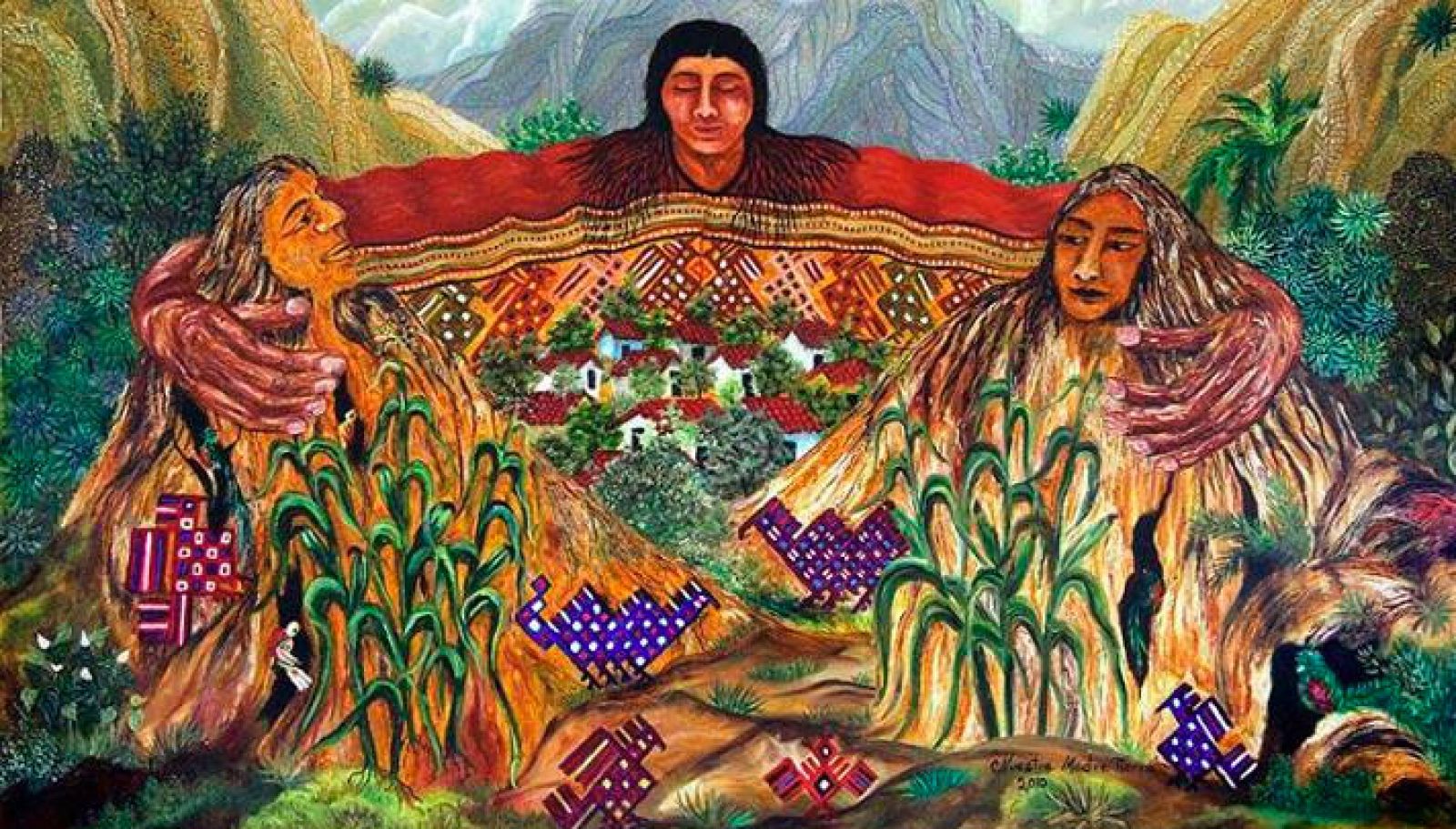
The concept of Vivir Bien (or Buen Vivir) gained international attention in the late twentieth century as people searched for alternatives to the rampage of neoliberalism. Imperfect translations of the Andean concepts of suma qamaña and sumaq kawsay, Vivir Bien and Buen Vivir reflect an indigenous cosmovision that emphasizes living in harmony with nature and one another. As these ideas’ popularity has grown, however, their meaning has been compromised. Governments in Bolivia and Ecuador incorporated Vivir Bien and Buen Vivir, respectively, into their constitutions and governing agendas on paper, but not in spirit. Rather than radical alternatives to the dominant paradigm of development and progress, these concepts have become new branding for (un)sustainable development. The lessons are clear: to avoid state cooptation, truly revolutionary change must be based on emancipation and self-determination from below. And to succeed in our interdependent world, proponents of Vivir Bien must link up with advocates of complementary global movements on the path of a better future for all.
Andean Renaissance
Three decades ago, few South Americans spoke of Vivir Bien (hereafter VB). They may have heard of suma qamaña and sumaq kawsay, concepts rooted in the systems of knowledge, practice, and organization of the native peoples of the Andes.1 VB is an incomplete and insufficient translation of this ethos, which has a more complex set of meanings, such as “plentiful life,” “sweet life,” “harmonious life,” “sublime life,” “inclusive life,” or “to know how to live.”
The formulation and embrace of VB emerged in the late twentieth and early twenty-first century. This might not have happened without the devastating impact of neoliberalism and the Washington Consensus. The relentless privatization and commodification of nature, along with the failure of Soviet socialism and lack of alternative paradigms, inspired a return to indigenous visions and practices.
The new concept of VB had not fully matured when the arrival of the governments of Evo Morales in Bolivia (2006) and Rafael Correa in Ecuador (2007) began a new phase. Vivir Bien, and the equivalent term Buen Vivir in Ecuador, were written into the new constitutions of each country, thereby becoming the basis for various normative and institutional reforms. The terms became central to the official discourse, and were incorporated into the national development plans of both countries.
The constitutional triumph of VB contributed to a growing interest in related alternative visions like Thomas Berry’s “Earth Jurisprudence.” VB also stimulated new ideas such as the rights of Mother Earth and the rights of nature not acknowledged originally in VB. At the same time, scholars and activists advancing other systemic perspectives, including degrowth, the commons, and ecosocialism, began finding a source of inspiration in VB.
However, high hopes soon gave way to profound disputes, especially over implementation. Is the essence of VB really being applied? Are we moving toward this goal, or have we lost our way? VB stands as a powerful yet contested framework for reconceptualizing the good society. To clarify its promise and its limits, this essay explores three areas: first, the cultural vision and practices that inspired and underlay VB; second, a critique of its implementation thus far; and third, its potential contribution to the broader challenge of nurturing the systemic alternatives urgently needed.
Core Elements
There is no decalogue of VB; rather, it is a broad, evolving framework. Any attempt to define it in absolute terms would thus stifle its dynamism. Still, we can locate various interpretations within an overarching cosmovision.
The Whole and the Pacha
The point of departure of any systemic alternative is its comprehension of the whole. For VB, the whole is the Pacha. This Andean concept has often been translated simply as Earth (hence we speak of Pachamama as Mother Earth). However, its meaning is much broader and deeper, including the indissoluble unity of space and time. Pacha is the whole in constant movement; it is the cosmos in a permanent state of becoming.
In this cosmovision, past, present, and future coexist and interrelate dynamically, reminiscent of Einstein’s well-known comment: “The distinction between the past, present and future is only a stubbornly persistent illusion.” VB understands time and space as cyclical rather than linear, a vision incompatible with mainstream notions of growth and progress. Time moves as a spiral; with any advance, comes a return, and any return brings an advance. This vision questions the very essence of the notion of “development,” of always advancing toward a higher point, always searching to do better. Such ascendant becoming is a fiction for VB, in which motion involves turns and change, and re-encounters of past, present, and future.
VB is Pachacentric, rather than anthropocentric. In the Pacha, there is no dichotomy between living beings and inert bodies—all have life, and all life is understood as the relation between all parts of the whole. In particular, there is no separation between human beings and nature. All are part of nature, and the Pacha as an entirety has life.
Coexisting in Multipolarity
The VB vision apprehends duality everywhere, since everything comes in contradictory pairs. Pure good or bad does not exist; good and bad always coexist. Everything is and is not. The individual and the community are two poles of the same unit. Without community, there is no individual, and without singular beings, there is no community.
This bipolarity—indeed, multipolarity—of partners is universal, with the individual-community polarity immersed in the humanity-nature polarity. Thus, the community becomes a community of both humans and non-humans. To pursue VB is to learn to live together in this complex interplay of being. The challenge is not “to be” but “to learn to interrelate” with the other contradictory parts of the whole. Existence becomes not a static state but a relational concept of becoming.
In the Andean communities, individual private property and communal property coexist. Naturally, differences and tensions surface between members of a community. To manage those tensions, various cultural practices promote some kind of redistributive resolution. For example, the wealthiest may pay for the fiesta of the entire community or other acts or services that benefit everyone. The worst punishment is to be expelled from the community because then you lose your membership, your essence, your identity.
VB is not egalitarian; perfect equality is an illusion because inequalities and differences always exist. The key is to coexist with them, to prevent inequalities and differences from becoming so acute and polarizing that they destabilize the whole. The fundamental call is to learn, or relearn, to live in community, respecting the multipolarity that is the whole.
Dynamic Equilibrium
VB seeks equilibrium among the various elements that make up the whole—a harmony among human beings and also between humanity and nature, between the material and the spiritual, between knowledge and wisdom, between diverse cultures, and between different identities and realities. This is not merely a version of development that is less anthropocentric and more democratic, holistic, or humanizing, for VB does not embrace the conventional Western equation of development with progress and permanent growth.
In a related vein, the equilibrium pursued by VB is itself not permanent. Any apparent equilibrium of a given moment will generate contradictions and disparities that call for new actions to find a new balance. That is the principal source of cyclical movement through space-time. The pursuit of harmony between human beings and with Mother Earth is not the search for an idyllic state but the ongoing raison d’être of the whole.
Equilibrium is always dynamic. Only by understanding the whole in its multiple components and in its becoming can we contribute to the search for a new equilibrium, the quest for harmonious coexistence. The role of humans is to act as a bridge, an intermediary within the whole connecting elements seeking equilibrium with nature, cultivating with wisdom what nature has given us. In this view, human beings are not “producers,” “conquerors,” or “transformers” of nature, but “caretakers,” “cultivators,” and “mediators.”
Complementarity
In complementarity lies the key to achieving equilibrium by balancing the opposites that together comprise a whole. The aim is not to cancel the other, but to augment each other in a new synthesis, seeking ways to complement and complete the totality of the different parts, even those that are antagonistic. Differences and particularities are part of nature and life. We shall never all be the same and equal. What we must do is respect diversity and find ways to articulate experience, share knowledge, and understand ecosystems.
From the perspective of complementarity, competition is negative because some win and others lose, unbalancing the totality. Complementarity seeks to optimize by combining strengths with the conviction that the more we work together, the greater the resilience of each and all. Complementarity, rather than implying neutrality between opposites, recognizes the possibilities diversity provides for balancing and integrating the contradictions of the whole.
Thus, VB is the encounter of diversity. “Knowing how to live” is to practice pluriculturalism that strives to recognize and learn from difference without arrogance or prejudice. Accepting diversity means that there are other valid Buen Vivires in addition to the Andean version. Those Buen Vivires survive in the wisdom, knowledge, and practices of peoples pursuing their own identities. Rather than a utopian regression to an idealized past, these perspectives look forward, knowing that throughout history there have been, there are, and there will be many forms of cultural, economic, and social organization that, to the extent they complement one another, can help overcome the systemic crisis humanity now faces.
Decolonization
VB envisions a continual struggle for decolonization. The Spanish conquest 500 years ago initiated a new cycle that did not end with the independence of the republics in the nineteenth century. Rather, that cycle continues under post-colonial forms and structures of domination.
The process of decolonizing entails change beyond formal autonomy to dismantling inherited political, economic, social, cultural, and mental systems that continue to rule us. Decolonization is a long-term historical process, not a single occurrence. We can achieve independence from a foreign power and still be economically dependent on it. We can secure a certain economic sovereignty, yet still be culturally subjugated. We can fully acknowledge our cultural identity in a new constitution, yet remain prisoners of Western consumerist values.
This is perhaps the most difficult part of the decolonization process: liberating our minds and souls, which have been captured by false and alien concepts. Building VB means decolonizing both our territories and our being. The decolonization of territory means self-management and self-determination at all levels. Decolonization of being is even more complex and includes overcoming many modes, beliefs, and values that impede our re-engagement with the Pacha. The first step is to see with our own eyes, think our own thoughts, and dream our own dreams. This journey begins by encountering our roots, our identity, our history, and our dignity. To decolonize is to reclaim our life, to recover the horizon.
Cooptation
Institutionalizing and formalizing a cosmovision inevitably leads to its dismemberment. Some aspects will be featured, others left aside. Some meanings will stand while others are lost. In the end, a mutilated corpus remains that may reach a wider audience but in incomplete form.
Such a distortion happened to VB under the governments of Evo Morales and Rafael Correa. For the first time, after centuries of exclusion, indigenous peoples’ vision was recognized and incorporated as a core element in the political agendas of both countries. Vivir Bien and Buen Vivir were included, in different wording, in the new constitutions of Bolivia (2008) and Ecuador (2009), respectively. The Ecuadorian version emphasizes a vision of rights whereas the Bolivian version stresses an ethical-moral concept.
Although their incorporation was a noteworthy achievement, Buen Vivir and Vivir Bien coexisted uneasily with the dominant developmentalist and productivist vision. Not surprisingly, along the way, Vivir Bien and Buen Vivir lost much substance. Focusing on Bolivia in this discussion, we can say that rather than transforming society along the lines of VB, the government has pursued a populist extractivist model, relying heavily on the drawdown of nonrenewable natural resources, under conditions of increasing authoritarianism.
By standard economic metrics, Bolivia’s story is one of success: GDP has grown, extreme poverty has been reduced, and public investment has increased. Such investment, along with new social programs and conditional cash transfers, has reduced income inequality. Quality of life has improved for various sectors of the population, which accounts for the popular support still enjoyed by the government.
Even so, Bolivia is not on the road to VB. The key measures of progress for that goal are not GDP, the Gini index, World Bank poverty indicators, or other such statistics. What matters most is whether urban and rural communities, social movements and social organizations, are getting stronger; becoming more self-organized, creative, and resilient; embracing greater solidarity; practicing complementarity; and contributing to the restoration of nature. On these criteria, Bolivia has lagged.
Bolivia’s economic boom depended on extraction. Increased state control over natural gas resources, combined with a commodities boom benefiting Bolivian raw materials, led to an eightfold growth in revenue for the government from 2005 to 2013, enabling an increase in public investment and expansion of basic services.2 Today, though, this model is in crisis: prices of hydrocarbons and raw materials have fallen, and the country faces plummeting exports and international reserves, along with ballooning foreign debt.3
Just as extractive industries have thrived, so, too, has agribusiness. Bolivia’s 2010 Law on the Rights of Mother Earth, which gives rights to—and protects the integrity of—nature, exists only on paper. GMOs have taken over soy production (from 21% of total exports in 2005 to 92% in 2012), with corn production following suit.4 National parks and protected areas are under threat by roads and mega-dams. Deforestation, once in decline, is on the rise, and the government is encouraging the expansion of agribusiness at the expense of forests.
While flush with revenue, Bolivia was able to ignore the need for economic diversification. As a result, the present economy is even more dependent on primary resource extraction than in the boom years. The government’s prospective plans through 2025 call for more exploitation of hydrocarbons, new mega-dams for electricity export, and the expansion of agribusiness with concomitant loss of forests. All of these strategies carry major environmental impacts and problematic economic implications.
The government has an opportunity to abjure the replication of this “old modernity” that lingers on from the twentieth century. Rather than continuing to focus on state corporations, it can, and should, follow a better model that incorporates the most recent technological advances within a communitarian and social perspective. For example, the future of energy lies in renewables, not fossil fuel extraction. The development of community, municipal, and residential solar and wind energy can transform Bolivians from mere consumers into producers of electricity, while shifting electricity generation to renewables from its current 70% reliance on natural gas. And the future of agriculture lies in agroecology, agroforestry, and the strengthening of food sovereignty based on the indigenous and peasant communities, not the expansion of agribusiness.
Last but not least, severe inequality will persist as long as countries adhere to extractivism. Such inequality cannot be overcome by conditional cash transfers alone. Redistribution cannot be limited to the reassignment of the fraction of revenue that is not appropriated by the economically powerful sectors. The search for equality cannot be reduced to welfare programs while big landlords, extractive enterprises, and banks continue to accumulate big profits.5 Structural inequities demand structural shifts in institutions, not just salves for the most egregious human impacts of a highly skewed society.
Beyond Statism and Extractivism
In Bolivia, a huge chasm has opened between discourse and reality, law and practice. The rights of Mother Earth during the last decade have never prevailed over the interests of extraction, pollution, and depredation of nature. Enforcing the rights of Mother Earth requires autonomous mechanisms and regulations to reduce and punish the constant violations against ecosystems, and above all to promote the restoration and recovery of previously degraded areas. The government, however, has shown no desire to limit its extractivist projects.
The fundamental role of the state should be to empower and help coordinate local networks of production, exchange, credit, traditional knowledge, and innovation. This contrasts sharply with Bolivia’s predominant statist vision, as articulated by the vice president: “The State is the only actor that can unite society. It is the State that takes on the synthesis of the general will, plans the strategic framework and steers the front carriage of the economic locomotive.”6 Such a vision is antithetical to VB.
Although the hardcore neoliberal right has lost power, democracy remains thin, with the parliament routinely rubber-stamping presidential decisions. We need real democracy to advance the self-management, self-determination, and empowerment of communities and social organizations. A more popular and decentralized democracy, the only way to identify and correct mistakes made as we build a new eco-society, is thus essential to VB.
When the central government makes public participation a mere formal exercise, coopts social organizations, and tightly controls power, it cripples the development of such a real democracy. But it does not have to be this way. Rather than engaging in clientelism, the state can empower communities and social organizations. How? By encouraging them to analyze, debate, question, and develop public policies, and in many cases carry them out, without waiting for a green light from the state.
The concepts of suma qamaña and sumak qawsay survived for centuries in struggle against the Inca state, the colonial state, the republican state, and the neoliberal state. These were weighty communitarian visions and practices, albeit unrecognized by the established powers in each of those epochs. The “statizing” of VB undermined its force for fostering self-management and questioning the status quo.
Often, the Marxist left’s goal is to take state power in order to change society from above. However, the Bolivian experience over the last decade demonstrates that for VB, the goal of taking power should be to encourage emancipation and self-determination from below, questioning and subverting the colonial structures that persist or arise even in the new “revolutionary” state. Any political movement that engages with power structures in order to transform society stands on shifting sands. Negative impacts and side effects, such as the temptations of privilege and corruption, pragmatic alliances and compromises, and the mirage of permanence in power are inevitable.
The best way to avoid being captured by the logic of power is to empower autonomous counter-powers, not as passive state clients, but as entities truly capable of counterbalancing the conservative and reactionary forces that remain, as well as those that develop within the new structures of power. Above all, the vitality of the transformation process depends on encouraging the idea and practice of the commons throughout society and between society and nature.
Systemic Alternatives
The experience of the past decade demonstrates that it is not possible to enact VB in a single country. The interdependence of the global economy exerts significant pressure on countries to align with the predominant capitalist, productivist, extractivist, patriarchal, and anthropocentric paradigm. The future of Vivir Bien therefore depends on the recovery, reconstruction, and empowerment of other visions worldwide that point toward the same broad objectives. Our success is tied to the success of parallel “great transitions” in other places and at the global level, which requires interaction and complementarity with other systemic alternative perspectives.
In order to flourish, BV and parallel alternatives elsewhere must expand beyond the national borders of their origins into the countries that now colonize the planet in different ways. Without dissemination to the centers of global power, they risk isolating themselves and losing vitality, ultimately repudiating the very principles and values that once animated them.
Seeking complementarity among VB, ecosocialism, the commons, degrowth, ecofeminism, and other aligned approaches will enrich them all.7 Rather than developing a single vision, the goal is intertwining diverse approaches in the search for holistic answers. Ultimately, all visions and approaches for a Great Transition have strengths and weaknesses. VB, for example, does not adequately address the issues of patriarchy, capitalism, globalization, or state power. Its core elements like totality, complementarity, multipolarity, dynamic equilibrium, and decolonization are essential, but not enough by themselves to transform the current system.
Mutually reinforcing systems—capitalism, productivism, extractivism, plutocracy, patriarchy, and anthropocentrism—are deepening the crisis of the Earth community. Their logics operate at all levels, from politics to personal relationships, from institutions to ethics, from historic memory to visions of the future. To think that we can resolve one without dealing with the others would be a fatal mistake.
We cannot overcome capitalism if we do not address the productivism that is deeply rooted in the extractivism of nature and in the reproduction of the plutocratic and patriarchal structures of power. Equally, it is impossible to recover the balance of the Earth system without getting out of the logic of capital that commodifies everything, perversely finding new business opportunities in the crisis. This understanding is one of the key contributions of ecosocialism.
The contemporary systemic crisis endangers the multiple ecosystems that have made possible diverse lifeforms, including the human species. The climatic stability that has allowed the rise of settled agriculture and numerous civilizations is now at risk. Many forms of life will disappear—a sixth major extinction—if the balance of the atmosphere, oceans, soil, and solar radiation continues to be compromised.
This challenge cannot be met by exchanging a capitalism of large private owners for a state capitalism under the name of “socialism.” A century of experience has made clear that an ecological and emancipatory alternative to the free market cannot have all spheres of life under control by the state. Redistribution and sustainability, to be effective, have to involve actors outside the market and the state. This is the great contribution of the notion of the commons, with its stress not just on the common good, but on self-organized and self-managed commoners who create that good.
It is worth repeating that the logic of capital does not act alone. It is nurtured and undergirded by anthropocentrism, patriarchy, wealth concentration, plutocracy, and a consumerist culture that valorizes competition and individualism. The expropriation and socialization of capital by the state does not in itself alter the productivist and extractivist essence of capital—it can even reinforce and aggravate it. The logic of capital can continue to govern even when the state has nationalized large-scale enterprises.
Extractivism can never be sustainable, and humanity has no future unless we stop plundering nature. It is not enough to socialize enterprises without transforming them based on respect for the vital cycles of nature and social well-being. Since unlimited growth of productive forces on a finite planet is impossible, we must finally abandon the growth imperative of capitalism. Degrowth offers a way to envision a future without economic growth based on a more human and natural scale.
Overcoming capitalism requires a new vision of modernity. If the objective of “development” remains for all to live and consume like the upper middle class, we will never survive let alone supersede the logic of capital and unlimited growth. Satisfying basic needs without increasing consumerism will take a self-organized and self-managed society. Letting the state lead from above while those below simply follow breeds authoritarianism and societal tension. Of course, the state can and should regulate where appropriate, but only in support of a society that increasingly manages the sources of life in a frugal way. Ultimately, the key to social transformation lies with the capacity of commoners to build a different modernity with balance, moderation, and simplicity at its center.
A true global change will rest with change at the personal, family, and community levels. Ecofeminism illuminates the need for complementarity between change in the public and private spheres. A sustainable transformation must be anchored in revolutionizing human relations in the most intimate nuclei of peoples’ lives. But the dismantling of patriarchal structures is difficult because their reproduction is insidiously invisible in the family, the union, the community, the political party, the school, and the government.
Capitalism has exacerbated this dynamic, but did not create it: patriarchy infused almost all precapitalist societies. Hence, the overthrow of capitalism will not itself lead to the overthrow of patriarchy. The experiences of state capitalism show that patriarchal social arrangements and values can survive long after the nationalization or expropriation of private capital. And the original conception of Vivir Bien did not confront patriarchy, although its vision of equilibrium between humanity and nature requires doing so.
Like the system of world capitalism it challenges, the dynamic process of constructing alternatives is constantly evolving. Correspondingly, searching for complementarity and synergy among VB, ecosocialism, the commons, degrowth, ecofeminism, and other proposals yields multiple and diverse interactions. Although not easy, nurturing a bold, synergistic approach is the only way to overcome the mistakes of fragmentation and the forces of cooptation in advancing a Great Transition.
Endnotes
1. “Vivir Bien,” the term commonly used in Bolivia, is referred to as “Buen Vivir” in Ecuador. Similar visions to suma qamaña and sumaq kawsay are found among other indigenous people of Latin America, such as Teko Kavi and Ñandereko of the Guaraní, Shiir Waras of the Shuar, and Küme Mongen of the Mapuche.
2. Rather than nationalize foreign companies, Bolivia renegotiated the distribution of profits. The share of total profits for transnational companies declined from 43% in 2005 to only 22% in 2013. See Carlos Arce Vargas, Una década de gobierno ¿Construyendo el Vivir Bien o el capitalismo salvaje? (Amsterdam: Centre for Latin American Research and Documentation, 2016), https://www.cedla.org/sites/default/files/revista_gpfd_17_una_decada_de_gobierno_carze_opt_0.pdf
3. Bolivian total exports reached 13 billion USD in 2014 then fell to 7.2 billion USD in 2016. International reserves decreased from 15 billion USD in 2014 to 10 billion USD in 2017. Foreign debt increased from 2.7 billion USD in 2007 to 7.2 billion USD in 2016.
4. Manuel Morales Alvarez, “El gobierno de Evo Morales y los Transgénicos,” Patria Insurgente Sol Para Bolivia, April 4, 2012, http://patriainsurgente.nuevaradio.org/?p=466.
5. Transnational and national oligarchies continue to benefit from the extractivist-populist model in Bolivia. The profits of the banking system rose from 80 million USD in 2006 to 283 million USD in 2014, while two transnational companies, Petrobras and Repsol, handle 75% of the natural gas production. The Minister of Finance encouraged investment in Bolivia by noting that the profits of private enterprises more than quadrupled from 2005 to 2013. See Marco Belmonte, “Arce estima que las empresas ganaron $us 4.111 millones,” Página Siete, November 22, 2013, http://www.paginasiete.bo/economia/2013/11/22/arce-estima-empresas-ganaron-4111-millones-6662.html.
6. Álvaro García Linera, “Fue un error no liderar el pedido autonómico,” El Deber, January 21, 2007, cited in Eric Toussaint, “¿Un capitalismo andino-amazónico?” Rebelión, October 23, 2009, http://www.rebelion.org/noticia.php?id=93828. .
7. I expand on this theme in my 2017 book Systemic Alternatives: https://systemicalternatives.org/category/english.
2. Rather than nationalize foreign companies, Bolivia renegotiated the distribution of profits. The share of total profits for transnational companies declined from 43% in 2005 to only 22% in 2013. See Carlos Arce Vargas, Una década de gobierno ¿Construyendo el Vivir Bien o el capitalismo salvaje? (Amsterdam: Centre for Latin American Research and Documentation, 2016), https://www.cedla.org/sites/default/files/revista_gpfd_17_una_decada_de_gobierno_carze_opt_0.pdf
3. Bolivian total exports reached 13 billion USD in 2014 then fell to 7.2 billion USD in 2016. International reserves decreased from 15 billion USD in 2014 to 10 billion USD in 2017. Foreign debt increased from 2.7 billion USD in 2007 to 7.2 billion USD in 2016.
4. Manuel Morales Alvarez, “El gobierno de Evo Morales y los Transgénicos,” Patria Insurgente Sol Para Bolivia, April 4, 2012, http://patriainsurgente.nuevaradio.org/?p=466.
5. Transnational and national oligarchies continue to benefit from the extractivist-populist model in Bolivia. The profits of the banking system rose from 80 million USD in 2006 to 283 million USD in 2014, while two transnational companies, Petrobras and Repsol, handle 75% of the natural gas production. The Minister of Finance encouraged investment in Bolivia by noting that the profits of private enterprises more than quadrupled from 2005 to 2013. See Marco Belmonte, “Arce estima que las empresas ganaron $us 4.111 millones,” Página Siete, November 22, 2013, http://www.paginasiete.bo/economia/2013/11/22/arce-estima-empresas-ganaron-4111-millones-6662.html.
6. Álvaro García Linera, “Fue un error no liderar el pedido autonómico,” El Deber, January 21, 2007, cited in Eric Toussaint, “¿Un capitalismo andino-amazónico?” Rebelión, October 23, 2009, http://www.rebelion.org/noticia.php?id=93828. .
7. I expand on this theme in my 2017 book Systemic Alternatives: https://systemicalternatives.org/category/english.