Showing posts with label Subsidies for fossil fuel. Show all posts

Tuesday, August 8, 2017

2684. Worldwide Fossil Fuel Subsidies are $5 Trillion a Year

By John Abrahams, The Guardian, August 7, 2017

Fossil fuels have two major problems that paint a dim picture for their future energy dominance. These problems are inter-related but still should be discussed separately. First, they cause climate change. We know that we’ve known it for decades, and we know that continued use of fossil fuels will cause enormous worldwide economic and social consequences. 
Second, fossil fuels are expensive. Much of their costs are hidden, however, as subsidies. If people knew how large their subsidies were, there would be a backlash against them from so-called financial conservatives.
A study was just published in the journal World Development that quantifies the amount of subsidies directed toward fossil fuels globally, and the results are shocking. The authors work at the IMF and are well-skilled to quantify the subsidies discussed in the paper.
Let’s give the final numbers and then back up to dig into the details. The subsidies were $4.9 tn in 2013 and they rose to $5.3 tn just two years later. According to the authors, these subsidies are important because first, they promote fossil fuel use which damages the environment. Second, these are fiscally costly. Third, the subsidies discourage investments in energy efficiency and renewable energy that compete with the subsidized fossil fuels. Finally, subsidies are very inefficient means to support low-income households.
With these truths made plain, why haven’t subsidies been eliminated? The answer to that is a bit complicated. Part of the answer to this question is that people do not fully appreciate the costs of fossil fuels to the rest of us. Often we think of them as all gain with no pain.
So what is a subsidy anyway? Well, that too isn’t black and white. Typically, people on the street think of a subsidy as a direct financial cost that result in consumers paying a price that is below the opportunity cost of the product (fossil fuel in this case). However, as pointed out by the authors, a more correct view of the costs would encompass:

not only supply costs but also (most importantly) environmental costs like global warming and deaths from air pollution and taxes applied to consumer goods in general. 
The authors argue, persuasively, that this broader view of subsidies is the correct view because they “reflect the gap between consumer prices and economically efficient prices.”
Without getting too deep into the weeds, the authors discuss both consumer subsidies (when the price paid by a consumer is below a benchmark price) and producer subsidies (when producers receive direct or indirect support which increases their profitability). The authors then quantify what benefits would be achieved if the fossil fuel subsidies were reformed.
Interested readers are directed to the paper for further details, but the results are what surprised me. Pre-tax (the narrow view of subsidies) subsidies amount to 0.7% of global GDP in 2011 and 2013. But the more appropriate definition of subsidies is much larger (8 times larger than the pre-tax subsidies). We are talking enormous values of 5.8% of global GDP in 2011, rising to 6.5% in 2013. 
The authors also broke the results down by fossil fuel type and usage (coal, petroleum, natural gas, electricity). It is not clear to me how the authors separated the various fuel sources out of electrical generation; however, the results show that petroleum and coal receive much larger subsidies compared to their counterpart fuels. The authors organized results by geographical region and found that the top three subsidizers of fossil fuels are China, USA, and Russia, respectively. The European Union is a bit less than half of the entire US subsidy. Other notable countries and regions are discussed.
There are two key takeaway messages. First, fossil fuel subsidies are enormous and they are costs that we all pay, in one form or another. Second, the subsidies persist in part because we don’t fully appreciate their size. These two facts, taken together, further strengthen the case to be made for clean and renewable energy. Clean energy sources do not suffer from the environmental costs that plague fossil fuels.
I asked one of the authors, Dr. Coady, why their work is important. He told me: 

A key motivation for the paper was to increase awareness among policy makers and the public of the large subsidies that arise from pricing fossil fuels below their true social costs—this broader definition of subsidies accounts for the many negative side effects associated with the consumption of these fuels. By estimating these costs on a global scale, we hope to stimulate an informed policy debate and provide renewed impetus for policy reforms to reap the large potential benefits from more efficient pricing of fossil fuels in terms of improved public finances, improved population health and lower carbon emissions.
As a climate scientist, I focus almost exclusively on the scientific questions related to climate change. But equally important are the economic issues that, when dealt with, will usher in a new era of energy.

Monday, August 10, 2015

1974. G20 Countries Pay Over $1,000 Per Citizen in Fossil Fuel Subsidies, Says IMF

By Damian Carrington, The Guardian, August 6, 2015
Source: The Guardian, May 18, 2015

Subsidies for fossil fuels amount to $1,000 (£640) a year for every citizen living in the G20 group of the world’s leading economies, despite the group’s pledge in 2009 to phase out support for coal, oil and gas.

New figures from the International Monetary Fund (IMF) show that the US, which hosted the G20 summit in 2009, gives $700bn a year in fossil fuel subsidies, equivalent to $2,180 for every American. President Barack Obama backed the phase out but has since overseen a steep rise in federal fossil fuel subsidies.

Australia hosted the most recent G20 summit, where prime minister Tony Abbott was forced to reaffirm the commitment to the phase out, but it still gives $1,260 per head in fossil fuel subsidies.

The UK, which is cutting renewable energy subsidies, permits $41bn a year in fossil fuel subsidies, which is $635 per person. In contrast, Mexico, India and Indonesia, where per capita subsidies average $250, have begun cutting fossil fuel support.

The vast fossil fuel subsidies estimated by the IMF for 2015 include payments, tax breaks and cut-price fuel. But the largest part is the costs left unpaid by polluters and picked up by governments, including the heavy impacts of local air pollution and the floods, droughts and storms being driven by climate change.

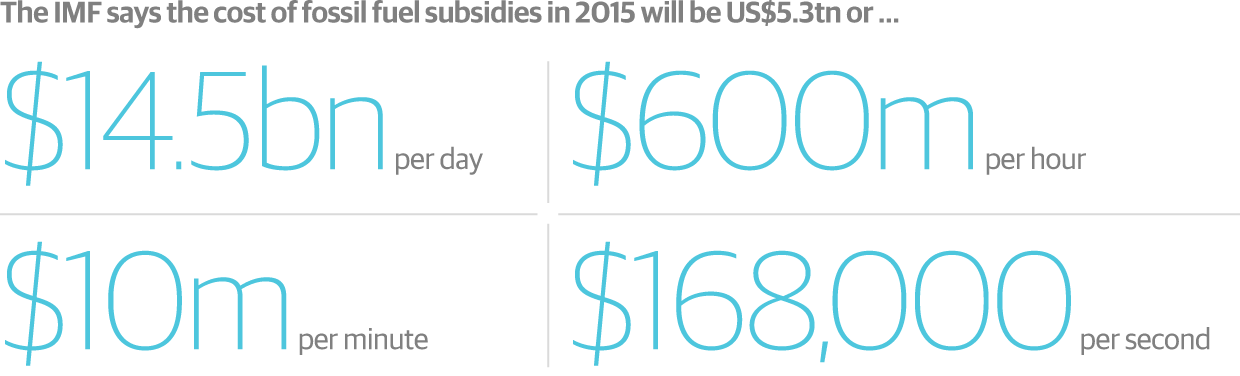
The IMF, which published a global estimate – $5.3tn a year – of fossil fuel subsidies in May, calculates that ending fossil fuel subsidies would slash global carbon emissions by 20%, a huge step towards taming global warming.

Ending the subsidies would also prevent 1.6m premature deaths from outdoor air pollution, a 50% cut. The money freed by ending fossil fuel subsidies could be an economic “game-changer” for many countries, says the IMF, by driving economic growth and poverty reduction.

“The [new] figures reveal the true extent to which individual countries are subsidising pollution from fossil fuels,” said Lord Nicholas Stern, an eminent economist at the London School of Economics. “The failure to reflect the real costs of fossil fuels in prices and policies means that the lives and livelihoods of billions of people around the world are being threatened by climate change and local air pollution.”

“In particular, these figures reveal that the G20 countries are wasting trillions of dollars each year on subsidies for fossil fuel pollution,” Stern said. “It is time for the G20 to recognise that the extent of subsidies is far greater than has been previously understood, and to honour their commitment.”

Stern criticised the UK government’s recent attacks on renewable energy subsidies: “The government should remember that if it wants to cut the subsidies for low-carbon energy, it should cut the subsidies for fossil fuel pollution that are at the core of the problem for which clean technology is the sensible and attractive solution.”


Fossil fuel subsidies

635
684
845
1,240
1,259
1,283
1,441
1,652
2,177
2,334
3,395
Germany
South Africa
Japan
Australia
Canada
South Korea
China
US
Russia
Saudi Arabia
Subsidies paid by G20 countries, US$ per capita 

n July, Stern estimated that tackling climate change would require investment of 2% of global GDP each year. The IMF work indicates that ending fossil fuel subsidies would benefit governments by the equivalent to 3.8% of global GDP a year.

Christiana Figueres, the UN’s climate change chief charged with delivering a deal to beat global warming at a crunch summit in December, said: “The IMF data reveal a simple and stunning truth: that fossil fuel subsidy reform alone would deliver far more funds than is required for the global energy transformation we need to keep the world below a 2C temperature rise [the level governments have promised to hold them to].”

In April, the president of the World Bank, Jim Yong Kim, told the Guardian that it was crazy that governments were still driving the use of coal, oil and gas by providing subsidies. He said they should be scrapped immediately as poorer nations were feeling “the boot of climate change on their neck”.

The new IMF data show that national fossil fuel subsidies are significant – about the same as defence spending – when compared to national GDP in the US (3.8%), Australia (2.0%) and UK (1.4%). In nations with severe air pollution problems, the subsidies are an even higher as a proportion of GDP, such as China (20%), India (12%) and Ukraine (60%).

The countries with the highest fossil fuel subsidies per person are the middle eastern oil states, with subsidies in Qatar amounting to $6,000 a year and those in Saudi Arabia $3,400. The UAE gives $3,000 a head, but announced on 22 July it was ending its $7bn-a-year petroleum subsidies.

Fossil fuel subsidy reforms are beginning in dozens of countries, including India where subsidies for diesel ended in October 2014.

“You could look at the glass as half empty or half full,” said Ian Parry, the IMF’s lead green taxes expert. “There are some encouraging signs, such as reforms in Mexico, India and Indonesia, and 40 countries now have some form of carbon pricing, albeit typically at a too low level. On the other hand, these schemes cover only 12% of global carbon emissions, so we are an awful long way from where we need to be. We are at base camp.”

Parry defended the inclusion of the costs of air pollution and climate change impacts in the IMF’s subsidy estimates: “We think that energy prices need to cover both the production and environmental costs. This is largely in countries’ own interest, as many of the environmental costs, like air pollution, are local.” Lord Stern said the IMF had actually underestimated the costs of global warming.

Fossil fuel subsidies can benefit some of the poorest in the world, but Parry said: “There are much more efficient ways to address those concerns. Most current benefits, from holding down energy prices, are poorly targeted, with much going to higher income groups.”