Showing posts with label Prehistory. Show all posts

Saturday, October 27, 2018

3059. Recent Find Suggests Neolithic People Demonstrated Advanced Skills

By Live Science, October 27, 2018

This undated photo provided by the Hochbaudepartment Zurich shows a 5,000-year old door that archaeologists in the Swiss city of Zurich have found and may be the oldest ever found in Europe. Photo: AP/Hochbaudepartment Zurich, Handout.
Archaeologists think they've spotted traces of social inequality in a 5,000-year-old village that was buried on the shores of Lake Zurich in Switzerland.
The prehistoric settlement was uncovered during the construction of an underground parking garage near the Parkhaus-Opéra in Zurich.
"When the construction started, we expected only minor archaeological remains if at all, but were suddenly confronted with the largest excavation with waterlogged preservation in the area for 30 years," Niels Bleicher, an archaeologist with the city of Zurich who led the excavation, told Live Science. [Photos: 4,000-Year-Old Artifacts Found in Swiss Alpine Pass]
During the Neolithic period and Bronze Age, people lived in pile dwellings (homes on stilts) along bodies of water in the Alps. Hundreds of these villages have been found across Europe. The waterlogged sites often have ideal conditions for the preservation of organic materials such as wood and textile, which typically don't survive in the archaeological record.
Over the course of nine months in 2010, about 60 workers dug at the site in Zurich, which covered an area nearly the size of two football fields. They found thousands of artifacts, from ceramic pots to wolf-tooth pendants to the wooden remains of walkways and houses that once stood on stilts over the marshy shores of the lake. They also found an astonishingly intact, 5,000-year-old wooden door that may be among the oldest in Europe.
In a new report published Oct. 26 in the journal Antiquity, Bleicher and his co-author describe how this village wasn't exactly a fixed place but something that shifted and moved over time.
"Every eight to 15 years or so, these settlements were abandoned and the house groups reorganized to form new settlements," Bleicher told Live Science. Between 3234 B.C. and 3060 B.C., the groups of houses tended to be arranged in quarters within a settlement.
"These were strictly organized with parallel houses in rows," Bleicher said. And the zones had some significant differences. For example, during one phase of the settlement, a zone the researchers labeled Sector A held the largest houses. Sector B did not contain any bear-fang pendants or high-status axes like the other zones did. Sector A and Sector B were also separated by a fence of thin poplar posts.
"We were very surprised to find that within one settlement, people built a fence to segregate themselves from the adjacent quarter," Bleicher said. "Such ostentatious social segregation is something nobody really expected in the late fourth millennium B.C."
The door was found inside a phase of the settlement that was used between 3176 B.C. and 3153 B.C.; Bleicher said its construction is impressive.
"It is important as a source of information on technical skills of Neolithic people, which are still often seen as some dumb brutes," Bleicher said. "I don't know many people today who could come up with such a wonderful technical solution to make a wooden door without planer, screw and nail or water-resistant glue."

Saturday, August 25, 2018

3004. Early humans Living At Least 500,000 Years Ago Had Anatomically Modern Human-Like Hands

By David Keys, Independent, August 23, 2018
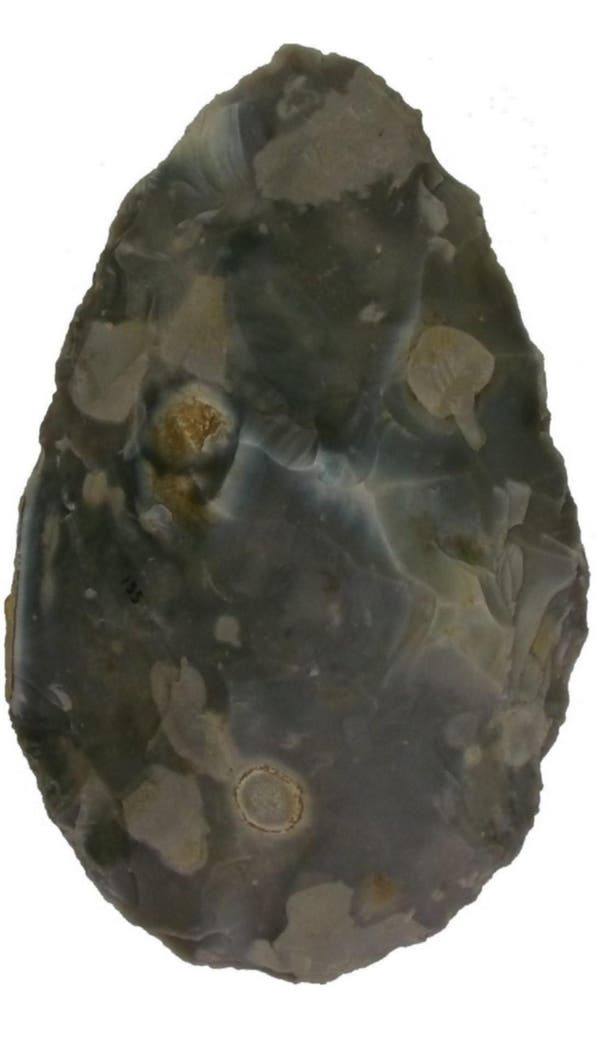
A beautifully crafted flint hand axe made by prehistoric toolmakers at Boxgrove, West Sussex, half a million years ago.

Evidence from a quarry in southern England is shedding extraordinary new light on the evolution of human intelligence.

Arguably, the most important driving force that enabled early humans to evolve into ever more intelligent creatures was the human hand, which gave us the physical ability to make things.

Without that crucial ability, there would never have been the need to imagine and visualise complex objects purely in the mind, or the ability to then invent, manufacture and use them.

Now archaeologists have demonstrated for the first time that a particular type of stone tool used some half a million years ago could not have been made without modern human-like hands.

The study – based on beautifully made prehistoric tools found at Boxgrove in West Sussex – reveals for the first time that early Stone Age humans had modern-style human hands, despite the fact that they belonged to a human species ancestral to our own but which became extinct more than 300,000 years ago.

Research in the UK and the US supports the concept that early human intellectual ability was largely developed in tandem with, and to a considerable extent courtesy of, hand evolution – and that eventually we (Homo sapiens) inherited our super-dextrous hands from prehistoric humans, which existed before the Neanderthals.

The specific stone tools which were analysed as part of the study were sophisticated flint hand axes, which had required a special technique to shape them.

The technique is known to prehistorians as ‘platform preparation’. In most very early stone tools, the manufacturing process is a simple single-stage affair in which the toolmaker merely hits a lump of flint with a stone repeatedly to systematically knock bits off it until the lump has been reduced to a desired shape.

However, more sophisticated toolmakers employed a two-stage approach. First they would successively "soften up" small portions of the flint’s surface, so as to then be able to more accurately remove flakes from it, thus creating a much more sophisticated and effective tool with a better and more refined cutting edge.

By attaching electronic sensors to the hands of skilled modern flint knappers, archaeologists from the University of Kent were able to demonstrate that "platform preparation" – and thus more sophisticated stone tools – was only achievable by prehistoric people equipped with anatomically modern human-like hands.

The study, led by Dr Alastair Key of the university’s School of Anthropology and Conservation, and funded by the British Academy, investigated how hands were used during the production of different types of early stone tools.

The research demonstrates that the Boxgrove early humans probably had significantly stronger grips compared to earlier populations.

It reveals that by 500,000 BC, humans had the physical capability needed to make sophisticated hand axes.

This in turn implies that they were also theoretically able to make a large range of other artefacts that required strong, dextrous hands – things made out of wood, antler and bone, as well as stone.

“Our experimental research not only suggests that early humans at least 500,000 years ago had anatomically modern human-like hands, but, when combined with other recent research, can also help us understand the way in which the human hand, brain and other anatomical elements co-evolved,” said Dr Key.

Although the fact that sophisticated tool manufacture could only be done with modern-human-like hands was demonstrated by the Boxgrove research, another set of similarly sophisticated tools have recently been found in South Africa (also dating from around 500,000 years ago) – and there are indications that "platform preparation" (the crucial diagnostic sophisticated technique) was being used for stone tool manufacture in Ethiopia as early as 850,000 years ago.

So the Boxgrove, the South African and the Ethiopian evidence now helps demonstrate quite clearly that humanity developed its manual dexterity, its intelligence and its manufacturing ability as part of a long interactive process across at least two and probably three continents.

Early (and indeed modern) humans were (and still are) not physically the strongest or even the fastest animals around. So, in order to survive, they had to evolve ways of administering physical force through their hands in ever more efficient ways. They needed to do that in order to hunt and gather more efficiently, in order to butcher prey more efficiently and in order to defend themselves against other animals (including other humans).

Over thousands of generations, the need to apply physical force more efficiently drove changes, through natural selection, in the shape and design of their hands.

Ultimately the process resulted in hands that could make sophisticated tools, weapons and other artefacts – and, in time, that physical ability to make things in turn allowed and drove additional evolutionary changes in their brains to enable them to even more effectively envisage and invent the ever more sophisticated items they needed to help them survive and flourish. The rest was history, as they say.

Just how intellectually able they had become by 500,000BC has been revealed by a recent experiment at Emory University in Atlanta, Georgia. Using the Boxgrove hand-axes as exemplars, 20 students and others were tasked with learning the tool-making skills to replicate them. It took, on average, 200-250 hours for each modern novice toolmaker to learn how to do it.