By Clifford Krause and Diane Cardwell, The New York Times, Janaury 25, 2016
 |
| International Enery Agency predicts the world drowning in oil. |
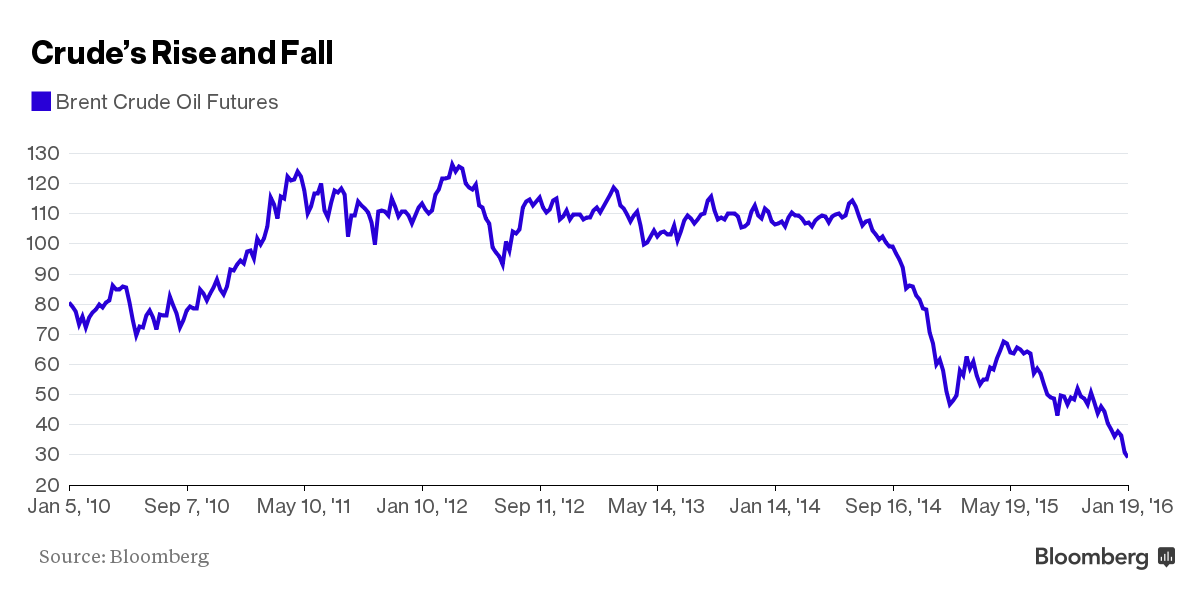
Barely a month after world leaders signed a sweeping agreement to reduce carbon emissions, the global commitment to renewable energy sources faces its first big test as the price of oil collapses.
Buoyed by low gas prices, Americans are largely eschewing electric cars in favor of lower-mileage trucks and sport utility vehicles. Yet the Obama administration has shown no signs of backing off its requirement that automakers nearly double the fuel economy of their vehicles by 2025.
In China, government officials are also taking steps to ensure that the recent plunge in oil prices to under $30 a barrel does not undermine its programs to improve energy efficiency. Earlier this month, the country’s top economic planning agency introduced a new regulation, effective immediately, aimed at deterring oil consumption.
For the climate accord to work, governments must resist the lure of cheap fossil fuels in favor of policies that encourage and, in many cases, require the use of zero-carbon energy sources. But those policies can be expensive and politically unpopular, especially as traditional fuels become ever more affordable.
“This will be a litmus test for the governments — whether or not they are serious about what they have done in Paris,” said Fatih Birol, executive director of the International Energy Agency.
So far, there is no sign that the world’s two largest energy consumers — the United States and China — are wavering. With those two countries staying the course, albeit in the early days since the signing, there is optimism among backers of the accord that the momentum is too strong to stop. And despite the recent turmoil in energy markets, renewable industries are prospering.
“The trend toward much greater penetration of low-carbon energy driven by policy and technological advancements is going to continue,” said Jason Bordoff, director of the Center on Global Energy Policy at Columbia University and a former top aide to President Obama. Despite the lower fuel costs, he added, “technological alternatives and policy drivers that are reducing demand for fossil fuels are already really starting to take a bite.”
A few days ago, the Energy Department projected that total renewable power consumed in the United States this year will increase by 9.5 percent, and the longer-term outlook appears bright as costs continue to plummet and after congressional action last December extended federal tax credits for new wind and solar projects.
Utility-scale solar power generation alone is expected to increase by 45 percent by 2017, according to the Energy Department. Administration officials express an ambition to make wind power the source of more than a third of the American electricity supply by 2050.
In China, the world’s biggest greenhouse gas emitter, the government implemented a new rule that no matter how low world crude oil prices may fall, the price of gasoline and diesel will continue to be set as though the world price of oil were still $40 a barrel. The goal is to prevent gasoline and diesel from becoming so cheap that China’s citizens would start consuming it indiscriminately.
China’s heavily state-owned refining industry will also not be allowed to keep the extra profits from buying crude oil cheaply and selling gasoline and diesel as though the crude oil still cost $40 a barrel. Instead, the Chinese government will take the extra refining profit margin and put the money into a special fund for energy conservation and pollution control.
But across the globe, the picture is not entirely rosy for zero-emission technologies.
Several nuclear power plants, which emit virtually no greenhouse gases, have closed in the United States in recent years, and few are under construction in part because of the competition of cheap natural gas.
Low oil prices also jeopardize the development of alternative fuels to replace petroleum in transportation and industry, including the advanced biofuels that once looked so promising. Cheap oil also reduces the price of diesel, the primary competitor of renewables in spreading electricity generation to impoverished rural areas of Africa and Southeast Asia.
And if governments’ support wanes, the alternative fuel industries could take a hit.
In Spain, the development of renewables has slowed to a crawl since the government started weakening support in 2009 because of an economic downturn. In Britain, analysts warn that the wind and solar industries could collapse as the government shifts subsidies away from renewables; two global wind developers recently canceled projects there. And in the United States, when an important tax credit lapsed briefly in 2013, installations of new wind farms all but ceased, falling 92 percent for the year.
“The challenge for governments is to continue appropriate clean energy subsidies even while the fossil fuel industry clamors over low prices,” said Paul Bledsoe, who was a staff member of the White House Climate Change Task Force under former President Bill Clinton.
Many developing countries have taken advantage of the decline in oil prices to cut subsidies on fuel consumption. India, Indonesia and Angola, among others, have taken such action, a move that economists say could conserve millions of barrels of oil from being burned every year in the future.
Saudi Arabia, one of the top energy-consuming nations, this month increased gasoline prices by 50 percent, and natural gas for industry and electrical generation by 67 percent.
Ultimately, supporters of the climate accord say that low oil prices can cut both ways in the march to renewables.
“It’s a double-edged sword,” said Amy Myers Jaffe, executive director for energy and sustainability at the University of California, Davis. She noted that low oil prices were cutting investments in drilling, which meant fewer emissions of methane, a powerful greenhouse gas, at well sites, and “it has clearly not slowed down the switch toward renewable energy.”
But at the same time, Ms. Jaffe said, low gasoline prices make driving more attractive, and in larger vehicles as well.
“It’s crippling for electric cars,” she said, “because the thing that made you think about buying an electric car was it was so painful for you to fill up your car with gasoline that was so expensive.”


