Showing posts with label Peak Oil. Show all posts

Tuesday, May 3, 2016

2307. This Could Be the Death of the Fossil Fuel Industry -- Will the Rest of the Economy Go With It?

By Nafeez Ahmed, Truthout, April 30, 2016
It's not looking good for the global fossil fuel industry. Although the world remains heavily dependent on oil, coal and natural gas -- which today supply around 80 percent of our primary energy needs -- the industry is rapidly crumbling.
This is not merely a temporary blip, but a symptom of a deeper, long-term process related to global capitalism's escalating overconsumption of planetary resources and raw materials.
New scientific research shows that the growing crisis of profitability facing fossil fuel industries is part of an inevitable period of transition to a post-carbon era.
But ongoing denialism has led powerful vested interests to continue clinging blindly to their faith in fossil fuels, with increasingly devastating and unpredictable consequences for the environment.
Bankruptcy Epidemic
In February, the financial services firm Deloitte predicted that over 35 percent of independent oil companies worldwide are likely to declare bankruptcy, potentially followed by a further 30 percent next year -- a total of 65 percent of oil firms around the world. Since early last year, already 50 North American oil and gas producers have filed bankruptcy.
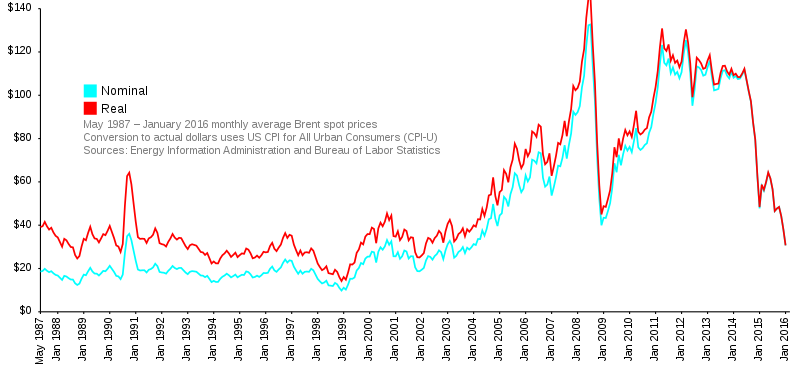
The cause of the crisis is the dramatic drop in oil prices -- down by two-thirds since 2014 -- which are so low that oil companies are finding it difficult to generate enough revenue to cover the high costs of production, while also repaying their loans.
Oil and gas companies most at risk are those with the largest debt burden. And that burden is huge -- as much as $2.5 trillion, according to The Economist. The real figure is probably higher.
At a speech at the London School of Economics in February, Jaime Caruana of the Bank for International Settlements said that outstanding loans and bonds for the oil and gas industry had almost tripled between 2006 and 2014 to a total of $3 trillion.
This massive debt burden, he explained, has put the industry in a double-bind: In order to service the debt, they are continuing to produce more oil for sale, but that only contributes to lower market prices. Decreased oil revenues means less capacity to repay the debt, thus increasing the likelihood of default.
Stranded Assets
This $3 trillion of debt is at risk because it was supposed to generate a 3-to-1 increase in value, but instead -- thanks to the oil price decline -- represents a value of less than half of this.
Worse, according to a Goldman Sachs study quietly published in December last year, as much as $1 trillion of investments in future oil projects around the world are unprofitable, effectively stranded.
Examining 400 of the world's largest new oil and gas fields (except U.S. shale), the Goldman study found that $930 billion worth of projects (more than two-thirds) are unprofitable at Brent crude prices below $70. (Prices are now well below that.)
The collapse of these projects due to unprofitability would result in the loss of oil and gas production equivalent to a colossal 8 percent of current global demand. If that happens, suddenly or otherwise, it would wreck the global economy.
The Goldman analysis was based purely on the internal dynamics of the industry. A further issue is that internationally-recognized climate change risks mean that to avert dangerous global warming, much of the world's remaining fossil fuel resources cannot be burned.
All of this is leading investors to question the wisdom of their investments, given fears that much of the assets that the oil, gas and coal industries use to estimate their own worth could consist of resources that will never ultimately be used.
The Carbon Tracker Initiative, which analyzes carbon investment risks, points out that over the next decade, fossil fuel companies risk wasting up to $2.2 trillion of investments in new projects that could turn out to be "uneconomic" in the face of international climate mitigation policies.
More and more fossil fuel industry shareholders are pressuring energy companies to stop investing in exploration for fear that new projects could become worthless due to climate risks.
"Clean technology and climate policy are already reducing fossil fuel demand," said James Leaton, head of research at Carbon Tracker. "Misreading these trends will destroy shareholder value. Companies need to apply 2C stress tests to their business models now."
In a prescient report published last November, Carbon Tracker identified the energy majors with the greatest exposures -- and thus facing the greatest risks -- from stranded assets: Royal Dutch Shell, Pemex, Exxon Mobil, Peabody Energy, Coal India and Glencore.
At the time, the industry scoffed at such a bold pronouncement. Six months after this report was released -- a week ago -- Peabody went bankrupt. Who's next?
The Carbon Tracker analysis may underestimate the extent of potential losses. A new paper just out in the journal Applied Energy, from a team at Oxford University's Institute for New Economic Thinking, shows that the "stranded assets" concept applies not just to unburnable fossil fuel reserves, but also to a vast global carbon-intensive electricity infrastructure, which could be rendered as defunct as the fossil fuels it burns and supplies to market.
The Coming Debt Spiral
Some analysts believe the hidden trillion-dollar black hole at the heart of the oil industry is set to trigger another global financial crisis, similar in scale to the Dot-Com crash.
Jason Schenker, president and chief economist at Prestige Economics, says: "Oil prices simply aren't going to rise fast enough to keep oil and energy companies from defaulting. Then there is a real contagion risk to financial companies and from there to the rest of the economy."
Schenker has been ranked by Bloomberg News as one of the most accurate financial forecasters in the world since 2010. The US economy, he forecasts, will dip into recession at the end of 2016 or early 2017.
Mark Harrington, an oil industry consultant, goes further. He believes the resulting economic crisis from cascading debt defaults in the industry could make the 2007-8 financial crash look like a cakewalk. "Oil and gas companies borrowed heavily when oil prices were soaring above $70 a barrel," he wrote on CNBC in January.
"But in the past 24 months, they've seen their values and cash flows erode ferociously as oil prices plunge -- and that's made it hard for some to pay back that debt. This could lead to a massive credit crunch like the one we saw in 2008. With our economy just getting back on its feet from the global 2008 financial crisis, timing could not be worse."
Ratings agency Standard & Poor (S&P) reported this week that 46 companies have defaulted on their debt this year -- the highest levels since the depths of the financial crisis in 2009. The total quantity in defaults so far is $50 billion.
Half this year's defaults are from the oil and gas industry, according to S&P, followed by the metals, mining and the steel sector. Among them was coal giant Peabody Energy.
Despite public reassurances, bank exposure to these energy risks from unfunded loan facilities remains high. Officially, only 2.5 percent of bank assets are exposed to energy risks.
But it's probably worse. Confidential Wall Street sources claim that the Federal Reserve in Dallas has secretly advised major U.S. banks in closed-door meetings to cover up potential energy-related losses. The Federal Reserve denies the allegations, but refuses to respond to Freedom of Information requests on internal meetings, on the obviously false pretext that it keeps no records of any of its meetings.
According to Bronka Rzepkoswki of the financial advisory firm Oxford Economics, over a third of the entire U.S. high yield bond index is vulnerable to low oil prices, increasing the risk of a tidal wave of corporate bankruptcies: "Conditions that usually pave the way for mounting defaults -- such as growing bad debt, tightening monetary conditions, tightening of corporate credit standards and volatility spikes -- are currently met in the U.S."
The End of Cheap Oil
Behind the crisis of oil's profitability that threatens the entire global economy is a geophysical crisis in the availability of cheap oil. Cheap here does not refer simply to the market price of oil, but the total cost of production. More specifically, it refers to the value of energy.
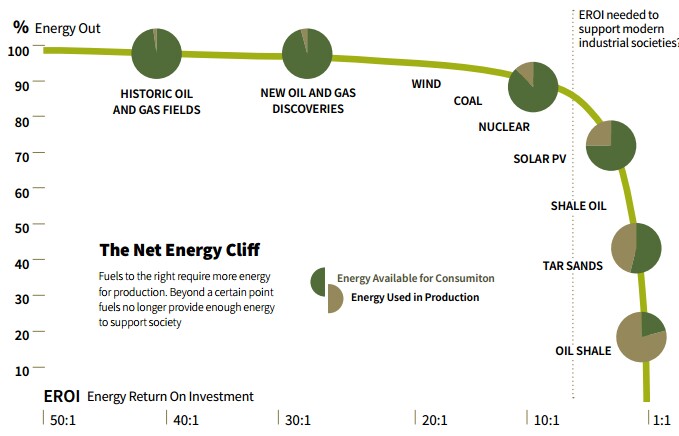
There is a precise scientific measure for this, virtually unknown in conventional economic and financial circles, known as Energy Return on Investment -- which essentially quantifies the amount of energy extracted, compared to the inputs of energy needed to conduct the extraction. The concept of EROI was first proposed and developed by Professor Charles A. Hall of the Department of Environmental and Forest Biology at the State University of New York. He found that an approximate EROI value for any energy source could be calculated by dividing the quantity of energy produced by the amount of energy inputted into the production process.
Therefore, the higher the EROI, the more energy that a particular source and technology is capable of producing. The lower the EROI, the less energy this source and technology is actually producing.
A new peer-reviewed study led by the Institute of Physics at the National Autonomous University of Mexico has undertaken a comparative review of the EROI of all the major sources of energy that currently underpin industrial civilization -- namely oil, gas, coal, and uranium.
Published in the journal Perspectives on Global Development and Technology, the scientists note that the EROI for fossil fuels has inexorably declined over a relatively short period of time: "Nowadays, the world average value EROI for hydrocarbons in the world has gone from a value of 35 to a value of 15 between 1960 and 1980."
In other words, in just two decades, the total value of the energy being produced via fossil fuel extraction has plummeted by more than half. And it continues to decline.
This is because the more fossil fuel resources that we exploit, the more we have used up those resources that are easiest and cheapest to extract. This compels the industry to rely increasingly on resources that are more difficult and expensive to get out of the ground, and bring to market.
The EROI for conventional oil, according to the Mexican scientists, is 18. They estimate, optimistically, that: "World reserves could last for 35 or 45 years at current consumption rates." For gas, the EROI is 10, and world reserves will last around "45 or 55 years." Nuclear's EROI is 6.5, and according to the study authors, "The peak in world production of uranium will be reached by 2045."
The problem is that although we are not running out of oil, we are running out of the cheapest, easiest to extract form of oil and gas. Increasingly, the industry is making up for the shortfall by turning to unconventional forms of oil and gas -- but these have very little energy value from an EROI perspective.
The Mexico team examine the EROI values of these unconventional sources, tar sands, shale oil, and shale gas: "The average value for EROI of tar sands is four. Only ten percent of that amount is economically profitable with current technology."
For shale oil and gas, the situation is even more dire: "The EROI varies between 1.5 and 4, with an average value of 2.8. Shale oil is very similar to the tar sands; being both oil sources of very low quality. The shale gas revolution did not start because its exploitation was a very good idea; but because the most attractive economic opportunities were previously exploited and exhausted."
In effect, the growing reliance on unconventional oil and gas has meant that, overall, the costs and inputs into energy production to keep industrial civilization moving are rising inexorably.
It's not that governments don't know. It's that decisions have already been made to protect the vested interests that have effectively captured government policymaking through lobbying, networking and donations.
Three years ago, the British government's Department for International Development (DFID) commissioned and published an in-depth report, "EROI of Global Energy Resources: Status, Trends and Social Implications." The report went completely unnoticed by the media.
Its findings are instructive: "We find the EROI for each major fossil fuel resource (except coal) has declined substantially over the last century. Most renewable and non-conventional energy alternatives have substantially lower EROI values than conventional fossil fuels."
The decline in EROI has meant that an increasing amount of the energy we extract is having to be diverted back into getting new energy out, leaving less for other social investments.
This means that the global economic slowdown is directly related to the declining resource quality of fossil fuels. The DFID report warns: "The declining EROI of traditional fossil fuel energy sources and its eventual effect on the world economy are likely to result in a myriad of unforeseen consequences."
Shortly after this report was released, I met with a senior civil servant at DFID familiar with its findings, who spoke to me on condition of anonymity. I asked him whether this important research had actually impacted policymaking in the department.
"Unfortunately, no," he told me, shrugging. "Most of my colleagues, except perhaps a handful, simply don't have a clue about these issues. And of course, despite the report being circulated widely within the department, and shared with other relevant government departments, there is little interest from ministers who appear to be ideologically pre-committed to fracking."
Peak Oil
The driving force behind the accelerating decline in resource quality, hotly denied in the industry, is 'peak oil.'
An extensive scientific analysis published in February in Wiley Interdisciplinary Reviews: Energy & Environment lays bare the extent of industry denialism. Wiley Interdisciplinary Reviews (WIRES) is a series of high-quality peer-reviewed publications which runs authoritative reviews of the literature across relevant academic disciplines.
The new WIRES paper is authored by Professor Michael Jefferson of the ESCP Europe Business School, a former chief economist at oil major Royal Dutch/Shell Group, where he spent nearly 20 years in various senior roles from Head of Planning in Europe to Director of Oil Supply and Trading. He later became Deputy Secretary-General of the World Energy Council, and is editor of the leading Elsevier science journal Energy Policy.
In his new study, Jefferson examines a recent 1865-page "global energy assessment" (GES) published by the International Institute of Applied Systems Analysis. But he criticized the GES for essentially ducking the issue of 'peak oil."
"This was rather odd," he wrote. "First, because the evidence suggests that the global production of conventional oil plateaued and may have begun to decline from 2005."
He went on to explain that standard industry assessments of the size of global conventional oil reserves have been dramatically inflated, noting how "the five major Middle East oil exporters altered the basis of their definition of 'proved' conventional oil reserves from a 90 percent probability down to a 50 percent probability from 1984. The result has been an apparent (but not real) increase in their 'proved' conventional oil reserves of some 435 billion barrels."
Added to those estimates are reserve figures from Venezuelan heavy oil and Canadian tar sands, bringing up global reserve estimates by a further 440 billion barrels, despite the fact that they are "more difficult and costly to extract" and generally of "poorer quality" than conventional oil.
"Put bluntly, the standard claim that the world has proved conventional oil reserves of nearly 1.7 trillion barrels is overstated by about 875 billion barrels. Thus, despite the fall in crude oil prices from a new peak in June 2014, after that of July 2008, the 'peak oil' issue remains with us."
Jefferson believes that a nominal economic recovery, combined with cutbacks in production as the industry reacts to its internal crises, will eventually put the current oil supply glut in reverse. This will pave the way for "further major oil price rises" in years to come.
It's not entirely clear if this will happen. If the oil crisis hits the economy hard, then the prolonged recession that results could dampen the rising demand that everyone projects. If oil prices thus remain relatively depressed for longer than expected, this could hemorrhage the industry beyond repair.
Eventually, the loss of production may allow prices to rise again. OPEC estimates that investments in oil exploration and development are at their lowest level in six years. As bankruptcies escalate, the accompanying drop in investments will eventually lead world oil production to fall, even as global demand begins to rise.
This could lead oil prices to climb much higher, as rocketing demand -- projected to grow 50 percent by 2035 -- hits the scarcity of production. Such a price spike, ironically, would also be incredibly bad for the global economy, and as happened with the 2007-8 financial crash, could feed into inflation and trigger another spate of consumer debt-defaults in the housing markets.
Even if that happens, the assumption -- the hope -- is that oil industry majors will somehow survive the preceding cascade of debt-defaults. The other assumption is that demand for oil will rise.
But as new sources of renewable energy come online at a faster and faster pace, as innovation in clean technologies accelerates, old fossil fuel-centric projections of future rising demand for oil may need to be jettisoned.
Clean Energy
According to another new study released in March in Energy Policy by two scientists at Texas A&M University, "Non-renewable energy" -- that is "fossil fuels and nuclear power" -- "are projected to peak around mid-century ... Subsequent declining non-renewable production will require a rapid expansion in the renewable energy sources (RES) if either population and/or economic growth is to continue."
The demise of the fossil fuel empire, the study forecasts, is inevitable. Whichever model run the scientists used, the end output was the same: the almost total displacement of fossil fuels by renewable energy sources by the end of the century; and, as a result, the transformation and localisation of economic activity.
But the paper adds that to avoid a rise in global average temperatures of 2C, which would tip climate change into the danger zone, 50 percent or more of existing fossil fuel reserves must remain unused.
The imperative to transition away from fossil fuels is, therefore, both geophysical and environmental. On the one hand, by mid-century, fossil fuels and nuclear power will become obsolete as a viable source of energy due to their increasingly high costs and low quality. On the other, even before then, to maintain what scientists describe as a 'safe operating space' for human survival, we cannot permit the planet to warm a further 2C without risking disastrous climate impacts.
Staying below 2C, the study finds, will require renewable energy to supply more than 50 percent of total global energy by 2028, "a 37-fold increase in the annual rate of supplying renewable energy in only 13 years."
While this appears to be a herculean task by any standard, the Texas A&M scientists conclude that by century's end, the demise of fossil fuels is going to happen anyway, with or without considerations over climate risks:
… the 'ambitious' end-of-century decarbonisation goals set by the G7 leaders will be achieved due to economic and geologic fossil fuel limitations within even the unconstrained scenario in which little-to-no pro-active commitment to decarbonise is required… Our model results indicate that, with or without climate considerations, RES [renewable energy sources] will comprise 87–94 percent of total energy demand by the end of the century.
But as renewables have a much lower EROI than fossil fuels, this will "quickly reduce the share of net energy available for societal use." With less energy available to societies, "it is speculated that there will have to be a reprioritization of societal energetic needs" -- in other words, a very different kind of economy in which unlimited material growth underpinned by endless inputs of cheap fossil fuel energy are a relic of the early 21st century.
The 37-fold annual rate of increase in the renewable energy supply seems unachievable at first glance, but new data just released from the Abu Dhabi-based International Renewable Energy Agency shows that clean power is well on its way, despite lacking the massive subsidies behind fossil fuels.
The data reveals that last year, solar power capacity rose by 37 percent. Wind power grew by 17 percent, geothermal by 5 percent and hydropower by 3 percent.
So far, the growth rate for solar power has been exponential. A Deloitte Center for Energy Solutions report from September 2015 noted that the speed and spread of solar energy had consistently outpaced conventional linear projections, and continues to do so.
While the costs of solar power is consistently declining, solar power generation has doubled every year for the last 20 years. With every doubling of solar infrastructure, the production costs of solar photovoltaic (PV) has dropped by 22 percent.
At this rate, according to analysts like Tony Seba -- a lecturer in business entrepreneurship, disruption and clean energy at Stanford University -- the growth of solar is already on track to go global. With eight more doublings, that's by 2030, solar power would be capable of supplying 100 percent of the world's energy needs. And that's even without the right mix of government policies in place to support renewables.
According to Deloitte, while Seba's forecast is endorsed by a minority of experts, it remains a real possibility that should be taken seriously. But the firm points out that obstacles remain:
"It would not make economic sense for utility planners to shutter thousands of megawatts of existing generating capacity before the end of its economic life and replace it with new solar generation."
Yet Deloitte's study did not account for the escalating crisis in profitability already engulfing the fossil fuel industries, and the looming pressure of stranded assets due to climate risks. As the uneconomic nature of fossil fuels becomes ever more obvious, so too will the economic appeal of clean energy.
Race Against Time
The question is whether the transition to a post-carbon energy system -- the acceptance of the inevitable death of the oil economy -- will occur fast enough to avoid climate catastrophe.
Given that the 2C target for a safe climate is widely recognized to be inadequate -- scientists increasingly argue that even a 1C rise in global average temperatures would be sufficient to trigger dangerous, irreversible changes to the earth's climate.
According to a 2011 report by the National Academy of Sciences, the scientific consensus shows conservatively that for every degree of warming, we will see the following impacts: 5-15 percent reductions in crop yields; 3-10 percent increases in rainfall in some regions contributing to flooding; 5-10 percent decreases in stream-flow in some river basins, including the Arkansas and the Rio Grande, contributing to scarcity of potable water; 200-400 percent increases in the area burned by wildfire in the US; 15 percent decreases in annual average Arctic sea ice, with 25 percent decreases in the yearly minimum extent in September.
Even if all CO2 emissions stopped, the climate would continue to warm for several more centuries. Over thousands of years, the National Academy warns, this could unleash amplifying feedbacks leading to the disappearance of the polar ice sheets and other dramatic changes. In the meantime, the risk of catastrophic wild cards "such as the potential large-scale release of methane from deep-sea sediments" or permafrost, is impossible to quantify.
In this context, even if the solar-driven clean energy revolution had every success, we still need to remove carbon that has already accumulated in the atmosphere, to return the climate to safety.
The idea of removing carbon from the atmosphere sounds technologically difficult and insanely expensive. It's not. In reality, it is relatively simple and cheap.
A new book by Eric Toensmeier, a lecturer at Yale University's School of Forestry and Environmental Studies, The Carbon Farming Solution, sets out in stunningly accessible fashion how 'regenerative farming' provides the ultimate carbon-sequestration solution.
Regenerative farming is a form of small-scale, localised, community-centred organic agriculture which uses techniques that remove carbon from the atmosphere, and sequester it in plant material or soil.
Using an array of land management and conservation practices, many of which have been tried and tested by indigenous communities, it's theoretically possible to scale up regenerative farming methods in a way that dramatically offsets global carbon emissions.
Toensmeier's valuable book discusses these techniques, and unlike other science-minded tomes, offers a practical toolkit for communities to begin exploring how they can adopt regenerative farming practices for themselves.
According to the Rodale Institute, the application of regenerative farming on a global scale could have revolutionary results:
Simply put, recent data from farming systems and pasture trials around the globe show that we could sequester more than 100 percent of current annual CO2 emissions with a switch to widely available and inexpensive organic management practices, which we term 'regenerative organic agriculture'… These practices work to maximize carbon fixation while minimizing the loss of that carbon once returned to the soil, reversing the greenhouse effect.
This has been widely corroborated. For instance, a 2015 study part-funded by the Chinese Academy of Sciences found that "replacing chemical fertilizer with organic manure significantly decreased the emission of GHGs [greenhouse gases]. Yields of wheat and corn also increased as the soil fertility was improved by the application of cattle manure. Totally replacing chemical fertilizer with organic manure decreased GHG emissions, which reversed the agriculture ecosystem from a carbon source… to a carbon sink."
Governments are catching on, if slowly. At the Paris climate talks, 25 countries and over 50 NGOs signed up to the French government's '4 per 1000' initiative, a global agreement to promote regenerative farming as a solution for food security and climate disaster.
The Birth of Post-Capitalism
There can be no doubt, then, that by the end of this century, life as we know it on planet earth will be very different. Fossil fueled predatory capitalism will be dead. In its place, human civilization will have little choice but to rely on a diversity of clean, renewable energy sources.
Whatever choices we make this century, the coming generations in the post-carbon future will have to deal with the realities of an overall warmer, and therefore more unpredictable, climate. Even if regenerative processes are in place to draw down carbon from the atmosphere, this takes time -- and in the process, some of the damage climate change will wreak on our oceans, our forests, our waterways, our coasts, and our soils will be irreversible.
It could take centuries, if not millennia, for the planet to reach a new, stable equilibrium.
But either way, the work of repairing and mitigating at least some of the damage done will be the task of our childrens' children, and their children, and on.
Economic activity in this global society will of necessity be very different to the endless growth juggernaut we have experienced since the industrial revolution. In this post-carbon future, material production and consumption, and technological innovation, will only be sustainable through a participatory 'circular economy' in which scarce minerals and raw materials are carefully managed.
The fast-paced consumerism that we take for granted today simply won't work in these circumstances.
Large top-down national and transnational structures will begin to become obsolete due to the large costs of maintenance, the unsustainability of the energy inputs needed for their survival, and the shift in power to new decentralized producers of energy and food.
In the place of such top-down structures, smaller-scale, networked forms of political, social and economic organization, connected through revolutionary information technologies, will be most likely to succeed. For communities to not just survive, but thrive, they will need to work together, sharing technology, expertise and knowledge on the basis of a new culture of human parity and cooperation.
Of course, before we get to this point, there will be upheaval. Today's fossil fuel incumbency remains in denial, and is unlikely to accept the reality of its inevitable demise until it really does drop dead.
The escalation of resource wars, domestic unrest, xenophobia, state-militarism, and corporate totalitarianism is to be expected. These are the death throes of a system that has run its course.
The outcomes of the struggles which emerge in coming decades -- struggles between people and power, but also futile geopolitical struggles within the old centers of power (paralleled by misguided struggles between peoples) -- is yet to be written.
Eager to cling to the last vestiges of existence, the old centers of power will still try to self-maximize within the framework of the old paradigm, at the expense of competing power-centers, and even their own populations.
And they will deflect from the root causes of the problem as much as possible, by encouraging their constituents to blame other power-centers, or worse, some of their fellow citizens, along the lines of all manner of 'Otherizing' constructs, race, ethnicity, nationality, color, religion and even class.
Have no doubt. In coming decades, we will watch the old paradigm cannibalize itself to death on our TV screens, tablets and cell phones. Many of us will do more than watch. We will be participant observers, victims or perpetrators, or both at once.
The only question that counts is, amidst this unfolding maelstrom, are we going to join with others to plant the seeds of viable post-carbon societies for the next generations of human beings, or are we going to stand in the way of that viable future by giving ourselves entirely to defending our interests in the framework of the old paradigm?
Whatever happens over coming decades, the choices each of us make will ultimately determine the nature of what survives by the end of this pivotal transitional century.

Sunday, January 17, 2016

2159. A Growing Oil Glut Is Hurting the Economy

By Clifford Krause, The New York Times, January 15, 2016


HOUSTON — The world is awash in crude oil, with enough extra produced last year to fuel all of Britain or Thailand. And the price of oil will not stop falling until the glut shrinks.

The oil glut — the unsold crude that is piling up around the world — is a quandary and a source of investor anxiety that once again rattled global markets on Friday.
As prices have dropped, the amount of excess production has been cut in half over the last six months. About one million barrels of extra oil is now being dumped on the markets each day.

But that means the glut is still continuing to grow, and it could take years to work through the crude that is being warehoused, poured into petroleum depots or loaded onto supertankers for storage at sea.

The shakeout will be painful, taking an even bigger toll on companies, countries and investors.

Global stocks sank sharply on Friday, as the price of oil slipped below $30 a barrel. The glut was at the heart of the tumult, as investors worried that the demand from China would drop and supplies from Iran would grow.

“The glut is the 800-pound gorilla in the room,” said Steve McCoy, vice president for drilling contracts at Latshaw Drilling, an Oklahoma service company that prospered in recent years from the American shale boom. “The world simply produced too much, and now we have to use it up or many oil-producing countries and some oil companies may drown.”

Just a couple of years ago, producers and petro-states were making vast fortunes drilling and pumping relentlessly to fuel expanding middle classes in Asia, Latin America and Africa. But suddenly they are producing more than anyone needs at a time when China and other rapidly growing economies, once hungry for energy, are pulling back.

The extra oil has sent the price of crude into a tailspin, down more than 70 percent over the last 18 months.

That, in turn, has helped depress stock markets around the world, as investors worry about global growth. The Standard & Poor’s 500-stock index is off around 8 percent in just the first two weeks of the year; European shares are down even more. Chinese stocks have dropped 20 percent from their December peak, putting the market in bear territory.

“What was once viewed as a gift is now viewed similarly to the gift of the monkey’s paw,” said Tom Kloza, global head of energy analysis for Oil Price Information Service. “Global financial damages trump the benefits of cheap oil at anything under $30 a barrel.”
It could get worse.

The nuclear deal with Iran should allow the country to start exporting far more oil, once sanctions are lifted, potentially in a matter of days. Iran could add as much as 500,000 barrels a day to the global markets.

Tentative progress in negotiations between warring factions in Libya, battling for control of oil and export terminals, could unleash another flood. And Saudi Arabia, Kuwait and Iraq continue to maintain a pumping frenzy to grab Asian markets.

The United States is slowly cutting production. Major oil companies have dropped their rig count, and dozens of small businesses have gone bankrupt. But the industry cannot simply flip the switch on big projects, like deepwater production projects in the Gulf of Mexico, that require companies to keep pumping to cover their costs. Smaller companies have to keep producing from shale fields, even at a loss, to keep paying their lenders.

“Sheikhs and shale caused this,” said Scott Tinker, director of the Bureau of Economic Geology at the University of Texas at Austin. “They are both producing more oil. That is the fundamental driver.”

A million to two million barrels a day of excess production may not seem like much in a world market that requires 94 million barrels daily. But the amount of daily oversupply in recent months is the largest since oil prices collapsed in the late 1990s.
Back then, the price dropped below $10 a barrel, on an inflation-adjusted basis. Oil from new fields flooded the market just as the Asian financial crisis was roiling emerging markets.

Most of the glut today can be explained by a near doubling of American domestic oil production since 2008. The shale boom added roughly three million barrels a day to the global market.

In the past, when markets got out of kilter, Saudi Arabia and its partners in the Organization of the Petroleum Exporting Countries slashed production to support prices. But this time, the Saudis and other big producers increased output to try to preserve market share and undercut higher-cost competitors like those drilling in the shale fields of Texas and North Dakota.

Even as prices slipped through 2015, global production climbed. The Energy Department projects that overall inventories will rise by an additional 700,000 barrels a day in 2016.

The balance of oil supply and demand can swing abruptly, along with price, as they did in the early 2000s.

At the time, the Chinese and other emerging-market economies went into overdrive just as production in the United States and Mexico was declining and big producers like Venezuela and Nigeria were facing political turbulence. By mid-2008, the price of oil had risen to nearly $150 a barrel.

That is the possibility that many analysts are now contemplating, even if not at a price that high. An unexpected drop in supply or rise in demand could create a floor for prices, ease the glut and eventually lead to a slow recovery.

On the supply side, if tensions erupting between Saudi Arabia and Iran lead to armed conflict or an insurrection, the excess production could quickly disappear.

The boom in Iraqi oil production faces multiple threats, including Islamic State terrorism. The government is falling behind in its payments to international oil companies, water is running low for pumping to revive aging oil fields, and northern Kurdish fields are short on pipelines.

Low oil prices have already constrained exploration and production investment around the world.

American oil producers are in retreat; companies have decommissioned more than 60 percent of their rigs in the last year or so. Since peaking at 9.7 million barrels a day early last year, domestic oil production has fallen by more than half a million barrels. Rosneft, Lukoil and Western companies are also dropping big projects in Russia.

Some analysts also say that the concerns about slowing demand in emerging markets, a byproduct of the economic weakness, are overblown. China and India, for example, are working hard to build up enormous strategic reserves, which adds to the demand.

RBC Capital Markets, a division of Royal Bank of Canada, estimates that China’s needs will continue to grow as it places an additional 65 million to 70 million barrels in its reserves this year. India began amassing a strategic reserve only last year, and it has a goal of storing roughly 330 million barrels over the next several years.

“Increased demand can certainly help,” said Michael Tran, an RBC commodity strategist. “But the growing supply glut is what ultimately got us below $30-a-barrel oil, and significant supply cuts are what will ultimately have to dig us out.”

Friday, June 5, 2015

1873. We Were Wrong on Peak Oil. There's Enough to Fry Us All

By George Monbiot, The Guardian, June 3, 2015


The facts have changed, now we must change too. For the past 10 years an unlikely coalition of geologists, oil drillers, bankers, military strategists and environmentalists has been warning that peak oil – the decline of global supplies – is just around the corner. We had some strong reasons for doing so: production had slowed, the price had risen sharply, depletion was widespread and appeared to be escalating. The first of the great resource crunches seemed about to strike.

Among environmentalists it was never clear, even to ourselves, whether or not we wanted it to happen. It had the potential both to shock the world into economic transformation, averting future catastrophes, and to generate catastrophes of its own, including a shift into even more damaging technologies, such as biofuels and petrol made from coal. Even so, peak oil was a powerful lever. Governments, businesses and voters who seemed impervious to the moral case for cutting the use of fossil fuels might, we hoped, respond to the economic case.

Some of us made vague predictions, others were more specific. In all cases we were wrong. In 1975 MK Hubbert, a geoscientist working for Shell who had correctly predicted the decline in US oil production, suggested that global supplies could peak in 1995. In 1997 the petroleum geologist Colin Campbell estimated that it would happen before 2010. In 2003 the geophysicist Kenneth Deffeyes said he was "99% confident" that peak oil would occur in 2004. In 2004, the Texas tycoon T Boone Pickens predicted that "never again will we pump more than 82m barrels" per day of liquid fuels. (Average daily supply in May 2012 was 91m.) In 2005 the investment banker Matthew Simmons maintained that "Saudi Arabia … cannot materially grow its oil production". (Since then its output has risen from 9m barrels a day to 10m, and it has another 1.5m in spare capacity.)

Peak oil hasn't happened, and it's unlikely to happen for a very long time.

A report by the oil executive Leonardo Maugeri, published by Harvard University, provides compelling evidence that a new oil boom has begun. The constraints on oil supply over the past 10 years appear to have had more to do with money than geology. The low prices before 2003 had discouraged investors from developing difficult fields. The high prices of the past few years have changed that.

Maugeri's analysis of projects in 23 countries suggests that global oil supplies are likely to rise by a net 17m barrels per day (to 110m) by 2020. This, he says, is "the largest potential addition to the world's oil supply capacity since the 1980s". The investments required to make this boom happen depend on a long-term price of $70 a barrel – the current cost of Brent crude is $95. Money is now flooding into new oil: a trillion dollars has been spent in the past two years; a record $600bn is lined up for 2012.

The country in which production is likely to rise most is Iraq, into which multinational companies are now sinking their money, and their claws. But the bigger surprise is that the other great boom is likely to happen in the US. Hubbert's peak, the famous bell-shaped graph depicting the rise and fall of American oil, is set to become Hubbert's Rollercoaster.

Investment there will concentrate on unconventional oil, especially shale oil (which, confusingly, is not the same as oil shale). Shale oil is high-quality crude trapped in rocks through which it doesn't flow naturally.

There are, we now know, monstrous deposits in the United States: one estimate suggests that the Bakken shales in North Dakota contain almost as much oil as Saudi Arabia (though less of it is extractable). And this is one of 20 such formations in the US. Extracting shale oil requires horizontal drilling and fracking: a combination of high prices and technological refinements has made them economically viable. Already production in North Dakota has risen from 100,000 barrels a day in 2005 to 550,000 in January.

So this is where we are. The automatic correction – resource depletion destroying the machine that was driving it – that many environmentalists foresaw is not going to happen. The problem we face is not that there is too little oil, but that there is too much.

We have confused threats to the living planet with threats to industrial civilisation. They are not, in the first instance, the same thing. Industry and consumer capitalism, powered by abundant oil supplies, are more resilient than many of the natural systems they threaten. The great profusion of life in the past – fossilised in the form of flammable carbon – now jeopardises the great profusion of life in the present.

There is enough oil in the ground to deep-fry the lot of us, and no obvious means to prevail upon governments and industry to leave it in the ground. Twenty years of efforts to prevent climate breakdown through moral persuasion have failed, with the collapse of the multilateral process at Rio de Janeiro last month. The world's most powerful nation is again becoming an oil state, and if the political transformation of its northern neighbour is anything to go by, the results will not be pretty.

Humanity seems to be like the girl in Guillermo del Toro's masterpiece Pan's Labyrinth: she knows that if she eats the exquisite feast laid out in front of her, she too will be consumed, but she cannot help herself. I don't like raising problems when I cannot see a solution. But right now I'm not sure how I can look my children in the eyes.

Tuesday, March 11, 2014

1350. The New Economics of Oil

By Samuel Alexander, Melbourne Sustainable Society Institute, March 2014
The geoscientist M. King Hubbert who proposed
the peak oil hypothesis in 1956.
Introduction
There has been a fair bit of talk recently about the so-called ‘death’ of peak oil. These eulogies have been motivated primarily by the upsurge of shale oil production in the US (Maugeri, 2012), as well as the recent announcement that the premiere peak oil website, The Oil Drum, is shutting up shop (The Oil Drum, 2013). Even the notoriously left-leaning, eco-journalist, George Monbiot (2012), has announced: ‘We were wrong about peak oil.’
But Monbiot is wrong about being wrong. For reasons outlined below, peak oil is very much alive and squeezing its hands ever more tightly around the throats of oil-dependent economies. In other words, it is not the dynamics of peak oil that are struggling to survive, but the industrial economies that are trying to ignore the implications of expensive oil. The new economics of oil also have alarming implications for climate change, as Monbiot acknowledged, suggesting that this is a subject we dismiss at our own peril.
This paper seeks to show that oil issues remain at the centre of global challenges facing humanity, despite recent claims of oil abundance, and that the challenges are only going to intensify in coming years as competition increases over the world’s most important source of fossil energy. The main issue, however, is not whether we will have enough oil, but whether we can afford to produce and burn the oil we have.
Is ‘Peak Oil’ Dead or Alive?
Peak oil, of course, does not mean that the world is running out of oil. There is a vast amount of oil left – approximately half of Earth’s original endowment (Sorrell et al, 2012; Maugeri, 2012). Over the last 150 years, however, we’ve picked the low hanging fruit, so to speak, meaning that the remaining oil is harder to find and more expensive to extract (Murphy, 2014; Murphy and Hall, 2011a). With the age of cheap and easy oil at an end, oil companies are now drilling in thousands of feet of water, processing tar sands, and being forced into extremely inhospitable areas, such as the arctic, while at the same time major existing wells are in decline (Lyons and Ghalambor, 2007; Klare, 2012). This is making it more difficult to increase the ‘flow’ of oil out of the ground.
When the rate of crude oil production cannot be increased, that represents peak oil. This situation is considered by many to signify a defining turning point in history, because oil demand is expected to increase as the world continues
to industrialise (Hirsch et al, 2010). The theory goes that as the supply of oil stagnates and the demand increases, the cost per barrel will rise, making the consumption of oil an increasingly expensive and debilitating addiction.
So is this theory alive or dead? Well, it’s not a theory, it’s a reality. Around 2005 the production of crude or ‘conventional’ oil stopped growing significantly and has been on a corrugated plateau ever since (see Miller and Sorrell, 2014: 6). Data from the Energy Information Administration show that between 2005 and 2012 there was only 0.3% average annual growth of crude oil production (see Heinberg, 2013: 6). Other mainstream institutions have acknowledged this plateau too, including the International Energy Agency (IEA, 2010: 6), which recently reiterated an acknowledgement of the crude oil peak through its chief economist, Fatih Birol (BBC, 2013). Global demand for oil, however, has continued to grow significantly (IEA, 2012), which has put upward pressure on the price of oil. Although there has been some price volatility in recent years, the IEA (2013: 6) notes that ‘Brent crude oil has averaged $110 per barrel in real terms since 2011, a sustained period of high oil prices that is without parallel in oil market history’.
Geopolitical instability in oil-rich regions of the world also helps keep prices high (Klare, 2012), with the recent situation in Syria being but the latest manifestation of this dynamic. Even if people reject the geological concerns over oil supply, the very real threat of ongoing geopolitical disruptions gives all oil importing nations a reason to prepare for supply disruptions (see Blackburn, 2014). This is especially so, as noted by the IEA, given that in coming years
the world will come to rely increasingly on a small number of producers, mainly in the Middle East and Northern African regions where oil is shipped along ‘vulnerable supply routes’ (IEA, 2011: 3). It is also worth bearing in mind that the price spikes from the oil crises of 1973 and 1979, both of which induced recessions, were driven not by geology but geopolitics. It would be naive to think that further crises could not arise, especially as competition over existing supplies continues to intensify (see Hiscock, 2012; Klare, 2012).
The upward pressure on price over the last decade has changed the economics of several sources of unconventional oil, making them more financially viable to produce when once they were not. For example, the main reason shale oil was not produced historically was because the costs of getting it out of the ground and refining it were significantly more than the market price for oil (Heinberg, 2013).
But now that oil is priced above US$105 per barrel1, producers are more likely to be able
to make money producing shale oil and other unconventional oils, even though their energy and economic return on investment is considerably lower than conventional oil (Murphy, 2014; Murphy and Hall, 2011b). The fact that unconventional oil is much more carbon-intensive than crude oil (Hansen and Kharecha, 2008) – exacerbating an already intractable climate problem (IPCC, 2013) – does not seem to trouble oil producers or most politicians.
Driven by high prices, this new production has meant that the total oil production (conventional plus unconventional oil) has been able to meet increasing global demand, even though conventional oil has shown almost no growth in recent years. Because total oil production has increased to meet demand, many commentators have declared that ‘peak oil’ is dead. These declarations, however, are based on a misunderstanding.
The current oil production situation does not debunk but rather confirm the peak oil argument. The peak oil position – at least, the most coherent iteration of its varieties – holds that when conventional oil reaches a plateau (and eventually declines), this will lead to an increase in price; but price increases make unconventional oils more financially viable, thus increasing their production and delaying a decline in overall production of liquid fuels. This is what we are seeing today (Brecha, 2013; Sorrell et al, 2012; Miller and Sorrell, 2014).
The key factor in understanding the implications of peak oil, therefore, has less to do with total oil production, or even total reserves. Rather, it is inextricably linked to the price of oil. The peak oil school always argued that oil dependent economies would suffer when the growth of conventional oil slowed and the price of oil increased.
This scenario is playing out before our very eyes. In short, the economics of peak oil are very much alive and well – just ask the struggling global economy (Tverberg, 2012).
Is the Shale Boom a Bubble?
Before looking more closely at the economic implications of expensive oil, it is worth noting that there is a serious question over whether there is even much money to be made producing shale oil, despite all the hype, or whether, by contrast, there is currently a shale ‘boom’ that may all- too-soon go ‘bust’. Although mainstream media and institutions are reporting on the ‘new age’ of American oil and gas (IEA, 2012), and even going so far as to claim that the US will soon be energy independent (Citigroup, 2012), evidence suggests that such claims lack foundation.
David Hughes, for example, has conducted the most rigorous and comprehensive examination to date on shale holdings in the US – based on data for 65,000 wells – and his conclusions are strikingly at odds with popular perception. While he acknowledges that shale production provides some ‘breathing room’ (Hughes, 2013: iii), he insists that optimistic claims that the US is heading for energy independence are ‘entirely unwarranted based on the fundamentals’ (Hughes, 2013: iv). Richard Heinberg’s new book reviews the evidence and is similarly critical, likening the so-called shale revolution to ‘snake oil’ (Heinberg, 2013).
One need not, however, rely solely on such critics as Hughes and Heinberg, respectable though their analyses may be (see also, Leggett, 2013). Strong messages have started to emerge even from within the oil and gas industry, to the effect that shale is not proving to be the energy ‘saviour’ that it was hoped to be, even a few years ago. If it was once assumed, for example, that shale gas production was going to lessen the oil supply challenges (for example, by shifting transport fuels from oil to gas), voices from within the industry suggest this does not seem to be a very promising or reliable strategy (see leaked emails and documents compiled in New York Times, 2014). In 2012 the CEO of Exxon-Mobil, Rex Tillerson, commented on what the shale boom has done for his company, saying ‘we are all losing our shirts today. We’re making no money. It’s all in the red’ (Krauss and Lipton, 2012). In 2013, Exxon Mobil’s quarterly profits are down a remarkable 57 per cent (Gilbert, Scheck, and Fowler, 2013).
Similarly, Royal Dutch Shell has just written down its shale holdings by $2.07 billion, which helped push the company’s second quarter earnings down 60% from a year earlier, as reported in the Wall Street Journal (Gilbert, Scheck, and Fowler, 2013). Even with the oil price placed over $105 per barrel, The Economist (2013a) speculates that ‘the day of the huge integrated international oil company is drawing to a close’. These are hardly intimations of a new ‘golden age’ in oil and gas production (IEA, 2012), despite some increases in US production in recent years. After all, it is no good having vast technically recoverable resources if producing them is uneconomic. Furthermore, if the price of oil were to drop to some extent – perhaps due to a further downturn in an already struggling global economy – this could also make some currently profitable shale holdings unprofitable, which soon enough would reduce shale production (see, e.g., Carroll and Klump, 2013). Even the IEA has reduced its enthusiasm for US shale in the last few months, with chief economist, Fatih Birol, telling the Financial Times that shale represents ‘a surge, rather than a revolution’ (Makan and Hume, 2013).
Closer to home, the Australian Petroleum Production and Association’s own Oil & Gas Gazette reported in June 2013 that the ‘shale gale is little more than hot air,’ that ‘... the whole shale oil and gas game still looks like a net negative cash flow business,’ and that production has been driven ‘...not by any notion of ongoing profitability of the business’ (Strachan, 2013: 4).
While the future of the shale boom remains an open question, the fact that industry insiders are already expressing doubts about its long-term significance suggests that shale is not an energy source our economies should be relying on to meet ongoing supply.
Given that shale oil production is, in fact, currently doing the most to meet growing oil demand, any shale oil ‘bust’ is likely to have significant implications for an already strained
oil market. Such a bust would also expose the stagnating production around the rest of the world, which is currently disguised (to the uncritical observer) by shale production gains (see data sources presented in Mushalik, 2013a). But even if there is no bust, as such, what seems beyond dispute is that the era of cheap and easy oil is over, owing primarily to the crude oil peak. Readers may recall the words of the Chevron advertisement from 2005, which noted ‘the age of easy oil is over’ (see Dodson and Sipe, 2008: 33).
A further reason to believe the price of oil is going to remain high, and perhaps continue to rise over the long term, is the fact that global demand for oil is expected to keep growing significantly. Much of this demand is coming from places like China and India, where energy intensive industrialisation is escalating at extraordinary rates, and where cheap cars are opening the door for hundreds of millions of new drivers that will need fuel. Naturally this increase in global demand is putting growing pressure on oil supply around the world.
The fact the consumption of oil in the US has gone down in the last few years is not a sign that ‘peak oil’ has been negated by ‘peak demand’ (Economist, 2013b), but that peak oil has increased the price of oil so much that ordinary consumption practices have become unaffordable, suggesting ‘demand destruction’ is a more appropriate term than ‘peak demand’. Given the close link between energy and economic growth (see, e.g., Ayers and Warr, 2009) this demand destruction has economic implications (as discussed further below).
What is less widely appreciated, however, is the fact that huge increases in consumption are occurring within oil exporting nations (e.g. such as Russia and the nations in OPEC) (see, e.g., Rubin and Buchanan, 2007; Heinberg, 2011). This rise in consumption is making it more difficult for those nations to maintain existing exports, for obvious reasons. As consumption grows within oil exporting nations, and as production stagnates, there is a great incentive for those exporting nations to keep more oil for themselves, which means that the OECD nations, for example, should not assume that they are going to get the same proportion of global oil production as they do presently. Indeed, as a result of the crude oil peak, exports also seem to have peaked around 2006 (see data sources presented in Mushalik, 2013b). Since internal supplies of most importers are also declining (Hirsch et al, 2010), this gives rise to a situation where most importers and exporters are wanting more oil, while they are also facing stagnating
or decreasing production. This is the ‘oil crunch’ that is likely to define the 21st century, a crunch that is in fact in the process of unfolding in the form of increased competition, increased production costs, and ultimately, historically unprecedented prices.
But can the world afford expensive oil?
The New Economics of Oil
The economic significance of the crude oil peak is clearest when we ‘do the maths’. In what follows, I briefly unpack the economic implications of the price of oil rising from its historical average of around $25 per barrel2 to around $105 per barrel at the time of writing (February 2014). I use the US as a test case, and then move on to the global situation. The same type of analysis could be repeated for all nations, with particular significance for oil importing nations. Even allowing for different assumptions regarding the price of oil, the essential conclusion is difficult to deny: due to the minimal growth of crude oil production, oil is getting increasingly expensive, and this is having a debilitating effect on oil- dependent economies, especially oil importing nations, as the peak oil school predicted. Here are the figures:
The US currently consumes 18.605 million barrels of oil per day (mbpd) (EIA 2013a), with net imports of 7.412 mbpd (EIA, 2013b). If crude oil production had continued growing at historic rates and prices had remained at the historic price of $25 per barrel, this would mean that the US today would be spending $465 million on oil every day, or $170 billion per year. At $25 per barrel, the US expenditure on net oil imports would be $185 million per day, or $68 billion per year. These figures are still high, but remember, these calculations are based on cheap oil.
At today’s price of around $105 per barrel, however, the US is spending a total of $2 billion per day on oil, or the equivalent of $713 billion per year. With respect to oil imports alone, the US is currently spending $778 million per day, or $284 billion per year. The critical point is the difference between these two scenarios, because that arguably represents the economic implications of the crude oil peak. Put otherwise, if crude oil had not peaked and the price of oil remained at around $25 per barrel, the US would be spending around $1.5 billion less per day on oil, or $543 billion less per year. Most importantly, however, the US would be spending almost $600 million less per day on oil imports, or $216 billion less per year.
I highlight the import costs, in particular, because that is money that is being sucked out of the US economy – or any oil importing economy, including Australia. The extent of imports means that these figures are hugely significant. Surely the US economy would be doing much better today (at least, growing faster) if it did not have to send out of the country, due to the rise in oil prices, an extra $600 million every day on oil imports. What would the US look like today if it had an extra $600 million every day to spend on renewable energy, schools, hospitals, or public transport?
Even leaving the issue of imports to one side, however, the increase in overall oil expenditure would have, and is having, an impact of its own, because this increased oil expenditure is drawing money away from the rest of the economy. Overall, were it not for the price increase, the US would have an extra $1.5 billion per day to spend in the broader economy, or $543 billion per year. Instead, all that money is being spent on expensive oil, which is distorting the economy (Kerschner et al, 2013; Murphy, 2014). Is it any wonder oil-dependent economies are struggling to grow their economies? Could it be that expensive oil signifies the twilight of industrial growth, as we have known it?
Another way to think of all this is in terms of oil expenditure as a proportion of GDP. In 2012, the GDP of the US was approximately $15 trillion.
If the US was paying historic average prices for oil, total oil expenditure would only be 1.13% of GDP. However, at the price of $105, total oil expenditure would be 4.75% of GDP. In other words, over the last decade or so, the costs of expensive oil have absorbed an extra 3.62% of GDP.
These figures are worrying, especially if oil continues to increase in price as global demand grows, exports decline, production costs increase, and overall production slows. James Hamilton (2011) has shown that 10 of the last 11 recessions in the US were preceded by high oil prices. By way of comparison with the figures above, Hamilton (2011: 5) notes, ‘in 2008, the U.S. consumed 7.1 billion barrels of oil at an average price of $97.26/barrel, for an economic value of $692 billion, or 4.8% of GDP.’ We all know how the US economy looked in 2008- 2009, in the midst of the global financial crisis, and the analysis above suggests that oil expenditure in the US is getting dangerously close to the level at which it could induce another recession (Murphy, 2014; Murphy and Hall, 2011a-b).
Even if expensive oil does not induce recession, it seems clear that expensive oil makes growth very difficult, and this provides some grounds for thinking that we are entering the twilight of growth globally (Heinberg, 2011). The above analysis, after all, can be repeated for the world as a whole, producing figures that are equally sobering. The world currently consumes around 90 million barrels of oil per day (IEA, 2012), and if each barrel was $25, that would be a global oil expenditure of $2.25 billion per day. At the current price of $105, however, the world spends $9.45 billion per day on oil, or $3.5 trillion per year. This is a difference of $7.2 billion every day, an extra cost to the global economy which is largely a result of crude oil having peaked. It lacks credibility to pronounce the death of something that is costing the global economy $7.2 billion per day – or $2.6 trillion extra per year. If people had listened to the warnings of the peak oil school, we could have broken our addiction to oil by now and had this money to spend on other things. Unfortunately, oil expenditure continues to grow. At the same time, the peak oil school, in good health, is strangely pronounced dead.
As these figures show, peak oil as a concept and phenomenon is alive and well, and placing an ever tighter stranglehold on the global economy. The global economy struggles to withstand the economic impacts of high oil prices, primarily because so much trade is now international and therefore dependent on oil for the transportation (and production) of goods. When oil prices get so high that the economy cannot function – which is arguably what happened in 2008 when oil reached $147 per barrel – the economy struggles to grow, and this reduction in economic activity means a reduction in oil demand, leading to fall in the price of oil (Heinberg, 2011). This fall in price is what happened after the Global Financial Crisis hit in 2008 (Rubin, 2012), and it is what happens whenever the demand for oil is reduced because of economic recession. Low oil prices, however, then aid economic recovery, but as economies recover from recession and begin to grow again, this puts more demand pressure on stagnating oil supplies, and the cycle repeats itself. This is what Murphy and Hall (2011b: 52) call the ‘economic growth paradox: increasing the oil supply to support economic growth will require high oil prices that will undermine that economic growth’.
In short, as oil production slows or stagnates, oil prices may continue to increase until they reach an economic breaking point, crashing or destabilising economies, which would lead to a crash in oil prices; the low oil prices would then facilitate economic recovery, which puts more demand pressure on oil, leading prices to rise till economic breaking point, and so on and so forth. This cycle of bust-recovery-bust is what we may face in coming years and decades, and ultimately economic contraction is what we may have to prepare for. The world is unlikely to escape this unhappy cycle until it transitions beyond a growth-based economy and breaks its addiction to oil (see Alexander, 2012; Alexander, 2014).
This point about breaking our addiction to oil deserves some brief elaboration, because it raises the spectre of what Tom Murphy (2011) has called the ‘energy trap’. In order to break the addiction to oil, economies dependent on oil will need to invest huge amounts of money and energy in building new social and economic infrastructures that are not so heavily dependent on oil (e.g. efficient public transport systems to incentivise people to drive less, organic food systems, renewable energy systems, etc.). But since this transition has not yet seriously begun, the necessary investment of money and energy is going to be required at a time when money and energy are scarcer than they have been in recent decades. This places us in the ‘energy trap’. Politicians are going to have a short-term incentive not to invest extra money and energy in new infrastructure, since people will already be feeling the pinch of high oil prices. This means that there will be very little or no surplus money and energy to direct towards the necessary infrastructure projects. But while passing the buck, so to speak, will provide some short- term relief for people and politicians, it only delays the inevitable need for that new infra-structure. A delay only exacerbates the problem, however, since the necessary investment will then need to come later, at a time when energy and money are scarcer still, the price of oil is probably even higher, and the time frame for change is tighter.
When oil gets expensive, everything dependent on oil gets more expensive, like transport, mechanised labour, industrial food production, plastics, among many other things. This pricing dynamic sucks discretionary expenditure and investment away from the rest of the economy, causing debt defaults, economic stagnation, recessions, or even longer-term depressions. That seems to be what we are seeing around the world today, with the risk of worse things to come (Tverberg, 2012). This should provide us all with further motivation to rapidly decarbonise the economy, not only because oil has become painfully expensive, but also because the oil we are burning is getting more carbon-intensive. I, for one, can think of many better things on which to spend $2.6 trillion dollars per year – things such as renewable energy, bike lanes, better public transport, and organic food production (Heinberg and Lerch, 2010).
The maths of peak oil suggest that we have entered a new era of energy and economics, one in which expensive oil is going to make it increasingly difficult for oil dependent economies to grow their economies. After two centuries of sustained economic growth, this surely marks a significant turning point in history, but little attention is being given to this issue at the macro- economic and political levels. Where are the politicians acknowledging this issue and giving it due public attention?
In the absence of a robust understanding of these issues, most economists and politicians around the world are still crafting their policies based on flawed, growth-based thinking, not recognising that the new economics of energy mean that the growth model, which assumes cheap energy inputs, is now dangerously outdated. The climatic implications of exploiting unconventional oils make the maths more worrying still (McKibben, 2012; Hansen and Kharecha, 2008). Granted, we are not running out of oil any time soon, but there will come a time when we run out of economically cheap, environmentally affordable oil, and in fact, it seems that time is already upon us.
Conclusion
Peak oil turned out to be a more complex phenomenon than theorists originally anticipated.
It has not been experienced as a precise ‘moment’ or ‘event’, but rather as a dynamic interplay between various forces that have provoked some adaptive adjustments (such as demand destruction or increased investments) in incremental and multidimensional ways. There may never be a ‘shock moment’ of peak oil’s arrival; instead, peak oil may continue to play out as a gradual, unplanned transition to a new set of energy and consumption patterns that are less oil dependent, giving rise to social, economic, and ecological impacts that no one can predict with any certainty. The evolving interrelationship of geological, geopolitical, economic, cultural, and technological variables has continued to surprise analysts – both the ‘cornucopians’, who claim there is nothing to worry about, and the ‘doomsayers’, who think collapse is imminent, as well as everyone in between. No doubt there will be more twists still to come in this energy tale. But what seems clear is that the consequences of peak oil are not going away.
Whether the next twist arrives in the form of a new war or financial crisis, a new technology, a bursting shale bubble, or perhaps a radical cultural shift away from fossil fuels in response to climatic instability, intellectual integrity demands that analysts continue to revise viewpoints as further evidence continues to arrive. This issue is too important to be governed by ideology.
Endnotes:
For the price of oil, see http://www.oil-price.net/, accessed 26 February 2014 (showing Brent Crude oil at US$110.64 and WTI Crude oil at US$102.82).
For data on the price of oil in history, see http://www.wtrg.com/prices.htm, accessed 10 September 2013.
References:
Alexander, S. (2012) ‘The Sufficiency Economy: Envisioning a Prosperous Way Down’ Simplicity Insti- tute Report 12s: 1-32.
Alexander, S. (2014) ‘Post-Growth Economics: A Paradigm Shift in Progress’ Melbourne Sustainable Society Working Paper (WP 2/14, February, 2014).
Ayers, R and Warr, B. (2009) The Economic Growth Engine: How Energy and Work Drive Material Prosperity. Edward Elgar: Cheltenham.
Blackburn, J. (2014) ‘Australia’s Liquid Fuel Security – Part 2’ NRMA Motoring and Services Report (February 2014). Available at: http://www.mynrma.com.au/about/fuel-security.htm (accessed 26 Febru- ary 2014).
Brecha, R. (2013) ‘Ten Reasons to Take Peak Oil Seriously’, Sustainability 5(2): 664-694.
British Broadcasting Corporation (BBC) (2013) ‘Hard-talk’ (interview with Fatih Birol), accessed 4 March 2014 at: http://www.youtube.com/watch?v=gSYjOIdPSYo
Carroll, J. and Klump, E. (2013) ‘Oil’s $5 Trillion Permian Boom Threatened by $70 Oil’ (Bloomberg, 25 October, 2013) accessed 25 October at: http://www.bloomberg.com/news/2013-10-24/oil-s-5-trillion- permian-boom-threatened-by-70-crude.html
Citigroup (2012) ‘Energy 2020: North American the New Middle East’ accessed 17 October 2013 at: http://tinyurl.com/mr3n2cj
Dodson, J. and Sipe, N. (2008) Shocking the Suburbs: Oil Vulnerability in Australian Cities, University of New South Wales Press, Sydney.
Economist, The (2013a) ‘The Global Oil Industry’, The Economist (3 August, 2013). Economist, The (2013b) ‘The Future of Oil: Yesterday’s Fuel’, The Economist (3 August, 2013).
Energy Information Administration (EIA) (2013a). See data at: http://www.eia.gov/dnav/pet/pet_cons_ psup_dc_nus_mbbl_a.htm (accessed 10 September 2013).
Gilbert, D., Scheck, J., and Fowler, T. (2013) ‘Shale Boom Profits Bypass Big Oil’, The Wall Street Journal (1 August, 2013).
Hamilton, J. (2011) ‘Historical Oil Shocks’, National Bureau of Economic Research, Working Paper 16790, accessed 10 September 2013 at: http://www.nber.org/papers/w16790.pdf
Hamilton, J. (2012) ‘Oil Prices, Exhaustible Resources, and Economic Growth’ National Bureau of Economic Research, Working Paper 17759, accessed 10 September 2013 at: http://www.nber.org/ papers/w17759.pdf
Hansen, J. (2012) ‘Game Over for the Climate’, International Herald Tribune (9 May 2012).
Hansen, J. and Kharecha, P. (2008) ‘The Implications of “Peak Oil” for Atmospheric CO2 and Climate’ Global Biochemical Cycles 22: GB3012, 1-10.
Heinberg, R. (2011) The End of Growth: Adapting to Our New Economic Reality, New Society Publish- ers, Gabriola Island.
Heinberg, R. (2013) Snake Oil: How Fracking’s False Promise of Plenty Imperils our Future, Post Car- bon Institute, Santa Rosa, CA.
Heinberg, R., and Lerch, D. (2010) The Post Carbon Reader: Managing the 21st Century’s Sustain- ability Crises, Watershed Media, Healdsburg.
Hirsch R., Bezdek, R., and Wendling, R. (2010) The Impending World Energy Mess, Apoge Prime: Burlington.
Hiscock, G. (2012) Earth Wars: The Battle for Global Resources, John Wiley & Sons, Singapore.
Hughes, J.D. (2013) ‘Drill, Baby, Drill: Can Unconventional Fuels Usher in a New Era of Energy Abun- dance’ Post Carbon Institute Report, accessed 10 September 2013 at: http://www.postcarbon.org/ reports/DBD-report-FINAL.pdf
International Energy Agency (2010) ‘Global Energy Outlook 2010: Executive Summary’, accessed 10 September 2013 at: http://www.worldenergyoutlook.org/media/weowebsite/2010/WEO2010_es_eng- lish.pdf
International Energy Agency (2011) ‘World Energy Outlook 2011: Executive Summary’, accessed 10 September 2013 at: http://www.worldenergyoutlook.org/media/weowebsite/2011/executive_summary. pdf
International Energy Agency (2012) ‘World Energy Outlook 2012: Executive Summary’, accessed 10 September 2013 at: http://www.iea.org/publications/freepublications/publication/English.pdf
International Energy Agency (2013) ‘World Energy Outlook 2013: Executive Summary’ accessed 10 February 2014 at: http://www.iea.org/publications/freepublications/publication/WEO2013_Executive_ Summary_English.pdf
Intergovernmental Panel on Climate Change (IPCC) (2013). ‘Climate Change 2013: The Physical Sci- ence Basis (Fifth Assessment Report)’ accessed 10 October at: http://www.ipcc.ch/report/ar5/wg1/#. Uk6k-CjqMRw
Kerschner, C., Prell, C. Feng, K. and Hubacek, K. (2013) ‘Economic Vulnerability to Peak Oil’, Global Environmental Change (in press).
Klare, M. (2012) The Race for What’s Left: The Global Scramble for the World’s Last Resources, Pica- dor, New York.
Kraus, C. and Lipton, E. 2012. ‘After the Boom in Natural Gas’ New York Times (20 October, 2012).
Leggett, J. (2013) The Energy of Nations: Risk Blindness and the Road to Renaissance. Routledge, London.
Lyons, G. and Ghalambor, W.C. (2007) ‘Production Decline Analysis’, in Petroleum Production Engi- neering. Gulf Professional Publishing, Burlington, VT. pp. 97-105
Makan, A. and Hume, N. (2013) ‘International Energy Agency Warns of Future Oil Supply Crunch’ Financial Times (November 12, 2013) accessed 10 February 2014 at: http://www.ft.com/intl/cms/s/0/ d005f176-4ad8-11e3-8c4c-00144feabdc0.html#axzz2teLXAuoT
McKibben, B. (2012) ‘Global Warming’s Terrifying New Math’, Rolling Stone (19 July 2012).
Maugeri, L. (2012) ‘Oil: The Next Revolution’ accessed 10 September 2013 at: http://belfercenter.ksg. harvard.edu/files/Oil-%20The%20Next%20Revolution.pdf
Miller, R. and Sorrel, S. (2014) ‘The Future of Oil Supply’, Philosophical Transactions of the Royal Society A, 372, 20130179: 1-27.
Monbiot, G. (2012) ‘False Summit’ accessed 10 September 2013 at: http://www.monbiot. com/2012/07/02/false-summit/
Murphy, D. (2014) ‘The Implications of the Declining Energy Return on Investment of Oil Production’, Philosophical Transactions of the Royal Society A, 372, 20130126: 1-19.
Murphy, D. and Hall, C. (2011a) ‘Adjusting to the New Energy Realities of the Second Half of the Age of Oil’, Ecological Modelling 223: 67-71.
Murphy, D. and Hall, C. (2011b) ‘Energy Return on Investment, Peak Oil, and the End of Economic Growth’, Annals of the New York Academy of Sciences 1219: 52-72.
Murphy, T. ‘The Energy Trap’ (2011) accessed 10 September 2013 at: http://physics.ucsd.edu/do-the- math/2011/10/the-energy-trap/
Mushalik, M. (2013a) ‘US Shale hides Crude Oil Peak in Rest of World’ accessed 15 October 2013 at: http://crudeoilpeak.info/us-shale-oil-hides-crude-oil-peak-in-rest-of-world
Mushalik, M. (2013b) ‘Shrinking Crude Oil Exports a Tough Game for Oil Importers’ accessed 15 Octo- ber 2013 at: http://crudeoilpeak.info/shrinking-crude-oil-exports-a-tough-game-for-oil-importers
New York Times, (2014) ‘Documents: Leaked Industry E-mails and Reports’ accessed 20 10 February 2014 at: http://www.nytimes.com/interactive/us/natural-gas-drilling-down-documents-4.html?_r=1&
Rubin, J. (2012) The End of Growth: But is that all bad?, Random House, Toronto.
Rubin, J. and Buchanan, P. (2007) ‘OPEC’s Growing Call On Itself’ (CIBIC, Occasional Report 62, 2007).
Sorrell, S., Speirs, J., Bentley, R., Miller, R. and Thompson, E. (2012) ‘Shaping the Global Peak: A Review of the Evidence on Field Sizes, Reserve Growth, Decline Rates and Depletion Rates’ Energy 37(1): 709-724.
Strachan, P. (2013) ‘Shale Gale little more than Hot Air’, Oil & Gas Gazette (June 2013).
The Oil Drum (2013) ‘Live Until 31 August, Oil Drum Successors Discussion, and User Profiles’ ac- cessed 10 September 2013 at: http://www.theoildrum.com/node/10081
Tverberg, G. (2012) ‘Oil Supply Limits and the Continuing Financial Crisis’, Energy 37(1): 27-34.

Dr. Samuel Alexander is a lecturer with the Office for Environmental Programs, University of Melbourne. He is also research fellow with the Melbourne Sustainable Society Institute and co-director of the Simplicity Institute.