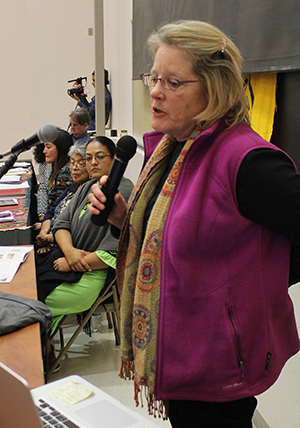
Verna Teller, former governor of Isleta Pueblo, who gave the keynote speech on Friday night. Photo by Robin Collier.
To see what “diversity” and “multiculturalism” are in action you should have attended the “Dismantling the Nuclear Beast Symposium” at the University of New Mexico last weekend. When I walked into the conference room on Saturday the attendees introducing themselves ranged from the Navajo Nation, Jemez Pueblo, Laguna Pueblo, Acoma Pueblo, Alaska, Utah, Arizona, Española, California, Tularosa, Albuquerque, White Mountain (Ute Mountain Utes), Santa Clara Pueblo, Isleta Pueblo, and Taos. They represent organizations that are fighting to dismantle the nuclear beast from uranium mining and enrichment to weapons production and nuclear waste storage: The Nuclear Issues Study Group; Diné No Nukes; Citizen Action New Mexico; Laguna/Acoma Coalition for a Safe Environment; Concerned Citizens for Nuclear Safety; Nuclear Watch New Mexico; Multicultural Alliance for a Safe Environment; Tewa Women United; Tularosa Basin Downwinders Consortium; Alliance for Environmental Strategies; Haul No!; and Southwest Research and Information Center.
The mining and milling of uranium has hit New Mexico particularly hard. Along what is referred to as the Grants mineral belt and on the Navajo Reservation are the remnants of underground such as La Jara Mesa, Roca Honda Mine, Mount Taylor Mine, Marquez Canyon Mine, four proposed surface mines in the Churchrock/Crown Point area, and 13 abandoned mines within a five mile radius of Churchrock. The open pit Jackpile Mine at Paguate, on Laguna Pueblo, sends radioactive dust into the air, and the former mill sites of Ambrosia Lake, Kerrmac, and Homestake near Milan have contaminated the groundwater and plumes are heading towards Grants and Bluewater. On July 16, 1979, 14 weeks after the Three Mile Island radiation release, the Church Rock uranium mill tailings disposal pond breached its dam and 1,100 tons of radioactive mill waste and approximately 93 million gallons of mine effluent flowed into the Rio Puerco, through the town of Gallup, and into Arizona. The contaminated water left residues of radioactive uranium, thorium, radium, and polonium, as well as traces of metals such as cadmium, aluminum, magnesium, manganese, molybdenum, nickel, selenium, sodium, vanadium, zinc, iron, lead and high concentrations of sulfates.
A precipitous drop in uranium prices in the 1980s squelched the mining and milling boom that created this development, but the panelists at the Saturday morning symposium are still dealing with its residue and anticipating its possible rebirth if the price of uranium once again increases. Klee Benally, a Diné activist who lives in Flagstaff, told the audience that 10 million people live in close proximity to abandoned uranium mines that have yet to be cleaned up; 3,272 of those mines are located in five western states. Because uranium is classified a “hard rock” mineral, it falls under the auspices of the 1872 General Mining Act that allows mining companies to avoid responsibility for clean-up (several bills to reform the Mining Act were introduced in the 2000s but were defeated by the mining lobby).
Chris Shuey of the Southwest Research and Information Center (SRIC) explained that the Superfund program is the only law with oversight over these clean-up sites and it’s sorely inadequate; only the Environmental Protection Agency and the corporations responsible for the contamination have a seat at the table to determine the clean-up operation. The billion dollars that has been spent on settlement negotiations has addressed only 40 percent of identified mines.
Yolanda Badback, of the Ute Mountain Ute tribe of Utah, lives in a community called White Mesa that lies five miles north of the White Mesa uranium mill, the only conventional uranium mill operating in the United States today. While the mill is currently undergoing a licensing renewal, there are plans to ship clean-up waste from mines and mills that are no longer in operation to the White Mesa mill. Badback wants the mine closed: her community has to drink bottled water because of aquifer contamination.
. . . . .
The afternoon panel consisted of activists who are engaged in the second phase of the nuclear beast: the development of nuclear weapons and nuclear waste storage. Beata Tsosie-Peña and Kathy Sanchez of Tewa Women United spoke about the impacts of Los Alamos National Laboratory (LANL), which sits on the Pajarito Plateau directly above their pueblos, on the environment, on their cultural connections, their art, and their personal lives. Myrriah Gomez, who is a UNM professor in the Honors College, spoke of her grandparents, who were part of the homesteaders community on the Pajarito Plateau forcibly removed when the Army took over the area to establish the Lab during World War II. Born and raised in El Rancho, where her family relocated, Gomez now works with both Concerned Citizens for Nuclear Safety (CCNS), and the Tularosa Basin Downwinders Consortium.
These two groups are led by powerful New Mexico women, Joni Arends and Tina Córdova. Córdova, born and raised in the small Hispano village of Tularosa, founded the Consortium in 2005 to force the U.S. government to acknowledge the impact on downwinders of the first nuclear blast test detonation at the Trinity Site near Tularosa in 1945. These “unknowing, unwilling, uncompensated, innocent victims” have suffered debilitating health defects from the radioactivity released during the bomb test. Her group has been pushing for a bill in Congress to include the Tularosa Downwinders in the Radiation Exposure Compensation Act (RECA) that covers uranium miners and workers exposed to atmospheric nuclear testing (according to Córdova, $2 billion has thus far been paid in compensation). The bill has been held up in Congress for seven years, and a recent hearing on the bill was postponed.
Joni Arends of Concerned Citizens for Nuclear Safety. Photo by Robin Collier
Joni Arends has been demanding accountability at LANL for 30 years as an opponent of the Waste Isolation Pilot Program and director of CCNS. More than 21 million cubic feet of toxic waste has been buried at LANL since 1943. Joni has done the due diligence necessary to monitor the Lab’s adherence to the Resource Conservation and Recovery Act (RCRA) that deals with the disposal of hazardous waste at LANL. Numerous violations have occurred over the years: monitoring wells designed to measure underground contamination were inadequately designed and built; chromium plumes extend from the Lab’s boundaries towards the Rio Grande. Since 2010 Joni has been working with Tina Córdova and the Tularosa Basin Downwinders Consortium to prepare a Health Impact Assessment on the downwinders.
While the moderators of the symposium, Leona Morgan (Diné) and Eileen Shaughnessy (UNM professor), co-founders of the Nuclear Issues Study Group, stressed throughout the day that the gathering was not only a report on the history of the nuclear industry and the battles currently being waged to dismantle it, but also a pledge of resistance with innovative ideas on how to proceed. But the last panelist on Saturday’s schedule, Jay Coghlan of Nuclear Watch New Mexico, acknowledged the difficulties of this fight in his discussion of current political realities. LANL currently spends $1.7 billion dollars a year on nuclear weapons production; Sandia Laboratory in Albuquerque spends $1.8 billion. Kirtland Air Force Base stores 2,500 warheads on the outskirts of Albuquerque. The National Nuclear Security Administration, which manages all things nuclear under the Department of Energy, has requested a $10.2 billion budge for 2018. Our congressional delegation continues to support pit production (the plutonium core of a nuclear weapon) at LANL, development of the so-called smart weapons, the stockpile stewardship program—in other words, all things nuclear. In the meantime, poverty listings by state (including Washington D.C.) rank New anywhere from 47th to 51st.
Eileen Shaughnessy and Leona Morgan. Photo by Robin Collier
Politically, our resistance has to debunk their rationale that these nuclear industries are the engines that drive the economy of New Mexico; all nuclear conductors should be fired and replaced with alternative energy drivers. A billion dollars spent on clean-up at both Labs and at Kirtland could provide thousands of jobs and perhaps save us from the chromium plume headed towards the Rio Grande, contamination from Sandia’s mixed waste landfill, and Kirtland’s jet fuel plume flowing beneath the streets of Albuquerque.
Signing the U.N Treaty on the Prohibition of Nuclear Weapons would be a huge step towards this goal. The indigenous people of the world, those who “have been most negatively impacted by nuclear colonialism,” are taking a leading role in the work necessary to dismantle this nuclear beast. They are the resistance.
With the third anniversary of the start of the Fukushima Daiichi nuclear catastrophe coming next week, the attempted Giant Lie about the disaster continues—a suppression of information, an effort at dishonesty of historical dimensions.
It involves international entities, especially the International Atomic Energy Agency, national governmental bodies—led in Japan by its current prime minister, the powerful nuclear industry and a “nuclear establishment” of scientists and others with a vested interest in atomic energy.
Deception was integral to the push for nuclear power from its start. Indeed, I opened my first book on nuclear technology, Cover Up: What You Are Not Supposed to Know About Nuclear Power, with: “You have not been informed about nuclear power. You have not been told. And that has been done on purpose. Keeping the public in the dark was deemed necessary by the promoters of nuclear power if it was to succeed. Those in government, science and private industry who have been pushing nuclear power realized that if people were given the facts, if they knew the consequences of nuclear power, they would not stand for it.”
Published in 1980, the book led to my giving many presentations on nuclear power at which I’ve often heard the comment that only when catastrophic nuclear accidents happened would people fully realize the deadliness of atomic energy.
Well, massive nuclear accidents have occurred—the 1986 Chernobyl disaster and the Fukushima catastrophe that began on March 11, 2011 and is ongoing with large discharges of radioactive poisons continuing to be discharged into the environment.
Meanwhile, the posture of the nuclear promoters is denial—insisting the impacts of the Fukushima catastrophe are essentially non-existent. A massive nuclear accident has occurred and they would make believe it hasn’t.
“Fukushima is an eerie replay of the denial and controversy that began with the atomic bombings of Hiroshima and Nagasaki,” wrote Yale University Professor Emeritus Charles Perrow in the Bulletin of the Atomic Scientistslast year. “This is the same nuclear denial that also greeted nuclear bomb tests, plutonium plant disasters at Windscale in northern England and Chelyabinsk in the Ural Mountains, and the nuclear power plant accidents at Three Mile Island in the United States and Chernobyl in what is now Ukraine.”
The difference with Fukushima is the scale of disaster. With Fukushima were multiple meltdowns at the six-nuclear plant site. There’s been continuing pollution of a major part of Japan, with radioactivity going into the air, carried by the winds to fall out around the world, and gigantic amounts of radioactivity going into the Pacific Ocean moving with the currents and carried by marine life that ingests the nuclear toxins.
Leading the Fukushima cover-up globally is the International Atomic Energy Agency, formed by the United Nations in 1957 with the mission to “seek to accelerate and enlarge the contribution of atomic energy to peace, health and prosperity throughout the world.”
Of the consequences of the Fukushima disaster, “To date no health effects have been reported in any person as a result of radiation exposure from the accident,” declared the IAEA in 2011, a claim it holds to today.
Working with the IAEA is the World Health Organization. WHO was captured on issues of radioactivity and nuclear power early on by IAEA. In 1959, the IAEA and WHO, also established by the UN, entered into an agreement—that continues to this day—providing that IAEA and WHO “act in close co-operation with each other” and “whenever either organization proposes to initiate a program or activity on a subject in which the other organization has or may have a substantial interest, the first party shall consult the other with a view to adjusting the matter by mutual agreement.”
The IAEA-WHO deal has meant that “WHO cannot undertake any research, cannot disseminate any information, cannot come to the assistance of any population without the prior approval of the IAEA…WHO, in practice, in reality, is subservient to the IAEA within the United Nations family,” explained Alison Katz who for 18 years worked for WHO, on Libbe HaLevy’s “Nuclear Hotseat” podcast last year.
On nuclear issues “there has been a very high level, institutional and international cover-up which includes governments, national authorities, but also, regrettably the World Health Organization,” said Katz on the program titled, “The WHO/IAEA—Unholy Alliance and Its Lies About Int’l Nuclear Health Stats.” Katz is now with an organization called IndependentWHO which works for “the complete independence of the WHO from the nuclear lobby and in particular from its mouthpiece which is the International Atomic Energy Agency. We are demanding that independence,” she said, “so that the WHO may fulfill its constitutional mandate in the area of radiation and health.”
“We are absolutely convinced,” said Katz on “Nuclear Hotseat,” “that if the health and environmental consequences of all nuclear activities were known to the public, the debate about nuclear power would end tomorrow. In fact, the public would probably exclude it immediately as an energy option.”
WHO last year issued a report on the impacts of the Fukushima disaster claiming that “for the general population inside and outside of Japan, the predicted risks are low and no observable increases in cancer rates above baseline rates are anticipated.”
Then there is the new prime minister of Japan, Shinzo Abe, who last year insisted before the International Olympic Committee as he successfully pushed to have the 2020 Summer Olympics in Tokyo (180 miles from Fukushima): “There are no health-related problems until now, nor will there be in the future, I make the statement to you in the most emphatic and unequivocal way.” Abe has been driving hard for a restart of Japan’s 54 nuclear power plants, all shut down in the wake of the Fukushima catastrophe.
His is a totally different view than that of his predecessor, Naoto Kan, prime minister when the disaster began. Kan told a conference in New York City last year of how he had been a supporter of nuclear power but after the Fukushima accident “I changed my thinking 180-degrees, completely.” He declared that at one point it looked like an “area that included Tokyo” and populated by 50 million people might have to be evacuated. “We do have accidents such as an airplane crash and so on,” Kan said, “but no other accident or disaster” other than a nuclear plant disaster can “affect 50 million people… no other accident could cause such a tragedy.” Moreover, said Kan, “without nuclear power plants we can absolutely provide the energy to meet our demands.” Japan since the accident began has tripled its use of solar energy, he said, and pointed to Germany as a model with its post-Fukushima commitment to shutting down all its nuclear power plants and having “all its power supplied by renewable power” by 2050. The entire world could do this, said Kan. “If humanity really would work together… we could generate all our energy through renewable energy.”
A major factor in Abe’s stance is Japan having become a global player in the nuclear industry. General Electric (the manufacturer of the Fukushima plants) and Westinghouse have been the Coke and Pepsi of nuclear power plants worldwide, historically building or designing 80 percent of them. In 2006, Toshiba bought Westinghouse’s nuclear division and Hitachi entered into a partnership with GE in its nuclear division. Thus the two major nuclear power plant manufacturers worldwide are now Japanese brands. Abe has been busy traveling the world seeking to peddle Toshiba-Westinghouse and Hitachi-GE nuclear plants to try to lift Japan’s depressed economy.
As for the nuclear industry, the “Fukushima accident has caused no deaths,” declares the World Nuclear Association in its statement “Safety of Nuclear Power Reactors…Updated October 2013.” The group, “representing the people and organizations of the global nuclear profession,” adds: “The Fukushima accident resulted in some radiation exposure of workers at the plant, but not such as to threaten their health.”
What will the consequences of the Fukushima Daiichi nuclear disaster be?
It is impossible to know exactly now. But considering the gargantuan amount of radioactive poisons that have been discharged and what will continue to be released, the impacts will inevitably be great. The claim of there being no consequences to life and the prediction that there won’t be in the future from the Fukushima catastrophe is an outrageous falsehood.
That’s because it is now widely understood that there is no “safe” level of radioactivity. Any amount can kill. The more radioactivity, the greater the impacts. As the National Council on Radiation Protection has declared: “Every increment of radiation exposure produces an incremental increase in the risk of cancer.”
There was once the notion of there being a “threshold dose” of radioactivity below which there would be no harm. That’s because when nuclear technology began and people were exposed to radioactivity, they didn’t promptly fall down dead. But as the years went by, it was realized that lower levels of radioactivity take time to result in cancer and other illnesses—that there is a five-to-40-year “incubation” period
Projecting a death toll of more than a million from the radioactivity released from Fukushima is Dr. Chris Busby, scientific secretary of the European Committee on Radiation Risk who has been a professor at a number of universities. . “Fukushima is still boiling radionuclides all over Japan,” he said. “Chernobyl went up in one go. So Fukushima is worse.”
Indeed, a report by the Institute for Science in Society, based in the U.K., has concluded: “State-of-the-art analysis based on the most inclusive datasets available reveals that radioactive fallout from the Fukushima meltdown is at least as big as Chernobyl and more global in reach.”
A death toll of up to 600,000 is estimated in a study conducted for the Nordic Probabilistic Safety Assessment Group which is run by the nuclear utilities of Finland and Sweden.
Dr. Helen Caldicott, a founder of Physicians for Social Responsibility, told a symposium on “The Medical Implications of Fukushima” held last year in Japan: “The accident is enormous in its medical implications. It will induce an epidemic of cancer as people inhale the radioactive elements, eat radioactive vegetables, rice and meat, and drink radioactive milk and teas. As radiation from ocean contamination bio-accumulates up the food chain…radioactive fish will be caught thousands of miles from Japanese shores. As they are consumed, they will continue the the cycle of contamination, proving that no matter where you are, all major nuclear accidents become local.”
Dr. Caldicott, whose books on nuclear power include Nuclear Madness, also stated: “The Fukushima disaster is not over and will never end. The radioactive fallout which remains toxic for hundreds to thousands of years covers large swaths of Japan will never be ‘cleaned up’ and will contaminate food, humans and animals virtually forever.”
Arnie Gundersen, a former nuclear industry senior vice president, has said: “The health impacts to the Japanese will begin to be felt in several years and out to 30 or 40 years from cancers. And I believe we’re going to see as many as a million cancers over the next 30 years because of the Fukushima incident in Japan.”
At Fukushima, “We have opened a door to hell that cannot be easily closed—if ever,” said Paul Gunter, director of the Reactor Oversight Project at the U.S.-based group Beyond Nuclear last year.
Already an excessive number of cases of thyroid cancers have appeared in Japan, an early sign of the impacts of radioactivity. A study last year by Joseph Mangano and Dr. Janette Sherman of the Radiation and Public Health Project, and Dr. Chris Busby, determined that radioactive iodine fall-out from Fukushima damaged the thyroid glands of children in California. And the biggest wave of radioactivity in the Pacific Ocean from Fukushima is slated to hit the west coast of North America in the next several months.
Meanwhile, every bluefin tuna caught in the waters off California in a Stanford University study was found to be contaminated with cesium-137, a radioactive poison emitted on a large scale by Fukushima. The tuna migrate from off Japan to California waters. Daniel Madigan, who led the study, commented: “The tuna packaged it up [the radiation] and brought it across the world’s largest ocean. We were definitely surprised to see it at all and even more surprised to see it in every one we measured.”
There is, of course, the enormous damage to property. The Environmental Health Policy Institute of Physicians for Social Responsibility (PSR) in its summary of the “Costs and Consequences of the Fukushima Daiichi Disaster” cites estimates of economic loss of between $250 billion and $500 billion. Some 800 square kilometers are “exclusion” zones of “abandoned cities, towns, agricultural land, homes and properties” and from which 159,128 people have been “evicted,” relates PSR senior scientist Steven Starr. Further, “about a month after the disaster, on April 19, 2011, Japan chose to dramatically increase its official ‘safe’ radiation exposure levels from 1 mSv [millisievert, a measure of radiation dose] to 20 mSv per year—20 times higher than the U.S. exposure limit. This allowed the Japanese government to downplay the dangers of the fallout and avoid evacuation of many badly contaminated areas.”
And last year the Japanese government enacted a new State Secrets Act which can restrict—with a penalty of 10 years in jail—reporting on Fukushima. “”It’s the cancerous mark of a nuclear regime bound to control all knowledge of a lethal global catastrophe now ceaselessly escalating,” wrote Harvey Wasserman, co-author of Killing Our Own, in a piece aptly titled “Japan’s New ‘Fukushima Fascism’.”
Meanwhile, back in the U.S., the nation’s Nuclear Regulatory Commission has over the past three years consistently refused to apply “lessons learned” from Fukushima. Its chairman, Dr. Gregory Jaczko, was forced out after an assault led by the nuclear industry after trying to press this issue and opposing an NRC licensing of two new nuclear plants in Georgia “as if Fukushima had never happened.”
Rosalie Bertell, a Catholic nun, in her book No Immediate Danger, wrote about the decades of suppression of the impacts of nuclear power and the reason behind it: “Should the public discover the true health cost of nuclear pollution, a cry would rise from all parts of the world and people would refuse to cooperative passively with their own death.”
Thus the desperate drive—in which a largely compliant mainstream media have been complicit—to deny the Fukushima catastrophe, a disaster deeply affecting life on Earth.