Showing posts with label Noise pollution. Show all posts

Tuesday, June 14, 2022

3594. How Nonhuman Animals Perceive the World

 By Ed Yong, The Atlantic, June 13, 2022
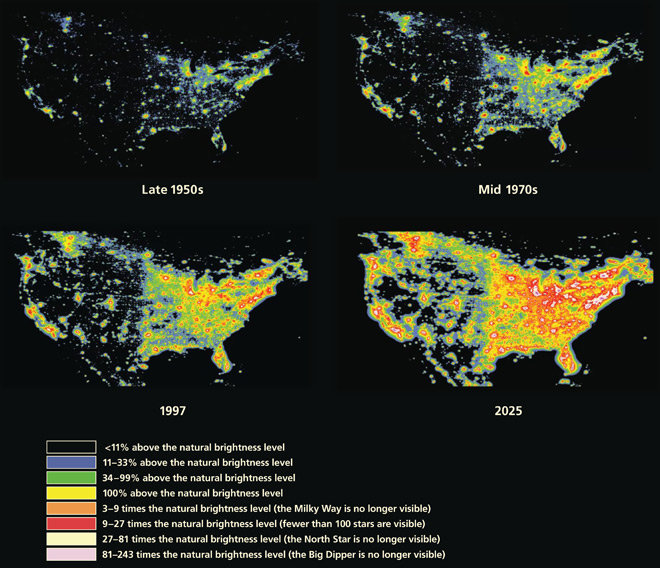
Increasing light pollution in the U.S.


Within the 310,000 acres of Wyoming’s Grand Teton National Park, one of the largest parking lots is in the village of Colter Bay. Beyond the lot’s far edge, nestled among some trees, is a foul-smelling sewage-pumping station that Jesse Barber, a sensory ecologist at Boise State University, calls the Shiterator. On this particular night, sitting quietly within a crevice beneath the building’s metal awning and illuminated by Barber’s flashlight, is a little brown bat. A white device the size of a rice grain is attached to the bat’s back. “That’s the radio tag,” Barber tells me. He’d previously affixed it to the bat so that he could track its movements, and tonight he has returned to tag a few more.

From inside the Shiterator, I can hear the chirps of other roosting bats. As the sun sets, they start to emerge. A few become entangled in the large net Barber has strung between two trees. He frees a bat, and Hunter Cole, one of his students, carefully examines it to check that it’s healthy and heavy enough to carry a tag. Once satisfied, Cole daubs a spot of surgical cement between its shoulder blades and attaches the tiny device. “It’s a little bit of an art project, the tagging of a bat,” Barber tells me. After a few minutes, Cole places the bat on the trunk of the nearest tree. It crawls upward and takes off, carrying $175 worth of radio equipment into the woods.

I watch as the team examines another bat, which opens its mouth and exposes its surprisingly long teeth. This isn’t an aggressive display; it only looks like one. The bat is unleashing a stream of short, ultrasonic pulses from its mouth, which are too high-pitched for me to hear. Bats, however, can hear ultrasound, and by listening for the returning echoes, they can detect and locate objects around them.

Echolocation is the primary means through which most bats navigate and hunt. Only two animal groups are known to have perfected the ability: toothed whales (such as dolphins, orcas, and sperm whales) and bats. Echolocation differs from human senses because it involves putting energy into the environment. Eyes scan, noses sniff, and fingers press, but these sense organs are always picking up stimuli that already exist in the wider world. By contrast, an echolocating bat creates the stimulus that it later detects. Echolocation is a way of tricking your surroundings into revealing themselves. A bat says “Marco,” and its surroundings can’t help but say “Polo.”

The basic process seems straightforward, but its details are extraordinary. High-pitched sounds quickly lose energy in air, so bats must scream to make calls that are strong enough to return audible echoes. To avoid deafening themselves, bats contract the muscles in their ears in time with their calls, desensitizing their hearing with every shout and restoring it in time for the echo. Each echo provides a snapshot in time, so bats must update their calls quickly to track fast-moving insects; fortunately, their vocal muscles are the fastest known muscles in any mammal, releasing up to 200 pulses a second. A bat’s nervous system is so sensitive that it can detect differences in echo delay of just one- or two-millionths of a second, which translates to a physical distance of less than a millimeter. A bat thus gauges the distance to an insect with far more precision than humans can.

Echolocation’s main weakness is its short range: Some bats can detect small moths from about six to nine yards away. But they can do so in darkness so total that vision simply doesn’t work. Even in pitch-blackness, bats can skirt around branches and pluck minuscule insects from the sky. Of course, bats are not the only animals that hunt nocturnally. In the Tetons, as I watch Barber tagging bats, mosquitoes bite me through my shirt, attracted by the smell of the carbon dioxide on my breath. While I itch, an owl flies overhead, tracking its prey using a radar dish of stiff facial feathers that funnel sound toward its ears. These creatures have all evolved senses that allow them to thrive in the dark. But the dark is disappearing.

Barber is one of a growing number of sensory biologists who fear that humans are polluting the world with too much light, to the detriment of other species. Even here, in the middle of a national park, light from human technology intrudes upon the darkness. It spews forth from the headlights of passing vehicles, from the fluorescent bulbs of the visitor center, and from the lampposts encircling the parked cars. “The parking lot is lit up like a Walmart because no one thought about the implications for wildlife,” Barber says.

Many flying insects are fatally attracted to streetlights, mistaking them for celestial lights and hovering below them until they succumb to exhaustion. Some bats exploit their confusion, feasting on the disoriented swarms. Other, slower-moving species, including the little brown bats that Barber tagged, stay clear of the light, perhaps because it makes them easier prey for owls. Lights reshape animal communities, drawing some in and pushing others away, with consequences that are hard to predict.

To determine the effect of light on the bats of Grand Teton, Barber persuaded the National Park Service to let him try an unusual experiment. In 2019, he refitted all 32 streetlights in the Colter Bay parking lot with special bulbs that can change color. They can produce either white light, which strongly affects the behavior of insects and bats, or red light, which doesn’t seem to. Every few days during my visit, Barber’s team flips their color. Funnel-shaped traps hanging below the lamps collect the gathering insects, while radio transponders pick up the signals from the tagged bats. These data should reveal how normal white lights affect the local animals, and whether red lights can help rewild the night sky.

Cole gives me a little demonstration by flipping the lights to red. At first, the parking lot looks disquietingly infernal, as if we have stepped into a horror movie. But as my eyes adjust, the red hues feel less dramatic and become almost pleasant. It is amazing how much we can still see. The cars and the surrounding foliage are all visible. I look up and notice that fewer insects seem to be gathered beneath the lamps. I look up even farther and see the stripe of the Milky Way cutting across the sky. It’s an achingly beautiful sight, one I have never seen before in the Northern Hemisphere.

Every animal is enclosed within its own sensory bubble, perceiving but a tiny sliver of an immense world. There is a wonderful word for this sensory bubble—Umwelt. It was defined and popularized by the Baltic German zoologist Jakob von Uexküll in 1909. Umwelt comes from the German word for “environment,” but Uexküll didn’t use it to refer to an animal’s surroundings. Instead, an Umwelt is specifically the part of those surroundings that an animal can sense and experience—its perceptual world. A tick, questing for mammalian blood, cares about body heat, the touch of hair, and the odor of butyric acid that emanates from skin. It doesn’t care about other stimuli, and probably doesn’t know that they exist. Every Umwelt is limited; it just doesn’t feel that way. Each one feels all-encompassing to those who experience it. Our Umwelt is all we know, and so we easily mistake it for all there is to know. This is an illusion that every creature shares.

Humans, however, possess the unique capacity to appreciate the Umwelten of other species, and through centuries of effort, we have learned much about those sensory worlds. But in the time it took us to accumulate that knowledge, we have radically remolded those worlds. Much of the devastation that we have wrought is by now familiar. We have changed the climate and acidified the oceans. We have shuffled wildlife across continents, replacing indigenous species with invasive ones. We have instigated what some scientists have called an era of “biological annihilation,” comparable to the five great mass-extinction events of prehistory. But we have also filled the silence with noise and the night with light. This often ignored phenomenon is called sensory pollution—human-made stimuli that interfere with the senses of other species. By barraging different animals with stimuli of our own making, we have forced them to live in our Umwelt. We have distracted them from what they actually need to sense, drowned out the cues they depend upon, and lured them into sensory traps. All of this is capable of doing catastrophic damage.
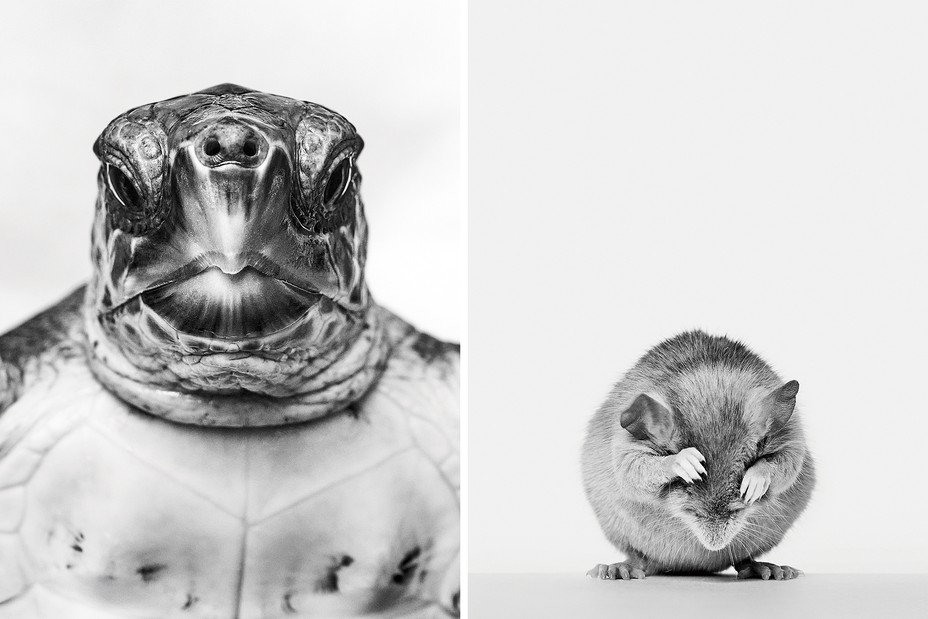

2 black and white photos: a close-up view of a sea turtle's head; a titmouse with head bowed and paws over eyes
A sea turtle’s hatchlings can be diverted away from the sea by artificial lights. For mice, human-made noise
can mask the sounds of predators. (Shayan Asgharnia for The Atlantic)

In 2001, astronomer Pierantonio Cinzano and his colleagues created the first global atlas of light pollution. They calculated that two-thirds of the world’s population lived in light-polluted areas, where the nights were at least 10 percent brighter than natural darkness. About 40 percent of humankind is permanently bathed in the equivalent of perpetual moonlight, and about 25 percent constantly experiences an artificial twilight that exceeds the illumination of a full moon. “‘Night’ never really comes for them,” the researchers wrote. In 2016, when the team updated the atlas, it found that the problem had become even worse. By then, about 83 percent of people—including more than 99 percent of Americans and Europeans—were under light-polluted skies. More than a third of humanity, and almost 80 percent of North Americans, can no longer see the Milky Way. “The thought of light traveling billions of years from distant galaxies only to be washed out in the last billionth of a second by the glow from the nearest strip mall depresses me to no end,” the visual ecologist Sönke Johnsen once wrote.

At Colter Bay, Cole flips the lights from red back to white and I wince. The extra illumination feels harsh and unpleasant. The stars seem fainter now. Sensory pollution is the pollution of disconnection. It detaches us from the cosmos. It drowns out the stimuli that link animals to their surroundings and to one another. In making the planet brighter and louder, we have endangered sensory environments for countless species in ways that are less viscerally galling than clear-cut rain forests and bleached coral reefs but no less tragic. That must now change. We can still save the quiet and preserve the dark.

Every year on September 11, the sky above New York City is pierced by two columns of intense blue light. This annual art installation, known as Tribute in Light, commemorates the terrorist attacks of 2001, with the ascending beams standing in for the fallen Twin Towers. Each is produced by 44 xenon bulbs with 7,000-watt intensities. Their light can be seen from 60 miles away. From closer up, onlookers often notice small flecks, dancing amid the beams like gentle flurries of snow. Those flecks are birds. Thousands of them.

This annual ritual, unfortunately, occurs during the autumn migratory season, when billions of small songbirds undertake long flights through North American skies. Navigating under the cover of darkness, they fly in such large numbers that they show up on radar. By analyzing meteorological radar images, Benjamin Van Doren showed that Tribute in Light, across seven nights of operation, waylaid about 1.1 million birds. The beams reach so high that even at altitudes of several miles, passing birds are drawn into them. Warblers and other small species congregate within the light at up to 150 times their normal density levels. They circle slowly, as if trapped in an incorporeal cage. They call frequently and intensely. They occasionally crash into nearby buildings.

Migrations are grueling affairs that push small birds to their physiological limit. Even a night-long detour can sap their energy reserves to fatal effect. So whenever 1,000 or more birds are caught within Tribute in Light, the bulbs are turned off for 20 minutes to let the birds regain their bearing. But that’s just one source of light among many, and though intense and vertical, it shines only once a year. At other times, light pours out of sports stadiums and tourist attractions, oil rigs and office buildings. It pushes back the dark and pulls in migrating birds.

In 1886, shortly after Thomas Edison commercialized the electric light bulb, about 1,000 birds died after colliding with illuminated towers in Decatur, Illinois. More than a century later, the environmental scientist Travis Longcore and his colleagues calculated that almost 7 million birds die each year in the United States and Canada after flying into communication towers. The lights of those towers are meant to warn aircraft pilots, but they also disrupt the orientation of nocturnal avian fliers, which then veer into wires or each other. Many of these deaths could be avoided simply by replacing steady lights with blinking ones.

We too quickly forget that we don’t perceive the world in the same way as other species, and consequently, we ignore impacts that we shouldn’t,” Longcore tells me in his Los Angeles office. Our eyes are among the sharpest in the animal kingdom, but their high resolution comes with the cost of low sensitivity. Unlike most other mammals, our vision fails us at night, so we crave more nocturnal illumination, not less.

The idea of light as a pollutant is jarring to us, but it becomes one when it creeps into places where it doesn’t belong. Widespread light at night is a uniquely anthropogenic force. The daily and seasonal rhythms of bright and dark remained largely inviolate throughout all of evolutionary time—a 4-billion-year streak that began to falter in the 19th century.

When sea-turtle hatchlings emerge from their nests, they crawl away from the dark shapes of dune vegetation toward the brighter oceanic horizon. But lit roads and beach resorts can steer them in the wrong direction, where they are easily picked off by predators or squashed by vehicles. In Florida alone, artificial lights kill baby turtles in the thousands every year. They’ve wandered into a baseball game and, more horrifying, abandoned beach fires. The caretaker of one property in Melbourne Beach found hundreds of dead hatchlings piled beneath a single mercury-vapor lamp.
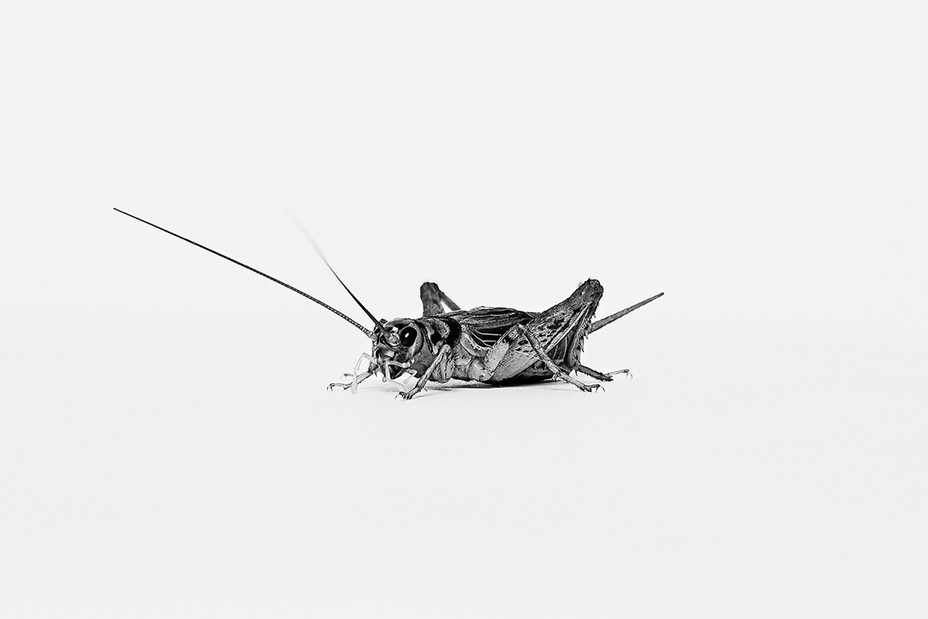

black and white photo of cricket
Female crickets struggle to find the best mates when noise pollution masks the males’ songs. (Shayan Asgharnia for The Atlantic)

Artificial lights can also fatally attract insects, contributing to their alarming global declines. A single streetlamp can lure moths from 25 yards away, and a well-lit road might as well be a prison. Many of the insects that gather around streetlamps will likely be eaten or dead from exhaustion by sunrise. Those that zoom toward vehicle headlights will probably be gone even sooner. The consequences of these losses can ripple across ecosystems. In 2014, as part of an experiment, the ecologist Eva Knop installed streetlamps in seven Swiss meadows. After sunset, she prowled these fields with night-vision goggles, peering into flowers to search for moths and other pollinators. By comparing these sites to others that had been kept dark, Knop showed that the illuminated flowers received 62 percent fewer visits from pollinating insects. One plant produced 13 percent less fruit even though it was visited by a day shift of bees and butterflies.

The presence of light isn’t the only factor that matters; so does its nature. Insects with aquatic larvae, such as mayflies and dragonflies, will fruitlessly lay their eggs on wet roads, windows, and car roofs, because these reflect horizontally polarized light in the same way bodies of water do. Rapidly flickering light bulbs can cause headaches and other neurological problems in humans, even though our eyes are usually too slow to detect these changes; what, then, do they do to animals with faster vision, like insects and small birds?

Colors matter, too. Red is better for bats and insects but can waylay migrating birds. Yellow doesn’t bother turtles or most insects but can disrupt salamanders. No wavelength is perfect, Longcore says, but blue and white are the worst of all. Blue light interferes with body clocks and strongly attracts insects. It is also easily scattered, increasing the spread of light pollution. It is, however, cheap and efficient to produce. The new generation of energy-efficient white LEDs contain a lot of blue light, and the world might switch to them from traditional yellow-orange sodium lights. In energy terms, that would be an environmental win. But it would also increase the amount of global light pollution by two or three times. 

Saturday, January 26, 2019

3170. Oceans Are Getting Louder, Posing Potential Threats to Marine Life

By Jim Robbins, The New York Times, January 22, 2019


A container ship crossing under the Lions Gate Bridge in Vancouver. Increasing traffic and the threat of seismic blasts for offshore drilling exploration are dangerous to marine life, scientists warn.CreditCreditAlana Paterson for The New York Times

Slow-moving, hulking ships crisscross miles of ocean in a lawn mower pattern, wielding an array of 12 to 48 air guns blasting pressurized air repeatedly into the depths of the ocean.

The sound waves hit the sea floor, penetrating miles into it, and bounce back to the surface, where they are picked up by hydrophones. The acoustic patterns form a three-dimensional map of where oil and gas most likely lie.

The seismic air guns probably produce the loudest noise that humans use regularly underwater, and it is about to become far louder in the Atlantic. As part of the Trump administration’s plans to allow offshore drilling for gas and oil exploration, five companies have been given permits to carry out seismic mapping with the air guns all along the Eastern Seaboard, from Central Florida to the Northeast, for the first time in three decades. The surveys haven’t started yet in the Atlantic, but now that the ban on offshore drilling has been lifted, companies can be granted access to explore regions along the Gulf of Mexico and the Pacific.

And air guns are now the most common method companies use to map the ocean floor.
“They fire approximately every 10 seconds around the clock for months at a time,” said Douglas Nowacek, a professor of marine conservation technology at Duke University. "They have been detected 4,000 kilometers away. These are huge, huge impacts.”

The prospect of incessant underwater sonic tests is the latest example cited by environmentalists and others of the growing problem of ocean noise, spawning lawsuits against some industries and governments as well as spurring more research into the potential dangers for marine life.

Some scientists say the noises from air guns, ship sonar and general tanker traffic can cause the gradual or even outright death of sea creatures, from the giants to the tiniest — whales, dolphins, fish, squid, octopuses and even plankton. Other effects include impairing animals’ hearing, brain hemorrhaging and the drowning out of communication sounds important for survival, experts say.

So great is the growing din in the world’s oceans that experts fear it is fundamentally disrupting the marine ecosystem, diminishing populations of some species as the noise levels disturb feeding, reproduction and social behavior.

2017 study, for example, found that a loud blast, softer than the sound of a seismic air gun, killed nearly two-thirds of the zooplankton in three-quarters of a mile on either side. Tiny organisms at the bottom of the food chain, zooplankton provide a food source for everything from great whales to shrimp. Krill, a tiny crustacean vital to whales and other animals, were especially hard hit, according to one study.

“Researchers saw a complete absence of life around the air gun,” said Michael Jasny, director of marine mammal protection for the Natural Resources Defense Council, one of several environmental groups suing the federal government in an effort to stop the seismic surveys.

Measuring the sounds of commerce

Each seismic shot from the air guns is estimated to reach up to 260 underwater decibels, equal to about 200 decibels in the atmosphere. Container ships, another noisemaker on the seas, make sounds up to 190 decibels — the equivalent of 130 decibels in the atmosphere. (The launch of a space shuttle, by contrast, reaches about 160 decibels for those nearby.)

Every 10 decibels is an order of magnitude. An explosion of 200 decibels, then, is 10 times more intense than the sound of a container ship. Because water is much denser than air, sound travels underwater about four times faster and much farther than above the sea’s surface.

“At any one time, there are 20, 30 or 40 seismic surveys going on around the world,” for oil and gas exploration, as well as for geological research, Dr. Nowacek said.

All told in the first year of the newly approved exploration, more than five million of these huge explosions would occur all along the United States’ eastern coastline.

Christopher Clark, a senior researcher in the bioacoustics program at the Cornell Lab of Ornithology, who has studied whale communication for 40 years, described the noise as a “living hell” for undersea life, which is exquisitely tuned to sound. 

A coalition of environmental groups has filed suit against the National Marine Fisheries Service, a division of the National Oceanic and Atmospheric Administration, claiming the agency is violating several federal laws protecting wildlife, including the Endangered Species Act, by allowing the blasts. And governors from 10 states have protested the offshore drilling decision and are seeking to join the legal action.

Harming or injuring marine mammals is forbidden under the Marine Mammal Protection Act. In November, NOAA issued five authorizations allowing seismic exploration companies to “incidentally, but not intentionally, harass marine mammals.” Because of the government shutdown, other government action to begin testing has been postponed until at least March 1.

The companies involved in the exploration disagree sharply with the claims of harm. “More than 50 years of extensive surveying and scientific research indicate that the risk of direct physical injury to marine mammals is extremely low,” Gail Adams-Jackson, vice president of communications for the International Association of Geophysical Contractors, said in a statement. She contended that the groups’ efforts are solely aimed at stopping offshore exploration and development.

The companies and NOAA Fisheries said that the effects on marine life could be kept to a minimum by careful monitoring and mitigation, which would involve acoustic monitoring to detect mammal vocalizations and shutting down exploration when sensitive species like the endangered North Atlantic right whales are observed.

There are no more than 400 to 500 of the migratory right whales, which can grow up to 60 feet long, and calve and nurse their young from North Carolina to Florida. Right whales are already emaciated and stressed by a warmer ocean — they live in the Gulf of Maine, which has warmed considerably more than other bodies of water. Reproduction has been drastically reduced. And the seismic noise can mask ship sounds, resulting in collisions, another leading danger for the whales.

“We require strong protections for North American right whales in areas where they are expected to be present, including all designated habitat,” Benjamin Laws, a NOAA biologist said, defending the issuance of the permits.

Carrying sound across the ocean

Cavitation, the noise from the synchronous collapse of bubbles created by a ship’s propeller, as well as the rumble of ship engines, poses an ever bigger problem to marine life. And shipping noise could double by 2030.

Years of constant blasts could be extremely harmful, others argue, and not just for right whales. Because of the way sound reverberates in the ocean, the noise can be unrelenting.

“Prolonged chronic stress of any kind is bad, because it shunts resources away from reproduction,” Dr. Nowacek said. “It presses your adrenal glands to produce adrenaline and stress hormones, causes weight loss and immunosuppression.”

In a landmark study, when ship traffic greatly decreased after the events of Sept. 11, 2001, researchers noted a significant drop in stress hormones in the feces of right whales in the 

Bay of Fundy in Canada, the first evidence that ship noise can cause chronic stress in whales.
Moreover, acoustic communication is primary in the marine ecosystem, where visibility is so limited. Many whale species are highly intelligent, social beings and communicate in the clicks, moaning, singing and calling of their own languages. Some whales, and orcas (the largest in the dolphin family despite their killer whale designation), hunt prey through echolocation, a kind of natural sonar.

“Sound can travel enormous distances very fast and whales have evolved to take advantage of that,” said Dr. Clark, who has listened to whales near Ireland from coastal Virginia. “They can hear storms a thousand miles away.”

Aside from the seismic noise, compounded sounds from container ships to navy sonar are posing a problem for marine life. As the number of ships moving around the world has increased significantlyin recent years, cavitation, the noise from the synchronous collapse of bubbles created by a ship’s propeller, as well as the rumble of ship engines, poses a bigger and bigger problem. A recent study found that shipping noise could double by 2030.

Noise masks whale expressions between families, which can affect orientation, feeding, care of young, detection of prey and even increase aggression. Already 80 percent of communications of some species of whales is masked by noise, according to models assessed by a team of biologists.

“It’s ripping the communications system apart,” Dr. Clark said. “And every aspect of their lives is dependent on sound, including finding food.”

About 20,000 known species of fish are able to hear, and some 800 species are known to make sounds of their own to hunt, mate, navigate and communicate. One fish, the plainfish midshipman, for example, sings to the females to mate and defends nests with barking sounds.

Other studies show that beaked whales are extremely sensitive to noise, and in frantic efforts to escape seismic air guns or navy sonar they have been forced to change their dive patterns to the surface. Some have died from decompression sickness.

Loud noises can also affect behavior and even ecosystems by altering where species go. In 2008 in Canada’s Baffin Bay, seismic testing is believed to have delayed the southward migration of narwhals — the whales with the long spiral tusk — until it was too late and they became trapped in sea ice. More than 1,000 died.

The blasting can take a particular toll on a part of the body in invertebrates called the statocyst. In octopuses, squid, lobsters and other invertebrates, the organ is responsible for orientation and balance. Damaged, it disorients the creatures and makes them vulnerable to predators.

Still, while research has expanded in the last decade, much is difficult to pinpoint and sometimes impossible to study. “You can’t study a whale’s hearing,” said Lindy Weilgart, a researcher at Dalhousie University in Nova Scotia and the author of an analysis of 115 studies, released in 2018.

The exposure of mammals to such noise has been likened to living in a permanent construction zone. “Sometimes listening on the headphones gives you a headache within 10 minutes,” Molly Patterson, a researcher who studies underwater sound, said in the 2016 documentary “Sonic Sea.” “You have to take the headphones off, you have to turn the volume down. The whales can’t turn the volume down.”

One way many have escaped the cacophony is by heading to the Arctic. But as polar ice melts, and seismic exploration and ship traffic there increase, it is no longer the refuge it once was.

Ocean noise can also have economic repercussions: Research in Norway shows that commercial fishermen return to the dock with 40 to 80 percent fewer fish when exploration is underway nearby.

Regulations on underwater noise are few and far between and experts are searching for solutions. The United Nations recently held a weeklong symposium on noise pollution and marine life.

Voluntary efforts to turn down the volume are having an effect: The Port of Vancouver started the ECHO (Enhancing Cetacean Habitat and Observation) Program, asking mariners to reduce noise by having ships slow down and fix cavitation on the propellers. 

At the same time, though, if the Trans Mountain pipeline is built from the tar sands of Alberta to a port near Vancouver, as planned, tanker traffic in the Salish Sea is expected to increase by seven times. Marine biologists say that would exacerbate the difficulties the region’s endangered orcas already face in finding prey.

Scientists and environmentalists are urging that more research be conducted, to learn much more about the effects of sound and ship traffic on the creatures of the sea.

“The effects on marine mammals are felt across an extraordinarily large scale,” Mr. Jasny, the marine mammal protection director, said. “And loud noise has an effect on species across the food web.”

Thursday, March 29, 2018

2860. How Songbirds Deal With Noise Pollution


By Hiroko Tabouchi, The New York Times, March 13, 2018
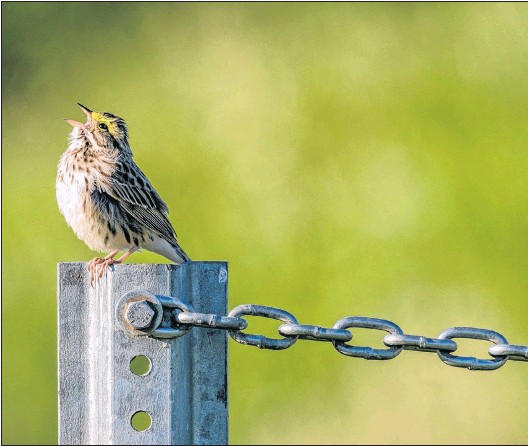
Savannah sparrow singing his love song.  
If a sparrow sings his heart out on an oil field, but his would-be sweetheart can’t hear him above the oil pumps, what’s a bird to do?

In Alberta, Canada, researchers analyzed hundreds of hours of Savannah sparrow love songs and discovered something extraordinary: To be heard above the din, the birds are changing their tune in complex ways that scientists are only starting to understand.

“They’re tailoring their songs depending on which part of their message is the most affected,” said Miyako Warrington, a University of Manitoba biologist who led a recent study on how sparrows cope with noise from the oil and gas infrastructure that dots Canada’s landscape. “This seems to show a complex level of adaptation. It’s not just everybody talking louder.”

Dr. Warrington is one of a growing number of scholars who study the noise generated by human activity — drills, turbines, roaring jet engines — and how that affects the natural world around us.

Mining on the fringes of the Brazilian rain forest, for instance, is disrupting the calls of local black-fronted titi monkeys, a study found last year. Whales and dolphins are known to be particularly vulnerable to the groans of ship engines or offshore drilling, which can disrupt the complex ways they communicate. Research has shown that noise pollution has doubled the background sound levels in more than 60 percent of protected areas in the United States.

And humans are not immune to the din. Epidemiologists have linked traffic noise to cardiovascular and other diseases.

Scholars of birdsong have long noticed that avian city dwellers sound different from their peers in the country. But Dr. Warrington wanted to understand how wild birds adapt to the pumps and drills that oil and gas development has brought to wide swaths of North America.

Her team at Manitoba decided to focus on the mating call of the male Savannah sparrow, a bird slightly larger than a tennis ball with handsome, streaky feathers and a dash of yellow above the eye. Once commonly found on North America’s grasslands, Savannah sparrow populations are on the decline as their natural habitat has dwindled.

In the audio clip below, you can hear two of the birds calling: one in his natural, quiet environment, and one near a generator-powered oil-well screw pump — a raucous machine with a rotating screw that pulls petroleum from the ground.In a quiet environment, the male sparrow’s love song is a string of playful staccatos followed by a throaty buzz and a final, triumphant trill. Using past research on sparrow songs, Dr. Warrington offered an approximate translation of what is essentially a pickup line: “Hey, hey, sexy, hey, I’m Bob, a Savannah sparrow, I’m sexy, sexy.”

In the presence of the screw pump, the sparrow not only adapts the middle section of his song but also lowers the pitch of the opening notes. Dr. Warrington theorizes that the first section is where the song most closely overlaps with the sounds of the screw pump, and that lowering the pitch improves the chances that the opening motif will not get drowned out.
Each bird, of course, adds its own quirks to its songs. To better understand an overall pattern of changes, the research team tracked and recorded 73 male Savannah sparrows at 26 sites within 200 kilometers, or about 125 miles, of the city of Brooks, at the heart of Canada’s oil country.

The researchers looked at sites near four types of oil and gas infrastructure: grid-powered screw pumps, generator-powered screw pumps, compressor stations that pump natural gas from wells and oil-well pump jacks with the “nodding head” pumps. The team also recorded birds at sites with no oil infrastructure.

Overall, the team found that birds altered their songs most near generator-powered screw pumps — the device heard behind the second songbird in the recording above and the loudest of the four types of oil infrastructure studied. The most common difference was in pitch and in the opening notes and buzzy parts of their songs. Researchers did not find that the content of the songs changed.

There was no consistent change to the final trill. That appeared to be a personal flourish that male sparrows changed at whim. (In the recording, the final trill performed by the two birds is clearly distinct.)

Dr. Warrington and her colleagues are now looking at how changes to songs can affect a bird’s reproductive chances. Separate research on mountain bluebirds and ash-throated flycatchers in New Mexico showed signs of chronic stress in birds exposed to steady noise from oil and gas infrastructure. In some cases, their chicks showed signs of stunted growth.
“The birds are altering their signals — but are these birds fine then? No, evolution doesn’t work like that,” said Nathan Kleist, a postdoctoral researcher in conservation biology at Colorado State University and a lead author of the study in New Mexico. Industrial noise, he said, “is having impacts on wildlife that we are just now beginning to understand.”

In an early encouraging sign, a follow-up study of female Savannah sparrows’ mating behavior — reciprocal calls, flirtatious wing flicks, annoyed attacks — showed that the male birds may be successfully wooing their belles with their modified tunes.

“We were worried that by changing their pitch, birds that used to sound like, say, George Clooney would now sound like Bart Simpson, and that might mean the ladies never come,” Dr. Warrington said. “But what you hope for is that, in the face of noise, you change your voice, and it’s still good.”